费率审核 · 签约前验证折扣宣传Rate Claim Audit · Verify Before You Sign

签约前如何验证物流平台「最高省 X%」的运费宣传How to Verify "Up to X% Off" Shipping Rate Claims Before Choosing a Shipping Platform

「最高省 31%」出现在你的收件箱、落地页和销售方案里,读起来像是一笔你即将拿到的折扣。实际上它是别人拿到的折扣:一条精心挑选的线路、一个特定的重量、商业件派送,以及承运商挂牌价为基准。当你的真实货量走同一个平台时,账单上的数字很少等于页面上的数字。"Up to 31% off." It shows up in your inbox, on landing pages, in sales decks. It reads like a discount you are about to receive. In practice it is a discount someone else received: one carefully chosen lane, one weight, commercial delivery, and the carrier's list price as the baseline. When your own shipments run through the same platform, the number on the invoice rarely matches the number on the page.

这篇指南给你一套可复现的方法,在签约前验证这些宣传:基于你自己的发货文件做五步费率审核。同样的包裹、同样的分区、同样的服务等级、全口径成本。文末附一个 500 单 DTC 样本的完整算例,和一份这周就能交给运营或财务团队的 12 问清单。This guide gives you a repeatable way to check the claim before you commit: a five-step rate claim audit built on your own shipment file. Same parcels, same zones, same service levels, fully loaded costs. It ends with a worked example on a 500-order DTC sample and a 12-question checklist you can hand to your ops or finance team this week.

扁平插画:放大镜悬停在印满小字的运费合同上,旁边有一张对比包裹成本的小柱状图,技术风格
宣传数字来自别人最漂亮的一条线路,审计数字来自你自己的货量The headline comes from someone's best lane, the audit comes from your own file

一、为什么「最高省 X%」不是你的折扣1. Why "Up to X% Off" Is Not Your Discount

先看宣传数字从哪来。报价「最高省 31%」的平台,通常是在一条特别好看的线路上算出这个数字的:比如一件 10 磅、发往 Zone 2 的商业件。这条线路基础费率很高,所以百分比显得很大;没有住宅附加费;也没有体积重。它是真实存在的数字,但几乎肯定不是你的数字。Start with where the headline comes from. A platform quoting "up to 31% off" typically earned that number on a single, flattering lane: a 10 lb commercial parcel to Zone 2, for example. That lane has a high base rate, so the percentage looks big; no residential surcharge; and no dimensional weight. It is a real number, and it is almost certainly not your number.

基准和百分比一样重要。「off」指的是在承运商公开挂牌零售价基础上的折扣,而这个价几乎没有任何成熟货主真的按原价付[^1]。你现在的平台报价已经在挂牌价之下了,所以新平台「挂牌价省 31%」只有在你用同一个基准、同一票货去比的时候才有意义。如果销售方案里没有给出线路、重量和基准,这个标题就是装饰。The baseline matters as much as the percentage. "Off" means off the carrier's retail list rate, the sticker price that almost no established shipper actually pays.[^1] Your current platform already quotes below list, so a new platform's "31% off list" is only meaningful compared with the same baseline and the same parcel. If the pitch deck does not show you the lane, the weight, and the baseline, the headline is decoration.

然后是附加费,折扣碰不到它们。住宅派送有固定附加费,在小件上可能抵得上基础运费本身[^2];偏远和扩展分区再加钱;体积重会让又轻又大的箱子按更高计费重量算[^3];旺季附加费从九月下旬一直收到一月中旬[^4]。这些每一项都按挂牌价收,叠在你打过折的基础运费之上,而营销数字把她们全都忽略掉了。Then there are the surcharges, which discounts do not touch. Residential delivery carries a flat fee that on a small parcel can equal the base freight itself.[^2] Remote and extended zones add more. Dimensional weight raises the billable weight on light, bulky boxes.[^3] Peak surcharges run from late September through mid-January.[^4] Every one of these is charged at list, on top of your discounted base, and the marketing number ignores all of them.

唯一值得围绕它谈判的数字,是你的有效平均节省:把真实货量的包裹结构、分区和附加费全部算进去,新平台对比现平台的全口径成本差。其他一切都是为了促成签约而设计的数字。The only figure worth negotiating around is your effective average savings: what your actual mix of parcels, zones, and surcharges costs, fully loaded, on the new platform versus the current one. Everything else is a number designed to make a sale.
二、费率审核衡量什么2. What a Rate Claim Audit Measures

费率审核是一次回测,不是看费率表。你拿一批真实发货,按承运商的方式跑过每个候选平台:同样的包裹、同样的服务等级、同样的附加费规则。产出是一组能交给采购的数字:A rate claim audit is a back-test, not a rate sheet review. You take one batch of real shipments and run it through each candidate platform the way a carrier would: same parcels, same service levels, same surcharge rules. The output is a set of numbers you can take to procurement:

  • 在你的货量上、而不是在销售线路上,每票相对挂牌价的实际折扣Actual per-parcel discount versus list price on your shipments, not the pitch lane
  • 整个样本按货量加权的每单平均节省Volume-weighted average savings per order across the whole sample
  • 按分区和重量段拆分的单票成本,看清节省到底在哪里是真的Per-parcel cost broken down by Zone and weight band, so you can see where savings are real
  • 服务等级对齐:陆运对陆运、两日达对两日达Service level alignment: ground rated against ground, 2-day against 2-day
  • 含平台费、面单费、附加费和账单调整项的全口径单票成本Fully loaded per-parcel cost, including platform fees, label fees, surcharges, and billing adjustments

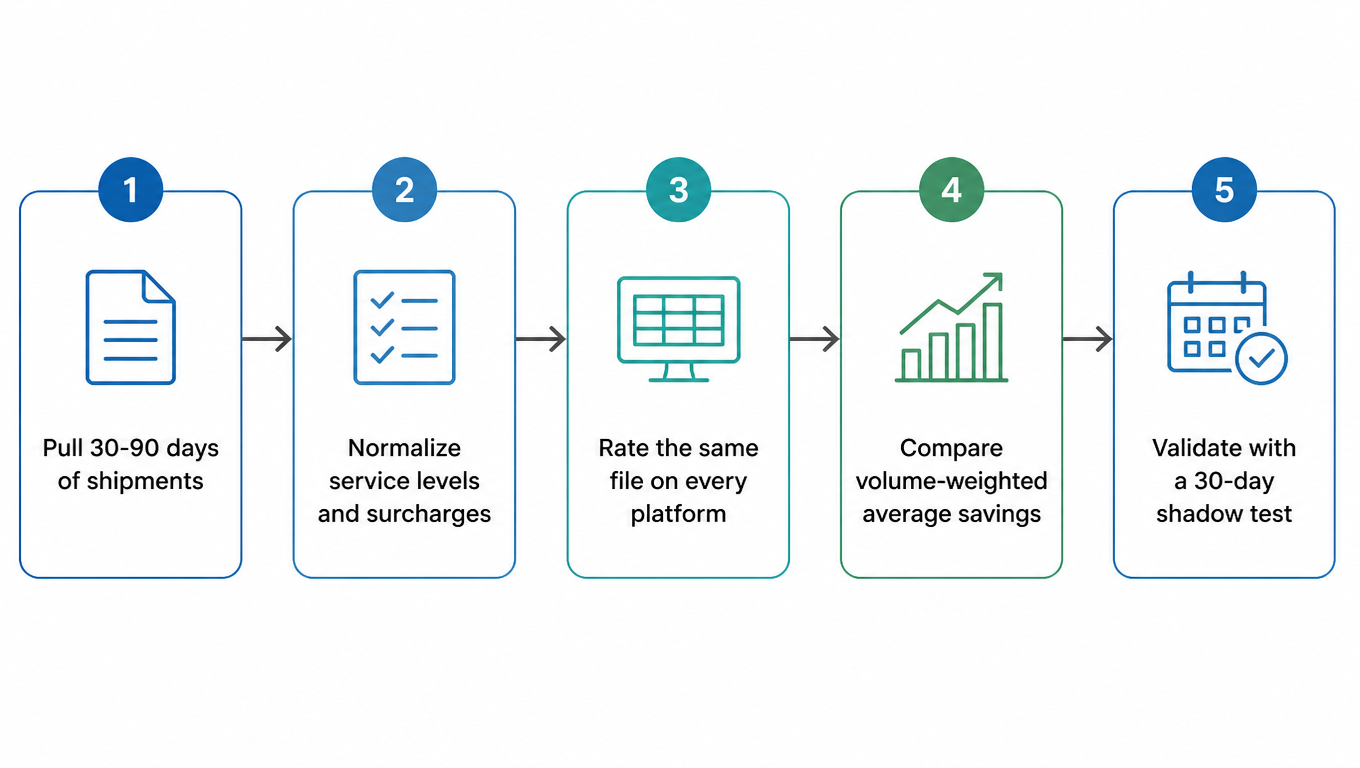
整个过程分五步:The whole process runs in five steps:

流程图:导出 30-90 天发货记录,统一服务等级与附加费口径,用同一份文件在各平台报价,比较货量加权平均节省,用 30 天影子测试验证Flowchart: pull 30-90 days of shipments, normalize service levels and surcharges, rate the same file on every platform, compare volume-weighted average savings, validate with a 30-day shadow test
五步:取样本,统一口径,同一文件跑所有平台,比平均节省,影子测试验证Five steps: pull the sample, normalize, rate the same file everywhere, compare averages, shadow-test it

下面依次展开每一步,然后用一个你可以照着自己数据复制的算例收尾。Each step is described below, followed by a worked example you can mirror with your own data.

三、第一步:构建有代表性的真实货量样本3. Step 1: Build a Representative Sample of Real Shipments

从你自己的历史数据开始。从现平台或承运商账单导出 30 到 90 天的发货:发货日期、重量、尺寸、分区、服务、住宅标志、账单金额。这个文件,而不是平台的演示数据,是后面所有工作的基础。Start with your own history. Export 30 to 90 days of shipments from your current platform or carrier billing: ship date, weight, dimensions, zone, service, residential flag, and billed amount. This file, not the platform's demo data, is the basis of everything that follows.

确保样本覆盖你的真实构成:从轻到重的各重量段、你发货的所有分区、住宅件和商业件,以及任何偏远或乡村邮编。如果 8% 的货量会触发体积重计费,样本里就要有这些箱子。如果你既发东北部又发西海岸,两个都得出现。Make sure the sample covers your actual mix: weight bands from light to heavy, all the zones you ship to, residential and commercial, and any remote or rural ZIP codes you serve. If 8% of your volume triggers dimensional weight, the sample needs those boxes. If you ship to the Northeast and the West Coast, both appear.

忍住把难看包裹筛掉的冲动。营销线路里永远不会有体积重超标的超大箱或乡村线路,但它们占你货量的 10%,也就意味着大约占你成本的 10%。一个悄悄丢掉它们的样本,会把所有报给你的折扣都算高。Resist the urge to screen out the ugly shipments. The marketing lane never includes a DIM-heavy oversized box or a rural route, but those are 10% of your volume, which means they are roughly 10% of your cost. A sample that quietly drops them overstates every discount you will be quoted.

数量上,至少用 300 到 1,000 票,如果 30 天全量更多就用全量。三十天通常足够捕捉你的分区构成;如果你的货量是周内尖峰式波动,拉长到 8 到 12 周,避免某个段意外主导样本。As for size, use at least 300 to 1,000 parcels, or a full 30 days if that is more. Thirty days is usually enough to capture your zone mix; if your volume comes in weekly spikes, stretch to 8 to 12 weeks so no segment dominates by accident.

四、第二步:统一服务等级与附加费口径4. Step 2: Normalize Service Levels and Surcharges

报价之前,先把每一票货映射到各平台的对等服务。陆运按陆运比,两日达按两日达比,隔夜按隔夜比。拿一个平台的陆运报价去比你现在两日达的账单,虚假节省就是这么造出来的。Before any quoting, map every parcel to the equivalent service on each platform. Ground gets rated as ground, 2-day as 2-day, overnight as overnight. Comparing a platform's ground quote against your current 2-day bill is how fake savings are manufactured.

然后统一附加费口径。各平台处理住宅、偏远、体积重、燃油和旺季附加费的方式不同:有的揉进混合费率,有的单独列项,少数直接在报价里漏掉。为每种附加费定一个定义,对每个平台一致地套用,比较才是苹果对苹果。Then standardize the surcharge set. Platforms apply residential, remote, DIM, fuel, and peak surcharges differently: some bundle them into a blended rate, others add line items, a few leave them out of the quote entirely. Decide one definition per surcharge and apply it identically to every platform, so the comparison is apples to apples.

附加费也是可以谈的。一个基础运费打 7 折、附加费按挂牌价收的平台,按你的货量构成算,可能比一个基础运费打 85 折、附加费也打折的平台更贵。要在全口径费率上谈判。如果销售拒绝报这个全口径数字,这本身就是一条情报。Surcharges are also negotiable. A platform offering 30% off base freight at list surcharges can end up more expensive than one offering 15% off base with discounted surcharges, depending on your mix. Negotiate on fully loaded rates. If a salesperson resists quoting the loaded number, that is a data point in itself.

五、第三步:用同一份文件跑所有平台5. Step 3: Run the Same File Through Every Platform

样本口径统一后,把同一份发货文件跑过每个候选:CSV 上传、报价 API、或平台自带的报价工具。所有地方用完全相同的输入。这份文件是你的唯一事实来源,报价是你要比较的输出。With the sample normalized, run the same shipment file through every candidate: CSV upload, a rating API, or the platform's quoting tool. Use identical inputs everywhere. The file is your one source of truth, and the quotes are the output you compare.

记录报价单上的数字,而不是营销页上的数字[^5]。要求按服务等级出书面报价,写清基准和附加费规则。如果平台只愿意给你一个百分比加一个微笑,它连算术都还没开始就已经挂掉了。Record the numbers on the quote, not the marketing page.[^5] Ask for a written quote per service level, with the baseline and surcharge rules stated. If a platform will only give you a percentage and a smile, it fails the audit before the math starts.

再加上费率卡上永远不会出现的平台成本:订阅费、每票面单费、地址纠正费、最低消费、账单调整项。在小件上,光一张面单费就能吃掉一两个点的折扣。把它们算进去,否则这份比较就是虚构的。Add the platform costs that never appear on a rate card: subscription fees, per-label fees, address correction charges, minimums, and billing adjustments. On small parcels a per-label fee alone can erase a point or two of discount. Include them, or the comparison is fiction.

对报价与账单之间的落差保持怀疑。报价是模型输出,账单才是现实。调整项、体积重争议和纠正费都是事后才出现的,这正是为什么这套审核不能停在报价这一步。Keep a skeptical eye on the quote-to-bill gap. Quotes are model outputs; invoices are reality. Adjustments, DIM disputes, and correction fees show up after the fact, which is exactly why this audit does not end at the quote.

六、第四步:比平均节省,不比宣传折扣6. Step 4: Compare Average Savings, Not Headline Discounts

现在算报价到底意味着什么。对每个平台算三个数:每票平均节省、中位数、货量加权平均。平均数可能被几件重货拉高;中位数代表典型包裹;货量加权平均才是你每个月银行账户里真正看到的数字。评审里三个都报,谈判用第三个。Now compute what the quotes actually mean. For each platform, calculate three numbers: the mean savings per parcel, the median, and the volume-weighted average. The mean can be pulled upward by a few heavy parcels. The median shows the typical parcel. The volume-weighted average is what your bank account actually sees each month. Quote all three in the review; negotiate on the third.

然后按分区和重量段拆节省。一个平台可能在短途分区便宜 9%,在长途分区反而更贵,这两个事实在混合平均里都看不见。拆开看,你才知道节省哪里是真的、哪里是平台在悄悄多收。Then break the savings down by Zone and weight band. A platform can be 9% cheaper on short-haul zones and slightly more expensive on long-haul ones, and both facts are invisible in a blended average. The breakdown tells you where the savings are real and where the platform is simply charging you more.

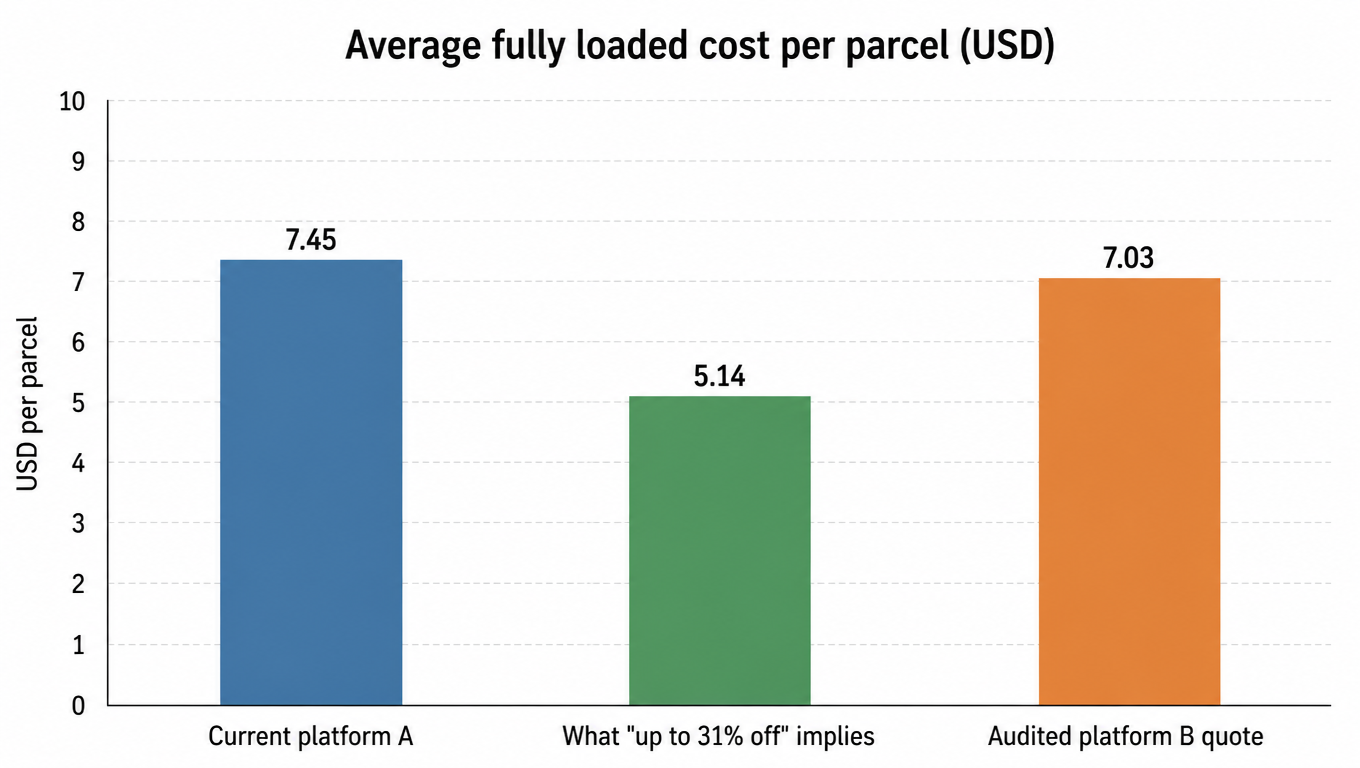
这就是宣传数字和审计数字之间的差距长什么样。某候选宣称「最高省 31%」。在一批平均全口径成本 $7.45 的真实货量样本上,这个宣传隐含 $5.14 一票。而审计后的报价是 $7.03:Here is the shape of the gap between a headline and an audit. A candidate claims "up to 31% off". On a sample of real shipments averaging $7.45 fully loaded, the claim implies $5.14 per parcel. The audited quote comes in at $7.03:

柱状图:现平台 A 单票全口径平均成本 7.45 美元,最高省 31% 隐含 5.14 美元,审计后平台 B 报价 7.03 美元Bar chart: current platform A averages 7.45 USD fully loaded per parcel, what up to 31 percent off implies 5.14 USD, audited platform B quote 7.03 USD
隐含与审计之间的差距,就是你的货量结构、你的附加费和宣传里没提的费用The gap between implied and audited is your mix, your surcharges, and the fees the headline never mentioned

宣传折扣是一条最优线路;你文件上的平均数是唯一会在一整年账单里复利的数字。这个差距就是做这件事的全部意义。A headline discount is a single best lane; the average on your file is the only number that compounds across a year of invoices. That gap is the whole point of the exercise.

七、第五步:用 30 天影子测试验证7. Step 5: Validate with a 30-Day Shadow Test

报价终究还是模型。签约之前,让新平台和现配置并行跑 30 天:同一票货两边都报价,切换不花一分钱,让账单自己累积起来。Quotes are still models. Before you sign, run the new platform in parallel with your current setup for 30 days: rate the same parcels on both, pay nothing to switch, and let the invoices accumulate.

每周在同一票货上对比报价和实付账单。跟踪调整项、地址纠正、体积重争议、退款,以及任何出现在账单上但没出现在报价里的费用。如果账单总额明显高于报价总额,你就找到了和这家平台做生意的真实成本。Each week, compare quote versus actual bill on the same parcels. Track adjustments, address corrections, DIM disputes, refunds, and any fee that appears on the invoice but not on the quote. If the invoice total runs meaningfully above the quoted total, you have found the real cost of doing business with this platform.

只有影子测试结果落进你一开始设定的容差,比如模型节省的 5% 以内,才签约。匹配就放心签;不匹配,你手里就有一份有据可查的理由离开,或者拿着审计结果回去重新谈。Only sign after the shadow test matches the model within the tolerance you set at the start, for example within 5% of modeled savings. If it matches, you sign with confidence. If it does not, you have a documented reason to walk away or to renegotiate with the audit output in hand.

这个测试花几百美元的面单费和 API 调用费。一份签错的 12 个月合同,在未经核实的费率上多付的钱,加上解约花的时间,远不止这些。The test costs a few hundred dollars in labels and API calls. A wrong 12-month contract at an unverified rate costs more, in freight overpayment and in the time spent unwinding it.

八、案例与审计工具箱:一个 500 单的 DTC 样本8. Case Study & Audit Toolkit: A 500-Order DTC Sample

认识一下样本品牌:每月 500 单,平均包裹 1.9 磅,62% 住宅件,8% 的货量触发体积重计费。现平台 A 的全口径平均账单是 $7.45 一票。候选平台 B 走进门,宣称「最高省 31%」。Meet the sample brand: 500 orders a month, average parcel 1.9 lb, 62% residential, 8% of shipments triggering dimensional weight. Their current provider, Platform A, bills a fully loaded average of $7.45 per parcel. A candidate, Platform B, walks in claiming "up to 31% off".

审核按本指南的流程跑。500 票样本,整整 30 天,统一到陆运服务和标准附加费口径,然后在两个平台上报价。结果:平台 B 在这份真实文件上的运费报价平均比挂牌价低 14.2%,离宣传的 31% 差得远。附加费和平台费吃掉了剩余差距的大部分。全口径算下来,平台 B 落在 $7.03 一票。The audit runs the way this guide describes. The 500-parcel sample, a full 30 days, is normalized to ground service and a standard surcharge set, then rated on both platforms. The results: Platform B's freight quotes averaged 14.2% below list on the actual file, far from the headline 31%. Surcharges and the platform fee absorbed most of the remaining gap. Fully loaded, Platform B lands at $7.03 per parcel.

那是每票 $0.42,5.6% 的节省,按每月 500 单算一年大约 $2,500。不大、真实,而且和推销词完全两回事。把同样比例放到一个月 20,000 票的 3PL 身上,就是一年超过 $100,000。审核就是把营销数字变成预算数字的那道工序。That is $0.42 per parcel, a 5.6% saving, roughly $2,500 a year at 500 orders a month. Modest, real, and nothing like the pitch. Scale the same percentage to a 3PL doing 20,000 parcels a month and it becomes more than $100,000 a year. The audit is what turns a marketing number into a budget line.

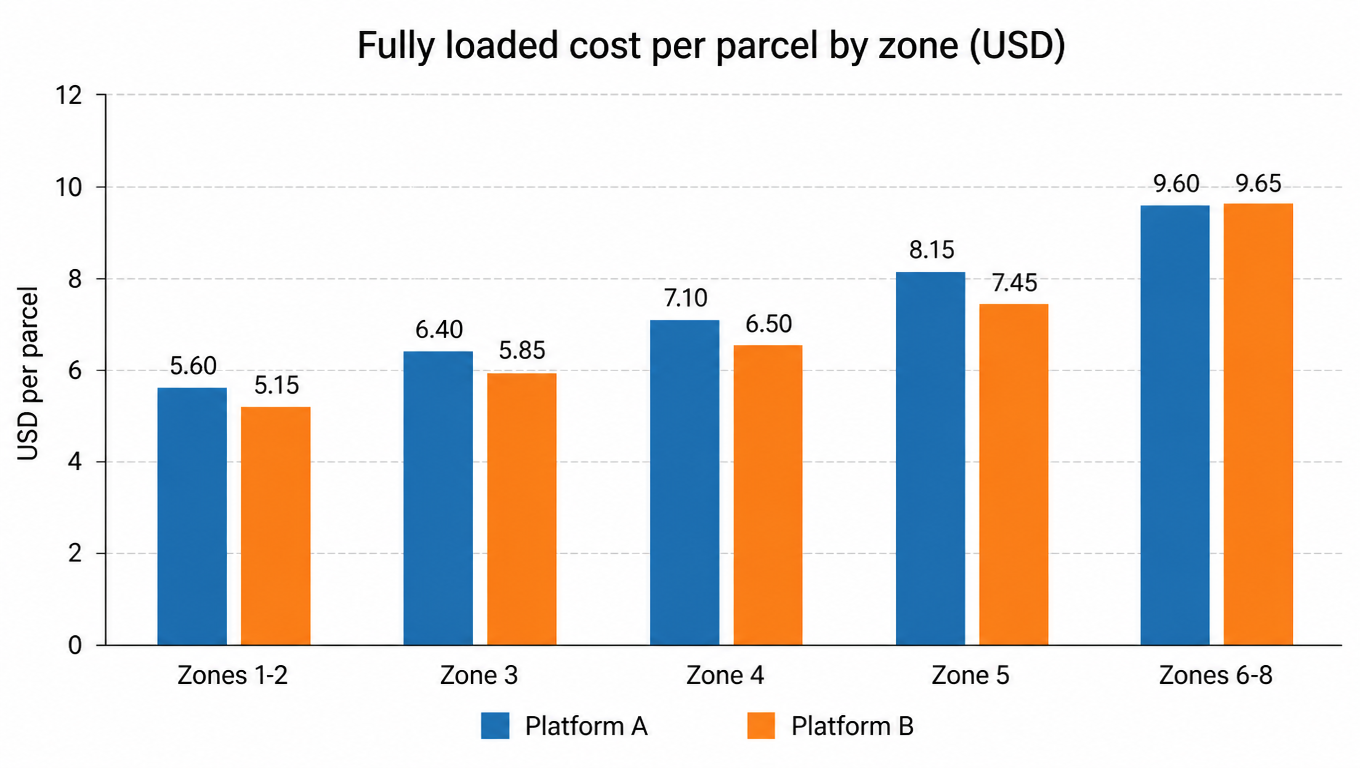
分区分拆显示节省住在哪里:The zone breakdown shows where the saving lives:

分区Zone 货量占比Share of volume 平台 A 均价Platform A avg 平台 B 均价Platform B avg B 对比 AB vs A
1-2 区Zones 1-218%$5.60$5.15-$0.45
3 区Zone 322%$6.40$5.85-$0.55
4 区Zone 419%$7.10$6.50-$0.60
5 区Zone 517%$8.15$7.45-$0.70
6-8 区Zones 6-824%$9.60$9.65+$0.05
柱状图:按分区对比平台 A 与平台 B 的单票全口径成本,短途和中等分区平台 B 便宜 8% 到 9%,6-8 区长途分区平台 B 略贵Bar chart: fully loaded cost per parcel by zone for platform A vs platform B, short and medium zones about 8 to 9 percent cheaper on B, long-haul zones 6-8 slightly more expensive
樱桃采摘的缩影:推销线路赢了,长途没有The cherry-picking pattern in miniature: the pitch lane wins, the long haul does not

短途和中等分区每票省 8% 到 9%。6 到 8 区的长途在平台 B 上略贵。这就是樱桃采摘模式的缩影:推销线路赢,长途不赢。这家品牌的结论是有条件的同意:冲着短途节省可以切换,但签约前拿着审计结果回去找平台 B 谈 6 到 8 区。Short and medium zones save 8% to 9% per parcel. Long-haul zones 6 to 8 cost slightly more on Platform B. That is the cherry-picking pattern in miniature: the pitch lane wins, the long haul does not. The verdict for this brand is a conditional yes: switch on the strength of the short-haul savings, but go back to Platform B and negotiate zones 6-8 before signing, using the audit output as leverage.

12 问审核清单The 12-Question Audit Checklist

签约前,让每个候选平台过一遍这份清单:Run every candidate through these before you commit:

  1. 折扣应用的基准到底是什么(承运商挂牌价、生效日期、费率档)?What exact baseline is the discount applied to (carrier list, effective date, rate tier)?
  2. 宣传百分比是哪条线路、哪种包裹画像算出来的?Which lane and parcel profile produced the headline percentage?
  3. 我真实发货文件上的平均折扣是多少,而不是宣传线路上的?What is the average discount across my actual shipment file, not the headline lane?
  4. 住宅、偏远、体积重、燃油、旺季附加费是否都包含在每一份报价里?Are residential, remote, DIM, fuel, and peak surcharges included in every quote?
  5. 服务等级是否一一对齐(陆运对陆运、两日达对两日达)?Are service levels matched one to one (ground to ground, 2-day to 2-day)?
  6. 运费之上还叠了什么订阅费、面单费、平台费?What subscription, per-label, and platform fees sit on top of the freight?
  7. 地址纠正和账单调整项怎么收费?How are address corrections and billing adjustments charged?
  8. 按分区和重量段的单票全口径成本是多少?What is the fully loaded per-parcel cost by zone and weight band?
  9. 整个样本按货量加权的每单平均节省是多少?What is the volume-weighted average saving per order across the whole sample?
  10. 如果我的分区构成或重量画像变化,报价会怎么变?How do quoted rates react if my zone mix or weight profile shifts?
  11. 签约前能不能跑 30 天影子测试?Can I run a 30-day shadow test before signing?
  12. 合同期多长、费率有没有保证、退出条款是什么?What is the contract term, the rate guarantee, and the exit clause?

CSV 模板Sample CSV Template

按这个格式导出你的发货,它覆盖审核需要的所有字段:Export your shipments in this shape; it covers every field the audit needs:

ship_date,weight_lb,length_in,width_in,height_in,zone,service,residential,dim_weight_lb,billed_amount,label_fee,adjustments
2026-07-14,1.9,12,10,4,4,ground,1,0,6.32,0.15,0
2026-07-14,5.2,18,14,12,2,ground,0,0,7.88,0.15,0
2026-07-15,0.8,15,14,9,7,ground,1,13.6,11.45,0.15,-2.10

第三行是一件触发体积重计费的乡村包裹:计费重量从 0.8 磅跳到 13.6 磅,账单上还多了一笔 $2.10 的调整项。正是这样的行,让宣传折扣不是你的折扣。The third row is a DIM-triggering rural parcel: billable weight jumps from 0.8 lb to 13.6 lb, and a $2.10 adjustment appears on the invoice. Rows like that are exactly why the headline discount is not your discount.

签约前先跑审核。你可以在自己货量上验证的折扣,才是你确定能拿到的折扣。Run the audit before you sign. The discount you can verify on your own shipments is the only discount you are guaranteed to get.

常见问题FAQ

它通常是一个别人拿到的数字:平台在一条精心挑选的线路上(一个特定重量、商业件、以挂牌价为基准)算出的最大折扣。它几乎从不是你自己货量结构的平均节省。你自己的平均数字会被住宅附加费、偏远区、体积重、旺季附加费和平台费往下拉,所以「最高省」和「你省多少」是两回事。It is usually a number someone else received: the platform's largest discount on one carefully chosen lane (a specific weight, commercial delivery, list price as the baseline). It is almost never the average saving on your own shipment mix. Your average gets pulled down by residential surcharges, remote zones, DIM, peak fees, and platform costs, so "up to X% off" and "what you save" are two different numbers.
跑一遍五步费率审核:导出 30 到 90 天的真实发货记录;统一服务等级与附加费口径;用同一份文件在所有候选平台报价;比较货量加权平均节省而不是宣传折扣;最后用 30 天影子测试验证报价和实付账单一致,再签约。Run the five-step rate claim audit: export 30 to 90 days of real shipments, normalize service levels and surcharges, rate the same file on every candidate platform, compare volume-weighted average savings instead of the headline discount, then validate with a 30-day shadow test that matches quotes to actual invoices before you sign.
每一票的发货日期、重量、尺寸、分区、服务等级、住宅/商业标志和账单金额,加上平台费、面单费和调整项。建议至少 300 到 1,000 票,或整整 30 天。文章里的 CSV 模板给出了完整字段清单。For every parcel: ship date, weight, dimensions, zone, service level, residential flag, and billed amount, plus platform fees, label fees, and adjustments. Use at least 300 to 1,000 parcels, or a full 30 days. The CSV template in this guide lists the complete field set.
宣传数字来自单条最优线路,你的平均数字包含住宅附加费、偏远区、体积重、旺季附加费和平台费,这些折扣都碰不到。案例里「最高省 31%」的宣传在真实样本上变成了 5.6% 的全口径节省。按你自己的货量算出的全口径平均,才是真正进你账户的数字。The headline comes from a single best lane, while your average includes residential surcharges, remote zones, DIM, peak fees, and platform costs that discounts never touch. In the worked example, a "up to 31% off" claim became a 5.6% fully loaded saving on the real sample. The fully loaded average on your own volume is the number that actually hits your bank account.
影子测试是新平台和现配置并行跑 30 天:同一票货两边都报价,不切换,让账单自己累积。每周对比报价和实付账单,跟踪调整项、地址纠正、体积重争议和退款。只有账单总额落在模型节省的容差内(比如 5%)才签约。花几百美元,避免签错 12 个月合同。A shadow test runs the new platform in parallel with your current setup for 30 days: rate the same parcels on both, switch nothing, and let invoices accumulate. Each week compare quote versus actual bill and track adjustments, address corrections, DIM disputes, and refunds. Sign only when the billed total falls within your tolerance of modeled savings, e.g. 5%. It costs a few hundred dollars and prevents a wrong 12-month contract.
Get Rate Comparison
Get Rate Comparison