
Ecommerce Shipping Guide

Own Carrier Account vs. 3PL or Platform Rates: Which Shipping Model Should You Use?

Your brand already ships on a UPS, FedEx or USPS account you negotiated yourself. A 3PL tells you its contract rates are lower. A shipping platform quotes discounted USPS and regional carrier rates[^2]. All three numbers are on the table, and none of them are directly comparable: different contract terms, different volume bases, different surcharge handling, different billing, different people answering the phone when something goes wrong. The real question is not which rate card is lowest this month. It is who controls the shipping relationship: whose contract, whose volume, whose invoice, whose claim path, whose support line. This guide takes the three quotes apart, gives you a framework for comparing four shipping models, and gets you to a decision based on lowest sustainable total cost instead of per-label price.

Brand founder compares three shipping quotations at a warehouse desk as a delivery van passes outside.
Three quotes, three different products

The real question is who controls the shipping relationship

The three quotes in front of you were built on different assumptions. Your own account price reflects your contract, your volume, and your billing terms. The 3PL's quote reflects its aggregate volume across all clients, its contract renewal cycle, and its markup policy. The platform's quote reflects its negotiated carrier network, built on discounted USPS rates and regional carrier agreements.[^2] Line them up side by side and you are not comparing the same product.

What changes when you switch? Your rate may not move with you if you leave. The discount may be built on someone else's aggregate volume, so it is not yours to keep. Adjustments, address corrections and re-weigh charges may land on your invoice with no visibility into how they were computed.[^1] And when a claim is denied, the person who filed it may be a stranger to you.

Two hands stretch a tape measure between a rate card and an invoice.
A rate card and an invoice are two ends of the same relationship

So the real question is not which rate card is lowest this month. It is who controls the shipping relationship: whose contract, whose volume, whose invoice, whose shipment data, whose claim path, whose support line. Control of those things decides whether the number you see today is the cost you pay next quarter, after surcharges, adjustments, claims disputes and a possible migration.

That is why the comparison has to shift from "lowest per-label rate" to "lowest sustainable total cost". Consider a hypothetical rate that is 2% lower but sits on top of opaque billing, someone else's data, and a claim process you do not control. That is not a saving; it is deferred cost. For a systematic approach to lowering total cost, see our guide to lowering shipping costs.
Why per-label price comparisons mislead

A per-label price is the visible tip of the shipping iceberg. Below the waterline sit the factors that decide what you actually pay:

  • Rate portability: whether the rate can move with your brand if you change partners
  • Discount base: whether the discount rests on your own volume or someone else's aggregate volume
  • Adjustment ownership: who absorbs DIM re-weighs, address corrections, fuel and accessorials
  • Invoice and data ownership: who receives the carrier invoice and holds the raw shipment data
  • Claims and refunds: who files the claim and who receives the refund
  • API credentials: who owns the credentials and integrations that actually move your parcels
  • Support and escalation: who you call when a shipment goes wrong
  • Markup policy: pass-through at cost or a margin added to the label price
  • Fallback capacity: what happens when an account is suspended or capacity tightens
  • Termination and migration: what it costs in time and money to leave

Two of these deserve special attention. Discount base decides how durable your price is: a 3PL or platform discount built on aggregate volume can be repriced when the provider's own contract renews, and that repricing is outside your control. Portability decides how expensive the wrong choice is: if your negotiated rate dies with the relationship, the "saving" on the quote is really a lock-in cost.

Then there is markup. A 3PL can quote a rate that looks identical to your own account's rate, then add a margin on top of the label. A platform with pass-through pricing earns on the spread between what it negotiates and what it charges you. Neither is wrong, but you cannot evaluate either without knowing which one you are looking at.

A quote that is 20 cents lower per label can buy you higher bill opacity, a claim process you cannot navigate, and a migration that eats the difference for a year. The cheapest quote is the one whose total cost you can see. Before you sign, learn how to verify "up to X% off" rate claims.

Four operating models for shipping

Model Rate control Implementation complexity Portability Carrier breadth
Brand-owned carrier accountHighHighHighDepends on the brand's contracts
3PL-provided ratesLow to mediumLowLow to mediumDepends on the 3PL's network
Platform-provided ratesMediumLow to mediumMediumDepends on the platform's carrier network
Hybrid modelHighMedium to highHighStrong by design

Brand-owned carrier account. Highest rate control and full portability: the contract is yours, the volume is yours, the data is yours. It only pays off when you have enough stable volume and negotiation leverage to earn a rate that beats what others can offer you, plus the internal capability to manage contracts, billing and claims. Without that, you are carrying operating cost for a rate you could buy elsewhere. For the negotiation side, see our guide to negotiating parcel shipping rates.

3PL-provided rates. Simplest to operate: the 3PL manages carrier contracts, integrations, billing and claims on your behalf[^1]. But rate control and portability are capped by the 3PL's contracts and markup policy, and your discount rides on the 3PL's aggregate volume. You are trading control for convenience, which is a fair trade only when you do not have the volume or staff to manage carriers yourself. For how 3PLs win better rates without becoming carriers, see how 3PLs offer better shipping rates.

Platform-provided rates. Discounted USPS and regional carrier access without any negotiation[^2], priced per shipment with rate comparison across the carrier network. Rate control is mid-level: you do not set the price, but you can see it before every shipment and switch carriers per parcel, which is a form of control 3PL billing rarely offers. For how USPS discounts work, see how to get USPS discounts.

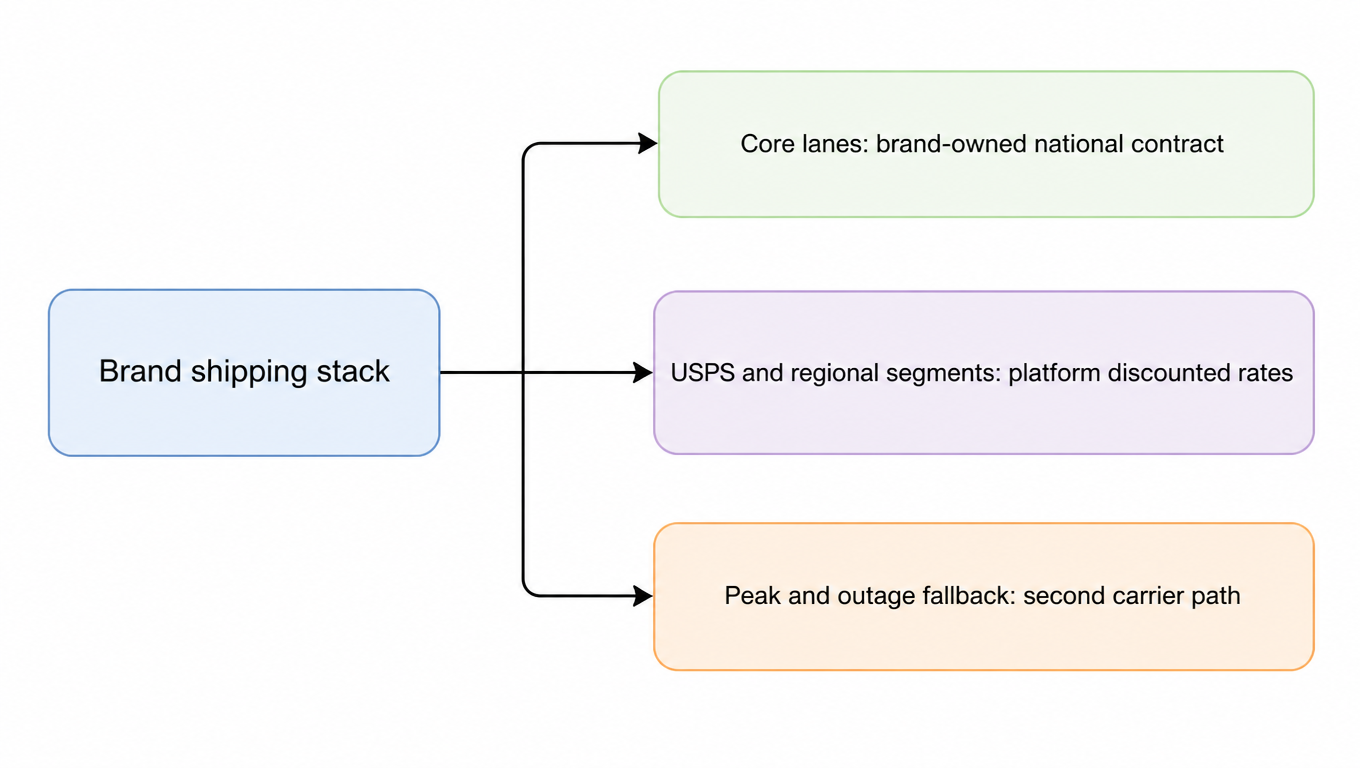
Hybrid model. You keep your own national-carrier contracts for the lanes where they win, and layer platform rates on the segments where the platform's network is cheaper, with a second carrier path reserved for peak and outage fallback. Highest total control and portability, at the cost of the most moving parts to manage. For the architecture, see our multi-carrier shipping strategy guide.

Each model wins in a different situation, and each breaks for a different reason: the brand-owned account breaks when volume drops below the negotiation threshold, the 3PL breaks when you outgrow its rates, the platform breaks if it cannot cover your ZIP mix, and the hybrid breaks only if you mismanage the split.

The variables that actually decide the model

The right model is decided by a handful of variables, not by the headline rate. They fall into three clusters.

Volume and parcel profile. Your monthly shipment volume and its stability, your parcel weight and dimension profile, your destination ZIP mix, your carrier and service mix, your direct negotiation leverage with national carriers, and your need for USPS and regional carrier access. These determine whether you can earn a rate yourself or should buy someone else's.

Financial terms. Base rate, surcharge and adjustment treatment; markup or pass-through policy; claims, refund and void ownership; billing frequency and credit terms. These determine what the quoted rate actually costs you after the invoice arrives.

Control and operations. Account portability, data visibility, API credential ownership, carrier support and escalation paths, backup capacity for peak and outages, and contract termination and migration clauses. These determine how much the model costs you to change.

Collect the variables you can measure, and ask each provider for the ones you cannot. The model that fits is the one that scores well on the variables you cannot live without, not the one with the lowest number on the label. For evaluating carriers on delivered cost instead of quotes, see cost per successful delivery.

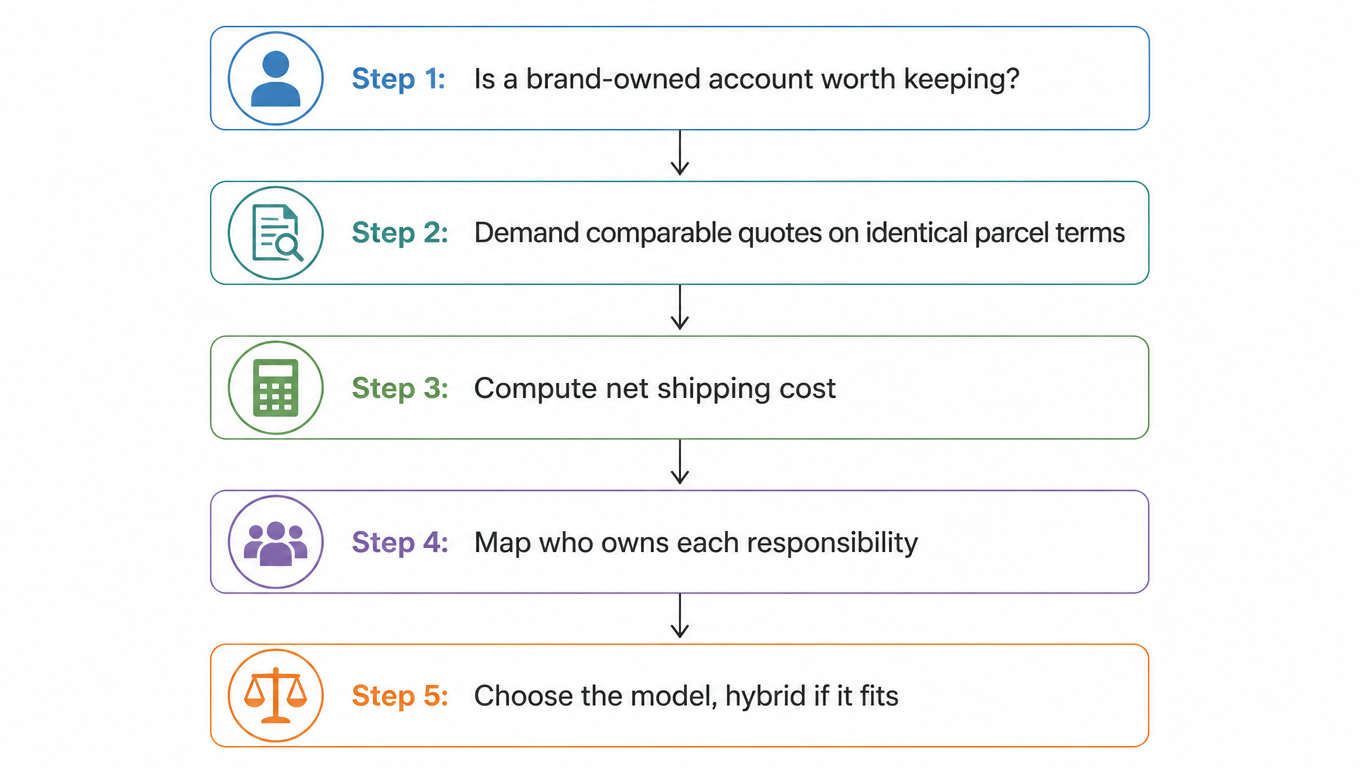
A five-step decision framework

Step 1: Decide whether a brand-owned account is worth maintaining

Test it against your own data: it earns its keep only when you have stable volume, a clear parcel profile, internal carrier management capability, negotiation leverage, and a genuine need for rate portability. If you lack even one of these, the account's low rate is a liability, not an asset.

Step 2: Demand comparable data

Do not accept sample rates. Ask for the same parcel, the same ZIP, the same service, the same surcharge assumptions, the same adjustment handling, and the same billing terms. A quote that cannot be produced on identical terms is a teaser, not a quote. For the verification method, see how to verify rate claims.

Step 3: Compute the net cost

Strip the marketing and add up the full picture: net shipping cost = label charge + surcharges + adjustments + claims and support burden + account and software operating cost − refunds and credits. Run your parcel profile through the shipping cost calculator.

Step 4: Clarify who owns what

For each model, write down who buys the label, who receives the carrier invoice, who absorbs adjustments, who files claims, who receives refunds, and who explains charges to the end customer. Every answer maps to a different model, and the model that leaves the most ownership with you is the model that protects you when things go wrong.

Step 5: Decide whether a hybrid fits

If your core lanes justify your own national contract but your lightweight and regional segments are cheaper on platform rates, the hybrid split is not complexity for its own sake; it is the cheapest total cost you can assemble.

Flowchart: Step 1 decide whether a brand-owned account is worth keeping, Step 2 demand comparable quotes on identical parcel terms, Step 3 compute net shipping cost, Step 4 map who owns each responsibility, Step 5 choose the model, hybrid if it fits
Walk the five steps in order; each one narrows the choice before you spend money migrating

Putting the framework to work

What does this look like in practice on a platform-rate path? Discounted USPS rates and a regional carrier network (UniUni, GOFO, SpeedX, SwiftX, UPS Mail Innovations) with per-shipment rate comparison across carriers[^2]. You see the price before you buy, you pick the cheapest carrier for that parcel and ZIP, and you do not need a single negotiation meeting to get the discount.

What stays with the brand? National-carrier contract negotiation and account ownership remain brand decisions when you keep them. For example, the platform does not replace a hard-won UPS or FedEx contract; it layers discounted rates on the segments where you have no contract, or where its network is cheaper for your parcel profile.

The honest boundary: the platform supports its own rate network and carrier integrations. Connecting an arbitrary brand-owned negotiated UPS or FedEx account so it competes in the same comparison is not a combination every platform supports, so confirm which account combinations are available before you design your stack around them.

A worked example: a brand keeps its national contract for core lanes, the high-volume ZIPs and heavy parcels where its negotiated rate wins. It uses platform rates for USPS and regional segments, the lightweight, ecommerce-standard parcels where the platform's network is cheaper. And it keeps a second carrier path as peak and outage fallback, so a suspended account or a capacity crunch never stops the store.

Diagram: a brand shipping stack splits into three paths, core lanes on a brand-owned national contract, USPS and regional segments on platform discounted rates, and peak and outage fallback on a second carrier path
The hybrid: core lanes, discounted segments, and a fallback path each in their place

That is the framework in full: know who controls the relationship, price the total cost, and assemble the model that gives you the cheapest sustainable cost, not the cheapest label.

FAQ

There is no universal answer, because the three quotes are built on different bases: your own contract, the 3PL's aggregate volume, and the platform's carrier network. Per-label price is only the tip of the iceberg. The number that matters is net shipping cost: label charge plus surcharges plus adjustments plus claims and support burden plus operating cost, minus refunds and credits.
Usually not. A 3PL or platform discount rests on its own aggregate volume and contracts, which are not yours and do not belong to you. A brand-owned account's rate travels with the contract and has the highest portability. So ask before you sign: if I leave, does this rate stay with me?
Demand comparable data, not a few sample rates. Same parcel, same ZIP, same service, same surcharge assumptions, same adjustment handling, same billing terms. Also ask about the markup policy: is the quote pass-through at cost or does it carry a margin, and who owns adjustments and claims? A quote that cannot be produced on identical terms is a teaser, not a quote.
When your core lanes justify your own national contract (high-volume ZIPs, heavy parcels, segments where your negotiated rate wins) and your lightweight and regional segments are cheaper on platform rates. A hybrid also gives you a second carrier path for peak and outage fallback. It is not complexity for its own sake; it is the lowest total cost you can assemble.
Not every platform supports that combination. Platforms support their own rate network and carrier integrations; connecting an arbitrary brand-owned negotiated account to compete in the same comparison depends on the specific platform's capabilities. Confirm which account combinations are supported before you design your shipping stack around them.

Want to choose between shipping models with evidence?

EasyShippingX operates in the carrier execution layer (rates, labels, tracking). Multi-carrier live rates, per-shipment comparison, and discounted USPS and regional carrier access[^2] let you pick the cheapest combination per parcel segment without giving up your own contracts. Run the net shipping cost framework first, then decide which model is yours.