USPS Guide

How to get USPS discount shipping and use it in a stable workflow

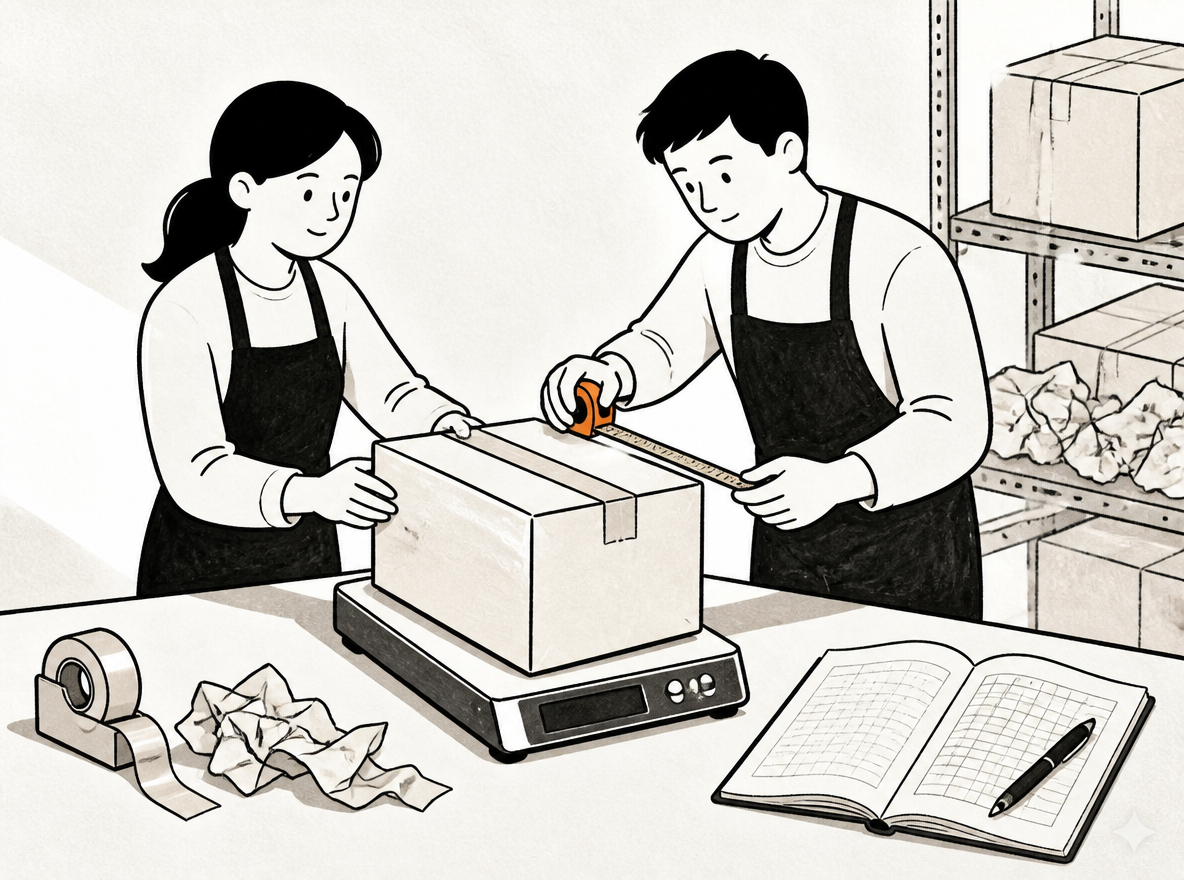
Illustration of a shipper comparing USPS postage purchase channels at a packing bench
Workflow illustration, not a customer case or an actual quote.

USPS remains a foundational last-mile option for many eCommerce sellers, 3PLs, and warehouse teams. People searching for how to get USPS discount shipping usually want three practical answers: which legitimate channels sell postage below the retail counter price, which cost items the discount actually moves, and how to prove it landed in the invoice. This page covers the access models, the price basis, a clearly labeled worked example, the invoice checks, and a low-risk rollout order, without overpromising the size of the discount.

This page also adds two things you can use directly: a five-question eligibility screen, and a comparison table you can copy and fill in with your own numbers.

What discounted USPS access actually means: it is a purchase channel, not a price list

A discount is not one product and it is not one number on a price list. What a parcel finally costs is decided by four things together: which channel you buy postage through, which service and zone the parcel falls into, whether the data on the label matches the physical box, and what happens after the label is created. Teams that only compare the headline percentage usually meet the rest of the stack during their first month-end reconciliation. USPS states the same idea plainly: shipping online with Click-N-Ship provides lower Commercial Rates, and business accounts can opt into the Business Rate Card for additional savings on select services. Sources: USPS Business Shipping and Click-N-Ship basics (verified 2026-10-04).

QuestionCommon assumptionMore practical view
Is the discount percentage the main factor?YesBilling consistency, workflow fit, and how adjustments are handled decide the outcome too
Does a quote lock the price of a parcel?YesDimensional weight and billing adjustments can still change the settled charge
Is an API required to get commercial pricing?AlwaysMany teams start in a portal or a spreadsheet and move to API later
Is a USPS account the same as an approved provider account?The sameAccount ownership, label source, funding, and data export rights differ

Four legitimate ways to buy USPS postage

Do not treat a discounted USPS account as one product. The access model determines who owns the account, which services are available, how postage is funded, where labels are created, who handles adjustments and refunds, and whether you can export complete billing data. Choose the model before you compare the price.

Access pathWho owns the account and the pricingWhat it solves firstConfirm before launch
Retail counter purchaseNot a discount channel, this is the baselineEstablishing the comparison baseline for the same parcelHow service, weight, dimensions, and zone are recorded
USPS.com account with Click-N-ShipYou own the account; Commercial Rates apply, and business accounts can opt into the Business Rate CardBuying commercial pricing below the counter with the lowest setup effortAccount type, payment, batch editing, and export features
USPS-approved postage provider or shipping platformThe platform aggregates many shippers' volume and prices from its authorized relationship with USPSPlacing postage purchase inside an existing shipping or multi-carrier workflowAuthorization, account ownership, price source, additional fees, and data portability
Negotiated Service Agreement with USPSA customized agreement between USPS and a specific customerCustomized pricing or classification terms for an eligible larger shipperEligibility, commitments, term, service scope, data, and operating requirements

Some price structures only exist inside specific purchase channels. USPS says that larger-volume shippers can work with a USPS specialist on commercial pricing and a plan tailored to the business, including a Negotiated Service Agreement, and that shippers of small, heavy items can use cubic prices based on package size and distance instead of weight. PC Postage software is also provided by USPS-approved third-party vendors, such as Stamps.com, Endicia, EasyPost, and Pitney Bowes, for customers who send high volumes. Sources: USPS Ground Advantage for Business, USPS PC Postage, Domestic Mail Manual 709, and Price List Notice 123 (verified 2026-10-04).

USPS also publishes retail prices and commercial prices as two separate schedules. On the USPS Ground Advantage page, retail prices start at 7.90 dollars at a Post Office location, and the same page points online shippers to lower Commercial Rates with Click-N-Ship. In other words, the first layer of the discount is not a negotiation result, it is switching from retail pricing to commercial pricing. Source: USPS Ground Advantage (verified 2026-10-04).

Screen for eligibility before comparing discount sizes

Five questions can be answered before you open any quote. If one of them fails, comparing discount sizes is pointless because the problem is not the percentage. It is the shift from "how much less" to "which conditions have to be true first".

ScreenHow to check it quicklyWhat to do first if it fails
Channel legitimacyWhether postage is bought on official pages or from an approved postage provider rather than from a private sellerChange the channel instead of comparing prices further
Price structure eligibilityWhether small, heavy parcels may qualify for structures priced by size and distance rather than weight. Those structures exist only in some purchase channels and some packaging conditions, and they do not cover every shapeCheck longest side, actual weight, volume, and packaging shape against the official rules, then fall back to the weight-based basis
Volume eligibilityWhether the path may lead to a specialist conversation and a negotiated agreement with its own conditions, commitments, and termStabilize commercial pricing and platform channels first, and revisit later
Data consistencyWhether label data (weight, dimensions, address type, service code) and the physical parcel come from the same processFix the data process first, or adjustments will cancel the discount
Account and data rightsWhether shipment-level charge detail can be exported and whether your baseline data leaves with you if the relationship endsSettle the data terms before talking price

All five can be done in house without help from the other side. Where one of them does need something in writing (authorization, price source, export method), get it before moving on. That is the same exercise as verifying a discount label source.

Which cost items the discount moves, and which ones it never touches

Almost every discount is expressed as a percentage of base transportation, which means only part of a parcel's final cost moves with it. The rest is decided by packaging, billable weight, entry method, and post-shipment handling. Before comparing two channels, separate the items that actually change from the items that do not.

Cost itemDoes the purchase channel change it?What it means for your comparison
Base transportation by service and zoneYes, this is the discount itselfOnly comparable when service, weight, and zone are identical
Commercial-only price structures such as cubicYes, and eligibility decides it, not negotiationThese exist only through approved purchase channels, so verify them separately
Billable weight and package sizeNo, but it decides the weight the discount applies toShrink the box first, then argue about the percentage
Surcharges and special handlingUsually noCharged on top, and they do not shrink with the percentage
Entry, pickup, and handoff methodPartlyWhere and how you induct affects both cost and first tracking scans
Billing adjustments and refundsNoA discount does not protect you from adjustments, accurate data does
Shipment-level data exportDepends on the channelWithout shipment-level data you cannot verify any of the rows above

Five levers that move cost more than the discount does

If base transportation is only part of a parcel's cost, then the five items below usually move the final number by as much as, or more than, the discount itself. None of them requires a negotiation. All of them require discipline.

  • Package profile. The same SKU in a different box can cross into a higher billable weight band. See how Ground Advantage pricing is built and how dimensional weight is applied.
  • Data accuracy at label creation. Weight, dimensions, address type, and service code are recorded the moment the label is created, and any mismatch comes back as an adjustment. Auditing every pricing input covers this in detail.
  • Service and zone selection. The same parcel priced under different services usually differs by more than the channel discount does. Defaulting to an upgraded service is the quietest recurring cost, so choose the service from the parcel profile instead of picking a winner first.
  • Whose volume your labels count toward. When you buy postage through an approved provider, your labels feed the platform's aggregated volume. Confirm who owns the account, whether you can export the data, and what happens to pricing if you leave, which is exactly the question behind own carrier account versus 3PL or platform rates.
  • Void, refund, and handoff discipline. An unvoided label is money spent, and a missed pickup is a parcel that starts over tomorrow. Neither is about the discount, and both can hand back everything the discount saved. See unused and voided labels and the carrier handoff checklist.

Worked example: how a percentage becomes a per-parcel cost

Every number below is a hypothetical input used to show the method. None of it is a USPS quote or a real platform's pricing. Assume one shipment segment where the retail counter price for the parcel is 10.00 dollars, your own USPS.com account quotes 8.00 dollars for the same service, zone, and billable weight, and a paid platform quotes 0.35 dollars less again while charging a 45.00 dollar monthly fee, with every other cost item identical. The point is not the numbers, it is flattening a percentage onto one parcel.

Per-parcel itemRetail counterOwn account, commercialPaid platform, deeper tier
Base transportation, assumed10.008.007.65
Entry and handoff0.350.350.35
Accessorials and billable weight variance0.550.550.55
Returns and re-sends0.200.200.20
Platform fee per parcel at 500 per month0.000.000.09
Total per parcel11.109.108.84

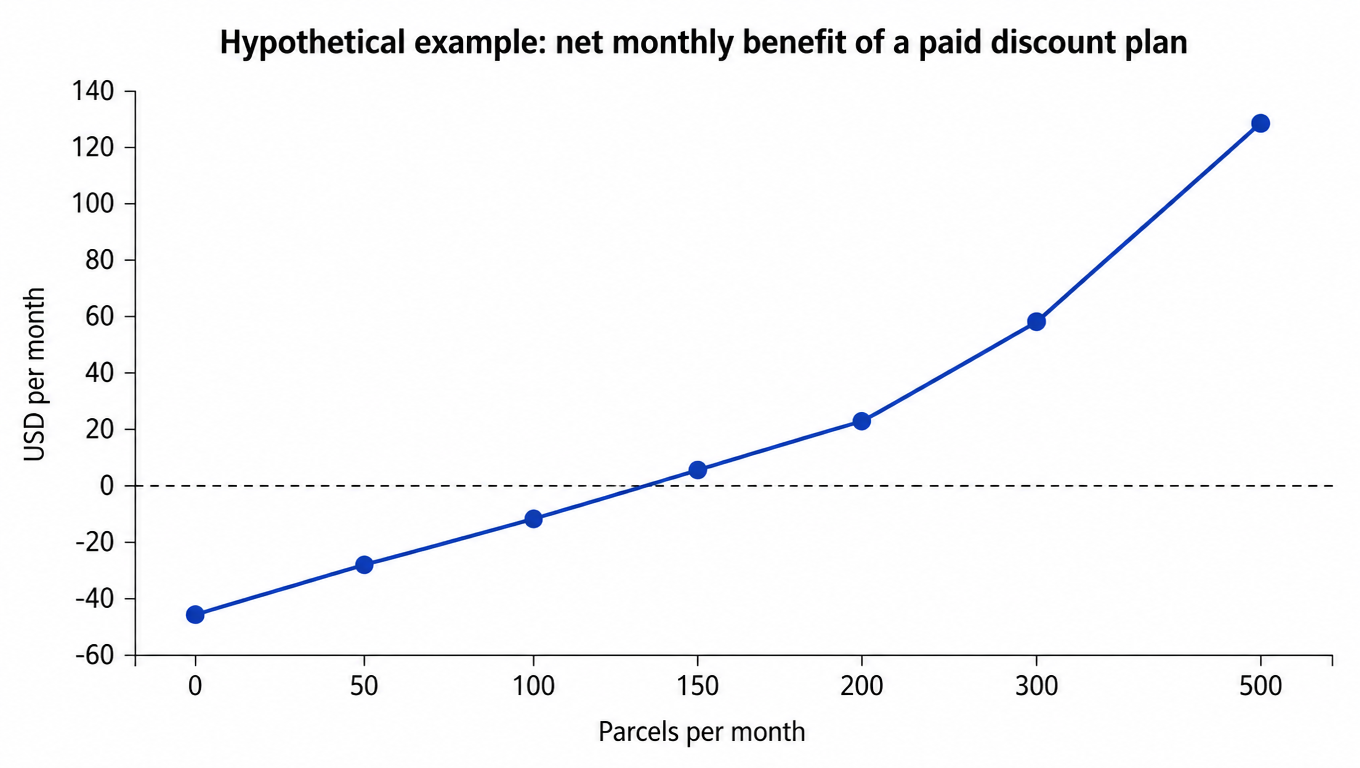
Under these assumptions the own-account path saves 2.00 dollars per parcel against the counter, while the paid platform's deeper tier saves only 0.26 dollars more than the free commercial channel, because the discount acts on base transportation while the platform fee is spread across every parcel. At 500 parcels a month that is roughly 130 dollars a month. The chart shows the same assumption across monthly volumes: the paid plan only pays for itself once volume passes about 129 parcels a month.

Line chart of the net monthly benefit of a paid discount plan against free commercial pricing across monthly parcel volumes, crossing zero at about 129 parcels per month with a 45 dollar monthly fee and a 0.35 dollar per-parcel saving
Hypothetical example: net monthly benefit of a paid discount plan against free commercial pricing (assumed values, not a quote and not a savings promise)

Applying this to your own data needs four inputs: what you actually pay per parcel today, what the candidate channel quotes per parcel, whether every non-base cost item is identical on both sides, and what any fixed fee becomes per parcel at your real monthly volume. Skip the last input and the comparison usually mistakes a deeper discount for a lower cost.

Replace the example with your own numbers: a table you fill in

Copy the table below into your own spreadsheet. Fill the baseline column with settled values from one full billing cycle rather than quotes, and keep fixed fees out of the base transportation row because they have to be divided by your real monthly volume.

Line itemYou today (baseline)Candidate channelDifference and basis note
Segment definition (facility, weight and size band, destination range, service)To fillTo fillFix the definition first, then fill every row against it
Base transportation per parcel, with basis and effective dateTo fillTo fillRetail and commercial pricing are two different bases, do not mix them
Accessorials and billing adjustments per parcel, actuals from the last cycleTo fillTo fillUse settled values, not quotes
Exceptions and re-sends per parcel at your own rateTo fillTo fillThese land after the charge and are the easiest to miss
Fixed fees divided by your monthly volumeTo fillTo fillPlatform and software fees belong on this row
Total settled cost per parcelTo fillTo fillAdd the rows above and use parcels shipped as the denominator
Owner and next review dateTo fillTo fillA comparison without this row rarely survives a second cycle

The last row is not a formality. A comparison with no named owner and no review date is usually forgotten by the next billing cycle, and the old channel stays in place on impression alone.

When the table has to be re-run

Three changes invalidate the table: a published price adjustment, a change to packaging or billable weight inputs, and a shift in volume mix. A discount is calculated against the published prices in force at the time, so when the baseline moves both paths move in absolute amounts and the relative gap does not stay the same by itself. Our summary of the January 2027 price adjustment shows how these changes take effect.

To turn the comparison into a live change, use the parallel pilot and reconciliation gates in the low-risk rollout guide: verify settled charges on a small batch first, then expand segment by segment.

The invoice test: six checks that prove the discount landed

A discount has only landed when it can be traced on the invoice. During the first full billing cycle after launch, replace "it feels cheaper" with the six checks below.

CheckWhat to compareFail signal
Quoted versus settled costPull 20 labels and compare the quoted amount with the settled charge on the invoiceThe same segment shows a consistent gap in the same direction
Adjustment rateAdjustments per 100 parcels, and the top reason codeAdjustments rise after the switch, or nobody can explain the top reason code
Accessorial compositionWhich surcharges appeared and what share of parcels triggered eachA charge nobody priced into the comparison appears every cycle
Billable versus actual weightHow many parcels settle above their actual weightA steady share of parcels is billed heavier every month
Void and refund turnaroundWhether unused labels are voided inside the window and refunded to the accountNobody owns the void step and refunds are never checked
Data exportWhether shipment-level charge detail can be exported, not just a monthly totalOnly a PDF summary is available, so none of the checks above can be repeated

Six ways teams give back a discount they already have

  • Comparing percentages instead of settled cost. The percentage may be measured against a different base at each channel; only the amount on one parcel is comparable.
  • Buying a subscription to unlock a deeper tier. A fixed fee becomes expensive per parcel at low volume, so compute the break-even volume first.
  • Letting data errors create adjustments. The parcel receives the discount and then is charged again for a weight or size mismatch.
  • Handing the account to a provider with no export path. Without shipment-level data you cannot prove the result or renegotiate it.
  • Treating a rate screenshot as a contract. An unusually deep discount is not proof of savings; USPS and the Postal Inspection Service both warn about counterfeit postage, see spotting fake labels and verifying a label source.
  • Switching everything at once with no baseline. Moving all volume in one step makes any regression impossible to see.

A more reliable order for getting and using the discount

Step one: confirm which purchase model you are actually buying

An own USPS account, an approved provider account, a platform's aggregated pricing, and a Negotiated Service Agreement decide account ownership, price source, and data rights. Pick the wrong model and every later step gets re-litigated.

Step two: confirm the price basis

Write down the applicable services, zones, weight and size bands, effective dates, and any commitments. A price without a basis is just a screenshot.

Step three: run a small parallel test on your main segment

Ship 20 to 50 parcels in parallel on one segment and record the quote, the label, the first scan, the delivery result, and the settled charge. The low-risk rollout guide gives a reusable check order.

Step four: reconcile the first full billing cycle

Line the test up against the invoice parcel by parcel and make sure the discount, the accessorials, and the adjustments are each explainable. This is where the real value shows up.

Step five: scale by segment and keep the previous path for one cycle

Scale the segment you validated first instead of moving all volume at once. Keep the previous path for at least one billing cycle, as insurance and as a comparison baseline. If one segment stays a repeatable mismatch, evaluate a second path separately using a carrier mix strategy rather than replacing USPS everywhere.

FAQ

Open a USPS.com account and buy labels through Click-N-Ship, which applies Commercial Rates, and business accounts can opt into the Business Rate Card for additional savings on select services. This path needs no negotiation and no API first.
No. Commercial pricing is available through USPS's own online purchase channels and through approved providers. A Negotiated Service Agreement is a separate, customized path for eligible larger shippers.
Not necessarily. Spread the platform fee across your real monthly volume and compare it with the per-parcel saving. Below the break-even volume the free commercial channel is usually cheaper.
Usually not. The discount is normally a percentage of base transportation, while surcharges, billable weight variance, and billing adjustments follow their own rules and need separate checks.
It depends on the access model. Confirm who owns the account, who funds postage, whether shipment-level data can be exported, and what happens to data and pricing if the relationship ends.
The most common cause is a mismatch between the physical parcel and the data used to create the label (weight, dimensions, address type, or service code), followed by surcharges. Check 20 parcels item by item before blaming the channel.
Divide the monthly fee by the per-parcel saving to get the minimum monthly volume, then compare that with your real volume. Below it, the fee eats the discount.
Buy from USPS or an approved postage provider. An unusually deep discount is a risk signal rather than proof of savings, and the Postal Inspection Service publishes clear guidance on counterfeit postage.
After every published price adjustment, and after any change to packaging, service selection, or volume mix. Each of those moves your main segment into a different price band.
Check the longest side, actual weight, volume, and packaging shape against the official rules first, then confirm the channel you intend to use offers that structure. Miss either one and pricing falls back to the weight-based schedule. Do not let a third-party calculator stand in for the official rules.
Yes. Discounts are normally calculated against the published prices in force at the time, so after an adjustment both paths move in absolute amounts and the relative gap does not stay the same by itself. Re-running it is cheap: keep the same segment definition and recompute settled cost per parcel on the new price basis.