USPS Guide

How to Avoid the USPS DIM Weight Fee (2026 Rules)

On July 12, 2026, the US Postal Service changed how it prices the space your package takes up. The dimensional weight divisor dropped from 166 to 139, which means the exact same box now produces a heavier billable weight than it did the day before. A lightweight box that used to bill at 18 or 19 pounds can suddenly bill at 22 pounds, and that difference shows up as real money on every single label.

If you ship with USPS at any volume, this guide is for you. We cover what the DIM weight fee actually is, what changed in the July 2026 rule, how to calculate your own packages, how to pick between Ground Advantage, Priority Mail, and Flat Rate, ten concrete ways to avoid the fee, and three worked case studies with real numbers. By the end you will have a checklist you can apply to your packing bench this week. It applies to ecommerce sellers, fulfillment warehouses, and 3PL operators alike.

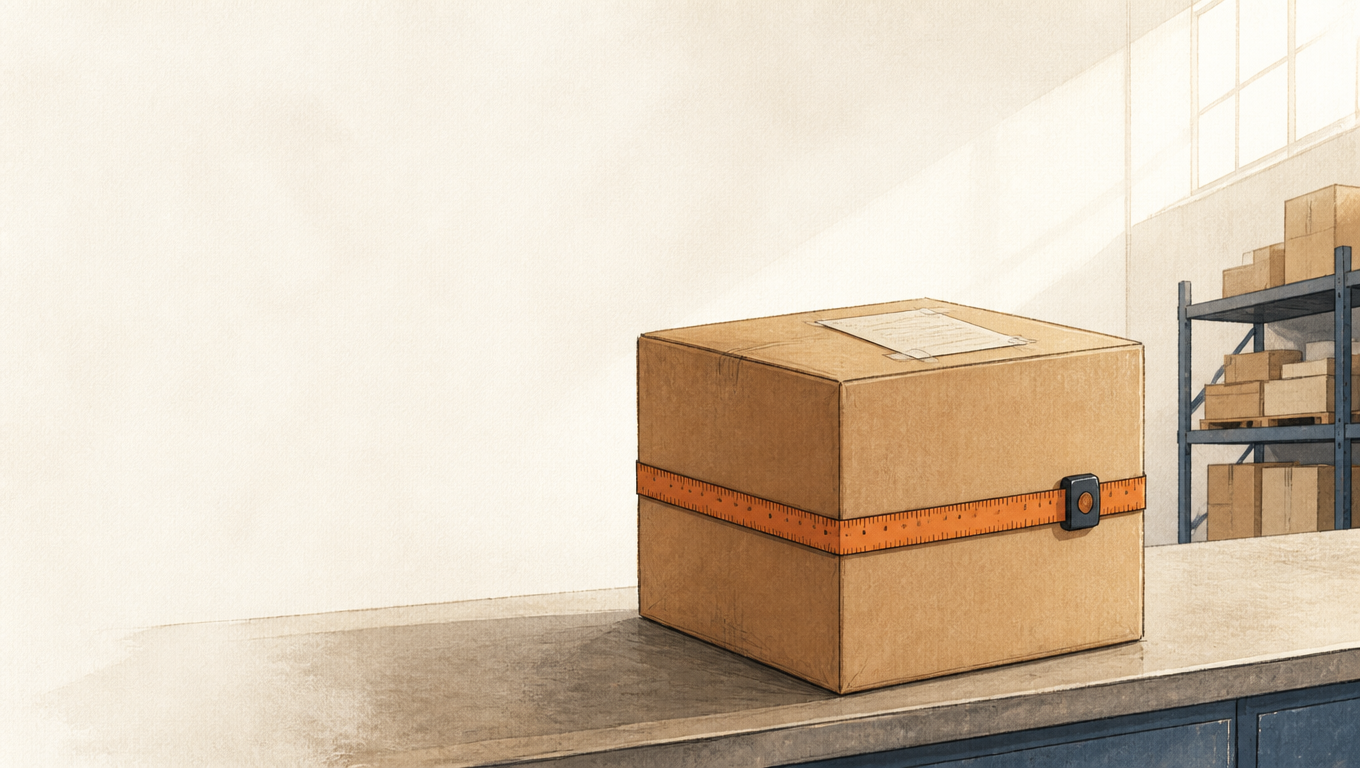
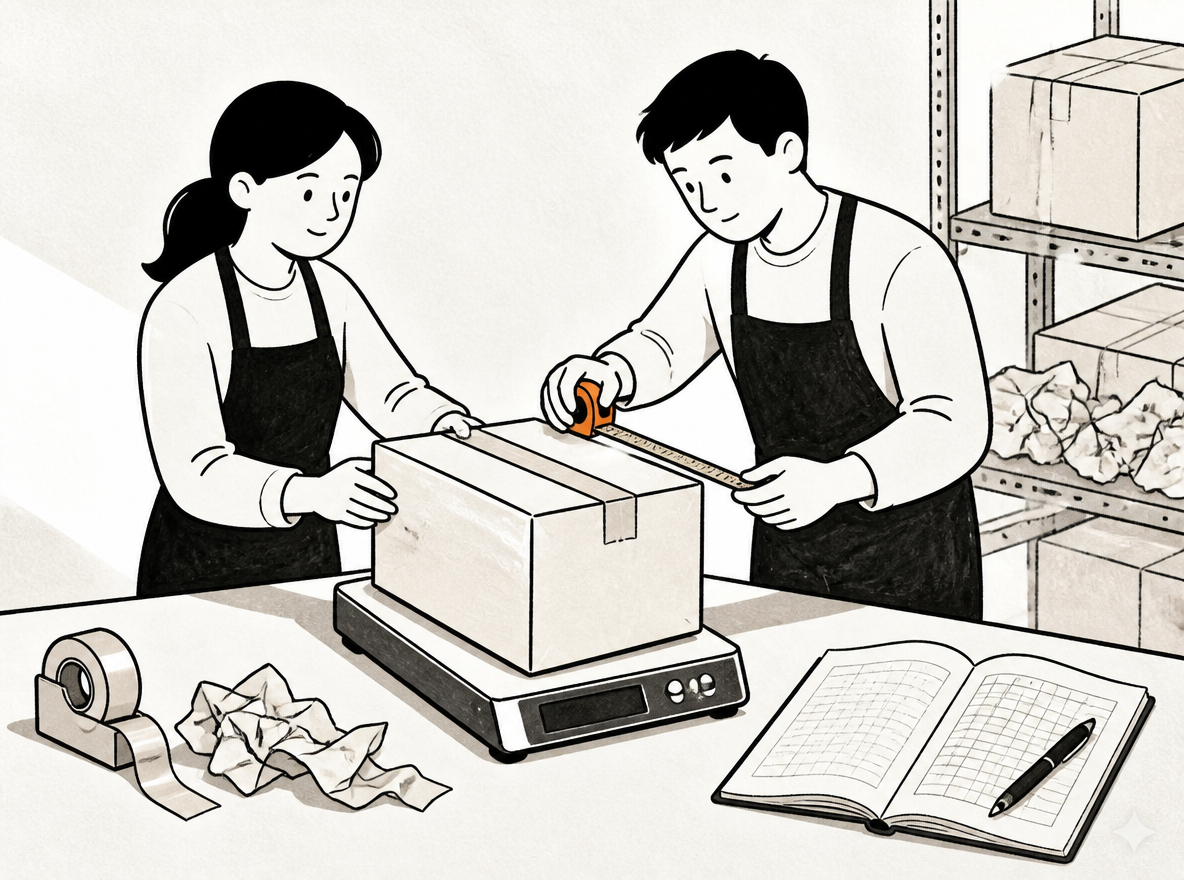
A warehouse shipping station with a cardboard parcel on a digital scale, a tape measure and boxes of different sizes nearby, warm natural light
Every box at the shipping station gets weighed and measured: dimensions decide whether you pay for air

What Is the USPS Dimension Fee?

Dimensional weight, usually called DIM weight, is a pricing method based on the volume of a package instead of its physical weight. The logic is simple: a big, light box full of air takes up just as much room in a trailer or an airplane as a heavy one does, so carriers charge for the space. USPS calculates DIM weight with this formula:

DIM weight = (Length × Width × Height in inches) ÷ 139

The result is rounded up to the next whole pound. The billed weight is then the greater of the actual scale weight or the DIM weight. If your DIM weight comes out above 70 pounds, you still pay only the 70-pound price, since that is the maximum USPS bills.

The fee only kicks in above a threshold. DIM weight applies when the package volume exceeds 1 cubic foot, which is 1,728 cubic inches. A box of 15 × 12 × 8 inches equals 1,440 cubic inches, so it slips under the threshold and bills on actual weight alone. A box of 18 × 14 × 12 inches equals 3,024 cubic inches, so it is well over, and DIM weight applies.

DIM weight is charged on the four main competitive parcel services: USPS Ground Advantage, Priority Mail, Priority Mail Express, and Parcel Select. Flat Rate products are the notable exception: they are priced by the box itself, so dimensional weight never applies to them. That distinction becomes a money-saving lever later in this guide.
The July 12, 2026 Rule Change: Why It Got More Expensive

The change that matters is the divisor. Before July 12, 2026, USPS divided package volume by 166 to get DIM weight. After that date it divides by 139, the same divisor UPS and FedEx already use domestically. A lower divisor produces a higher DIM weight for the same box, so everything over the 1-cubic-foot threshold got more expensive overnight.

The rule change also tightened measurement. All fractional package dimensions are now rounded up to the next whole inch before the volume is calculated, so a side that measures 17.1 inches counts as 18 inches. Small measurement differences that shippers used to shrug off now cost money.

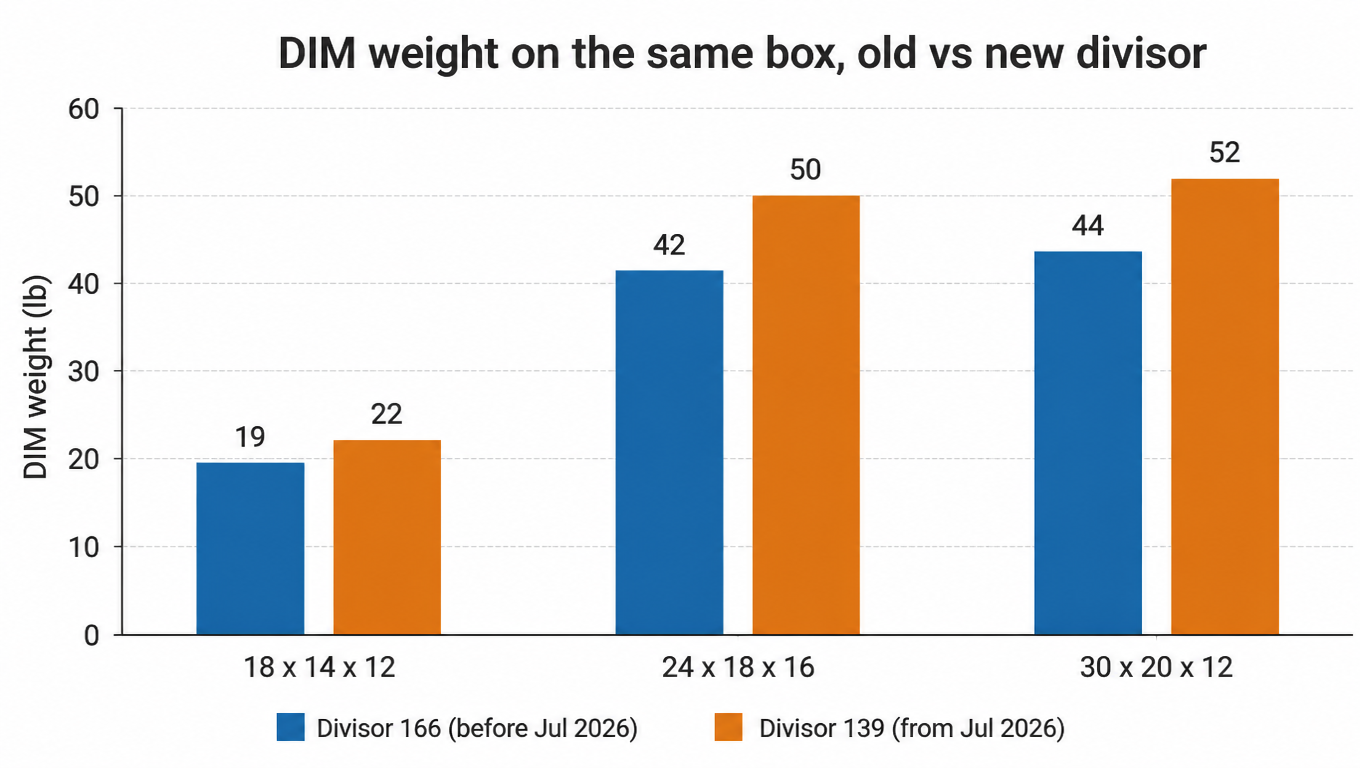
Here is what the divisor change does to real boxes.

Bar chart of DIM weight on the same boxes, old divisor 166 versus new divisor 139, for 18x14x12, 24x18x16 and 30x20x12
The same box is roughly 19% heavier by DIM under the new divisor

Take the common 18 × 14 × 12 inch box: 3,024 cubic inches. Under the old divisor, 3,024 ÷ 166 = 18.2, rounded up to 19 pounds. Under the new divisor, 3,024 ÷ 139 = 21.8, rounded up to 22 pounds. That is a three-pound jump on a box that weighs almost nothing on its own, worth roughly $1.50 to $2.50 per parcel depending on zone and service.

The July change landed on top of a year of rate increases. On January 18, 2026, USPS raised Ground Advantage by 7.8% on average, Priority Mail by 6.6%, Priority Mail Express by 5.1%, and Parcel Select by 6.0%. Then on April 26, 2026, it added a temporary 8% surcharge on the same package services, scheduled to run through January 17, 2027. Separately, the overweight and oversize fee rose to $200: any package over 70 pounds, or over 130 inches in combined length and girth, found anywhere in the postal network now draws the $200 fee plus a rate correction to the 70-pound price.

For a shipper, the practical summary is: every parcel over 1 cubic foot got more expensive, measurements got stricter, and the rate environment around it is unusually volatile. That makes the avoidance tactics below worth more than ever.

How to Calculate Your DIM Weight

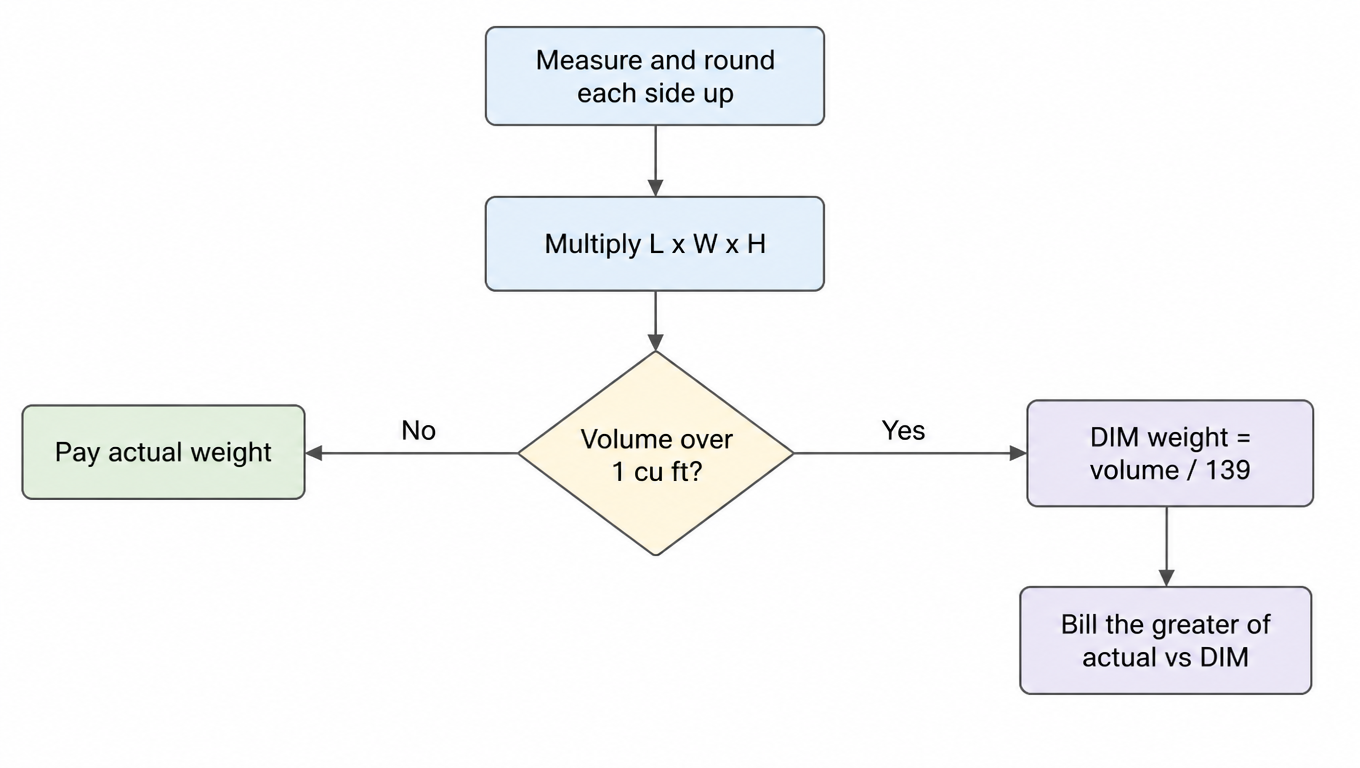
You can compute the DIM weight of any package in four steps. First, measure each side to the nearest whole inch, rounding up if there is any fraction. Second, multiply the three numbers to get the volume in cubic inches. Third, divide the volume by 139. Fourth, round the result up to the next whole pound. That is the DIM weight, and the billed weight is whichever is larger, the DIM weight or the actual scale weight.

Flowchart of DIM weight calculation: measure and round each side up, multiply L x W x H, check the 1 cubic foot threshold, divide by 139, bill the greater of actual vs DIM
Four steps to your DIM weight and billable weight

A worked example makes it concrete. Suppose your product measures 17.2 × 13.8 × 9.1 inches. Round each side up: 18 × 14 × 10 = 2,520 cubic inches, which is over 1,728, so DIM weight applies. Divide 2,520 by 139 = 18.1, rounded up to 19 pounds. If the parcel actually weighs 12 pounds, you are billed for 19. If it actually weighs 25 pounds, you are billed for 25, because the actual weight is the greater number.

The table below shows how the same logic plays out across common box sizes.

Box (L × W × H) Volume (cu in) DIM weight Actual weight Billed weight
15 × 12 × 81,440 (under threshold)none3 lb3 lb
18 × 14 × 123,02422 lb10 lb22 lb
20 × 16 × 123,84028 lb5 lb28 lb
24 × 18 × 166,91250 lb30 lb50 lb

Beyond DIM weight, watch the nonstandard fees, which stack on top of the base rate. USPS charges $4.50 if any side of the package exceeds 22 inches but is no more than 30 inches, $10 if any side exceeds 30 inches, and $21 if the volume exceeds 2 cubic feet (3,456 cubic inches). These are additive: a box of 32 × 15 × 10 inches triggers the $10 length fee because it is over 30 inches, and the $21 cubic fee because 4,800 cubic inches is over 3,456, for $31 of add-ons before any DIM math. When you are designing packaging, you want to stay under every one of those lines, not just the 1,728 cubic inch one.

USPS Product Comparison: Which Is Cheapest?

For most parcels, USPS Ground Advantage is the default. It delivers in 2 to 5 days, takes DIM weight over the 1-cubic-foot threshold, and generally offers the lowest commercial rate of the four services. If your parcel is under 1 cubic foot and not time-sensitive, Ground Advantage is almost always the cheapest USPS option.

Priority Mail delivers in 1 to 3 days and also takes DIM weight. It costs more than Ground Advantage on most routes, so you should use it only when speed genuinely sells the order. The one special case is Priority Mail Cubic, a commercial-only pricing scheme available through label providers and 3PLs: it prices boxes in tiers from 0.1 to 0.5 cubic feet (up to 20 pounds) with no DIM calculation on top. A small, dense box under half a cubic foot can ship Priority Mail Cubic for less than Ground Advantage.

Flat Rate products work differently. USPS sells specific boxes and envelopes at a fixed price regardless of weight (up to the 70-pound limit) and regardless of dimensions, so DIM weight never applies. That makes Flat Rate the clear winner for heavy but small items, especially across long distances, where per-pound pricing climbs fastest.

Service Speed DIM weight? Best for
Ground Advantage2-5 daysYes, over 1 cu ftDefault for most parcels
Priority Mail1-3 daysYes, over 1 cu ftSpeed-sensitive orders
Priority Mail Cubic1-3 days (commercial)No, tier price up to 0.5 cu ft and 20 lbSmall boxes, dense items
Flat Rate1-3 daysNoHeavy but small items, up to 70 lb

The decision framework is short. If the item is heavy for its size and going far, quote Flat Rate first. If the box is under 0.5 cubic feet and you have commercial access, quote Priority Mail Cubic. If the parcel is under 1 cubic foot and in no hurry, Ground Advantage wins. If the parcel is over 1 cubic foot, your first move is not picking a service, it is shrinking the box, which is exactly what the next section covers.

10 Ways to Avoid the Fee

  1. Downsize the box. This is the single biggest lever. Every inch you trim reduces volume, and volume reduction is what moves you away from the DIM weight entirely. Revisit boxes you have used for years; most products fit something smaller.
  2. Stay under 1 cubic foot. The threshold is 1,728 cubic inches. A box that is 13 × 12 × 12 equals 1,872 and gets hit with DIM weight; a box of 12 × 12 × 12 equals 1,728 and does not. That 1 inch can be the difference between billing at 14 pounds and billing at 3.
  3. Send heavy items in Flat Rate. Fixed price, no DIM weight, up to 70 pounds. A 25-pound steel part in a Medium Flat Rate Box costs the same whether it travels 50 miles or 2,000, which is why Flat Rate dominates long-haul heavy shipments.
  4. Send small boxes as Priority Mail Cubic. If your box is between 0.1 and 0.5 cubic feet and under 20 pounds, Cubic pricing charges by tier, not by DIM weight. A 12 × 10 × 6 box (720 cubic inches, 0.42 cubic feet) can price like a much lighter parcel.
  5. Measure precisely, and design for the rounding. A side of 17.1 inches counts as 18 inches, and the DIM math uses the rounded number. If you can shave a product or a box design to land on whole inches, or just below the threshold, the savings are automatic.
  6. Cut the air. Void fill and oversized bubble wrap inflate volume without adding weight. Custom-fit inserts, kraft fill that compresses flat, and tight packing all reduce the volume the carrier measures.
  7. Use poly mailers for soft goods. Apparel, textiles, and foam products do not need a rigid box. A poly mailer collapses around the product, slashing measured volume and often dropping you below the DIM threshold entirely.
  8. Split or consolidate deliberately. Sometimes two small boxes cost less than one big one. If combining orders pushes you over 1 cubic foot, or over 2 cubic feet where the $21 fee kicks in, splitting can be cheaper than paying DIM on air.
  9. Audit your invoices. Compare the dimensions billed on each label against what you actually measured. Carriers occasionally bill 18 inches for a box that measures 17.6. Systematic over-billing is exactly the kind of leak a monthly audit catches, and you can dispute it with photos and scale receipts.
  10. Use a 3PL or discounted shipping channel. Commercial rates, Priority Mail Cubic access, and software that automatically picks the cheapest product per parcel are usually available only through label providers and 3PLs. The right platform turns tactics 1 through 9 into automation.
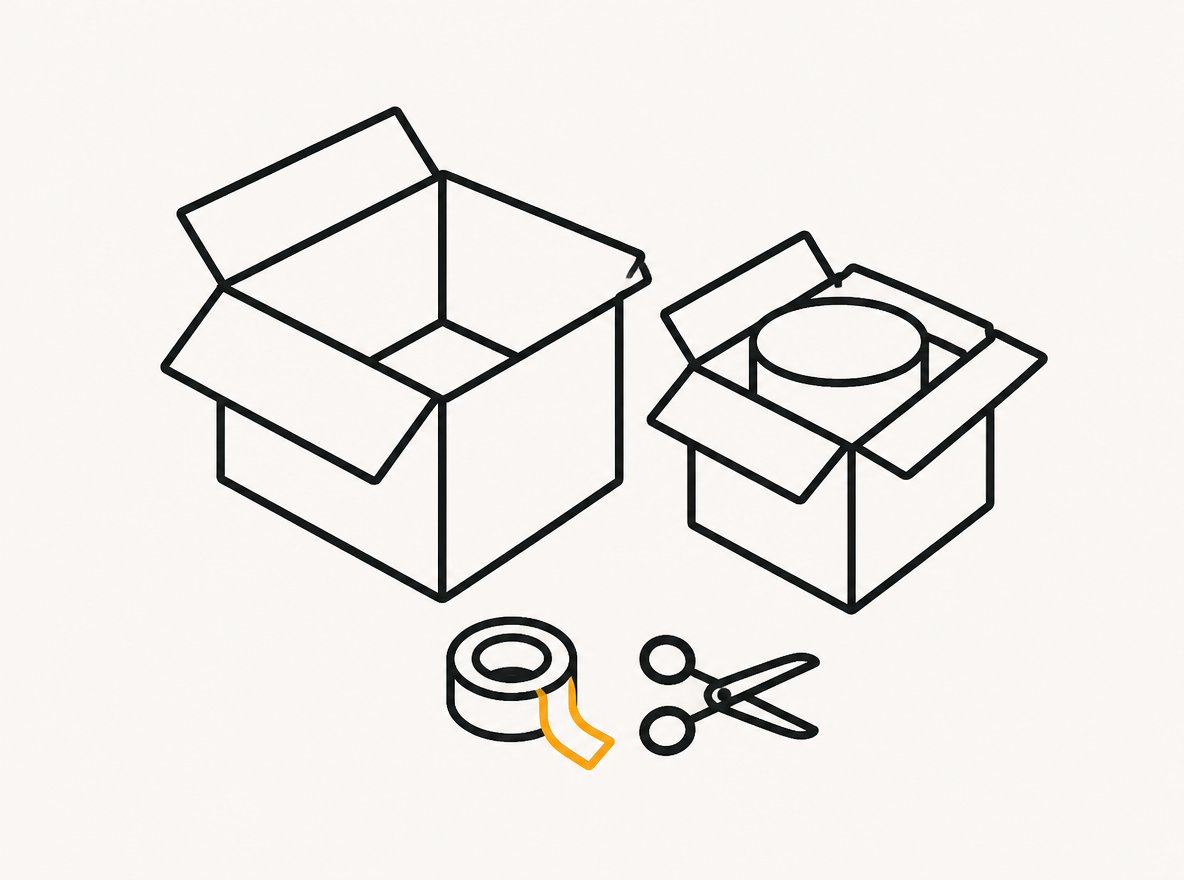
Two cardboard boxes side by side, one oversized with empty space inside, one snugly fitting its product, with a roll of tape and scissors on the table
Right-sizing the box is the first and most rewarding move

Case Studies: The Numbers

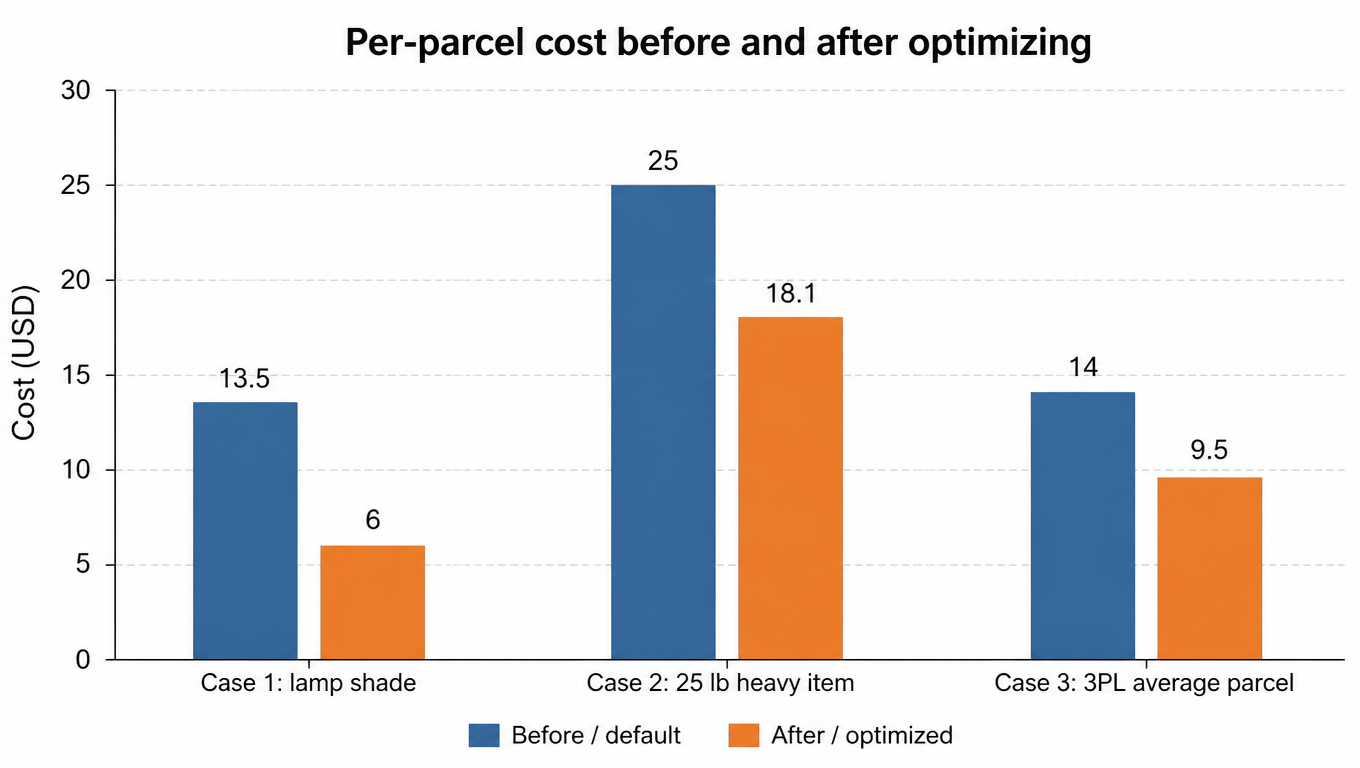
Case 1: the lightweight lamp shade. A 3-pound lamp shade ships in a 17 × 14 × 11 inch box: 2,618 cubic inches, well over the threshold. DIM weight is 2,618 ÷ 139 = 18.8, rounded up to 19 pounds, so the parcel bills at 19 pounds instead of 3. At Ground Advantage commercial rates in a mid-distance zone that is roughly $13.50. Re-engineer the packaging to a 15 × 12 × 8 inch box: 1,440 cubic inches, under the threshold, so the parcel bills at its true 3 pounds, roughly $6.00. The resizing saves about $7.50 per parcel, more than half the shipping cost, and the fix is a one-time packaging change.

Case 2: the heavy steel part. A 25-pound item in a 16 × 12 × 10 inch box (1,920 cubic inches) computes to a DIM weight of 14 pounds, but the actual 25 pounds is greater, so the parcel bills at 25 pounds regardless. On a long-haul route (zone 8) Ground Advantage commercial runs roughly $25. The same item in a Medium Flat Rate Box ships for about $18 no matter the zone. Flat Rate wins by roughly $7 here, because for heavy items going far, a fixed price beats per-pound pricing. The caveat: in nearby zones Ground Advantage can be cheaper, so quote both before you choose.

Case 3: the 3PL view. A fulfillment operator ships 2,000 parcels a month and attacks DIM on three fronts. First, box standardization: every SKU's packaging is measured, and boxes that hover just above 1,728 cubic inches are redesigned below it. Second, automated rate selection: the shipping software quotes Priority Mail Cubic for anything under 0.5 cubic feet, Flat Rate for heavy items, and Ground Advantage otherwise, taking the cheapest option per parcel. Third, invoice auditing: the 3PL catches a carrier that has been billing 18 inches on a box that measures 17.6, and recovers the difference. If roughly 60% of those 2,000 parcels are optimized by an average of $1.50 each, that is about $1,800 a month, or $21,600 a year, recovered without selling a single extra unit.

Bar chart of per-parcel cost before and after optimizing: Case 1 lamp shade 13.5 to 6, Case 2 heavy item 25 to 18.1, Case 3 3PL average 14 to 9.5
Per-parcel cost before and after optimizing (USD)

Action Checklist

  1. Measure every SKU's actual box, rounding up each side, and compute the volume in cubic inches.
  2. Redesign any box that sits above 1,728 cubic inches, the 1-cubic-foot DIM threshold.
  3. Match product to service: Flat Rate for heavy and small, Priority Mail Cubic for under 0.5 cubic feet, Ground Advantage as the default.
  4. Cut air: right-size boxes, use custom inserts, and switch soft goods to poly mailers.
  5. Standardize SKU packaging so measurements are known, repeatable, and documented.
  6. Set your shipping software to auto-select the cheapest product for every parcel.
  7. Audit carrier invoices monthly for dimension errors and dispute what is wrong.
  8. Re-run this checklist after every USPS rate change, since USPS has changed pricing multiple times in 2026 alone.

The July 12, 2026 rule change made shipping air measurably more expensive, but it also made smart packaging more valuable. The boxes you choose, the products you match them to, and the software you route them through now determine whether USPS's new math works for you or against you. Run the checklist, re-measure your top SKUs, and let the numbers on your next invoice tell you what worked.

FAQ

No. Flat Rate boxes and envelopes are priced per box, so dimensional weight does not apply, and the price does not change with distance. The 70-pound maximum still applies, and the $200 overweight and oversize fee applies if a parcel exceeds the 70-pound or 130-inch combined length and girth limits.
International services are priced on their own schedules, but most Priority Mail International products use the same 139 divisor and the same 1,728-cubic-inch threshold. Because international rates change frequently, confirm the current figure on the USPS Postal Explorer page before you quote a specific destination.
Yes. If the dimensions on your invoice do not match what you measured and declared, file an inquiry with your evidence: photos of the box against a tape measure, scale receipts, and the label data from your shipping software. Audits that catch systematic over-measurement, like a carrier billing 18 inches on a 17.6-inch side, are where the recovery is biggest.

Ready to put these rules into your label workflow?

EasyShippingX bakes USPS commercial pricing, DIM weight logic, and automatic product selection into your order flow, so every parcel is priced by the rules automatically.