You can ship a 2 lb throw pillow in a box the size of a mini-fridge. The carrier will happily take it, and bill you as if it weighed 40 lb. That is dimensional weight, usually written as DIM weight, the pricing rule that decides most of what e-commerce sellers pay for shipping. This guide breaks the math down completely: the formula, the carrier divisors, the rounding rules, and three worked examples, so you can predict your bill before you buy the label.
The whole concept reduces to one sentence: shipping is billed on the greater of actual weight and dimensional weight, and that larger number is the billable weight. Bulky light packages pay for space, small dense packages pay for weight. Everything in this guide expands that sentence: how the formula works, what divisor each carrier uses, when you should worry, and how to push the number down.
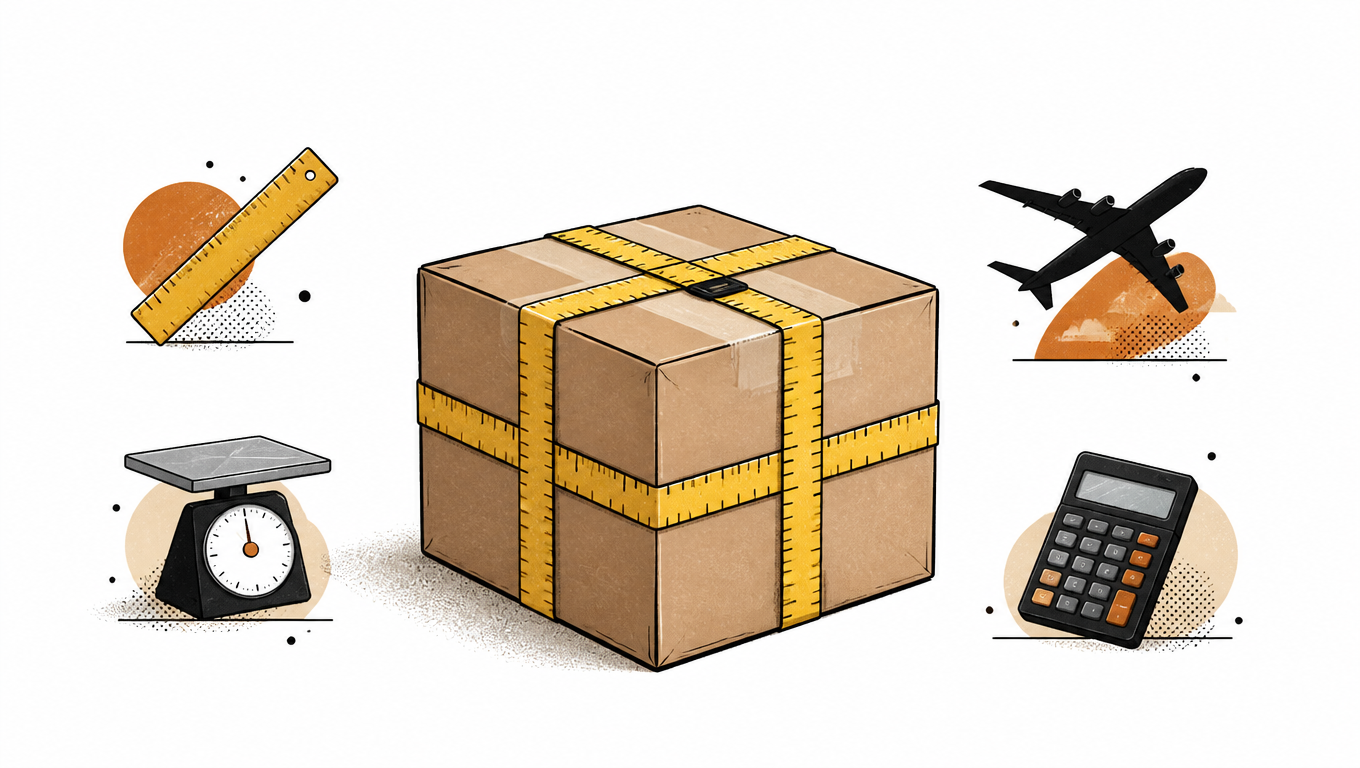
DIM weight is the space your packed box occupies, not just how much it weighs
What Is Dimensional Weight?
Dimensional weight is a carrier pricing method based on how much space a package occupies, not just how much it physically weighs. Carriers calculate the package volume, divide it by a set divisor (also called the DIM factor), compare the result with the actual weight, and bill on whichever is larger: the billable weight.
Carriers introduced DIM weight for a simple business reason: a truck, a plane, or a container holds a fixed amount of space, and bulky but light packages displace cargo that pays more per cubic foot. A full trailer of empty boxes still burns fuel, occupies dock time, and blocks out dense shipments. Charging by space keeps the economics fair for both sides, and it pushes shippers to package more efficiently.
You meet DIM weight at every level of the shipping stack: USPS, UPS, FedEx, and DHL all use it, freight forwarders quote it, and e-commerce fulfillment centers apply it on their customers' behalf. The math is identical everywhere, but two details differ by carrier and you need to track both: the divisor, and the unit system. US domestic carriers quote in inches and pounds, while international shipments almost always work in centimeters and kilograms.
The DIM Weight Formula
The core formula is the same for every carrier in the world: DIM weight = (Length × Width × Height) ÷ divisor. Measure the three outer dimensions of the packed box, multiply to get the volume in cubic inches or cubic centimeters, and divide by the carrier's divisor. For a 24 × 18 × 14 in box with a divisor of 139, that is 6,048 ÷ 139, which comes out to about 43.5 lb.
The divisor is the single number that controls your bill. A bigger divisor produces a lower DIM weight: the same box divided by 166 instead of 139 gives you roughly 36 lb instead of 43.5 lb. That is why the divisor matters more than almost any other variable, and why the first question to ask any carrier or forwarder is which divisor they apply to your lane.
Two rounding rules apply on top of the formula. First, round each dimension up to the next whole unit: a box that measures 23.4 in counts as 24 in. Second, round the final DIM weight up per the carrier's rule, usually to the next whole pound (USPS, UPS, FedEx) or to the next 0.5 kg increment (DHL Express international)[2][3][5]. Never round DIM weight down; it only works against you when the bill arrives.
Two practical cautions. Never mix unit systems: dividing inches and pounds by 5000, or centimeters and kilograms by 139, produces nonsense numbers that get billed at face value. And if the numbers feel arbitrary: 5000 cm³/kg and 139 in³/lb are the same standard expressed in two unit systems (139 in³ of water weighs almost exactly 5 lb, and 5000 cm³ is about 305 in³), which is why international and US rates line up the way they do.
Carrier Divisors at a Glance
Each carrier sets its own divisor, rounding rule, and the package size below which DIM weight simply does not apply. Here is the current US and international landscape, and the standing advice: confirm the numbers on the carrier's rate card before you ship, because divisors change over time. The biggest recent change: on July 12, 2026, USPS lowered its DIM divisor from 166 to 139 for Priority Mail, Priority Mail Express, Ground Advantage, and Parcel Select packages over 1 cu ft, and began rounding each dimension up to the next whole inch[1].
Ground/Home Delivery over 1 cu ft; Express: all packages
DHL Express (international)
cm / kg
5000
up to next 0.5 kg
all international shipments
Air freight (IATA standard)
cm / kg
6000
up to next whole kg
general air cargo and most postal economy lines
Amazon FBA fulfillment fees (US)
in / lb
139
up to next whole lb
US fulfillment fees; cm/kg elsewhere
The pattern to remember: as of mid-2026, USPS, UPS, and FedEx all sit at 139 for packages over 1 cu ft, with UPS retail rates still on 166[2], and the rest of the world works in centimeters divided by 5000, or 6000 on air freight and economy lines[6]. Amazon applies the same 139 divisor to US FBA fulfillment fees[8]. If a seller tells you their freight quote doubled out of nowhere, the first thing to check is which divisor the forwarder applied, because 5000 versus 6000 alone changes the DIM weight by 17%[6].
Worked Examples
The formula is only real once you run it on actual packages. Here are three worked examples covering the two common outcomes, a small dense parcel where actual weight wins, and a large light box where DIM weight crushes it, plus one international shipment in centimeters.
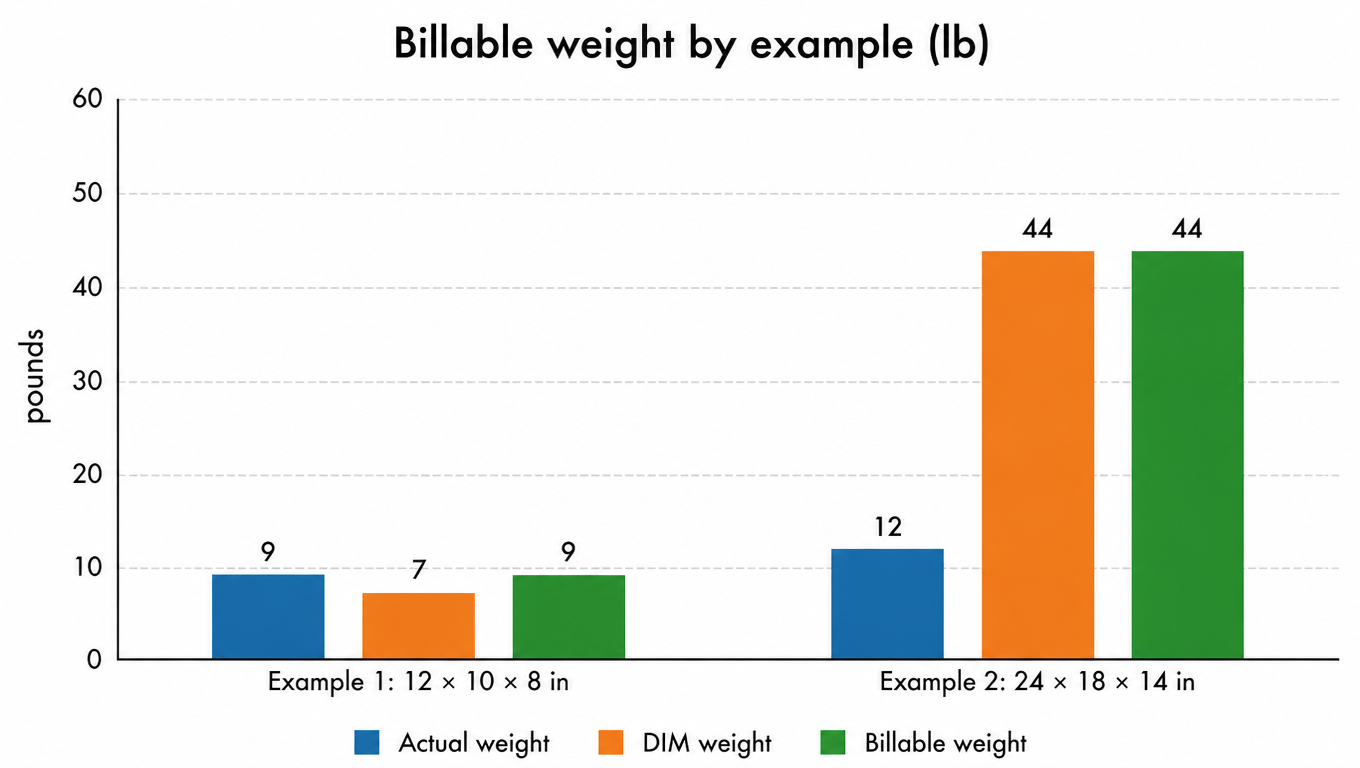
Example 1: small dense parcel, actual weight wins. A 12 × 10 × 8 in box of hardware weighs 9 lb. Volume is 12 × 10 × 8 = 960 in³. Divide by 139: 960 ÷ 139 = 6.9, which rounds up to 7 lb DIM weight. Actual weight is 9 lb, DIM is 7 lb, so the billable weight is the greater number, 9 lb, and DIM weight costs you nothing here.
Example 2: large light box, DIM weight wins. A 24 × 18 × 14 in box of plush toys weighs 12 lb. Volume is 24 × 18 × 14 = 6,048 in³. Divide by 139: 6,048 ÷ 139 = 43.5, which rounds up to 44 lb DIM weight. The actual weight is 12 lb, but the billable weight is the greater number, 44 lb. The package bills at more than three times what it weighs, and this is exactly the case that eats small budgets.
Example 3: international shipment, centimeters and kilograms. A 60 × 40 × 30 cm carton weighs 6.5 kg. Volume is 60 × 40 × 30 = 72,000 cm³. Divide by 5000: 72,000 ÷ 5000 = 14.4 kg, which rounds up to 14.5 kg under DHL Express's 0.5 kg increment rule[5]. Billable weight is 14.5 kg, more than double the actual 6.5 kg.
Billable weight is always the greater of actual and DIM weight
The chart makes the lesson visual: in Example 1 the billable bar follows the actual weight, and in Example 2 it jumps to the DIM bar, over three times the physical weight. The international example uses kilograms, so it stays in the prose rather than mixing onto a pounds axis; the logic is identical.
Skip the hand math with the DIM weight calculator
Drop your packed box dimensions into our free dimensional weight calculator to get actual, DIM, and billable weight in one pass, including separate runs for the current USPS, UPS, and FedEx divisors. Use the numbers to decide which carrier to use and whether a smaller box pays off: faster than mental math, and steadier too.
Billable weight is the number the carrier actually charges on: the greater of actual weight and DIM weight. Actual weight is what the scale says, DIM weight is what the tape measure says, and billable weight is whichever is larger after all rounding is applied. Nothing else enters the calculation, and this three-way distinction is the whole game.
The 1 cubic foot threshold (1,728 in³) does most of the quiet work in US domestic shipping. Below it, USPS and FedEx Ground and Home Delivery products bill on actual weight, so the thousands of small boxes e-commerce sellers ship every day never trigger DIM at all; FedEx Express, by contrast, applies DIM to every package regardless of size[4][1]. UPS applies DIM by service and rate program, so check the current rules for your lane[2]. You can do the mental math without a calculator: take the volume in cubic inches, divide by 139, and if the answer is below the actual weight, DIM weight is irrelevant to that parcel.
The packages to worry about are light products in big boxes: pillows, plush toys, foam, lamps, decorative items, and anything with heavy packaging relative to its contents. Dense products almost never hit DIM limits because their actual weight is already high: books, tools, hardware, supplements, and canned goods bill on scale weight in practice.
Product type
Typical packaging
What usually bills
Books, tools, supplements
tight box or mailer
actual weight
Apparel (folded)
poly mailer
actual weight
Pillows, plush toys, foam
big box
DIM weight
Lamps, mirrors, decor
oversized box with void fill
DIM weight
Electronics
manufacturer box, sealed
borderline, check both
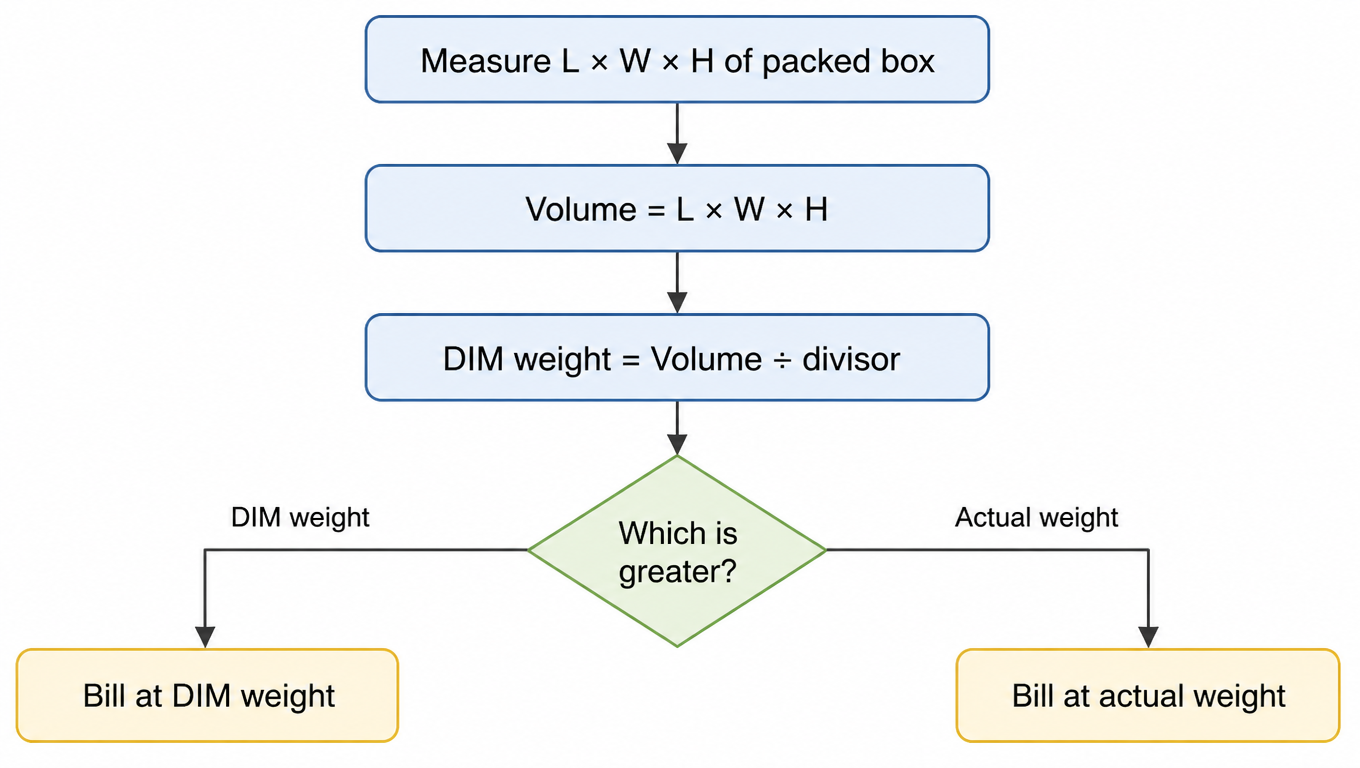
The decision flow is simple enough to run on every order, whether you are a 3PL doing 10,000 parcels a day or a seller packing one box at the kitchen table:
Run this flow on every order
When DIM Weight Doesn't Apply
DIM weight is not universal, and knowing the exemptions saves real money. USPS Flat Rate boxes and envelopes are the classic case: a flat price regardless of weight and dimensions within the size limits, which means DIM weight simply does not exist for them[7]. USPS letters and envelopes under the size threshold are likewise billed by weight class only.
Packages under 1 cu ft on most US ground products bypass DIM entirely, as covered above, and this is the biggest practical exemption of all. Some regional and last-mile carriers, especially newer US networks that compete on density, bill on actual weight only, which can make them dramatically cheaper for bulky light freight. Freight and LTL shipments use an entirely different pricing model, per hundredweight, so DIM weight is not part of that quote. For when to switch modes from parcel to LTL, see our guide to parcel vs. LTL shipping.
One caveat on the exemption: Flat Rate only saves money when the item actually fits and is heavy enough to justify the fixed price. A 3 lb item in a flat-rate box beats DIM pricing, but a 1 lb item in the same box is usually cheaper on regular Priority Mail. Run the comparison instead of assuming the flat rate always wins.
How to Cut DIM Weight and Save Money
DIM weight is a bill you can shrink with packaging decisions, and the levers are all in your hands. Right-size the box first: the smallest box the item fits in, with void fill eliminated wherever protection allows. A box that is 2 in too long in each dimension adds thousands of cubic inches, and a handful of inches is often the difference between a 30 lb and a 50 lb bill. Comparing every lane on billable weight instead of retail list price is exactly what our guides to lowering shipping costs and rate shopping automation break-even expand on.
Switch rigid boxes to poly mailers for soft goods. Apparel, textiles, and plush items that ship in 6 in thick boxes can often ship in 1 in mailers, and that single change routinely cuts DIM weight by half or more. For fabrics, vacuum sealing and flat folding collapse the volume further. Then remove the void fill: packing peanuts, air pillows, and bubble wrap are pure volume, and they are the most expensive material in your box per cubic inch. For a per-SKU packaging profile that measures a bulky SKU across box and mailer options, see our guide to auto parts parcel shipping costs.
Split versus consolidate is the nuance that trips people up. Splitting one huge light order into smaller boxes only helps when it lowers the total billable weight enough to offset the cost of the extra label, and consolidating dense items into one box usually wins on both weight and label cost. Run both numbers before changing anything. Re-measure after every packaging redesign: a new box size, a new mailer supplier, or a new void-fill routine changes the DIM weight, and yesterday's spreadsheet is wrong the moment the packaging changes. For re-working your box math after USPS dropped its divisor from 166 to 139 in July 2026, see our guide to avoiding the USPS DIM weight fee.
At volume, the divisor itself becomes a negotiation lever. Carriers and forwarders discount on volume, and a better divisor or DIM-friendly rate is a legitimate ask once you have consistent weekly volume. Multi-carrier comparison is the other free win: the same box can bill at 139 with one carrier and at 166 with another, so comparing the billable weight before buying the label is worth more than any coupon code. For breaking down the hidden line items on your bill, see our guide to the true cost of last-mile delivery.
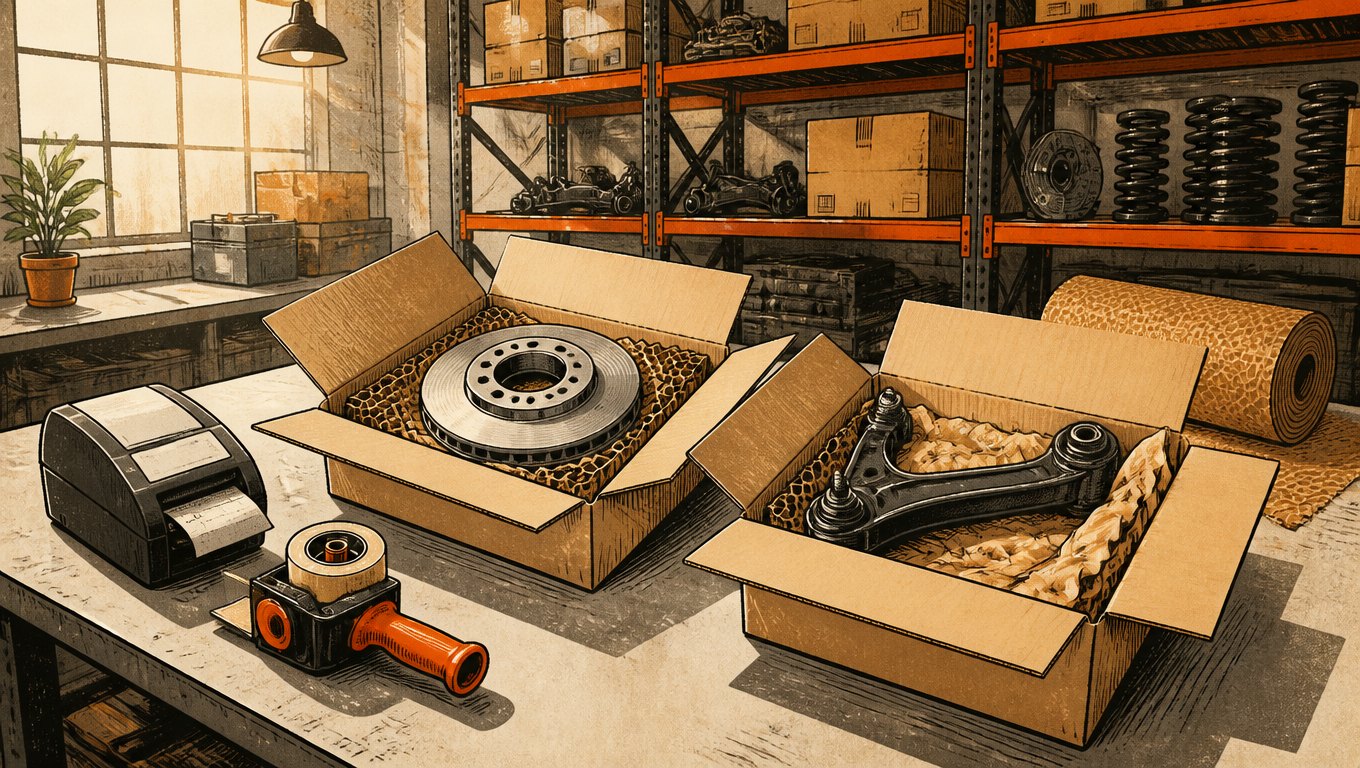
The same product, two packages, two billable weights
The arithmetic is worth doing once, properly. Take the plush toy box from Example 2, a 24 × 18 × 14 in box billed at 44 lb, and right-size it to 18 × 14 × 10 in, which is 2,520 in³ ÷ 139 = 18.1, rounding to 19 lb. That is 25 lb of billable weight saved per parcel. If you ship 100 of these a month at a blended ground rate of about $1.40 per billable pound, the savings are 100 × 25 × 12 × $1.40, roughly $42,000 a year, from one box size change. That is the entire argument for treating packaging as a cost center instead of an afterthought.
Common Mistakes + Quick Reference
The mistakes that cost money are all variations on the same theme: measuring the wrong thing or rounding in the wrong direction.
Mistake
Consequence
Fix
Measuring the product, not the packed box
DIM weight too low, surprise on the bill
Measure the sealed box, outside dimensions
Rounding DIM weight down
Underbilled quote, overcharged invoice
Round up, always, per carrier rule
Mixing inches with kg or cm with lb
Nonsense DIM number billed at face value
Keep one unit system per calculation
Ignoring the 1 cu ft threshold
Over-paying on small boxes that bill by actual weight
Check volume against 1,728 in³ first
Ignoring length + girth
Oversize surcharges on top of DIM weight
Check length and girth limits per carrier
Using yesterday's divisor
Wrong DIM weight after a rate change
Confirm the divisor on the current rate card
The quick reference below is the whole method on one table. Measure the sealed box, round each dimension up, divide by the divisor for the carrier and lane you are using, round the result up, and bill on the greater of DIM and actual weight.
Carrier / product
Divisor
Units
Rounding
DIM threshold
USPS
139
in / lb
up to next whole lb
over 1 cu ft
UPS
139
in / lb
up to next whole lb
varies by service
FedEx
139
in / lb
up to next whole lb
Ground >1 cu ft; Express all
DHL Express intl.
5000
cm / kg
up to next 0.5 kg
all shipments
Express couriers intl.
5000
cm / kg
up to next whole kg
all shipments
Air freight (IATA)
6000
cm / kg
up to next whole kg
all shipments
That is the entire workflow: measure the packed box, calculate the volume, divide by the divisor, compare with the actual weight, and bill on the greater. Do that on every order, and dimensional weight stops being a surprise line item and becomes a number you control.
EasyShippingX is a channel-neutral shipping layer: one consistent way to compare US domestic carrier options and execute through a portal, a spreadsheet, or an API. For the same SKU and the same dimensions, compare actual, DIM, and billable weight side by side, and let the billable number pick the carrier for each lane instead of a guess. See pricing or book a demo.
DIM weight = (Length × Width × Height) ÷ divisor. Measure the three outer dimensions of the packed box (inches or centimeters), multiply to get the volume, and divide by the carrier's divisor (139 is common in the US; 5000 or 6000 internationally). Round each dimension and the final result up, compare the DIM weight with the actual weight, and bill on the greater: the billable weight.
As of mid-2026: USPS uses 139 for packages over 1 cu ft since July 12, 2026; UPS uses 139 on daily rates and 166 at retail; FedEx uses 139 for ground and air (Ground/Home Delivery applies it over 1 cu ft, Express on all packages). Internationally, DHL Express uses 5000 and the IATA air freight standard is 6000. Always confirm on the carrier's site before shipping, because divisors change.
Start with the volume in cubic inches. Packages under 1,728 in³ (1 cu ft) bill on actual weight with USPS and FedEx Ground and never trigger DIM weight. Above the threshold, divide the volume by 139; if the result is below the actual weight, you still bill on actual weight, and if it is above, you bill on that number. FedEx Express is the exception and applies DIM to every package. Big boxes of light goods (pillows, plush toys, lamps) are the usual victims.
Actual weight is what the package weighs on a scale. Dimensional weight is the space-equivalent weight (length × width × height ÷ divisor). Billable weight is the greater of the two after rounding, and it is what the carrier charges on. For bulky light packages, billable weight equals DIM weight; for small dense packages, it equals actual weight.
Right-size the box per SKU to the smallest one that fits, and remove pure-volume void fill like peanuts and air pillows. Switch soft goods from boxes to poly mailers, which routinely cuts DIM weight by half or more, and vacuum-seal fabrics. Re-measure and recalculate after every packaging change. At volume, negotiate a better divisor or DIM-friendly rate, and compare billable weight across carriers before buying the label.
EasyShippingX is a channel-neutral shipping layer: one consistent way to compare US domestic carrier options and execute through a portal, a spreadsheet, or an API. For the same SKU and dimensions, compare how each carrier treats actual, DIM, and billable weight side by side, let the billable number pick the carrier per lane, and turn the results into reusable routing rules.