Parcel to LTL Switch Guide

Parcel vs. LTL Shipping: When Should Ecommerce Brands and 3PLs Switch Modes?

If you ship with UPS or FedEx Ground, you are on the parcel network. Parcel is priced per package, per zone, and the math is designed for small, light, door-friendly boxes. Carriers move your box through a hub-and-spoke network alongside thousands of others, and they impose hard limits: 150 lb maximum weight, 108 in on the longest side, 165 in length plus girth[1]. Cross any of those and the package is refused, or accepted with punishing surcharges.

LTL, less-than-truckload, is a different network with different pricing. Freight rides on pallets, moves through regional terminals, and travels with a small group of other shipments sharing trailer space. Price is based on the shipment as a whole: NMFC class (which is mostly density), actual weight, and distance. Delivery is dock to dock, pickup is scheduled, and the receiver gets an appointment window. There is a minimum charge, often $100 to $150, but above that floor the per-pound economics get dramatically better than parcel.

The core difference to internalize: parcel prices each package, LTL prices each shipment. A 60 lb box and a 60 lb box are two separate shipments in parcel. The same 600 lb of freight on one pallet is one LTL shipment, one pickup, one delivery, one bill. The switch from parcel to LTL is not about a single magic weight; it is about when the shipment stops being a package and starts being freight.

Four terms will come up constantly, so know them: NMFC class is the freight classification assigned from density, packaging, and handling; density is weight in pounds divided by cubic feet; accessorials are the add-on charges (liftgate, residential delivery, detention) that often decide whether LTL is actually cheaper; and the BOL, bill of lading, is the contract document that declares commodity, class, weight, and piece count. One more: liftgate, the truck-mounted platform used when the receiver has no loading dock.

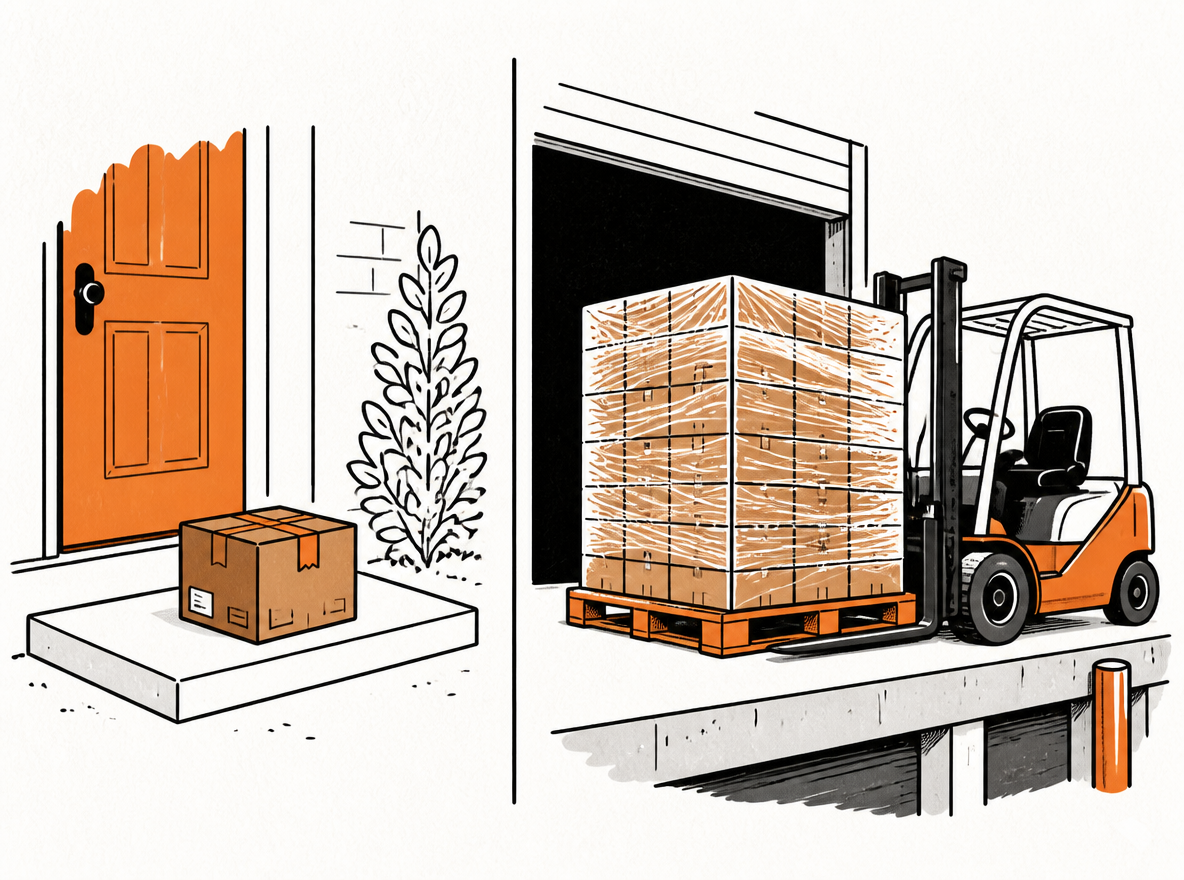
A parcel at a doorstep contrasts with a wrapped freight pallet and forklift at a loading dock.
Small parcels land on the doorstep; bulky freight changes hands at the dock

Parcel vs. LTL: What Actually Changes

For small, light packages, parcel wins outright. There is no minimum charge, 1 to 5 day transit is standard, and the doorstep delivery experience is what residential customers expect. If your typical order is a 10 lb box, moving to LTL would add cost, transit time, and friction with no upside.

The problem is that parcel pricing punishes size, not just weight. Carriers bill on dimensional weight: length × width × height divided by a divisor (139 for most UPS and FedEx Ground programs)[2]. A 100 lb box that is 30 × 30 × 30 in bills at roughly 194 lb (27,000 / 139), so you pay for weight you do not have. On top of that, oversize surcharges kick in for boxes longer than 96 in or with length plus girth beyond 130 in[3]. Parcel also tops out: UPS and FedEx Ground do not take packages over 150 lb at all[1]. For the mechanics of the dim-weight penalty and how to dodge it, see our guide to avoiding dimensional weight surcharges.

LTL sits on the other side of the ledger. Every LTL shipment pays a minimum charge, typically $100 to $150 including fuel, so a 40 lb pallet is an expensive mistake. But once freight is palletized and crosses roughly 150 lb, the per-pound cost drops below parcel and keeps falling as density improves. The crossover is not a single number; it lands in the 100 to 200 lb range depending on dimensions, class, and accessorials[7]. The chart below shows an illustrative comparison for a residential delivery in the same zone.
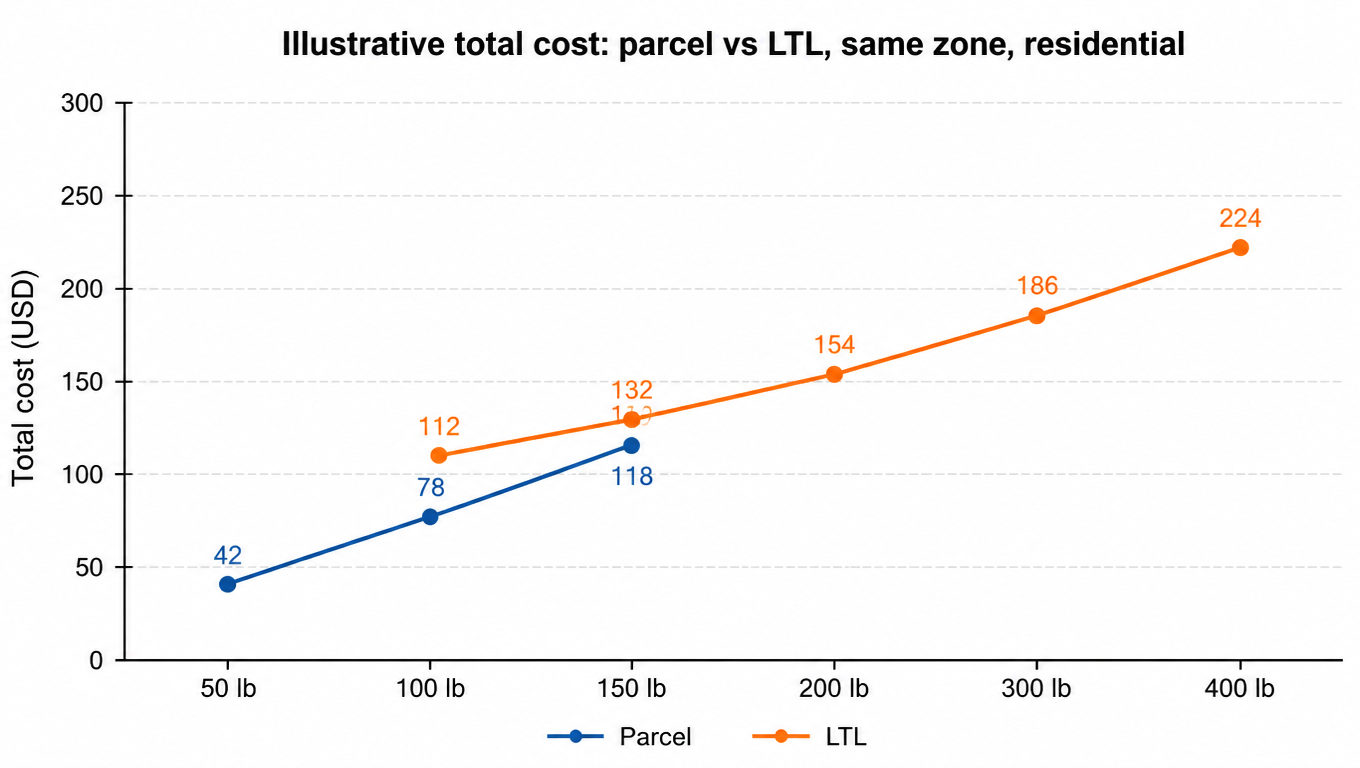
Line chart: illustrative total cost for a residential delivery in the same zone from 50 to 400 lb; parcel wins below about 100 lb, the curves cross between 100 and 200 lb, and LTL wins from there
Illustrative numbers: the crossover sits between 100 and 200 lb, depending on dimensions, class, and accessorials

Read the crossover like this: up to about 100 lb, parcel is cheaper in almost every scenario. Between 100 and 200 lb it depends on dimensions and class, so run both quotes. Above 200 lb, or any time the freight is palletized, LTL wins on cost and is often the only option the carrier will accept. The decision gets even clearer when you multiply by volume: ten 200 lb parcels a week is ten pickups and ten deliveries; one pallet is one of each.
The Math: Where the Cost Curve Crosses

Start with the hard triggers, the ones that are not a judgment call: single piece weight over 150 lb (parcel carriers will refuse it[1]); longest side over 108 in; length plus girth over 165 in; and any item that must ship on a pallet, such as most assembled furniture, treadmills, and engine blocks. If any of these apply, the mode is decided, and LTL (or a higher mode) is the only option.

The soft triggers require judgment, and they are where most brands wait too long. Watch for: damage claims climbing on large parcels (a 120 lb box thrown down a residential driveway rarely survives); shipping cost consuming more than roughly 10 to 15 percent of order value (a $70 ship cost on a $400 treadmill is 17.5 percent, and it is not sustainable); recurring oversize and dim-weight surcharges on the same SKUs month after month; and drivers or handlers refusing, delaying, or mishandling the shipment. Any one of these is a signal to quote the LTL option. For what actually drives last-mile cost and how to break it down, see our guide to the true cost of last-mile delivery.

For 3PLs the trigger is volume and consolidation, not a single order. When several client orders headed to the same or nearby destinations sit in the warehouse, they can be consolidated onto one pallet and moved as a single LTL shipment. The same logic applies to a single bulky SKU that has reached consistent monthly volume, five to ten pallets or more; that is the point where a negotiated LTL contract, or even a truckload move, starts to pay for itself. For squeezing the parcel side of the ledger, see our guides to avoiding dimensional weight surcharges and lowering shipping costs.

The red flags that mean you stayed on parcel too long: you pay oversize surcharges on a SKU in every single order; your packaging is 80 percent air because the box has to survive parcel handling; your damage claim ratio on big-ticket items is climbing while the carrier's response is slow; your customer asks why the delivery came unannounced and damaged. When the pattern repeats on the same SKUs, stop patching and switch the SKU, not just the box.

Mode Triggers: Signs It's Time to Switch

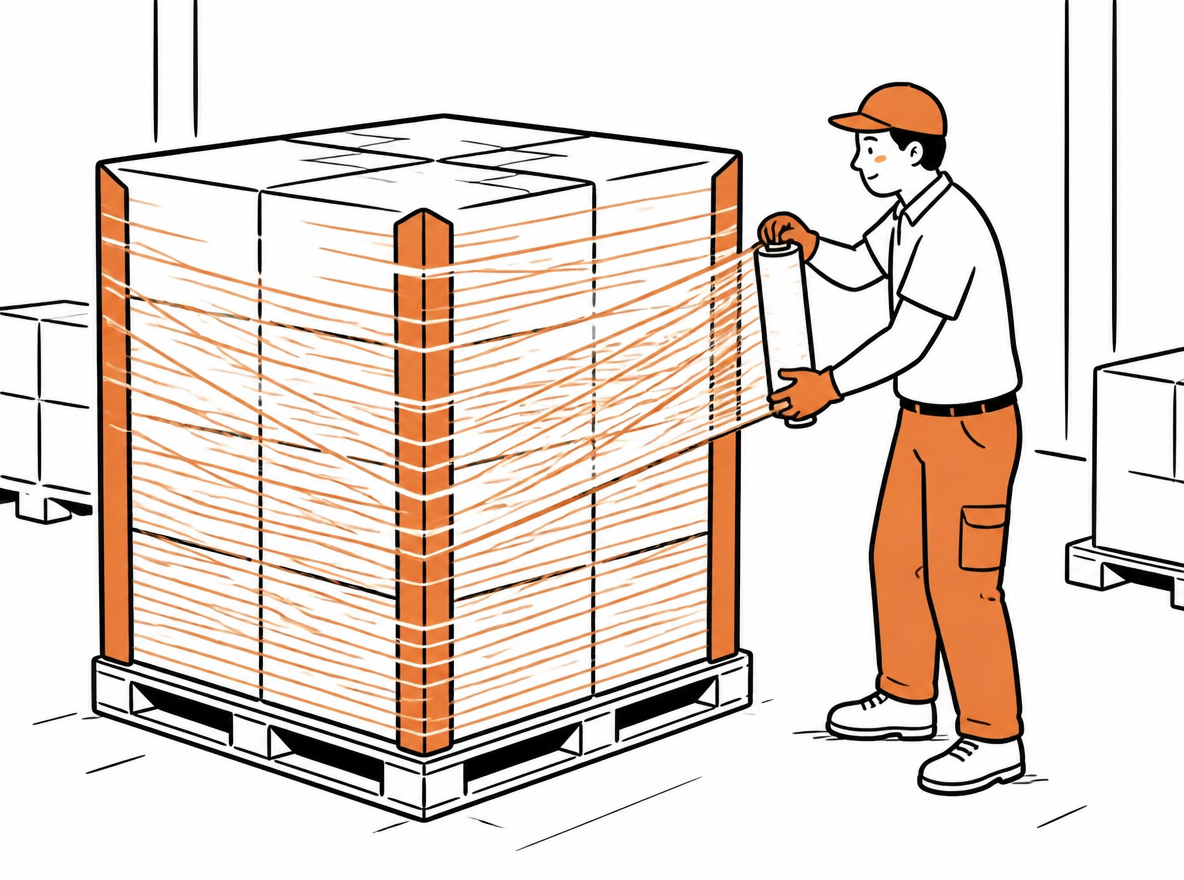
The handoff from parcel to LTL changes how you package, how you declare, and how you schedule. On the dock, the pallet is the unit of work. Start with a sound pallet: the standard GMA 48 × 40 in wood pallet for most domestic freight. Stack in columns where possible, each carton directly on top of the one below, which distributes weight cleanly, rather than interlocking bricks, and keep the load level and within the pallet footprint. Do not overhang the edges: overhang invites crush damage and can trigger re-palletizing charges at the terminal.

Secure the load properly. Stretch wrap the pallet from bottom to top, use corner protectors on vertical edges to keep the wrap from tearing and to shield cartons, and consider banding or slip sheets for loads that shift. Mind the pallet's weight capacity, typically about 2,200 lb for a standard GMA pallet[6], and the height limit, usually 48 to 60 in for LTL before a shipment is reclassified as tall freight with penalties. A neat, stable, well-wrapped pallet is also the fastest way to avoid damage claims, because it is the image the carrier's network sees.

Worker stretch-wraps a pallet with corner protectors in a warehouse.
The standard palletizing move: column stacking, corner protectors, full stretch wrap

Classification is where money leaks. NMFC class runs from 50 (dense, easy to handle) to 500 (light, bulky), and it is driven by density: weight in pounds divided by volume in cubic feet[4]. A 300 lb pallet occupying 40 cubic feet has a density of 7.5 lb/ft³, which maps to class 125. Furniture commonly lands in class 100 to 175, fitness equipment 85 to 150, auto parts anywhere from 70 to 200 depending on packaging. If you declare the wrong class, the carrier re-classes at the terminal and bills a re-classification fee, often $50 to $150, plus the corrected, higher class rate. Get the density right before you quote, and know your NMFC item numbers.

The bill of lading is your contract, so fill it completely: commodity description, NMFC class and item, actual weight (carriers weigh, and an under-declared pallet gets re-weighed and re-billed), piece count, and the class. Then handle the delivery details up front: is the receiver residential or commercial, does the site have a loading dock, do you need a liftgate (usually $60 to $120 extra), inside delivery, or an appointment window? LTL delivers by appointment, so the receiver must be ready to accept a window, often 2 to 4 hours, and a no-show means a re-delivery charge plus possible storage.

How to Prepare a Parcel-to-LTL Handoff

Carrier choice starts with the network. National carriers such as FedEx Freight, UPS Freight, XPO, and Estes offer broad coverage and strong linehaul, which matters when your customers are spread across all 50 states. Regional carriers often undercut them on price and transit within their home territory, but their coverage ends at the network edge and they hand off to a partner carrier for the rest, which adds handling, transit time, and claim risk. For a brand whose volume clusters in one or two regions, a strong regional can be the better deal; for coast-to-coast furniture, national coverage usually wins. For when regional carriers genuinely save money, see our guide to when regional carriers save money.

The base rate is a small part of the story. LTL quotes come with a long tail of accessorials: fuel surcharge (a percentage that tracks the national diesel index, typically 20 to 40 percent of linehaul[8]), residential surcharge, liftgate, inside delivery, detention (free time is usually 30 to 60 minutes at pickup and delivery, then $75 to $150 per hour), re-delivery after a failed appointment, and limited-access fees for construction sites, farms, and other non-standard locations[9]. When you compare carriers, compare the total landed cost including every accessorial that will actually apply, not the headline rate.

Liability is another place the cheap quote hides costs. Standard LTL liability is low, commonly pennies per pound under the released-value tariff, so a $2,000 treadmill declared at released value recovers almost nothing if it is destroyed. Declared value or cargo coverage costs extra, and claims have strict timelines: visible damage must be noted on the BOL or delivery receipt at delivery, concealed damage is typically reported within 5 days (though the legal deadline under Carmack is 9 months[5]), and the claim needs photos, the original BOL, and the invoice. Decide before shipping whether the extra coverage is worth it; for high-value bulky goods it usually is.

The evaluation method that works: take one real shipment, ideally your most representative bulky SKU to a typical destination, and run it through two or three carriers with identical specs: weight, class, dims, residential or commercial, liftgate or not. Compare total cost, transit time, appointment reliability, and claims reputation. Do the same for your top three destination zones. That small matrix will tell you more than any rate sheet.

Picking an LTL Carrier

For a 3PL, mode decisions are a product feature, not an afterthought. The smart play is to write the rules into the client SLA: a mode routing guide that says, for example, any single line over 150 lb or 108 in goes LTL automatically; orders under 50 lb stay parcel; between 50 and 150 lb, quote both or follow a dimension table. When the rules live in the contract and the WMS, nobody re-litigates every shipment, and the client gets consistent cost and service. For the bigger framework around fulfillment operating models, see our guide to the fulfillment break-even framework.

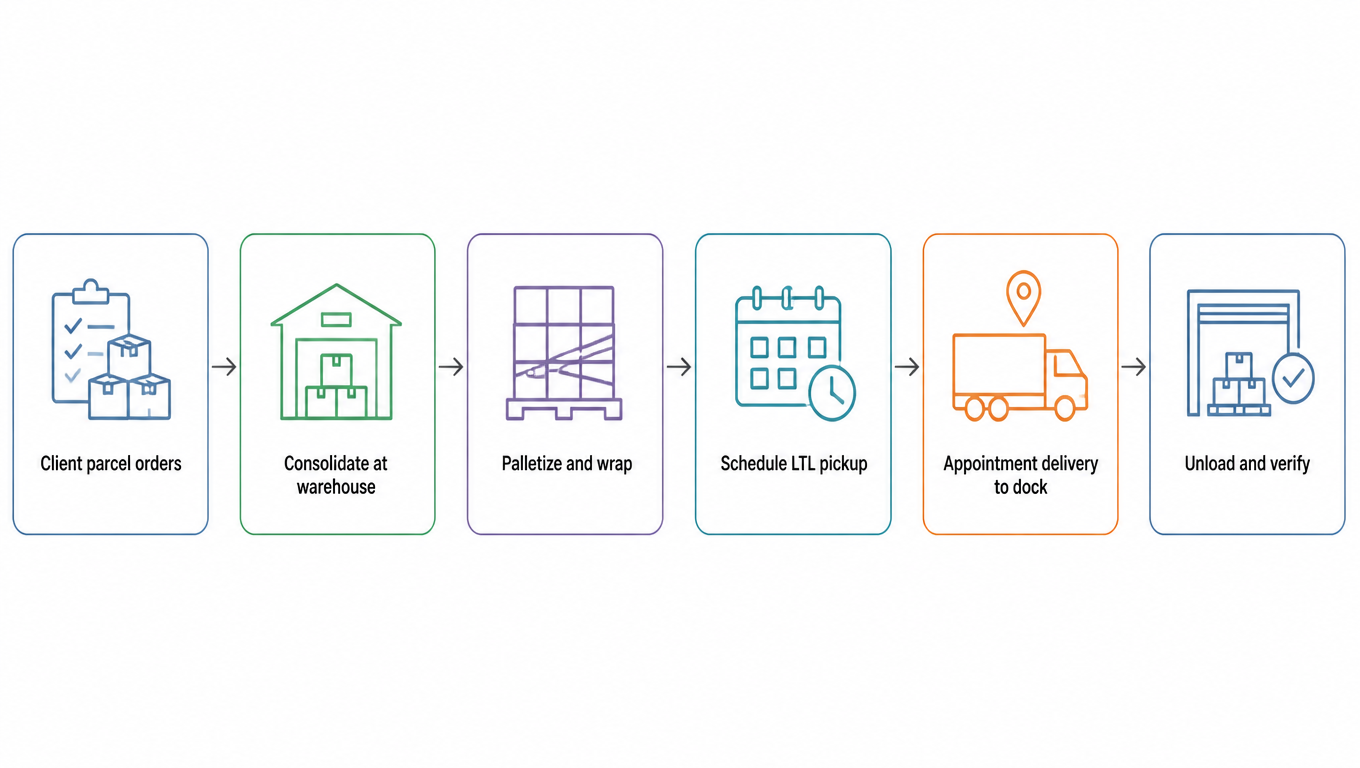
Consolidation is the 3PL's biggest lever. Ten parcel orders from three clients, all headed to the same metro, become one pallet, one LTL pickup, one delivery, and one bill if the timing and warehouse layout cooperate. The diagram below shows the flow.

Flowchart: client parcel orders, consolidate at warehouse, palletize and wrap, schedule LTL pickup, appointment delivery to dock, unload and verify
Consolidating parcel orders into one LTL shipment

For bulky-goods clients, design onboarding LTL-ready from day one. That means pallet racking or floor storage sized for the SKUs, packaging specs that survive dock handling (corner protection, wrap standards, pallet specs), and carrier contracts negotiated before the first order ships, not after the fifth pallet is damaged. It also means telling the client the truth about triggers: their 40 lb lamp should stay on parcel, their 300 lb assembled desk should never touch it.

Advise, don't guess. The 3PL that automatically LTLs everything over 100 lb is leaving money on the table for dense, compact freight that parcel moves cheaper; the one that keeps everything on parcel is eating claims and surcharges. Your value is knowing the crossover for each SKU, updating it as rates change, and showing the client the math, so they trust the mode decision instead of second-guessing it. For whether rate comparison itself should be automated and when it pays for itself, see our guide to rate shopping automation break-even.

The 3PL's Role in Mode Decisions

Before you flip a SKU or a client from parcel to LTL, run this checklist. If you answer no to several of the cost and fit questions, quote both modes before committing. If you hit any hard trigger, LTL is not a choice; it is the requirement.

  • Weight: is single piece weight over 150 lb? Hard trigger.
  • Dimensions: longest side over 108 in, or length plus girth over 165 in? Hard trigger.
  • Density and class: what NMFC class does the freight actually qualify for? Verify with a density calculation, not a guess.
  • Palletization: does the item ship on a pallet by nature, or could it? Palletized freight belongs on LTL.
  • Volume: how many of these ship per week or month? One-off moves and steady volume change the carrier math.
  • Destination: residential or commercial? Dock or doorstep? Liftgate needed?
  • Accessorials: which surcharges apply (fuel, residential, liftgate, detention, limited access)? Compare total landed cost, not base rate.
  • Carrier fit: national vs regional, coverage matches your destinations, claims reputation is solid.
  • Damage history: climbing claims on this SKU in parcel is a switch signal.
  • Cost share: is shipping eating more than roughly 10 to 15 percent of order value? That is the threshold where the mode, or the product economics, has to change.

Ready to run both modes on your own numbers?

EasyShippingX is a channel-neutral shipping layer: one consistent way to compare US domestic carrier options and execute through a portal, a spreadsheet, or an API. When a SKU enters the 100 to 200 lb crossover band, run parcel and LTL quotes side by side with identical specs (weight, dims, zone, residential or commercial) and let the crossing point decide. See pricing or book a demo.

FAQ

Three hard triggers decide it: single piece weight over 150 lb (UPS and FedEx Ground will not take it), longest side over 108 in, length plus girth over 165 in, and anything that must ship on a pallet. For the soft trigger, look at the crossover: for residential deliveries the parcel and LTL cost curves typically cross between 100 and 200 lb, depending on dimensions, NMFC class, and accessorials; above 200 lb, or once palletized, LTL wins in almost every scenario. Run both quotes with your own weight, dims, and zone.
No. LTL has a minimum charge (typically $100 to $150 including fuel), so a 40 lb pallet is an expensive mistake, and accessorials (fuel, residential, liftgate, detention, re-delivery, limited access) often eat the headline-rate advantage. LTL wins when freight is palletized, sits above roughly 150 lb, and has reasonable density, and when you compare total landed cost rather than the base rate. Small, light, compact, dense freight is usually cheaper on parcel.
Start with density: weight in pounds divided by volume in cubic feet. NMFC class runs from 50 (dense, easy to handle) to 500 (light, bulky); higher density means a lower class and a cheaper rate. As a reference: furniture commonly lands in class 100 to 175, fitness equipment 85 to 150, auto parts 70 to 200. Declaring the wrong class triggers a re-classification at the terminal plus a $50 to $150 fee, so run the density calculation before you quote.
When multiple orders head to the same or nearby destinations and sit in the warehouse at the same time. Ten parcel orders to the same metro become one pallet, one LTL pickup, one delivery, one bill. A single bulky SKU at a steady five to ten pallets a month is also the point to negotiate an LTL contract. Decide on volume and destination, not on any single order.
EasyShippingX is a channel-neutral shipping layer: one consistent way to compare US domestic carrier options and execute through a portal, a spreadsheet, or an API. When a SKU enters the 100 to 200 lb crossover band, run parcel and LTL quotes side by side with identical specs so the data decides the mode instead of a guess; once you switch, the new mode rules drop straight into your routing logic and every shipment follows them.