
USPS Guide

USPS January 2027 Rate Change Preview: The DRA Waiver and the 8% Surcharge Expiry, a Dual Timeline 3PLs Need to Watch

For most cross-border logistics operators, USPS rate changes are an annual, summer event. January 2027 is different: two entirely independent rate lines converge in the same month. One decides your invoice, the other decides your customers' direct-mail costs. This article breaks down both lines and gives you an actionable preparation checklist.

Worker pushes a cart of USPS parcels toward a truck in an overseas warehouse shipping area.
January 2027 is not an ordinary annual rate change; two rate lines land at once

1. Why January 2027 is a "dual event"

The first line is market-dominant rates, covering letters, periodicals, and marketing mail. It runs through the DRA waiver motion: in July 2026 USPS asked the Postal Regulatory Commission (PRC) to move the annual adjustment window for these rates from July back to January[2]. The second line is competitive parcel rates, covering Ground Advantage, Priority Mail, Priority Mail Express, and Parcel Select. It faces a different fact: the 8% temporary surcharge that took effect in April 2026 expires at midnight on January 17, 2027[1].

Both lines land in the same month, but they are entirely different in nature. The market-dominant line is a fight over rules and windows: it sets the anchor for future rate cycles. The parcel line is a fight over what happens to the number 8%: it writes directly into your per-parcel cost. For warehouses and 3PLs, one line affects the last-mile price you quote to customers, the other affects your customers' direct-mail budget, and both squeeze into the same January.

What this means for operators: two rate systems, two timelines, one landing month. When you open your label system on the morning of January 18, you may be facing two new price sheets at once. The goal of this article is to let you know what is coming before that morning.
2. Line one: the DRA waiver motion and market-dominant rates

First, the background. Since the Postal Service Reform Act (PSRA), market-dominant rates are no longer adjusted annually against a simple CPI cap. Instead, a density-based formula was introduced: the Density Rate Adjustment (DRA), which stacks an adjustment on top of inflation, driven by how much mail volume per delivery point has declined. The mechanism is designed to keep USPS financially sustainable when volume falls but fixed costs do not, but its calculation depends on a full fiscal year of data, so the default adjustment window sits in July.

On July 16, 2026, USPS filed a waiver motion with the PRC (Docket 140418[3], Federal Register Notice 2026-15049[2]), asking for a partial waiver of the DRA rules: instead of a full fiscal year of data, it wants to calculate the density rate authority using a blend of actual FY2026 results and forecasts, the so-called YTD Methodology. The direct purpose is to let market-dominant rates adjust in January 2027 instead of waiting until July 2027.

But the motion is more ambitious than that. In it, USPS explicitly evaluates moving the annual rate cycle from July back to the traditional January on a permanent basis (which requires Governors' approval)[5][9]. For direct-mail customers and marketing mailers, a January adjustment means budget season and rate season align, and it lets USPS pass inflation and volume decline into prices sooner.

What happens next: after the PRC accepts the motion, a comment period opens, industry parties (including MTAC, which represents large direct-mail customers) file their views[7], and a ruling is expected in fall or winter 2026. If approved, the new market-dominant rates take effect in January 2027. Historically, market-dominant adjustments have mostly been single-digit percentages, but the 2027 magnitude depends on how FY2026 actuals come in.

3. Line two: the 8% parcel surcharge expires on 2027-01-17

This line sits closer to your invoice. On March 25, 2026, USPS announced a time-limited price increase averaging about 8% across four parcel services: Priority Mail Express, Priority Mail, Ground Advantage, and Parcel Select, effective April 26, 2026. The increase is explicitly labeled time-limited: it expires at midnight on January 17, 2027[1].

What happens when it expires? Three outcomes are possible, and USPS has not said which one it will pick. First, the 8% folds into the base price and becomes permanent, anchoring the price level in effect since April. Second, the 8% is replaced by a new January increase: USPS rolls out a new rate structure around expiry, the old surcharge exits and new prices take the stage. Third, the 8% disappears cleanly and parcel rates return to their pre-April-2026 levels.

History does not favor a clean disappearance. The 2013 exigent increase was originally approved by the PRC as a temporary measure[6], then folded into base rates in the 2018 rate case (R2018-1)[8]; most of the COVID-era temporary increases never fully went away either. Once a temporary rate becomes part of the revenue baseline, it sticks: ongoing financial pressure and declining volume give USPS no incentive to cut prices[7].

Why this line matters most to 3PLs: Ground Advantage is the workhorse last-mile product for warehouses, so the fate of the 8% directly sets per-parcel cost, which in turn sets what you quote customers, your margin, and how you compare against UPS Ground and FedEx Ground. This is the single most important number to watch in January 2027.

4. The full January 2027 timeline

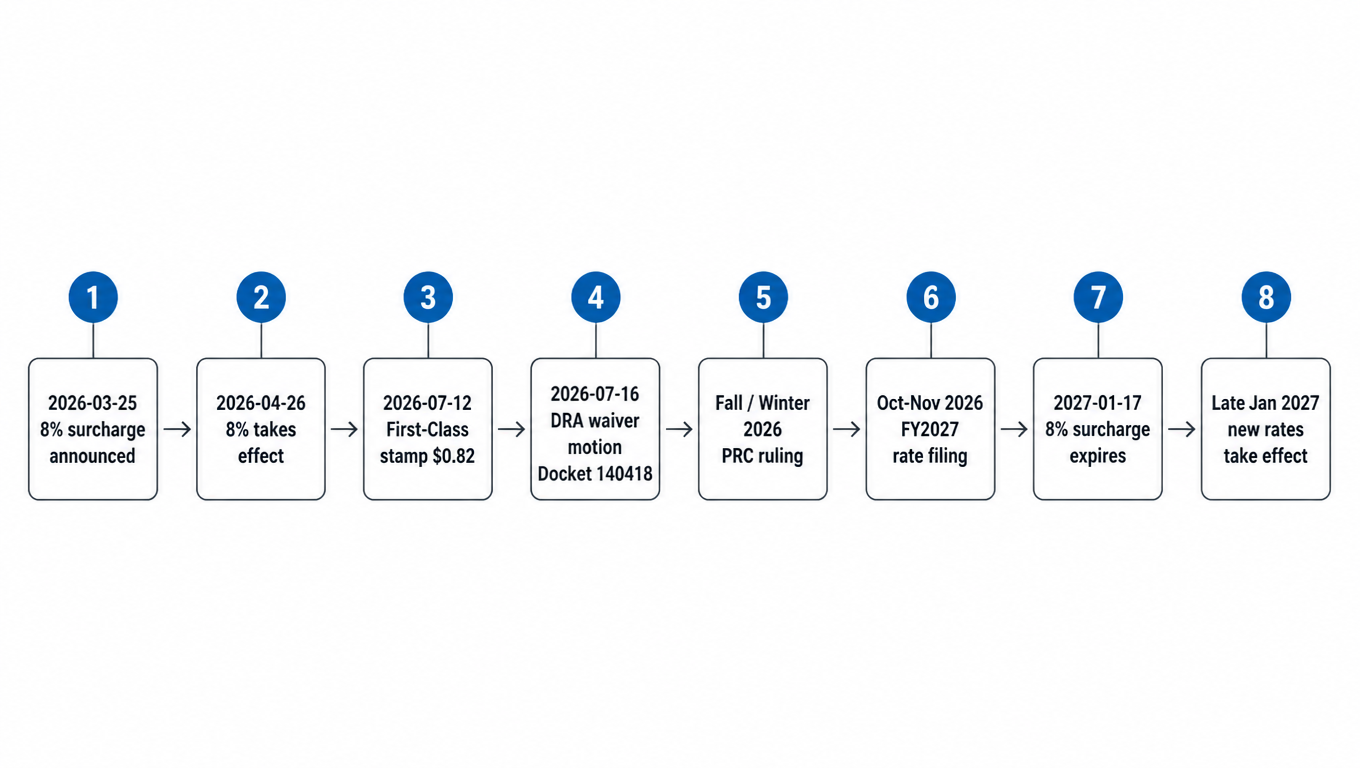
String the two lines' dates together, from March 2026 to the end of January 2027, and you get eight key milestones:

USPS January 2027 rate timeline: 2026-03-25 8% surcharge announced, 04-26 takes effect, 07-12 stamp rises to $0.82, 07-16 DRA waiver motion filed, fall/winter PRC ruling, Oct-Nov FY2027 rate filing, 2027-01-17 8% expires, late January new rates take effect
Two rate lines, eight milestones, all converging on January 2027

Watch how the two dates dovetail. The 8% surcharge expires at midnight on January 17, while new market-dominant rates (if the motion is approved) are expected in late January, leaving a window of roughly two weeks in between. On the parcel side, if USPS intends to replace the 8% with a new increase, it needs to lay out that plan in the October-to-November rate filing[9] so old and new prices transition smoothly in mid-January. Otherwise January 18 creates a price cliff: parcel rates theoretically drop, then jump when the new rates take effect. USPS has not published a transition plan yet, which is exactly what to watch after October.

5. Cost impact scenarios for operators

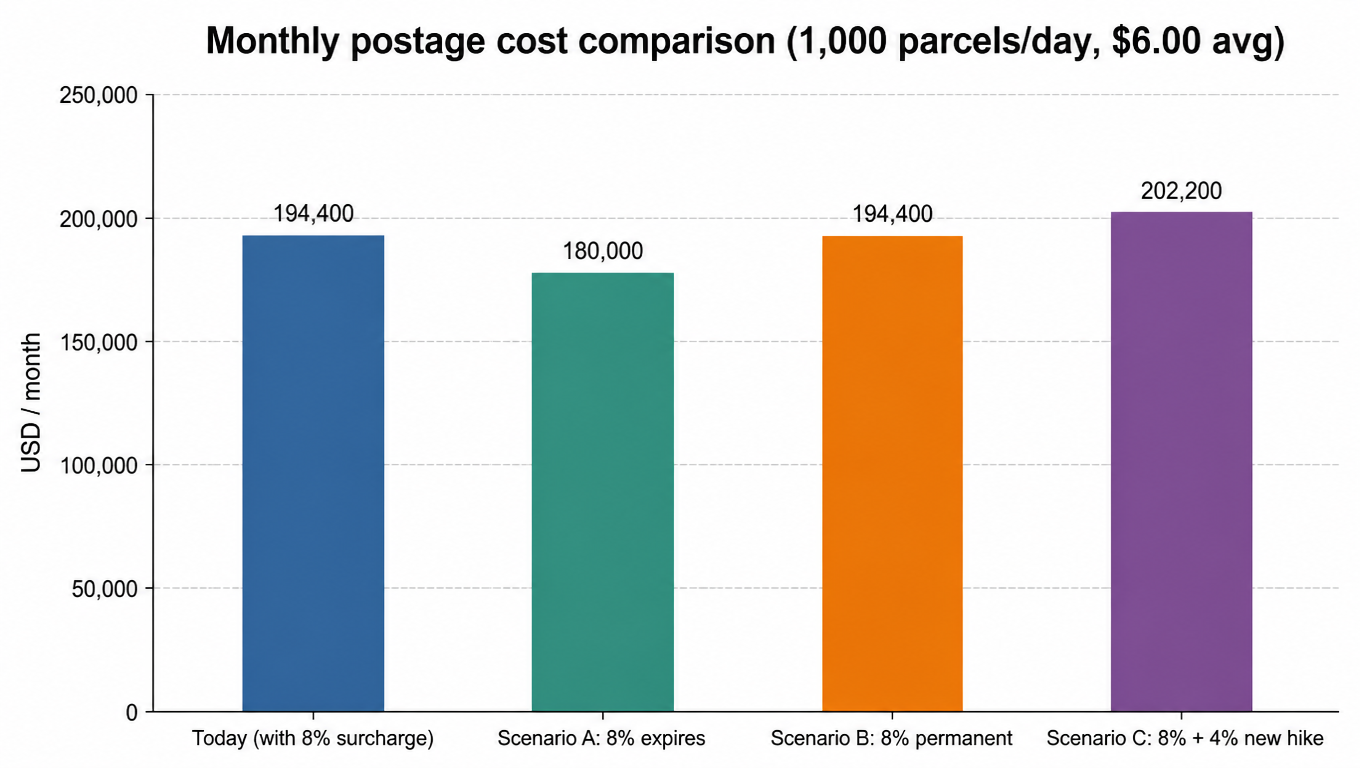
Start with simple math. Take a warehouse doing 1,000 parcels a day at a $6.00 average base postage rate: the 8% surcharge works out to about $0.48 per parcel. Put the three scenarios on a 30-day monthly ledger:

  • Scenario A (8% expires, base prices unchanged): per-parcel cost returns to $6.00, monthly postage about $180,000, saving roughly $14,400 versus today.
  • Scenario B (8% folds into base, no new increase): per-parcel stays at $6.48, monthly about $194,400, flat versus today.
  • Scenario C (8% permanent plus a new ~4% increase in January): per-parcel about $6.74, monthly about $202,200, roughly $7,800 more than today.
Monthly postage cost comparison: today with the 8% surcharge $194,400; Scenario A $180,000; Scenario B $194,400; Scenario C $202,200
Monthly cost under the three scenarios; the fate of the 8% decides the magnitude

Another angle makes it plainer: on common last-mile prices of $5 to $10 per parcel, 8% is $0.40 to $0.80 per parcel. For a 1,000-parcel-a-day warehouse, that is $400 to $800 a day, or roughly $8,800 to $17,600 a month (at 22 shipping days). If the 8% becomes permanent and a January increase stacks on top, that number climbs further. Multiply these figures by your own real volume and average per-parcel price, and you get the magnitude to lock into your 2027 budget now.

6. Operator prep checklist

Two rate sheets and a stack of shipping labels on a logistics desk.
The two price sheets around January 17 are worth preparing now

First, check your contracts. What do your customer contracts say about rate pass-through? Does your quote include the 8% floating component? Is there a clause for automatic USPS rate pass-through? If not, the extra $0.40 to $0.80 per parcel after January comes straight out of your margin.

Second, prepare two price sheets. Have one version for before January 17 and one for after, and pull UPS Ground and FedEx Ground into the comparison; fuel policies in early 2027 will be a key variable in that comparison too.

Third, watch two documents. Docket 140418[3] (searchable on the PRC website) decides whether the market-dominant line lands in January; the 2027 rate filing USPS submits in October to November is the first official number for the 2027 increase[9]. Subscribing to PRC docket updates beats refreshing the news.

Fourth, let your system change the prices for you. Put 2027-01-17 and "late January" on the calendar, update rate tables through your label system's automatic sync, and never edit prices by hand during peak hours; that is the highest-error operation there is.

7. Conclusion + key date quick reference

January 2027 is not an ordinary annual rate change; it is a dual event where two rate lines land at once. The market-dominant line decides whether the anchor of the rate cycle moves from July back to January; the parcel line decides whether the 8% surcharge becomes permanent, gets replaced, or disappears. For warehouses and 3PLs, the latter writes directly into per-parcel cost and the former affects your customers' direct-mail budget. Both are worth preparing for before October.

Date Event What it means for operators
2026-03-258% temporary surcharge announcedAlready happened
2026-04-268% takes effectAlready happened; your per-parcel cost already includes it
2026-07-12First-Class stamp rises to $0.82[4]Already happened; direct-mail costs went up first
2026-07-16DRA waiver motion filed (Docket 140418)Already happened; under PRC review
Fall/Winter 2026PRC ruling on the waiverDecides whether market-dominant rates can land in January
Oct-Nov 2026FY2027 rate filing (by convention)First official number for the 2027 increase
2027-01-178% surcharge expiresParcel rate structure may reset; have both price sheets ready
Late January 2027New market-dominant rates take effect (if approved)Dovetails with the 8% expiry; both lines land

One sentence to take away: between now and January, every signal is worth watching.

FAQ

Most likely not. Historical precedent (the 2013 exigent increase and most COVID-era temporary increases) ended up folded into base rates. Three outcomes are possible: permanent, replaced by a new increase, or removed. USPS has not said which. Budgeting on the assumption that it becomes permanent is the safer preparation.
The official numbers will only come with the 2027 rate filing in October to November 2026. The market-dominant line depends on the PRC's ruling on the Docket 140418 waiver; the parcel line depends on what happens to the 8%. What is certain today is the timeline, not the magnitude, so plan budget scenarios in the +4% to +8% range.
Four things: review the rate pass-through clauses in customer contracts; prepare two price sheets around January 17 and compare across carriers; subscribe to PRC Docket 140418 and watch the October-November rate filing; put 2027-01-17 on the calendar and let your label system sync rate updates automatically.

Do not want to scramble to change prices on the morning of January 18?

EasyShippingX bakes carrier rate table updates, cross-carrier comparison, and quote pass-through into your shipping flow, so the 2027 rate changes automatically show up on every label.