Carrier Selection · USPS

USPS Ground Advantage vs. Priority Mail vs. Flat Rate: A Parcel-Profile Decision Guide

You are a DTC brand, a Shopify seller, an Amazon FBM seller, or the person who runs fulfillment for one. Every morning your warehouse faces the same quiet decision: which USPS service should this parcel go out on? Ground Advantage, Priority Mail, or a Flat Rate box. The answer looks simple, until you notice that the cheapest option for one order is the most expensive for the next one. This guide gives you a repeatable way to decide: build a parcel profile from your own data, compare all-in cost per service, and write routing rules that send each parcel to the right product instead of forcing one service on everything.

Parcels bearing different USPS service labels on a warehouse bench.
Same warehouse, different parcels, different services

1. Why "Pick One Service" Is the Wrong Frame

Most warehouses solve the USPS question with a default: "we ship everything Ground Advantage," or "heavy stuff goes Flat Rate." A default is comfortable because it removes thinking, but it quietly leaks money on every parcel that does not fit the assumption. The other extreme, picking the service by hand on every order, costs labor and depends on whoever is at the scale that day. Both approaches treat the choice as a one-time decision when it is really a per-parcel one.

The three services are not three tiers of the same product. They are three different cost curves, and the curves cross depending on weight, dimensions, zone, packaging, and the promise you made to the customer. A light 8 oz parcel is cheapest on Ground Advantage by a wide margin. A 15 lb dense parcel to a far zone is cheapest in a Flat Rate box, if it fits. A big lightweight box can trigger dimensional weight and suddenly cost as much as a parcel three times its actual weight. The winning service changes with the parcel, which is why any rule that ignores the parcel profile is wrong by construction.

The goal is therefore not to crown a permanent winner. It is to route each parcel to the right service. The framework this guide builds is: Parcel Profile → Service Eligibility → All-in Cost → Delivery Risk → Routing Rule. Each step removes options, prices the survivors, and turns the result into a rule your warehouse can execute without thinking. The rest of this guide walks through the framework with real 2026 rates.
2. The Three Services at a Glance

USPS Ground Advantage is the everyday parcel product: 2 to 5 business days, a 70 lb limit, tracking, and up to $100 of included insurance for eligible parcels. Effective July 12, 2026, published commercial prices no longer differ across the 4, 8, 12, and 15.999 oz points, and the DIM divisor changed to 139. Check the official USPS Ground Advantage guidance and current standards before buying a label.

Priority Mail currently carries an official expected delivery time of 2 to 3 days, a 70 lb limit, tracking, and up to $100 of included insurance for most eligible shipments. Whether the premium is worthwhile depends on origin, destination, packaging, and the checkout promise; use the current service standard and live quote on the official USPS Priority Mail page.

Priority Mail Flat Rate uses the Priority Mail service standard but prices by the selected USPS packaging rather than by zone, up to 70 lb. Prices change, so the worked examples below demonstrate the decision method only; production routing should read USPS Notice 123 or a live rate response.

ServiceDeliveryMax weightDIM pricingTracking & insurancePrice driver
Ground Advantage2-5 business days (USPS)70 lbYes, per current standardsTracking and up to $100 included insurance (conditions)Weight + zone
Priority Mail2-3 days (USPS)70 lbYes, per current standardsTracking and up to $100 included insurance (conditions)Weight + zone
Priority Mail Flat Rate2-3 days (USPS)70 lbPackaging-basedTracking and up to $100 included insurance (conditions)Box type only

A quick win map: light small parcels belong on Ground Advantage. Heavy dense parcels to far zones belong in a Flat Rate box if they fit. Everything in the middle depends on the numbers, and the numbers are the next section.

3. The Seven Variables That Decide Cost

1. Actual vs. billed weight. USPS rounds up to the next weight tier, so a 4.2 oz parcel pays the 8 oz price and anything over 15.999 oz pays the 1 lb rate. Dimensional weight can override the scale entirely for large boxes.

2. Parcel dimensions and packaging. Your own box competes with Flat Rate packaging. A box that triggers DIM weight is a box that may have been cheaper in a Flat Rate alternative, if one fits.

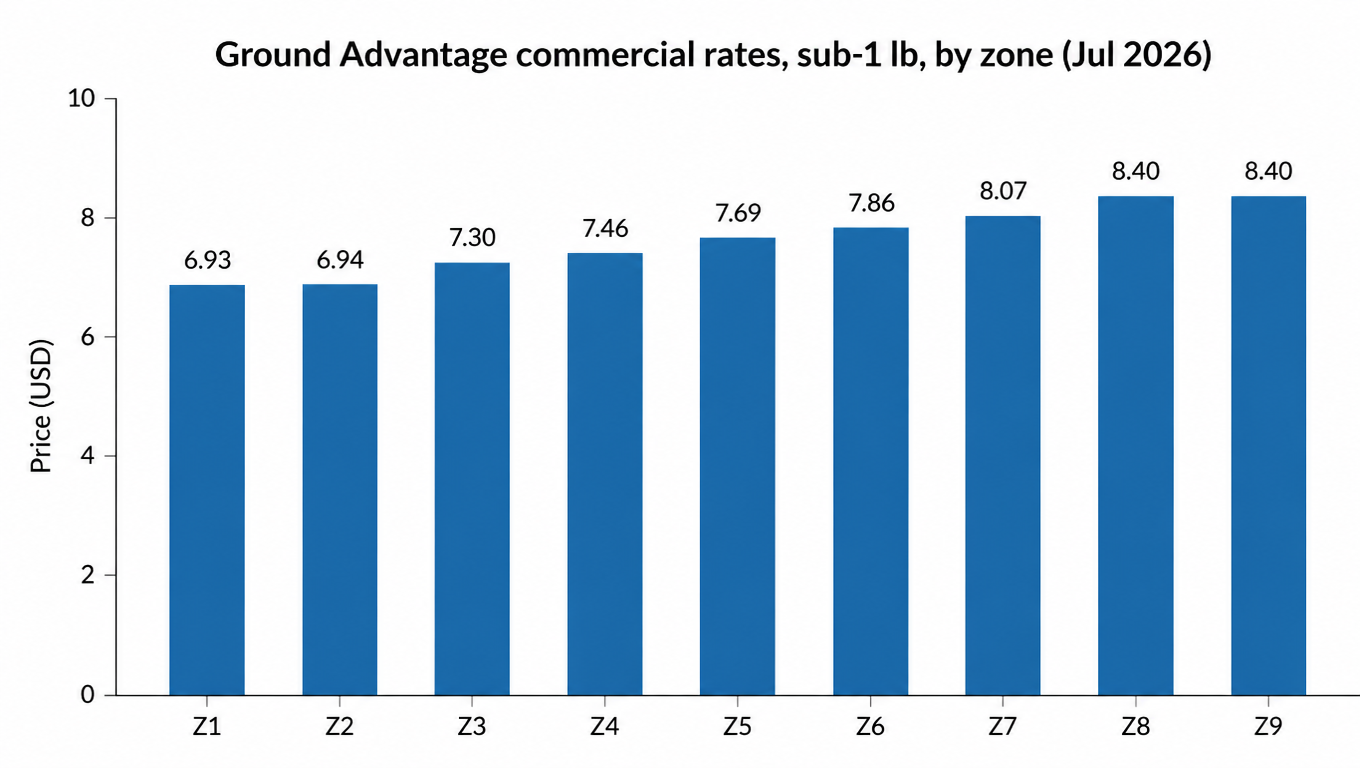
3. Origin and destination zone. The nine domestic zones (1-9) are driven by distance. Ground Advantage commercial pricing for a sub-pound parcel runs from $6.93 in Zone 1 to $8.40 in Zone 8 or 9. Flat Rate ignores zones, which is exactly why it wins on long-haul heavy parcels.

4. Service reachability. Each service has size and weight limits. Oversize or over-70-lb parcels simply cannot go Ground Advantage or Priority Mail, and Flat Rate only works if the item fits the box. Eligibility comes before cost, not after.

5. Delivery promise vs. customer promise. Your checkout page sets an expectation. If you promise 2-day delivery, Ground Advantage's 5-day worst case is a refund and a support ticket, which is a cost the rate sheet never shows.

6. Order value and margin. When order value exceeds the included coverage, verify added coverage and signature options with USPS, then include both the extra fees and the risk they hedge in the comparison.

7. Address and exception risk. Bad addresses, reroutes, and undeliverables cost real money per incident. Segments with chronic address problems may be worth routing differently, or at least worth a data fix before a service change.

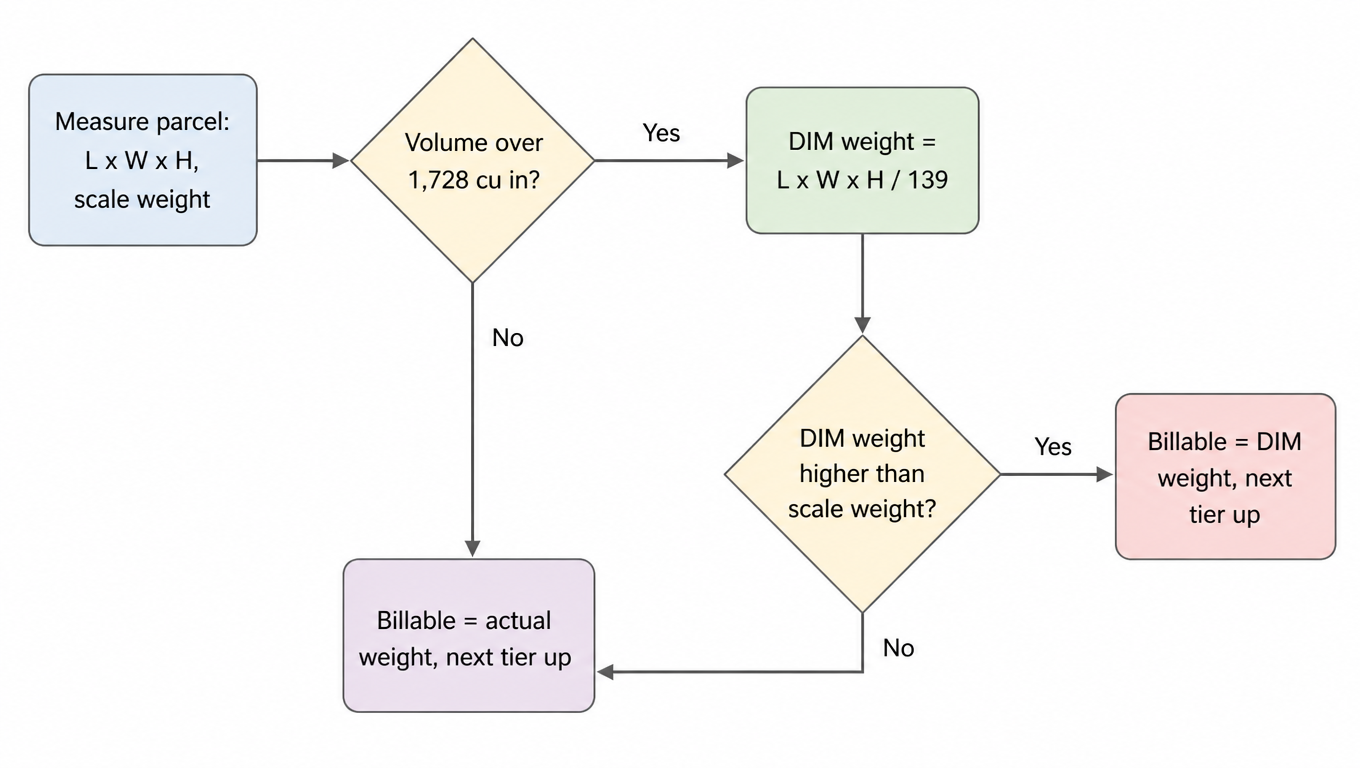
Flowchart: measure parcel and weigh it, volume over 1728 cu in? no bills actual weight next tier, yes computes DIM weight = L x W x H / 139, then checks DIM vs scale weight, bills the greater
Billable weight: volume first, then the greater of DIM and scale weight

4. Building a Parcel Profile from Your Own Data

For planning, use the most recent 30 to 90 days as a recommended starting window and export shipment data from your shipping software or carrier API. Capture service, actual weight, dimensions, origin and destination ZIPs, zone, postage paid, and exception events. This window is an internal analysis starting point, not an industry benchmark; expand it for seasonal businesses.

Segment the export by weight band, dimension profile, zone, and promised delivery speed. Useful internal analysis groups can include light small parcels, mid-weight standard boxes, heavy dense items, DIM-heavy big boxes, far-zone orders, and orders whose value exceeds included coverage. Record monthly volume for each segment, because volume determines whether a routing rule is worth building; set the exact boundaries from your own data and current USPS standards.

Illustrative example: a store averaging 1.4 lb per parcel could still have 30 percent of volume in 12 lb, far-zone items that fit Flat Rate packaging. These are assumptions used to explain segmentation, not an industry distribution; replace them with your own data.

5. All-in Cost: Worked Comparisons (2026 Rates)

The comparisons below are illustrative examples based on the July 12, 2026 rules snapshot, not standing quotes. The retail-to-commercial difference varies by product, zone, account, and effective date; replace the sample numbers with USPS Notice 123 or a live rate response before putting a rule into production.

Example 1: Light parcel, 8 oz, small box, Zone 5. Ground Advantage commercial is $7.69, the flat sub-pound price for Zone 5. Priority Mail starts at 1 lb and costs $9.04 or more. A Flat Rate envelope costs $11.12 at commercial pricing and a Small Flat Rate Box $13.65, before you even fill them. Ground Advantage wins, and it wins by enough that routing light parcels anywhere else is simply leaving money on the table. The July 2026 change removed ounce tiers, so an 8 oz parcel and a 15.5 oz parcel now cost the same to Zone 5; there is no longer a reason to compare ounce weights when segmenting.

Bar chart: Ground Advantage commercial rates under 1 lb by zone, from $6.93 in Z1 to $8.40 in Z8/Z9 (Jul 2026)
Sub-1 lb commercial rates climb with the zone, a spread of about $1.50

Example 2: DIM-heavy parcel, 2 lb actual weight in a 16 × 12 × 10 in box, Zone 8. Volume is 1,920 cubic inches, over the 1,728 threshold. DIM weight is 1,920 ÷ 139 ≈ 13.8 lb, billed at the 14 lb tier. The parcel therefore pays like a 14 lb package despite weighing 2 lb. Neither Flat Rate box fits a 16 × 12 × 10 box, so Flat Rate is off the table; the choice is Ground Advantage versus Priority Mail at the 14 lb Zone 8 rate, and Ground Advantage wins there too. The real lesson is upstream: a product that repeatedly ships in an oversized box is paying DIM tax on every order, and repackaging is a cost cut that beats any rate negotiation.

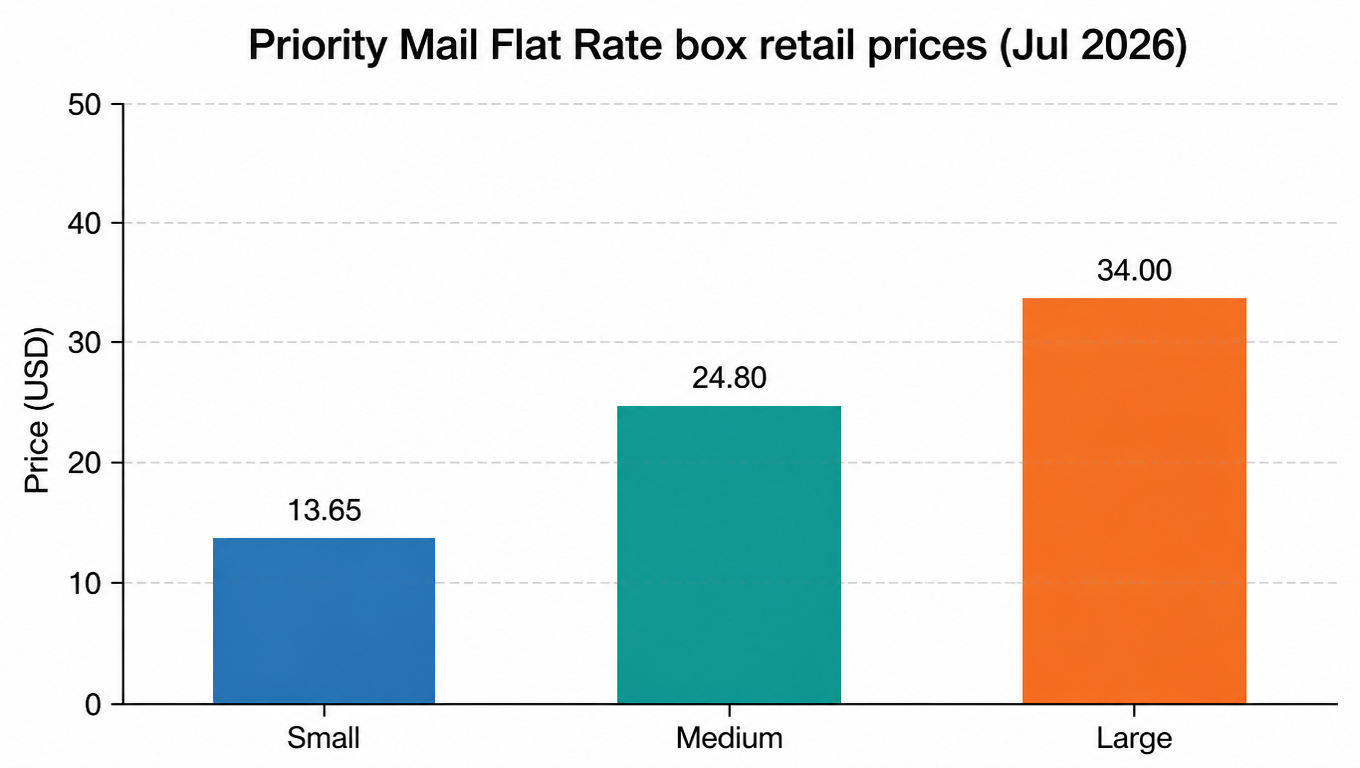
Example 3: Heavy dense parcel, 15 lb, Zone 8, fits in a Medium Flat Rate Box. Ground Advantage commercial at 15 lb to Zone 8 lands in the high-$20s to low-$30s range on the current rate curve; Priority Mail prices above it at every weight. The Medium Flat Rate Box is $24.80 retail, less at commercial pricing, and it ignores the zone entirely. If the product fits, the Flat Rate box is the cheapest option by a clear margin, and it gets cheaper relative to the alternatives the farther the parcel travels. If the product only fits the Large box at $34.00, Flat Rate still beats Ground Advantage on the longest zones but loses on mid-distance ones, which is exactly the kind of boundary a routing table should capture.

Bar chart: Priority Mail Flat Rate box retail prices, Small $13.65, Medium $24.80, Large $34.00 (Jul 2026)
Flat Rate prices follow the box, not weight or zone

These illustrative examples do not name a permanent winner; they establish a review order: check packaging and eligibility, compare current rates, then ask whether the customer promise needs Priority Mail's current 2-to-3-day expected delivery. Live rates must decide the boundary cases.

6. Delivery Risk and Cost per Successful Delivery

Rate sheets compare price, but your P&L compares delivered outcomes. USPS publishes an expected delivery time of 2 to 5 business days for Ground Advantage and 2 to 3 days for Priority Mail. Do not assume either product is more consistent on every lane; compare actual delivery and exception data by ZIP pair and customer promise before deciding whether a premium is worthwhile.

Cost per successful delivery puts these factors into one metric: total spend for an internal analysis segment, including postage, packaging, added coverage, refunds, and support labor, divided by parcels that arrived on time, in good condition, and without an exception. As an illustrative principle, a cheaper label can still produce the higher total cost when your actual exception costs erase the price difference. Calculate this by segment with your own rate and exception data instead of applying a universal price gap or exception rate.

Manual per-order selection hides a cost of its own: the labor of deciding, the inconsistency between shifts, and the errors when a new hire guesses wrong. A routing table removes the decision from the pick line entirely. The table does not have to be perfect on day one; it has to be explicit enough to audit, because an explicit wrong rule gets fixed, while an implicit habit never gets questioned.

7. Routing Rules: Turning Profiles into Decisions

Step 1: Eligibility filter. For each parcel segment, strike the services that cannot carry it: over 70 lb or over 130 inches goes nowhere on these products; oversized boxes eliminate Flat Rate; dimension-check every segment against the three Flat Rate box sizes.

Step 2: Cost comparison. Pull current commercial rates for each remaining service at the segment's typical weight and zone mix. Include insurance beyond included coverage, signature fees, and packaging cost deltas. Compare all-in cost, then overlay the delivery promise: which segments actually need Priority Mail's current 2-to-3-day expected delivery?

Step 3: Draft routing rules. Write one rule per segment as a lookup table. A rule names the trigger (weight band, dimension profile, zone range, order value) and the service to use.

Parcel segmentTriggerRoute to
Light small parcelUnder 1 lb, fits any box, any zoneCompare live rates
Standard mid-weightStandard boxCompare live rates
Long-haul mid-weightFar zoneCompare live rates
Dense parcel fitting Flat Rate packagingEligible dimensions and weightCompare Flat Rate with weight-based pricing
DIM-heavy boxTriggers current DIM standardFix packaging, then rate-shop
Customer promise 2-3 daysCheckout promise requires itCheck Priority Mail service standard
High valueValue exceeds included coverageCompare added insurance and signature options

Step 4: Small pilot. Run the rules for two to four weeks on real volume before rolling out. Compare cost per successful delivery against the old behavior, and watch the exception rate, not just the average label price. Adjust the boundary rows (the ones where two services are within a dollar) based on what the pilot shows.

Step 5: Monthly review. Rates change, zones shift, and your product mix drifts. Re-run the segment cost comparison monthly, or whenever USPS announces a rate change (January and July are the usual cadence; 2026 saw changes effective January 18 and July 12). Track cost, transit time, and exception rate per segment on a single sheet, and revisit any rule whose boundary moved.

Implementation matters less than the table itself. A carrier API with rating calls, shipping software with saved presets, or even a printed lookup sheet at the pick line all execute the same rules. The framework survives tooling changes because the logic lives in the parcel profile, not in the label printer.

FAQ

Build a parcel profile by weight, dimensions, zone, and promised speed, then compare live all-in rates across eligible services. Priority Mail's current official expected delivery time is 2 to 3 days; whether Flat Rate wins depends on packaging, weight, and current pricing, so a fixed weight threshold cannot replace a live quote.
First confirm that the item meets the size and weight requirements for the selected USPS Flat Rate packaging, then compare the current Flat Rate price with live Ground Advantage and Priority Mail quotes for the same parcel. There is no universal weight or zone threshold; packaging, account pricing, and effective date can all change the result.
Parcels over 1,728 cubic inches (one cubic foot) bill on dimensional weight: length × width × height ÷ 139 (the divisor dropped from 166 to 139 on July 12, 2026), charged on the greater of actual and DIM weight, rounded up to the next pound. Big lightweight boxes trigger DIM; the fix is a smaller box.
There is no fixed percentage; the difference varies by service, packaging, weight, zone, account, and effective date. Compare retail and commercial prices for the same parcel in USPS Notice 123 or a live rate response.
Use a monthly review as an internal starting point, and review sooner when USPS publishes pricing or standards changes or when product mix or exception performance shifts materially. Use cost per successful delivery and live quotes to evaluate boundaries instead of relying only on average label price.