3PL Management

3PL Parcel Shipping Performance Scorecard: How to Tell an Occasional Failure from a Systemic Breakdown

The complaints about your 3PL arrive from every direction: late pickups, labels that fail to generate, invoices that never match the quote, tracking numbers that sit silent for days, customer tickets you end up answering yourself. Each one is small. Together they are a fog you cannot see through, and behind them sits an expensive question you have been avoiding: is this partner failing occasionally, or breaking down systemically? This article gives you a six-domain scorecard that answers it with evidence, and a workflow that turns the score into one of four decisions: stay, remediate, unbundle the shipping layer, or switch.

The scorecard evaluates the 3PL's whole fulfillment stack, not a single carrier, and its output is a defensible decision document, not another pile of KPIs. You get the six domain definitions and key metrics, a method for attributing every incident to one of four layers, warehouse, software, carrier, or billing, a remediation pilot design, and, if a switch is warranted, a complete exit plan. To see how the whole 3PL operating model fits together, start with the 3PL shipping operations model.

An ecommerce operator reviews a six-metric scorecard surrounded by parcel, truck, server and cost icons.
A scorecard turns "something feels off" into six scored domains, each with an owner and a next step

The Question This Scorecard Answers

You are probably reading this because the problem list is long, the responsible parties are many, and the cost of switching is high enough that you need certainty before you act. The list has late shipments, mispicks, mystery surcharges, support tickets that take a week to answer, and the occasional label that simply never prints. But nobody in your org or theirs can tell you what the pattern means. Occasional failures are normal operations noise; you fix them case by case and move on. Systemic breakdown means the partner, its software, or its carrier network is not built to carry your volume, and no number of escalating complaints will change that.

The traditional way to judge a 3PL, on communication, pricing and reliability, is too blunt to answer this. All three collapse different failure modes into one vague feeling. "Reliability is slipping" could mean the warehouse mispicks orders, or the label software dies at peak, or the carrier the 3PL selected is slow on your lanes, or the billing team charges you wrong weights every week. The fix for each is different and the owner is a different party. Until you separate the layers, you will negotiate with the wrong person about the wrong metric, and nothing improves no matter how many times you raise it.

This article does one job: it turns scattered complaints into a scored decision. Six domains, each mapped to a responsible party, each scored against contract SLAs and actual evidence, with the score feeding a simple workflow that ends in stay, remediate, unbundle, or switch. It deliberately does not re-explain what a 3PL is or how pick and pack works, our pick and pack guide covers that, and it does not score individual carriers, that is what a carrier performance scorecard is for. If you are still choosing a 3PL from scratch, run the parcel RFP process instead. This article is for the harder situation: you already have a partner and you need to know whether to fix it, split it, or leave it.
The Six-Domain Scorecard

The scorecard scores the 3PL's whole fulfillment stack, not a single carrier. Six domains cover every step a parcel takes, from the moment your order enters the WMS to the moment the invoice settles. Each domain asks one question. Cost & Billing: are we paying what we agreed? Warehouse Execution: did they pick, pack and ship correctly? Carrier Handoff: did the parcel reach the carrier cleanly and fast? Delivery & Tracking: did it arrive on time and could anyone watch it get there? Exception Management: how fast and how well do problems get resolved? Integration & Data: does the system talk to yours, and can you get your data back out if you need to leave?

Each domain carries four pieces of information: the evidence that proves it, the party that owns it, and the corrective action that fixes it. That is what turns a score from a complaint list into a working document. A low score with no corrective action means you have not found the real owner yet.

DomainEvidence sourceOwnerCorrective action
Cost & BillingInvoices vs quotes, rate cards, dispute logBilling / financeAudit, dispute, renegotiate terms
Warehouse ExecutionWMS scan logs, pick accuracy, on-time shipWarehouseRetrain, re-layout, reinspect process
Carrier HandoffFirst-scan timestamps, pickup manifests3PL ops + carrierChange pickup slot, carrier, or manifest flow
Delivery & TrackingCarrier scans, tracking event qualityCarrierChange carrier or service level
Exception ManagementTicket log, close times, escalations3PL opsNew SOP, named owner, SLA on resolution
Integration & DataAPI / webhook logs, label failures, export testsSoftwareFix, upgrade, or replace the shipping layer

One thing to keep straight: this is not a carrier scorecard. A carrier performance scorecard asks which carrier earns your volume; this one asks whether the 3PL as a whole, its people, its software and its carrier choices, is performing. A 3PL can have excellent warehouse scores and a broken billing process. It can run great carriers and terrible tracking integration. You need the full stack scored, because you are evaluating one partner, not one vendor inside it.

Key Variables That Predict Trouble

Each domain reduces to a small set of variables you can actually pull from reports, logs and invoices. These are the ones that predict trouble before the customer does.

Cost & Billing: settled cost, the number on the invoice after every surcharge, not the number on the quote. Quote vs final charge variance, how often and by how much the invoice differs from what was quoted, our billing checklist walks through the comparison. Billing dispute rate, how many invoices you have to challenge, and how many of those challenges you win, see weight adjustment disputes for the carrier side of that fight.

Warehouse Execution: on-time ship rate, the share of orders that leave the building by the committed cutoff. Pick accuracy, measured from WMS scan logs, not from customer complaints[^5]. WMS scan completeness, whether every step of the pick, pack and ship process is actually scanned, because unscanned steps are where "we shipped it, trust us" lives.

Carrier Handoff: first-scan latency, the gap between label generation and the carrier's first scan, which is the earliest honest signal of whether parcels physically reached the carrier. Missing handoff scans, parcels that never show a first scan at all. Same-day carrier pickup completion, whether everything manifested actually made the truck it was promised to.

Delivery & Tracking: promised vs actual transit time per service level, and tracking event quality, meaning whether events are real scans or placeholders, see our multi-carrier tracking workflow for how to judge event data. Exception Management: exception close time, how long a lost, damaged or delayed parcel takes to resolve, and manual workaround coverage, how many exceptions get fixed by hand instead of by process, because hand-fixes do not scale and they do not leave an audit trail.

Integration & Data: webhook and label failure rate, how often your order feed or their label generation drops events. Data export capability, whether you can pull complete shipment, inventory and billing history in a usable format. Exit and inventory handoff terms, the contract language that defines how you would get your stock and your data back.

A useful way to read this list is by timing. First-scan latency, label failures, webhook failures and scan completeness are leading indicators; they degrade weeks before customers feel it. On-time delivery, billing disputes and exception close times are lagging indicators; they tell you damage already happened. A scorecard that only watches lagging indicators is a post-mortem machine. Pull the leading ones monthly and you get a few weeks of warning, which is exactly the window a remediation pilot needs.

The Workflow: From Symptoms to a Decision

Scoring the six domains is the measurement half. The workflow is the decision half, and it is deliberately boring: pick a window, build one timeline, attribute every incident, score, pilot, decide. Boring wins here because the decision may end a contract.

Step 1: pick one representative order and incident window. Not your worst week, not peak season, not the week your competitor launched and doubled volume. Choose a normal 30 to 60 day stretch and pull every order and every incident in it, the good, the bad and the unremarkable.

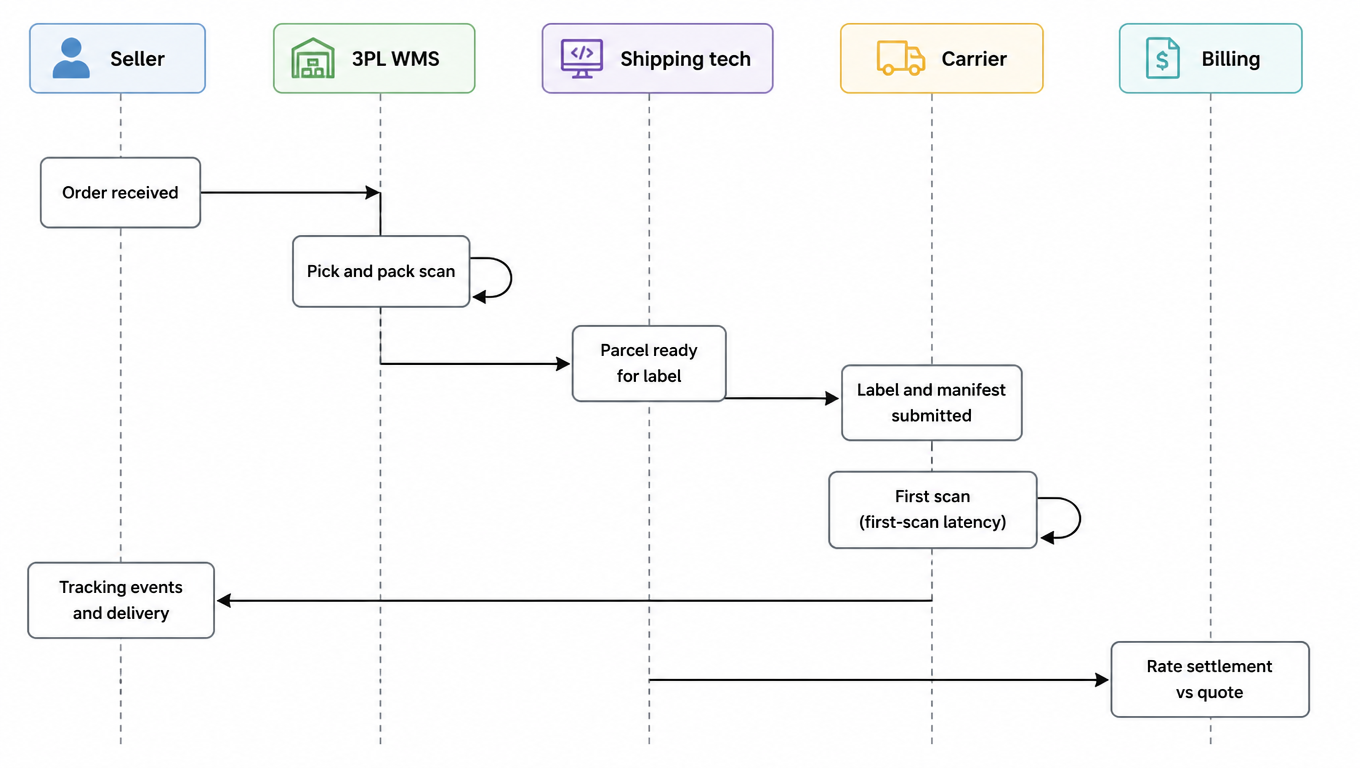
Step 2: place every incident on a single unified shipment timeline. One order, one timeline, with every timestamp that exists: order received, pick scan, pack scan, label generated, first carrier scan, in-transit events, delivery, and the final rate settlement. The timeline below shows the standard lifecycle and the party responsible at each step.

Unified shipment timeline sequence diagram: seller sends order to 3PL WMS, WMS scans pick and pack, shipping tech submits label and manifest to the carrier, carrier first scan (first-scan latency), tracking events and delivery back to seller, then rate settlement vs quote
One order, every timestamp, a responsible party at each step: place incidents here and attribution begins

Step 3: attribute each incident to one of four layers: warehouse, software, carrier, or billing. A late parcel with a clean first scan is a carrier problem. A parcel with no scans after label generation is a handoff problem, possibly the 3PL's manifest flow, possibly the carrier's pickup. A label that never printed is software. An invoice that charges the wrong weight is billing. This attribution step is where the shipping diagnostic framework does most of its work, and it is the step that separates this process from a complaint meeting.

Step 4: score each domain against the contract SLAs and the actual evidence. Not against vibes, not against what the account manager promised on the last call, against the SLA table in your contract, with the invoice, the scan log and the ticket log as proof. Section 7 covers what counts as evidence and what does not.

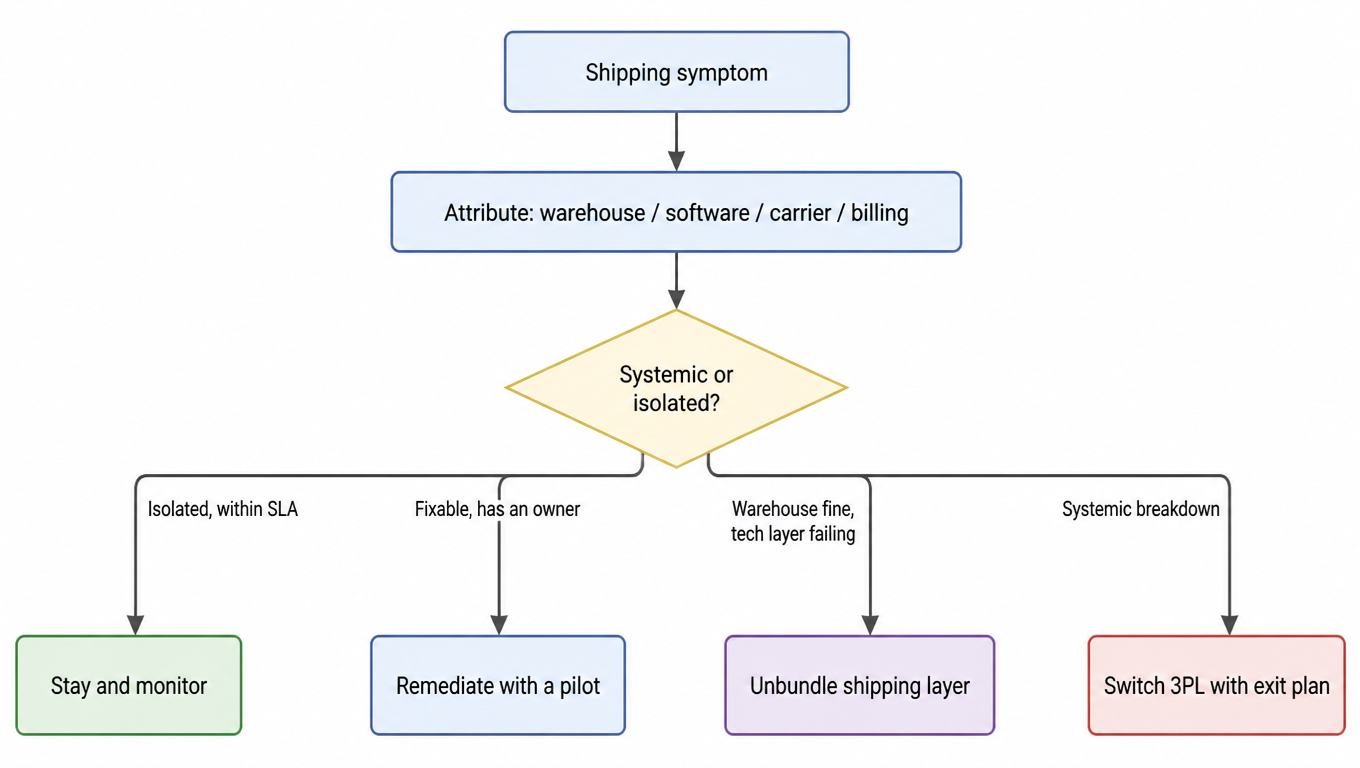
Step 5: run a remediation pilot with a named owner, a deadline and pass criteria, detailed in section 5. Step 6: decide. The decision tree below is the whole article in one picture.

Decision tree: shipping symptom attributed to warehouse, software, carrier, or billing, then systemic or isolated: isolated and within SLA means stay and monitor, fixable with an owner means remediate with a pilot, warehouse fine but tech layer failing means unbundle the shipping layer, systemic breakdown means switch 3PL with an exit plan
Attribute first, characterize second, then one of four exits

Run the Remediation Pilot Before You Decide

Switching costs are high, so the scorecard's first job is to find the problems that can be fixed without a migration[^1][^2]. Most 3PL failures are fixable in principle: a pickup slot that does not match your cutoff, a billing rule that misapplies a surcharge, a support process with no escalation owner. The question is whether this 3PL will actually fix them, and a pilot is how you test that with almost no risk.

Design the pilot around one domain that scored badly, or one symptom cluster, not six at once. Give it a named owner on their side and a named counterpart on yours. Give it a deadline, typically 30 to 45 days, long enough for a full order cycle and short enough to stay credible. Give it measurable pass criteria written in advance: first-scan latency under X hours for 95% of parcels, invoice dispute rate below Y, exception close time under Z business days. The criteria come from your contract SLA where one exists, and from your own tolerance where it does not.

Then read the result honestly. If the pilot meets its criteria and the fix holds, you have a remediated partner and you move to monthly monitoring with the leading indicators from section 3. If it partially fails, extend once with a narrower scope, and if the second run still misses, you have your answer: the problem was not a process, it was the partner's capacity or will, and that does not fix itself. This is also the moment to talk to your account manager about the SLA conversation, the first-90-days SLA playbook has the framing for turning agreed fixes into written commitments. A pilot that fails is not a waste; it is the cheapest evidence you will ever get that a switch is necessary.

If You Switch: The Exit Plan

A switch is a project, not a decision, and it fails on logistics, not on intent. Four workstreams cover the risk. Inventory audit: count your stock at the incumbent warehouse and reconcile it against your system before you announce anything, because the count you agree on at exit is the count you will be invoiced for, and disputes are much cheaper before the pallets move. Data export: pull complete order, shipment, billing and inventory history in a usable format, CSV or API, and verify the export is complete before you give notice, not after, because access rights often shrink the moment the contract ends. Parallel label printing: run the new provider on a slice of volume while the incumbent still carries the rest, so the new operation proves itself on real orders before it carries everything, which is also how the RFP pilot should have ended. Rollback plan: define in advance what happens if the new provider fails its first weeks, which orders go back, who re-runs them, and for how long you keep the old labels valid.

Two warehouse workers count inventory on a pallet beside a laptop and checklist.
The two most expensive words in an exit plan are "count first, then notify"

Contract terms determine how much of this you can actually do. Read the exit clause before you need it: the notice period, usually 30 to 90 days[^3], data ownership, whether the WMS data formats are documented and exportable, exit fees, and any requirement to return or destroy labels and packaging. If your contract is silent on data export, assume the worst and test it now, while you are still a paying customer. The 3PL operations guides and the billing checklist are the right place to verify the financial side before you sign anything new.

Evidence Rules: What Counts as Proof

The scorecard is only as honest as its evidence, and the rules are strict. Contract SLAs and actual data beat everything: an SLA table, a real invoice, a WMS scan log, a carrier scan history, a ticket log with timestamps. Anecdotes, account-manager promises and "it feels like" do not count. When a score conflicts with an anecdote, trust the data and investigate the gap; when the data conflicts with the contract, you have found the real problem, which is that the partner is not meeting the terms you agreed to.

For each domain, name the document that proves it. Cost & Billing is proven by invoices compared against quotes and the rate card, with the weight adjustment dispute process as the backstop for carrier-side billing errors[^4]. Warehouse Execution is proven by WMS scan logs, not by customer complaints, which arrive late and without attribution. Carrier Handoff and Delivery are proven by carrier scan data, which you can pull directly rather than asking the 3PL to summarize it. Exception Management is proven by the ticket system with close timestamps. Integration & Data is proven by testing: run an export, watch a webhook, count label failures over a week, do not take a feature list as evidence.

Benchmarks deserve a special warning. Industry numbers have a way of becoming "facts" after they are quoted a few times, and most of them are unverifiable. A mispick percentage someone posted in a Reddit thread is not evidence about your 3PL, and a benchmark from a sales deck is a sales tool, not a baseline. Only use a benchmark if you can trace it to a source you can name and check, and even then, your contract SLA and your own data outrank it. Where the article needs a number, it is either your contract term or your measured data; where it needs a pattern, the pattern comes from your own timeline. That keeps the scorecard defensible when you present it, which matters, because at some point you will present it to the 3PL, and it will read the evidence rules too.

When the Scorecard Points at Shipping Technology

Some failures are the 3PL's people, and some are its technology, and the scorecard separates them cleanly. The telltale pattern is a scorecard where Warehouse Execution scores well, the people pick, pack and ship correctly, while the failures concentrate in the shipping technology layer: rates that do not match the quote, labels that fail or print wrong, carrier selection that ignores your service-level rules, tracking events that never arrive, billing records that do not reconcile. When the pattern looks like that, the problem is not the warehouse and not necessarily the partner's intentions, it is the rates, labels, carriers, tracking and billing software underneath the operation.

That pattern has a distinct remedy: unbundle the shipping layer instead of replacing the whole 3PL. You can keep the warehouse operation you trust and upgrade the shipping technology independently, bringing your own rates and carrier logic, your own label generation, your own tracking and billing data flow, and letting the 3PL's people keep doing what they score well at. This is a controlled change, and it deserves the same discipline as any other pilot: pick a slice of volume, run both paths in parallel, compare first-scan latency, label failures and billing accuracy, and only expand after the new layer clears its pass criteria on real orders. The build vs buy analysis for 3PL integrations and the multi-carrier shipping API cover how that layer gets built and operated.

One honesty rule applies here, and it is the rule this whole article runs on: the scorecard decides, not the remedy. If the evidence shows warehouse execution failing, a shipping technology upgrade will not fix mispicks, and you should remediate the warehouse or switch, not buy software. The independent shipping layer is the right move only when the scorecard itself points at the technology layer. When it does, that is the cleanest of the four outcomes, because it improves performance without the cost and risk of a full migration. When it does not, no product pitch changes the evidence, and the honest answer is the one the scorecard already gave you.

FAQ

Attribute it on the unified timeline: a late parcel with a clean first scan is a carrier problem; a parcel with no scans after label generation is a handoff problem, possibly the 3PL's manifest flow or the carrier's pickup; a label that never printed is software; an invoice charging the wrong weight is billing. Do not open a remediation conversation with either party until the attribution is clean.
Take a normal 30 to 60 day order and incident window, not your worst week or peak season. Pull leading indicators (first-scan latency, label failures, scan completeness) monthly, and let lagging indicators (on-time delivery, billing disputes, exception close time) settle with the cycle. Together they are enough to separate the occasional from the systemic.
30 to 45 days, long enough for a full order cycle and short enough to stay credible. Scope it around the worst-scoring domain or one symptom cluster, name an owner on each side, and write measurable pass criteria in advance, for example first-scan latency under X hours for 95% of parcels or a billing dispute rate below Y. Take the criteria from your contract SLA where one exists, from your own tolerance where it does not.
When Warehouse Execution scores well and the failures concentrate in the rates, labels, carrier selection, tracking, and billing software layer. The remedy is to keep the warehouse you trust, upgrade the shipping technology independently, validate on a slice of parallel volume, and expand only after the pass criteria clear. If the evidence shows warehouse execution itself failing, no technology upgrade fixes mispicks, so remediate the warehouse or switch.
Read the exit clause before you need it: the notice period (usually 30 to 90 days), data ownership and whether the WMS formats are exportable, exit fees, and any requirement to return or destroy labels and packaging. If the contract is silent on data export, assume the worst and test the export now, while you are still a paying customer.