Four Signals That It's Time to Move Off Self-Fulfillment
The first signal is time. If packing, labeling, and drop-offs eat two to four hours a day, plus a full weekend day every month, that time is being stolen from the work that grows the business. A simple test: look at the last two weeks and count how many days you skipped listing work, supplier follow-ups, or creative tasks because orders needed to go out.
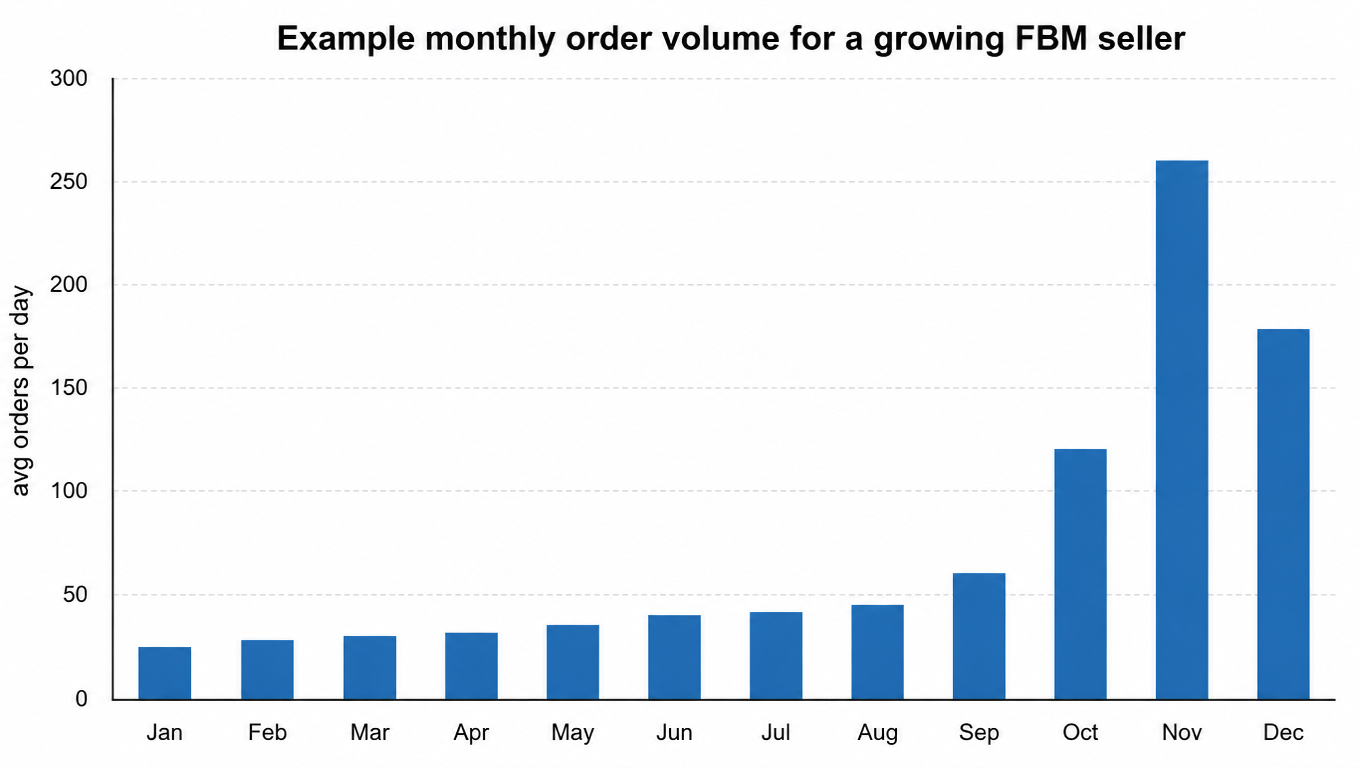
The second signal is peak season. From Black Friday through New Year, a normal 30-order day can become a 300-order day. Self-ship operations break under that multiple: late shipments, missed promise dates, and a late-shipment rate that drags on your account health. Amazon's public target for seller-fulfilled orders is under 4 percent[^1]. If last Q4 forced you to pause offers or apologize to buyers, you have already crossed the line.
The third signal is cost. When you cannot state, within a dollar, what it costs to fulfill one order, you cannot price, promote, or plan with any confidence. Self-shipping with retail carrier rates, retail packaging, and unplanned returns usually costs more per order than a 3PL that passes through negotiated volume rates. The fourth signal is scale. Adding a new SKU should be exciting, not a chore that multiplies your packing time and your error rate. If growth feels like punishment and fulfillment quality dips as SKUs multiply, the operation itself has become the bottleneck.
One-line tests for each signal: time, you regularly skip high-value work to pack orders; peak, last Q4 you missed promise dates or paused offers; cost, you cannot say your cost per order within a dollar; scale, new SKUs feel like a burden rather than an opportunity. Hit any one of these, and a 3PL conversation is worth having.