FBM 运费优化FBM Shipping Costs

亚马逊卖家如何降低 FBM 运费,而不伤派送表现How Amazon Sellers Can Reduce FBM Shipping Costs Without Hurting Delivery Performance

对 FBM(卖家自发货)卖家来说,运费是仅次于采购成本的第二大支出,也是漏损最隐蔽的一环。每一件包裹在基础费率之上,还要叠加燃油附加费、住宅附加费、派送区域附加费、体积重调整和分区溢价。大多数卖家按默认费率卡付钱,因为从来没人告诉他们:账单在实际中是可以谈的,不只是纸面上。For Fulfillment by Merchant (FBM) sellers, shipping is the second-largest line item after cost of goods, and it is the one with the most silent leakage. Every parcel carries a base rate, then fuel surcharges, residential surcharges, delivery area surcharges, dimensional weight adjustments, and zone premiums stack on top. Most sellers pay the default rate card price because nobody ever told them the invoice is negotiable in practice, not just on paper.

难的地方在于:你不能靠发得慢一点或便宜一点来解决。亚马逊衡量延迟送达率、ship-on-date(SOD)合规与整体账户健康,并把配送速度作为决定谁能赢得 Buy Box 的重要权重。砍错成本,等于用一块钱运费换一次转化崩塌。The hard part is that you cannot fix this by simply shipping slower or cheaper. Amazon measures late delivery rate, ship-on-date (SOD) compliance, and overall account health, and it weights shipping speed heavily when deciding who wins the Buy Box. Cut the wrong cost and you trade a dollar of freight for a collapse in conversion.

本指南是一套按卖家规模组织的实战手册:小卖家起步手册(签不了承运商合同)、中大型卖家成长手册(可以谈判)、规模化卖家进阶手册(运营一张网络)。每个手册都覆盖 FBM 成本的两大板块:美国境内尾程,以及从中国出发的跨境直发。每一章结尾都有你今天就能做的动作。This guide walks you through a playbook organized by seller size: a starter playbook for small sellers who cannot sign carrier contracts, a growth playbook for mid-size sellers who can negotiate, and an advanced playbook for sellers running a network. Each playbook covers the two big blocks of FBM cost: US domestic last-mile delivery and cross-border direct shipping from China. Every chapter ends with actions you can take today.

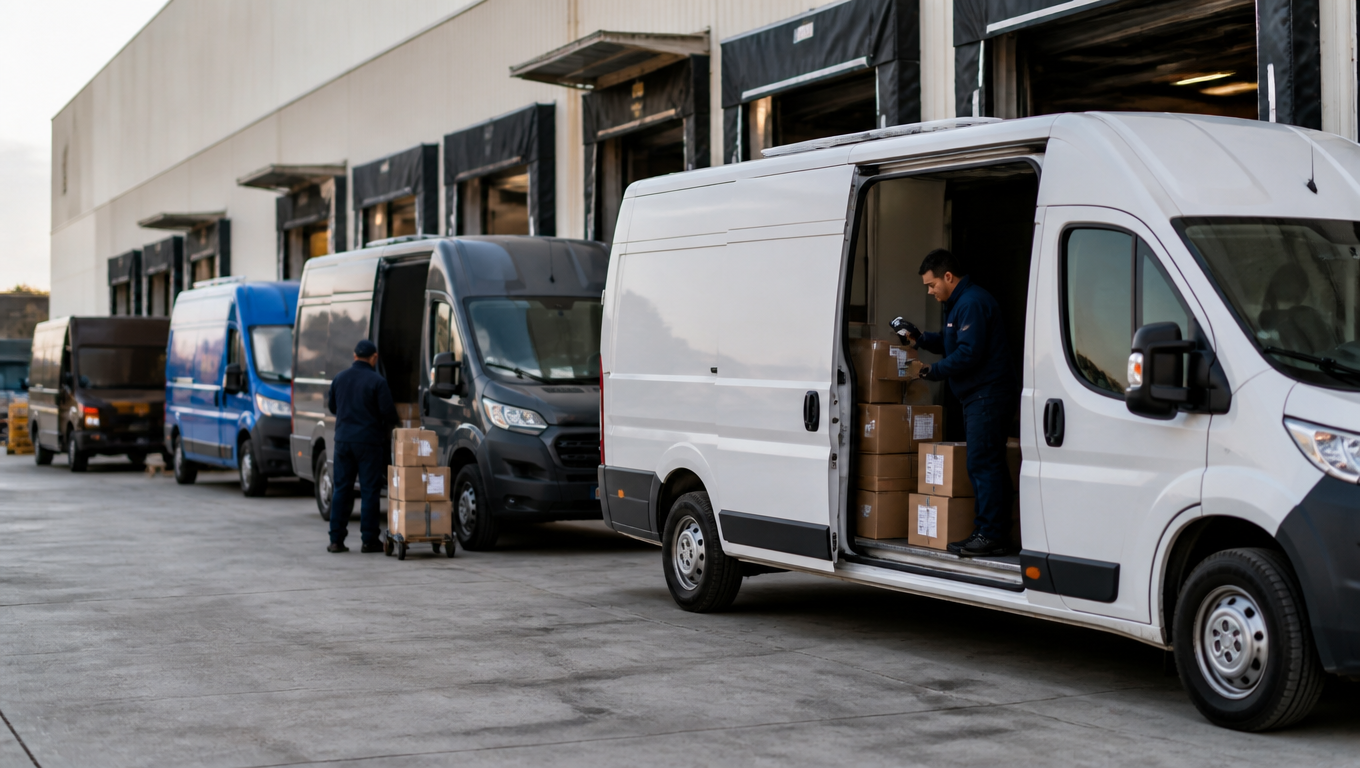
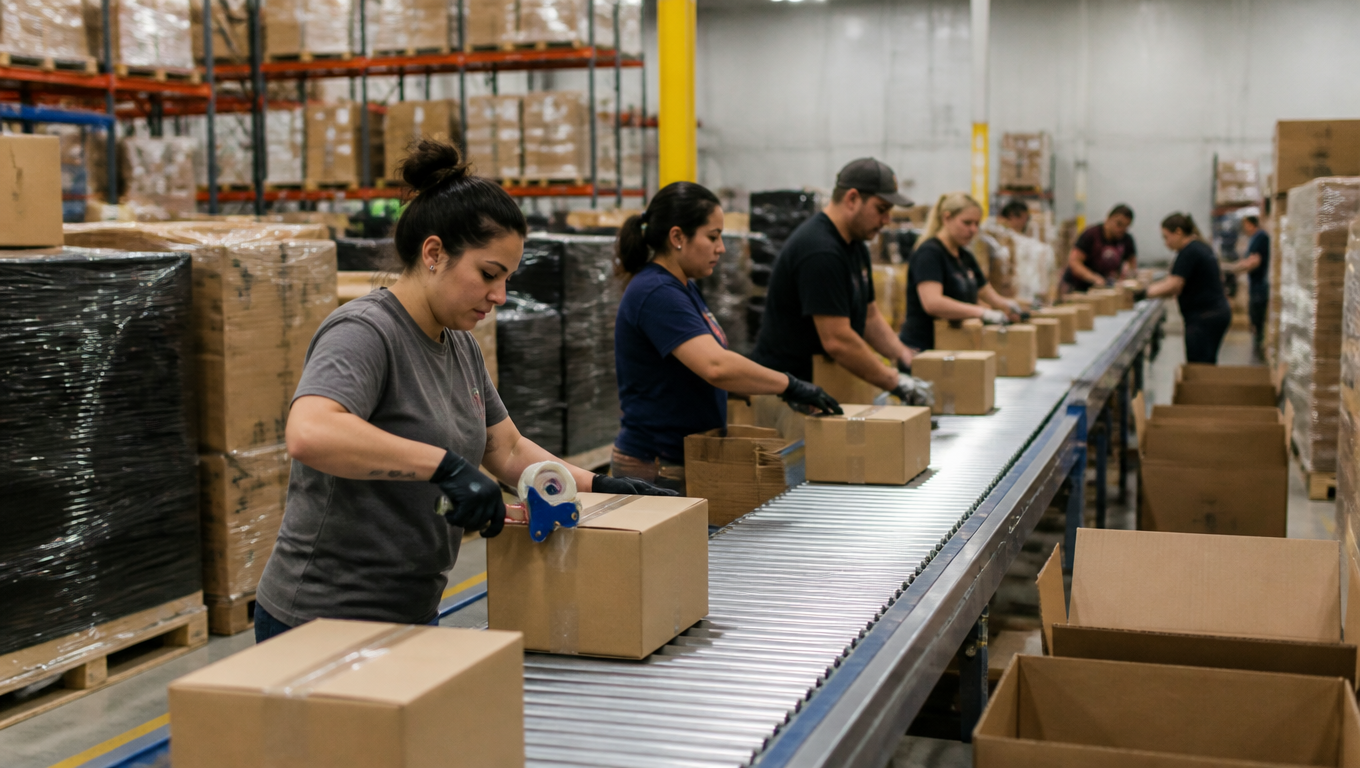
打包台上的棕色瓦楞纸箱、胶带卷、包裹秤和打印好的面单,小仓库里洒满温暖的日光
每一件包裹都在悄悄决定你的利润,也从下单那一刻开始决定客户体验Every parcel quietly decides your margin, and shapes the customer experience from the moment the order is placed

为什么运费是 FBM 利润最大的漏点Why Shipping Is the Biggest Leak in FBM Profit

运费不是一个数字,而是一摞组件的叠加,每一层都可以单独下手。基础费率来自承运商费率表,取决于三个输入:包裹重量、尺寸,以及分区,也就是发货地邮编到客户邮编之间的距离。同一只箱子,寄给邻居和寄给 2,000 英里外的客户,基础费率可能翻倍。Shipping cost is not one number. It is a stack of components, and each one can be attacked separately. The base rate comes from a carrier rate table, which depends on three inputs: the weight of the parcel, its dimensions, and the zone, meaning the distance between your origin ZIP code and the customer's ZIP code. Ship the same box to a neighbor and to a customer 2,000 miles away and the base rate can double.

尺寸几乎和重量一样重要,因为 UPS 和 FedEx 按体积重计费。公式是长 × 宽 × 高 ÷ 139,如果结果超过实际重量,就按大的那个收。比如一只 12 × 10 × 8 英寸的箱子,体积重约 6.9 磅;往里面放一件 2 磅的商品,承运商按 7 磅向你收费。只为了一箱空气,你的运费就乘了 3.5 倍。Dimensions matter almost as much as weight, because UPS and FedEx bill on dimensional weight. The formula is length × width × height divided by 139, and if the result exceeds the actual weight, you pay for the larger figure. A 12 × 10 × 8 inch box, for example, computes to about 6.9 lb dimensional weight. Put a 2 lb item inside it and the carrier bills you for 7 lb. That is a 3.5× multiplier on your freight for nothing but empty air.

然后附加费登场。一件典型的 2 磅 UPS Ground Zone 5 包裹,费率表可能报基础价 11.20 美元,但账单实际接近 20.60 美元:燃油约 3.00 美元(约占基础费率的 27%)、住宅附加费 4.90 美元、派送区域附加费 1.50 美元层层叠加。到了 11 月和 12 月,旺季附加费再压一层。Then the surcharges arrive. On a typical 2 lb parcel shipped UPS Ground to Zone 5, the rate card might quote $11.20 for the base rate, but the invoice lands closer to $20.60 once fuel (about $3.00, roughly 27% of the base rate), residential delivery ($4.90), and delivery area ($1.50) surcharges stack on. During November and December, peak surcharges add another layer on top.
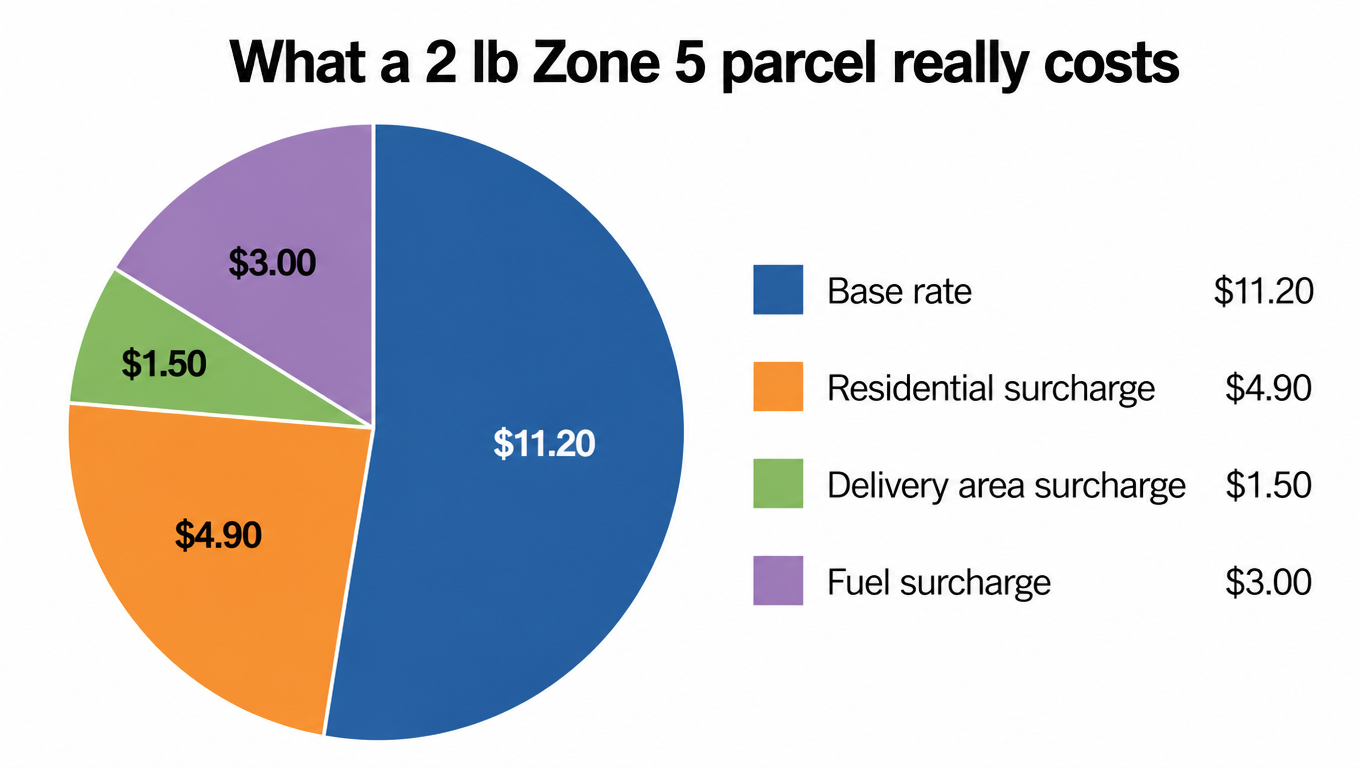
一个 2 磅 Zone 5 包裹的真实成本构成:基础费率 11.20 美元、住宅附加费 4.90 美元、派送区域附加费 1.50 美元、燃油附加费 3.00 美元What a 2 lb Zone 5 parcel really costs: base rate $11.20, residential surcharge $4.90, delivery area surcharge $1.50, fuel surcharge $3.00
2 磅 Zone 5 包裹的真实成本:费率表报价只是起点What a 2 lb Zone 5 parcel really costs: the rate card is only the starting point

最大的诱惑是拿速度换成本,而这正是 FBM 卖家伤到自己的地方。亚马逊把 Buy Box 给到价格、配送速度和派送表现组合最优的报价。如果你的承诺送达日期一再延误,或者你持续晚发,延迟送达率就会爬升,账户健康分随之下降。一家便宜但比承诺晚两天送达的承运商并不便宜;它是你未来每一笔订单都要交的转化税。The temptation is to cut speed to cut cost, and that is where FBM sellers hurt themselves. Amazon gives the Buy Box to the offer with the best combination of price, shipping speed, and delivery performance. If your promised delivery date slips, or you consistently ship late, your late delivery rate climbs and your account health score drops. A cheap carrier that delivers two days later than promised is not cheap; it is a conversion tax you pay on every future order.
小卖家起步篇:不签合同也能省下的钱Starter Playbook for Small Sellers: Savings Without Contracts

如果你一个月只发几百单,拿不到 UPS 合同,也根本不需要。小卖家最大的杠杆是选对 USPS 服务档位。USPS Ground Advantage 是大多数 1 磅以下小件包裹的默认选择,通常比 Priority Mail 便宜,同时仍能 2 到 5 天送达。当你承诺了更快的时效、需要 1 到 3 天窗口时,Priority Mail 才派上用场。Priority Mail Flat Rate 盒子按固定价格计费、与重量无关,所以对书、五金件、铸件这类又重又密的商品非常划算,对又轻又大的商品则是灾难。If you ship a few hundred orders a month, you will not get a UPS contract, and you do not need one. The biggest lever for a small seller is choosing the right USPS service tier. USPS Ground Advantage is the default for most small parcels under about 1 lb and often beats Priority Mail on price while still delivering in 2 to 5 days. Priority Mail makes sense when you promised faster delivery and need the 1 to 3 day window. Priority Mail Flat Rate boxes charge a fixed price regardless of weight, so they shine for heavy, dense items such as books, hardware, and cast parts, and they lose badly on light, bulky items.

第二个杠杆是运费重算(rate shopping)。Easyship、Shippo、ShipStation 这类多承运商比价工具会为每件包裹拉取 USPS、UPS、FedEx 的实时费率,并自动选择满足你时效承诺的最便宜选项。easyshippingx 也属于这一类,专注让卖家在每一单发货前把合约价和零售价并排对比。如果你还在邮局柜台打单,或者按承运商官网的零售价付钱,你每一件包裹都在多付几美元,而且天天如此。The second lever is rate shopping. Multi-carrier comparison tools such as Easyship, Shippo, ShipStation, and similar platforms pull live rates from USPS, UPS, and FedEx for each parcel and automatically select the cheapest option that meets your delivery promise. easyshippingx is another example in this category, focused on letting sellers compare negotiated and retail rates side by side before every drop. If you are printing labels at the post office counter or paying retail at the carrier website, you are leaving several dollars per parcel on the table, every single day.

第三个杠杆是地址校验。街道名拼错、漏写公寓号、邮编不对,都会触发地址更正费(2026 年 UPS 每件超过 21 美元),再加上派送失败和退货。在打印面单之前,用 USPS 数据库校验每一个结账地址,几乎不花钱,却能消灭大部分这类费用。The third lever is address validation. A typo in a street name, a missing apartment number, or a wrong ZIP code triggers address correction fees, over $21 per package with UPS in 2026, plus failed deliveries and returns. Checking every checkout address against the USPS database before you print costs almost nothing and eliminates most of these charges.

第四个杠杆是包装,本质上就是体积重管理。把箱子换到合适的尺寸、软商品改用快递袋、去掉多余的填充物。尺寸每削掉一英寸,体积重和计费重量都会变小。而且在默认任何箱子之前,先问一句:对这件商品,Flat Rate 是不是比体积重价格更划算?The fourth lever is packaging, which is really dimensional weight management. Right-size your boxes, use poly mailers for soft goods, and remove excess padding. Every inch you shave off a dimension shrinks the dimensional weight and the billed weight. And before you default to any box, ask whether a Flat Rate option beats the dimensional weight price for that particular item.

中大型卖家成长篇:谈判与承运商组合Growth Playbook for Mid-Size Sellers: Negotiation and Carrier Mix

一旦你一个月发几千单,承运商就想要你的生意,一切都变了。UPS 和 FedEx 都会按货量谈基础费率折扣,成长型货量通常在价目表的 25% 到 40% 之间,而且第一次报价几乎永远不是最终数字。带上按分区和服务拆分的货量数据,加上竞争对手的报价,去要三样东西:基础折扣、住宅附加费豁免、派送区域附加费豁免。燃油附加费很少能谈,但它是百分比,基础费率降了它自动缩水。Once you ship a few thousand orders a month, carriers want your business, and that changes everything. UPS and FedEx both negotiate base rate discounts off list, typically in the 25% to 40% range for growing volume, and the first ask is almost never the final number. Bring your volume data, split by zone and service, plus competitor quotes, and ask for three things: a base discount, residential surcharge waivers, and delivery area surcharge waivers. Fuel surcharges are rarely negotiable, but they are percentage-based, so a lower base rate shrinks them automatically.

第二个杠杆是承运商组合,尤其是区域承运商。OnTrac、UniUni 这类网络覆盖美西和西南大片区域,用分区计价在自家地盘上把全国承运商压下去。在它们覆盖良好的邮编区,区域承运商每件可以比 UPS Ground 便宜 15% 到 30%,时效相当甚至更好,因为包裹根本不出区域。诀窍是精确知道每家承运商哪些邮编区覆盖得好,只把那些订单路由过去。The second lever is the carrier mix, specifically regional carriers. Networks such as OnTrac and UniUni cover large parts of the US West and Southwest with zone-based pricing that undercuts the national carriers on their home turf. In the ZIP codes they serve well, a regional carrier can be 15% to 30% cheaper per parcel than UPS Ground, with comparable or better transit times, because the parcel never leaves the region. The trick is knowing exactly which ZIP codes each carrier serves well and routing only those orders to them.

第三个杠杆是分区策略:让库存位置匹配客户地理。如果你的客户大多在西海岸,而包裹从东海岸发出,每一单都在付 Zone 7 或 Zone 8 的费率。第二个备货点,哪怕很小,就能把这些订单压到 Zone 1 或 Zone 2 的定价,对 2 磅包裹来说,通常每件便宜好几美元。The third lever is zone strategy: match your inventory position to your customer geography. If most of your customers are on the West Coast and your parcel ships from the East, every order pays a Zone 7 or Zone 8 rate. A second stocking point, even a small one, collapses those orders to Zone 1 or Zone 2 pricing, which for a 2 lb parcel is often several dollars cheaper.

第四个杠杆是多承运商实时路由。当你和两三家承运商都谈好了费率,没有哪一家承运商在每条线路上都是最便宜的。用软件按每件、每分区、每服务比较你的合约费率,指派仍能满足承诺送达日期的最低价承运商,总运费可以省下 8% 到 15%,而且一单都不拖慢。这正是 easyshippingx 所属的多承运商比价类别在做的事,也是从中型卖家开始真正回本的阶段。The fourth lever is multi-carrier real-time routing. Once you have negotiated rates with two or three carriers, no single carrier is cheapest for every lane. Software that compares your contracted rates per parcel, per zone, and per service and assigns the lowest-priced carrier that still meets the promised delivery date can shave 8% to 15% off total freight without slowing down a single order. This is exactly the job of the multi-carrier comparison category easyshippingx belongs to, and mid-size sellers are where it starts to pay for itself.

规模化卖家进阶篇:网络级优化Advanced Playbook for Scale: Network-Level Optimization

当月发货量达到几千单、品类又复杂时,单件层面的战术不再是瓶颈,网络成为杠杆。多仓布局(典型的是东、中、西三个点)让你按客户地理拆分库存,绝大多数订单在一两个分区内送达。资本成本是真实的,这正是它属于进阶档的原因,但运费降幅会随着每一单复利。At thousands of orders a month across a catalog, parcel-level tactics stop being the bottleneck and the network becomes the lever. A multi-warehouse footprint, typically East, Central, and West, lets you split inventory by customer geography so the vast majority of orders ship within one or two zones. The capital cost is real, which is why this belongs in the advanced tier, but the freight reduction compounds with every order.

网络级省钱来自数据。按线路跟踪成本,也就是每个发货仓、每个目的分区、每家承运商,并建立一张把成本、准时率和破损率加权在一起的承运商计分卡。便宜 10% 但可靠性差 3% 的承运商,对低价值、非紧急的商品可能是正确选择,而你的高端品类需要可靠的伙伴。路由决策从此不再是拍脑袋,而是一次计算。Network-level savings come from data. Track cost per lane, meaning per origin warehouse, per destination zone, and per carrier, and build a carrier scorecard that weighs cost, on-time rate, and damage rate together. A carrier that is 10% cheaper but 3% less reliable may still be the right choice for low-value, non-urgent items, while your premium catalog needs the reliable partner. The routing decisions stop being gut calls and become a calculation.

与 3PL 合作,是许多卖家不拥有仓库就获得网络规模的方式。经济性只有合同设计得好才成立:按件谈拣货打包费、按托盘谈仓储费,SLA 要覆盖截单时间、当日出库窗口,以及破损或丢失时的异常处理。坚持要拿到和自己仓库一样的数据:每单运费和每承运商绩效,否则你就是在别人的楼里蒙眼飞行。Working with a 3PL is how many sellers get network scale without owning warehouses. The economics only work if the contract is designed well: negotiate pick-and-pack fees per unit, storage on a per-pallet basis, and a service level agreement that covers cutoff times, same-day dispatch windows, and exception handling when a parcel is damaged or lost. Insist on the same data you would get from your own warehouse, per-order shipping costs and per-carrier performance, or you are flying blind inside someone else's building.

旺季是网络被压力测试的地方,附加费是失血点。8 月就要预测 11 月和 12 月的货量,提前锁定承运商运力,在旺季附加费表公布之前谈好假日费率。把货量分散到更多承运商,并在每周内更早发货,可以平滑掉那些触发最贵附加费档位的尖峰。Peak season is where networks get stress-tested, and surcharges are where they bleed. Forecast your November and December volume in August, reserve carrier capacity early, and negotiate holiday rates before the peak surcharge schedule is published. Spreading volume across more carriers, and shipping earlier within each week, smooths the spikes that trigger the most expensive surcharge tiers.

跨境直发篇:中国出发怎么省钱Cross-Border Playbook: Saving on China-Origin Shipments

从中国采购的卖家面临第二个完全不同的成本问题:把包裹从工厂送到客户手上。渠道选择主导一切。国际小包(ePacket 那一类)是最便宜的选择,通常每件只要几美元,但慢,通常 7 到 20 天,跟踪也有限。挂号邮政服务加一点钱就能补上跟踪和可追溯性。商业快递(DHL、UPS、FedEx 国际件)3 到 5 天送达、跟踪优秀,但价格是小包的数倍。Sellers who source from China face a second, completely different cost problem: getting the parcel from the factory to the customer. The channel choice dominates everything else. International small packet services, the ePacket-type class, are the cheapest option, often a few dollars per parcel, but they are slow, typically 7 to 20 days, with limited tracking. Registered postal services add tracking and traceability for a little more. Commercial express, DHL, UPS, and FedEx international, delivers in 3 to 5 days with excellent tracking but costs multiples of small packet pricing.

税费和合规是隐藏的一层。对进入美国的包裹来说,2025 年 8 月之后情况变了:800 美元的 de minimis 关税豁免被暂停,低价小包不再自动免税,发往美国的 ePacket 类小包现在也要交税。直发美国客户仍然可行,但它现在背负着以前没有的关税与合规成本。如果你卖亚马逊欧洲,规则反过来:低价包裹进入欧盟需要 IOSS(进口一站式服务)注册和 VAT 处理,搞错了就意味着海关扣件、退件,以及寄到客户手里的意外账单。2026 年 7 月起,欧盟还对 150 欧元以内的低价件按件征收 3 欧元固定关税,取代了旧的免税政策。Taxes and compliance are the hidden layer. For parcels entering the United States, the picture changed in August 2025: the $800 de minimis duty exemption was suspended, so low-value small packet shipments are no longer automatically duty-free, and ePacket-type shipments to the US are now taxed. Direct shipping to US customers still works, but it now carries tariff and compliance costs it did not carry before. If you sell to Amazon Europe, the rules flip: you need IOSS (Import One-Stop Shop) registration and VAT handling for low-value parcels entering the EU, and getting that wrong means customs holds, returned parcels, and surprise bills to the customer. Since July 2026 the EU also applies a flat €3 customs duty per item on low-value consignments up to €150, replacing the old duty exemption.

DDP 与 DAP 的选择,决定谁扛关税风险。走 DDP(完税后交货),你预付关税,客户收货时没有任何意外费用,转化和评价都得到保护。走 DAP(目的地交货),关税在派送时向客户收取,一个拒绝付款的客户可能导致包裹被拒收、退回,费用由你承担。DDP 的现金流和风险成本更高,但对跨境 FBM 来说,它通常是转化上的赢家。The DDP versus DAP decision decides who carries the duty risk. Under DDP (Delivered Duty Paid), you pay duties upfront and the customer receives the parcel with no surprise charges, which protects conversion and reviews. Under DAP (Delivered at Place), duties are collected at delivery, and a customer who refuses to pay can cause the parcel to be refused and returned to you at your expense. DDP costs more in cash flow and risk, but for cross-border FBM it is usually the conversion winner.

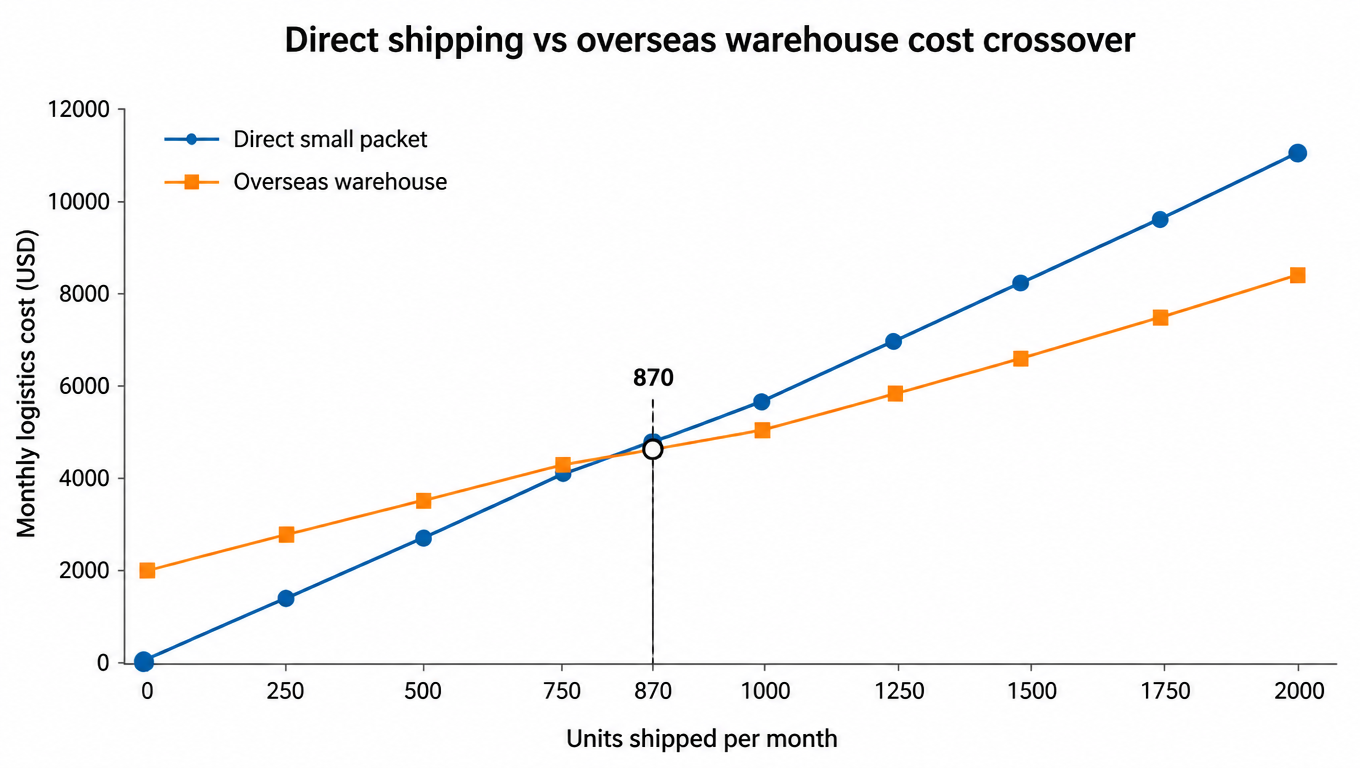
到某个量级,直发不再划算,海外仓接管。这是一道交叉题:直发小包每件全包约 5.50 美元,没有固定成本。海外仓(海运整批库存、仓储、美国尾程)每月固定成本约 2,000 美元,加每件 3.20 美元。解 5.5x = 2,000 + 3.2x,交叉点落在每月约 870 件;超过这个量,海外仓每件更便宜,而且用 2 到 5 天送达替代 7 到 20 天,还能改善你的 Buy Box 位置。At some volume, direct shipping stops making sense and an overseas warehouse takes over. The math is a crossover: direct small packet costs roughly $5.50 per unit all-in, with no fixed cost. An overseas warehouse, with ocean freight for bulk inventory, storage, and US last-mile delivery, costs about $2,000 per month in fixed costs plus $3.20 per unit. Solve 5.5x = 2,000 + 3.2x and the crossover lands near 870 units per month; above that, the warehouse is cheaper on a per-unit basis, and it delivers in 2 to 5 days instead of 7 to 20, which also improves your Buy Box position.

直发小包与海外仓月度物流成本对比折线图,交叉点约在每月 870 件Direct shipping vs overseas warehouse monthly logistics cost crossover line chart, crossover near 870 units per month
直发 vs 海外仓:每月约 870 件是分水岭Direct shipping vs overseas warehouse: the crossover is around 870 units per month

决策框架:什么时候省运费会伤到时效Decision Framework: When Cost-Cutting Hurts Performance

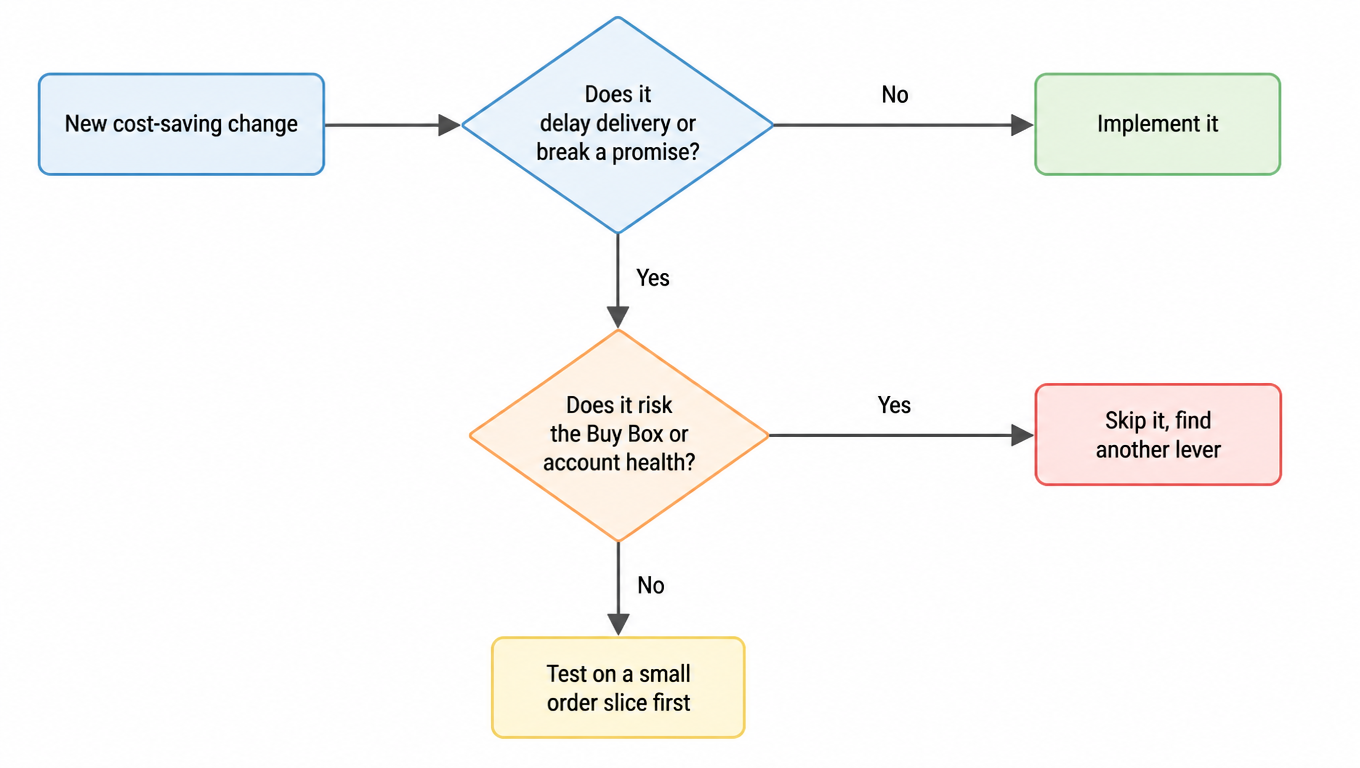
本指南里的每个省钱想法都要过一道测试:它有没有改变客户看得见的东西?客户看得见你承诺的送达日期、跟踪更新和结账时的速度;亚马逊看得见你的延迟送达率、SOD 合规和账户健康。一个省钱动作把承诺 3 天送达的订单悄悄拖成 5 天,这不是省钱,这是在赌 Buy Box。Every saving idea in this guide needs to pass one test: does it change something the customer sees? Customers see the delivery date you promised, the tracking updates, and the speed at checkout, and Amazon sees your late delivery rate, SOD compliance, and account health. Cutting a cost that quietly pushes delivery from 3 days to 5 days on orders where you promised 3 days is not a saving; it is a bet against the Buy Box.

框架很简单。砍客户永远看不见的:幕后的承运商选择、包装与体积重、地址校验、可以靠改路由绕开的附加费。保护客户看得见的:你承诺的配送速度、可靠的跟踪、以及你宣传的任何周末或加急服务。拿不准的时候,先在小切片上测试再铺开。The framework is simple. Cut what customers never see: carrier choice behind the scenes, packaging and dimensional weight, address validation, and back-end surcharges you can avoid by rerouting. Protect what customers do see: the delivery speed you promised, reliable tracking, and any weekend or expedited service you advertise. When in doubt, test on a small slice before rolling out.

省钱决策流程图:新省钱方案,会不会拖慢时效或破坏承诺,不会则实施,会则看是否危及 Buy Box 或账户健康,是则放弃换一个杠杆,否则先在小批量订单上测试Cost-saving decision flow: new change, does it delay delivery or break a promise, if no implement it, if yes does it risk the Buy Box or account health, if yes skip it and find another lever, otherwise test on a small order slice first
先问会不会破坏承诺,再问值不值得冒险First ask whether it breaks a promise, then whether it is worth the risk

然后持续监控,因为运费优化是每周的习惯,不是一次性的项目。在一张简单看板上跟踪每单运费、准时率和 ODR,每周看一次,每一项设一个阈值。每单成本漂移上行,说明分区结构或承运商线路变了,数据里看得见。准时率下滑,说明你优化过头了,需要回撤。这两个数字放在一起,能在问题变成事故之前告诉你一个改变是否有效。Then monitor, because shipping cost optimization is a weekly habit, not a one-time project. Track per-order shipping cost, on-time rate, and ODR on a simple dashboard, reviewed weekly with a threshold for each. If per-order cost drifts up, a zone mix or carrier lane has changed and it is visible in the data. If on-time rate drifts down, you are over-optimizing and need to pull back. The two numbers together tell you whether a change is working before it becomes a problem.

落地行动清单Action Checklist

小卖家,本周就做:把轻件的默认 USPS 档位切到 Ground Advantage;设置一个多承运商比价工具,停止付零售价;结账时开启地址校验;把箱子换到合适尺寸、软商品改用快递袋;在你最重的几款商品上,核对 Flat Rate 是否比体积重价格划算。Small sellers, do these this week: switch your default USPS tier to Ground Advantage for light parcels, set up a multi-carrier comparison tool and stop paying retail, enable address validation at checkout, right-size your boxes and switch soft goods to poly mailers, and check whether Flat Rate beats dimensional weight on your heaviest items.

中大型卖家,本月就做:拉出最近 90 天的货量,按分区和承运商拆分成本;带上货量数据开启一次 UPS 或 FedEx 谈判;在区域承运商覆盖最好的邮编区把它们加进来;建立按线路的路由规则,而不是只有一个默认承运商;如果你有进口,自己算一遍海外仓的交叉点。Mid-size sellers, do these this month: pull your last 90 days of shipments and split cost by zone and carrier, open a UPS or FedEx negotiation with your volume data, add a regional carrier for the ZIP codes they serve best, build a per-lane routing rule instead of one default carrier, and calculate your own crossover point for an overseas warehouse if you import.

规模化卖家,本季度就做:为第二个或第三个仓库的选址建模运费影响;建立一张把成本、准时、破损加权在一起的承运商计分卡;以可审计的按件计费和 SLA 条款重谈你的 3PL 合同;在附加费表公布前锁定旺季运力和费率。Sellers at scale, do these this quarter: model the freight impact of a second or third warehouse location, build a carrier scorecard that weights cost, on-time, and damage together, renegotiate your 3PL contract with per-unit and SLA terms you can audit, and lock peak-season capacity and rates before the surcharge schedule is published.

从今天就能做的一个改变开始。对大多数卖家来说,那就是给接下来 20 个包裹打开按单比价,然后看账单发生了什么。这个月省下的钱,会为下个月那个十倍于此的谈判、包装升级或第二个仓库买单。Start with one change you can make today. For most sellers, that is turning on rate shopping for your next 20 parcels and watching what the invoice does. The money you save this month funds the negotiation, the packaging upgrade, or the second warehouse that saves you ten times more next year.

常见问题FAQ

按单比价,也就是用多承运商比价工具为每件包裹自动选择最低价且满足时效的承运商,通常单件立刻省下几美元。然后是两件几乎零成本的事:把轻件默认档位从 Priority Mail 切到 Ground Advantage,以及在结账时开启地址校验,避免每件 20 多美元的地址更正费。Rate shopping: a multi-carrier comparison tool picks the cheapest carrier that still meets your delivery promise for every parcel, often saving several dollars per piece immediately. Then two near-zero-cost moves: switch your default tier to Ground Advantage for light parcels, and enable address validation at checkout to avoid $20-plus address correction fees per package.
能。小卖家的折扣藏在三处:选对 USPS 服务档位(Ground Advantage 常常比 Priority Mail 便宜)、用多承运商比价工具拿到 USPS/UPS/FedEx 的平台折扣费率而不是零售价,以及用 Flat Rate 盒子和包装降体积重。合同不是拿折扣的唯一途径。Yes. Small-seller discounts hide in three places: choosing the right USPS tier (Ground Advantage often beats Priority Mail), using a multi-carrier comparison tool to access platform-negotiated rates instead of retail, and using Flat Rate boxes plus packaging that lowers dimensional weight. A signed contract is not the only path to a discount.
只有当你砍到了客户看得见的东西时才会。亚马逊把 Buy Box 给到价格、配送速度和派送表现组合最优的报价,延迟送达率和 SOD 合规是红线。安全的省钱对象是客户看不见的:后台承运商选择、包装与体积重、地址校验、可绕开的附加费。任何把承诺时效悄悄拖慢的改变,都是拿 Buy Box 下注,先在小批量上测试再铺开。Only if you cut something the customer sees. Amazon gives the Buy Box to the best combination of price, shipping speed, and delivery performance, and late delivery rate plus SOD compliance are red lines. Safe targets are invisible to customers: back-end carrier choice, packaging and dimensional weight, address validation, avoidable surcharges. Any change that quietly slows a promised date is a bet against the Buy Box, so test on a small slice before rolling out.
看量。直发小包每件全包约 5.50 美元、无固定成本,但通常 7 到 20 天达;海外仓每月固定约 2,000 美元加每件 3.20 美元,2 到 5 天达。交叉点约在每月 870 件:低于它直发划算,高于它海外仓每件更便宜,而且更快的时效还改善 Buy Box 位置。It depends on volume. Direct small packet costs about $5.50 per unit all-in with no fixed cost but typically takes 7 to 20 days; an overseas warehouse costs about $2,000 per month plus $3.20 per unit and delivers in 2 to 5 days. The crossover is near 870 units per month: below it, direct shipping wins; above it, the warehouse is cheaper per unit, and the faster transit also improves your Buy Box position.
2025 年 8 月起,美国暂停了 800 美元的 de minimis 关税豁免,低价小包不再自动免税,发往美国的 ePacket 类小包现在也要交税。同时,发往欧盟的卖家需要 IOSS 注册和 VAT 处理,2026 年 7 月起欧盟还对 150 欧元以内的低价件按件征收 3 欧元固定关税。跨境直发依然可行,但关税与合规成本必须算进定价,DDP 通常比 DAP 更能保护转化。Since August 2025, the US suspended the $800 de minimis duty exemption, so low-value small packets are no longer automatically duty-free and ePacket-type shipments to the US are now taxed. Meanwhile sellers shipping to the EU need IOSS registration and VAT handling, and since July 2026 the EU applies a flat €3 duty per item on consignments up to €150. Cross-border direct shipping still works, but tariff and compliance costs must be priced in, and DDP usually protects conversion better than DAP.
Get Rate Comparison
Get Rate Comparison