亚马逊 FBA · FBM 混合策略Amazon FBA · FBM Hybrid Strategy

FBA + FBM 混合策略:为什么两个履约模型比一个好FBA + FBM Hybrid Strategy: When Two Fulfillment Models Are Better Than One

每个亚马逊卖家迟早都会问同一个问题:用 FBA 还是 FBM?大多数卖家在交够仓储费、或看着爆款断货之后,最终得到的答案是「两个都用」。FBA 和 FBM 不是互相竞争的理念,它们是两件成本曲线不同、风险画像不同、分工不同的履约工具。真正的问题不是你在哪个模型上,而是哪个 SKU 该待在哪个模型里。Every Amazon seller eventually asks the same question: FBA or FBM? The answer that most sellers eventually land on, after paying too much in storage fees or watching a best seller run out of stock, is "both". FBA and FBM are not rival philosophies. They are two fulfillment tools with different cost curves, different risk profiles, and different jobs to do. The real question is not which model you are on, it is which SKU belongs in which model.

这篇文章给你一套回答这个问题的决策框架、一份 FBM 到底怎么执行的速查、以及一个把 100 个 SKU 拆到两个模型里的完整案例。如果你经营 3PL 或履约仓,这也是你的地盘:这个框架每送一个 SKU 去 FBM,就意味着有订单等着人去拣、打包、发货。读的时候,看看你自己的位置。This article gives you a decision framework for answering that question, a quick-reference for how FBM actually gets executed, and a worked case study of a seller who split 100 SKUs across both models. If you run a 3PL or fulfillment warehouse, this is also your territory: every SKU this framework sends to FBM is an order that someone has to pick, pack, and ship. Read it knowing where you fit.

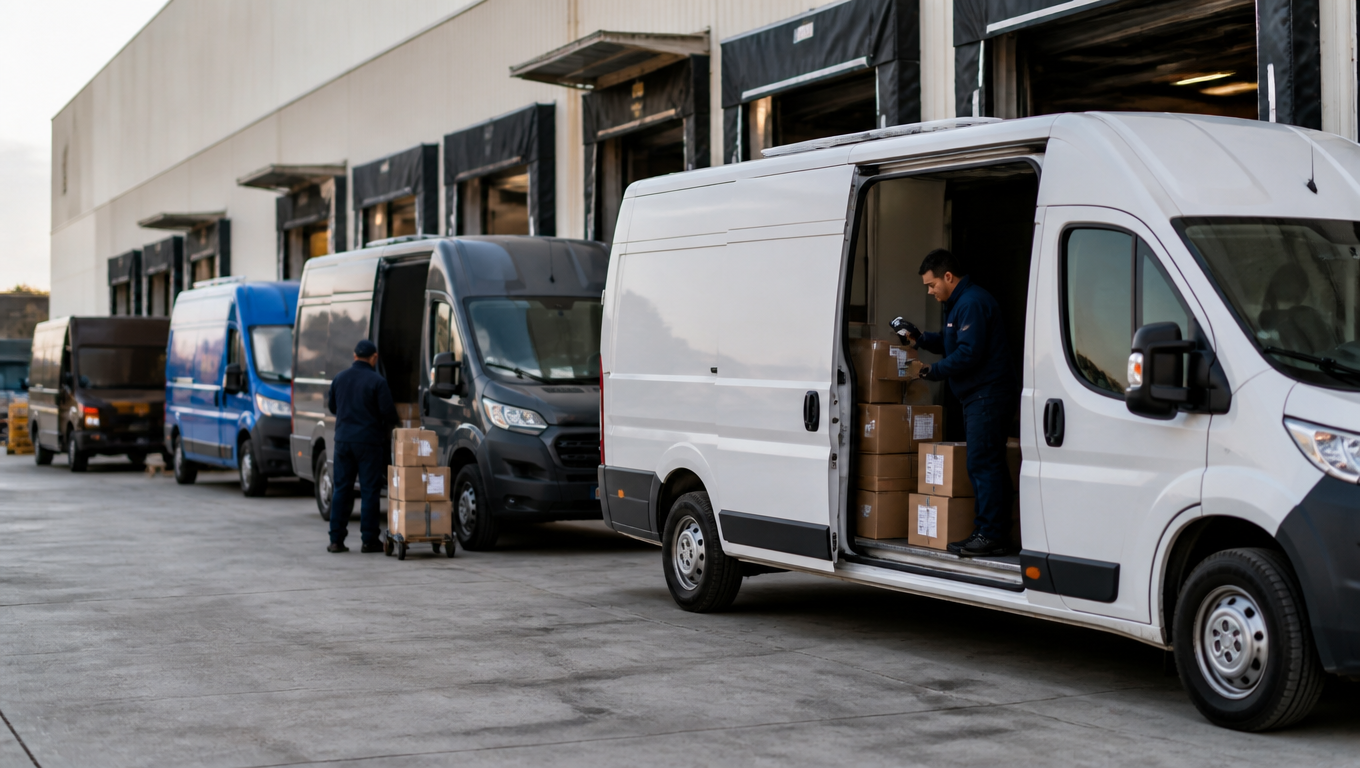
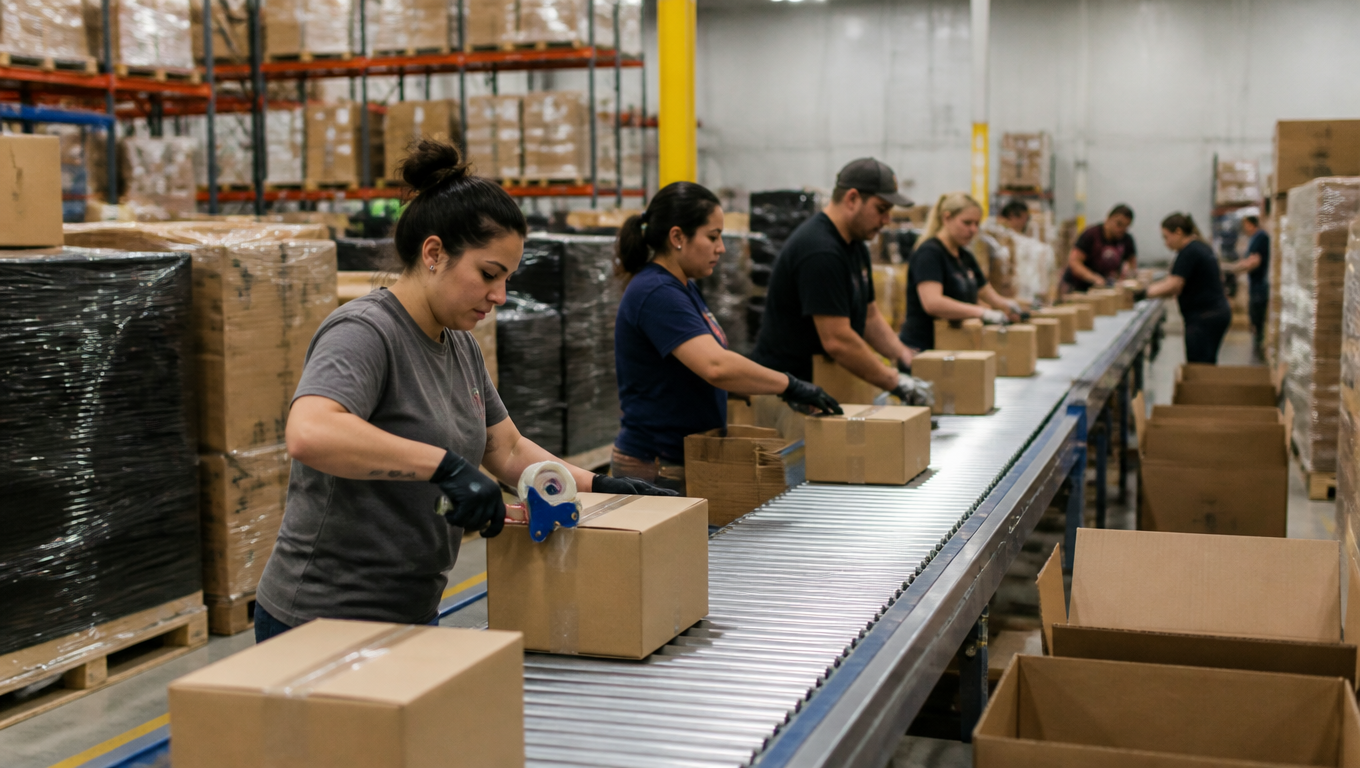
分屏仓库场景:左侧是带机器人和传送带的亚马逊履约中心,右侧是卖家在整洁的工作台前打包,一条虚线把两侧连起来,表示混合履约的分工
混合策略不是二选一,而是给每个 SKU 找到自己的主场A hybrid is not a choice between two models, it is finding each SKU the right home

为什么纯 FBA 越来越难自圆其说Why FBA-Only Is Getting Harder to Defend

FBA 仍然在做它一直在做的事:把你的产品放到 Prime 买家面前,享受大多数 FBM 链接比不了的转化优势。但天平的成本那一端,这几年一直在朝全 FBA 卖家倾斜。FBA still does what it has always done: it puts your product in front of Prime shoppers with a conversion advantage most FBM listings cannot match. But the cost side of that trade has been moving against the all-in-FBA seller for years.

仓储费和长期仓储附加费一路在涨[^1],而且会在慢动销库存上复利。一个月只卖 3 件的 SKU,每个月照样为它的货架空间付费,一旦跨过长期仓储门槛,附加费又叠在基础费率之上。对一个长尾满满的目录来说,月度仓储账单会悄悄成为损益表上最大的条目之一,往往比这些货最终能赚出来的利润还大。Storage fees and long-term storage surcharges keep climbing[^1], and they compound on slow inventory. A SKU that sells three units a month still pays for its shelf space every single month, and once it crosses the long-term storage threshold the surcharge stacks on top of the base rate. For a catalog full of slow movers, the monthly storage bill quietly becomes one of the biggest line items in the P&L, often larger than the profit those units will eventually generate.

履约费惩罚「形状不对」的货。体积重计费意味着超规或低密度的商品按它占的空间付费,而不是按它有多重[^2]。一件卖得不错的大件商品,即便毛利打满,在 FBA 费率下也可能结构性亏损。更别说入库配置费[^3]和旺季附加费[^4],给成本与备货规划叠了一层又一层过去根本不存在的复杂度。Fulfillment fees punish the wrong shapes. Dimension-based pricing means an oversized or low-density item pays for the space it occupies, not the weight it carries[^2]. A bulky product that sells fine can be structurally unprofitable under FBA fees even at full margin. On top of that, inbound placement fees[^3] and peak-season surcharges[^4] add layers of cost and planning complexity that used to be trivial.

风险面同样真实。冲排名期间断货、限制补货的容量上限、Q4 漫长的入仓上架周期,都会在最不能承受的时候烧掉销量和 momentum。旧的思维模型「FBA 等于增长、FBM 等于兜底」已经过时了。两个模型都有清晰的主场,无视这一点的目录,要么在费用上、要么在流失的销量上,总有一头在漏钱。The risk side is just as real. Stockouts during a rank-building push, capacity limits that slow restocks, and long warehouse-to-shelf lead times during Q4 all cost sales and momentum at exactly the moment you can least afford it. The old mental model, FBA equals growth and FBM equals fallback, is outdated. Both models have clear homes, and a catalog that ignores that is leaving money on the table in fees, in lost sales, or both.
什么时候 FBA 是对的归宿When FBA Is the Right Home

先从最明显的说起:FBA 换来 Prime 徽章和随之而来的 Buy Box 胜率。在买家货比十家的竞争关键词上,Prime 是一个稳定胜过 FBM 链接的转化杠杆,哪怕对手的 FBM 很快[^5]。如果一个 SKU 的生死系于某个竞争激烈的搜索词,这就是把它放 FBA 的有力理由。Start with the obvious: FBA earns the Prime badge and the Buy Box win rate that goes with it. On competitive keywords where buyers are comparing ten similar products, Prime is a conversion lever that consistently beats an FBM listing, even a fast one[^5]. If a SKU lives or dies on a competitive search term, that is a strong argument for FBA.

FBA 也是快销 SKU 的正确归宿,这笔账很直白。仓储费按每件每月收,一个月卖 40 件的 SKU 在仓里只待几天。周转越快,FBA 仓储分摊到每件售出上的成本就越低,这正是快销品恰好是 FBA 便利性最便宜的地方。小、轻、高毛利的产品把这个效应再放大一层:履约费占比小,毛利轻松消化,稳定的 Prime 销量带来的排名和评论速度,会随时间把 SKU 推向热卖位置。FBA is also the right home for high-velocity SKUs, and the math is straightforward. Storage fees are charged per unit per month, so a SKU that turns 40 units a month spends only a few days in the warehouse. The faster the turnover, the cheaper FBA storage becomes per unit sold, which is why fast movers are exactly where FBA's convenience is cheapest. Small, light, high-margin items compound the effect: the fulfillment fee is proportionally small, the margin absorbs it easily, and the rank and review velocity from steady Prime sales pushes the SKU toward best-seller positions over time.

还有一个纯粹务实的理由。如果你没法在家稳定地备货打包,比如经常出差、有本职工作、或者就是讨厌缠胶带,FBA 把整个运营负担从你肩上卸掉。对短板在执行而不是在毛利的卖家来说,花钱让 FBA 干,往往到最后反而是更便宜的选择。There is also a purely practical case. If you cannot prep and pack reliably at home, because you travel, work a day job, or just hate taping boxes, FBA removes an entire operations burden from your plate. For sellers whose weak point is execution rather than margin, paying FBA to handle it is often the cheaper option in the end.

什么时候 FBM 是对的归宿When FBM Is the Right Home

FBM 的主场从 FBA 费用开始变得苛刻的地方开始。超规和体积重商品是最典型的例子:一件大件货,FBA 每单收体积重费用,每个慢月收长期仓储费。换成 FBM,同一件商品只是一次拣货打包加一张承运商面单,差额可能就是整条毛利。FBM's home turf starts where FBA's fees get punishing. Oversize and dimensional-weight items are the clearest case: a bulky product pays FBA dimension fees on every order and long-term storage on every slow month. Under FBM, that same product costs one pick-and-pack operation and a single carrier label, and the difference can be the entire margin.

慢动销是第二个清晰的案例。一个 SKU 在 FBA 里一个月卖 4 件,一年要付 12 次月度仓储费,货却一直躺在仓库。换成 FBM,它可以住在你的车库或 3PL 的货架上,只有真卖出去的那个月才付费。对长尾库存来说,仓储费的数学几乎每次都赢过履约便利。Slow movers are the second clear case. A SKU selling four units a month under FBA pays twelve monthly storage fees a year while sitting in a warehouse. Under FBM, it can live in your garage or a 3PL's rack, and you only pay for the month you actually sell. For long-tail inventory, the storage-fee math beats fulfillment convenience almost every time.

季节性爆发也该归 FBM。一个只在 10 到 12 月好卖的产品,不该为全年 12 个月的 FBA 仓储位买单。旺季期间用 FBM 跑,或在季前把一部分库存转到 FBM,既覆盖了需求,又不用为 11 个月的空仓位付费。Seasonal spikes deserve FBM too. A product that only sells hard in October through December should not commit to year-round FBA storage. Running it as FBM during the spike, or shifting a chunk of the inventory to FBM before the season, covers demand without paying for eleven months of empty shelf space.

然后是一类 FBA 本来就处理不好的商品:易碎品、危险品、任何需要特殊处理的货。FBA 的流程是为规模化速度设计的,不是为玻璃器皿设计的。最后,如果你除了亚马逊还在自建站、Walmart 或 TikTok Shop 卖货,FBM 让你用同一个库存池喂所有渠道,而不是把亚马逊的货圈进一个只有亚马逊能碰的系统里。Then there are the products FBA simply handles poorly: fragile items, hazmat, or anything needing special handling. FBA's process is built for speed at scale, not for glassware. And finally, if you sell on your own site, Walmart, or TikTok Shop as well as Amazon, FBM gives you one inventory pool that feeds every channel, instead of walling off Amazon inventory in a system only Amazon can touch.

FBM 执行方式速查FBM Execution Quick-Reference

FBM 不是单一一种做法,它是一条光谱,你选的执行层直接决定成本和劳动量。三种选项覆盖几乎所有卖家。FBM is not one thing. It is a spectrum, and the execution layer you pick changes the cost and the work. Three options cover almost every seller.

卖家自发货(自配送)。在家里拣货、打包、发货。适合小、轻、量少、时间比钱多的卖家。典型成本就是承运商面单,小件大约几美元,加上包装。它在货量暴增、出差、或迟发指标开始啃账号健康的时候崩掉,到那时「免费」的劳动力就不再免费了。Merchant-fulfilled (self). You pick, pack, and ship from home. It fits sellers with small, light, low-volume SKUs and more time than money. Typical cost is the carrier label, roughly a few dollars for small parcels, plus packaging. It breaks down when volume spikes, when you travel, or when late-shipment metrics start eating your account health, at which point the "free" labor stops being free.

3PL / 履约仓。第三方替你存库存、替你发货,通常是月度仓储费加每单拣货打包费加承运商费率。适合货量已经超出车库、卖大件重货、或者多渠道销售想用一个仓喂所有渠道的卖家。当每单费用加仓储比你自己的时间和错误率更便宜时,它就回本了。3PL / fulfillment warehouse. A third party stores your inventory and ships on your behalf, usually with a monthly storage fee plus a per-order pick-and-pack fee plus carrier rates. It fits sellers whose volume has outgrown the garage, who sell heavy or bulky items, or who sell across multiple channels and want one warehouse feeding all of them. It pays off once the per-order fee plus storage is cheaper than your own time and error rate.

两种混用。按货型的经验法则很简单:轻小走自配送,大重走 3PL,混合目录按 SKU 段位拆分。很多卖家把轻的中速 SKU 自己发,重的和慢的交给 3PL。如果你经营 3PL,这就是你的话术:你是 FBA 费用和在家打包都搞不定那批 SKU 的执行层。A split between the two. The product-type rule of thumb is simple: small and light goes self, big and heavy goes 3PL, and a mixed catalog splits by SKU band. Many sellers self-fulfill the light mid-velocity SKUs while a 3PL handles the heavy and the slow. If you run a 3PL, this is your pitch: you are the execution layer for the SKUs that FBA fees and home packing both fail at.

分货决策框架The Allocation Decision Framework

框架一共四步,设计目标是在电子表格上跑,而不是凭感觉。The framework is four steps, and it is designed to be run on a spreadsheet, not a gut feeling.

第一步:给目录分段。拉出每个 SKU,按四个轴打标签:动销(每月件数)、重量尺寸、毛利率、季节性。大多数目录很快就自己分好了:少数快销品、一条肥中间、一条长尾。Step 1: Segment the catalog. Pull every SKU and tag it on four axes: velocity (units per month), weight and dimensions, gross margin, and seasonality. Most catalogs sort themselves quickly: a few fast movers, a fat middle, and a long tail.

第二步:给 FBA 适配度打分。对每个 SKU,权衡动销、重量、毛利和仓储风险。动销和毛利支持 FBA,重量和慢周转反对 FBA。你不需要复杂的打分模型,一个对阈值过还是不过的简单判断就够了。Step 2: Score FBA fit. For each SKU, weigh velocity, weight, margin, and storage risk. Velocity and margin argue for FBA; weight and slow turnover argue against it. You do not need a complex scoring model, a simple pass-fail against thresholds works.

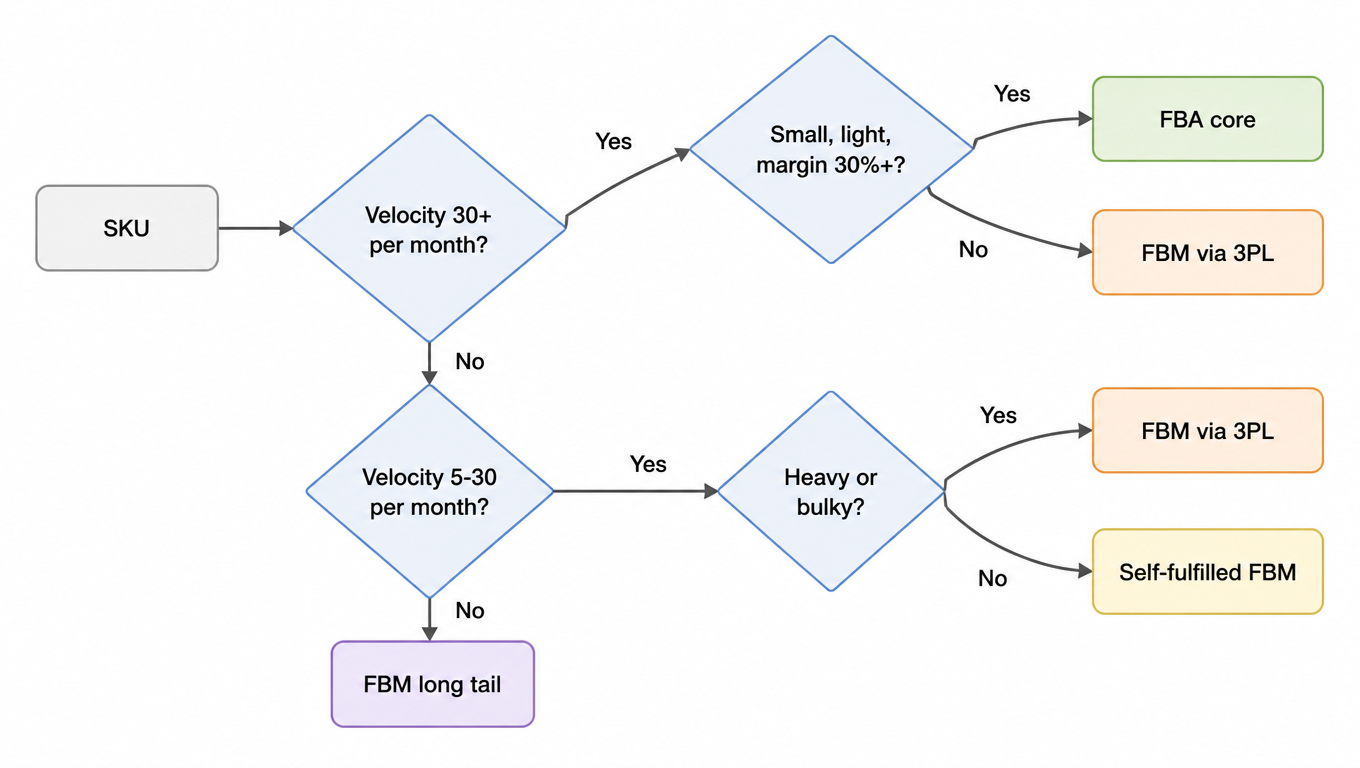
第三步:套阈值。用这样的规则:月销 30 件以上、轻小、毛利率 30% 以上的 SKU 进 FBA;超过 3 磅或体积大的 SKU 走 FBM 3PL;月销 5 到 30 件、重量轻的走自配送 FBM;月销不足 5 件的是 FBM 长尾,大件走 3PL,轻小自配送。Step 3: Apply thresholds. Use rules like these: a SKU selling 30 or more units a month that is small and light with a margin of 30 percent or more belongs in FBA. A SKU over 3 pounds, or bulky, belongs in FBM via a 3PL. A SKU in the 5 to 30 units a month band that is light belongs in self-fulfilled FBM. Anything under 5 units a month is FBM long tail, 3PL if bulky, self if light.

第四步:每季度复核再平衡。需求会变,费率会变,三月还是快销品的 SKU,七月可能就成了长尾包袱。每季度固定留出时间,重跑分段,把 SKU 在两个池之间搬动。这个拆分是一套系统,不是一次性的决定。Step 4: Review and rebalance quarterly. Demand shifts, fees shift, and a SKU that was a fast mover in March can be a long-tail liability in July. Block time every quarter, rerun the segmentation, and move SKUs between the pools. The split is a system, not a one-time decision.

分货决策流程图:先看月销是否 30 件以上,再看是否轻小且毛利率 30% 以上,落到 FBA 核心、FBM 走 3PL、FBM 长尾或自发货 FBMAllocation decision flow: velocity 30+ per month first, then small and light with 30%+ margin, landing on FBA core, FBM via 3PL, FBM long tail, or self-fulfilled FBM
四步框架的决策流:先看动销,再看重量与毛利The four-step allocation flow: velocity first, then weight and margin

案例:把 100 个 SKU 拆成 FBA 和 FBM 两摊Case Study: Splitting 100 SKUs Across FBA and FBM

来看一个典型的美国市场卖家。100 个 SKU,月营收约 12 万美元,100% 走 FBA。目录是经典的混搭:少数赢家、一条肥中间、一条悄悄累积仓储费的长尾。Meet a typical US-market seller. One hundred SKUs, roughly $120,000 a month in revenue, and 100 percent of it flowing through FBA. The catalog was a classic mix: a handful of winners, a fat middle, and a long tail that had been quietly accumulating storage charges.

数据自己会说话。按动销:21 个 SKU 月销 30 件以上,46 个在 5 到 30 件之间,33 个不足 5 件。按重量:34 个 SKU 不足 1 磅,41 个在 1 到 3 磅之间,25 个超过 3 磅。只有 38 个 SKU 毛利率过 30%。月度仓储账单 4,800 美元:3,100 美元基础费,加上 19 个在仓超过 270 天的 SKU 的 1,700 美元长期附加费。The data told the story. By velocity, 21 SKUs sold 30 or more units a month, 46 sold between 5 and 30, and 33 sold under 5. By weight, 34 SKUs were under a pound, 41 were between 1 and 3 pounds, and 25 were over 3 pounds. Only 38 SKUs cleared a 30 percent gross margin. The monthly storage bill was $4,800: $3,100 in base fees plus $1,700 in long-term surcharges on 19 SKUs that had been sitting for over 270 days.

拆分照着框架走。18 个 SKU 进 FBA 核心:快、轻、高毛利的赢家,约占 55% 营收。54 个交给 3PL:所有超规件、慢动销,以及快但重的例外,约占 30% 营收。21 个轻的中速 SKU 走自配送 FBM,约占 10%。最后 7 个 SKU 双挂:FBA 拿 Prime 流量和排名速度,FBM 那条用更高的价格接住非 Prime 需求。每个 SKU 只按主归属算一次。The split followed the framework. Eighteen SKUs went to the FBA core: the fast, light, high-margin winners, about 55 percent of revenue. Fifty-four went to a 3PL: all the oversize items, the slow movers, and the fast-but-heavy exceptions, about 30 percent of revenue. Twenty-one light mid-velocity SKUs went self-fulfilled FBM, about 10 percent. The last seven SKUs were dual-listed: FBA for the Prime traffic and rank velocity, with an FBM listing at a higher price to capture the non-Prime demand. Every SKU was counted once, by its primary home.

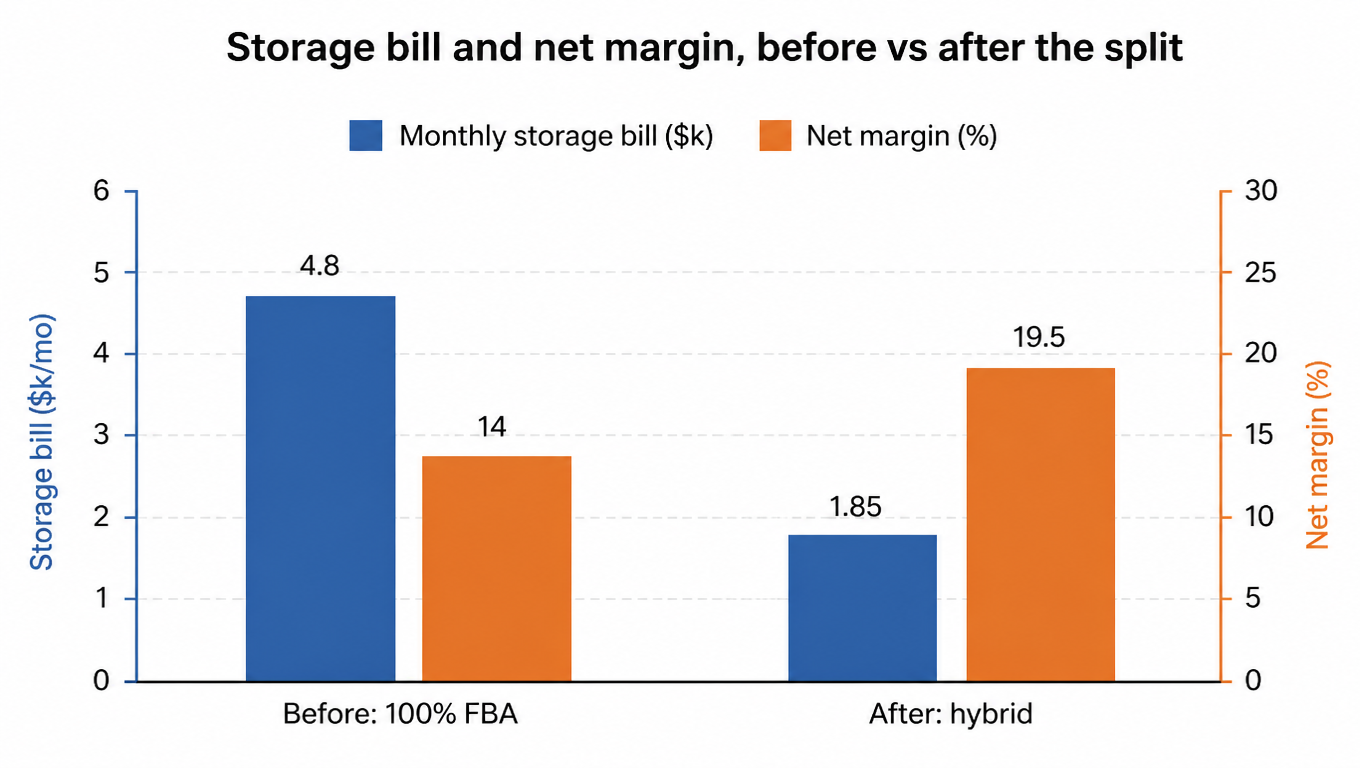
拆分前后对比柱状图:月度仓储费从 4,800 美元降到 1,850 美元,净利率从 14% 升到 19.5%Before vs after bar chart: monthly storage bill from $4,800 down to $1,850, net margin from 14% up to 19.5%
拆分后一个季度:仓储费下降 61%,净利率从 14% 升到 19.5%One quarter after the split: storage bill down 61 percent, net margin from 14 to 19.5 percent

一个季度后的结果。月度仓储账单从 4,800 美元降到 1,850 美元,降幅 61%,因为长尾库存离开了 FBA 的月度收费结构。断货率从 11% 降到 3%:赢家双挂,Prime 断货不再等于彻底丢单,FBM 那条链接继续卖。净利率从 14% 升到 19.5%,月营收从约 11.8 万美元爬升到 12.4 万美元,双挂的赢家接住了单条 FBA 链接一直漏掉的需求。卖家没有放弃 FBA,只是不再用 FBA 做所有事。The results after one quarter. The monthly storage bill dropped from $4,800 to $1,850, down 61 percent, because the long-tail inventory moved out of FBA's monthly fee structure. The stockout rate fell from 11 percent to 3 percent: the winners were dual-listed, so a Prime stockout no longer meant a total loss of sales, the FBM listing kept selling. Net margin moved from 14 percent to 19.5 percent, and revenue crept up from about $118,000 to $124,000 a month as the dual-listed winners captured demand that a single FBA listing had been missing. The seller did not abandon FBA. The seller stopped using it for everything.

30 秒速查表The 30-Second Cheat Sheet

场景Scenario 模型Model 为什么Why
快销、轻小、毛利率 30%+Fast mover, light, 30%+ marginFBA 核心FBA corePrime 转化、单件仓储低、排名速度最快Prime conversion, low per-unit storage, fastest rank velocity
大件或超 3 磅Oversize or over 3 lbFBM 走 3PLFBM via 3PL避开体积重计费和长期仓储附加费Avoids dimension fees and long-term storage surcharges
慢动销、月销不足 5 件Slow mover, under 5 units/monthFBMFBM仓储费数学胜过履约便利Storage-fee math beats fulfillment convenience
季节性爆发Seasonal spike当季走 FBMFBM for the season覆盖需求,不必为 12 个月仓位买单Cover demand without 12 months of shelf space
易碎、危险品、特殊处理Fragile, hazmat, special handlingFBMFBMFBA 的规模化速度流程不适合它们FBA's speed-at-scale process mishandles them
多渠道(自建站、Walmart、TikTok Shop)Multi-channel (own site, Walmart, TikTok)FBMFBM一个库存池喂所有渠道One inventory pool feeds every channel
冲排名爆款Best seller fighting for rankFBA 为主,FBM 高价承接FBA, plus FBM at higher pricePrime 放大排名,FBM 链接接住溢出需求Prime compounds rank; the FBM listing catches overflow
深陷长期仓储Stuck in long-term storage迁往 FBMMigrate to FBM停止为死库存付附加费Stop paying surcharges on dead weight

要避免的常见错误。凭感觉拆分而不是用四步框架,慢动销就是这样在两个季度内又溜回 FBA 的。把一切全倒进 FBM,白白丢掉真正需要它的 SKU 身上的 Prime 转化优势。把拆分当成一次性事件,从不重新平衡,目录就是这样悄悄漂回糟糕形态的。只在亚马逊上跑 FBM,浪费了 FBM 最大的优势:同一批库存同时服务自建站、Walmart 和 TikTok Shop。Common mistakes to avoid. Splitting by gut feeling instead of the four-step framework, which is how the slow movers end up back in FBA within two quarters. Dumping everything to FBM, which throws away the Prime conversion advantage on the SKUs that actually need it. Treating the split as a one-time event and never rebalancing, which is how a catalog drifts back into a bad shape. And running FBM on Amazon only, which wastes the biggest FBM advantage of all: the same inventory serving your own site, Walmart, and TikTok Shop.

混合是一套系统,不是一次性的决定。每季度跑一遍框架,让数据把 SKU 在两个池之间搬动,并且记住案例证明过的事:目标从来不是在 FBA 和 FBM 之间二选一,而是确保每个 SKU 自己挣回它的履约成本。The hybrid is a system, not a decision you make once. Run the framework quarterly, let the data move SKUs between pools, and remember what the case study proved: the goal was never to choose between FBA and FBM. It was to make sure every SKU pays for its own fulfillment.

常见问题FAQ

不是。双挂只是八种去向之一,案例里也只有 7 个 SKU 双挂,而且每个 SKU 按主归属只算一次。多数 SKU 有明确的主场:快、轻、高毛利进 FBA,大件、慢动销、季节品走 FBM。双挂专用于既要 Prime 流量和排名速度、又不想把非 Prime 需求白白放掉的爆款,FBM 那条用更高价格接溢出。双挂需要盯库存和价格,防止两个链接互相打架。No. Dual-listing is just one of several outcomes, only 7 of the 100 SKUs in the case study were dual-listed, and every SKU is counted once by its primary home. Most SKUs have a clear home: fast, light, high-margin goes to FBA; oversize, slow, and seasonal goes to FBM. Dual-listing is reserved for best sellers that need both Prime traffic and rank velocity without letting non-Prime demand go to waste, with the FBM listing at a higher price catching the overflow. It requires monitoring inventory and pricing so the two listings do not fight each other.
三个信号:仓储费开始吃利润,慢动销每个月都在为货架空间付费,超过 180 天还有长期仓储附加费;体积重计费让大件结构性亏损;季节性产品要为 11 个月空置的仓位买单。别凭感觉判断,跑一遍四步框架:动销、重量尺寸、毛利率、季节性四个轴分段,再套阈值(月销 30+ 且轻小且毛利 30%+ 进 FBA,超 3 磅或大件走 FBM,月销不足 5 件归 FBM 长尾)。Three signals: storage fees start eating margin, because a slow mover pays for shelf space every month and crosses into long-term surcharges after 180 days; dimension-based pricing makes an oversize item structurally unprofitable; and a seasonal product pays for eleven months of empty shelf space. Do not judge by gut feeling. Run the four-step framework instead: segment on velocity, weight and dimensions, margin, and seasonality, then apply the thresholds (30+ units a month, small and light, 30%+ margin goes to FBA; over 3 lb or bulky goes to FBM; under 5 units a month is FBM long tail).
小、轻、量小的 SKU 自配送,成本就是一张面单加包装;货量超出车库、大件重货、多渠道销售,就交给 3PL,按月仓储费加每单拣货打包费加运费结算。粗略的判断标准:当每单费用加仓储比你自己的时间和错误率更便宜时,就该升级。混合目录最常见的做法是轻的中速 SKU 自配送,重的和慢的走 3PL。Small, light, low-volume SKUs suit self-fulfillment, where the cost is a carrier label plus packaging. Once volume outgrows the garage, or the items are heavy or bulky, or you sell across multiple channels, a 3PL fits, priced as monthly storage plus a per-order pick-and-pack fee plus carrier rates. The rough test: when the per-order fee plus storage is cheaper than your own time and error rate, it is time to upgrade. The most common mixed-catalog setup is self-fulfilling the light mid-velocity SKUs while a 3PL handles the heavy and the slow.
不会,前提是快销核心留在 FBA。Prime 转化优势是 FBA 留给真正需要它的 SKU 的:把爆款核心留在 FBA 拿 Prime 流量和排名速度,把 FBM 留给大件、慢动销和季节品,两边优势都不丢。案例里 18 个核心 SKU 占 55% 营收仍走 FBA,净利率反而从 14% 升到 19.5%,断货率从 11% 降到 3%。No, as long as the fast-moving core stays in FBA. Prime conversion is the advantage FBA keeps for the SKUs that genuinely need it: keep the best-seller core in FBA for Prime traffic and rank velocity, give FBM the oversize, slow, and seasonal items, and you keep both advantages. In the case study, 18 core SKUs representing 55 percent of revenue stayed in FBA, yet net margin still rose from 14 to 19.5 percent and the stockout rate fell from 11 to 3 percent.
每季度一次。需求会变,费率会变,三月的快销品到七月可能就成了长尾包袱。每季度固定留出时间,重跑四步框架:分段、打分、套阈值、重新分配,把 SKU 在两个池之间搬动。混合是一套系统,不是一次性的决定;不做季度复核,目录就会悄悄漂回糟糕形态。Every quarter. Demand shifts and fees shift, and a SKU that was a fast mover in March can be a long-tail liability in July. Block time each quarter and rerun the four-step framework: segment, score, apply thresholds, reallocate, moving SKUs between the pools. The hybrid is a system, not a one-time decision; skip the quarterly review and the catalog quietly drifts back into bad shape.
Get Rate Comparison
Get Rate Comparison