
Ecommerce Shipping Guide

How to Pilot a 3PL Before You Sign: A Test-Order Framework for Rates, Labels, Tracking, Returns, and Billing

Every 3PL sales process ends the same way: a polished demo, a competitive rate card, a wall of carrier logos, and a handshake. The uncomfortable truth is that none of those artifacts survive contact with a real order. Rate cards price a theoretical package, demos run on clean data, and integration logos prove a connection exists somewhere, not that it holds up on your SKUs, your zones, and your return policy.

The fix is to stop judging a candidate on what it says and to judge it on evidence. This guide gives you a test-order framework: one representative order set, run identically through every candidate 3PL, measured across five stages from order intake to final billing, and scored against pass lines you define in advance. What survives the pilot is what you should sign. What cannot be demonstrated in a controlled two-week test will not magically appear once the contract starts. Written for both ecommerce sellers and the 3PLs that serve them, so you can hand the same framework to a candidate without flinching.

Seller reviews a contract and test-order checklist beside a scale, label printer and labeled parcel.
Rate cards and demos do not survive real orders. Test orders do.

Why Rate Cards, Demos, and Warehouse Tours Can't Tell You Which 3PL Will Actually Work

Here is the buying problem most merchants hit. You shortlist two or three 3PLs, sit through their demos, and receive rate cards that differ by a few cents on a handful of lanes. On paper the candidates are indistinguishable, so the decision defaults to price, gut feel, or whichever rep replied fastest. The differences that will actually determine your success do not live on those slides. They only show up when real orders flow through the candidate's systems, and by then you have signed.

Each of the classic evaluation tools fails for a structural reason. A warehouse tour proves the building and the headcount exist; it does not prove this team can pick your oddly shaped SKU, hit your cutoff, and keep your backorders straight. A rate card prices a clean, single-unit, zone-5 parcel at list time; it says nothing about dim-weight re-rates, peak surcharges, address corrections, or the invoice you will receive in month three. An integration logo proves a connector was built at some point; it does not prove an order survives the path from your cart to their WMS to a generated label to a tracking event in your customer's inbox without a human patching it weekly.

The shift this guide asks you to make is modest but consequential. Instead of collecting sales artifacts, collect operational artifacts. Run a controlled set of test orders through each candidate and ask every stage of the journey to produce something verifiable: an order confirmation, a label, a tracking event, a return record, an invoice line. Verbal answers are logged for context but never weighted. A 3PL that refuses this kind of diligence is telling you something about the two years after you sign.

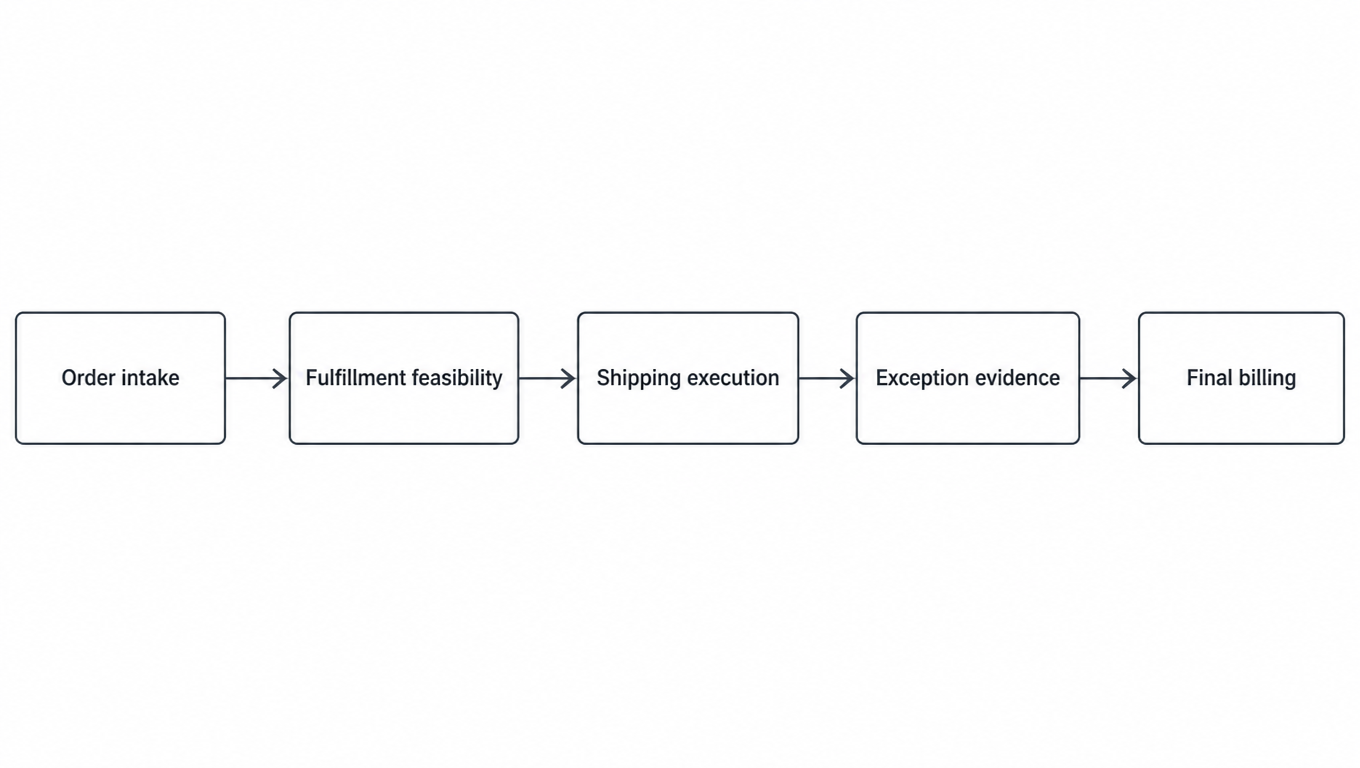
The pilot walks a full closed loop, and every stage in it maps to a section of this guide: order intake, fulfillment feasibility, shipping execution, exception evidence, and final billing. Each stage must yield a verifiable artifact, and each has a pass line you can check off before you move on.

The Pilot Design: One Representative Order Set, Run Identically Through Every Candidate

The golden rules of a useful pilot are three. First, run the same orders through every candidate; you are comparing candidates against each other, and the only fair way to do that is identical inputs. Second, use the same script and the same measurements, so results land on a single scorecard rather than a set of anecdotes. Third, accept only evidence. When a sales rep tells you "we handle that in production," log it, but do not let it count. What counts is the artifact the test order produced.

Flowchart: order intake → fulfillment feasibility → shipping execution → exception evidence → final billing, a five-stage closed loop
Five-stage closed loop: every stage must produce a verifiable artifact

Start with ghost orders before you touch real inventory. A ghost order is a fake order you create in the candidate's test environment that flows end to end through their systems: intake, allocation, labeling, tracking simulation, and billing. Ghost orders validate process and integrations cheaply, with zero risk to real customers or stock. Reserve real orders for the second phase, once the plumbing demonstrably works, and keep the real orders small enough that any mistake costs you a few dollars, not a reputation.

The representative order set is where most pilots quietly fail. Sales teams love to pilot on your flattering mix: single-SKU, midweight, near-warehouse zones. Your real mix is messier, and your pilot must reflect it. Cover your actual channels and order types: cart and marketplace feeds, single-line and multi-line orders, split shipments, and backorders or partials. Cover the physical reality: your weight and dimension bands, including the one that crosses a dim-weight threshold. Cover geography: your true zone spread, residential and commercial addresses, and the occasional PO box. Cover promises: whatever delivery speed you advertise to customers belongs in the test set, because if the candidate cannot meet it with the carriers it holds, your customer service team will feel it for years. If you are still choosing the shortlist itself, our parcel shipping RFP guide will normalize the candidates first; the pilot assumes you have two or three real contenders.

Every stage must produce a named artifact, so results stay comparable across candidates. Use this table as the spine of your scorecard:

Pilot stageArtifact you collectWhat it proves
Order intakeOrder confirmation with SKUs, quantities, and addresses as submittedTheir system accepts your real order shapes
Fulfillment feasibilityPick, pack, and ship-ready state within their stated SLAInventory and capacity can actually serve your mix
Shipping executionGenerated label and tracking events at carrier cadenceLabels, carriers, and tracking match what your customer sees
Exception evidenceCancel, void, return, and claim records with timestampsException paths exist and close, not just in the demo
Final billingInvoice lines that trace to pilot order IDsThe rate card reconciles to the real invoice

Timing and volume matter less than consistency, but a workable default is a staged two-week design: week one is the process week, where you run ghost orders and close integration gaps with each candidate; week two is the real-order week, where a small batch of genuine orders confirms the process under near-production conditions. For each scenario you care about, three to five clean data points are enough to trust the signal. If a scenario fails twice in a row, you have your answer; you do not need to run it ten times. A 20 to 30 order pilot, spread across your scenarios, is proportionate for a contract that will bind you for one to three years.

Order Intake and Fulfillment Feasibility

The first stage answers a deceptively simple question: can this 3PL accept the orders your store actually produces, in the shapes it actually produces them? Order intake is where channel and order-type coverage shows up. If you sell through Shopify plus Amazon plus a wholesale portal, each feed has its own quirks, and the pilot needs at least one order per channel, not one channel done beautifully. Multi-line orders, split shipments, and backorders are where systems earn their keep: a candidate can look flawless on single-SKU traffic and then split a two-line order into two boxes without telling you, or sit on a backorder until you ask.

Physical reality checks belong in this stage too, because rate cards are priced on assumptions your products will violate. Pull a sample of your real SKUs and confirm each candidate's system accepts their true weight and dimensions, including the box that pushes a shipment over a dim-weight threshold [^1]. Ask how the candidate treats dim weight versus actual weight, and watch what happens on the invoice, not in the conversation. Packaging is part of this: the box that looked fine on the warehouse tour may not survive your fragile category, and a SKU the sales rep swore was shippable may not fit the smallest carton they stock.

Address and promise reality is the quiet killer. A candidate's rate card may quote attractive zone-2 pricing while your customers cluster in zones 5 to 8. Confirm the promised delivery speeds are actually offered by the carriers the candidate holds accounts with, and probe the address types your business genuinely serves: residential with a delivery fee, commercial with a dock, PO boxes that ground most parcel carriers. Cutoff and weekend behavior deserve their own test: compare the stated cutoff with the observed cutoff by placing an order at 4:58 pm against a 5:00 pm promise, and check whether Saturday pickup actually happens or exists only in the sales deck. Seasonal behavior is harder to pilot in two weeks, so ask pointed questions and verify what you can: how peak surcharges and capacity letters land on your bill [^2], and what the candidate did for its current customers during the last peak.

The pass line for this stage: orders flow through the candidate's systems and your store end to end without manual patches. Every order that needed a human workaround, a re-entered field, or a "we fixed it on our side" email gets logged as a conditional, not forgiven.

Shipping Execution: Labels, Tracking, and Carrier Selection

Shipping execution is where a 3PL's real carrier relationships become visible. Start with label accuracy. The generated label must match what you authorized: the correct service level, weight, and dimensions. If you sell on marketplaces that require their own prepaid-label flow, and Amazon's Seller Fulfilled Prime program is the best-known example [^3], confirm the candidate actually flows those labels through instead of quietly bypassing them and billing you for its own, which is both a cost leak and a policy violation on that channel. Ship a label to yourself and read it like a customer would: service name, expected delivery date, and a tracking number that resolves.

Tracking completeness and latency is the second check. A tracking number that never updates, or updates only after you email someone, is indistinguishable from no tracking to your customer. Confirm events appear and update at the carrier's normal cadence, and that the status reaches your order record and your customer's inbox through the native integration, not through a scraping hack someone built and forgot. The pilot artifact here is simple: place the order, note the timestamp, and watch whether events appear without you asking. Whether the candidate built its carrier connections or bought them shows up in exactly these edge cases; our build-vs-buy guide for 3PL carrier integrations explains what to look for.

Carrier and service eligibility is the layer most merchants never inspect. Ask which carriers the candidate actually holds accounts with, then verify the service selection matches both your promise and the zone. A quote that assumes UPS Ground on a zone-8 delivery is only honest if the candidate will actually ship UPS Ground there at the quoted rate. This is also the moment to check that the quoted rate uses the carrier it will really ship with; quoting cheap on one carrier and shipping on another is a classic way rate cards lie.

The failure-path test is the most informative single exercise in the entire pilot. Deliberately disable the primary carrier or force a service the candidate cannot fulfill, then watch what happens. Does the system re-rate and route to a working fallback within a defined window, does it alert someone who fixes it, or does the order stall in exception limbo until a customer emails? Every 3PL claims resilience in the demo; the failure-path test is where you see whether fallback logic actually exists. A useful phrasing for the script: "this is a hypothetical scenario for the test set: primary carrier down, how does this order ship?" The answer, demonstrated on a real test order, tells you more than an hour of slides about redundancy.

The pass line for this stage: label and tracking artifacts match what a real customer would see, and a deliberately induced carrier failure routes to a working fallback within a window you and the candidate agree on in advance.

Exception Evidence: The Bad-Weather Tests

Normal orders prove a 3PL can do the easy part. Exceptions prove it can do the job. This stage is where you throw the operational weather at each candidate, one scenario at a time, and demand a documented resolution for each.

A storm cloud over a parcel surrounded by voided-label, return and torn-receipt symbols.
The bad-weather tests: every exception must come back with a timestamped, auditable resolution path

Start with cancel and void, the cheapest exceptions and the ones with the fastest cost exposure. Cancel an order before label creation and confirm it simply dies. Cancel one after the label is created and watch who eats the label cost, how fast the void reaches the carrier, and whether the refund or credit actually flows back to you or floats forever in a balance you cannot reconcile. Two scenarios, two timestamps, two answers.

Returns and RMA behavior is the customer-facing exception, and it is where brands bleed. The return label your customer receives must match your published policy: same carrier, same service tier, same cost to the customer or to you. Then follow the inbound leg: is the returned item received, inspected, and restocked or dispositioned with a visible status, or does it vanish into a bin for three weeks? Finally, confirm the loop closes: the customer gets their refund notification and you get your inventory update without a spreadsheet dance on your side. Run one return per channel you support, because return flows are rarely the same across Shopify, Amazon, and your own site.

Damage, loss, and claim ownership needs to be settled before it happens, and the pilot is the cheapest place to learn it. When a parcel is damaged or lost, who files the claim: the carrier, the 3PL, or you? Who owns the evidence: photos, weight tickets, delivery scans? And when the claim pays out, where does the credit land and how is it applied? The answer you want is a named owner and a stated timeline, demonstrated on the test order, not a "we handle claims" sentence.

Data ownership and portability is the exception nobody tests and everybody regrets. Establish in the pilot who owns the order, inventory, and label data, what an export actually looks like, and whether your customer database leaves with you on exit. Run the export on a small pilot dataset and open the file. A 3PL that cannot export cleanly today will hold your history hostage when you leave, and the contract language is far easier to negotiate while they still want your business.

The pass line for this stage: every exception you throw at the pilot produces a documented, time-stamped resolution path you could audit later. Exceptions that resolve only after a phone call, or that produce no record, fail the stage.

Final Billing: Reconcile the Rate Card to the Invoice

Billing is where pilots end and marriages begin, so make the final invoice the centerpiece of the exercise. The quote-to-bill walk is simple to describe and rare in practice: take each pilot order's quoted rate and find it on the final invoice. As an example, say the rate card quoted 9.85 dollars for your 3 lb zone-5 box and the invoice shows 13.60 dollars. The delta is not rounding. The question is whether the candidate can decompose that delta line by line, on the phone, while you watch, and whether the decomposition matches the rate card's own terms. For the systematic version of this drift, see our guide on why rate quotes don't match final carrier charges.

Weight adjustments, surcharges, and fees are where most unexplained deltas live. Watch specifically for dim-weight re-rates that appear after the fact [^1], fuel and peak surcharges applied on top of quoted rates, address correction fees, and any line item that exists only on the invoice and nowhere in the quote. None of these are necessarily wrong; all of them must be explainable and predictable. The pilot tells you which candidate explains them and which one hopes you do not ask. When deltas keep appearing and nobody can explain them, our guide to auditing 3PL shipping rates walks the full accounting.

Credits and refunds deserve their own test, because cash flow follows them. Void a label and time the credit. File a claim and time the credit. Overcharge a pilot order on purpose, if your contact will play along, and time the correction. The question is whether credits land quickly and reconcile to the specific order, or float as a lump balance nobody can attribute. Merchants who skip this test discover in month six that their 3PL balance is a black box with a positive number in it.

Billing transparency is the final layer: every invoice line item should trace back to an order ID, and the billing contact should be able to explain any line on demand. If the person who sells you the account cannot explain the pilot invoice, the person who bills you in year two definitely cannot.

Red-flag signals for this stage (seller-facing): recurring unexplained fees; credits that never reconcile to an order; quote-to-bill drift beyond the tolerance you set before the pilot; and carrier-rate opacity, where you cannot see the underlying carrier charge beneath the 3PL's markup. Any one of these warrants a conditional at best.

The Decision Framework: Pass, Conditional Pass, Unbundle Shipping, or Fail

When the pilot is done, score each candidate against the pass lines you set in advance and place it in one of four buckets. Do not score against how much you liked the sales rep.

Pass. Normal orders and exception orders closed end to end, and the quote explains the final bill. Sign, and use the pilot artifacts as the baseline in your contract.

Conditional Pass. The candidate is shipworthy with conditions: one channel needs a fix, tracking latency exceeds your tolerance, a billing line needs a rule. The fixes go into the contract as SLA language with dates and named owners, not into a hallway promise. A conditional without a dated, written remediation plan is a fail wearing a better outfit.

Unbundle Shipping. This is the bucket most merchants do not know exists. Warehousing and pick-pack pass, but rate transparency, carrier selection, or data visibility fails. You can keep the 3PL for storage and fulfillment and run the shipping layer separately, through a channel-neutral shipping platform you control that compares US domestic carrier options, executes the shipment, and keeps the underlying rates visible. Unbundling converts a mediocre all-in-one into two good vendors, and it is a legitimate answer to a pilot that is 80 percent clean.

Fail. A key channel, delivery promise, exception path, or billing line cannot be verified in the pilot. Fail the candidate. No contract fixes what a pilot could not demonstrate, because the pilot is the easiest conditions will ever be: small volumes, your attention, and a vendor trying to impress you. If it fails now, it fails harder at peak.

Red-flag signals across all stages (seller-facing): a touring-only sales motion with no interest in your order data; no test environment to run ghost orders; no documented fallback when you force a carrier failure; billing that cannot be explained line by line; and visible reluctance to put pilot results into the contract. Treat any one of these as a strong negative, and two as disqualifying regardless of the rate card.

Locking It In: From Pilot Evidence to Contract

A pilot that ends when the pilot ends is a wasted two weeks. The point of collecting evidence is to convert it into contract language you can enforce. Take each pass line the candidate met and turn it into a measurable SLA clause: turnaround time from order to carrier scan, tracking-event latency, billing dispute windows with defined response times, and claim ownership with stated filing and credit timelines. Where the pilot exposed a gap, the SLA is where the fix gets a date and an owner.

The pilot also hands you negotiating leverage on contract specifics that are painful to change later. With evidence in hand, push for fallback-carrier obligations with a defined switchover window, surcharge pass-through rules that match what the pilot showed, a data export clause with a tested format and an exit timeline, and pilot-to-production terms so the pricing and behavior you validated survive the transition. These clauses are far easier to get before signing than after, because at this moment you have what every 3PL wants: a ready-to-sign customer with clean diligence.

Plan the re-test cadence on the calendar before you forget why it matters. Run the same pilot order set annually, and run it again whenever carriers, pricing, or your order mix materially change. A 3PL relationship drifts: reps leave, warehouses consolidate, carriers renegotiate, and your product mix shifts. The annual pilot is the early-warning system that catches the drift while it is still cheap to correct. To keep watching performance after launch, our 3PL parcel shipping performance scorecard is the operating version of the same discipline.

Finally, weigh how the candidate behaved during the pilot itself, because that behavior is data. A good 3PL treats a pilot request as standard diligence: it supplies a test environment, names a technical contact, documents its own processes, and welcomes you running the same script at its competitor. That last point matters most. A confident operator knows the identical test set across all candidates is the fairest possible comparison, and it is happy to be measured. The candidate that hesitates, obfuscates, or negotiates the test itself is telling you, in real time, exactly how the next two years will feel. Listen.

When you run these tests, put the candidates and your own accounts on one table: ZIP-based carrier serviceability and rate comparison, so every "is this rate right, and who should ship it" question runs on data. A channel-neutral shipping layer like EasyShippingX compares US domestic carrier options uniformly and executes through a portal, Excel, or API, which is exactly the tooling for getting rates, labels, tracking, and billing onto one table before and after you sign. To do the arithmetic, use our shipping rate calculator and shipping cost optimization advisor; to see how this layer fits daily operations, our guide to 3PL shipping operations is the hub, and our pricing page shows how a channel-neutral shipping layer is delivered. It fits inside the broader operation rather than replacing it.

FAQ

Aim for three to five clean data points per scenario you care about; a scenario that fails twice in a row is your answer, no need to run it ten times. A 20 to 30 order pilot spread across your scenarios is proportionate for a contract that will bind you for one to three years. Run ghost orders through the candidate's test environment first to validate the plumbing, then confirm with a small batch of real orders under near-production conditions, so any mistake costs a few dollars rather than a reputation.
Yes. Running the identical order set and script across all candidates is the fairest possible comparison and produces the highest-quality evidence. A confident 3PL treats a pilot request as standard diligence and welcomes you running the same script at its competitor; one that hesitates, obfuscates, or negotiates the test itself is telling you in real time what the next two years will feel like.
A ghost order is a fake order you create in the candidate's test environment that flows end to end through intake, allocation, labeling, tracking simulation, and billing, validating process and integrations with zero risk. Once the plumbing demonstrably works, add a small batch of real orders so any mistake costs a few dollars, not a reputation. Reverse the order and you are debugging with your own customers and stock.
Ask the candidate to decompose the delta line by line on the spot: dim-weight re-rates that appear after the fact, fuel and peak surcharges on top of quoted rates, address correction fees, and any line item that exists only on the invoice. The decomposition must match the rate card's own terms. Set your quote-to-bill tolerance before the pilot; a gap beyond it that nobody can explain is a red flag and warrants a conditional at best.
Yes, and that is exactly what the Unbundle Shipping bucket is for: warehousing and pick-pack pass, but rate transparency, carrier selection, or data visibility fails. Keep the 3PL for storage and fulfillment, and run the shipping layer on a channel-neutral platform you control that compares US domestic carrier options, executes the shipment, and keeps underlying rates visible. A pilot that is 80 percent clean often deserves two good vendors more than one mediocre all-in-one.