3PL Guide

How 3PLs Can Add More Shipping Carriers Without Building Every Integration In-House

The carriers a 3PL can ship with used to be a quiet operational detail. Today it is a sales conversation. Retailers mandate which carriers their vendors can use. Marketplaces route orders through preferred partners. Drop-shippers show up with their own last-mile networks and expect you to plug in. When a prospect asks, "Can you ship with carrier X?", the answer decides whether you win the account, not whether you do a little extra engineering.

The problem is that every additional carrier can become another in-house project spanning API documentation, sandbox work, certification, testing, and ongoing maintenance. This guide uses $30,000–$80,000 and three to six months as illustrative planning ranges, not market quotes. Replace them with your own engineering cost, certification timeline, and maintenance load before using the six-question build-versus-buy scorecard.

A busy 3PL warehouse floor at dusk, workers scanning and loading parcels onto conveyor belts
One more carrier in the warehouse should not mean one more project for the dev team

1. Why Carrier Count Is Now a Growth Problem

The carriers a 3PL can ship with used to be a quiet operational detail. Today it is a sales conversation. Retailers mandate which carriers their vendors can use. Marketplaces route orders through preferred partners. Drop-shippers show up with their own last-mile networks and expect you to plug in. When a prospect asks, "Can you ship with carrier X?", the answer decides whether you win the account, not whether you do a little extra engineering.

Scope the carrier integration against the Shipping API workflow overview before costing the maintenance work. Use the 3PL API procurement guide to compare the procurement requirements after the build-versus-buy decision. For a carrier-specific checklist, continue to the SpeedX integration guide.

Saying no has a price. A 3PL that cannot support the carrier a shipper already uses is asking that shipper to change its business to fit the 3PL. Few shippers will. The request goes to the next 3PL on the list, and the deal goes with it.

More carriers used to mean more engineering. Every new carrier was its own project: its own API docs, sandbox, certification, and test cycle. The sales team could win on service, but the delivery pipeline moved at the speed of the dev backlog. That is the real bottleneck now. It is no longer finding customers who want more carriers; it is building the integrations fast enough to say yes.

2. The Real Cost of One In-House Integration

Start with the upfront work. An engineer needs to read the carrier's API documentation, set up a sandbox account, build rate parsing, label generation, tracking hooks, and exception handling, then test against real shipments. Nothing about this is trivial, and the quality bar is high because labels and rates feed directly into customer-facing operations.

Then comes certification. Many carriers require an approval process before production access, and that process runs on the carrier's calendar, not yours.[^3][^4] Weeks is normal; months happens.

The cost that surprises most operators is the ongoing one. Carrier APIs change. Endpoints get deprecated, authentication flows get updated, label formats shift. Every change means monitoring, re-testing, and redeploying, forever, for every carrier you have ever integrated.[^5] That is recurring engineering spend that never appears on the original project budget.

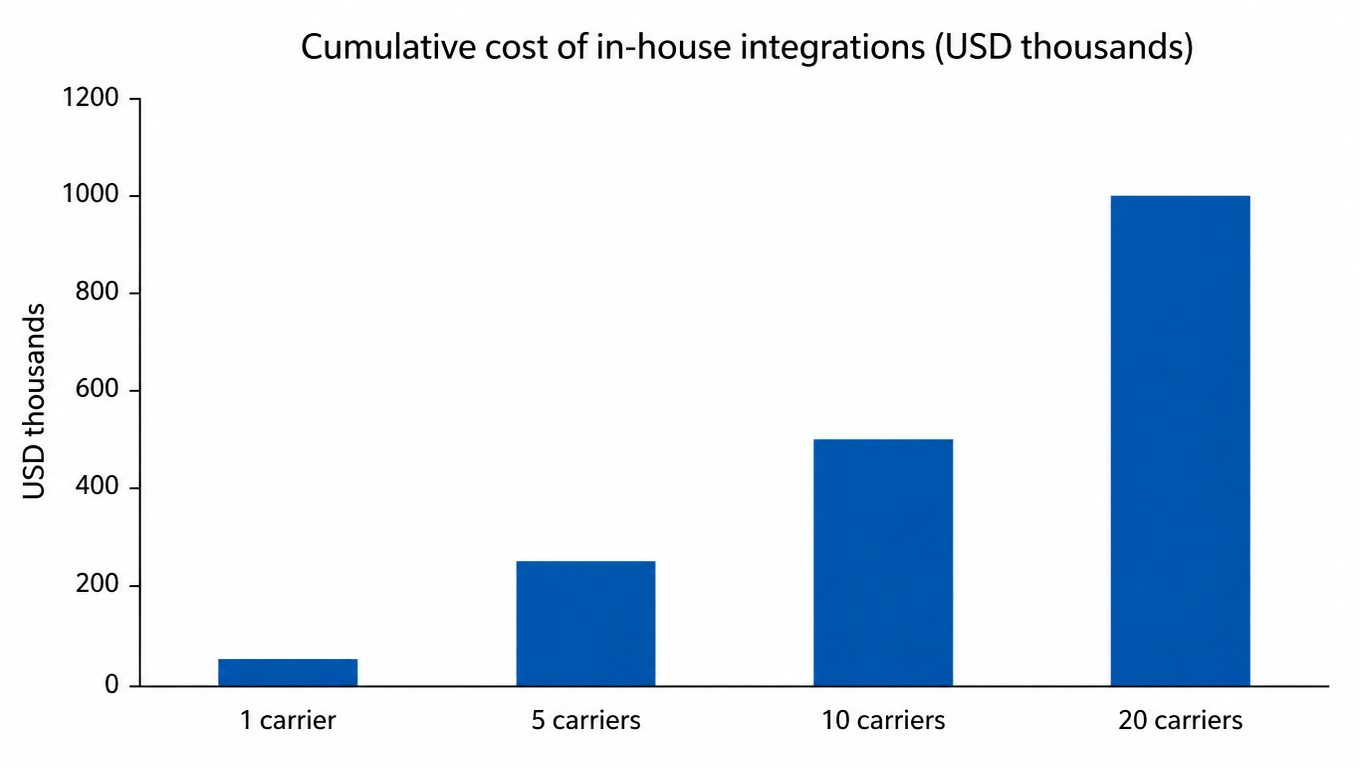
A realistic all-in figure for one carrier integration, including development, certification, and the first year of maintenance, lands between $30,000 and $80,000, with three to six months of calendar time.[^1][^2] Multiply by the ten to twenty carriers a competitive 3PL wants to offer, and the math explains why so many 3PLs stall at a handful.

Bar chart of cumulative in-house integration cost: $50K for 1 carrier, $250K for 5, $500K for 10, $1M for 20 (USD thousands)
The more carriers, the steeper the in-house cost curve

3. Speed: The Sales Clock and Onboarding Bottleneck

Carrier requests arrive during the sales cycle, not after it. A prospect asks for a specific carrier in week two of negotiations. If the answer is "we can start development," the deal enters a holding pattern that competitors can break. Every week of waiting is a week the shipper is being courted by someone who can already say yes.

The same clock runs on onboarding. When a signed shipper already ships with carrier X, the 3PL cannot go live until the integration ships. That delay pushes revenue into the future, strains the relationship at the exact moment it should be building trust, and makes the new account look like a bad decision.

Self-build scales linearly.[^6] Each new carrier is a new project with its own queue position behind every other project. A 3PL with two integrations in flight is two projects deep; a 3PL with ten is a small software company that happens to run a warehouse. The competitive gap is simple: the 3PL that can say "yes, next week" beats the one that says "we'll start development."

4. Risk: Every Carrier API Change Is a Fire Drill

Carriers change their APIs on their own schedule.[^8] Endpoints move, authentication flows change, label formats shift, and the notice is often short. For a 3PL that maintains integrations in-house, each change is an incident: an engineer drops everything, reproduces the failure, patches the code, and redeploys.

The failures surface at the worst moments. A rate request that silently fails at end of day, or a label error during peak season, hits when there is no slack in the operation. These are the calls nobody wants to take at 9 p.m. in December.

Certification and sandbox changes add a quieter risk: integrations can break without a visible event, until a shipper's package sits on the dock. The cumulative effect is that in-house teams spend their cycles firefighting carrier plumbing instead of improving the service that actually differentiates the 3PL.

A logistics manager on the phone at night, staring at a screen showing a failed carrier rate request during peak season
The late-night peak-season call is often not from a client, it is from a carrier API

5. Build vs Buy, Side by Side

The honest way to choose is to put both options on the same sheet and compare them dimension by dimension. The table below does exactly that.

Dimension Build in-house Multi-carrier layer
Time to first carrier3 to 6 monthsDays to a week
Time per additional carrierMonths, queued behind other projectsConfiguration, not code
Upfront cost per carrier$30,000 to $80,000One integration, shared cost
Ongoing maintenanceYour team, foreverHandled by the layer
Carrier coverageWhatever you have builtAlready-connected network
Control and customizationFull control, full burdenControl where it matters
Team bandwidth neededDedicated integration teamMinimal

The key insight: buying does not mean losing control. It means trading the maintenance burden for flexibility. The 3PL still chooses which carriers to offer, still sets its own rates, and still owns the client relationship. What it gives up is the recurring cost of keeping dozens of carrier connections alive.

6. The Scorecard: 6 Questions That Decide Build or Buy

A scorecard turns the trade-off into a decision. Score each of the six questions from 1 to 3, add the points, and read the total.

  1. How many carriers do you plan to offer? 1 to 2 (1 point), 3 to 10 (2 points), more than 10 (3 points).
  2. How often do carrier APIs change, and how much maintenance does each integration need? Low (1), moderate (2), high (3).
  3. How much engineering bandwidth can you spare for integrations? Plenty (1), some (2), none to spare (3).
  4. How fast does onboarding need to be? Slow (1), moderate (2), fast (3).
  5. How much deep per-carrier customization do you need? High (1), some (2), little (3).
  6. How comfortable is the budget with ongoing maintenance? Comfortable (1), tight (2), no room (3).

Total of 6 to 9: build what you need. Total of 10 to 14: hybrid, build the one or two carriers that differentiate you and buy the rest. Total of 15 to 18: buy broadly; engineering should improve your product, not maintain carrier plumbing.

Most 3PLs land in the hybrid zone. The carriers that are strategic differentiators, the ones clients choose you for, are worth building. Everything else is breadth, and breadth is exactly what a multi-carrier layer is built to provide.

7. What "Buying" Actually Looks Like

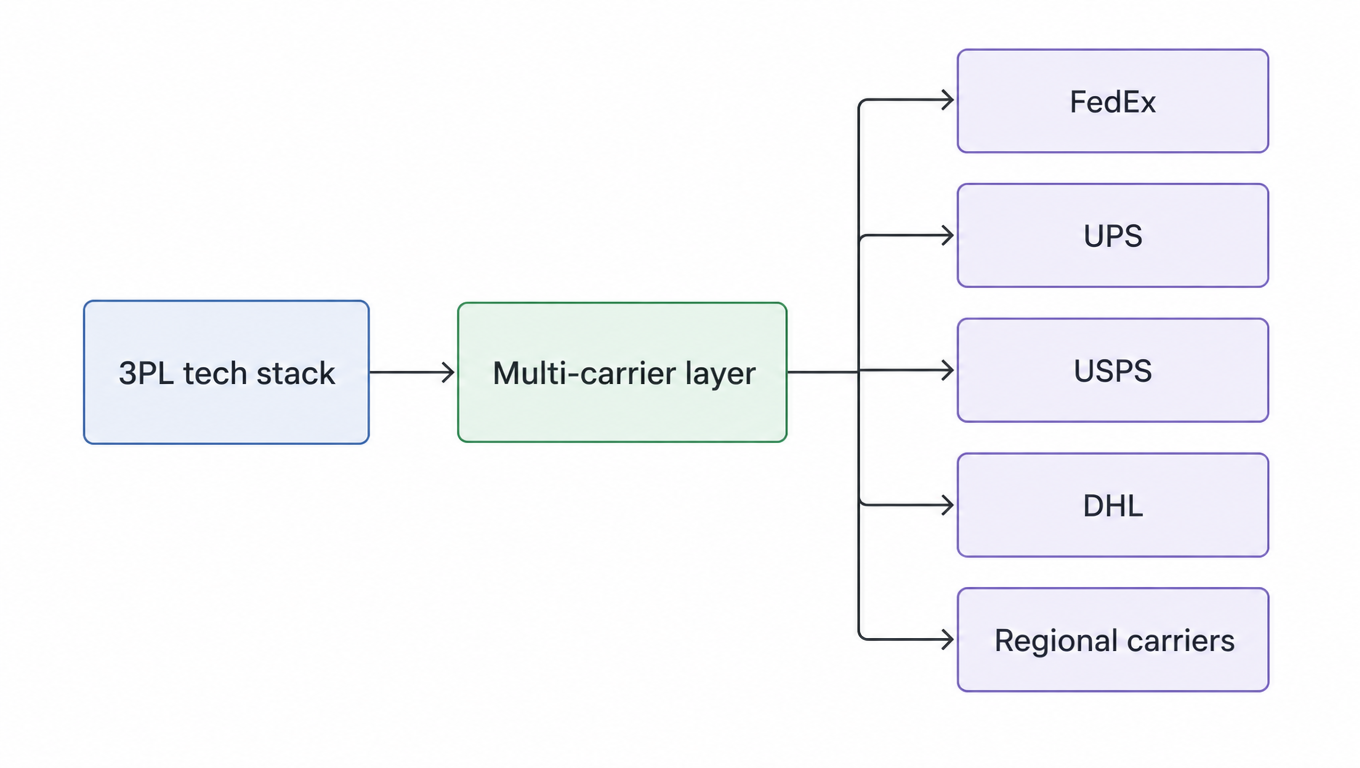
Buying a multi-carrier layer means connecting your tech stack once. From then on, adding a carrier is configuration: you pick the carrier, add your credentials, and start shipping. No API docs to read, no certification to chase, no test cycle to schedule.

The carriers that matter are already there. FedEx, UPS, USPS, DHL, and a long tail of regional and last-mile carriers are connected and maintained by the layer,[^7] which means they absorb every API change and certification renewal on your behalf.

Your own-account rates still pass through. The layer routes through the credentials and negotiated pricing you already have, so the 3PL keeps its pricing edge, its margins, and its carrier relationships intact.

Architecture diagram: 3PL tech stack connects to a multi-carrier layer, which connects to FedEx, UPS, USPS, DHL, and regional carriers
Connect your tech stack once; the layer maintains the carrier network

8. The Decision, in One Paragraph

Cost, speed, and risk all point the same direction for most 3PLs. In-house integration is expensive per carrier, slow to deliver, and a permanent maintenance commitment. A multi-carrier layer converts that fixed cost into a shared one and turns months into days.

The framework, in one sentence: build the one or two carriers that differentiate you, and buy the rest.

Carrier breadth is a sales weapon. Every carrier you can say yes to is a deal you can win and an account you can onboard faster. Make it easy to say yes.

FAQ

Including development, certification, and the first year of maintenance, a realistic all-in figure for one carrier integration is $30,000 to $80,000, with three to six months of calendar time. On top of that comes permanent maintenance: every carrier API change means monitoring, regression testing, and redeployment for every carrier you have ever integrated. Multiply by 10 to 20 carriers and the math grows fast.
Self-build scales linearly: each new carrier is a new project queued behind every other, and each one needs permanent maintenance. For a small team that means pulling engineering resources away from improving the service and into maintaining carrier plumbing. The scorecard usually pushes small teams to a hybrid: build the one or two carriers that differentiate you, and buy the rest from a ready-made multi-carrier layer.
Yes. A multi-carrier layer routes through the credentials and negotiated pricing you already have, so your own-account rates pass straight through. The 3PL still chooses which carriers to offer, still sets its own rates, and still owns the client relationship. What buying buys you is not having to maintain dozens of carrier connections yourself, not giving up pricing power.

Ready to make "yes" the default answer?

EasyShippingX provides Portal, Excel import, and API workflows for USPS and regional carriers, with services and rates governed by the enabled account list. Validate coverage and total charges by origin hub, destination, and parcel profile, then pilot tracking, billing, and a fallback path. Automatic routing or fallback requires separate configuration and validation.