
Carrier Selection

Parcel Shipping RFP: Compare Carriers, Normalize Total Cost, Run a Pilot

Picture a typical scenario: you just spent two weeks turning your parcel volume into a spreadsheet, sent it to four carriers, and received four proposals back. Carrier A offers 68% off list. Carrier B quotes a custom rate card with no discount percentage at all. Carrier C adds a residential surcharge that only applies in certain zones, and Carrier D promises better tracking APIs without pricing them. None of the four documents speaks the same language, and picking a winner by discount percentage is a guess, not a decision. This guide replaces the guess with a seven-gate process: you will compare carriers on normalized all-in cost, verify their operational and technical promises before you commit, and prove the economics on real volume with a small, low-risk pilot. Every decision is backed by data you generated yourself, and no single carrier ever becomes a bet.

Logistics manager reviews four carrier proposals beside a seven-step checklist on a whiteboard.
Four proposals, four languages: the value of an RFP is making them comparable

The Seven-Gate Framework at a Glance

The framework is a pipeline, and each gate hands its output to the next.
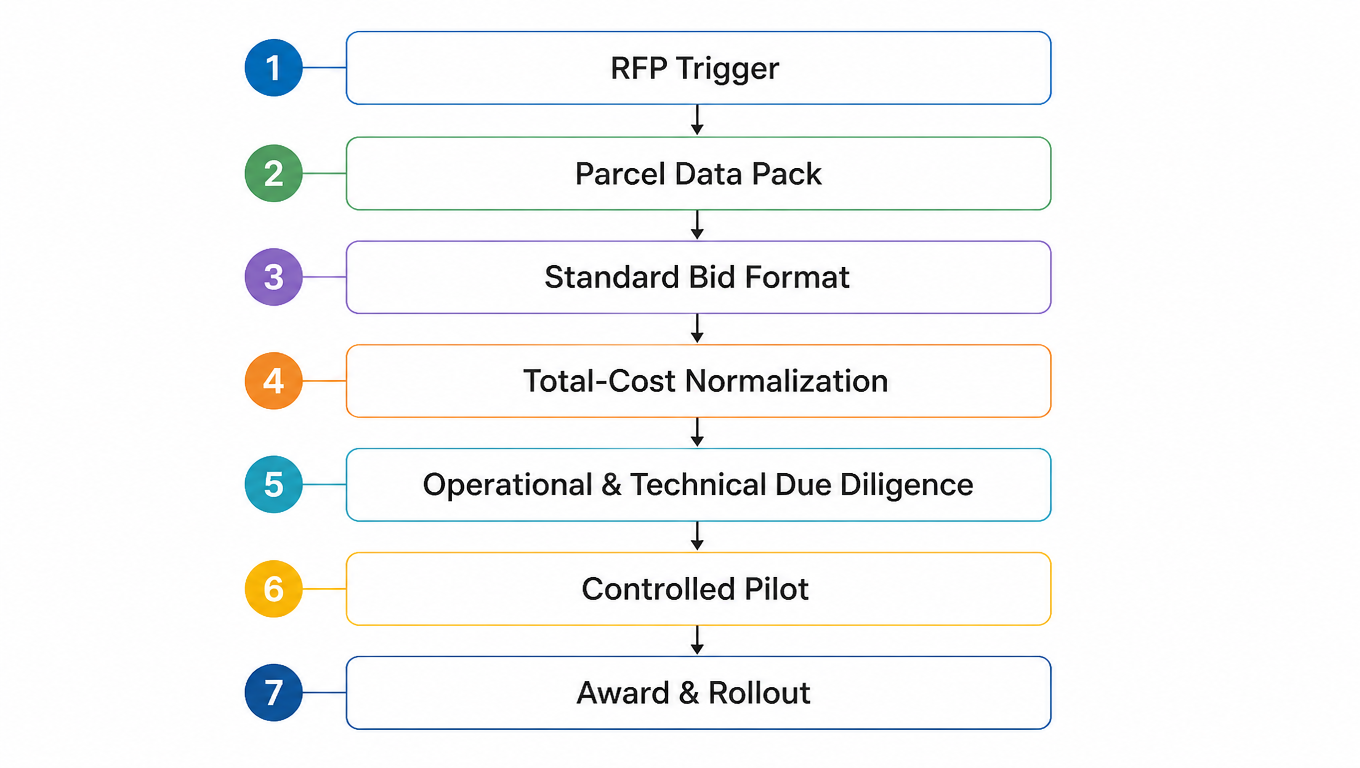
Seven-gate flow: RFP Trigger to Parcel Data Pack to Standard Bid Format to Total-Cost Normalization to Operational & Technical Due Diligence to Controlled Pilot to Award & Rollout
  • Gate 1, RFP Trigger: a Go/No-Go decision on whether this is the right moment to run an RFP at all.
  • Gate 2, Parcel Data Pack: one standardized file describing your volume, weights, zones, residential share, and surcharge exposure.
  • Gate 3, Standard Bid Format: one template every carrier must fill in the same structure, with service guide clause references.
  • Gate 4, Total-Cost Normalization: every proposal converted to all-in cost per zone and weight band on your parcel profile.
  • Gate 5, Operational & Technical Due Diligence: serviceability, service commitments, workflows, and APIs verified hands-on.
  • Gate 6, Controlled Pilot: 5-10% of traffic run in parallel on shortlisted carriers, scored against pre-agreed criteria.
  • Gate 7, Award & Rollout: contract, phased ramp, and a standing fallback.

The order is not cosmetic. The Data Pack is built to answer questions only you can answer, the Bid Format exists because the Data Pack defines what needs comparing, and Normalization is meaningless without a standard format to normalize. Skip a gate and you are making a later decision on data nobody validated. The most common failure mode in parcel procurement is not a bad negotiation; it is a well-negotiated contract built on a mischaracterized parcel profile.

Gate 1: RFP Trigger

An RFP is a real project with real costs, for you and for the carriers. Before you assemble anything, run a Go/No-Go check.

Run the RFP when any of these holds:

  • Your contract is within 90 days of expiry or auto-renewal and you have no rate lock you can live with.
  • Your carrier announced a general rate increase larger than the previous year's, or one that lands on your heaviest weight bands. In the 2026 cycle: FedEx up 5.9%, UPS up 5.9%, and USPS Ground Advantage up 7.8%.
  • Operational pain is measurable: refunds you had to chase, tracking complaints you had to answer, capacity refusals in peak.
  • Your parcel profile changed materially since the last negotiation, for example a shift to residential-heavy sales or heavier average weights.

Hold off when none of these is true. An RFP run purely to see what's out there spends carrier sales resources, weeks of your team's time, and, if you go to market without real intent to move, weakens your position for the next genuine negotiation. Carriers price the deals they believe will close, and a tire-kicker signals exactly that. If you are not sure the effort is worth it, start with the bill-level analysis in how to lower shipping costs before you commit weeks to a procurement cycle.

If you do proceed, write down your walk-away conditions before the first call: the minimum improvement that justifies switching, and the maximum disruption you will tolerate. Those numbers become the pass/fail thresholds for the pilot in Gate 6.

Gate 2: Parcel Data Pack

The Data Pack is the single most important document in the RFP, because every later gate runs on it. It is one file, or one set of files, that describes your traffic precisely enough for a carrier to price it and for you to audit the pricing afterward.

At minimum it contains:

  • Origin and destination ZIPs, plus your warehouse locations and the zone each one falls into for every major destination.
  • Actual weight, dimensions, and billable weight per parcel, bucketed into the weight bands you negotiate.
  • Residential share, including the ZIPs where residential service applies.
  • Surcharge exposure: DAS, large package, additional handling, and any oversized or non-conforming items, counted rather than estimated.
  • Volume by lane and by month, with peak-season share shown separately.

Build it from shipment records and carrier invoices, not from memory. Your shipping platform can export most of it; the carrier invoice adds the adjustments and surcharges that reveal where the real costs sit. Export a full 12 months if you can, because zone mix and weight mix shift across the year. If you must sample, weight the sample by peak-season share so the carrier prices your actual annual pattern, not your slowest month.

A wrong Data Pack produces a confidently wrong price. If you undercount residential share, every residential parcel gets priced at commercial rates and the pilot becomes a surprise. If you omit your DAS exposure, the normalization in Gate 4 misses the fee that quietly dominates. The carriers will price exactly what you give them; handing them a distorted picture is not a negotiation tactic, it is a self-inflicted error that survives all the way into the contract. The same data pack is also your leverage at the table, and our parcel rate negotiation playbook shows how to build and use it.

Gate 3: Standard Bid Format

Carrier proposals arrive in incompatible shapes. One quotes a discount off a published list, another a custom rate card, a third a hybrid with zone-specific multipliers. Surcharge definitions differ, fuel is sometimes included and sometimes not, and every document uses its own service names. Comparing them directly is impossible, so you make comparison possible by defining the format.

Send every carrier the same template: a table with rows for each zone and weight band you negotiate, and columns for base rate, fuel, residential, DAS, large package, additional handling, peak surcharge, and any other fee you identified in the Data Pack. Require one all-in number per cell, or the components plus the arithmetic, and require each line to cite the service guide or tariff clause it comes from. A carrier that refuses to fill the template, or fills it with vague ranges, is telling you how their billing will feel for the next three years.

Watch for the classic traps inside the returned bids:

  • Surcharges described as in certain zones or may apply, which are unpriceable promises.
  • Peak surcharges quoted as a flat amount without the dates and weight bands.
  • Capacity or minimum-volume commitments buried in the fine print, which turn a discount into a penalty if your volume dips.
  • Fuel formulas with an index floor that behaves differently from your current contract.

Your job in this gate is not to judge the bids yet. It is to force them into the same structure so Gate 4 can judge them fairly.

Gate 4: Total-Cost Normalization

A discount percentage tells you almost nothing; the all-in cost per parcel on your profile tells you everything. Normalization means rebuilding every bid from its components, for every zone and weight band you ship, using the Data Pack as the weighting.

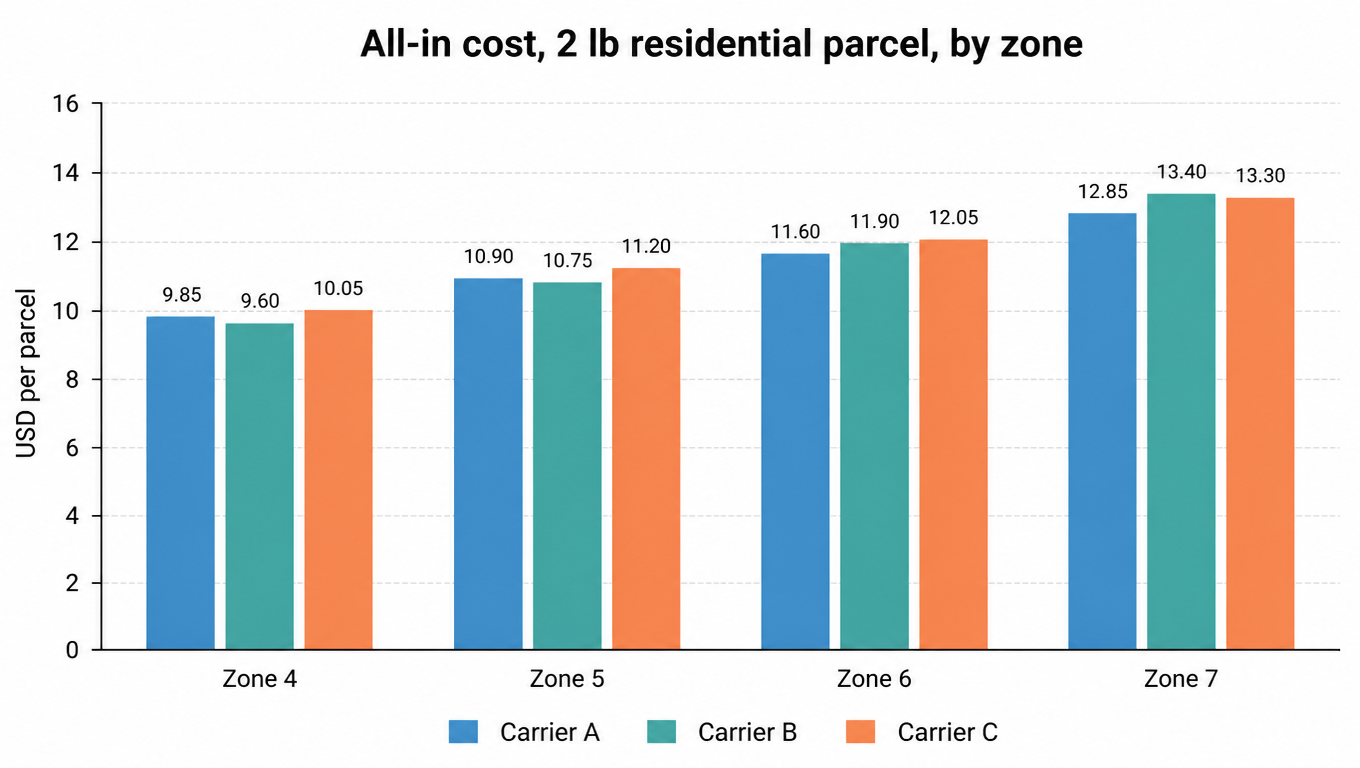
The worked example that follows runs a 2 lb residential parcel through three proposals: Carrier A, a national incumbent; Carrier B, a regional network; and Carrier C, a national discounter. Here is the Zone 5 breakdown:

  • Carrier A: 5.60 base + 0.45 fuel + 4.85 residential = 10.90
  • Carrier B: 6.55 base + 0.52 fuel + 3.68 residential = 10.75
  • Carrier C: 4.85 base + 0.39 fuel + 4.90 residential + 1.06 DAS = 11.20

Carrier C advertises the lowest base rate, but its DAS fee pushes the all-in cost above both competitors. The same pattern repeats across zones:

All-in cost for a 2 lb residential parcel across Zone 4 to Zone 7, bar comparison of Carrier A, B, and C, with C highest in every zone

The zone story is the point. Regional Carrier B wins the short zones, where its residential economics are strong. National Carrier A wins the far zones, where its density pays off. Carrier C loses everywhere once fees are included, despite the cheapest headline rate. A negotiation that compared discounts would have crowned the wrong carrier, and a contract on C would have shipped every parcel more expensive than the runner-up.

Two more disciplines belong in this gate. First, weight the comparison: a 68% discount on a weight band you rarely ship is worthless, so multiply every all-in cell by the volume in that cell from the Data Pack and compare total spend, not rates. Second, reconcile three layers: the quote, the label charge, and the final charge after adjustments. Run a handful of real test shipments through each carrier's system and confirm that what the bid promised is what the invoice shows. Before you trust the components, verify shipping rate claims shows how to test a carrier's numbers on your own lanes, and the gap between quote and final charge is dissected in rate quote vs final charge. Run your own lane comparison with the shipping rate calculator.

Gate 5: Operational & Technical Due Diligence

Price is only half the decision; the other half is whether the carrier can actually deliver on your traffic. Verify before you commit, not after.

Serviceability first. Build a test set of your highest-frequency destination ZIPs, spread across the zones you ship, and check each carrier's coverage and delivery commitment for those exact ZIPs. Coverage maps are marketing; a ZIP-level check of your real destinations is data. Then ask what happens in exception scenarios: weather events, peak overflows, and misdelivered or refused parcels. The answer to what is your fallback plan tells you more about a carrier than its brochure. A full ZIP-level validation workflow lives in carrier serviceability validation.

Next, verify the workflows you will use every day: label generation, manifest submission, voids, and refunds. Time each one. A carrier whose refund process requires a phone call and a PDF upload will cost you hours every month, and that time is a real line in the total-cost column. Ask about tracking event completeness: what is the first-scan rate, are there scans at handoff, how are exception events surfaced to you, and can your support team actually see them?

Finally, the technical checklist. If you integrate via API, run a UAT against the carrier's sandbox for four interface categories: quoting, labeling, tracking, and billing. For each one, verify the failure modes, not just the happy path: what happens when the quote endpoint is down, when a label call times out, when tracking returns a gap, and when a billing adjustment lands without an explanation. The carriers with the best sales decks often have the least testable APIs, and the pilot in Gate 6 will only be as clean as the integration underneath it.

Gate 6: Controlled Pilot

Worker divides parcels between a blue truck and an orange truck at a warehouse dock.
Run in parallel: incumbent and pilot carrier each take a slice, so failure costs nothing and success is proven on real data

With two or three carriers still standing after due diligence, run a pilot that proves the economics on real volume at small scale. Design it before you announce it: a recommended threshold of 5-10% of your traffic, across two or three representative lanes, for four to six weeks. Representative means the lanes carry your typical zone mix, residential mix, and weight mix, not your easiest lane. The point is to surface exceptions, and exceptions hide in hard lanes.

Run the pilot in parallel. The incumbent keeps the rest of the volume, and the pilot carrier takes the 5-10% slice, so a failure costs you nothing and a success is proven on real, time-boxed data. This is the low-risk mechanism the whole framework is built on: you never bet the network on a proposal, you test it on a slice.

Score every pilot parcel against the pre-agreed criteria: actual charge vs quoted charge, on-time delivery, first-scan time, damage and loss, and refund handling time. Keep the scorecard simple enough to fill in ten minutes a day, and write the pass and exit thresholds before the pilot starts, not after. If the pilot carrier clears the thresholds, you have the evidence for Gate 7. If it does not, you exit with four to six weeks of cost and zero network risk. Let the scorecard, not the sales relationship, make the call.

Gate 7: Award & Rollout

The award is a contract, not a handshake. Before you sign, confirm the clauses that protect the normalization you did: the rate validity period, the cap on any mid-term rate increase, the service commitments with defined remedies, the claims process and its deadlines, a named support and escalation path, and clear exit conditions with no punitive termination fees. Every one of these maps back to a risk you identified in the earlier gates, and the contract is where those risks get priced and managed. Run the final draft through the clause-by-clause carrier contract audit before you sign.

Then ramp gradually, with a checkpoint at each tier: move 10% of volume as the first target, review the scorecard for two weeks, then 30%, then 50%, then 100%. Each review compares actual performance against the pilot baselines, and any degradation pauses the ramp until the cause is found. Keep the incumbent or a second carrier warm through the ramp, so the fallback is real, not theoretical.

Finally, institutionalize the review. Run a monthly scorecard that tracks the same metrics as the pilot, reconcile quotes against final charges, and re-run the normalization whenever your parcel profile shifts. The RFP was not a one-time event that ended with a signature; it was the first iteration of a process that keeps your shipping costs honest, and a standing fallback carrier is the insurance that keeps the negotiation real for the next cycle.

Run this RFP process on your own numbers.

EasyShippingX is a channel-neutral shipping layer: one consistent way to compare US domestic carrier options and execute through a portal, a spreadsheet, or an API. It fits the pilot stage of this process naturally: run a controlled trial on real orders, with multi-carrier rate comparison, label generation, tracking, and billing reconciliation in one place, so every gate before you sign is backed by data. See pricing or book a demo.

Frequently Asked Questions

Four triggers: a contract within 90 days of expiry or auto-renewal with no acceptable rate lock; a general rate increase larger than prior years or landing on your heaviest weight bands; measurable operational pain (chasing refunds, tracking complaints, peak refusals); or a parcel profile that changed materially since the last negotiation. If none holds, hold off, because a tire-kicker RFP spends carrier goodwill and weeks of your time, and weakens your position in the next genuine negotiation.
A discount is not a price. In the worked example, Carrier C had the lowest base rate, but its DAS fee pushed the all-in cost to 11.20 on a 2 lb residential Zone 5 parcel, above Carrier A at 10.90 and Carrier B at 10.75. Normalization rebuilds every bid on your own profile: base plus fuel plus residential plus DAS plus large package plus additional handling plus peak plus adjustments, weighted by your volume.
A recommended threshold is 5-10% of your traffic across two or three representative lanes for four to six weeks, run in parallel with the incumbent. Representative lanes carry your typical zone, residential, and weight mix, not your easiest lane. Write the pass and exit thresholds before the pilot starts, and let the scorecard, not the sales relationship, make the call.
No. During the pilot, generate labels and submit manifests through your shipping platform or a portal. API UAT is a separate technical track for the integration decision, testing quoting, labeling, tracking, and billing failure modes against the sandbox. The pilot proves the economics first; integration risk is verified separately.
The exit thresholds were written before the pilot started, and because the pilot ran in parallel, the incumbent kept the rest of your volume all along, so a failure costs four to six weeks of effort and zero network risk. Keep a second carrier warm through the ramp so the fallback is real, not theoretical, and make sure the contract's exit conditions carry no punitive termination fees.