
合同审计Contract Audit

签署承运商合同前,如何完成一次完整的条款审计How to Audit a Parcel Carrier Contract Before You Sign

对电商品牌、3PL 和履约服务商而言,小包裹运费通常是仅次于人力的第二大运营成本。一份把折扣写错一个百分点、或把体积重除数用错的合同,每个月都在悄悄转移数千美元,直到年度复盘时才被发现。审计不是法律动作,而是财务动作;它应当发生在签字之前,而不是第一张账单带来意外之后。本指南逐条款拆解承运商合同中十个以上最高风险的区域,并给出签字前的检查清单与谈判顺序。For e-commerce brands, 3PLs, and fulfillment operators, parcel shipping is usually the second-largest operating cost after labor. A contract that misstates a discount by one percentage point, or applies the wrong DIM divisor, quietly moves thousands of dollars every month until the annual review surfaces it. The audit is not a legal exercise; it is a financial one, and it belongs before you sign, not after the first invoice surprises you. This guide walks clause by clause through more than ten of the highest-risk areas of a parcel carrier agreement and gives you the signature checklist and negotiation sequence.

A logistics manager in a warehouse office reviewing a dense carrier contract with rate tables and shipping labels on the desk

1. 为什么签约前的审计能自己赚回成本1. Why the Pre-Sign Audit Pays for Itself

对大多数电商品牌、3PL 和履约运营者来说,小包裹运费在成本账上仅次于人力。合同里一个百分点的折扣差错,或一个错误的体积重除数,每个月都会悄无声息地转移数千美元,直到年度复盘才暴露。审计不是法律练习,而是财务练习;它应该发生在签字那一刻,而不是第一个账单周期带来意外之后。For most e-commerce brands, 3PLs, and fulfillment operators, parcel shipping sits just behind labor on the cost ledger. A contract that misstates a discount by one percentage point, or applies the wrong DIM divisor, quietly moves thousands of dollars every month, and no one notices until the annual review arrives. The audit is not a legal exercise; it is a financial one, and it belongs at the moment of signature, not after the first invoice cycle surprises you.

承运商起草的合同天然是单方面的。标准协议是为起草方服务的:终止权、数据定义、附加费表和责任上限,默认都偏向承运商利益。文件里不存在中立的「标准表述」。每一条款都经过承运商法务的起草或审阅,你的签名决定了整个合同期内权力平衡的落点。Carrier-drafted contracts are inherently one-sided. Standard agreements are written to protect the party that wrote them: termination rights, data definitions, surcharge schedules, and liability caps all default to the carrier's interest. Nothing in the document is neutral "standard language." Every clause was drafted or reviewed by the carrier's counsel, and your signature is the point where the balance of power is set for the life of the term.

只做一次签约审计是不够的,因为每个条款都会续约。静默自动续约、埋在修正案里的体积重除数变更、连续三个旺季的附加费爬升,都是谈判结束很久之后才以成本超支形式浮现的条款。纪律是每次续约都用同一份清单重新审计,因为承运商在续约时的报价不是你签过的那份合同,而是借旧合同名字的新条款。A single audit at signature is not enough, because every term renews. Silent auto-renewal, a DIM divisor change buried in an amendment, surcharge creep across three consecutive peak seasons: these are the clauses that surface as cost overruns long after the negotiation is done. The discipline is to re-audit at each renewal with the same checklist, because the carrier's offer at renewal is not the contract you signed; it is a new set of terms wearing the old one's name.
2. 准备:谈判前先建立你的议价画像2. Preparation: Build Your Bargaining Profile Before You Negotiate

谈判从数据开始,而不是从合同草稿开始。在任何费率对话之前,先整理 12 个月的发货历史:按月货量、重量段、目的地分区、燃油敞口,以及落入住宅、大件或偏远地区类别的包裹占比。这正是承运商销售团队手里已经握着的数据,也是你需要用来为自己定价的数据。Negotiation starts with data, not with the draft contract. Before any conversation about rates, assemble 12 months of shipping history: volume by month, weight bands, destination zones, fuel exposure, and the share of packages that fall into residential, large-package, or remote-area categories. This is the profile the carrier's sales team already holds, and it is the same profile you need to price the deal yourself.

识别你的核心线路和旺季集中度。如果全年 40% 的货量集中在 10 月和 11 月,那么合同的旺季条款比基础费率更重要。如果两条线路占了你大部分支出,就针对这两条线路谈判,而不是接受一个覆盖全网的平均折扣。承运商按线路和重量段定价,你的议价画像也应该建在同样的粒度上。Identify your top lanes and your peak-season concentration. If 40 percent of your annual volume ships in October and November, the contract's peak-season language matters more than its base rate. If two lanes account for most of your spend, negotiate those lanes specifically rather than accepting one average discount across the network. The carrier prices by lane and by weight band, and your bargaining profile should be built at the same granularity.

计算你的实际折扣:实际支付金额,减去同样货量按牌价计算的结果。多数货主会发现,谈判来的折扣被附加费、体积重和取整规则稀释,实际折扣往往比合同封面上的数字低好几个百分点。这个数字,而不是宣传的折扣,才是谈判的基线。Calculate your effective discount: what you actually paid, minus what the same shipments would cost at list price. Most shippers discover that their negotiated discount is diluted by surcharges, dimensional weight, and rounding rules, so the effective discount often sits several points below the number on the contract cover page. That number, not the advertised discount, is your baseline for negotiation.

弥合信息不对称。承运商知道你每个月的货量、线路结构和季节性,因为它给你发出的每一票货开票。如果你走进谈判室时只知道发票总额,你就是在跟一个握有全部信息的对手谈判。坐下来之前先建立同样的视图:分线路支出、分重量段分布、以及一个季度接一个季度增长的附加费行项目。Close the information asymmetry. The carrier knows your volume, lane mix, and seasonality because it bills every shipment you tender. If you walk into the room knowing only your invoice total, you are negotiating against a counterparty with full information. Build the same view before you sit down: per-lane spend, per-weight-band distribution, and the surcharge line items that have grown quarter over quarter.

3. 定价条款:费率表、折扣与激励计划3. Pricing Terms: Rate Tables, Discounts, and Incentive Programs

先审计折扣是打在什么之上的,再庆祝折扣本身。承运商发布基础费率表,谈判来的折扣是这张表的百分比折扣。因为费率表是承运商的文件,它可以随时重新发布,一个看起来慷慨的折扣可能在墨迹未干之前就被一次调表侵蚀。要求拿到签约时生效的费率表,并阅读合同关于承运商在合同期内如何、何时可以修订费率表的规定。Audit what the discount is applied to before you celebrate the discount. Carriers publish a base rate table, and the negotiated discount is a percentage off that table. Because the table is the carrier's document, it can be republished at any time, and a discount that looks generous can be eroded by a table change before the ink dries. Ask for the rate table in effect at signature, and read what the contract says about how and when the carrier may revise it during the term.

激励计划同样值得逐字审视。许多合同提供阶梯激励:月度支出跨过门槛后折扣加深。陷阱在于门槛如何计量。如果阶梯基于毛开票收入而非净额,附加费和燃油会把货主推入更高阶梯,激励实际上是在为承运商从你这里收取的附加费买单。按你实际货量结构计算该计划的有效成本,而不是按承运商提案里假定的货量。Incentive programs deserve the same scrutiny. Many contracts offer a tiered incentive: a deeper discount once monthly spend crosses a threshold. The trap is in how the threshold is measured. If the tier is based on gross billed revenue rather than net, surcharges and fuel push you into the tier, and the incentive effectively pays the carrier back for surcharges it collects from you. Calculate the true effective cost of the program at your actual volume mix, not at the volume the carrier assumed in its proposal.

年度费率上调是包裹合同里最容易被误读的条款。承运商每年发布 General Rate Increase(GRI),合同对它的适用方式各不相同:有的直接转嫁上调,有的只作用于基础表,有的封顶在固定百分比,有的把附加费排除在上调之外。你想要的条款应明确说明哪些组成部分受上调影响、哪些被冻结。如果合同沉默不语,解释权归承运商,而承运商的解释很少是保护你的那种。Annual rate increases are the most routinely misread clause in parcel contracts. Carriers publish an annual General Rate Increase, and contracts differ on how it applies: some pass the increase through directly, some apply it to the base table, some cap it at a fixed percentage, and some carve out surcharges from the increase. The clause you want states explicitly which components are subject to the increase and which are frozen. If the contract is silent, the carrier's interpretation governs, and that is rarely the one that protects you.

最后,审计牌价本身。没有费率表的折扣百分比没有意义。把报价表与承运商在你线路上公布的费率对比,因为一个打在虚高牌价上的 35% 折扣,可能还不如一个打在合理费率表上的 25% 折扣。在合同允许的情况下,把费率表版本钉进合同,让交易不会被单方面调表重新定价。Finally, audit the list price itself. A discount percentage is meaningless without the table it is applied to. Compare the quoted table against the carrier's published rates for your lanes, because a 35 percent discount off an inflated list can be worth less than a 25 percent discount off a competitive table. Where the contract permits, pin the table version to the contract so the deal cannot be re-priced by a unilateral table change.

4. 计费规则:体积重、最低计费与分区定义4. Billing Rules: DIM Weight, Minimums, and Zone Definitions

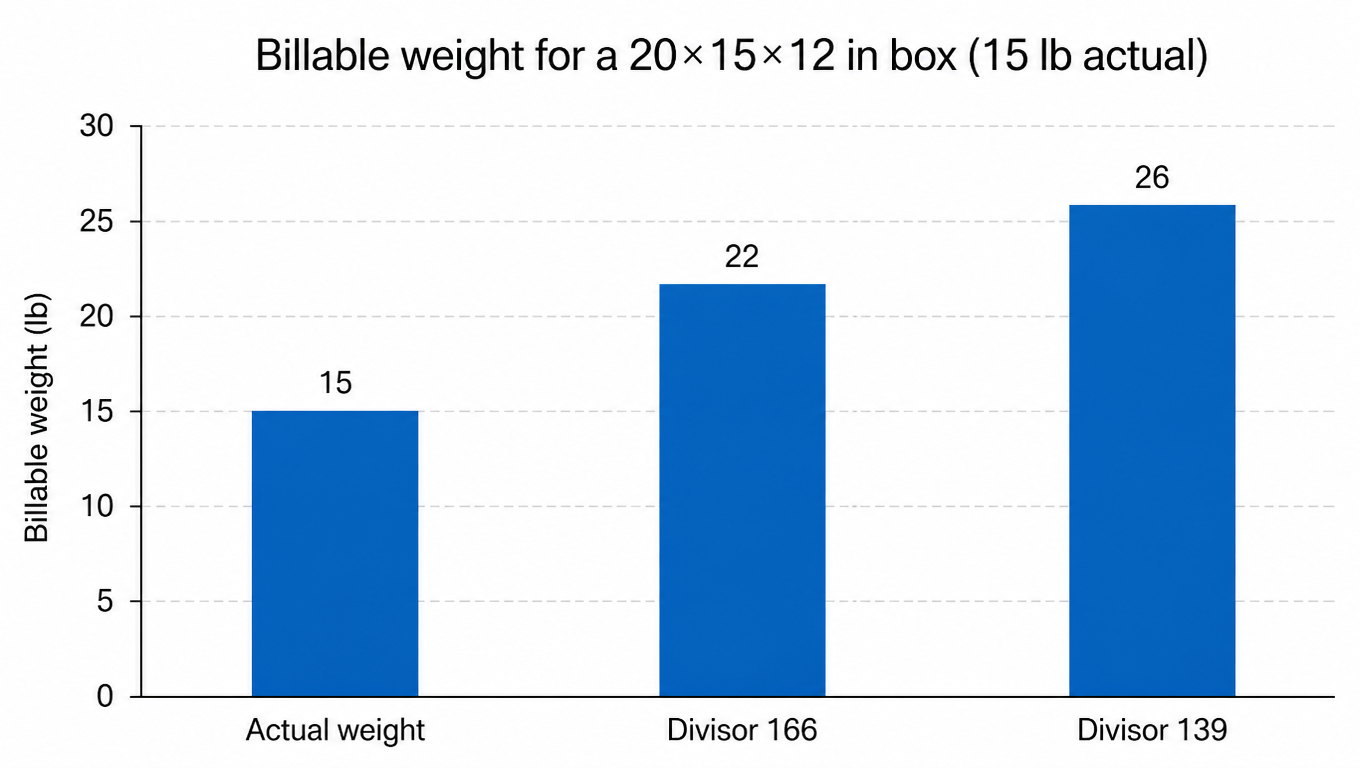
体积重决定轻泡货的计费,也是最可能在毫无预警的情况下改变你成本的计费规则。承运商按实际重量与体积重中的较大者计费,体积重等于长乘宽乘高再除以承运商设定的除数。这个算术对电商毫不留情。一个 20×15×12 英寸的纸箱是 3,600 立方英寸:除数 166 时按 22 磅计费,除数 139 时按 26 磅计费,而一箱实际只有 15 磅的货,按两者中较高的数字计费。除数变更不是取整细节,而是你所有轻泡货的成本转移。Dimensional weight decides what you pay for lightweight, bulky packages, and it is the billing rule most likely to move your cost without warning. Carriers bill the greater of actual weight and DIM weight, where DIM weight equals length times width times height divided by a divisor set by the carrier. The arithmetic is unforgiving for e-commerce. A 20 by 15 by 12 inch box is 3,600 cubic inches: at a divisor of 166 it bills at 22 pounds, at a divisor of 139 it bills at 26 pounds, and a package that actually weighs 15 pounds is billed at whichever number is higher. A divisor change is not a rounding detail; it is a cost shift across every bulky shipment you run.

20×15×12 英寸纸箱的计费重量(实际 15 磅):实际重量 15 磅,除数 166 计费 22 磅,除数 139 计费 26 磅Billable weight for a 20×15×12 in box (15 lb actual): actual weight 15 lb, DIM divisor 166 bills 22 lb, divisor 139 bills 26 lb

最低计费重量和取整规则会放大这一效应。多数承运商按磅向上取整并设每件最低计费重量,合同还可能对某些服务或分区设置更高的下限。取整在边际上很重要:一件按 1.1 磅计费的包裹取整到 2 磅,费用几乎翻倍。确认取整是按件、按票还是按发票行执行,因为每种约定暴露的风险不同。Minimum billable weight and rounding rules compound the effect. Most carriers round up to the nearest pound and enforce a minimum billable weight per package, and the contract may set a higher floor for certain services or zones. Rounding matters at the margin: a package billed at 1.1 pounds rounds to 2, nearly doubling the charge. Confirm whether rounding applies per package, per shipment, or per invoice line, because each convention changes your exposure differently.

分区定义决定始发地与目的地之间的距离如何定价。分区基于 ZIP 码配对,分区表由承运商定义。一份只写「按公布分区」而不附分区表的合同,等于没有定义你的线路价格。核实合同中的分区与你实际发货的线路一致;许多货主发现自己的最重线路比销售提案假设的高了一个分区。Zone definitions determine how the distance between origin and destination is priced. Zones are based on ZIP code pairs, and the zone table is the carrier's to define. A contract that references "zones as published" without attaching the table leaves your lane pricing undefined. Verify that the zones in the contract match the lanes you actually ship; many shippers discover their heaviest lane sits one zone higher than the sales proposal assumed.

计费争议最终归结为数据治理。当承运商的秤与你的不一致时会发生什么?合同决定承运商的系统记录是否具有最终效力、你是否能对计费数据提出异议、以及在什么时间窗口内。没有明确的争议流程,承运商的发票就是事实,而错误会随着每月数千票货不断累积。Billing disputes come down to data governance. What happens when the carrier's scale disagrees with yours? The contract determines whether the carrier's system of record is conclusive, whether you can dispute billing data, and within what window. Without a defined dispute process, the carrier's invoice is the truth, and errors compound across thousands of packages a month.

5. 附加费:燃油、住宅与按服务计费的项目5. Surcharges: Fuel, Residential, and Service-Based Add-ons

燃油附加费通常是最大的一条附加费,它的机制值得完整通读。条款设定一个指数(通常是公布的燃油价格基准)、一个指数低于它就不收附加费的地板价、以及把指数换算成百分比的公式。地板价保护的是承运商而不是你:当燃油价格跌破地板价时,附加费不会跟着降。分别审计指数、地板价和公式,并询问附加费在价格飙升时是否有封顶。The fuel surcharge is usually the largest surcharge line, and its mechanics deserve a full read. The clause sets an index, commonly a published fuel price benchmark; a floor below which no surcharge applies; and a formula that converts the index into a percentage. The floor protects the carrier, not you: when fuel prices fall below it, the surcharge does not fall with them. Audit the index, the floor, and the formula separately, and ask whether the surcharge is capped at a ceiling when prices spike.

住宅、派送区域、大件和偏远地区附加费是第二梯队,每一条都有自己的定义陷阱。住宅附加费在目的地是家庭地址而非商业地址时收取,合同对「住宅」的定义决定你付它的频率。派送区域附加费挂在承运商指定的更难服务的 ZIP 码上,而这些清单会无预警变更。大件附加费由长度或围长阈值触发,很容易意外踩中。叠加起来,这些附加费可以抹掉你谈下来的基础折扣。Residential, delivery area, large-package, and remote-area surcharges are the second tier of add-ons, and each has its own definition trap. A residential surcharge applies when the destination is a home address rather than a business, and the contract's definition of "residential" determines how often you pay it. Delivery area surcharges attach to ZIP codes the carrier designates as harder to serve, and those lists change without notice. Large-package surcharges trigger on length or girth thresholds that are easy to trip by accident. Stacked together, these add-ons can erase the base discount you negotiated.

旺季附加费是时机问题。合同应写明触发它们需要多少提前通知、适用于哪些日期、是否封顶。许多货主签了一份基础费率协议,到 10 月才发现旺季附加费适用于每一票货而不只是增量货量,把一份不错的一年期费率变成糟糕的旺季费率。Peak-season surcharges are where timing matters. The contract should state how much notice triggers them, which dates they apply to, and whether they are capped. Many shippers sign a base-rate deal and discover in October that peak-season surcharges apply to every package, not just incremental volume, converting a good annual rate into a bad seasonal one.

哪些附加费可以谈?燃油、住宅和派送区域附加费经常可以谈,尤其是续约时,承运商有动力保住关系。合同应把可谈的附加费封顶在固定百分比或指数水平,并明确列出不可谈的项目。写「按公布的附加费」的条款是一张空白支票;逐项列出的条款才是一份预算。Which surcharges are negotiable? Fuel, residential, and delivery area surcharges are frequently negotiable, especially at renewal, when the carrier has an incentive to protect the relationship. The contract should cap the negotiable ones at a fixed percentage or index level and list the non-negotiable ones explicitly. A clause that says "surcharges as published" is a blank check; a clause that itemizes them is a budget.

6. 承诺与期限:最低货量、罚则与自动续约6. Commitments and Term: Minimum Volume, Penalties, and Auto-Renewal

最低货量承诺是折扣的镜像。承运商以你承诺每月发出一定货量为条件给出费率,短量罚金按承诺与实际之间的差额向你收费。审计问题很直接:承诺多少货量、如何计量(件数、磅数还是开票收入,退货算不算)、每单位短量的罚金是多少、有没有宽限期或不可抗力条款。按开票收入计量的货量承诺最危险,因为这是你最无法控制的那个数字。Minimum volume commitments are the mirror image of the discount. The carrier grants a rate on the condition that you ship a stated monthly volume, and the shortfall penalty charges you for the gap between commitment and actual. The audit questions are straightforward: what volume is committed, how it is measured (packages, pounds, or billed revenue, and do returns count?), what the penalty is per unit of shortfall, and whether a cure period or force-majeure carve-out exists. Volume measured in billed revenue is the most dangerous, because it is the number you control least.

自动续约是合同里伤害最安静的地方。多数包裹协议会自动续约一整期,除非任一方在特定窗口内发出通知,通常是周年日前 30 到 90 天。错过窗口,你就被锁进另一年按多年前谈成的条款。检查清单:续约期限长度、通知期、要求的通知方式、以及续约是沿用原费率还是重置为承运商当时公布的费率。Auto-renewal is where contracts do their quietest damage. Most parcel agreements renew automatically for another full term unless either party gives notice within a defined window, often 30 to 90 days before the anniversary. Miss the window and you are locked in for another year at terms negotiated years ago. The checklist: the renewal term length, the notice period, the required method of notice, and whether renewal carries the same rates or resets them to the carrier's then-current published rates.

期限长度和退出条款决定你的风险有多少是有时间边界的。多年期合同买来的是费率确定性,但前提是包含期中退出:提前通知的便利终止、重大违约终止、以及承运商被收购或重组时允许你离开的控制权变更条款。询问承运商所有权在期内变更时,你的费率和承诺货量会怎样。Term length and exit provisions determine how much of your risk is time-bound. A multi-year term buys rate certainty, but only if it includes mid-term exits: termination for convenience with notice, termination for material breach, and change-of-control clauses that let you leave if the carrier is acquired or restructured. Ask what happens to your rates and your committed volume if the carrier's ownership changes mid-term.

最深的陷阱是选择权的不对称。一个有货量承诺却没有对应费率保障的合同,意味着承运商握着选择权:它可以涨价,而你仍然受合同约束必须发出最低货量。如果合同承诺了你的货量,它就必须同时承诺承运商的价格、附加费表和服务水平,并为每一项违约设定明确后果。谁握着唯一可执行的选择权,谁就握着这笔交易。The deepest trap is asymmetry of options. A volume commitment with no matching rate guarantee means the carrier holds the option: it can raise rates while you remain contractually bound to ship a minimum volume. If the contract commits your volume, it must also commit the carrier's price, surcharge schedule, and service levels, with defined consequences for failure on each. Whoever holds the only enforceable option holds the deal.

7. 风险与责任:限额、理赔与服务标准7. Risk and Liability: Limits, Claims, and Service Levels

承运商责任不是保险。标准包裹合同把责任上限设在申报价值阈值,通常每件 100 美元,除非你申报更高并付费,同时排除一长串损失:间接损失、利润损失和异常价值货物。审计问题是上限和排除项是否与你实际发出货物的价值匹配。如果你的平均纸箱价值高于上限,合同默认把风险转嫁给你,你应该把这部分风险计入交易成本,或自备保险。Carrier liability is not insurance. Standard parcel contracts cap liability at a declared-value threshold, commonly $100 per package unless you declare more and pay a fee, and they exclude a long list of losses: consequential damages, lost profits, and goods of unusual value. The audit question is whether the cap and the exclusions match the value of what you actually ship. If your average carton is worth more than the cap, the contract shifts risk to you by default, and you should price that risk into the deal or carry your own coverage.

理赔流程决定责任上限是否真的会赔付。合同定义申报窗口(通常是派送或预定派送后若干天)、所需文件(通常是发票、价值证明,有时还要原始包装)和承运商的响应期限。错过申报期限,无论理赔多么有理有据都归零。审计是流程问题:你的组织里谁负责申报、谁保管文件、合同的期限对你的运营是否现实。The claims process decides whether the liability limit is ever paid. Contracts define the filing window, typically a set number of days after delivery or scheduled delivery; the required documentation, often the invoice, proof of value, and sometimes the original packaging; and the carrier's response deadline. Miss a filing deadline and the claim is gone regardless of merit. The audit is about process: who files claims in your organization, who holds the documentation, and whether the contract's deadlines are realistic for your operation.

服务水平协议承诺准时派送,但积分结构决定承诺有没有价值。SLA 条款通常只赔付受影响货件费用的一个很小百分比、要求你在很短的窗口内申报、并把旺季排除在考核之外。一个 99% 准时承诺,如果赔付需要手动申报且排除你最忙的几周,就是营销声明而不是救济手段。审计考核窗口、赔付计算和申报机制。Service-level agreements promise on-time performance, but the credit structure determines whether the promise has value. SLA clauses often pay credits as a small percentage of the affected shipment's charges, require you to file for the credit within a short window, and exclude peak season from the measurement. A 99 percent on-time commitment with a credit that requires manual filing and excludes your busiest weeks is a marketing statement, not a remedy. Audit the measurement window, the credit calculation, and the filing mechanics.

覆盖缺口位于承运商责任与你的自有保险之间。申报价值在承运商责任框架内覆盖单件风险,但受排除项限制;货物保险则按另一套规则覆盖整票货。承运商会赔付的金额与货物实际价值之间的差额就是你的敞口,合同应明确哪一方承担哪部分风险,而不是留给你去推断。The coverage gap sits between carrier liability and your own insurance. Declared value covers per-package risk within the carrier's liability regime, subject to exclusions, while cargo insurance covers the full shipment under a different set of rules. The difference between what the carrier will pay and what the goods are worth is your exposure, and the contract should state which party carries which risk rather than leaving it to inference.

8. 谈判手册:从审计发现到合同语言8. Negotiation Playbook: From Audit Findings to Contract Language

审计产出一份风险清单,谈判把风险清单变成合同语言。筹码来自三个地方:其他承运商的竞争报价、续约时机(你的签名在承运商季末附近比在旺季开始时更值钱)、以及你的增长故事(相信你货量会翻倍的承运商,与看到一个静态账户的承运商,定价完全不同)。在第一次对话前把三样都准备好。The audit produces a list of exposures; the negotiation converts them into contract language. Leverage comes from three places: competing quotes from other carriers, renewal timing (your signature is worth more near the carrier's quarter-end than at the start of a busy season), and your growth story (a carrier that believes your volume will double prices the deal differently from one that sees a static account). Prepare all three before the first conversation.

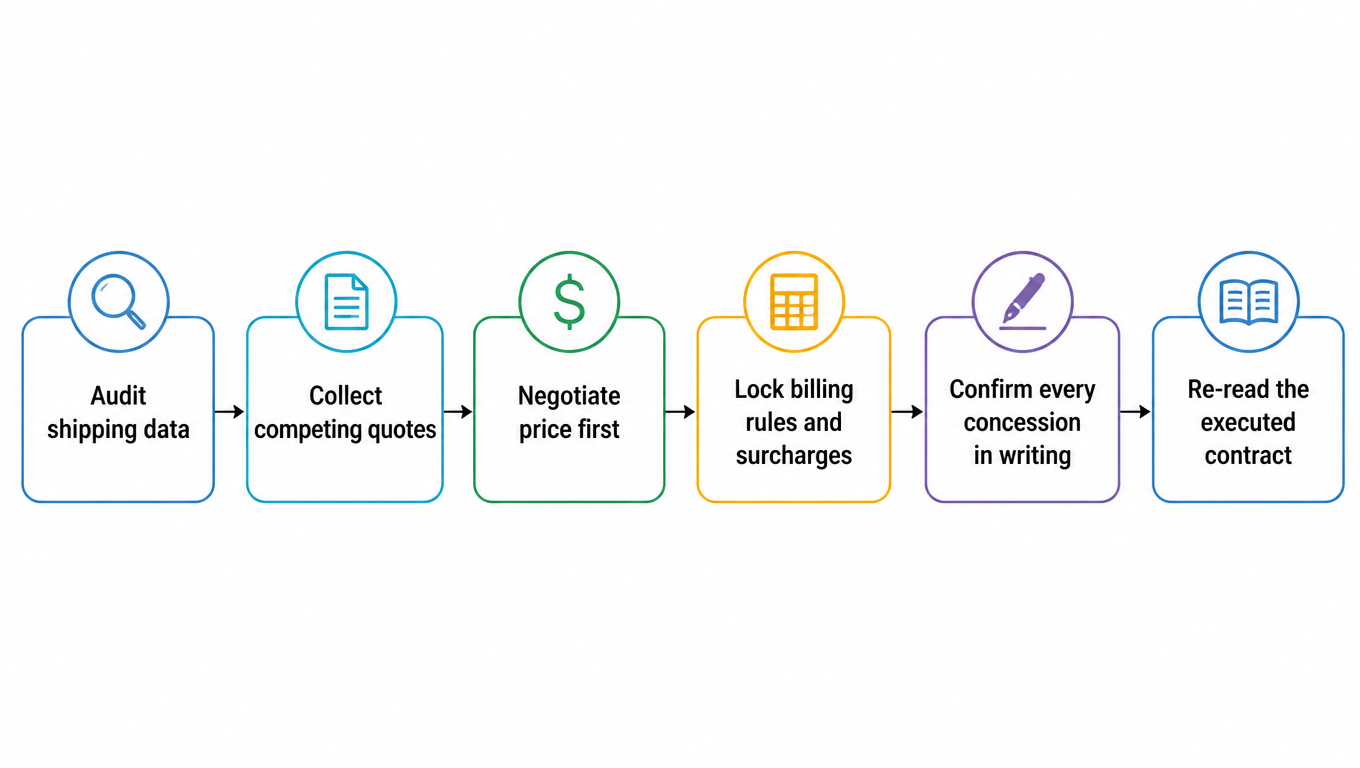
顺序比任何单点让步都重要,顺序是:先价格,再计费规则与附加费,最后是承诺与责任。如果你定了价格却留着条款敞开,承运商可以通过计费规则和附加费表把折扣还回去。如果你定了条款却留着价格敞开,你锁定了保护却不知道它们花了多少钱。下面的流程让交易的每一阶段都与上一阶段保持一致。Sequencing matters more than any individual concession, and the order is price first, then billing rules and surcharges, then commitments and liability. If you settle price and leave terms open, the carrier can give the discount back through billing rules and surcharge schedules. If you settle terms and leave price open, you have locked in protections without knowing what they cost. The sequence below is the one that keeps each stage of the deal consistent with the last.

谈判顺序:审计发货数据 → 收集竞争报价 → 先谈价格 → 锁定计费规则与附加费 → 书面确认每项让步 → 重读签署版合同Negotiation sequence: audit shipping data, collect competing quotes, negotiate price first, lock billing rules and surcharges, confirm every concession in writing, re-read the executed contract

有些让步对承运商零成本、对你却保护巨大:把费率表版本钉进合同、逐项列出附加费表而不是引用「按公布」、定义计费争议流程、书面确认续约通知机制。先在这些上面争取,再去压价。它们更容易赢,而且在整个合同期内持续增值。Some concessions cost the carrier nothing and protect you a great deal: attaching the rate table version to the contract, itemizing the surcharge schedule instead of referencing it as published, defining the billing dispute process, and confirming the renewal notice mechanism in writing. Push for these before you push on price. They are easier to win, and they compound in value over the term.

每一句口头承诺都必须落到合同文字里。销售代表那句「附加费封顶只是走个形式」或「最低货量罚金从没执行过」,在续约时一文不值,那时销售代表已经离开,文字说了算。谈判结束后,重读执行版而不是你谈判的那版草稿;修正案、附件和附表是重新定价条款藏身的地方。最终签字检查清单很短:费率与商定的费率表一致、附加费逐项列出、续约通知窗口已经写进日历、对话中的每一项让步都出现在你签署的文件里。Every verbal promise must land in the contract text. The salesperson's assurance that the surcharge cap is a formality, or that the minimum volume penalty is never enforced, is worth nothing at renewal, when the salesperson has moved on and the text governs. After negotiation, re-read the executed version, not the draft you negotiated; amendments, exhibits, and schedules are where re-priced terms hide. The final signature checklist is short: rates match the agreed table, surcharges are itemized, the renewal notice window is on the calendar, and every concession from the conversation appears in the document you sign.

常见问题Frequently Asked Questions

承运商合同里最容易漏掉的、代价最高的条款是什么?What is the most expensive clause to miss in a parcel carrier contract?

没有一个条款能单独当选,但三类最常造成成本超支:体积重除数变更(藏在修正案里,改变所有轻泡货的计费)、自动续约(错过通知窗口就被锁进一整年旧条款)、以及「按公布」的附加费和分区引用(让承运商可以单方面重新定价)。审计的价值恰恰在于把这三类条款从角落里找出来,在签字前处理掉。No single clause wins, but three categories cause the most cost overruns: DIM divisor changes hidden in amendments that repriced every bulky shipment, auto-renewal that locks you into a full year of old terms if you miss the notice window, and "as published" references to surcharges and zones that let the carrier re-price unilaterally. The value of the audit is finding exactly these clauses before you sign.

承运商可以在合同期内改费率表吗?Can a carrier change its rate table mid-contract?

取决于合同怎么写。费率表是承运商的文件,除非合同明确把某个费率表版本钉进协议、或规定变更需要通知和同意,否则承运商通常可以重新发布。年度费率上调(GRI)也因合同而异:有的直接转嫁、有的封顶、有的把附加费排除在外。签约时要的是「版本钉进合同 + 上调适用范围明确」的写法。It depends on the contract language. The rate table is the carrier's document, and unless the contract pins a specific table version to the agreement or requires notice and consent for changes, the carrier can generally republish it. Annual rate increases also vary by contract: some pass through, some cap, some exclude surcharges. What you want at signature is a pinned table version plus an explicit statement of what the increase applies to.

牌价折扣和实际折扣有什么区别?What is the difference between list-price discount and effective discount?

牌价折扣是合同封面上的百分比;实际折扣是你真正支付的金额减去同货量按牌价计算的结果。附加费、体积重、取整和分区错误都会稀释折扣,实际折扣通常比宣传的低好几个百分点。谈判的基线是实际折扣,不是封面数字。The list-price discount is the percentage on the contract cover page; the effective discount is what you actually paid minus what the same shipments would cost at list price. Surcharges, dimensional weight, rounding, and zone errors all dilute the discount, so the effective number is usually several points lower than the advertised one. Negotiate from the effective discount, not the cover number.

签了自动续约合同还能退出吗?Can I exit an auto-renewing parcel contract?

可以,但窗口很短。多数合同要求任一方在周年日前 30 到 90 天发出书面通知,错过就自动续一整期。谈判时争取便利终止条款(提前通知即可退出)、重大违约终止和承运商被收购时的控制权变更退出权,并把续约通知窗口写进日历。Yes, but the window is short. Most contracts require written notice 30 to 90 days before the anniversary, and missing it renews the full term. In negotiation, push for termination for convenience with notice, termination for material breach, and a change-of-control exit if the carrier is acquired, then put the renewal window on your calendar.

包裹丢失或损坏时,承运商赔多少?How much will the carrier pay if a parcel is lost or damaged?

标准包裹合同默认每件上限约 100 美元,除非申报更高价值并付费,同时排除间接损失和利润损失。理赔还受申报窗口和文件要求限制,错过期限即失效。如果平均货值高于上限,要么把风险计入交易成本,要么自备货物保险覆盖差额。Standard parcel contracts cap liability at about $100 per package unless you declare more and pay a fee, and they exclude consequential damages and lost profits. Claims are also subject to filing windows and documentation requirements, and missing the deadline voids the claim regardless of merit. If your average carton is worth more than the cap, price the risk into the deal or carry cargo insurance to cover the difference.

签字之前,让每一份合同都经过审计Put every contract through the audit before you sign.

easyshippingx 帮你把合同审计变成日常:多承运商实时比价、自动体积重计算、账单对账与附加费核对,让谈判来的折扣真正落在每一票货上,而不是被计费规则悄悄吃回去。easyshippingx turns contract audits into daily practice: real-time multi-carrier rate comparison, automatic DIM calculation, billing reconciliation, and surcharge verification, so the discount you negotiate actually lands on every shipment instead of being quietly eaten by billing rules.

Get Rate Comparison
Get Rate Comparison