Ecommerce Seller Shipping Guide

How to Audit a Multi-Warehouse 3PL: Carrier Coverage, Cutoffs, Rates, and Fallbacks

When you evaluate a multi-warehouse 3PL, it is tempting to treat the brand as one uniform capability. It is not. A multi-warehouse 3PL is a single brand operating several independent nodes, and each node negotiates its own carrier contracts, runs its own cutoff schedule, and makes its own backup decisions. Three mistakes cause most selection errors: trusting the brand's reputation instead of each warehouse's actual capabilities, comparing national marketing claims instead of node-level reality, and trying to evaluate every warehouse with one company-wide rate sheet. The argument of this guide is simple: every warehouse is a separate operating unit, and you can only compare candidates fairly by auditing them warehouse by warehouse. This guide gives you a four-part framework for that audit, plus a printable scorecard.

Logistics manager holds an audit scorecard as a truck is loaded at a warehouse dock.
Score the warehouse, not the brand

1. Why Multi-Warehouse 3PLs Complicate Carrier Selection

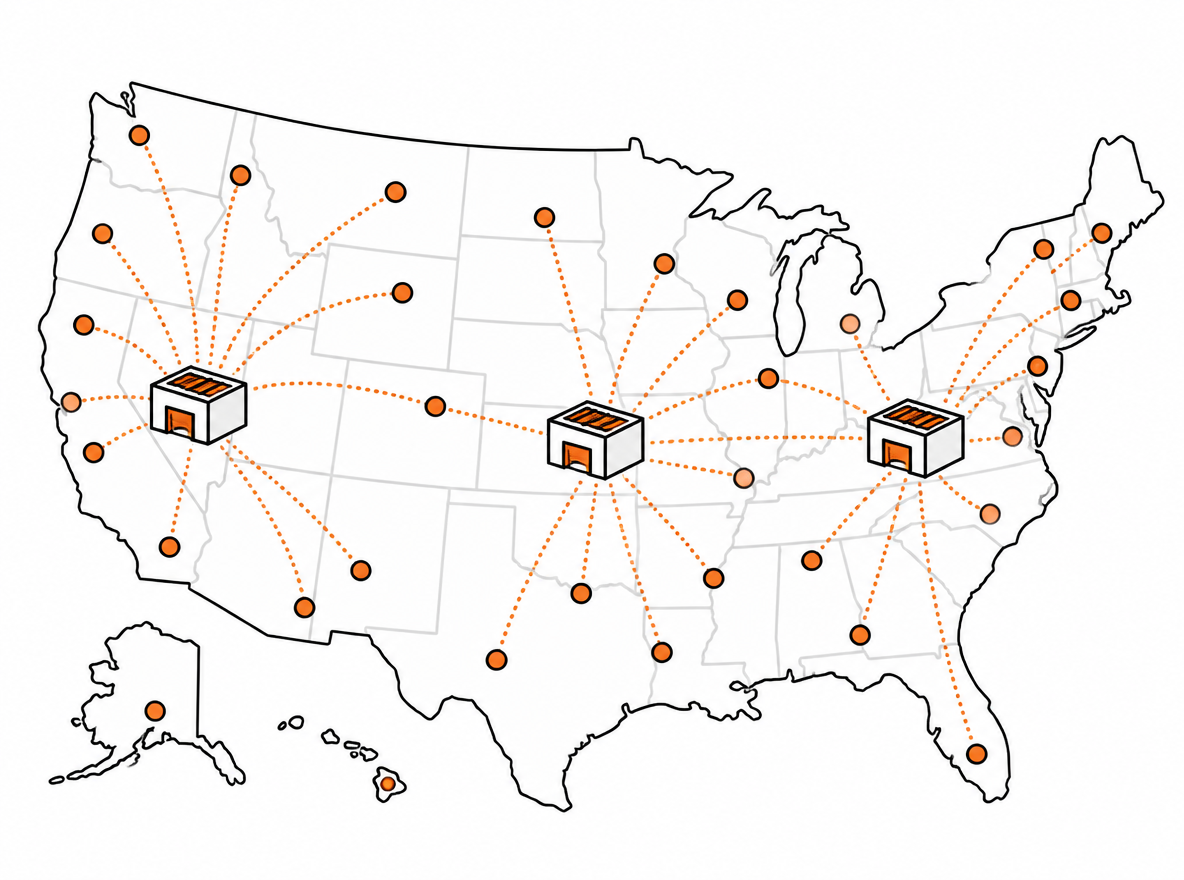
A single-warehouse 3PL is a simple problem. One network, one cutoff, one rate card. Ask ten questions, get ten answers, and you know where you stand. A multi-warehouse 3PL is a different animal. The brand is one, but each fulfillment center is its own operation with its own carrier agreements. The Memphis node may have a negotiated UPS contract; the Reno node may ship everything at retail rates through the same carrier. The Ohio node may have a daily FedEx pickup; the California node may rely on a shared pickup window that misses the afternoon sort. None of this shows up in the sales deck.

The multi-warehouse strategy provides the inventory and facility framework for this audit. Follow the carrier serviceability checks to verify the service rules separately for each origin warehouse.

Three assumptions get sellers into trouble. First, "national coverage" does not mean every warehouse can ship every carrier. Second, "we work with UPS" does not mean your volume runs on a discounted contract; it may mean the warehouse buys labels at retail and marks them up. Third, one company-wide rate sheet hides the node-to-node variation that actually determines your landed cost, because zone and surcharge math change with the origin warehouse.

What actually varies between nodes: the carrier list, zone-based rates, cutoff times, holiday schedules, and peak-season capacity. All five are decision-grade information, and all five need to be verified per node. Audit before you sign, because after the contract is signed, changing carriers, renegotiating rates, or adding fallback obligations is expensive and slow. The selection process is the only moment you hold all the leverage.
2. Carrier Coverage: Map Every Warehouse's Network

Ask for a carrier list per warehouse, not a company-level master list. A simple table works: one row per warehouse, one column per carrier, one cell per service level. If a sales rep cannot produce this table, that is a signal in itself.

Start with national carriers. UPS, FedEx, USPS, and DHL eCommerce each have their own support profile at every node. A warehouse may have daily UPS and FedEx pickups but only consolidated USPS service, meaning your Priority Mail and First-Class volume ships on a slower, cheaper lane. Another node may have no FedEx daily pickup at all, so every FedEx label sits until a scheduled pickup that runs on a different day.

Then map regional carriers. OnTrac, GLS, LaserShip, Better Trucks, SpeedX, and Veho cover different territories and are available from different nodes[1]. The Reno node may route western ZIPs through OnTrac at a 30% discount; the Columbus node may have no western regional option at all. Regional carriers are where the real savings live, so coverage gaps here directly change your economics.

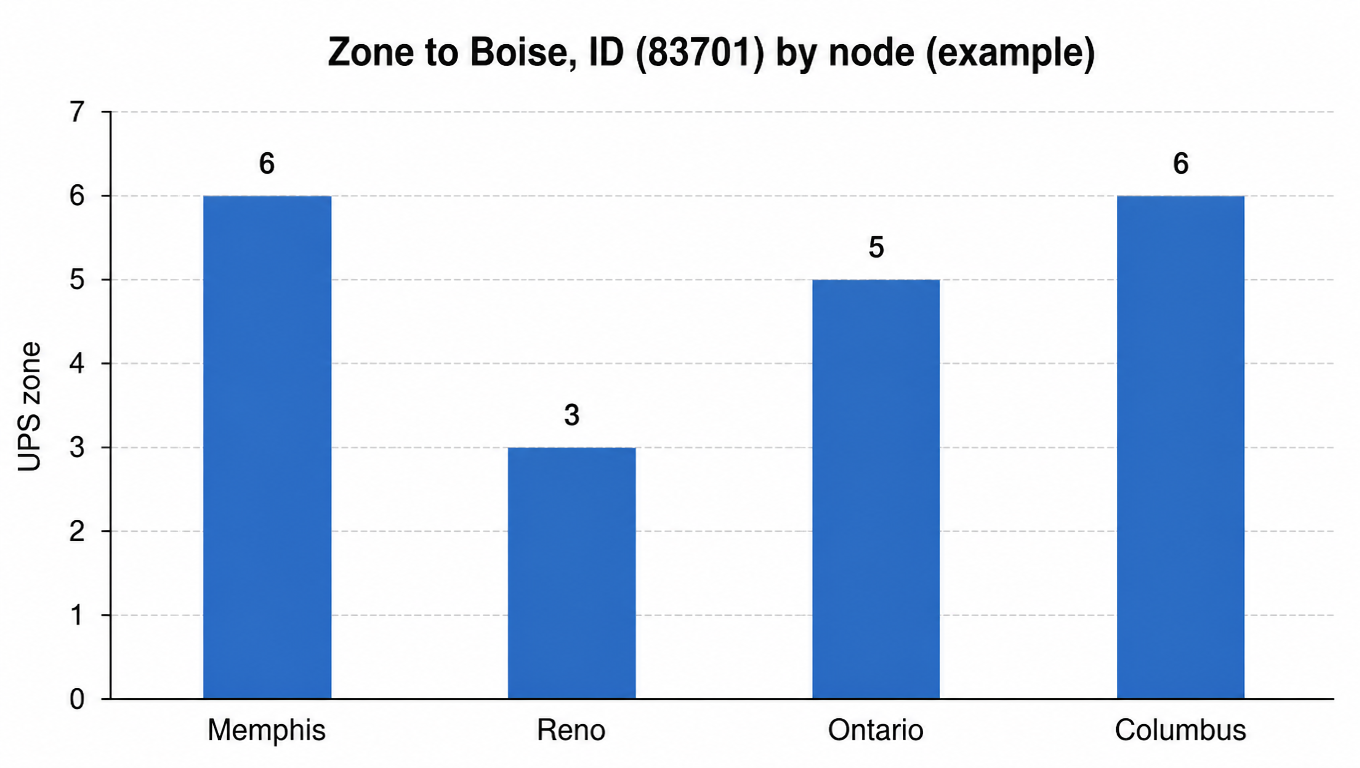
Zone math is where node-level thinking matters most. The same destination ZIP produces different zones, and therefore different prices, from different origins[2]. As an example, a Boise, ID ZIP (83701) ships as Zone 6 from the Memphis node, Zone 3 from the Reno node, Zone 5 from the Ontario node, and Zone 6 from the Columbus node. A customer in Boise is cheap to serve from Reno and expensive to serve from Memphis, regardless of which brand owns both nodes.

Bar chart: UPS zone to Boise, ID (83701) by node (example): Memphis 6, Reno 3, Ontario 5, Columbus 6
Same destination, different origin, different zone and price

Require a ZIP coverage matrix: the zones each node serves for each carrier, or a map you can spot-check. Then verify with test orders. Send a real order to a ZIP in each of your top ten destination clusters from each node, and check that the promised service level and transit time actually hold. Red flags to watch for: a rep who says "we can ship anything anywhere" but cannot produce node-level detail, and a regional carrier that looks great on paper but has a coverage hole in one of your core ZIPs.

3. Cutoff Times: Verify What "5 PM Cutoff" Really Means

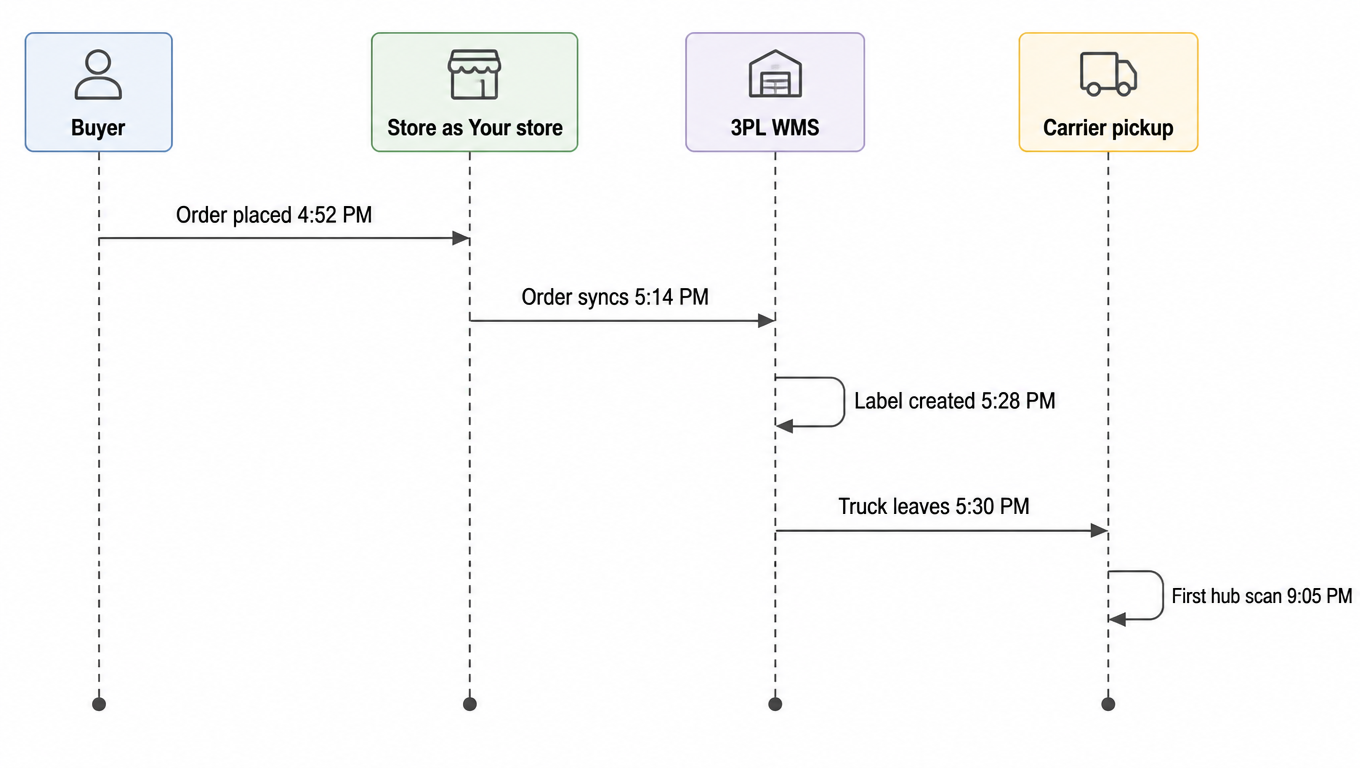
A cutoff time is not a pickup time. When a 3PL says "5 PM cutoff," it usually means labels and pick tasks must be created by 5 PM. The truck may leave at 5:30, and the package may not enter the carrier network until the first hub scan hours later. If you promise customers "order by 5 PM, ships today," you need to know which of those three events actually happens by 5 PM.

Time zones are the second trap. "5 PM" from a national 3PL is often the warehouse's local time, which may be Eastern, Central, or Pacific depending on the node. A customer in California ordering at 4:50 PM Pacific gets a very different experience from a node in Tennessee whose cutoff is 5 PM Eastern. Ask for every node's cutoff in your customers' time zone, and put that in writing.

Weekends and holidays move cutoffs too. A Friday 5 PM cutoff with a Saturday pickup is a different promise than a Friday cutoff with no pickup until Monday. Ask how the schedule shifts around holidays, and whether the cutoff you are quoted for a normal Tuesday still holds on the day after Thanksgiving.

Integration cutoffs are a separate question from warehouse cutoffs. If your storefront pushes order files at 10 PM, a 5 PM warehouse cutoff means every one of those orders ships the next day. Find out whether the 3PL accepts late file drops with next-day processing, and what the actual lag is between order sync, label creation, and pickup. Peak season changes everything again: many nodes pull cutoffs forward in Q4, sometimes by two or more hours, to protect capacity[5].

Sequence diagram: buyer orders 4:52 PM, store syncs 5:14 PM, 3PL WMS creates label 5:28 PM, carrier pickup truck leaves 5:30 PM, first hub scan 9:05 PM
A "5 PM cutoff" day: the label exists, but the package is not in the carrier network yet

The sequence above is a typical "5 PM cutoff" day: the label exists by 5:28 PM, but the package does not enter the carrier network until the truck leaves and receives its first hub scan after 9 PM. That gap is the difference between a cutoff and a pickup, and it decides whether "ships today" actually means anything to your customer.

Verify all of this directly. Ask for the pickup schedule per node, watch one pickup if you can visit, and place test orders at specific times to see what really happens. Then write the actual pickup commitment into the contract as an SLA: not "5 PM cutoff," but "labels created by 5 PM local, truck departs by 5:30 PM local, first carrier scan by 10 PM local, on all business days."

4. Rate Structures: Compare Apples to Apples

Every warehouse negotiates its own carrier contracts, so rate cards differ by node. A price quoted for "UPS Ground from our network" is meaningless until you see the card for the node your volume will actually ship from. Get one card per node and compare them side by side.

Zone-based rates are the first thing to check. Because zones depend on origin, the same destination ZIP costs different amounts from different nodes, and the difference is often larger than the carrier discount. The Boise example above is not just a zone chart, it is a price chart: serving Boise from Reno versus Memphis can differ by several dollars per package before any surcharge is applied.

Surcharges are where rate cards hide their real cost. Residential delivery, fuel, oversized items, address correction, and dimensional-weight rules vary by carrier and by contract. A node quoting a low base rate may add back more on surcharges than a node with a higher base and cleaner terms. Ask for a fully loaded rate on your actual package profile, not the base rate on the marketing sheet.

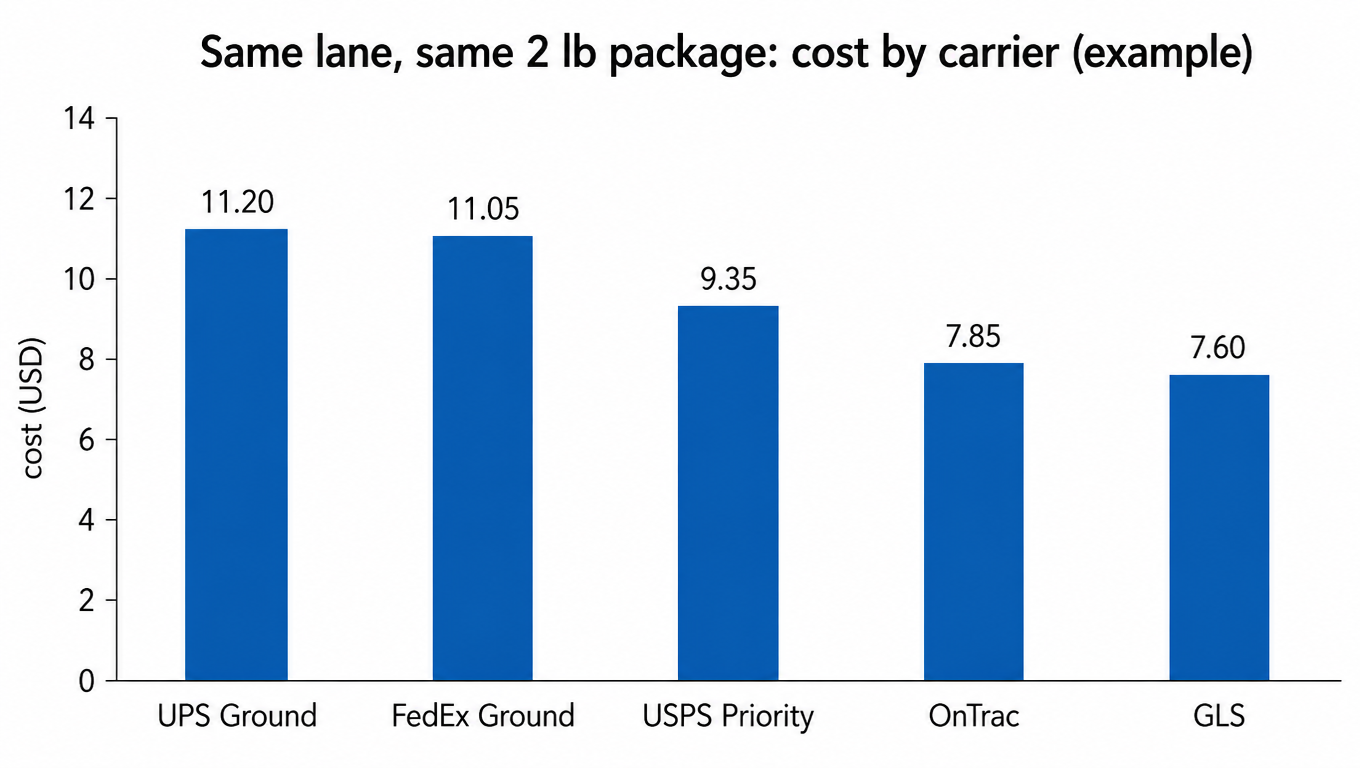
Regional carriers change the math dramatically within their coverage zones. On a sample 2 lb ground shipment from Sacramento to Seattle, the same package costs roughly $11.20 with UPS Ground, $11.05 with FedEx Ground, $9.35 with USPS Priority Mail, $7.85 with OnTrac, and $7.60 with GLS. That is a 30% savings on the regional lanes, which is typical: regional carriers run 20 to 40% cheaper inside their coverage areas[3].

Bar chart: same lane, same 2 lb package, cost by carrier (example, USD): UPS Ground 11.20, FedEx Ground 11.05, USPS Priority 9.35, OnTrac 7.85, GLS 7.60
Same lane, and regional carriers run 20-40% cheaper inside their coverage

Mixed and consolidated services need the same scrutiny. SurePost and FedEx SmartPost look cheap on a per-label basis, but the transit time is slower, the tracking is sparser, and the final mile is handed to USPS[4]. Whether that trade is worth it depends on your customers' expectations, not on the label price.

Hidden fees round out the picture: minimum charges, storage, receiving, in-bound and out-bound handling, per-unit pick fees. Add them all to the per-order total. The right comparison is total landed cost per order across your real order profile, not the headline rate per label. Build a test-lane matrix: your ten highest-volume destination ZIPs, run through every node you are evaluating, with every carrier each node can actually ship. Compare the full cost of that matrix, because that is the number your P&L sees.

5. Fallbacks: Stress-Test the Backup Plan

Carriers fail. Weather closes a hub, a strike reroutes the network, a system outage stops label creation. When your primary carrier is down, what happens to your orders depends on what the 3PL built before the failure, not on what the sales rep promises during it.

Start with the backup carrier question per node. Is a second carrier already loaded in the WMS, or does the node have to onboard one during the outage? A node that can flip a toggle and route through its backup carrier recovers in hours. A node that needs to set up a new carrier account, negotiate rates, and test labels recovers in days.

Missed-cutoff orders are the everyday version of a fallback. An order placed at 5:20 PM after a 5 PM cutoff: does it sit until tomorrow's pickup, or does the node have a late sort that pushes it into the evening carrier window? The answer shapes your shipping promise, and most sellers never ask it.

Peak-season capacity is the third test. Regional carriers fill up first in Q4, and nodes without an overflow plan quietly downgrade your regional volume to more expensive national lanes. Ask what the node does when its regional carrier hits capacity, and how much notice you get before the economics of your shipping change.

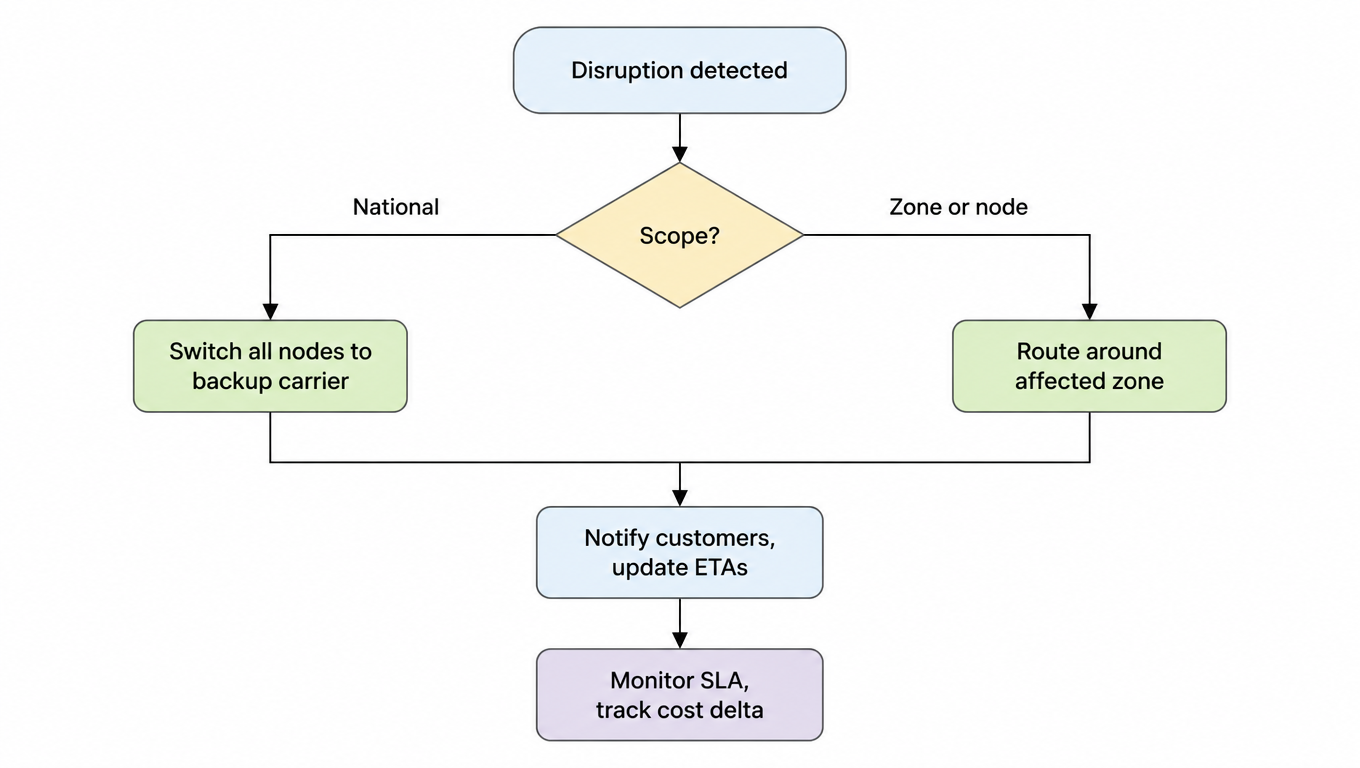
Decision flowchart: disruption detected → scope? → national: switch all nodes to backup carrier / zone or node: route around affected zone → notify customers, update ETAs → monitor SLA, track cost delta
A working fallback plan: trigger, switch, notify, review

The decision flow above is what a working fallback plan looks like: a clear trigger, a defined switch, a customer communication step, and a cost review. Ask who decides when to switch, how fast the switch can happen, and who absorbs the cost difference between the primary and backup carrier. If the answer to any of these is vague, the plan is a hope, not a process.

Pressure-test it. Ask for the node's most recent real disruption: what happened, how long it took to detect, how long to switch, and what the customer impact was. A 3PL that can name a specific incident and walk you through its handling has a plan. One that cannot is asking you to trust an untested process with your customer experience.

Finally, put fallbacks in the contract. The 3PL should commit to a backup carrier being loaded at every node, to a defined switch procedure, and to service credits when the fallback fails. SLA language that only covers "best effort" is not a commitment; your contract should specify what the backup obligation is, how quickly it activates, and what you are owed if it does not.

6. The Multi-Warehouse 3PL Audit Scorecard

Score every node separately, then weight the scores by where your orders actually go. If 60% of your volume ships from the Reno node and 10% from Memphis, Reno's numbers deserve six times the weight in your decision. For each section below, score each statement from 1 (not true at all) to 5 (fully true), and fill one scorecard per node.

Part 1: Carrier Coverage

  1. The node produced a per-warehouse carrier list, not a company-level list
  2. National carriers (UPS, FedEx, USPS, DHL eCommerce) are available at the service levels I need
  3. Regional carriers cover my top destination ZIPs from this node
  4. I received a ZIP coverage matrix and verified it with test orders
  5. The node's carrier list matches my package profile (weight, DIM, volume)

Part 2: Cutoff Times

  1. The cutoff is defined precisely: label time, pickup time, and first carrier scan
  2. Cutoff times were quoted in my customers' time zone, not just local warehouse time
  3. Weekend and holiday schedule changes are documented, including Q4 changes
  4. Integration lag (order sync to label) is measured and acceptable for my promise
  5. The actual pickup commitment is written into the contract as an SLA

Part 3: Rates

  1. I received a rate card per node, not one company-wide sheet
  2. Zone-based rates were compared across nodes for my top destination ZIPs
  3. All surcharges (residential, fuel, DIM, oversized, address correction) are quantified
  4. Regional carrier rates were quoted and their coverage verified for my lanes
  5. Total landed cost per order is clear, including minimums and handling fees

Part 4: Fallbacks

  1. A backup carrier is already loaded in the WMS at this node
  2. Missed-cutoff orders have a defined handling path (late sort, next pickup)
  3. Peak-season overflow plan is documented, including regional capacity limits
  4. The node described a real past disruption and how it handled it
  5. Fallback obligations and service credits are in the contract

Scoring is straightforward: add the four part totals, weight by node volume share, and read the result. A node scoring 80 out of 100 or higher is ready for your volume. 60 to 79 means usable, but only with the gaps closed in the contract. Below 60, the node is a liability no brand promises can fix, and you should ask why the sales deck did not show it.

Weight the answer sources too. What sales tells you in a pitch counts less than what operations confirms in writing, which counts less than what a contract guarantees, which counts less than what a test order proves. If a claim matters to your decision, it should survive at least two of those four tests.

7. How to Run the Audit in Practice

Run the audit in five steps.

  1. Send a data request. Per-node carrier lists, per-node rate cards, pickup schedules, ZIP coverage matrices, and the peak-season plan. Make the request in writing and see how long the response takes; responsiveness during the audit is a preview of responsiveness during an outage.
  2. Score from documents, then verify on site. The scorecard above works on paper, but the highest-value checks are physical: watch a pickup, look at the label printer queues, count the loaded trucks.
  3. Send test orders. From every candidate node, ship to your top destination clusters and track actual transit times and scan quality against what was promised.
  4. Negotiate with the audit in hand. Every score below 4 on your weighted nodes is a contract item: close the carrier gap, tighten the cutoff SLA, cap the surcharges, commit the backup carrier. The audit gives you the specific language; the leverage comes from having it on paper before you sign.
  5. Re-audit every year. Re-audit any node the 3PL adds, closes, or moves during the contract. Networks change, contracts lapse, regional carriers expand and shrink. The audit that was true at signing is a snapshot, not a promise.

Convert the scorecard into contract language and you are done: each part of this framework becomes an SLA clause, and each clause has a number you can verify. That is the difference between choosing a 3PL by reputation and choosing one by evidence.

Audit done? Now compare your real lanes.

EasyShippingX is a channel-neutral shipping layer: one consistent way to compare US domestic carrier options and execute through a portal, a spreadsheet, or an API. The audit gives you each node's carrier list and rate structure; the next step is comparing rates on your real order profile so the savings the audit uncovered become actual cost. See pricing or book a multi-carrier workflow demo.

FAQ

Run a full audit yearly, and re-audit any node the 3PL adds, closes, or moves during the contract. Networks change, contracts lapse, and regional carriers expand and shrink, so the audit that was true at signing is a snapshot, not a promise.
Because carrier zones are determined by both the origin warehouse and the destination ZIP. The same destination ZIP can be a different zone, and therefore a different price, from different nodes, and the gap is often larger than the carrier discount. That is why rates must be compared per node, not on one company-wide sheet.
That is a signal in itself. A multi-warehouse 3PL negotiates rates warehouse by warehouse, and without per-node rate cards you cannot compare landed cost. A "network rate" on the sales deck is meaningless until you see the card for the node your volume will actually ship from. Make per-node rate cards a required deliverable before you sign.
Ask for the pickup schedule per node, place test orders at specific times to see what really happens, and watch a pickup if you can visit. Then write the real commitment into the contract as an SLA: not "5 PM cutoff," but separate written times for label creation, truck departure, and first carrier scan.