Shipping nationwide from a single warehouse is the default choice for most cross-border sellers at the start: simple processes, clear books, easy management. But once order volume crosses a certain threshold, the hidden costs of the single-warehouse model surface one by one. This article does not argue that multi-warehouse is always better. It lays out the benefits, the costs, the decision criteria, and the allocation methods, so you can run the math on your own data.
Warehouses are a means, not the goal: faster fulfillment and steadier profit are
Why Sellers Start Considering Multi-Warehouse: The Single-Warehouse Bottleneck
The single-warehouse model's biggest strength is also its biggest weakness: all eggs in one basket. Early on, one warehouse means the lowest fixed costs and the simplest management. But as order volume grows, three hidden bottlenecks appear in sequence.
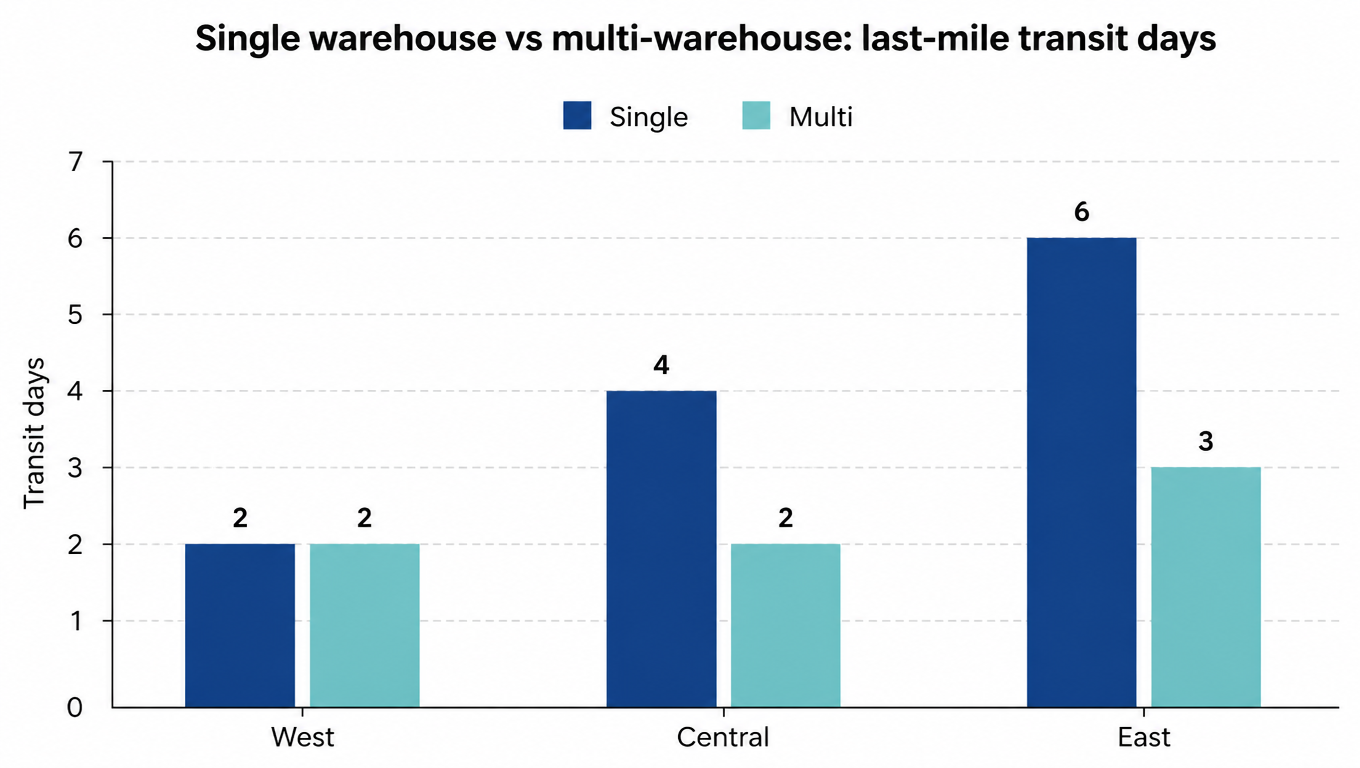
The first bottleneck is a ceiling on last-mile speed. From a West Coast warehouse, packages to East Coast customers typically take 4 to 6 days, while those customers are used to 2 to 3 day e-commerce delivery. The speed gap converts directly into cart abandonment: a checkout page that says "estimated 6 days" and one that says "estimated 2 days" move conversion in completely different directions.
The second bottleneck is uneven costs. Remote areas (Montana, Maine, Alaska, and so on) either take longer to reach or carry remote-area surcharges, and under a single warehouse there is no way to spread that cost. The third is concentrated risk: peak-season overflow, a weather event at the warehouse location, any disruption at the one warehouse, and every order in the store stalls together.
There is also pressure from the platforms. Amazon FBA's inventory-splitting logic and the platforms' fulfillment-speed requirements are all forcing sellers to reconsider whether one warehouse is really enough.
The Real Benefits of Multi-Warehouse: Speed, Conversion, Returns
The most direct effect of multiple warehouses is last-mile speed. Shipping to the East Coast from a local East Coast warehouse takes just 2 to 3 days. Put the typical transit days of one warehouse and two warehouses side by side and the gap is obvious:
Single warehouse vs multi-warehouse: last-mile transit days
Faster delivery produces measurable business returns. A shorter estimated delivery date (EDD) directly lifts conversion and cuts abandonment, with some sellers measuring conversion gains of 5% to 15% depending on category and price point [^11]. For high-ticket items, speed is itself a trust signal: customers will pay for a promise of "arrives tomorrow".
The third benefit sits on the returns side. US e-commerce return rates average 15% to 30% [^4], and cross-border sellers pay more to process returns. With multiple warehouses, returns go back to a nearby local warehouse, reverse logistics costs drop, restocking is faster, and inventory loss shrinks.
One warning: these benefits only materialize if orders are actually routed to the nearest warehouse. If routing is chaotic and stock sits in warehouse A while orders ship from B, multi-warehouse turns into a cost center overnight.
The Real Cost of Multi-Warehouse: A Detailed Breakdown
Multi-warehouse is not free; every benefit has a matching cost. First, storage: a second warehouse means a second rent, a second labor team, a second insurance policy, and a second software license. A 2,000 to 5,000 square foot US warehouse typically runs into the thousands of dollars per month, and that money has to be spread across every order.
Second, inventory cost, the most easily underestimated line item. After splitting, every warehouse carries its own safety stock, so total inventory levels rise and so do capital tied up and storage fees. In practice, moving from one warehouse to two typically raises total safety stock by 20% to 30% [^8].
Third, freight. Inbound shipments now split across multiple warehouses, each batch is smaller, and full-container or full-truckload discounts may disappear; inter-warehouse transfers add two-way freight; and separate replenishment per warehouse can miss volume discounts. Fourth, the hidden costs: multi-warehouse systems (WMS/OMS that support multiple locations), order routing rules, cross-warehouse data sync, and coordination across multiple teams. None of these show up on a freight bill, but all of them show up in your management hours every month.
Total the four cost buckets, compare them against the benefit side, and that is the correct way to open the split-warehouse decision.
The Decision Framework: Should You Split or Not
Start with six metrics: monthly order volume, average order value, margin, category characteristics, target-market concentration, and speed sensitivity. Volume is the entry gate; AOV and margin decide whether the marginal cost of splitting can be absorbed; category characteristics (size, weight, fragility, seasonality) shape how flexibly each warehouse can replenish; and market concentration determines how many transit days "ship from nearby" actually saves.
The accounting logic is simple: the marginal benefit of multiple warehouses (conversion gains from faster delivery plus returns cost savings) must exceed the marginal cost (storage plus inventory plus freight plus hidden costs). Plug the numbers from the previous two sections into your own data and the breakeven point appears by itself.
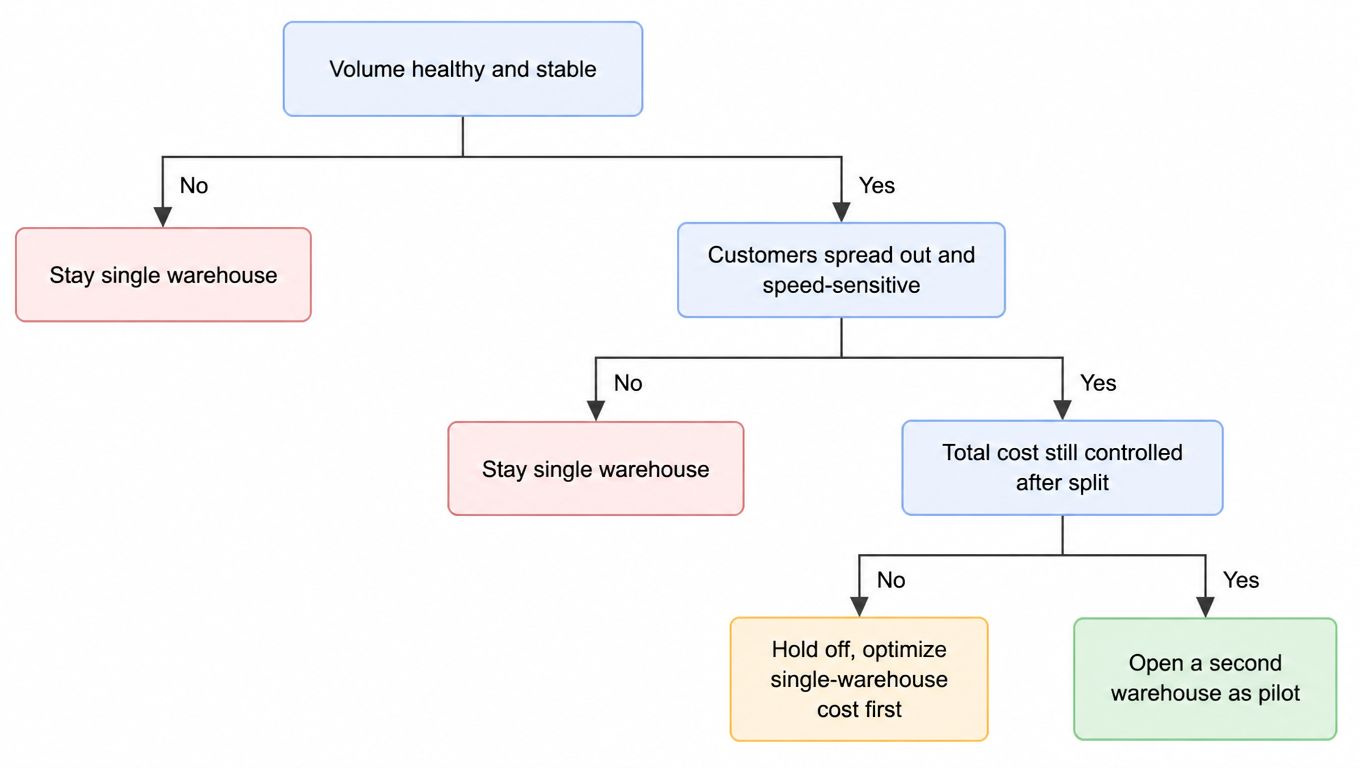
There are clear cases for not splitting: monthly volume still under 10,000 orders, one region contributing over 80% of orders, margins too thin to absorb a second set of fixed costs, or a category so seasonal that other warehouses would sit idle most of the year. Splitting is a scaling tool, not a growth tactic; forcing it before the data supports it only dilutes profit.
The decision path condenses into the flowchart below:
The split-warehouse decision path
Choosing Locations: From a Second Warehouse to a Five-Warehouse National Network
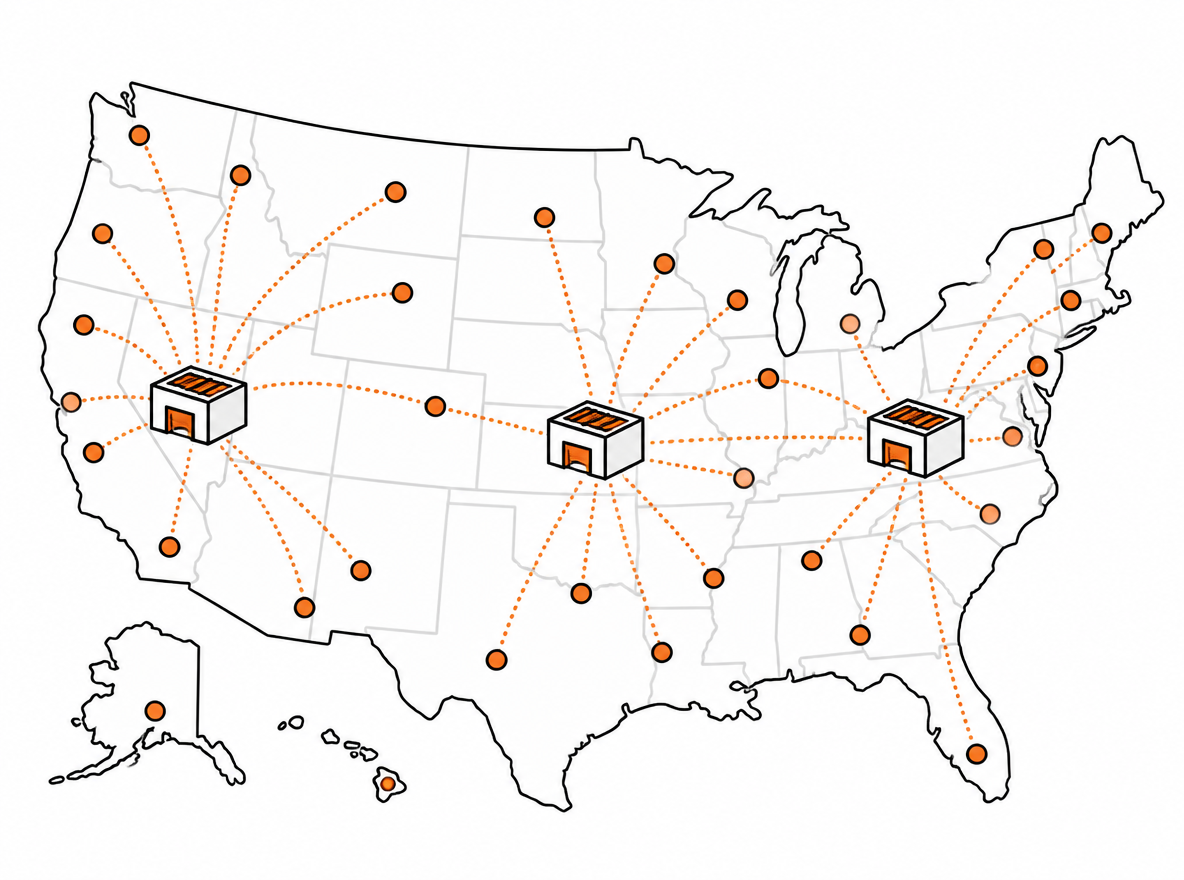
Once you have decided whether to split, the next question is where. The core logic of site selection is not spreading warehouses evenly, but "demand density first plus the 2-day radius". Ground delivery follows a practical rule: within a 250 to 350 mile radius of a warehouse, 2-day delivery is reliably achievable [^5]. In other words, choosing warehouse locations is essentially "covering the most demand density with the fewest warehouses".
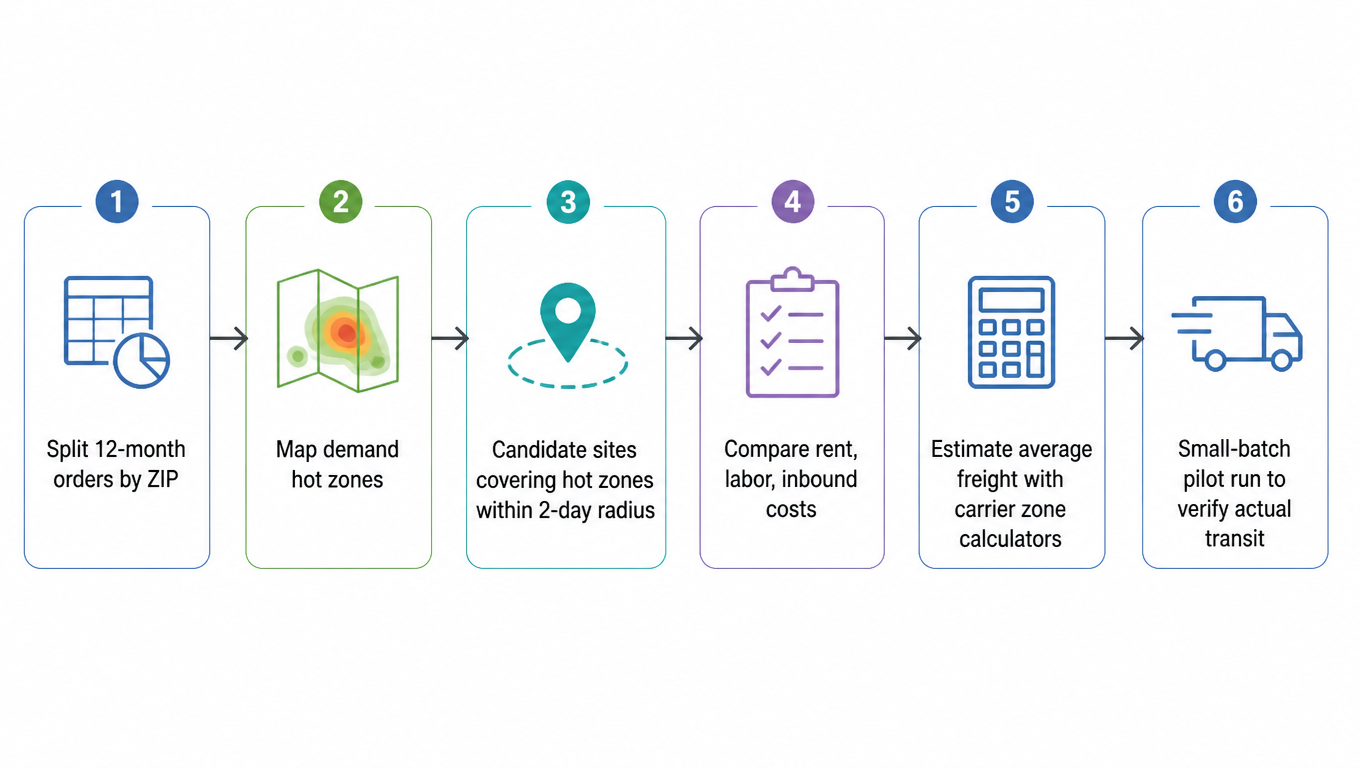
Going from one warehouse to two is simple: split the last 12 months of orders by state and ZIP, map the demand hot zones, find the region that is both farthest from your current warehouse and most concentrated in orders, and put the second warehouse there. A typical West Coast starter almost always lands its second warehouse in New Jersey or Pennsylvania; an East Coast starter does the reverse and lands in inland California. Sock brand Bombas is a real example of the latter path: it kept its distribution center of gravity in New Jersey, then worked with a freight forwarder to move distribution to California, cutting ocean transit from 28 days to 18 [^1]. For sellers who import mainly from Asia, the West Coast warehouse often doubles as the first-mile offload point: containers dock directly at West Coast ports, skipping the cross-country truck leg, and the time saved becomes working capital and lower stockout risk. The goal of this step is not nationwide coverage; it is closing the most painful transit gap first.
Going from two to five warehouses, mature national networks in the industry converge on roughly the same five nodes: Northeast (New Jersey/Pennsylvania, around Allentown), Southeast (Atlanta), South Central (Dallas), North Central (Chicago), and West (Los Angeles or inland California). Why these five? Each one satisfies two conditions at once: high local demand density and its own regional transportation hub. Atlanta is one of the world's most important supply chain and logistics hubs, within 3.5 hours' drive of the Port of Savannah [^12]; Dallas-Fort Worth (DFW) is one of the largest industrial logistics markets in the US [^13]; Chicago is the national intermodal hub; and the NJ/PA corridor hugs the Northeast population belt. This combination typically brings over 95% of the US population within a 2-day ground delivery radius [^9]. For reference, a single centrally located warehouse (even in Kansas or Kentucky) covers only about 75% to 80% [^10].
But five warehouses are not a destination you jump to; they are a path that grows. Run two warehouses first, watch the actual turnover and transfer costs at each, then evaluate the third and the fifth. Every step returns to the same question: does the money saved on freight and speed outweigh the extra money spent on storage, inventory, and management? There is an easily missed hidden benefit here: regional carriers (OnTrac, GLS, LSO, and similar) typically run 15% to 30% cheaper than FedEx/UPS on short-haul zones 2 through 4 [^6]. The closer your warehouses sit to customers, the more you can use these low-cost regional networks, and the better your multi-warehouse freight math looks.
Finally, not every SKU belongs in all five warehouses. Fast movers deserve network-wide placement; slow movers should concentrate in one or two warehouses to save a large chunk of inventory cost. Mattress brand Casper is the frequently cited example: mattresses are bulky and per-unit freight is a huge share of cost, so it used a 3PL multi-warehouse network to place inventory closer to customers, compressing the last leg as far as possible without building its own logistics team [^7]. The counter-example is just as common: a slow-moving SKU takes one pallet in a single warehouse, spread across three warehouses it becomes three pallets, each holding its own safety stock, and cash gets silently diluted [^2]. One estimate shows the same 1,000 cubic feet of inventory raising monthly storage cost from about USD 750 to about USD 1,275, roughly 70% more, when split across two warehouses [^3]. This tiering idea, fast movers across the network, slow movers concentrated, is the key to controlling inventory cost in a five-warehouse network.
Site selection itself can follow a five-step process:
The five-step site selection process
Inventory Allocation: How to Divide Stock Across Warehouses
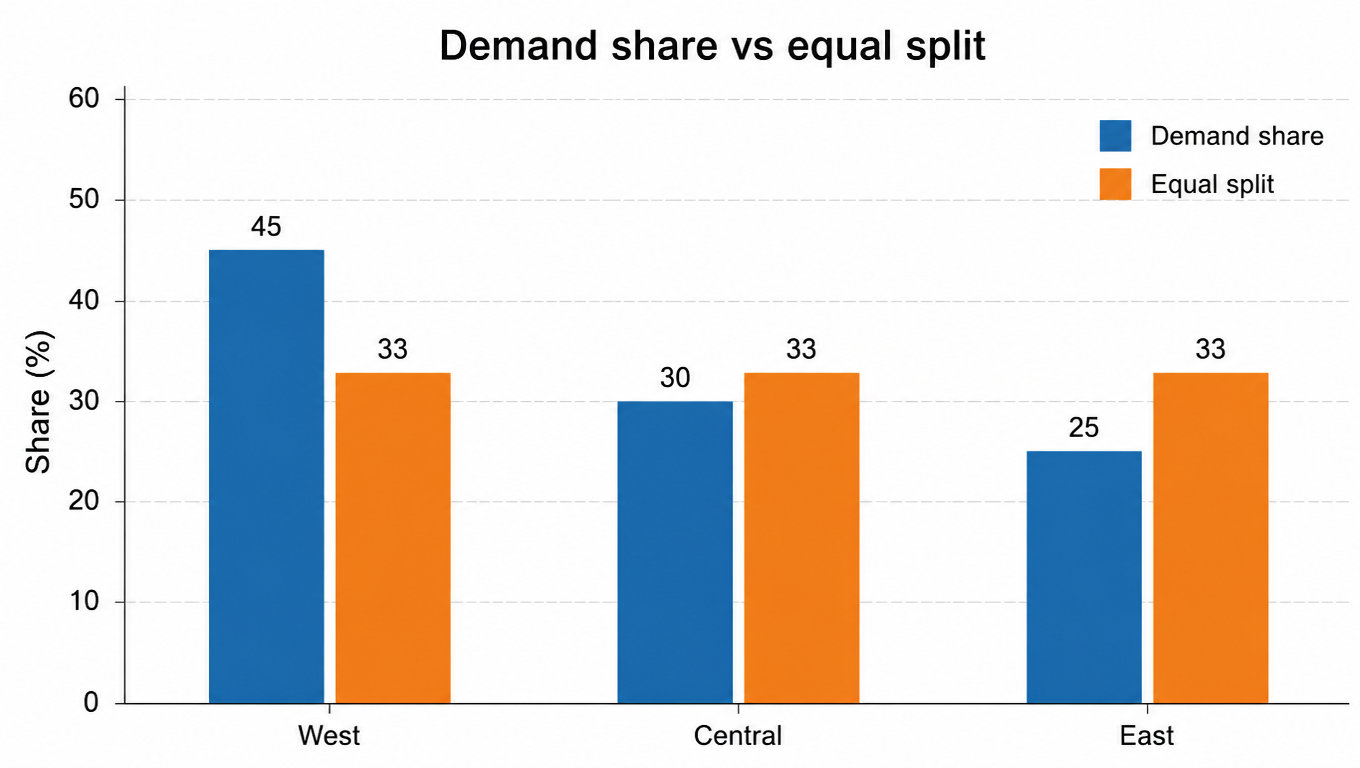
The most common mistake after splitting is equal allocation: one third in each of three warehouses. But demand is never equal. For a typical US-market seller, orders might run 45% from the West, 30% from the Central region, and 25% from the East; equal allocation inevitably means West stockouts and East overstock.
Demand share vs equal split
The right way is to let inventory follow demand: break historical orders into regions by state, ZIP, or platform sales reports, compute each region's demand share, allocate inventory by that share, and hold a 10% to 15% buffer for fluctuation.
The safety stock formula has not changed; it is still demand variability times replenishment lead time. But after splitting, each warehouse calculates its own, and the summed total necessarily rises. The trade-off: the more you stock, the lower the stockout rate, but the higher the capital tied up. In practice, set an acceptable target stockout rate (say, under 5%) and derive each warehouse's safety stock backward from it, rather than arbitrarily adding 20%.
Inter-warehouse transfers become part of daily life after splitting: when one warehouse's stock drops below its safety line and another has surplus, a transfer triggers. Trigger conditions should be written as rules (transfer when stock falls below X days of sales), and frequency depends on warehouse distance and freight; frequent small transfers are usually more expensive than one large transfer.
Running It: Replenishment Cadence and KPIs After the Split
With one warehouse, replenishing once a week may be enough. After splitting, each warehouse consumes at a different pace, so replenishment cadence has to go from weekly to daily granularity, or you easily end up with warehouse A overflowing while warehouse B runs out.
After the split, watch five KPIs: inventory turnover days (per warehouse), stockout rate, inter-warehouse transfer cost as a share of sales, fulfillment speed attainment (for example, the share of orders hitting the 2-day promise), and total inventory capital. The first three reflect inventory health; the last two reflect fulfillment quality and capital efficiency.
At the system level, multi-warehouse order routing must be automated: at order time, compute the optimal ship-from warehouse from the delivery address, each warehouse's stock, and transit distance, instead of relying on human judgment. Inventory sync needs to be real-time or at least near-real-time, or routing decisions run on stale data. Most mainstream WMS/OMS products support multiple warehouses, but between "supports it" and "uses it correctly" sits the hard work of tuning routing rules.
Two pitfalls are the most common. First, warehouse inventory imbalance compounds until it snowballs; the fix is writing transfer rules into the system instead of coordinating by email. Second, dead stock rises when demand in some region underperforms and goods sit in that warehouse; the fix is a quarterly cross-warehouse rebalance that concentrates slow movers in one warehouse instead of keeping a copy in every one.
Beyond the US: From Domestic to Global Multi-Warehouse
Domestic multi-warehouse solves the last mile; global multi-warehouse has to handle the whole chain beyond the first mile: duties and compliance, local payments and returns, and the differences between each country's last-mile networks. The decision criterion also changes, from transit days to a three-way balance of duty cost, speed, and local service capability.
When should you open an overseas warehouse? The rule of thumb: monthly order volume in a country or region is enough to cover one warehouse's minimum operating cost (typically several consecutive months of stable volume at a meaningful scale), the category's local return rate is low, and compliance risk is manageable. Below that threshold, testing with local direct shipping or FBA is more cost-effective.
For the starting point, many sellers begin with Amazon FBA overseas warehouses, using the platform network to validate demand, then gradually move to third-party 3PL networks for more category freedom. The evolution from multi-warehouse to a distributed inventory network points one way: inventory closer to demand, data more real-time, routing smarter, until you end up with a network where stock sits wherever people buy.
Conclusion: The Roadmap from Single to Multi-Warehouse
Here is a four-step roadmap: run the math, pilot, expand, then keep tuning. First, run your own data through the framework from the earlier sections. Second, open only the second warehouse as a pilot and watch conversion, stockout, and transfer data for 2 to 3 months. Third, only after the pilot works consider the third and fourth warehouses. After that, review each warehouse's turnover and costs quarterly and keep tuning the allocation ratios.
Splitting is a means, not an end. It serves only two things in the end: fulfillment experience and profit. If one warehouse already delivers both, there is no need to split; if splitting makes both better, then do not hesitate.
When monthly volume is under 10,000 orders, one region contributes over 80% of orders, margins are too thin for a second set of fixed costs, or the category is so seasonal that other warehouses would sit idle most of the year. Splitting is a scaling tool; forcing it without the data only dilutes profit.
Split the last 12 months of orders by state and ZIP, map the demand hot zones, and place it in the region both farthest from your current warehouse and most concentrated in orders. West Coast starters usually land in New Jersey or Pennsylvania; East Coast starters land in inland California. For import-heavy sellers, a West Coast warehouse can double as the first-mile offload point.
Moving from one warehouse to two typically raises total safety stock by 20% to 30%, because each warehouse carries its own buffer. The formula is still demand variability times lead time; set an acceptable target stockout rate (say, under 5%) and derive each warehouse's stock backward, rather than guessing.
Fast movers deserve network-wide placement; slow movers should concentrate in one or two warehouses. The counter-example: spreading a slow mover across three warehouses multiplies stock and safety stock, silently diluting cash. Run a quarterly cross-warehouse rebalance to consolidate slow movers into one warehouse.