Every dollar you shave off shipping might be burning a hole in your customer acquisition budget.
This isn't alarmist thinking. High-volume brands share a deeply ingrained reflex: treating logistics as pure cost. Ship a few thousand orders a month, save 50 cents a unit, and you've "saved" six figures a year. The math feels solid. But it has a blind spot the size of a warehouse: it sees nothing beyond the freight invoice. It misses entirely the profit quietly leaking out the back door because of a lousy delivery experience.
Who is this for? If your brand ships more than 3,000 orders a month, this is your playbook. If someone on your team keeps insisting that "shipping is just about rates," forward this to them. And if you run a 3PL or fulfillment center and you're tired of racing to the bottom on price, consider this paper your next pitch deck.
Let's peel back the layers and see what "cheap shipping" actually costs.
1. You're Squeezing Freight Rates. You're Burning Your Acquisition Budget.
Let's start with a piece of business math that's been validated so many times it's practically gospel: acquiring a new customer costs 5 to 25 times more than keeping an existing one. That finding traces back to Frederick Reichheld at Bain & Company, published in Harvard Business Review in 1990, and it remains the bedrock of customer economics.
Use the shipping-cost optimization overview to connect the investment model to controllable operating changes. The cost-per-successful-delivery method helps keep modeled savings separate from measured delivery results.
What does that have to do with which carrier you pick?
Bad logistics is one of the most efficient ways to push existing customers out the door. The same body of HBR research shows that raising customer retention by just 5% can boost profits by 25% to 95%. And delivery experience is a core driver of retention. According to a 2025 report from consumer research firm Emplifi, 70% of consumers will abandon a brand after just two negative experiences. Nearly a quarter will leave after one.
The chain works like this: you pick a cheap carrier to save on freight → transit times stretch, tracking goes dark, packages show up damaged → the customer has a bad experience → they don't come back → you keep burning ad dollars chasing new customers → your CAC stays sky-high. The few cents you saved per shipment? A rounding error next to your acquisition costs.
Here's the cruel part: those lost customers won't tell you why they left. They won't fill out a survey saying "your shipping was too slow so I'm done." They just disappear. You'll see "repeat purchase rate declining" on your dashboard and never connect it to the budget carrier you switched to three months ago.
2. Hidden Cost #1 — Your Return Rate Isn't "Industry Average." Your Logistics Is Casting the Vote.
A lot of brands treat return rates like the weather: something that just happens. "Apparel always has high returns." That's half true.
According to a joint report from the National Retail Federation (NRF) and Happy Returns, the average e-commerce return rate in 2024 was 16.9%. That's nearly 17 returns for every 100 orders. In categories like apparel and footwear, it can hit 20% or even 30%.
But "industry average" is a dangerous phrase. It buries a critical fact: a portion of your returns has nothing to do with product quality. Damaged packaging, wrong address, missed delivery windows, product damage in transit — these returns aren't about what you made. They're about how it got there. Your logistics is voting on your behalf, and the results show up in your returns column.
And each return costs a lot more than the reverse shipping label. Product depreciation, re-inspection, restocking labor, packaging materials: add it all up and it dwarfs the freight savings you were chasing. Plus, returned inventory rarely resells at full price.
Let's run a real scenario: a brand shipping 5,000 orders a month. If poor logistics pushes the return rate up 3 percentage points — from 17% to 20% — that's an extra 1,800 returns a year. At a conservative $12 per return in total processing costs, you're burning an extra $21,600 annually. And what did you save? Maybe $0.30 a shipment, which comes out to $18,000.
Saved $18,000. Lost $21,600. Has your CFO seen that math?
3. Hidden Cost #2 — WISMO. You're Paying People to Answer "Where's My Stuff?"
WISMO — "Where Is My Order" — is the oldest, most annoying, and most expensive question in e-commerce.
During normal operations, WISMO inquiries eat up 10% to 25% of all customer service volume. During peak season — Black Friday, Christmas — that number can spike to 40%. Each WISMO interaction costs between $5 and $22 to resolve, depending on whether you're using human agents, how long they spend digging through carrier portals, and how many systems they have to cross-reference.
Now do the math: a brand shipping 10,000 orders a month, at a 15% WISMO rate, generates 1,500 inquiries. At the low end of $5 per ticket, that's $7,500 a month. $90,000 a year. That money creates zero value. It doesn't solve a problem — it compensates for missing information.
And the root cause is painfully obvious: opaque tracking. When customers can't see where their package is in real time, don't know the estimated delivery window, and receive no proactive updates, they come looking for you. That $7,500 a month is, at its core, the price of inadequate tracking infrastructure.
Switch to a logistics partner that delivers end-to-end visibility — where your customer can pull up real-time tracking and an accurate ETA right on your brand's website — and your WISMO rate drops sharply. The customer service savings alone probably beat whatever freight-rate concession you've been negotiating for.
4. Hidden Cost #3 — Shipping Reviews Are Quietly Killing Your Conversion Rate
This one is the easiest to overlook. And the most devastating.
A product page with more than four negative reviews can see sales drop by 70%. Seventy percent. Not a marginal dip. In a DTC world where social proof drives every purchase decision, bad reviews are a conversion black hole.
And shipping-related reviews are the most unfair kind. The product itself was fine. The fabric, the build quality, the functionality — all good. But the customer waited 14 days, the box arrived looking like it went through a war zone, or the tracking number sat frozen for five days. So they left a one-star review.
Those reviews live on your product page forever. They don't come with a disclaimer saying "this was the carrier's fault." A new shopper reading "took two weeks to arrive, never again" won't pause to wonder whether it was the brand or the courier. They'll close the tab and buy from someone else.
Repeat purchase rate drops. Lifetime value shrinks. Referral potential evaporates. Every customer lost to a shipping review is months or years of repeat revenue and word-of-mouth value gone. The freight savings that caused it? A rounding error in comparison.
Consumer research shows that 79% of shoppers say they're unlikely to buy from a brand again after a single bad post-purchase experience. And shipping is the core of the post-purchase experience.
5. Supply Chain — Inventory Distortion Costs an Order of Magnitude More Than Freight
So far we've stayed on the customer experience side. Now let's pull the lens back and look at the supply chain.
Global retail loses $1.77 trillion annually to inventory distortion. That's the combined cost of out-of-stocks and overstocks — roughly $1.2 trillion from not having enough, and $562 billion from having too much.
High-volume brands are especially vulnerable. When your inventory is spread across multiple fulfillment centers and multiple sales channels (your own site, Amazon, Walmart, TikTok Shop) and none of those systems talk to each other, misallocation is practically guaranteed. Warehouse A is overflowing while Warehouse B sits half-empty. You're out of stock during peak and drowning in excess during the off-season. Cross-warehouse transfers devour your logistics budget. These problems play out every single day.
The data gap between brands and their 3PLs also creates a silent cost sink: reconciliation. Many brand teams spend 15 to 20 hours a week manually reconciling inbound, outbound, and inventory balances across warehouses. Convert that time to dollars and it may exceed whatever freight discount you negotiated.
And stockouts carry a multiplier effect. A customer wants to buy your product and finds it unavailable. They won't wait. They'll buy from a competitor. And if they try the competitor and it works fine, you haven't just lost that order — you've lost that customer. Permanently. The churn rate from stockouts far exceeds normal fulfillment scenarios.
6. Recalculate. Shipping Is an Asset, Not a Cost.
Lay out all five layers and the conclusion is hard to ignore: cheap shipping is expensive.
Expensive not in freight rates, but in the returns, customer service tickets, bad reviews, inventory misallocation, and customer churn it triggers. These hidden costs are scattered across different department budgets — customer service, marketing, operations, finance — each looking small on its own. Stack them together and you're staring at an iceberg.
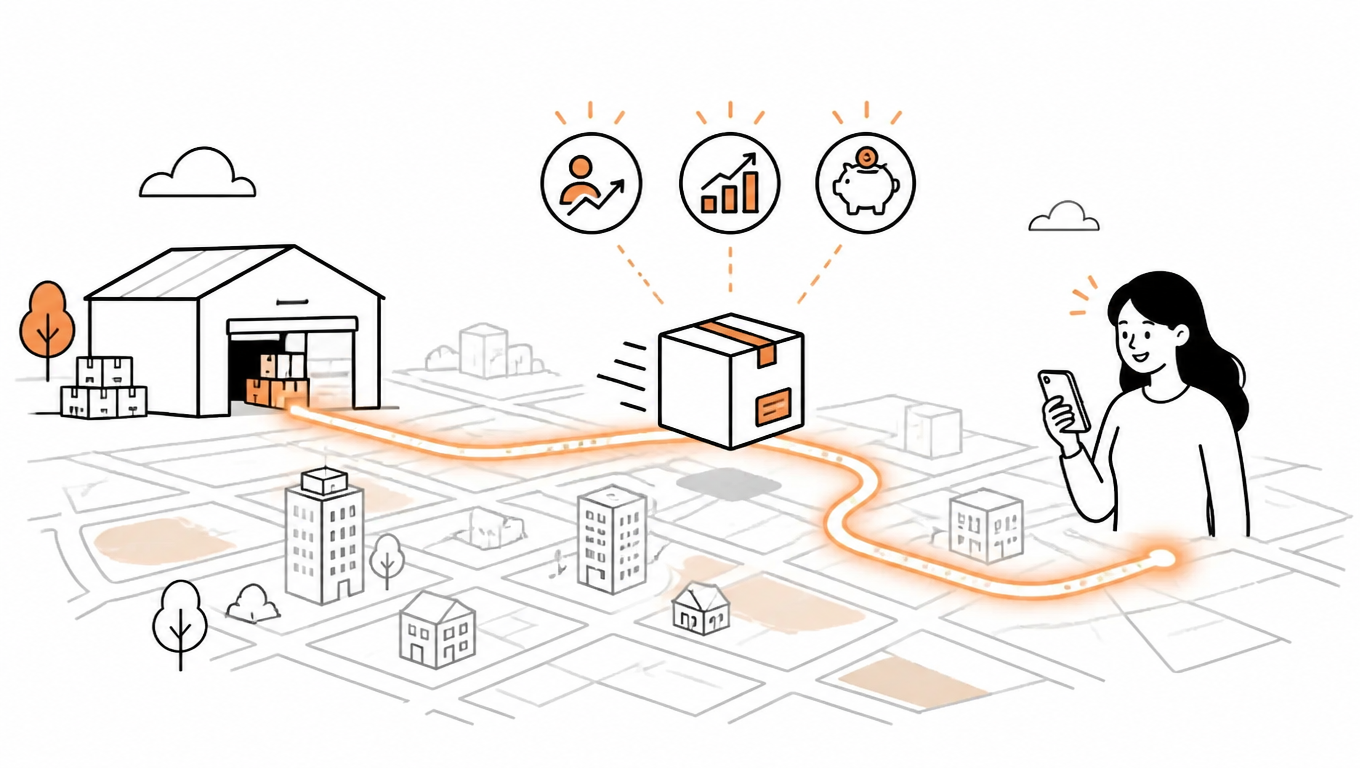
Flip the lens. Quality logistics isn't "spending money." It's making more of it. The virtuous cycle is straightforward: predictable delivery times plus end-to-end transparent tracking → fewer returns, fewer WISMO inquiries, fewer bad reviews → higher repeat purchase rates → longer LTV → acquisition costs spread across more orders → wider margins.
This isn't cost optimization. It's asset allocation. What you invest in logistics is fundamentally an investment in customer retention and brand reputation. The return on that investment runs circles around what you're getting from your Facebook and Google ad spend.
High-volume brands really only need three things from their logistics: predictable delivery windows, end-to-end tracking the customer can actually see, and a unified data dashboard that feeds back into operational decisions. Those three together transform shipping from a line item on the P&L into fuel for your growth engine.
That's what EasyShippingX delivers. Its intelligent route optimization engine compares carrier performance in real time, helping 3PLs match every brand to the best lane. Its end-to-end tracking gives brand customers full visibility into every step of their shipment, right on the brand's own website. And its unified data dashboard is the infrastructure that connects multi-warehouse, multi-channel inventory into a single pane of glass. With these capabilities, a 3PL no longer delivers "warehouse space plus carrier capacity." It delivers quantifiable logistics ROI.
7. For 3PL Partners — This Paper Is Your Sales Weapon
If you run a 3PL or fulfillment center and you're pitching high-volume brands, you know the scene. The first question out of their mouth is: "What's your rate per kilo?"
This paper is how you change that conversation. When a brand is stuck in freight-rate tunnel vision, put this white paper on the table. Walk them through the full picture of hidden costs. You're not selling warehouse space and carrier contracts. You're showing them profit they're already losing and don't even know it.
A calculator beats a rate card every time. Help them work through the numbers: how much are you burning each month on hidden logistics costs right now? With our solution, how much does your return rate drop? How much do your WISMO tickets fall? What does conversion look like with fewer shipping complaints on your product pages? Lay those numbers out and price stops being the only variable.
Nobody wins a price war. But a partner who helps their clients make more money never loses negotiating power. Shipping can be your client's cost center. Or it can be the profit engine you helped them build. The difference is in how you tell the story.