Shopify Fulfillment Costs · 2026

Shopify Fulfillment Costs 2026: 3PL, Shipping & Hidden Fees

There is no "official Shopify warehouse" in 2026. Shopify Fulfillment Network (SFN) was sold to Flexport in 2023, and Shopify has fully exited self-run fulfillment to focus on software. So when you search for "Shopify fulfillment cost", you are not looking at one price list. You are looking at a combination of two things: discounted carrier rates through Shopify Shipping, plus the invoice from the 3PL you choose.

These two numbers are usually discussed separately, but to you they are one pot of money. This article gives you three things: a complete cost map (where an order's money actually goes), a decision table (at what scale to self-fulfill, at what scale to outsource), and a hidden-fee list (the 10 line items most likely to overcharge you).

The headline first: for DTC sellers doing 100-5,000 orders a month, total fulfillment cost usually splits into three blocks: carrier shipping (about 55%), 3PL service fees (about 25%), and the surcharges and miscellaneous fees hiding in the corners of the invoice (about 20%). Shipping is the biggest line, but the easiest money to save sits in the other two.

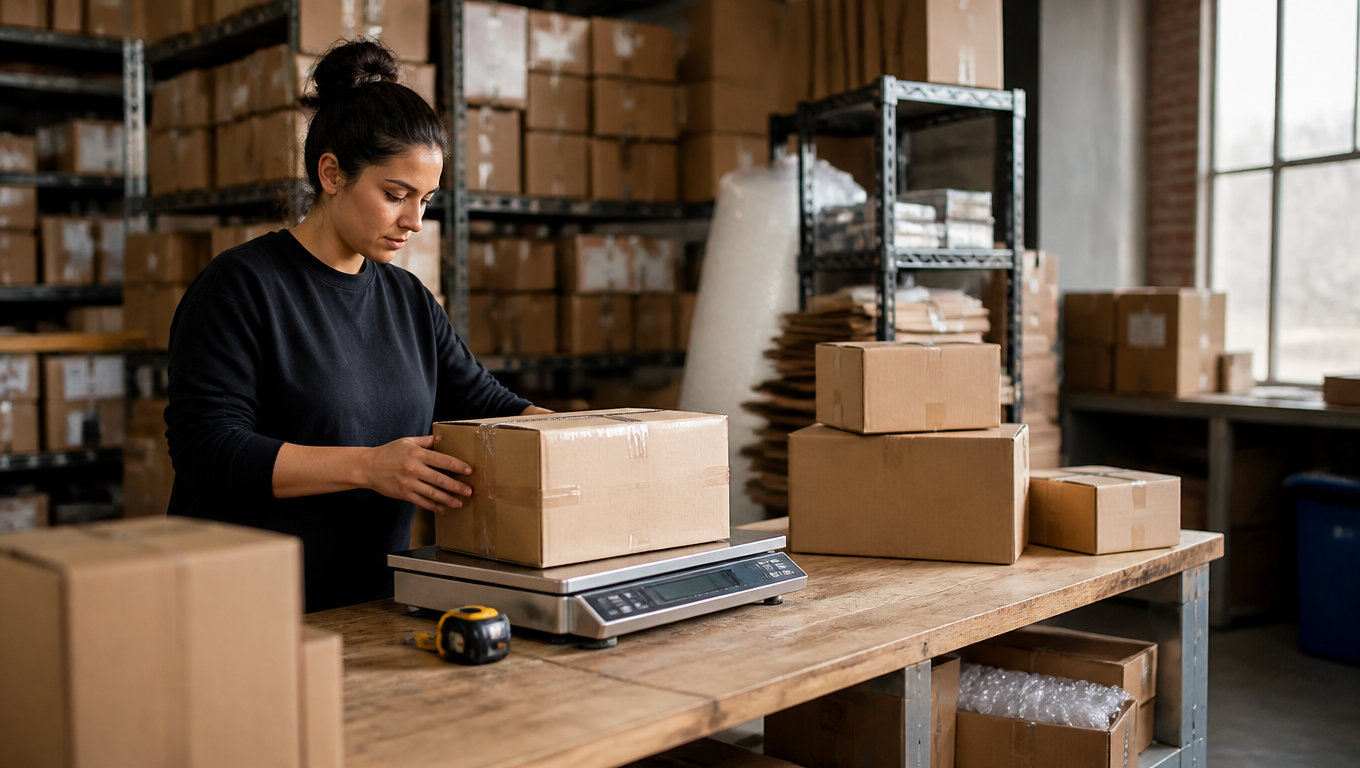
Workers pack products at a U.S. ecommerce warehouse beside labeled parcels awaiting dispatch.
The cost of fulfilling an order is never a single shipping number

1. The Full Cost Picture: What One Order Really Costs

Every order's fulfillment cost breaks into the same three blocks: 3PL service fees, carrier shipping, and hidden fees. The 3PL service fee is what the warehouse charges you. 2026 market rates run roughly: receiving $15-40 per pallet, storage $18-45 per pallet per month, pick and pack $2-5 per order (about $3.20 on average), with value-added services (labeling, inspection, custom cards) priced separately.

Shipping is the biggest block, and 2026 just brought another round of increases: UPS and FedEx raised rates by an average of 5.9% for their 2026 fiscal years (UPS effective December 22, 2025; FedEx effective January 5, 2026); USPS market-dominant products rose about 4.8% on average (effective July 12, 2026), while competitive products like Priority Mail and Ground Advantage saw base rates up about 8%, with Ground Advantage averaging 7.8%. The good news: Shopify Shipping passes on carrier discounts of up to 88%, one of the best base rates you can get.

A concrete example. Say you ship 500 orders a month with an average parcel of 1.5 lb via USPS Ground (Shopify discounted rate about $7.20 per order). The monthly ledger looks like: shipping $7.20 x 500 = $3,600; pick and pack $3.20 x 500 = $1,600; storage allocated at 6 pallets x $30 per month = $180, about $0.40 per order; hidden fees (fuel surcharges, DIM differences, peak surcharges, etc.) about $2.60 per order, $1,300 total. That is roughly $6,700 a month, about $13.40 per order. Hidden fees are close to a fifth of the total, and most sellers have never reconciled them.
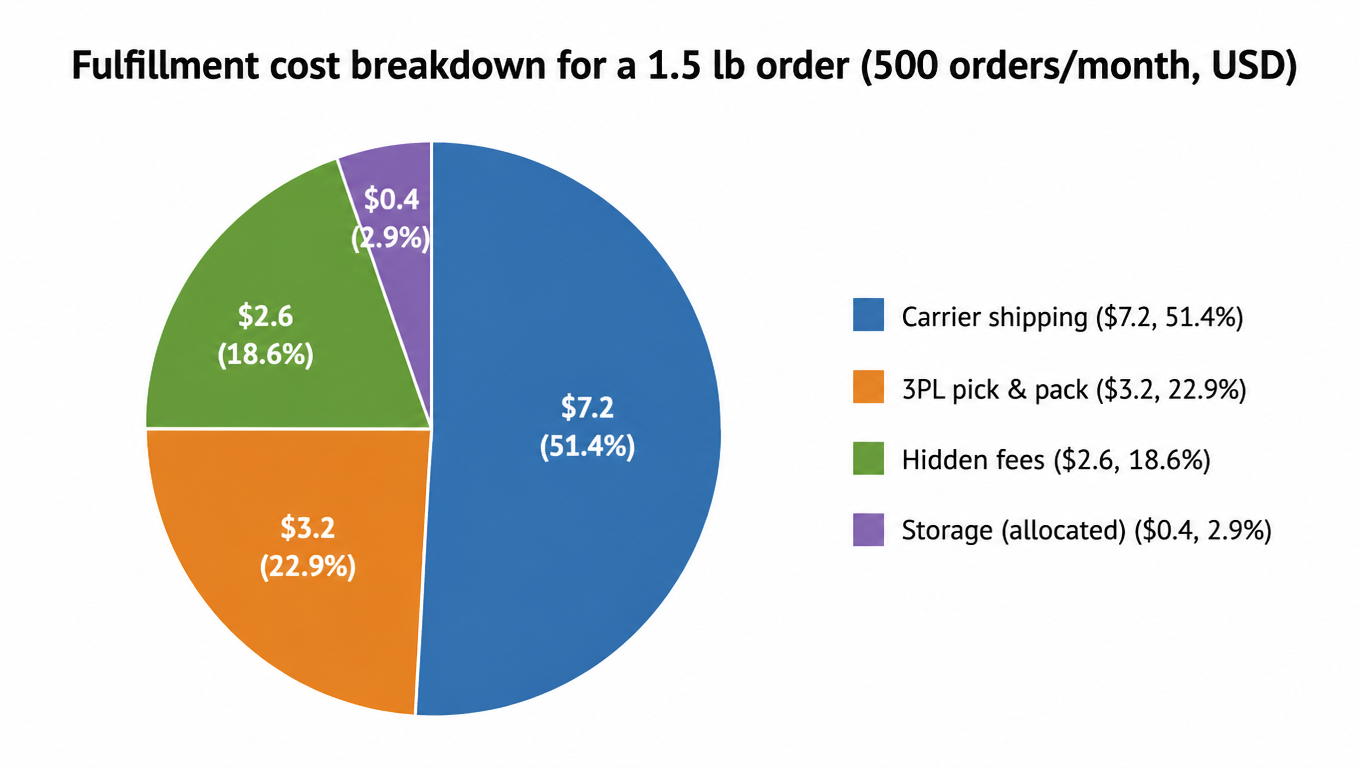
Pie chart of fulfillment cost for a 1.5 lb order: carrier shipping $7.20, 3PL pick and pack $3.20, hidden fees $2.60, storage allocated $0.40
Hidden fees are close to a fifth of the total, and the easiest to overlook

2. Shopify Shipping vs a 3PL: The Real Prices of Each

First, clear up the most common misunderstanding: Shopify Shipping is not a warehouse. It is a doorway to discounted carrier rates. You print USPS, UPS, FedEx, and DHL labels from the Shopify admin at the wholesale discounts Shopify negotiated, up to 88% off. It solves "shipping is expensive", not "I have nowhere to store inventory and no time to pack".

A 3PL is a full service: receiving, storage, pick and pack, and dispatch, with shipping at the contract rates the 3PL negotiated with carriers. Because 3PLs have volume, contract discounts usually sit well below retail. But here is the catch: the shipping rates a 3PL passes on to you are not necessarily cheaper than what you get through Shopify Shipping. Many 3PL quotes simply list "contract rate plus a small markup".

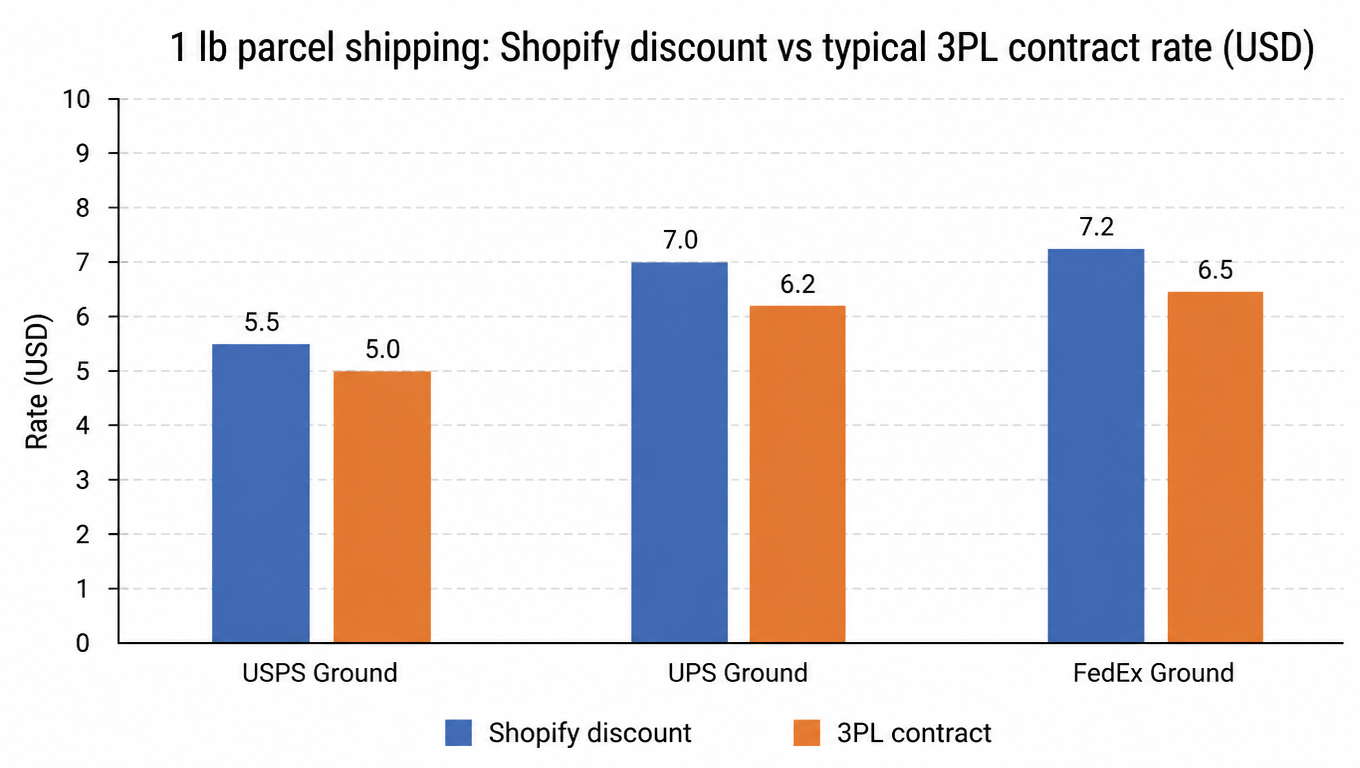
For the same 1 lb parcel (median zone), the real gap between the two channels looks like this:

Service Shopify discounted rate Typical 3PL contract rate Gap
USPS Ground$5.50$5.00$0.50
UPS Ground$7.00$6.20$0.80
FedEx Ground$7.20$6.50$0.70

The takeaway: shipping cost is decided by your volume, and whoever holds the better contract wins. When you evaluate a 3PL, compare its shipping contract discounts against your current Shopify discounts line by line, instead of assuming the 3PL is automatically cheaper. The gap usually runs $0.50-1.50 per order, which at 500 orders a month is $250-750 of pure profit.

Bar chart of 1 lb parcel rates: Shopify discounted rate vs typical 3PL contract rate for USPS Ground, UPS Ground, FedEx Ground
The gap runs $0.50-1.50 per order; at 500 orders a month that is $250-750

3. The Hidden Fee List: The 10 Most Expensive Line Items on Your Invoice

Hidden fees come from two sides: carrier surcharges, added to shipping, and 3PL miscellaneous fees, added to the service invoice. Each line is small on its own, but stacked they can inflate your fulfillment cost by 15-20%. Go through the list below line by line; every item shows the reasonable industry range and how to catch it.

The 3 carrier-side items:

1. DIM weight. Since July 12, 2026, USPS lowered its DIM divisor from 166 to 139 to align with UPS and FedEx, and all fractional inches now round up. A smaller divisor means a heavier billable weight for the same box: a 12 x 10 x 6 inch box is about 4.3 lb under 166 (billed at 5 lb) and about 5.2 lb under 139 (billed at 6 lb), a full rate tier jump. UPS and FedEx also introduced a 40 lb minimum billable weight in January 2026 for parcels that trigger DIM billing (UPS January 26, FedEx January 12). How to catch it: measure your boxes, run them through 139, and compare against the invoice.

2. Fuel surcharge.A weekly floating percentage on UPS and FedEx, mostly in the 20-25% range in 2026. It never appears on the quote, only on the invoice. How to catch it: look up the current weekly rate on the carrier's site and apply it to your shipping charges.

3. Peak surcharge.UPS and FedEx add these from late October through January, ranging $0.50-8 per parcel by package type. How to catch it: compare peak-season invoices line by line to confirm nothing was overcharged.

The 7 3PL-side items:

4. Receiving fees.Charged per pallet or per case; $25-45 per pallet is the normal range, and anything above that deserves a question.

5. SKU setup fees.Entering and slotting a new SKU, commonly $0.25-1 per SKU or billed hourly.

6. Case-breaking fees.When a supplier ships full cases that need breaking down and sorting, billed per case or hourly; this one is often waivable.

7. Return handling.$2-5 per return is the common range; anything above that is negotiable.

8. Labeling.$0.10-0.25 per label is common, many 3PLs do it free, and paid ones can usually be negotiated away.

9. Address correction.When a buyer's address is wrong, carriers or 3PLs charge $5-15 per correction; address validation before dispatch avoids it.

10. Monthly minimums and account fees.Monthly minimums averaged around $500 in 2026, and low-volume sellers are the ones most likely to lose margin to them; ask before signing.

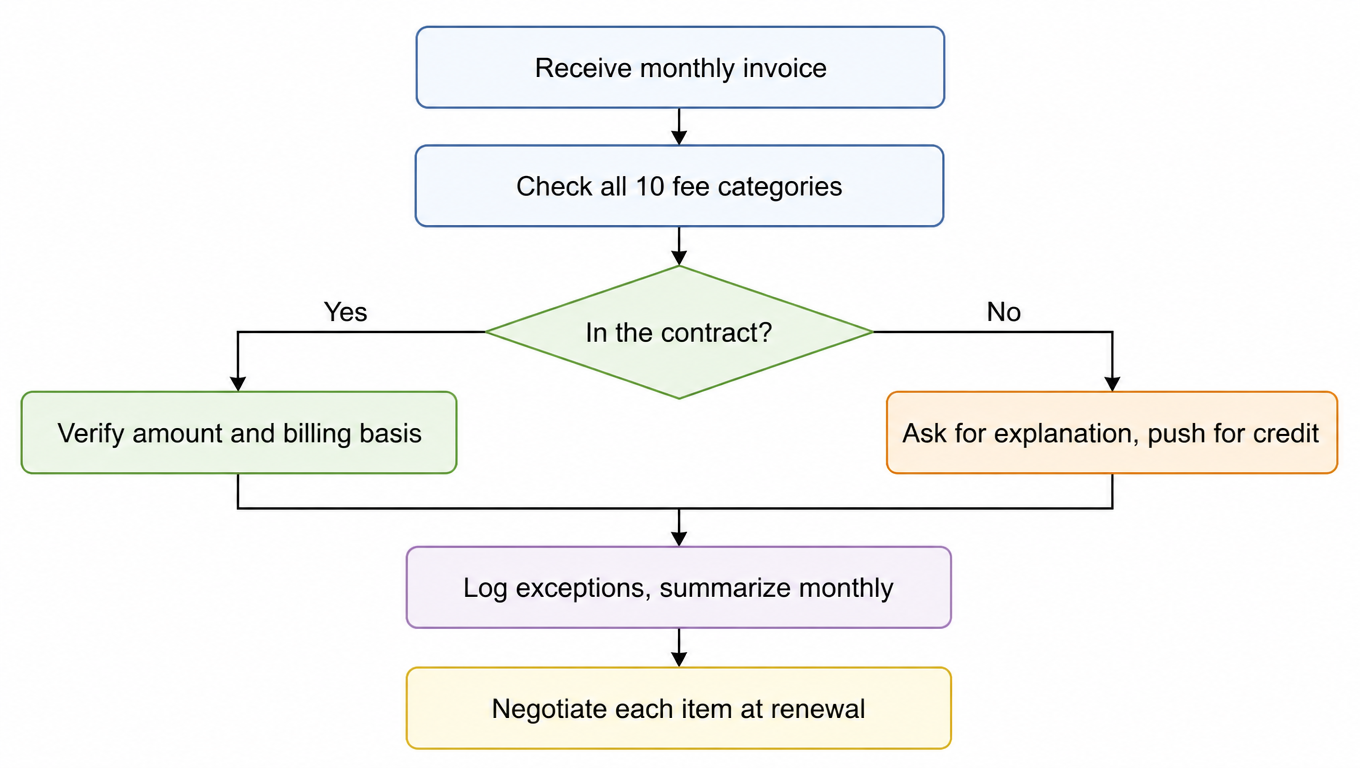
How to negotiate: take this list and ask your 3PL rep, item by item, "is this in the contract, what is the rate, and can it be waived". Most 3PLs will waive one to three of these, and everything waived is pure profit. The reconciliation flow looks like this:

Monthly invoice reconciliation flow: check all 10 fee categories, verify amount and billing basis if in the contract, ask for explanation and push for credit if not, log exceptions, then negotiate each item at renewal
Reconcile monthly, then negotiate each item at renewal

4. Self-Fulfillment vs a 3PL: When to Switch

Self-fulfillment is fixed-cost-heavy: space (from a corner of your home to a dedicated warehouse), labor (your time is the most expensive line), packaging materials, equipment (printer, tape dispenser, scale), and insurance. If fixed costs are not spread thin, per-order cost runs high; but the marginal cost of one more order is tiny, just a few extra minutes of your time.

A 3PL's cost structure is the reverse: no fixed investment, pay per order, but every order carries an unavoidable service-fee floor (pick and pack around $3.20, plus storage, plus a monthly minimum). At low volume a 3PL is not cheap, because the monthly minimum spreads over only a few hundred orders and drags the per-order cost up.

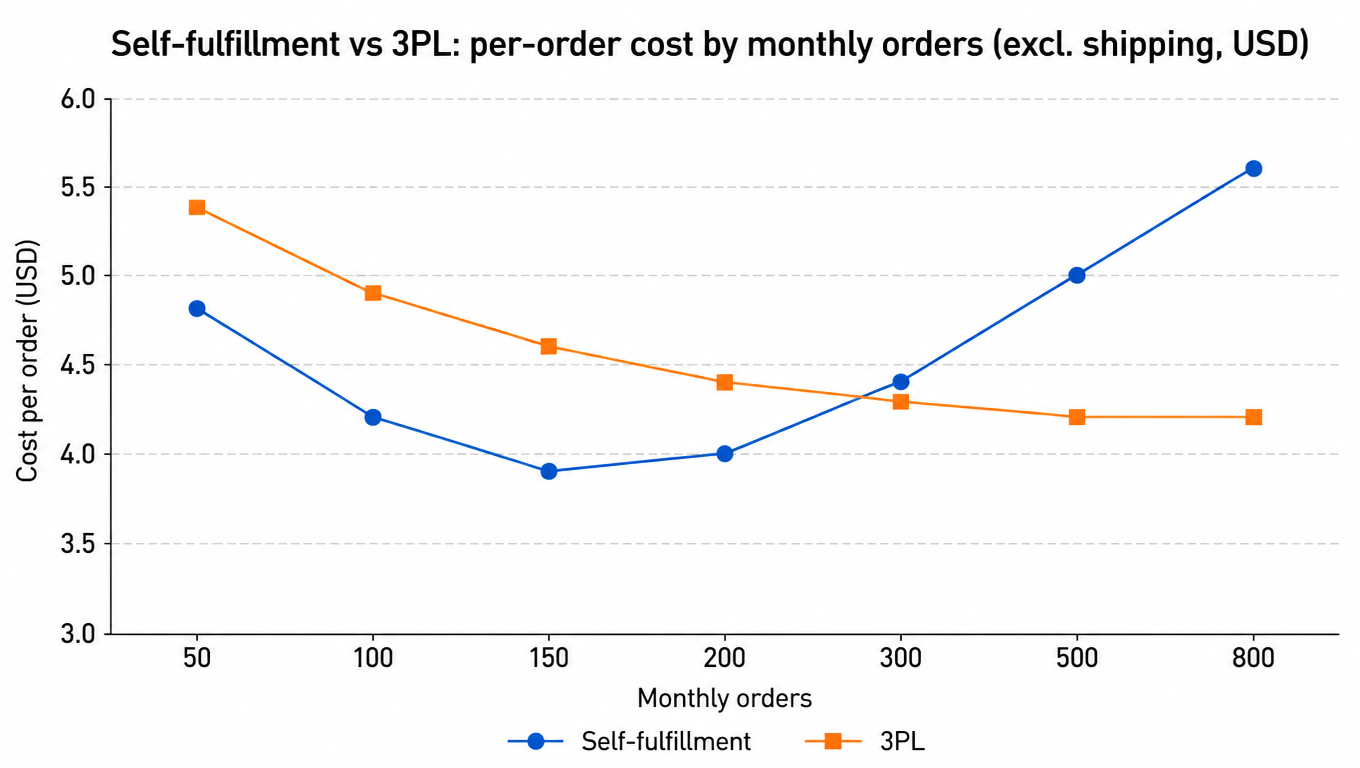
The industry rule of thumb puts the dividing line at 100-200 orders a month: below that, packing at home is cheapest; above roughly 200, your time starts running out, and hiring or renting space jumps your fixed costs up a tier, letting the 3PL's scale advantage take over. The exact number depends on five variables: monthly order volume, average parcel weight, SKU count, the labor you can invest, and growth expectations. The chart below shows the typical shape of both curves (excluding shipping, comparing fulfillment service fees only):

Line chart of per-order fulfillment cost by monthly orders: the crossover sits just above 200 orders a month, self-fulfillment cheaper on the left, 3PL cheaper on the right
The crossover sits just above 200 orders a month

How to read it: the crossover sits just above 200 orders a month, self-fulfillment is cheaper on the left, and the 3PL takes over on the right. If you are above 300 orders a month and still packing at home, run your time cost through the math first; you are probably already losing. Also note the 3PL curve stays flat at high volume: more volume means better contract discounts and a thinner monthly minimum.

5. Cost-Cutting Plays: Minimize Total Fulfillment Cost in 2026

Six plays, ranked by savings, each one quantifiable:

1. Right-size your packaging and fight the DIM battle.With the USPS divisor at 139, every cubic inch costs money. Switching a 13 x 10 x 6 inch box to 11 x 9 x 5 (volume down from 780 to 495 cubic inches) drops the billable DIM weight from 6 lb to 4 lb, saving $2-3 per order. At 500 orders a month, that is $12,000-18,000 a year.

2. Compare shipping contracts.Line up the 3PL's contract rates against your Shopify Shipping discounts, and take the $0.50-1.50 per order difference straight to the negotiation. Save $250-750 a month.

3. Negotiate the hidden fees away.Reconcile against the list in section 3, and you can usually get one to three items waived (labeling and account fees are the easiest). Save $0.50-1 per order.

4. Go hybrid.Self-fulfill the small and light, send the heavy and bulky to a 3PL (or the reverse). Small and light has low DIM and packs fast; bulky items eat storage and handling, and are better negotiated separately. Total cost usually drops 10-20%.

5. Use regional carriers.For parcels in the western US, look at regional delivery networks like UniUni and GOFO, which are often 15-30% cheaper than national carriers within their regions; route by zone alongside your Shopify USPS discounts.

6. Automate routing.Let shipping software pick the carrier by lowest price with an acceptable transit time, instead of manually grabbing the most expensive option every time; average 5-10% off shipping.

You do not need all six: start with 1 and 3 (no supplier changes needed), then 2 and 4 (contract negotiation), and leave 5 and 6 as the finishing touches. Stacking 1, 2, and 3, a 500-order-a-month seller saving more than $20,000 a year is realistic.

Closing: An Actionable Checklist

Five things you can do today:

  • Open your latest 3PL invoice and annotate every line with "what is this fee"; anything you cannot label is a suspect.
  • Measure the box sizes for every SKU and write down the length, width, and height.
  • Run the DIM math with a divisor of 139 and compare against the billable weights on the invoice.
  • Look up this week's UPS and FedEx fuel surcharge rates and check the fuel line on your invoice.
  • Email your 3PL rep and ask for a line-by-line comparison of your contract discounts versus Shopify Shipping discounts.

The 30-day decision roadmap: week 1 reconcile (the five things above); week 2 run the math (use the models in sections 1 and 4 to find your true per-order cost); week 3 negotiate (bring the hidden-fee list and the shipping comparison to one conversation with your 3PL); week 4 decide: stay self-fulfilled, switch to a 3PL, or go hybrid. Fulfillment is not a one-time decision. Your volume and parcel mix will change, so rerun this cost map every six months.

FAQ

No. Shopify Fulfillment Network was sold to Flexport in 2023, and Shopify has fully exited self-run fulfillment to focus on software. "Shopify fulfillment cost" is really two things: discounted rates through Shopify Shipping, plus the invoice from whichever 3PL you choose.
No. Shopify Shipping is a doorway to discounted carrier rates: you print USPS, UPS, FedEx, and DHL labels from the admin at up to 88% off. It does not store inventory or pack boxes. A 3PL is the full fulfillment service: receiving, storage, pick and pack, dispatch, at its own contract rates. The two work together: the 3PL handles the warehouse operations, and shipping goes to whichever side, your Shopify discount or the 3PL's contract rate, is cheaper.
The industry rule of thumb puts the dividing line at 100-200 orders a month, and the cost crossover usually lands just above 200: below that, packing at home is cheapest; above it, the 3PL's scale advantage takes over. The exact number depends on five variables: monthly volume, average parcel weight, SKU count, the labor you can invest, and growth expectations. If you are above 300 orders and still packing at home, run your time cost first.
Stacked, they usually inflate fulfillment cost by 15-20%. The big ones are DIM differences, fuel surcharges, and peak surcharges on the carrier side, plus monthly minimums, receiving fees, and return handling on the 3PL side. Reconcile against the 10-item list in section 3 and you can usually negotiate one to three items away; everything waived is pure profit.
Since July 12, 2026, USPS lowered its DIM divisor from 166 to 139 to align with UPS and FedEx, with all fractional inches rounding up. The same box now bills at a heavier weight: a 12 x 10 x 6 inch box jumps from the 5 lb tier to the 6 lb tier. UPS and FedEx also added a 40 lb minimum billable weight for DIM-triggering parcels starting January 2026. The fix is right-sizing your packaging: switching a 13 x 10 x 6 box to 11 x 9 x 5 drops billable DIM from 6 lb to 4 lb.