Ecommerce Shipping Guide

Order Status vs. Shipment Status vs. Tracking Status: Why Ecommerce Systems Disagree

Every ecommerce seller has lived this scene: a customer emails "where is my order?" ten minutes after the shipping notification went out, because the tracking page still says "label created". The order system says the package shipped. The warehouse system says it left the building. The carrier system says it has never seen it. All three are telling the truth, and that is exactly the problem. This article maps the four status layers that coexist inside every ecommerce operation, shows where they drift apart, and gives each role a concrete policy for deciding which layer to trust for notifications, SLAs, and dispute resolution.

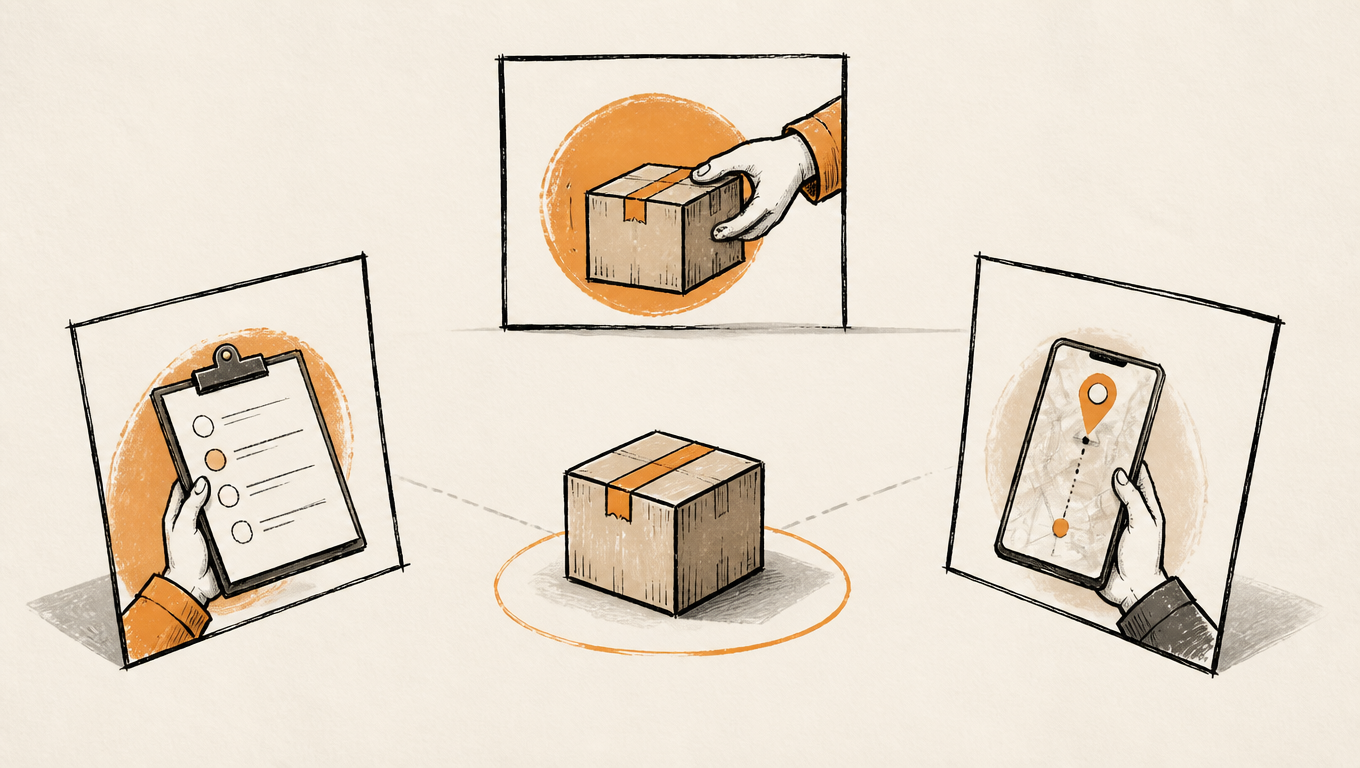
A parcel surrounded by three signs showing different status stages.
One package, three status boards that disagree

Why three systems disagree

A single package passes through at least four systems before it reaches a customer: the commerce platform that took the order, the warehouse system that picked it, the shipping integration that printed the label, and the carrier that actually moves it. Each of these systems keeps its own status field, updated by its own operator, on its own schedule.

The Shipping API workflow overview shows where status changes enter the shipping workflow. Use the shipping data-model guide to assign each status to the correct order, shipment, package, or label identifier.

Status is a local view, not a shared truth. The commerce platform does not know what happens inside the warehouse until an event is synced back. The warehouse does not know whether the carrier accepted the package until a scan comes in. The carrier does not know what the customer was promised. Every system renders the world from its own corner, and the corners do not update at the same moment.

The disagreements are not bugs. They are the predictable result of distributed systems that communicate through asynchronous events. Once you accept that, the question stops being "why do they disagree?" and becomes "which layer should I trust for each decision?" That is the question this article answers.

The four-layer status model

Think of status as four stacked layers, each owned by a different system. Knowing who owns each layer, and what updates it, is the foundation for everything else in this article.

Layer 1, commerce order status, is owned by the platform or OMS: Shopify, Amazon, eBay, Etsy, an ERP, or a headless commerce backend. Its states are things like unfulfilled, partially fulfilled, fulfilled, and refunded.[^4] It updates when fulfillment and tracking events sync back from the layers below. This is the layer customers see in their order history, and the layer marketplaces use for performance scoring.

Layer 2, warehouse/fulfillment status, is owned by the WMS or the 3PL. Its states are things like received, allocated, picked, packed, and shipped. It updates on warehouse scans and user actions, and it drives pick lists, packing stations, and the 3PL's own reporting. Customers rarely see it, which is why its inaccuracies stay invisible until something goes wrong.

Layer 3, shipping transaction status, is owned by the shipping integration: the label API, the multi-carrier platform, or the carrier's own shipping portal. Its states are things like label created, manifested, and in carrier possession. It updates when a label is purchased, a manifest is transmitted, or a pickup is confirmed. This is where the word "shipped" is used most loosely, because a label can exist long before a package moves.

Layer 4, carrier tracking status, is owned by the carrier's tracking system. Its states are things like acceptance scan, in transit, out for delivery, and delivered. It updates on scans at drop-off points, sort facilities, and doorsteps.[^6] This is the only layer that proves a package physically changed location, which makes it the ground truth for movement.

Layer Who updates it When it changes Example states Customer-visible?
1 Commerce order statusPlatform / OMSOn order and fulfillment eventsunfulfilled, fulfilled, refundedYes (order history)
2 Warehouse/fulfillment statusWMS / 3PLOn warehouse scans and actionspicked, packed, shippedNo
3 Shipping transaction statusShipping integrationOn label, manifest, pickup eventslabel created, manifested, in carrier possessionSometimes (via portal)
4 Carrier tracking statusCarrier systemsOn physical scansaccepted, in transit, deliveredYes (tracking page)

The core insight is that an event is the truth and a status is just a projection. A status field is nothing more than the latest known event rendered as a short label. Systems disagree because each one has projected a different slice of events, or received the same events at a different time. Every reconciliation strategy in this article follows from that one sentence.
Where the disconnects happen

Four fault lines explain most status disagreements.

First, "Order shipped" often means nothing more than "label created". The commerce platform marks the order fulfilled the moment a fulfillment record is synced, which usually happens when the label is generated, not when the package moves. The customer gets a notification while the box still sits on a warehouse shelf.

Second, manifested does not equal accepted. A manifest is a declaration of intent: the shipping system tells the carrier "these packages are coming". The carrier only takes possession at the first physical scan. Between manifest and acceptance there is a window where the shipping layer says "in carrier possession" and the carrier says "never seen it".

Third, the tracking the customer sees may not be the carrier's raw stream. Many platforms and shop apps show an aggregated tracking feed assembled from several sources. Aggregators can lag, drop events, or reorder them. The customer stares at a page that is itself a third-hand projection.

Fourth, timezones and batch syncs add delay. A carrier scans at 11 pm Eastern, the platform syncs tracking twice a day, and the customer checks at 9 am and sees yesterday's state. The package is fine, the status is late.

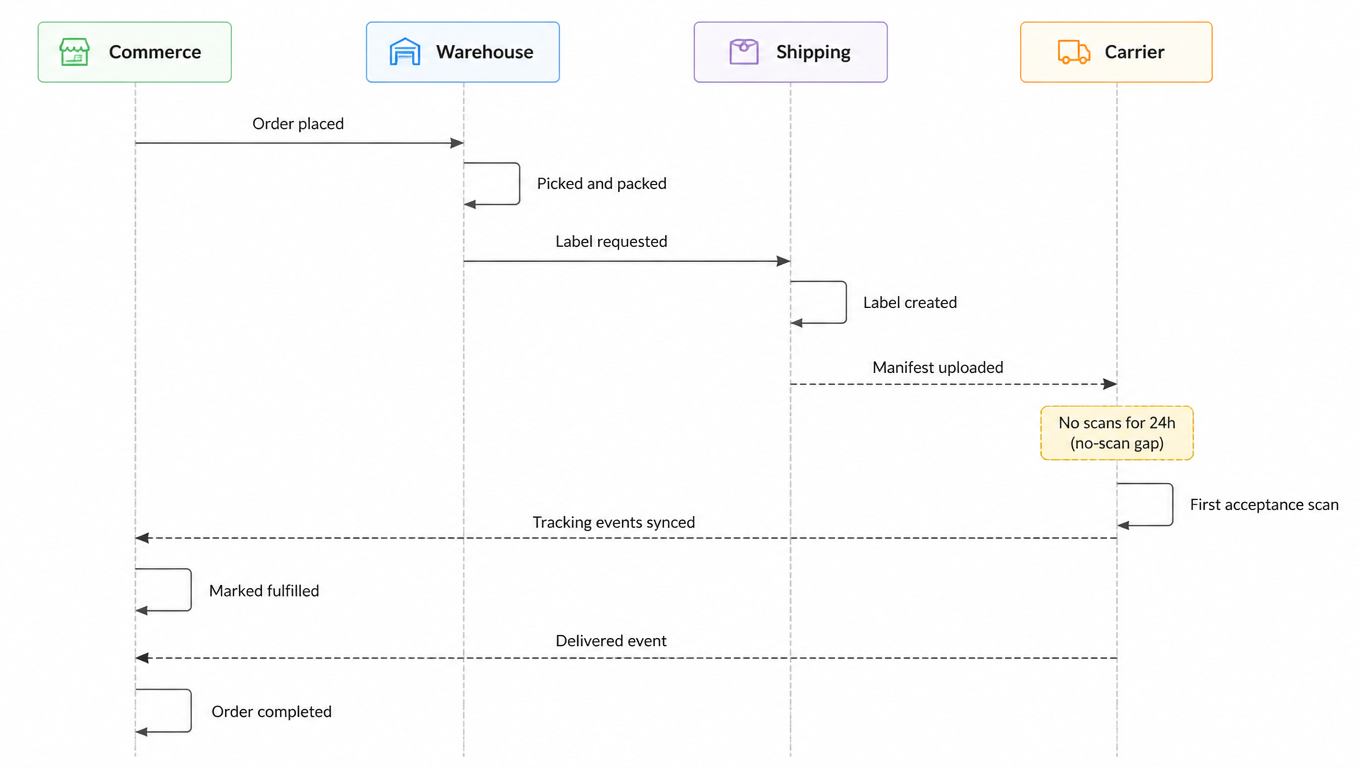
The sequence below shows one package passing through all four layers, including the classic no-scan gap:

Sequence diagram: Order placed, Picked and packed, Label requested, Label created, Manifest uploaded, 24h no-scan gap, First acceptance scan, Tracking events synced, Marked fulfilled, Delivered event, Order completed
By the time the notification fires, the carrier may not have scanned the package once

By the time the customer's notification fires, the carrier may not have scanned the package once. Nothing malfunctioned. The layers simply disagree for a while, and the customer is the one who notices.

What goes wrong when they disagree

The costs of status drift are concrete, and they compound.

Premature shipping notifications. A notification keyed to label creation tells the customer "your order is on its way" while the tracking page still reads "label created". The customer refreshes, finds nothing, and the trust deficit starts before the package leaves the building.

Customer anxiously watches a loading indicator and question mark on a laptop.
The "where is my order" ticket is the customer-service face of the same problem

WISMO spikes. "Where is my order" tickets are the customer-service symptom of the same problem. Every hour of status lag converts into inbound chats, emails, and phone calls, all answerable with the same script: "it actually hasn't shipped yet". That labor has a cost, and it scales with order volume.

Wrong SLA calculations. If the fulfillment SLA starts at label creation, a carrier pickup delay is invisible to the clock until the SLA has already burned down. Brands get charged for late fulfillment that was never late by any physical measure, and 3PLs get blamed for delays that started after the package left their dock.

Marketplace performance risk. Marketplaces score sellers on things like late dispatch rate, valid tracking rate, and order defect rate.[^1] Those scores are computed from the platform's own status events, so a platform that counts "shipped" at label creation will punish a seller whose carrier scans late, even when the warehouse was on time.

Premature refunds and replacements. When the tracking stream goes quiet, support teams guess. A package that is simply waiting for its first scan looks identical to a lost package, and a generous rep will refund or reship on day three. If the carrier then delivers, the brand owns a double fulfillment.

3PL vs brand blame games. When status layers disagree, responsibility becomes negotiable. The brand says the warehouse shipped late, the 3PL says the carrier accepted late, and the carrier says it never received the manifest on time. Without a shared event record, every dispute is decided by whoever argues louder.

A policy map: from event to action

The fix is not to force all four layers to agree in real time. It is to assign each decision to the layer that is trustworthy for that decision. The table below maps the events that matter to the actions they should (or should not) trigger.

Event Trigger customer notification? Start SLA clock? Confirm carrier possession? Needs human review?
Order placedNoMaybe (promise date)NoNo
Label createdNoNoNoNo
Manifest transmittedNoNoNoNo
First carrier scan (acceptance)YesYesYesNo
In transitNoNoAlready confirmedNo
Out for deliveryOptional (delivery window)NoNoNo
DeliveredYes (delivery confirmation)NoNoNo
No scan longer than thresholdNo (alert, not notification)NoNoYes
Delayed / address correction / refused / damagedNoNoNoYes
Status rollback (delivered back to in transit)NoNoNoYes

Three rules deserve emphasis.

Notifications key off carrier possession, not label creation. The only event that proves a package is physically moving is the first carrier scan. If you notify earlier, you are notifying about a label. Use the label-created event only for what it is good for: a late-pickup alert when the carrier has not scanned within a promised window.

The SLA clock starts at the possession point you can defend. That is the first carrier scan, or the platform's promise date, whichever your contract names. Never start the clock at label creation. If you must, name it in the contract and price for it, because you are taking carrier pickup risk onto your own books.

Exceptions are human work. No-scan gaps, delays, address corrections, refusals, damage, and status rollbacks are where automation ends and judgement begins. Route them to a queue with an escalation SLA instead of letting them sit in a status field.

How platforms define "shipped" differently

The same warehouse action produces different consequences in every marketplace, because each platform decides for itself what "shipped" means and which metrics hang off it.

Shopify treats fulfillment as a record, not a physical event. The order moves to fulfilled when a fulfillment event is registered, typically by an app or a 3PL integration, and Shopify does not itself track carrier scans.[^4] The notification is whatever the fulfillment app says it is, which is why two Shopify stores can have visibly different shipping behavior on the same carrier.

Amazon ties shipped to carrier evidence. Order status and performance metrics such as valid tracking rate and late dispatch rate are driven by tracking uploads and carrier scans. A seller who marks an order shipped without a valid tracking number, or whose carrier scans late, takes a direct hit to account health.[^1]

eBay keys shipped to handling time and tracking upload. The late shipment rate is measured against the seller's stated handling time, and uploading tracking is what turns "handling" into "shipped" in the buyer's view and in seller metrics.[^2]

Etsy uses shipping date and tracking upload for its on-time dispatch measurement, which feeds the Star Seller badge. The dispatch clock runs from the date the seller commits to, and the tracking number is the evidence.[^3]

Temu and TikTok Shop push platform logistics control further. In semi-managed and marketplace models, the platform monitors both label generation and actual carrier scans, and the gap between "label created in the virtual warehouse" and "first real scan" is exactly where seller penalties and shipping-time targets are decided.[^5][^7]

The lesson is the same everywhere: before you design a notification or an SLA, read the platform's own definition of shipped. It is a contractual choice, not a technical one.

Platform "Shipped" is triggered by Main performance lever
ShopifyFulfillment record (app/3PL sync)Store-level, none by default
AmazonTracking upload + carrier scanValid tracking rate, late dispatch rate
eBayTracking upload within handling timeLate shipment rate
EtsyShipping date + tracking uploadOn-time dispatch, Star Seller
Temu / TikTok ShopLabel + real carrier scan monitoredSeller penalties, shipping time

Engineering the reconciliation

For teams building the plumbing, four engineering practices close most of the gap.

Deduplication. Carriers and platforms resend events. Webhooks retry, polling overlaps, and the same scan can arrive twice from two sources. Every event needs a stable id, and every consumer needs idempotency: applying the same event twice must produce the same result. Otherwise the projection drifts on its own.

Ordering. Events arrive out of order. A delivered event can land before the acceptance scan when a webhook queue backs up. Sort by the event's own timestamp, not by arrival time, and use a buffer with a watermark so you only commit events whose predecessors have arrived. Never let "I saw it first" win over "it happened first".

Normalization. Four carriers will name the same moment four different things: "picked up", "acceptance", "origin scan", "collected". Map everything into one canonical event schema with a fixed vocabulary, and when a platform's aggregate feed disagrees with the carrier's raw stream, trust the raw stream. Aggregates are projections too.

Event-sourced state machines. Derive status from events instead of assigning it. Keep the event log as the source of truth and compute each layer's status as a projection over the log. That makes rollback, replay, and dispute resolution trivial: if a customer or a marketplace questions a status, you show the events, not the label.

Finish with a reconciliation checklist you can run per order, per day, or per dispute:

  • Four layers reconciled: commerce, warehouse, shipping, and carrier states agree on which events have occurred.
  • Notification rules keyed to carrier possession, with label-created reserved for late-pickup alerts.
  • SLA clock defined and defended at the possession point named in the contract.
  • Exceptions (no-scan gaps, delays, address corrections, refusals, damage, rollbacks) routed to human review with an escalation SLA.
  • Pipeline idempotent, ordered by occurred_at, normalized to a canonical schema, with raw carrier events as the source of truth.

None of this makes the four systems identical. It makes them trustworthy in different ways, and that is the whole point. The order system is the customer's view, the warehouse system is your operations view, the shipping system is your transaction view, and the carrier system is the physical world. Decide which one answers each question, agree on the events that cross the boundaries, and the disagreements stop costing you money.

FAQ

Because each layer is owned by a different system, updated by different events on different schedules. The platform owns order status, the warehouse owns fulfillment status, the shipping integration owns transaction status, and the carrier owns tracking status. Status is a projection; the event is the truth. Systems disagree because each has projected a different slice of events, or received the same events at a different time.
Key it to carrier possession, which means the first carrier scan. If you notify at label creation, the customer refreshes a tracking page that still says "label created", and trust erodes before the package leaves the building. Reserve the label-created event for late-pickup alerts.
The first carrier scan, or the platform's promise date named in your contract. Never from label creation, because a label can exist long before a package moves, and you would be taking carrier pickup risk onto your own books.
Only at the first physical scan. A manifest is a declaration of intent, not possession. Between manifest upload and the first scan there is a window where the shipping system says "in carrier possession" and the carrier says "never seen it". The only evidence of possession is the first carrier scan.
Because marketplace scores are computed from the platform's own status events. Amazon's valid tracking rate and late dispatch rate, eBay's late shipment rate, and Etsy's on-time dispatch all use tracking upload or carrier scan as evidence. When a platform counts shipped at label creation or tracking upload, a carrier that scans late hurts your metrics even when the warehouse was on time.
Three practices: deduplicate with a stable event id and idempotent consumers, handle out-of-order arrivals by sorting on the event's own timestamp with a watermark buffer, and normalize every carrier event into one canonical schema. Derive status from the event log (event sourcing) so rollback, replay, and dispute review become trivial.

Want the four layers to stop disagreeing?

EasyShippingX operates in the carrier execution layer (rates, labels, tracking). Multi-carrier real-time tracking normalizes every carrier's raw scan events into one view, so you can key notifications to the first acceptance scan, anchor the SLA clock to carrier possession, and reconcile through an idempotent event pipeline. The four-layer status model and the event-to-action policy map are exactly the infrastructure that turns "where is my order" into a question you can answer with evidence.