TikTok Shop grows fast, but fulfillment is another story. When orders go from a few dozen a week to a few hundred a day, packing orders yourself hits a ceiling. This guide puts the four paths (Amazon MCF, a regular 3PL, your own warehouse, and hybrid fulfillment) on one table and helps you choose with one metric and five gates.
The hidden thread of this decision is control: where inventory sits, whose system orders flow through, who picks carriers and reports tracking, where returns go, and who handles exceptions. Every option reallocates these controls, and they decide all of your downstream cost and risk. Below we define the right metric, walk the variables that decide it, run every option through five gates, and land on a 30-day pilot design.
Four paths, one underlying question: who controls what
You Are Not Choosing a Warehouse. You Are Choosing Who Controls What.
Once TikTok Shop is generating steady orders, sellers usually face four paths: Amazon MCF (Multi-Channel Fulfillment, shipping from Amazon's warehouses), a regular 3PL (third-party logistics or a US fulfillment center), your own warehouse (rent space, hire people), or hybrid fulfillment (multiple options allocated by SKU or channel). Many sellers treat this as a "which warehouse is cheaper" question and line up quotes.
Choosing a warehouse is only the surface. The real decision is: where does inventory sit, whose system do orders flow through, who picks carriers and prints labels, who reports tracking events to the platform, where do returns go, and who handles exceptions (lost, damaged, wrong address)? How these controls are split decides all of your downstream costs and risk exposure.
For a seller who currently packs orders at home, upgrading is not "find a warehouse to do the work." It is deciding which controls to hand over and which to keep. Get this clear first, and the selection process will not run off the rails.
Why Comparing Only Pick-and-Pack Fees Gets It Wrong
The most common selection method is to line up each provider's pick-and-pack fee, monthly rent, and promotional discount and pick the cheapest. This works at small scale with simple order structures; once TikTok Shop orders start fluctuating, the real bill stops matching the quote.
The costs usually missed: whether shipping and fulfillment are bundled (some bill shipping at retail carrier rates, some at negotiated rates); peak-season fees and surcharges (residential, oversize, fuel); failed-delivery and return costs (wrong address, refusal, reshipment); whether the platform recognizes your tracking data (if not, order status goes abnormal and hits your performance metrics); capacity during viral spikes; carrier fallback (is there a backup when the primary carrier is overloaded or down); the risk of inventory locked in a single network (to switch, you must first move your stock out); and integration and manual-processing costs (who handles label printing, reconciliation, and exceptions).
So cost per order is the wrong unit of measurement. With the same pick-and-pack fee, different order structures, failure rates, and compliance outcomes produce real costs that differ by multiples.
The Metric That Matters: Cost per Successfully Delivered TikTok Shop Order
The right unit is Cost per Successfully Delivered TikTok Shop Order, the fully loaded cost of one successfully delivered order. "Successfully delivered" is the denominator: only orders whose tracking the platform recognized, that arrived within the promised time, and that did not need reshipment or support count.
Full cost = pick + pack + storage + shipping + surcharges + failed-order costs (reship, return, compensation) + support. Every point of failure rate adds hidden cost to every successful order.
On top of the metric, add three constraints: Platform compliance (order, tracking, and return requirements must be met); Delivery promise reliability (TikTok Shop's On-Time Delivery Rate directly affects your Shop Performance Score, with hard thresholds [^2]); and Operational control and recoverability (when something breaks, you can step in and take over).
The cheapest order that fails tracking, is late, or cannot be recovered is not a low-cost order. It is a debt you will pay later.
The Variables That Decide Your Real Cost
The same option costs completely different amounts for different sellers, because the cost is decided by your own variables. Before talking to any provider, inventory these. The first group decides the bulk of your shipping: your SKU size and weight distribution (any oversize or irregular items), the share of multi-item orders (merged or split), and your destination ZIP and zone distribution (concentrated or nationwide).
The second group decides the gap between the quote and the real bill: fee structure (how pick, pack, storage, shipping, and surcharges are charged, and how peak-season fees work), delivery cutoff (by what time an order ships the same day), the delivery promise you show buyers, tracking IDs and event reporting (can the platform receive standard tracking events), and failed-delivery and reshipment costs.
The third group decides whether you can sleep at night: inventory allocation and safety stock (how many warehouses your stock is split across and how safety stock is set), carrier control and fallback (can you specify carriers, is there a backup), return labels and the return-inbound path (who issues return labels, which warehouse receives returns, can units be restocked), system responsibility (what the app, OMS, and API each own), and exception-handling processes and costs (failed delivery, lost parcels, support).
The Five-Gate Decision Framework
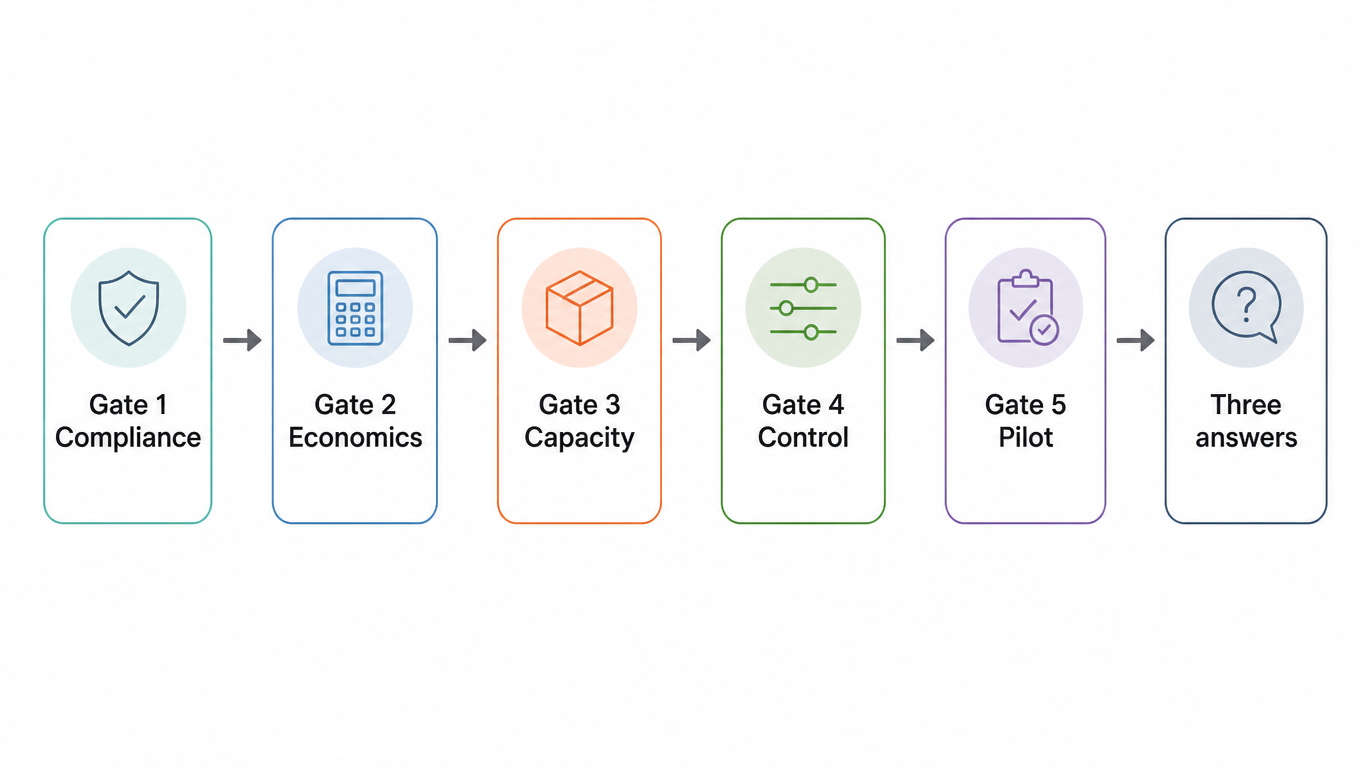
Turning the variables into an executable screening process is the five gates. Run them in order; if any gate fails, the option does not hold under current conditions, or must satisfy conditions first. The flow:
Five gates in order: a fail at any gate means the option does not hold
Gate 1 Compliance: can this option meet TikTok Shop's current order, tracking, return, and warehouse requirements [^3]? If the requirements are not aligned, nothing else matters. Gate 2 Economics: compute the successfully delivered cost per order from your SKUs, weights, zones, and order types, not the average fulfillment fee. This gate alone eliminates most options that look cheap on the quote.
Gate 3 Capacity: test three scenarios, normal days, campaign days, and sudden spikes, for cutoff, inventory, and carrier capacity, and confirm it can hold at peak. Gate 4 Control: do you need carrier choice, branded packaging, exception handling, and customer communication control? If you do, the option must leave that control with you instead of deciding for you. Gate 5 Pilot: test in parallel with part of your SKUs or part of your orders, then commit to MCF, 3PL, or hybrid allocation. The five gates are not a one-time score; they roll. When your business changes, say a new live-shopping hit, run them again.
Three Answers: MCF, 3PL + Multi-Carrier, or Hybrid
Amazon MCF fits sellers who already have FBA inventory, want to fulfill TikTok Shop orders from the same stock [^1], accept Amazon's terms, and ship from its warehouses with its carrier network, tracking, and returns. The upside is convenience and a fast ramp; the cost is that control mostly goes to Amazon, shipping is bundled, peak season adds peak fees and surcharges [^4], and inventory is locked in the FBA network. If you are making the same call for Shopify, your own site, or another channel, the general off-Amazon version lives in Amazon MCF vs. 3PL + Multi-Carrier Shipping.
A 3PL with multi-carrier shipping fits sellers who want carrier choice and rate control (picking between UPS, FedEx, USPS, and regional carriers per parcel, or routing by zone), branded packaging and inserts, tracking events reported straight to TikTok Shop for a native buyer experience, and the ability to step in when something goes wrong. The cost is that you now own carrier strategy, reconciliation, and fallback.
Dimension
Amazon MCF
3PL + Multi-Carrier
Carrier choice
Amazon decides
You choose: UPS / FedEx / USPS / regional carriers
Shipping rates
Bundled quote
Negotiated, routed by zone
Packaging
Amazon standard
Branded packaging, inserts
Tracking reporting
Through Amazon's system
Direct to platform or self-built
Inventory location
Locked in FBA
Your choice, multi-warehouse possible
Returns
Amazon standard process
Your process, restock possible
Control
Low
High
Hybrid is the third answer: allocate dynamically by SKU, channel, order type, or inventory state. A typical split: bestsellers and live-show items go to the 3PL for speed and capacity, long-tail SKUs ride MCF's existing inventory, and orders in zones or carriers one leg cannot cover go to the other. It is the most flexible and the most demanding on OMS and data capabilities. This is the same muscle as an FBA + FBM hybrid strategy, and for when in-house, automated, or outsourced fulfillment wins at different volumes, see our fulfillment break-even framework.
For sellers who currently pack at home, the safest path is not one giant step: use Gates 1 to 4 to narrow the field to two or three options, pick a 3PL you trust for a 30-day pilot (next section), and run MCF as the control on the same SKUs. Do not lock in a single answer before the data is in.
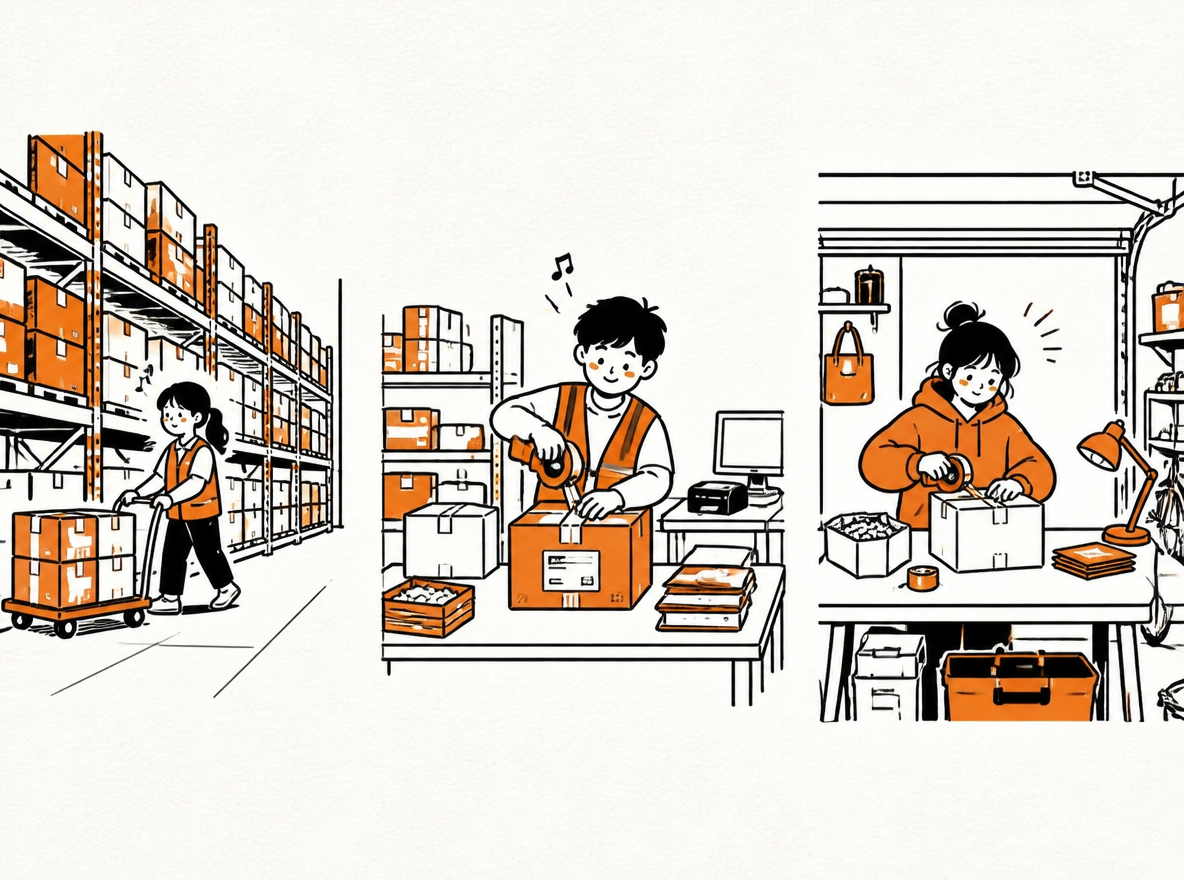
MCF, a 3PL, and your own packing bench: control rises from left to right
Next Steps: What to Do This Week
Run the numbers before you talk price. Pull the last 60 to 90 days of orders: SKU weight and size distribution, destination zone distribution, daily volume versus the peak multiple (how many times normal a viral spike is), failure and return rates, and your real average cost per order including packing materials and your own time. These numbers are the input to every gate.
Walk the five gates with the data: for each candidate (at least one 3PL and one MCF), check compliance, economics, capacity, and control item by item, and cross out the failures. When evaluating a candidate 3PL's carrier network, check carrier serviceability by ZIP and compare rates, putting the real rates for the same destination ZIPs on one table. A channel-neutral shipping layer like EasyShippingX compares US domestic carrier options uniformly and executes through a portal, Excel, or API, which saves a lot of reconciliation time in this step. It fits inside a broader multi-carrier shipping strategy rather than replacing one.
Finally, design a 30-day pilot: scope 20 to 50 representative SKUs covering different weight bands and zones; track successfully delivered cost, tracking recognition rate, delivery promise attainment, failure rate, and support tickets; and define rollback conditions, the cases where you switch back to self-fulfillment or change options. Let the data decide MCF, 3PL, or hybrid when the pilot ends.
Yes. Amazon MCF fulfills orders from any channel using your FBA inventory, and TikTok Shop is one of the channels it can serve. You keep inventory in FBA, MCF picks, packs, and ships, and tracking events flow through Amazon's system. The trade-offs are the ones covered above: shipping is bundled at Amazon's rates, there is no carrier choice, packaging is Amazon's, and peak season adds fees and surcharges. The important part is verifying that the setup satisfies TikTok Shop's current order, tracking, and return requirements before judging price.
TikTok Shop requires sellers to enter a valid, trackable tracking number within the Order Handling Time and to keep the On-Time Delivery Rate (OTDR) above the platform threshold, sellers should hold 80% or higher, because it directly affects the Shop Performance Score. Tracking events must be reported so order status updates properly. A fulfillment option that cannot report standard tracking events to the platform puts you in a compliance hole no matter how cheap it is.
It depends on your variables. If you already have FBA stock, want zero setup, and your items are light and standard, MCF can be the faster answer, with peak-season and bundled-shipping costs as the price. If you need carrier choice, negotiated rates, branded packaging, native tracking reporting, and capacity for viral spikes, a 3PL with multi-carrier shipping leaves the control with you. Run the five gates and a 30-day pilot before deciding; hybrid (bestsellers on the 3PL, long-tail on MCF) is a legitimate third answer.
It is the fully loaded cost of one order that the platform recognized as trackable, arrived on time, and did not need reshipment or support. Full cost = pick + pack + storage + shipping + surcharges + the failed-order share (reship, return, compensation) + support. It replaces the naive per-order fee comparison, because the same fee produces real costs that differ by multiples under different failure rates, zone distributions, and compliance outcomes. That is why comparing only pick-and-pack fees gets it wrong.
That is exactly what Gate 3 tests. Before signing, ask for their normal-day, campaign-day, and spike capacity: cutoff times, labor headcount, and carrier capacity at peak, plus their fallback plan when the primary carrier is overloaded. A 3PL with multi-carrier shipping can spread spike volume across USPS, UPS, FedEx, and regional carriers, which is precisely how you avoid a single-network bottleneck. Ask with your real spike multiple, not an average.