You opened a Shopify store (or your own site, or a second marketplace), flipped on Multi-Channel Fulfillment, and let Amazon's warehouses ship your off-Amazon orders. It was the easiest possible setup: no new warehouse, no new software, no new invoices. Then the monthly statement started creeping up, and when you dug into it, you could not tell exactly why. You are not alone.
This guide does three things. First, it breaks the MCF bill into a line-by-line model so you can see exactly what you pay and where. Second, it prices the main alternative, a 3PL with multi-carrier shipping, at three realistic order volumes (500, 1,500, and 5,000 orders a month) so you can see where the numbers flip. Third, it gives you a decision framework and a migration plan that does not run you out of stock mid-switch.
Two roads: MCF's convenience, or a 3PL's cost control
Why the MCF Bill Is So Hard to Read
The line that catches your eye is the per-order fulfillment fee. It looks like a single, predictable number, so the math appears simple: orders times fee. In reality each fee bundles picking, packing, and shipping, and the amount changes with the product's size tier and shipping weight. The same SKU can cost a different amount on different orders, because the fee follows the package, not the product.
Dimensional weight adds another layer of opacity. Light but bulky items are billed on volume, not scale weight, so a fluffy product and a dense one can carry very different fees at the same label weight. And because Amazon decides the box, you do not always control which tier your order lands in.
Storage, returns, and removals are billed separately and on different cycles, so no single statement ever shows the fully loaded number. The fee line is not the cost. The cost is everything summed over twelve months, divided by the orders you actually shipped. That is the only number that should drive this decision, and it is the one this guide computes in Section 4.
MCF's Real Cost Structure, Line by Line
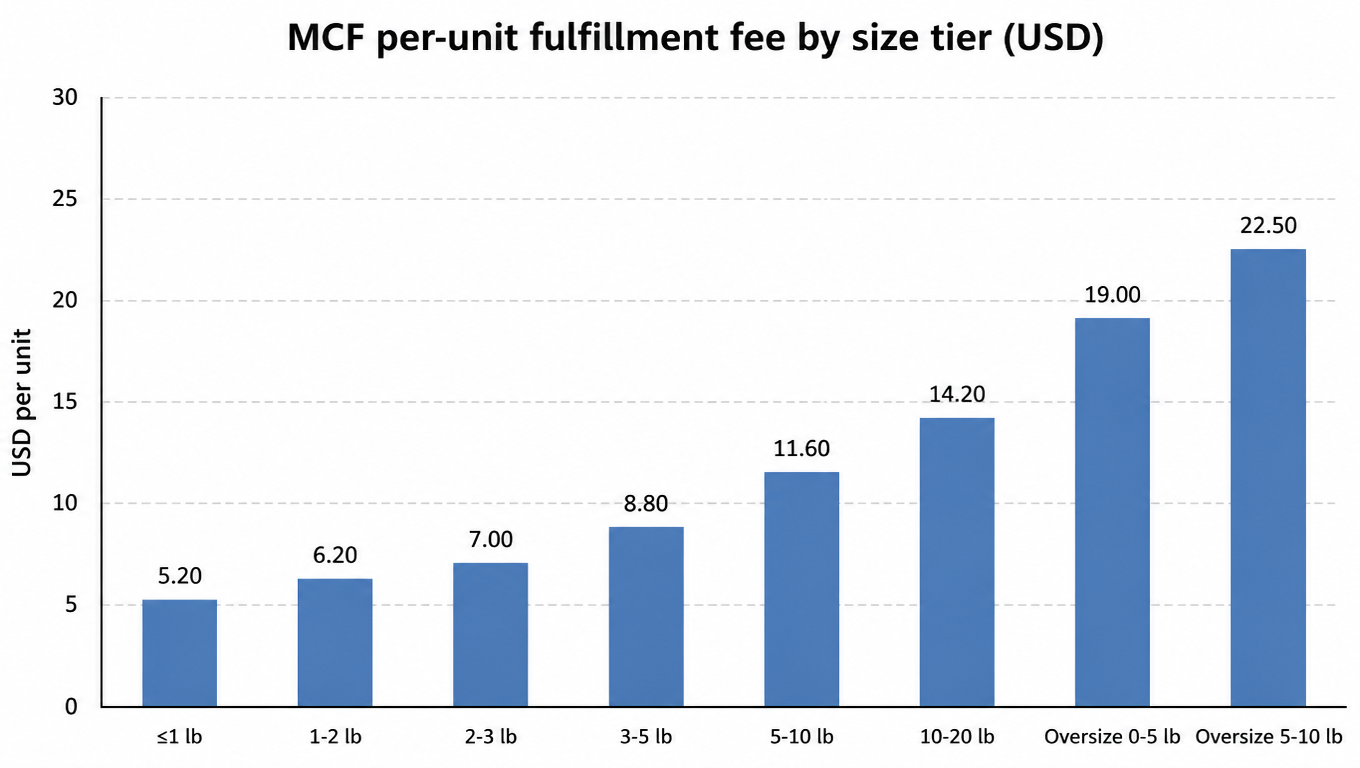
The fulfillment fee. Amazon publishes a schedule by size tier and shipping weight. On the rate card at the time of writing, standard-size tiers run from about $5.20 per unit at 1 lb or less up to about $14.20 per unit in the 10-20 lb tier, and oversize items jump to $19.00 and higher.[^1] The schedule is republished most Januarys, and the recent trend has been upward.[^2]
Storage and its traps. Monthly inventory storage is charged per cubic foot, and the rate roughly triples in October through December.[^3] Long-term storage surcharges attach to inventory aged 181 days or more,[^4] and removal or disposal fees are charged per unit when you finally clear it out. For seasonal products, the storage line can quietly consume the margin the fulfillment fee never touched.
Returns. MCF charges a return processing fee per returned unit, around $4 for standard size,[^5] on top of whatever refund or restocking you handle yourself. At a 4-5% return rate, that is a real line item, not a rounding error.
Costs that never appear on an invoice. Inventory is locked into the FBA network: if you want units back for a different channel, you pay removal. Your own site does not get a Prime badge,[^6] so the delivery promise you sell is not the one MCF guarantees. Packaging is restricted to Amazon-branded boxes, with no custom packing slips or inserts. You get no carrier choice and no negotiated multi-carrier rates. And multi-item orders can split into multiple shipments, each carrying its own fee.
MCF's per-unit fee climbs steeply with the size tier, especially for oversize items
What 3PL + Multi-Carrier Shipping Actually Looks Like
The 3PL model is the opposite of a bundled fee. You pay a pick-and-pack fee per order, storage per pallet or per cubic foot, and one-time receiving and setup costs. Nothing is hidden inside a single line, because every line is billed separately. The trade-off is that you now own the operational details MCF used to absorb.
Multi-carrier shipping is where the cost curve bends. Instead of one fixed per-unit rate, each parcel is matched to the best option among USPS, UPS, FedEx, and regional carriers based on weight, zone, and speed promise. Rate shopping across carriers, plus negotiated contracts on the lanes you actually ship, is exactly where the savings come from, especially for heavy and oversize items that MCF prices at the top of its schedule. For Amazon sellers this is the same muscle as building a multi-carrier strategy for Amazon FBM.
You also get the brand layer MCF cannot offer: your boxes, your packing slips, your inserts, gift options, and a packing slip that says something other than 'Fulfilled by Amazon.' On the integration side, modern 3PLs plug into Shopify natively, expose APIs and EDI for custom workflows, and run portal-based label workflows for the long tail of channels. Choosing the right partner is its own process, covered in our guide on the 15 questions to ask a 3PL before you sign.
The structural advantage is channel neutrality. One inventory pool and one carrier strategy across Amazon, Shopify, and your own site means you stop renegotiating shipping every time you add a channel. A channel-neutral shipping layer like EasyshippingX lets you compare US domestic carrier options for every parcel and execute through a portal, Excel, or API, so the way you ship does not change when the sales channel does. It fits inside a broader multi-carrier shipping strategy rather than replacing one.
The Math: 500 / 1,500 / 5,000 Orders a Month
The model is deliberately simple: fully loaded cost per order equals fulfillment (or pick-and-pack) plus the storage share plus carrier plus the return share. The numbers below are illustrative, but they are anchored to the published MCF schedule and representative 3PL quotes, so the shape of the comparison is realistic even if your exact prices differ.
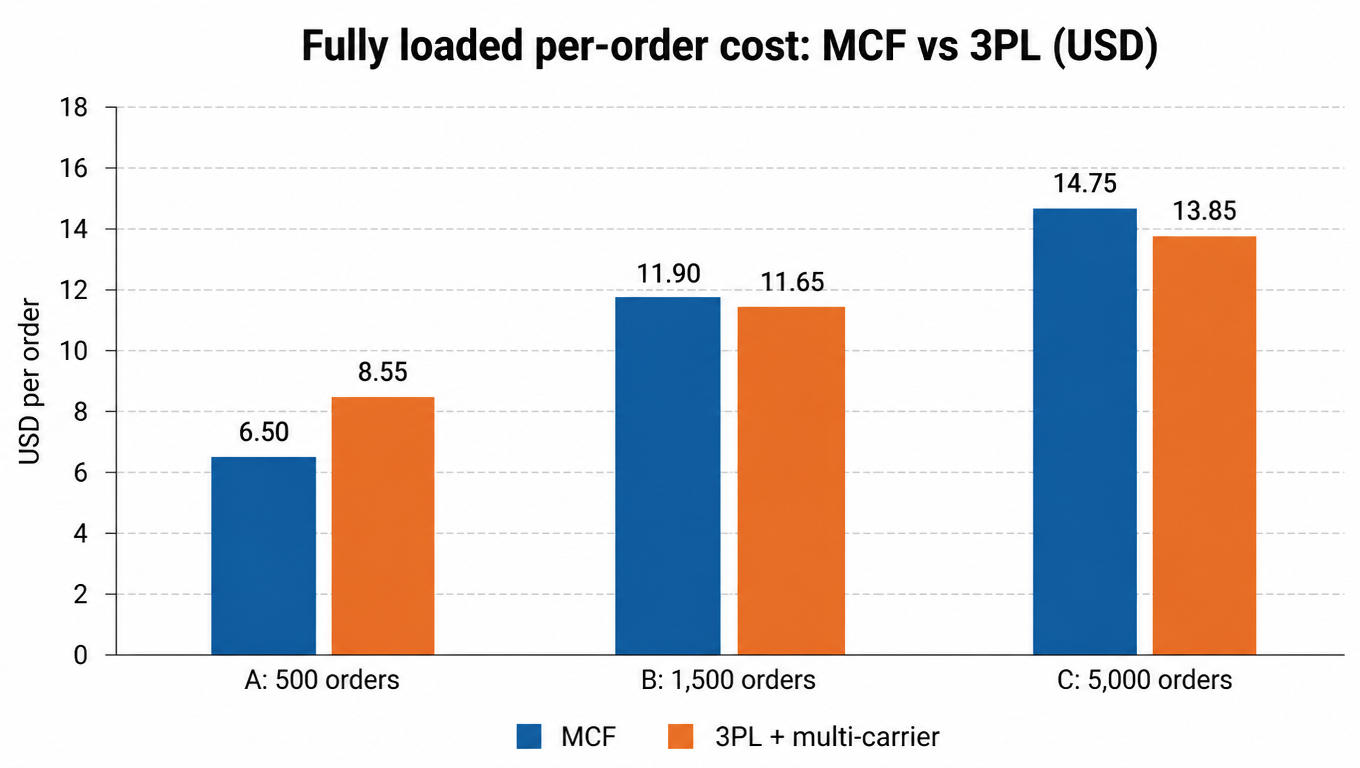
Scenario A: 500 orders a month, 1-2 lb items, single-unit orders. MCF: fulfillment $6.20, storage $0.15, returns at a 3% rate times $4.00 gives $0.12, for a fully loaded $6.50 per order. The 3PL: pick-and-pack $3.50, storage $0.15, negotiated USPS Ground Advantage on a 1.5 lb average $4.80,[^7] returns $0.10, for $8.55. MCF saves about $2.05 per order, roughly $1,000 a month. At this profile the convenience is genuinely cheap, and the honest answer is to stay unless brand experience is the priority.
Scenario B: 1,500 orders a month, mixed 1-10 lb items, 20% multi-unit orders, 10% oversize. MCF's blended fee: 15% of orders at $6.20, 30% at $7.00, 20% at $8.80, 25% at $11.60, and 10% oversize at $19.00, an average of $9.59 per unit, times 1.2 units per order, plus storage $0.22 and returns $0.18, for $11.90. The 3PL: pick-and-pack $4.40, storage $0.22, a consolidated negotiated carrier mix at $6.90, and returns $0.15, for $11.65. The gap is a quarter per order. This is the inflection zone: the decision stops being arithmetic and becomes brand, packaging, and channel control.
Scenario C: 5,000 orders a month, heavier 2-20 lb mix with 25% oversize, 15% multi-unit orders. MCF: a blended unit fee of $12.40, times 1.15 units, plus storage $0.25 and returns $0.23, for $14.75 fully loaded. The 3PL: pick-and-pack $4.80, storage $0.25, carrier $8.60, returns $0.20, for $13.85. The 3PL saves about $0.90 per order, roughly $4,500 a month and $54,000 a year. At this profile the switch is a real margin event, not a preference. For a fuller treatment of when in-house, automated, or outsourced fulfillment wins at different volumes, see our fulfillment break-even framework.
Fully loaded per-order cost: MCF wins small and light, the 3PL wins heavy at scale
Three levers drive the inflection: weight, multi-unit consolidation, and storage. Light single-unit standard items favor MCF, because its shipping is subsidized by Amazon's scale. Heavy, oversize, and multi-unit orders favor the 3PL, because MCF's fee schedule punishes exactly those packages and a 3PL can consolidate them into one box with one negotiated label.
The Hidden Costs on Both Sides
MCF's hidden costs live in storage and the edges of the fee schedule: peak-month storage rates, aged-inventory surcharges, removal and disposal fees, return flowback (both the fees and the units), and the brand opportunity cost of Amazon packaging on every off-Amazon parcel. None of these appear in the per-order fee, which is why the fee feels cheap until the year-end review.
The 3PL's hidden costs are more visible but still easy to miss in a quote: monthly minimums that assume a certain volume, one-time setup and receiving fees, technology or platform fees for the software that runs your fulfillment, remote-zone surcharges for rural ZIPs, and zone-heavy variance in carrier rates when your customer base is not where your quote assumed it was.
This is why a naive per-order price comparison misleads. The MCF fee looks flat and the 3PL quote looks itemized, but storage curves and minimums change the shape of both cost lines over a year. You have to model both on the same 12-month volume before the comparison means anything.
Hidden costs on both sides sit below the waterline
A Decision Framework, Not a Gut Call
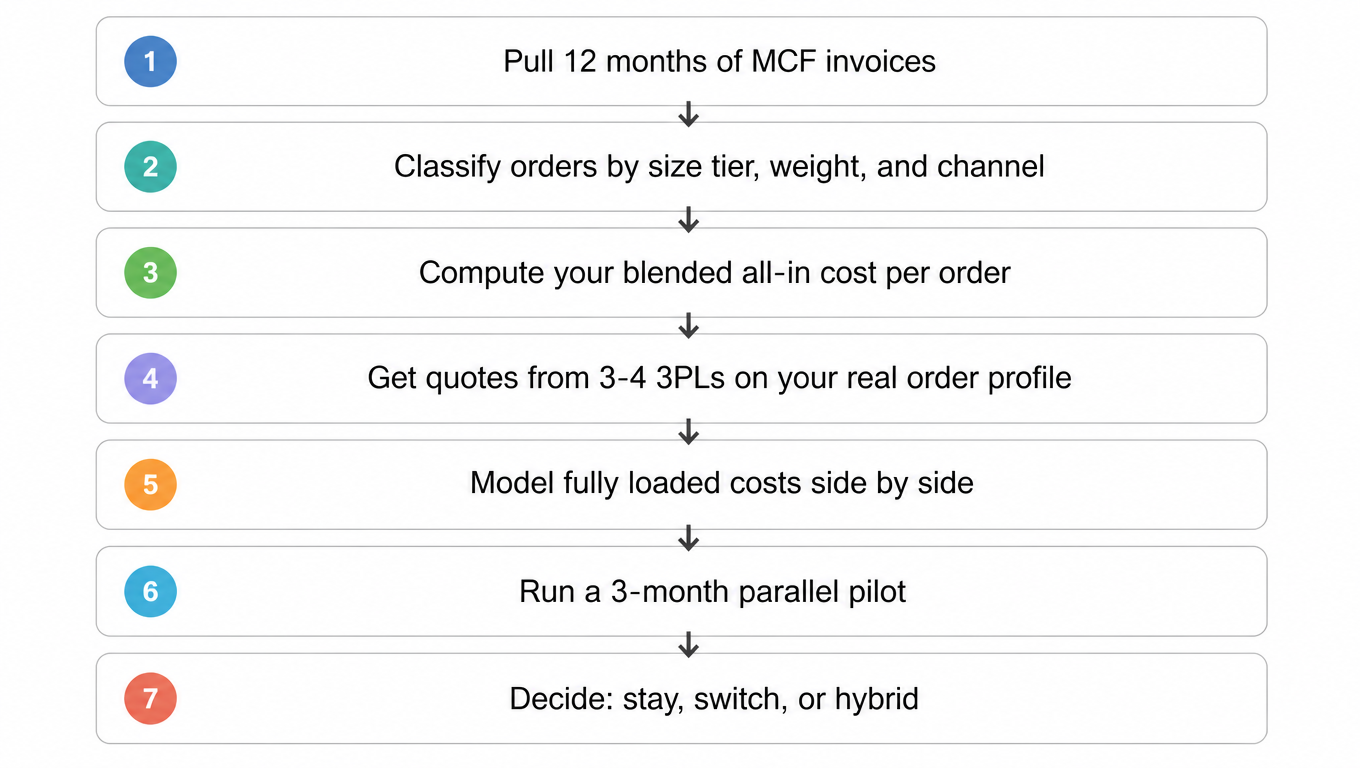
Step 1: pull twelve months of MCF invoices. Export every order, and classify by size tier, shipping weight, channel, and whether it was multi-unit. This is your raw material; without it every later estimate is a guess.
Step 2: compute your own blended all-in cost. Sum fulfillment, storage (including peak months and surcharges), returns, and removals, then divide by orders. The result is the number to beat.
Step 3: build your order profile and shop it. A realistic profile is not an average order; it is a distribution of weights, zones, and multi-unit rates. Send that exact profile to 3 or 4 3PLs and ask for quotes on it. A quote built on a made-up profile is worthless.
Step 4: model fully loaded costs side by side. Add each 3PL's storage and minimums to the carrier rates they quoted by zone and weight, and run the same 12-month volume through both models. This is where scenario B lives: the answer can flip with 5% more oversize orders. If you are weighing two warehouses as part of the change, a multi-warehouse strategy helps you place inventory before you commit.
Step 5: run a 3-month parallel pilot. Ship a single channel (or a single SKU set) through the chosen 3PL while MCF keeps serving the rest. Measure on-time, damage, returns, and cost per order against your MCF baseline before you commit.
The five-step decision flow: know your own numbers before you shop quotes
The Migration Playbook (Without the Stockout)
The classic migration mistake is a hard cutover: transfer everything in one weekend and hope the new 3PL hits its SLA from day one. The safe version splits inventory across MCF and the 3PL during the transition, so both networks are live and one failure does not stop your shipping. Keep MCF serving one channel while the 3PL ramps on another, and only shift more volume as the metrics confirm the new operation.
Before day one, set up the carrier integrations and test labels, tracking numbers, and delivery notifications end to end with real test orders. Switch packaging and packing slips in stages, and watch customer support threads closely during the change: packaging is a visible part of the unboxing experience, and a sudden change generates questions. Plan returns handling at the new 3PL before the first return arrives, including where return labels send the package and who processes the refund.
Finally, communicate the change to customers and monitor delivery metrics for 90 days: on-time rate, damage rate, return rate, and cost per order. Those four numbers, tracked weekly against your MCF baseline, tell you whether the switch is working before your inventory is fully committed.
Bottom Line
Stay with MCF when your off-Amazon volume is small, your items are light and standard-size, orders are single-unit, and you have no appetite for setup. At that profile, per the Scenario A math, MCF is usually the cheaper answer, and the convenience is real.
Switch to a 3PL with multi-carrier shipping when volume is meaningful, items are heavy, bulky, or oversize, multi-unit orders are common, brand experience matters on your own site, or you plan to keep adding channels. That is Scenario C territory, where the savings are measured in five figures a year.
And remember the hybrid: you do not have to choose one answer for everything. Keep FBA for Amazon, put off-Amazon on a 3PL. Or keep MCF for your light SKUs and route heavy SKUs to the 3PL. The framework in Section 6 tells you which slice is which. Run it, get real quotes on your real order profile, and pilot in parallel. The bill stops being opaque the day you model it yourself. When you are ready to compare rates, our shipping rate calculator and shipping cost optimization advisor will do the arithmetic for you, and our pricing page shows how a channel-neutral shipping layer fits in.
It depends on your order profile. With light standard-size items, single-unit orders, and low monthly volume, MCF is usually cheaper: in Scenario A (500 orders a month) MCF saves about $2 per order. Once items get heavier or oversize, multi-unit orders become common, and volume reaches thousands of orders a month, MCF's fee schedule punishes those packages and a 3PL with multi-carrier shipping takes over: in Scenario C (5,000 orders a month) the 3PL saves about $54,000 a year. The right approach is not comparing per-order fees, it is modeling both sides on your own 12-month volume and comparing fully loaded cost per order.
Four buckets. First, storage: rates are roughly triple in October through December, and inventory aged 181 days or more carries long-term surcharges. Second, clearing out: removal or disposal fees are charged per unit. Third, returns: about $4 in processing per returned unit, plus whatever refund and restocking you handle yourself. Fourth, the implicit costs: no Prime badge on off-Amazon orders, Amazon-branded packaging only (no custom packing slips or inserts), no carrier choice, and multi-item orders can split into multiple shipments each with its own fee. None of these show up in the per-order fee line, so judge by the fully loaded annual cost.
Yes, and it is the recommended approach. Two common splits: by channel, keeping FBA for Amazon and routing all off-Amazon orders to a 3PL; or by SKU, keeping light fast-moving SKUs on MCF and sending heavy, oversize, and slow movers to the 3PL. During migration a parallel setup is also recommended: MCF keeps serving one channel while the 3PL ramps on another, and volume only shifts once metrics confirm the new operation. Either way, one failure does not stop your shipping.
Start by pulling 12 months of MCF invoices and computing your own blended all-in cost per order; that is the baseline to beat. Then build your order profile as a distribution of weights, zones, and multi-unit rates rather than a single average order, and send that exact profile to 3 or 4 3PLs for quotes. Once quoted, add each 3PL's storage, minimums, setup, and platform fees to the zone-and-weight carrier rates, model the same 12-month volume, and compare with the MCF baseline. Finally, verify with a 3-month parallel pilot instead of a hard cutover.
Off-Amazon orders never had a Prime badge under MCF, so this is not something you are losing. The Prime badge and Prime promise belong to FBA orders on Amazon only. Off-Amazon speed depends on the carriers and service tiers you choose: a 3PL with multi-carrier shipping matches each parcel to the delivery promise of USPS, UPS, FedEx, or a regional carrier, and you can promise at checkout the speed you can actually deliver. The key is defining your own SLA first and letting carrier routing fulfill it, instead of treating a speed promise as something you get by default.