Amazon FBM Seller Guide

Seller Fulfilled Prime Shipping Readiness: Can Your Warehouse, 3PL, and Tech Stack Survive the Trial?

Selling Fulfilled Prime (SFP) is one of the cheapest Prime badges in e-commerce. No FBA storage fees, no inbound shipment planning, no unit limits. You keep your own warehouse, your own 3PL, and your own carrier mix, and Amazon puts the Prime badge on your listings anyway. The catch is that the badge is a promise Amazon enforces with hard numbers: on-time delivery, valid tracking, and cancellations. Miss them during the trial and you do not just lose the badge, you carry the performance damage into your account health.

The question this article answers is the one most sellers ask too late: can your warehouse, your 3PL, your carriers, and your tech stack actually pass the SFP trial and keep performing through peak season? This is a readiness guide. We walk requirement by requirement, map each one to an operational control you can audit before you apply, and end with a go/no-go decision you can defend to yourself.

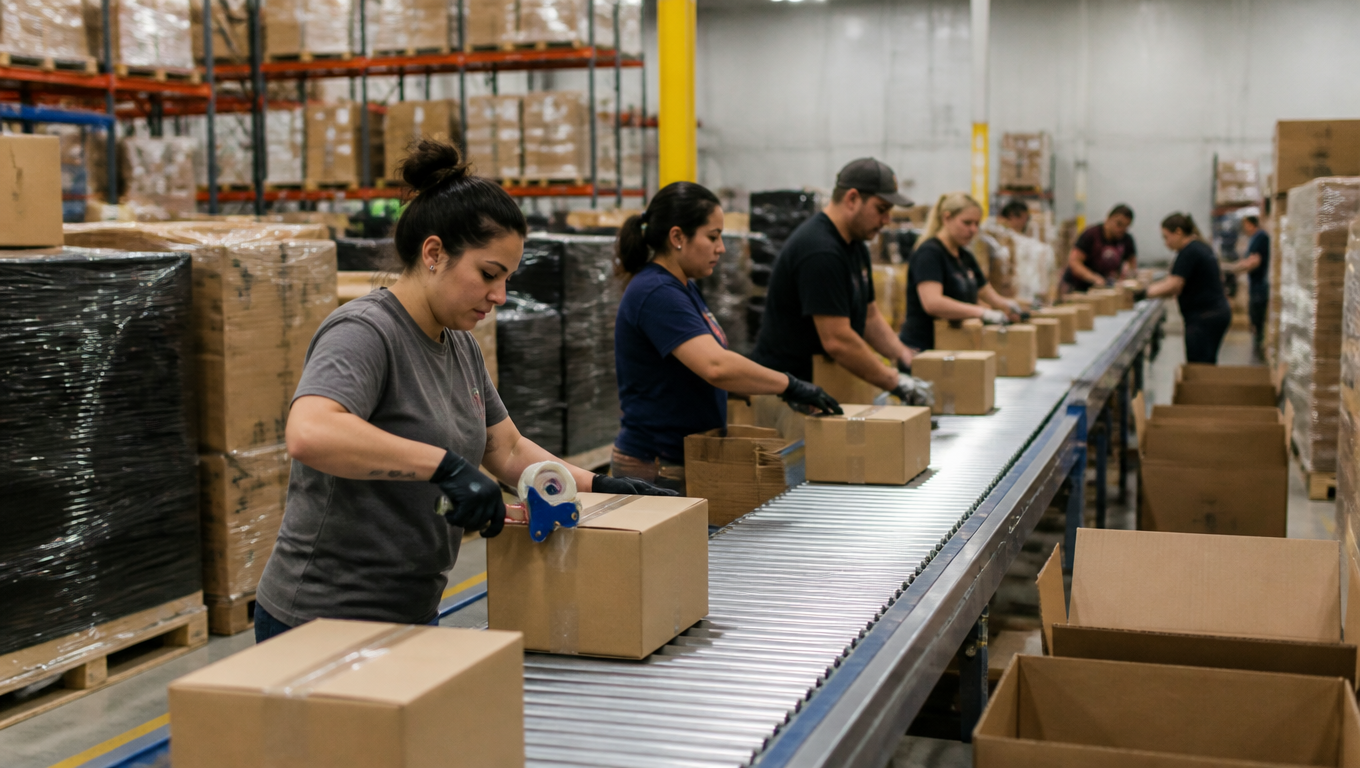
Warehouse dispatcher checks a tablet beside labeled boxes, carrier carts and a loading door.
The badge is a promise, and the metrics are hard numbers

Why "Hitting the Metrics" Is the Wrong Readiness Test

On-time delivery rate (OTDR), valid tracking rate (VTR), and seller-initiated cancellation rate look like the natural readiness test. They are not. They are outcomes, lagging indicators. A dashboard that is green today tells you nothing about week six of the trial, when your 3PL changes its shift schedule, a carrier reroutes a zone, or a label API starts failing silently.

The metrics are produced by control points you can inspect before you apply: order cutoff, pick and pack throughput, service coverage, label purchase, first scan, tracking mapping, and exception recovery. Each one is measurable and assignable to an owner. If every control point holds, the metrics follow. If one control point breaks, no amount of dashboard-watching saves the trial.

So this article uses one framework throughout: Amazon Requirement, Operational Control, Required Evidence, Failure Mode, Owner, Go/No-Go. For each requirement Amazon publishes, you identify the control that produces it, the evidence that proves the control works, the way it typically fails, and the person or system that owns it. Only then do you make the call.

The 2026 SFP Bar: Pre-Qualification, Trial, and the Numbers That Matter

SFP enrollment today runs in three stages. First, pre-qualification: Amazon checks your account eligibility and basic shipping setup[1]. Second, the trial: you ship at least 100 orders under SFP terms while maintaining the same performance as enrolled sellers[2]. Third, enrollment, once the trial period passes. The detail that matters most is that the trial is scored against enrolled-seller parity, not against "good enough."

The numbers that matter: on-time delivery rate at or above 93.5%, valid tracking rate at or above 99%, and seller-initiated cancellations below 0.5%[3]. Since July 6, 2026, delivery promises are tiered by package size: standard-size parcels carry the tightest expectations, roughly 40% of orders delivered within 1 day, 75% within 2 days, and 90% within 5 days, while oversize and extra-large parcels get longer windows[4]. Verify these figures against Amazon's current official pages before you apply; the tiered promises are the part Amazon adjusts most often.

How you buy labels matters. Labels purchased through Buy Shipping or Shipping Automation qualify for OTDR protection in specific scenarios, meaning carrier-caused delays do not count against you, and tracking flows to Amazon automatically[5]. Labels from outside systems can work, but they put the tracking burden entirely on you. You also set your own daily order limit: the number of orders you commit to shipping reliably every day[6]. This is not a cap Amazon imposes. It is a lever you use to keep the trial manageable.

Map Every Requirement to an Operational Control

Convert each requirement into a control you can measure, test, and assign. Seven control points cover almost every SFP failure mode. Order cutoff: the last moment an order can enter and still ship today. If orders trickle in at 4 PM and your cutoff is 2 PM, every afternoon order slips a day. Pick and pack throughput: the orders per hour your warehouse can actually sustain, because 93.5% OTDR leaves room for only 6.5 misses per 100 orders. Service coverage: whether your carrier mix can deliver the 1/2/5-day promise to the ZIP codes your customers actually live in. Label purchase: whether every order can get a valid label before cutoff, including the duplicate and void paths. First scan: whether the carrier scans the package at pickup, which is your proof of handoff. Tracking mapping: whether Amazon's tracking numbers line up with your labels, because a mismatch counts as a failed delivery. Exception recovery: how fast you can re-route, re-label, or cancel when something breaks, because recovery time is the difference between one late order and a streak of them.

Evidence and failure modes go together. A cutoff that is too late relative to your order curve shows up in the next morning's OTDR. Pick capacity below the order curve means the target is unreachable at peak no matter how good the carriers are. A coverage gap means certain ZIP codes can never hit the promise, even with perfect execution, because no carrier in your mix serves them at that speed. Each control point needs an explicit owner before you start. The mapping usually looks like this: the warehouse owns cutoff and pick throughput, the 3PL owns handoff and first scan, the tech stack owns label and tracking integration plus the exception queue, carriers own serviceability, and you own the daily limit and the rollback decision.

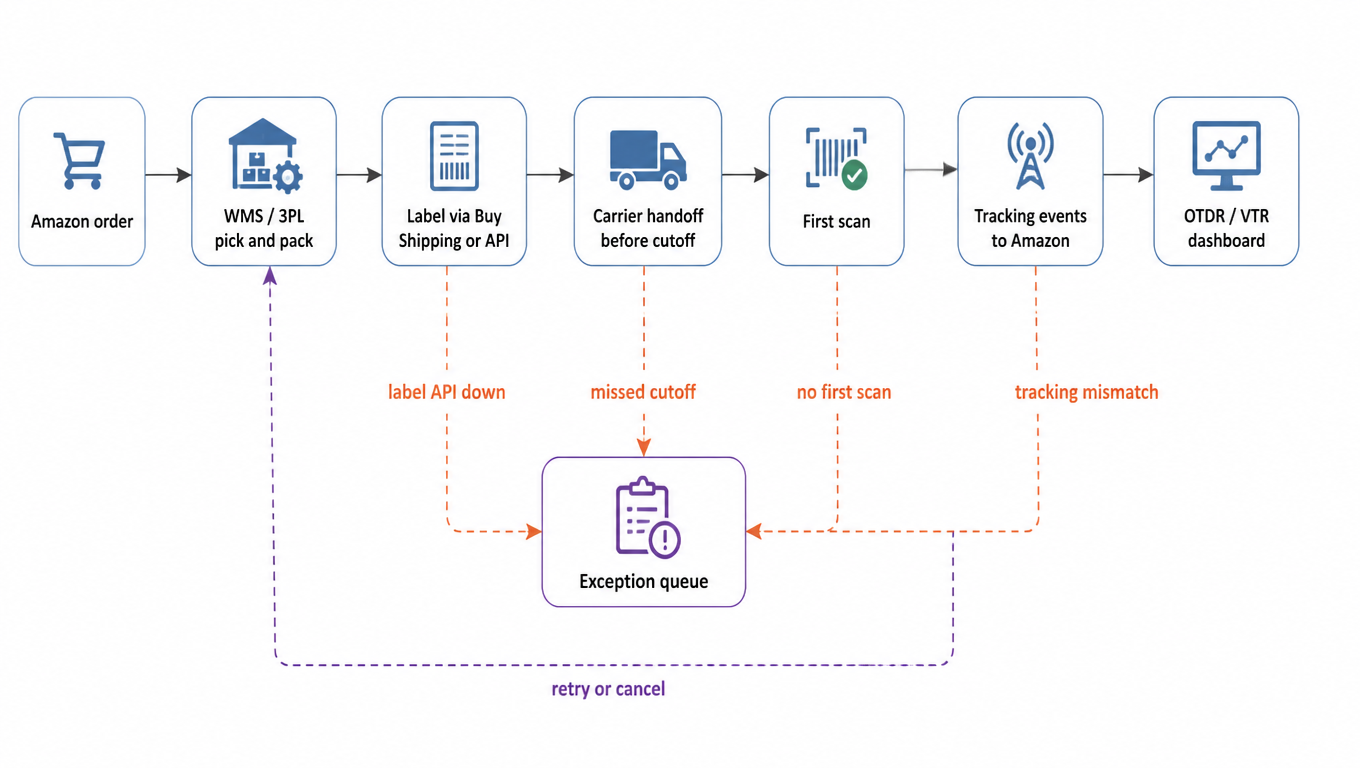
The swimlane below shows the full order-to-Prime flow with the common failure points marked. Every lane has an owner, and every dashed line is a place where the chain can break.

Flowchart: Amazon order, WMS/3PL pick and pack, label via Buy Shipping or API, carrier handoff before cutoff, first scan, tracking events to Amazon, OTDR/VTR dashboard; label API down, missed cutoff, no first scan, and tracking mismatch all fall back to the exception queue, which retries or cancels
The order-to-Prime flow, with every dashed line a place the chain can break

Run the Pre-Qualification Audit on Your Own Data

Before you touch Seller Central, pull 90 days of your own order data and answer three questions. What are you shipping: the weight and dimension distribution, which tells you your size tier and therefore your promise window. Where are you shipping: the ZIP distribution of your orders, which tells you which zones and which carrier service areas you depend on. When do orders arrive: the order entry curve, which tells you how much work lands in the hours before your cutoff.

Then replay coverage and cost. For each ZIP in your history, ask whether your current carrier mix can actually deliver within the promise window for that size tier. Carriers publish service commitments by zone, and the answer is frequently no for a meaningful share of orders. That share is your coverage gap baseline. In the same replay, compute the all-in cost per order that would have to deliver on time: shipping at the tier speed, packaging, handling, and a share of exception cost. This is the number the go/no-go decision eventually lives or dies on.

Watch out for the average-versus-tail trap, because averages hide failure. Suppose your average transit is 2.1 days against a 2-day promise. That looks fine. But if the tail says 30% of orders take 3 days or more, your OTDR on that promise sits near 70%, roughly 4.5 times the miss budget the 93.5% target allows. Audit percentiles, not averages.

Failure-Test the Label, Tracking, and Cancellation Paths

Start with the label path. Test what happens when the Buy Shipping or shipping API call times out, when a request duplicates, and when a label is voided and repurchased. The pass criteria: a duplicate request resolves to the same label without a double charge, a timeout retries cleanly, and voiding repurchases within the window Amazon allows. Owner: tech stack.

Then the tracking path. Create test orders that never get a first scan, that carry scan events below Amazon's standard, and whose tracking numbers map to the wrong order. Verify that tracking events reach Amazon within the required window after handoff. A missing first scan is the silent killer of VTR: the package may arrive perfectly, but if the first scan never happened, the order looks undelivered[7]. Owner: 3PL and carriers.

Finally the cancellation and timeout path. Measure your seller-initiated cancellation rate against the 0.5% bar, and make sure you know who initiates each cancellation in your records, because Amazon counts only the ones you initiate[3]. Then build the timeout path: orders approaching the ship-by deadline without confirmation need an automated fallback, re-route, expedite, or cancel, that fires before the miss lands in your metrics. Owner: tech stack and warehouse.

Pilot Small, Then Survive the Trial

Do not enter the trial cold. Run a shadow pilot first: route a small daily volume through the exact label, tracking, and carrier flows you would use under SFP, without the badge, and compare promised versus actual delivery every day for two to four weeks. Measure your exception rate and get the dashboard running. When the pilot holds, set your daily order limit to a level the pilot proved you can sustain, and only then enter the trial.

During the trial, monitor daily and review weekly. Watch OTDR, VTR, and cancellations as rates, not counts: in a 100-order trial, a single bad day is a full percentage point of your sample. Define escalation thresholds in advance: who gets paged when a carrier misses pickup two days running, when tracking sync stops, when the exception queue grows past a limit. The first week of the trial is not the time to discover who owns the problem.

Peak-season dispatcher reviews route maps and schedules beside pickup paperwork and parcels.
Peak season is the real exam

Peak season is the real exam. Passing a trial in February proves nothing about November. Plan peak capacity explicitly: pick throughput at peak volume, carrier serviceability during peak, meaning whether your carriers hold the 1/2/5-day promises in November, and a peak daily limit that keeps you inside the metrics when volume doubles.

After the trial, keep auditing weekly against the same seven control points, and write the rollback rules in advance. Decide now when you would exit voluntarily: when all-in cost per Prime order exceeds the badge lift, when a carrier degrades a key zone, when peak capacity cannot hold. Exiting on your terms beats being disabled on Amazon's.

Go/No-Go: The Economics of One Compliant Prime Delivery

The final gate is economics. Compute the all-in cost per compliant Prime delivery: shipping at the speed your ZIP mix requires, which usually means upgrading from ground to 2-day or regional for a share of orders, plus packaging, handling, and exception cost. For most sellers this is where regional carriers and multi-carrier routing change the answer, because they are the difference between a 2-day promise that costs 20% more and one that costs 5% more.

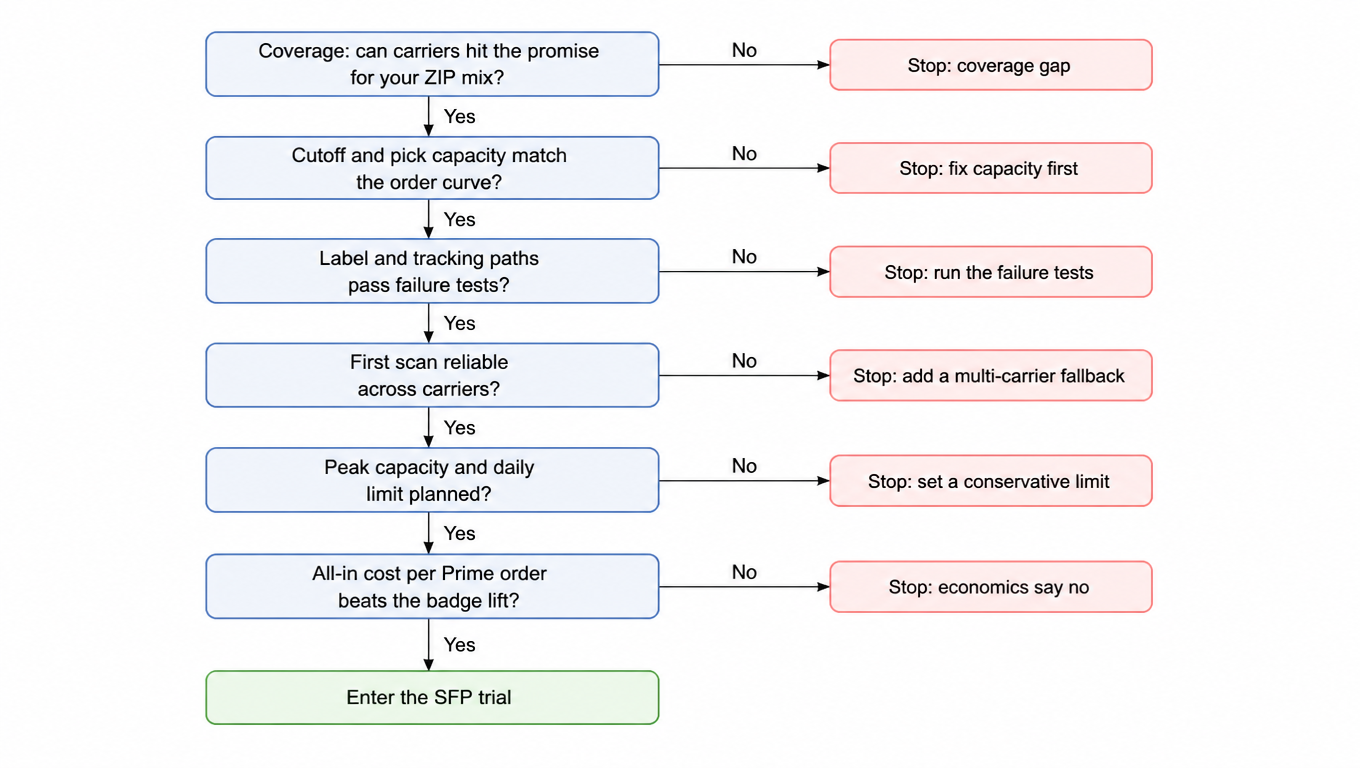
Then quantify the badge lift: what the Prime badge adds in conversion and Buy Box win rate for your listings. The ROI boundary is simple: the badge lift per order must exceed the cost delta per order over your current FBM shipping. If it does not, the badge is a donation. Work the decision tree in order, and only reach the trial box if every earlier gate passes.

Decision tree: can carriers hit the promise for your ZIP mix, else stop on coverage gap; cutoff and pick capacity match the order curve, else fix capacity first; label and tracking paths pass failure tests, else run them; first scan reliable across carriers, else add a multi-carrier fallback; peak capacity and daily limit planned, else set a conservative limit; all-in cost per Prime order beats the badge lift, else economics say no; only then enter the SFP trial
Seven gates, and only a full pass reaches the trial

Three situations where the honest answer is no. A coverage gap you cannot close, meaning core ZIPs cannot hit the promise with any carrier you can access. A low average order value where the cost delta eats the margin entirely. And no peak capacity plan, where you would pass the trial and fail November. In all three, staying FBM without the badge is the rational move, and the audit saved you from a worse outcome.

Close the Gaps in Order

Whatever the audit finds, classify every gap into one of six buckets: rate, meaning the tier speed costs too much; coverage, meaning no service to the ZIP; multi-carrier, meaning a weak carrier needs a fallback; label, meaning Buy Shipping or API integration breaks; tracking, meaning the scan or event flow is broken; and integration, meaning WMS to shipping API gaps. Fix in order: coverage and integration first, because they block everything else, then label and tracking, then rate and multi-carrier optimization.

Three of these buckets have dedicated deep dives. If the audit points at your 3PL's cutoff, handoff, and scan reliability, read Choosing a 3PL for Amazon FBM. If it points at coverage and fallback risk, read Multi-Carrier Strategy for Amazon FBM. If it points at why these metrics matter beyond the badge, read How Shipping Affects Amazon Buy Box, VTR, and Account Health. For peak volume planning, Shipping Capacity Planning covers the capacity and limit work, and WMS, Shipping API Integration Testing covers the label and tracking failure tests in detail. SFP sits inside the wider multi-carrier playbook, and the full framework starts at our multi-carrier shipping strategy hub.

The natural next step follows the audit, not the other way around. Finish the readiness audit first. Only if your gaps land in rate, coverage, multi-carrier, label, tracking, or integration does it make sense to compare carrier rates, request test credentials, or book a technical assessment of your shipping stack. If no gap lands in those buckets, you are either already ready or already decided, and no tool changes that.

Did the audit land your gaps in rate, coverage, or integration?

EasyShippingX is a channel-neutral shipping layer: one consistent way to compare US domestic carrier options and execute through a portal, a spreadsheet, or an API. Multi-carrier routing and regional carrier access are exactly the layer that moves a 2-day promise from 20% more to 5% more. See pricing or book a technical assessment.

FAQ

During the trial you ship at least 100 orders under SFP terms while maintaining the same performance standards as enrolled sellers. The duration is driven by reaching the volume and performance bar, not by a fixed calendar window. The trial is scored against enrolled-seller parity, so do not enter it before your performance is ready.
At most 6.5 orders per 100 can arrive late, across all promised deliveries. In a 100-order trial, one bad day is a full percentage point, which is why a passing average transit time means nothing once the tail stretches. Audit delivery time by percentile, not by average.
SFP delivery promises are defined against US domestic delivery, with roughly 40% of standard-size orders in 1 day, 75% in 2 days, and 90% in 5 days. Cross-border small packets from China rarely fit those windows, which is why workable SFP sellers almost always ship from a US-based warehouse or 3PL. Replay coverage against your own ZIP mix and carrier transit before deciding whether SFP justifies restructuring how you ship.
Labels bought through Buy Shipping or Shipping Automation qualify for OTDR protection in specific scenarios, where carrier-caused delays do not count against you and tracking flows to Amazon automatically. Labels from outside systems can work, but valid tracking is entirely your responsibility, and any scan or mapping problem counts as a failure. Run the failure tests on your label and tracking paths, especially first scan and tracking-number mapping, before you decide.
Plan before November, not during it. Pick throughput at peak volume, carrier serviceability in peak season, and a peak daily limit that keeps you inside the metrics when volume doubles, all set before the trial. Then write your rollback rules in advance: all-in cost per Prime order exceeding the badge lift, a carrier degrading a key zone, and peak capacity failing to hold are all legitimate reasons to exit voluntarily. Exiting on your terms beats being disabled on Amazon's.