Address & Carrier Rules Guide

Shipping to a PO Box: Carrier Rules, Address Formats, and a Seller's Checklist

A customer order with a PO Box ship-to line is not undeliverable, it is unrouted. This guide answers the six questions a fulfillment team actually asks: whether a PO Box can receive a parcel and what happens when it does not fit, which services can legally finish a delivery at a post office, how the address should be written and stored, why Street Addressing and private mailboxes look like street addresses, when to restrict rather than refuse at checkout, and what the warehouse should check before the label prints.

The order of operations is fixed: identify the address type first, find the service that supports it at that destination second, and only then make a request of the buyer. Reverse it and you get the failure this guide opens with, a rejected label and a manual ticket for an order that could have shipped.

Editorial illustration of a warehouse pack station seen straight on, a taped parcel resting next to a printed order sheet and a label, a single postal collection box visible through the open loading door in the middle distance, muted daylight, hand-inked linework with one restrained orange accent.
The problem is not the parcel, it is the routing: whether a label may enter a post office is decided by the service

Why PO Box orders break inside a fulfillment workflow

An order enters the wave with the ship-to line reading PO BOX 4471. It picks fine, it packs fine, and then the label request comes back rejected, because the default service cannot deliver to that address. The order sits in the staging area, the wave closes without it, and customer service opens a ticket asking the buyer for a street address.

Fit the address-type rule into the routing policy in the multi-carrier strategy overview. Use the carrier serviceability checks to check address type separately from a destination ZIP appearing in a coverage file.

The buyer answers that this is the only address they have, and that reply is where most teams make the wrong move. The question is not whether the buyer can be made to change. It is which service can actually reach this address, and answering it takes three steps in a fixed order.

  1. Identify what the address actually is. A PO Box, a street-addressed PO Box, a private mailbox, a rural route, and a military address look different in the data and behave differently in routing.
  2. Find the service that supports that address type at that destination. Check it against real account rules rather than a coverage map.
  3. Only then talk to the buyer, and only if the first two steps leave no workable option.

A PO Box is not a delivery problem. It is a routing problem, and it is solvable for most orders. The generic address-validation and serviceability system design lives in the linked guides, not here; this article stays on what actually happens on the PO Box line.

Can a PO Box receive a package, and what happens if it does not fit?

Yes. A PO Box is a real delivery point, and USPS delivers parcels to it (USPS PO Box service). What makes it different from a street address is the physical path the parcel takes: it travels to the post office that holds the box, and staff there match it to a box number on file. Delivery is not attempted at a door, because there is no door.

Most parcels sent to a PO Box are larger than the box itself, and that is normal. USPS does not return an item simply because it will not fit. A parcel too large for the box is normally held for counter pickup or placed in a parcel locker where the location has one, with a notice left in the box (DMM 508, Recipient Services).

The practical consequence is the important part: the box dimensions are not the dimensions of the largest parcel you can send, and treating them as equivalent will make you refuse orders that are perfectly deliverable. What actually triggers a return is a failed attempt or an unclaimed item that runs past the holding period, not size by itself.

For a fulfillment operation the takeaway is narrow. Package dimensions are almost never the reason to refuse a PO Box shipment; the reason is that a given service does not enter the post office. The cost that does show up on this line is the uncollected parcel: the buyer never goes to the counter, the hold window expires, and the item comes back on your account. That return has a cost, an owner, and a destination warehouse, and all three need a written policy before it happens rather than after. See return to sender and which warehouse receives a return for the routing and cost side.

Which carriers and services can actually deliver to a PO Box?

Start with the structural fact, because it settles most of the confusion below. A PO Box sits inside a USPS facility, and delivery access to that facility belongs to USPS. Private carriers cannot complete a delivery at a post office on their own authority (USPS PostalPro guide to Post Office Box street addresses). Everything below follows from that one rule.

USPS's own services are the straightforward answer. Priority Mail, Priority Mail Express, and Ground Advantage can all be delivered to a PO Box, including the Flat Rate packaging variants.

Private carriers are the opposite case. UPS Ground and UPS Home Delivery cannot. FedEx Express, FedEx Ground, and FedEx Home Delivery cannot. DHL Express cannot either, and unlike UPS and FedEx it offers no hybrid service that hands the last leg to USPS (DHL Express shipping FAQ). Amazon's own delivery network cannot. This is not a pricing or preference matter, so no account configuration changes it.

The workaround that genuinely exists is the hybrid service, also called a lightweight or last-mile-outsourced product. UPS Mail Innovations and FedEx Ground Economy, the service long sold as SmartPost, carry the parcel in the private network for most of the journey and then hand it to USPS for final delivery. Because USPS performs the delivery, the parcel can reach a PO Box.

UPS SurePost, now sold as UPS Ground Saver, is the exception that always needs care. Not every service level, weight band, or destination is open, and the handoff point determines where tracking breaks and who owns a claim. These terms also move: UPS and USPS renegotiated their last-mile agreement at the start of 2025, PO Box delivery was excluded for roughly a year before being restored, and Alaska, Hawaii, Puerto Rico, and the US territories remain outside it (Supply Chain Dive).

The table below gives the rule per carrier and service, and the failure symptom each one produces when the rule is ignored. The last column is the one worth showing to whoever handles the exceptions, because the symptoms are not interchangeable: some surface at label time, some surface as a fee, and some only surface at the destination post office days later.

Carrier Service Delivers to a PO Box? Final-mile operator Typical failure symptom
USPSPriority Mail, Priority Mail Express, Ground AdvantageYesUSPSNone at label time; the risk is an unclaimed parcel returned after the hold window
UPSGround, Home DeliveryNoNoneLabel rejected at print time, or an exception logged at the destination post office
UPSMail InnovationsYesUSPSRates fine; failures come from size or service-level exclusions rather than the PO Box rule itself
UPSSurePost (now Ground Saver)ConditionalUPS or USPSRates fine, then fails on excluded destinations such as Alaska, Hawaii, Puerto Rico, or the territories
FedExExpress, Ground, Home DeliveryNoNoneLabel rejected at print time, or an address-correction fee before the parcel comes back
FedExGround Economy (formerly SmartPost)ConditionalUSPSRates fine, then fails label validation on excluded service levels or oversize parcels
DHL ExpressExpress servicesNoNoneLabel rejected at print time, with no hybrid fallback to switch to
AmazonSelf-operated delivery networkNoNoneDelivery attempt fails at the post office and the parcel is returned
GOFO / SwiftX / UniUni / SpeedXServices offered through EasyShippingXNot supportedThe selected carrier networkExclude PO Box and APO/FPO/DPO addresses, even when the ZIP matches coverage.
Other regional delivery networks and aggregator channelsVaries by serviceConfirm against account rules, not the coverage mapUsually the network itselfZIP matches the coverage map and the label prints, yet the parcel cannot be finished at a postal facility

GOFO, SwiftX, UniUni, and SpeedX services offered through EasyShippingX: Delivery to APO/FPO/DPO military or diplomatic addresses and PO Box addresses is not supported, even when the destination ZIP is within the coverage area.

The same caution applies to platform prepaid labels. A prepaid label bought inside a marketplace or storefront is still a specific service underneath, and that underlying service either reaches a PO Box or it does not. Resolve which service is being bought before you decide the order can ship.


How should a PO Box address be written and stored?

The USPS standard format is simple, and it is worth enforcing because downstream systems often key on it. The recipient name goes on the first line. The box line goes on the second line, written as PO BOX followed by the number, in capitals, with no periods and the number on the same line. The city, two-letter state abbreviation, and ZIP complete the address, preferably with the ZIP+4 (Publication 28, section 28).

JANE DOE
PO BOX 1234
SPRINGFIELD IL 62704-1234

The mess usually arrives from somewhere upstream. Systems contain P.O. Box, P O Box, POBox, Post Office Box, Box 1234, and #1234 as interchangeable variants, and platform exports shift fields so that the box number lands in address line 2 while line 1 carries the name or a company. None of these are fatal on their own, but they break the pattern matching that routing rules depend on.

The storage rule to standardize on is one line: the box line stays in address line 1 as its own line, line 2 is either empty or a second recipient, and the box number is never merged with the city or the state. That single convention removes most downstream parsing errors.

PO Box is also not the only format that behaves this way, and a system that only recognizes the literal string PO BOX will misroute the rest.

  • Rural Route and Highway Contract addresses, written as RR 2 BOX 45 or HC 60 BOX 3, are not PO Boxes, but they are served the same way, with no street delivery.
  • Military addresses, PSC 808 BOX 12 with APO AE 09303, are handled at domestic rates and do not use a nine-digit ZIP in the usual way (USPS military and diplomatic mail).
  • US territories including Puerto Rico, Guam, the US Virgin Islands, American Samoa, and the Northern Mariana Islands are treated as domestic by USPS, while private carriers may require customs paperwork or may not serve them at all (USPS FAQ on domestic territories).

The normalization step belongs before rating, not after a label fails, and the output should be an address type label rather than merely a clean string. Retyping an address into a prettier format is not the goal. Knowing what kind of address it is, so the routing layer can act on it, is the goal. That distinction is the core of address validation.

One rule overrides convenience here: do not rewrite the buyer's address on your own initiative. Converting a private mailbox into a PO Box, or stripping a street-addressed PO Box down to a bare box number, changes which carriers are permitted to deliver and will produce a failed delivery that looks like the buyer's error (Publication 28, section 284).

Why do some PO Boxes look like street addresses?

This is the part of the problem that breaks batch workflows, because two address types that look nearly identical in the data have opposite routing rules.

Paired editorial illustration of two envelopes on a pale desk, the left one beside a small brass post office box key and a numbered drawer, the right one beside a shopfront key with a mail crate, both envelopes shown with soft indistinct address strokes and no legible lettering, clean ink lines with a single orange accent.
A post office box on the left, a private mailbox in a shop on the right: similar look, opposite delivery rules

Type one: Street Addressing. USPS offers a service in which a PO Box holder may use the post office's own street address plus the box number, written for example as 100 MAIN ST #1234 (USPS PostalPro, premium PO Box street addressing). The address is still that PO Box, but the post office at that location accepts deliveries from other carriers on the box holder's behalf. It is not universal and it is not automatic: only participating locations offer it, the box holder must opt in or consent, and there are size and signature conditions attached (Publication 28, section 284). If the format is wrong, the address falls back to plain USPS-only treatment. The common failure is treating such an address as ordinary residential and routing it to a private service whose destination post office does not participate in the program.

Street Addressing does not automatically override the PO Box exclusion for GOFO, SwiftX, UniUni, or SpeedX. Do not rewrite a postal-box address to bypass the restriction; assess CMRA/PMB private mailboxes according to their actual address type.

Type two: CMRA and PMB. A Commercial Mail Receiving Agency is a private business that rents mailboxes, and its addresses look like street addresses because they are. A typical form is 1215 MAIN ST PMB 123, and you will also see #123 used loosely in its place (Publication 28, section 285). This is not a USPS facility, so private carriers can and do deliver there normally. The box holder files PS Form 1583 with the agency (PS Form 1583), and the address is supposed to be written with the PMB designation, not as APT or STE. The batch risk is that a single pattern for a number followed by a unit designator matches both a PMB and an apartment number, so a naive rule either sends a commercial mailbox down the USPS-only path or sends a residential apartment to a service that will not deliver.

Type three: inconsistent references. A buyer enters the post office's street address in one field and the box number in another, so the street number and the box number describe different places. Nothing downstream can resolve that automatically, and the order needs a human.

The detection strategy that holds up is classification plus a carrier deliverability check, not regular expressions. Parse the address into a type, store that type as a field on the order and the shipment so routing and customer service can both see it, and validate serviceability against the carrier before a label is requested. Carrier serviceability validation covers how that check is structured when it has to run at batch speed.

Should a seller block PO Boxes at checkout?

By default, no. The decision should follow whether a workable service exists, not the category of address the buyer typed. Blocking an entire address type turns away orders that USPS would have delivered without incident, and it teaches the buyer that the storefront is hard to buy from.

Situation Treatment at checkout What the buyer sees
At least one service supports this address and destinationAllow the order, no restrictionNormal rates and a window calculated from the options that actually serve it
Only some services are availableRestrict the shipping optionsThe valid options only, with honest transit times rather than a suppressed promise
Address type is unclear, or the destination carries extra conditionsHold for manual reviewA prompt with a substitute-address option, and a clear note that the order is being checked

The same batch can legitimately split. A PO Box order and a residential order in the same wave can go out on different services, and that is a normal outcome of per-order routing rather than an exception to explain away.

When you do surface a message at checkout, offer the alternative address before you refuse. A prompt that says the order cannot ship to this address ends the conversation, while a prompt that asks whether the buyer can also receive at a street address sometimes resolves the order before it is placed, and it costs nothing when they cannot. Place the prompt after the address fields are complete, not on page load, so it only interrupts the buyers it affects.

Refusal is justified in three cases: no service reaches the address at all, the item itself is incompatible (size, a signature requirement, or restricted contents), or the promised window cannot be met on any available service and the buyer will not accept a substitute. Outside those three, the order is a routing task, not a cancellation.

One discipline belongs here explicitly. Do not write promises about capabilities you have not confirmed. The channel-neutral approach is to check eligibility for the destination ZIP, compare the available options, and execute the chosen one through the Portal, Excel, or the API, keeping the promise equal to what the chosen service has actually been observed to do.

What should the warehouse check before it ships?

The check that prevents almost all PO Box failures is short enough to live on one line of a pack station screen.

  • Address type. Confirm a type is assigned: PO Box, rural route or highway contract, street addressing, CMRA or PMB, military, or territory. An untagged address is the first thing to stop on.
  • Box number. Confirm the box or unit number is complete and is not merged into another field or truncated by a character limit.
  • Service support. Confirm the selected service supports that address type at that destination, checked against account rules rather than a coverage list.
  • Package conditions. Confirm the size and any signature requirement will not push the parcel past what the destination facility can hold or hand over.
  • Delivery promise. Confirm the promised window was calculated from a service that genuinely reaches this address, not from the default option.
  • No suitable service. Confirm the escalation path is defined: switch service, request an alternative address, or hold and notify per the client's rule.

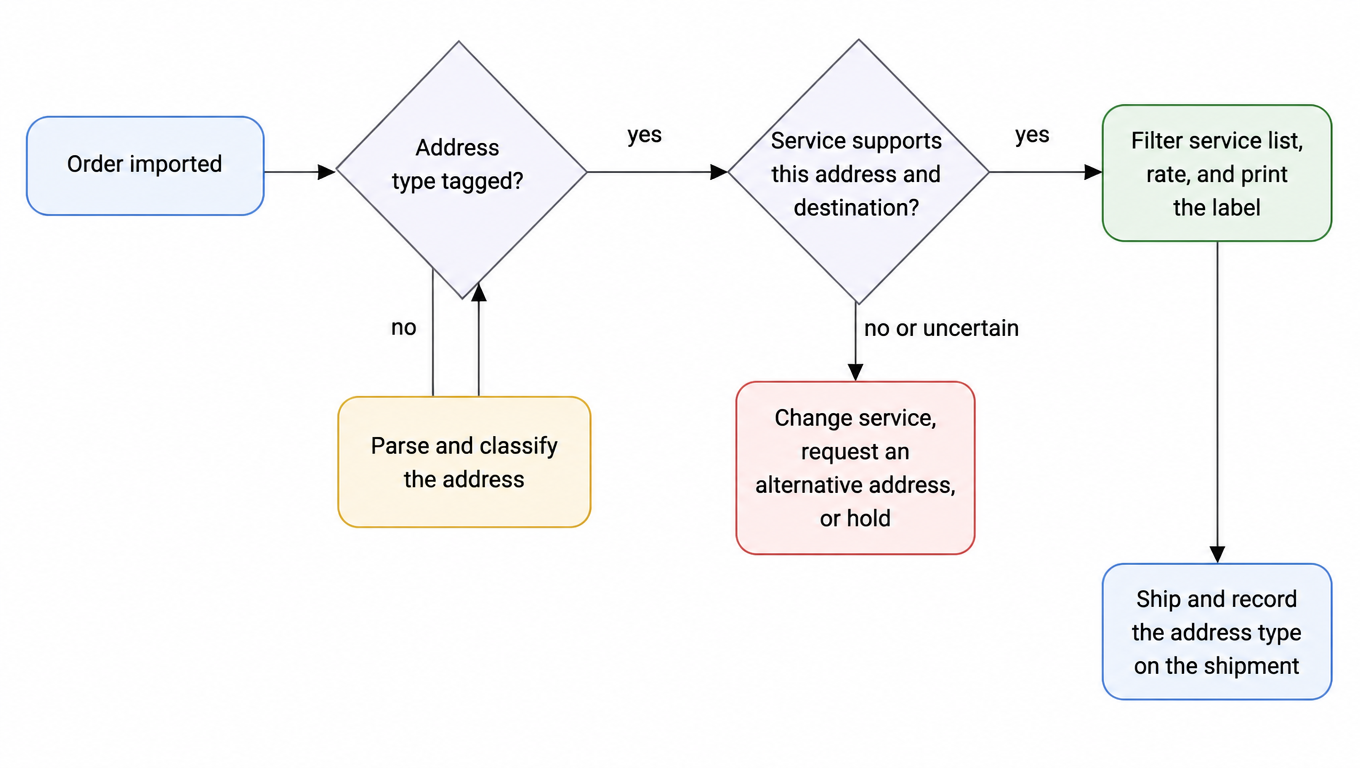
The decision itself follows a path short enough to automate.

Flowchart: after an order is imported, the system checks whether the address type is tagged, and parses and classifies it if not; once tagged it checks whether the service supports that address and destination, then filters the service list, rates and prints the label, or changes service, requests an alternative address, or holds the order; finally it ships and records the address type on the shipment
The routing path: classify first, choose the service second, contact the buyer last

Exceptions need an owner before they need a fix. An uncollected parcel that returns after the hold period, a counter item nobody picked up, and a failure caused by someone rewriting the address all have different cost owners, and the difference matters more at month end than at the moment the ticket opens. Writing the handoff into the SOP, including which warehouse receives the return and who absorbs the second shipment, keeps this line from quietly becoming a margin leak.

The customer service script is the last piece and the cheapest to fix. Do not open with a request that the buyer change to an address you can serve. Start by checking whether a service already reaches theirs, and only ask for an alternative when the check comes back empty. The first version reads as a store that cannot deliver. The second reads as a store that looked.

Wire the address type into carrier selection

EasyShippingX is a channel-neutral shipping layer: it compares US carrier options in one place and executes them through the Portal, Excel, or the API. A PO Box order and an ordinary order run on the same quoting logic; the only difference is that the address type filters the available services before the rate is quoted and the label prints.