Automated carrier selection sounds simple: connect every carrier, compare rates, let the system pick. The hard part is that the system has to pick a carrier that can keep the delivery promise the customer already saw, at a price that keeps the business profitable. This article walks through the rule layers that make that possible, the scoring model that ranks the survivors, and how multi-carrier rate comparison and shipping APIs execute the whole pipeline.
Automated carrier selection: promise first, cost second
Why "Pick the Cheapest Rate" Breaks Delivery Promises
Automation in shipping usually starts with the same promise: connect every carrier, compare rates, and let the system pick the cheapest option for every order. Fewer manual decisions, faster label printing, lower cost per shipment. It works, until it does not. The cheapest rate is not the same as a deliverable promise. A low regional rate means nothing if the carrier cannot reach the ZIP code, if the package misses today's pickup cutoff, or if the service's transit time is two days slower than the estimate the customer saw at checkout. The result is late delivery, undeliverable packages, refunds, and a support inbox full of complaints.
Marketplaces enforce these promises mechanically. Amazon measures valid tracking and on-time delivery through its VTR program, which requires a Valid Tracking Rate above 95% for seller-fulfilled listings[^1], eBay tracks late shipments as defects against seller performance[^2], Walmart scores on-time delivery against the promise shown to the buyer, holding sellers to an on-time delivery rate of 90% or higher[^3]. Every missed promise is not just an unhappy customer, it is a metric that lowers placement and raises costs. The business case for automation is strong, but the automation has to be built around the promise, not around the price.
That is the core principle this article builds on: constraints first, scoring second. Hard constraints disqualify carriers before any comparison happens. Scoring ranks the carriers that survive. Automation is the execution layer that applies the rules at scale; the rules themselves are the decision layer that protects the promise. Get the decision layer right, and automation becomes a competitive advantage. Get it wrong, and you have automated the mistakes.
The Hard Constraint Layer: Eight Rules That Disqualify a Carrier
Hard constraints are boolean gates. A carrier-service either passes or it fails, and a single failure removes it from consideration entirely. Failed candidates never enter scoring, no matter how cheap they are. This structure matters because a score can hide a fatal flaw: a carrier with a great cost score cannot compensate for a delivery promise it cannot keep.
The order in which checks run matters too. Cheap local checks run first: ZIP coverage, weight limits, address format. Expensive remote checks run last: live rate calls, address validation APIs, capacity queries. A well-ordered pipeline rejects most candidates with a local lookup before spending a single API call.
1. Address and Serviceability
USPS reaches every residential address in the country, but regional carriers do not. Each regional network serves a specific set of states and ZIP codes, and coverage changes as the network expands[^5]. Serviceability is the first gate: is this carrier physically able to deliver to this address?
Address type matters as much as geography. PO Boxes and military APO/FPO addresses need USPS[^6]. Alaska, Hawaii, and Puerto Rico have their own service rules and surcharges. Remote and rural ZIPs trigger fees on some carriers and are simply out of range on others. The address should be validated and standardized before carrier selection begins, not after a label has been purchased.
2. Parcel Restrictions
Every service has physical limits: minimum and maximum weight, maximum dimensions, and DIM pricing rules that change the effective cost of large lightweight boxes. A package that exceeds a regional carrier's maximum box size is not a candidate, full stop.
Product category adds another layer. Hazmat, lithium batteries, liquids, and fragile items each have their own allowed-carrier lists. A carrier that takes the box but not the contents is still disqualified. The rules engine needs the parcel profile (weight, dimensions, category) before it can apply any of this.
3. Checkout Delivery Promise
This is the rule that most directly protects the promise. Every service advertises a transit window, and the customer at checkout sees a delivery estimate built from that window. The automation must compare the two: any service whose promised transit time is slower than the checkout promise is disqualified, even if it is the cheapest option in the system.
The rule gets stricter when the customer pays for speed. If someone pays for expedited delivery, only services that can actually meet that commitment qualify. This is where automation most often goes wrong, because the data is easy to miss: the service table says 2 to 5 days, the checkout promise says 3 days, and the difference is invisible to a cost-first selector.
4. Carrier Capacity and Cutoff
A carrier may be serviceable, within limits, and fast, and still be unavailable today. Every carrier has a pickup cutoff. Past the cutoff, the shipment cannot leave today, and if the checkout promise assumed today's pickup, the carrier is out for this order. The cutoff must be checked per carrier, per service, per facility, against the current time in the facility's time zone.
Peak season adds capacity caps, daily order quotas, and batch limits that temporarily remove carriers from the eligible set. Announced outages, holiday schedules, and temporary suspensions should feed the same gate. A carrier that was fine this morning can be unavailable at 3 p.m. during Q4, and the rules engine should treat that as a hard fact, not a surprise.
5. All-in Cost
The rate quote is not the cost. All-in cost is base rate plus fuel surcharge, residential and remote surcharges, oversize and DIM fees, insurance, and an expected-cost share for returns. Two quotes that look similar at the rate level can differ by several dollars once every surcharge is applied.
Cost plays two roles in the system. As a hard constraint, a budget ceiling can remove carriers when the strategy requires it, for example, when a category must ship under a certain price to stay profitable. As a scoring factor, cost ranks the survivors. The rule to remember: compare cost only after the promise is met, never before.
6. Tracking Requirements
Marketplaces require tracking, and they enforce it. Amazon, eBay, and Walmart all mandate tracking upload and valid first scans within defined windows, and both Amazon and Walmart evaluate Valid Tracking Rate alongside on-time delivery in their seller performance reviews[^4]. A service whose tracking cannot satisfy the marketplace's rules is disqualified, because the penalty for non-compliance is not worth any rate saving.
Customers have their own expectations: last-mile scans, a visible ETA, delivery notifications. Services without adequate tracking fail the customer experience even when the package arrives on time. When in doubt, treat weak tracking as a disqualifier rather than a discount.
7. Fallback Carrier
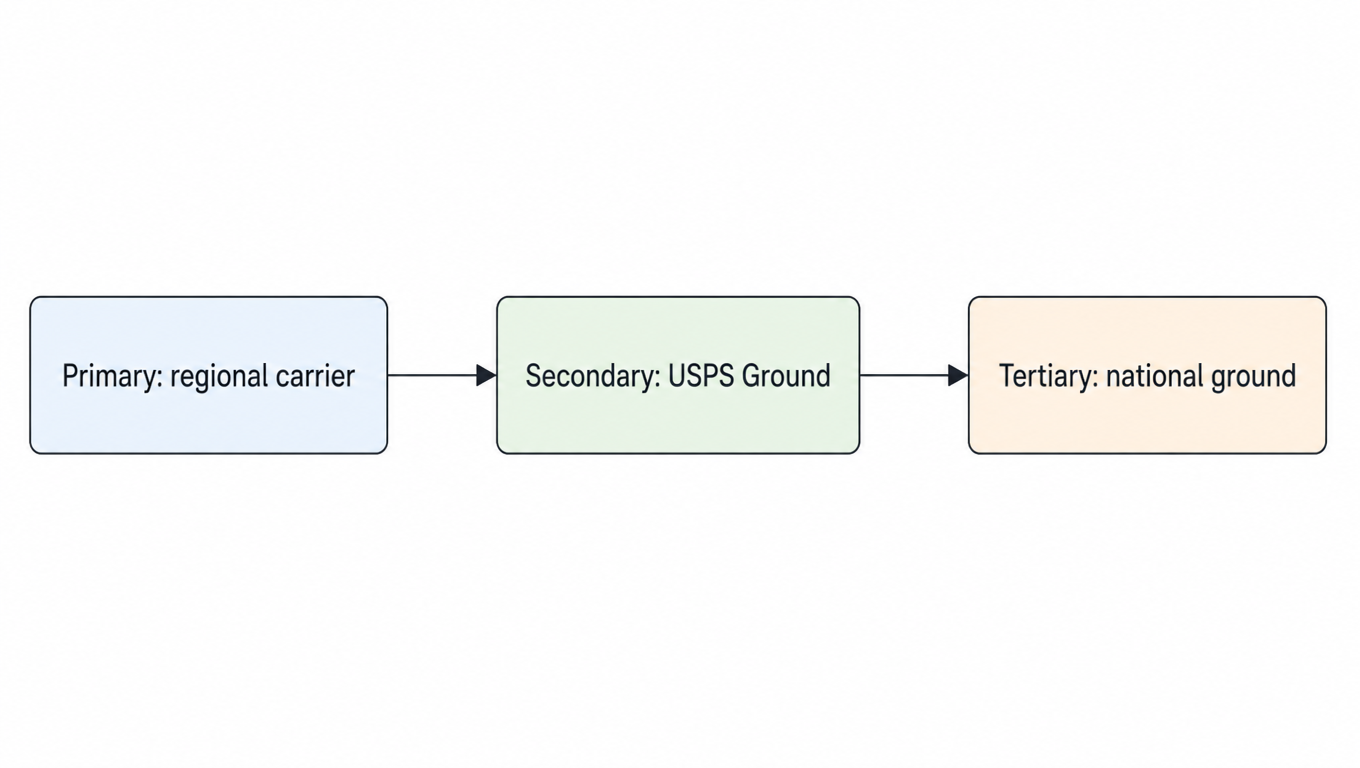
Every automated pipeline needs an answer for the moment when the preferred carrier fails, and that answer must be defined before the moment arrives. Define the degradation chain explicitly: primary, secondary, tertiary. The fallback is not "whatever is available", it is a pre-decided carrier-service that has been vetted for the same lanes.
Fallbacks must pass the same hard constraints as the primary. And when a fallback changes the delivery date, the new ETA must flow back to the customer and to the marketplace, because a promise that silently changes is a broken promise with extra steps.
Define the fallback chain in advance, not on the fly
8. Manual-Review Conditions
Some orders should never be auto-decided. Define the conditions explicitly: addresses that cannot be validated or look fraudulent, high-value shipments above a dollar threshold, the first occurrence of a new product category, ZIP, or zone, and any order where no carrier passes all hard constraints. A rule conflict is a signal, not an error: it means the data or the rules need attention, and a human should look before a machine guesses.
Coverage data that is missing or stale deserves the same treatment. When in doubt about the data, route to manual review. The cost of a human check on a few orders is trivial compared to the cost of an automated bad decision.
The Soft Scoring Layer: The Multi-Factor Model
Once the hard constraints have done their work, the surviving carrier-services are ranked by a weighted score. The model in this article uses four factors: all-in cost, transit time relative to the promise, reliability (historical on-time rate, damage, loss, and returns), and coverage margin, how comfortably the carrier covers the lane. Each factor is normalized to a 0 to 100 scale using real shipment data, not marketing claims, so the score reflects what carriers actually did last quarter, not what they promise in a sales deck.
The weights are a starting point, not a law. Cost gets weight because it is the point of automation. Speed gets equal weight because it is the promise. Reliability carries the risk of complaints, refunds, and marketplace penalties, so it cannot be an afterthought.
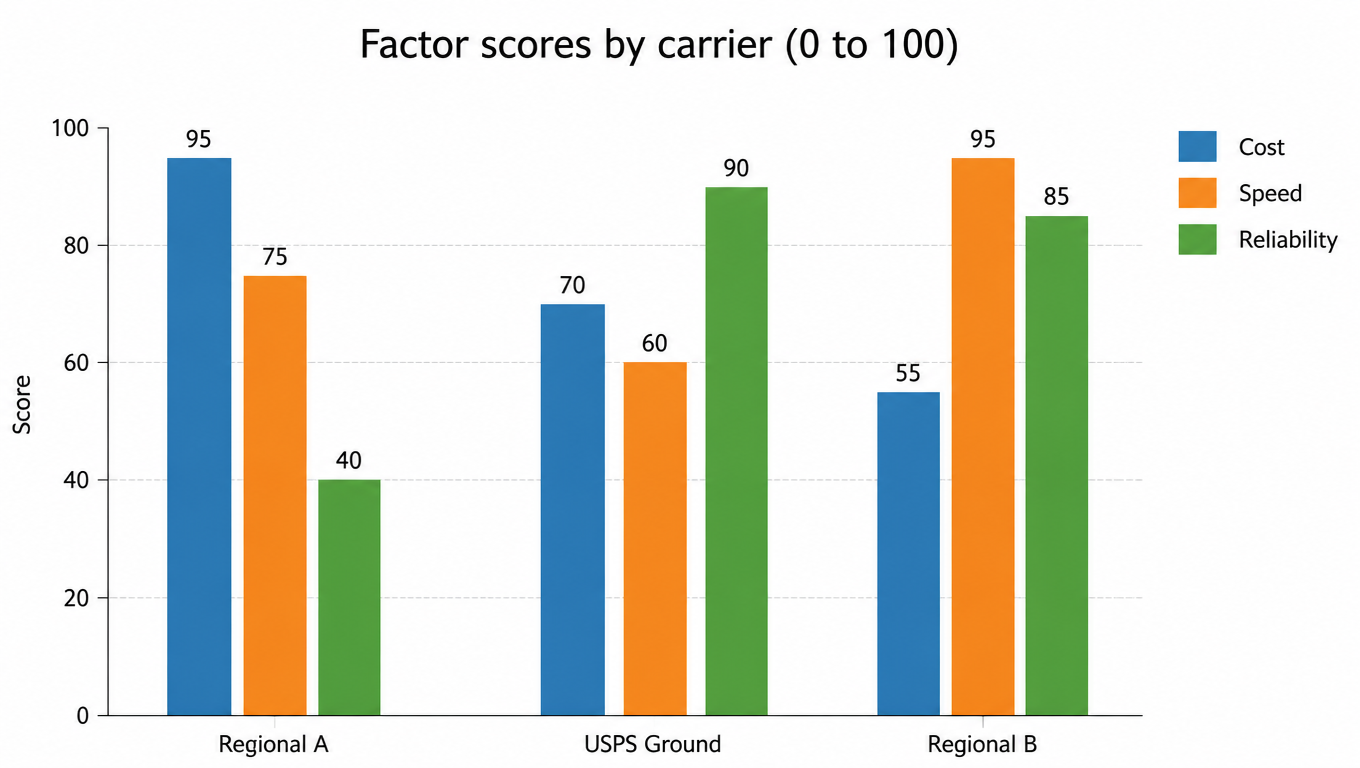
Worked example: three services survive the hard constraints for an order with a 3-day checkout promise.
Regional carrier A: cheapest, cost score 95, speed score 75 (2 to 3 days), reliability score 40 (on-time rate dropped after a network expansion)
The cheapest carrier loses. A is $1.10 cheaper per shipment than B, but its reliability problems and its narrow speed margin push it to the bottom. B wins because it is fast enough to comfortably beat the promise and reliable enough to keep it. This is the whole point of scoring: the decision is not "cheapest", it is "cheapest among carriers that can keep the promise", then "best weighted value among those".
Weights should be recalibrated monthly from actual performance. If late deliveries rise, shift weight toward speed and reliability. If costs drift, re-examine the cost normalization. The score is a management instrument; tune it the way you would tune any instrument.
How the Rules Execute: Multi-Carrier Rate Comparison + Shipping API
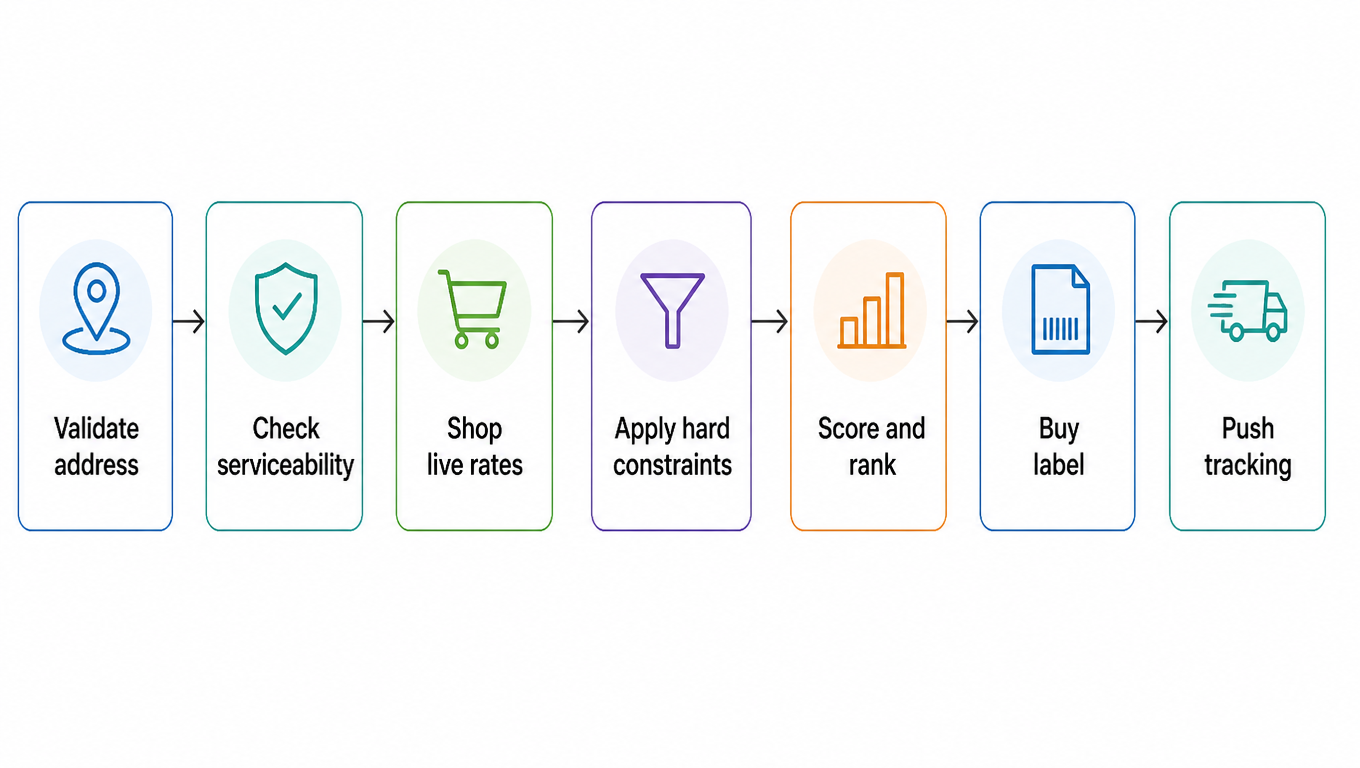
The rules only protect the promise if they run on real, current data. The execution pipeline looks like this:
Disqualify first, score second, buy the label last
Multi-carrier rate comparison is the data source in the middle of the pipeline. One request returns real rates, real transit promises, and real availability from every connected carrier, which is exactly what the hard-constraint layer needs. The rules run on top of live quotes, not on a static price table, because a static table cannot know about today's surcharges, today's cutoffs, or today's service interruptions.
The shipping API provides the operations around the decision. Address validation cleans and standardizes the address before anything else runs. The rate API aggregates quotes. The label and shipment API creates, buys, and manifests the shipment. The tracking API pushes scans to the marketplace, detects exceptions, and alerts on deviations. Failure handling ties it together: timeouts and retries on the API side, failover to the next fallback carrier when a label purchase fails, and clean error paths that route to manual review instead of guessing.
The pipeline should also be event-driven after the label is bought. A tracking exception, a missed scan, a delivery exception: each triggers re-selection logic, the choice between reship, address fix, refund, or alert. The same rules engine that chose the carrier at checkout decides what happens when the carrier stumbles. Automation does not end at the label; it continues through delivery and exception handling.
Go-Live Checklist: Rules Before Code, Shadow Mode First
Ship the rules before you ship the code. Write the rule table first: carrier, service, constraint, threshold, and the source of truth for each value. Every rule needs an owner and a review date. If you cannot write a rule down, you cannot automate it, and what you automate is only as good as the table you wrote first.
Then run shadow mode. The system records what it would have chosen for every order without acting on it. Compare shadow choices against what human operators actually chose for a few weeks. The gaps between the two are the specification for the rules you forgot to write.
Monitor five numbers from day one: automation adoption rate, promise-achievement rate, late rate, complaint rate, and cost per order. Automation that saves money while keeping the promise is working. Automation that saves money while the late rate climbs is a tax bill arriving in the form of refunds and lost buyers.
Five monitoring numbers, from day one
Review rule hits and misses weekly in the beginning, monthly once stable. Every mis-selected order is a case study: which rule was missing, which threshold was wrong, which data was stale. Recalibrate weights, close the gaps, and the automation gets smarter every cycle.
Route to manual review, and do not lower the bar. An empty result usually means stale data (coverage tables, capacity, cutoffs) or rules that need recalibration. The cost of a human looking at a few orders is far below the systemic broken promises that come from lowering the threshold to force a pick. It is also the signal that the rule table needs an update.
No. The 0.35 / 0.35 / 0.30 split is a starting point. Recalibrate monthly from actual performance: if late deliveries rise, shift weight toward speed and reliability; if costs drift, redo the cost normalization. The score is a management instrument; tune it to the data, not to feel.
The degradation chain is pre-defined (primary, secondary, tertiary), not "whoever is available", and every fallback must pass the same hard constraints as the primary. A failed label purchase or a tracking exception triggers the failover; if the fallback changes the delivery date, the new ETA flows back to the customer and the marketplace instead of silently changing.
Yes, but only under defined conditions: unvalidatable addresses, high-value items, first occurrences of new products or zones, rule conflicts, and empty results. Automation is only safe when both "machine decides" and "exception goes to a human" are written into the rule table.
Only if the rules are written backwards. Hard constraints disqualify every service that cannot meet the checkout promise, serviceability, timing, and tracking requirements before any comparison happens; scoring only compares cost among the survivors. Promise first, cost second, and automation saves money while keeping its word.
Want automated carrier selection that keeps the delivery promise and the margin?
EasyShippingX operates in the carrier execution layer (rates, labels, tracking). Multi-carrier live rates, hard constraints and scoring rules you can encode instead of decisions your team has to make, and real-time per-order cost at the moment the label prints, run the "disqualify first, score second" logic at scale. Rule tables, shadow mode, and monitoring metrics are built in, so your carrier selection automation is built around the delivery promise from day one.