The day you turn on automated carrier selection usually goes smoothly. Rules are configured, labels print themselves, and the cost dashboard is all green. A few weeks or months later the problems start: finance shows up with invoices that do not match the quotes, customer support forwards complaints, and your team is manually overriding the carrier more and more. That is when you need to answer one question: why is the system picking this carrier?
Turning on automated selection is just the start; the cost truth lives in the settlement invoice
The Problem: The System Is Choosing, but Nobody Can Explain Why
Behind that question sit four specific ones. What is the basis for the system's choice? Is it genuinely better than the other executable options in the candidate list? Does the saving come from real settled cost, or only from the numbers on a quote page? And is delivery performance quietly getting worse because you chased the lowest price? If your team cannot answer all four, automation has only saved operator time, at the cost of control over the decision.
Two more signals are easy to miss. First, a rising manual override rate: is it the alarm that your rules are failing, or the natural distribution of legitimate exceptions? Second, how much have the rates, carrier coverage, and parcel profile the rules were built on changed since go-live? Rates move, carriers add and drop lanes, and the average weight and dimensions of your parcels drift, while the rules may never have been touched once. UPS and FedEx alone raised base rates by roughly 5-7% for 2026, and total cost increases reached 10-18% once surcharges were added[^4].
The point of an audit is not to undo automation, but to make it explainable again. For the broader cost framework, start with our guide on how to lower shipping costs.
Why Traditional Metrics Prove Nothing
In the past, success for carrier selection automation was usually measured by a few familiar criteria: fewer carrier portals to log into, faster label printing, every selection showing the lowest price, and less manual work.
These metrics measure convenience, not decision quality. A rule can satisfy every one of them and still pick wrong every day. A low number on the quote page is not a low settled cost: DIM weight adjustments[^1], residential surcharges[^2], and fuel surcharges[^3] all change the real cost afterwards. A cheap service can also break the promise you made at checkout, and one late day is a bad review or a refund.
More insidious is the error that gets multiplied. Carrier coverage and performance change, and those changes do not walk into your rules by themselves. Consider a scenario where a dimensions field is wrong or a rule priority is misconfigured: automation does not stop to correct itself, and it executes the same mistake thousands of times. In the manual era, one operator's mistake affected one parcel. In the automation era, one configuration mistake affects every parcel. To avoid these pitfalls when the rules are first designed, see the sister guide on automating carrier selection without breaking delivery promises.
A New Framework: The Carrier Decision Quality Loop
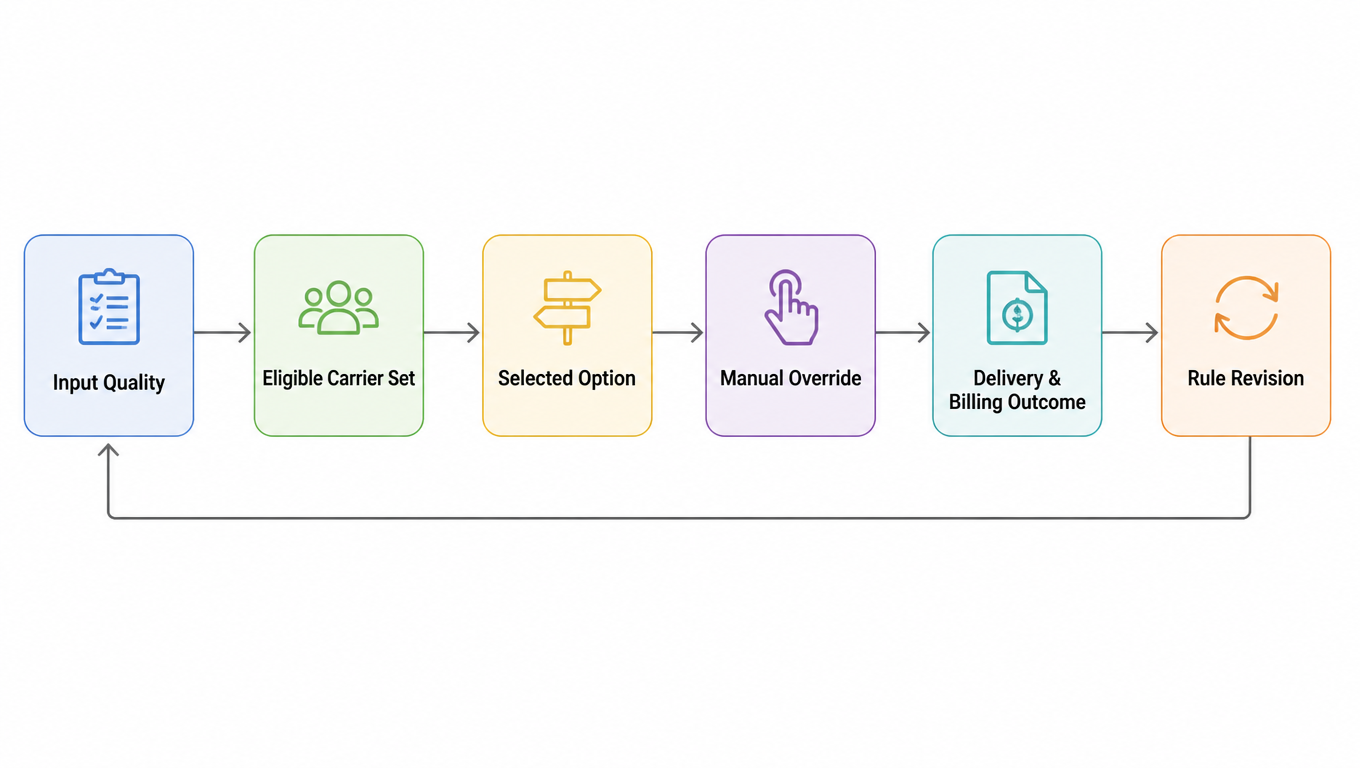
To escape the trap of outcome-only metrics, this guide works from the hypothesis that decisions, not outcomes, are the right unit of analysis. We use a framework called the Carrier Decision Quality Loop, a closed loop that covers the full decision chain: Input Quality → Eligible Carrier Set → Selected Option → Manual Override → Delivery & Billing Outcome → Rule Revision.
The Carrier Decision Quality Loop: from inputs to settlement and back into rule revision
Each stage answers one concrete question:
Input Quality: can you trust the inputs: weight, dimensions, address, and service eligibility?
Eligible Carrier Set: is the candidate set complete, and is every option truly executable?
Selected Option: which rule picked this option, and can the reason be explained?
Manual Override: why was a human override applied, and what was it changed to?
Delivery & Billing Outcome: how far do actual delivery and actual billing land from what was expected at selection time?
Rule Revision: write the findings from the previous five stages back into the rules, then start the loop again.
The point of this framework is not which carrier is best; it is whether every decision can be explained, verified, and improved. The next time someone asks whether the rules still work, you do not need to guess. You walk the loop and produce the evidence for each stage.
The Key Variables to Audit
An audit cannot stay at the framework level; it has to land on concrete variables. Group them by responsibility into five sets and check set by set, which is far more reliable than checking point by point.
The first set is eligibility and data: origin, destination ZIP, zone, and serviceability decide whether a carrier can take the parcel at all; actual weight, dimensions, and billable weight decide what gets billed; and eligibility limits such as HAZMAT, PO Box, and high-value orders mean many parcels should never enter the candidate pool. This set is the entry point of the whole chain; if it is wrong, every later stage runs on a wrong foundation. The second set is promise and execution: does the delivery promise shown at checkout match the warehouse cutoff? Take a simple example: the promise says 3 days and the system picks a 5-day service; you are manufacturing a complaint.
The third set is rates and settlement: keep base rate, foreseeable surcharges, and final settled cost separate. The gap between the quote page and the invoice is where the savings illusion comes from, and it deserves its own deep dive in our guide on rate quotes vs. final charges. The fourth set is performance and outcomes: split carrier performance by lane, service, and parcel profile, because a carrier can look great overall and be weak on your main lane. On-time, claim, RTS, refund, and reship are the hard outcome metrics, and our carrier performance scorecard shows how to score carriers on them. The fifth set is rules and exceptions: rule priority, rule conflict, and fallback behavior decide in what order and under what conditions rules fire; API timeouts, no-rate responses, and label failures are system-level exceptions; override rate and override reason are the health report of your rules; and 3PLs additionally need to check that client-specific carrier policies are correctly covered by the rules.
Variable group
Fields to check
Typical anomaly signals
Eligibility & data
origin/destination ZIP, zone, serviceability; actual weight, dimensions, billable weight; HAZMAT, PO Box, high-value order limits
the same ZIP repeatedly returns no-rate; DIM does not match physical volume
Promise & execution
checkout delivery promise, warehouse cutoff
promise and selected service transit do not match
Rates & settlement
base rate, foreseeable surcharges, final settled cost
quote-to-invoice variance concentrates in a few surcharge types
Performance & outcomes
on-time, claim, RTS, refund, reship by lane, service, and parcel profile
on-time on one lane is persistently below the overall rate
overrides concentrate on one order type; fallback fires frequently
Why Are Staff Overriding Your Automated Shipping Rules?
A few months after go-live, a new pattern shows up: staff are overriding the carrier the system picked more and more often. Managers usually react in one of two ways, and both are wrong. One is to treat overrides as a discipline problem and tell the team to follow the system. The other is to see the number rise, conclude the rules are broken, and start editing them. The question worth answering is smaller and more specific: was this override a system error, or did the person know something the system does not?
"Less manual work" cannot independently prove the rules pick correctly. A rule set can drive manual work to nearly zero while picking wrong every day. The total override rate has the opposite problem: it blends two very different things, legitimate business exceptions and genuinely failing rules. Treating every override as a failure punishes necessary human judgment and teaches the floor not to stop a parcel that is clearly wrong. Treating every override as "staff know better" hides a different loss, where someone picks the familiar service out of habit, each parcel costs a little more, and no record can prove or disprove the judgment.
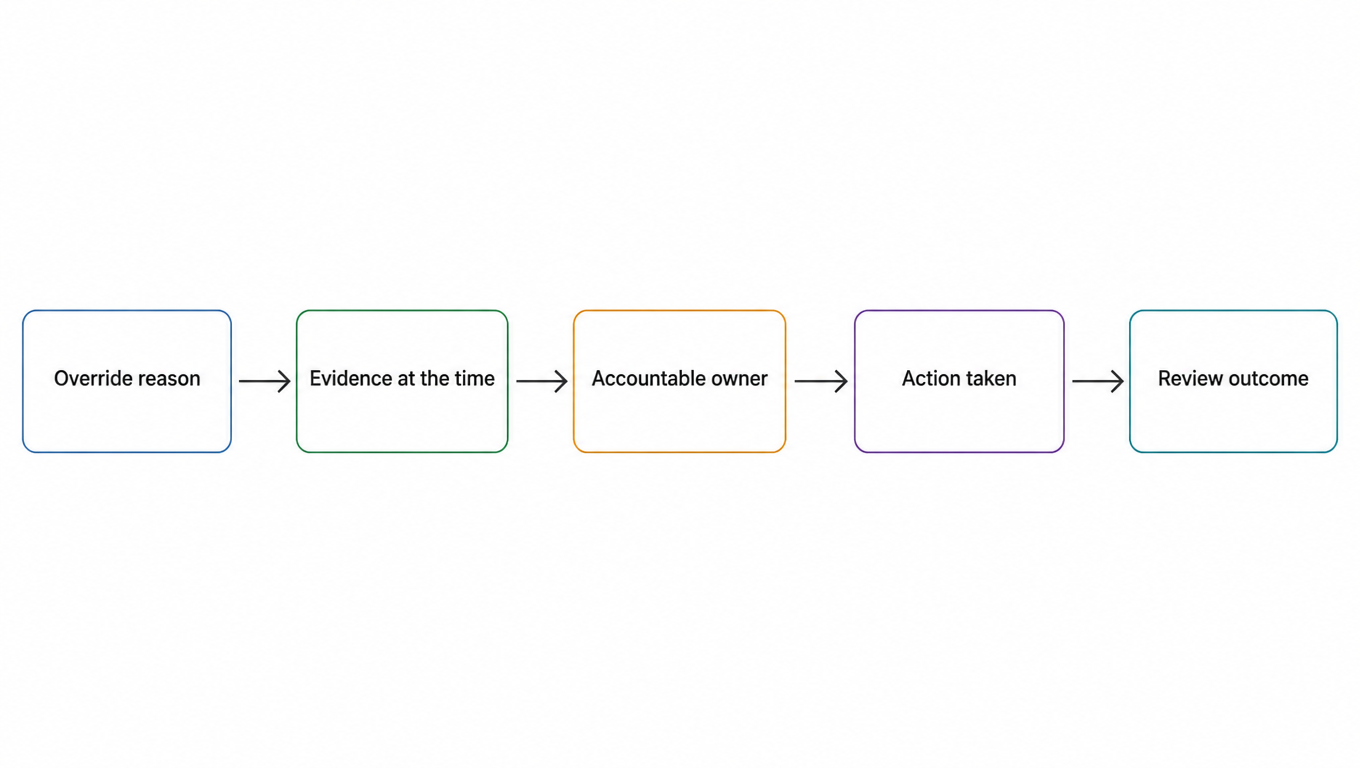
To judge which kind of override you are looking at, extend the existing audit loop with one override review chain: override reason → evidence available at the time → accountable owner → action taken → review outcome. The discipline is that each link records what was known at that moment, not a reason written afterwards. Then classify every override into one of four kinds: a valid exception, an input error, a rule error, or a change in execution conditions. The classification has to rest on the evidence available when the override happened, never on the outcome that followed, or you are just reasoning backwards to a conclusion you already hold.
The override review chain: turning every manual override into a reviewable record
The fields to record follow that chain: the originally selected service, the service it was changed to, the rule version, the reason code, order and parcel attributes, customer constraints, the cutoff and pickup conditions at that moment, and both the quoted cost and the final actual cost. The denominator is easier to get wrong than the fields. If the numerator is overridden shipments, the denominator has to be shipments that entered the automated selection flow, not orders and not packages. Orders and packages cannot share one ratio: a multi-parcel order inflates the denominator and deflates the rate. Once the denominator is clean, group by customer, warehouse, and reason code, and you can tell whether the problem is global or local.
Once you have the classification and the groupings, use the table below to decide what to do.
Finding
Recommended action
Weight, dimensions, or address input error
Fix the data source, then re-run the rules
Customer explicitly restricts a carrier
Turn the confirmed customer requirement into an eligibility filter
The originally selected service has missed the handoff window
Check which alternatives are still executable; if none fit, handle it manually
Multiple rules conflict
Review the priority order and test it on the affected sample
The override came only from personal habit
Compare the options that were executable at the time with the outcome, then decide whether to adjust
The override reason or the candidate list is missing
Build the record first; do not claim the rules are broken on missing evidence
One boundary is easy to cross: for an alternative that never actually carried the parcel, you can estimate or pilot it, and nothing more. You cannot record its cost and delivery performance as a result that happened. Before saying that switching to option B would have saved money, ask where that number comes from: the quote at the time, actual settled cost on a comparable lane from history, or your instinct. A quote is a quote, an estimate is an estimate, and only parcels that were actually carried and delivered count as a result you can cite.
The 30-Day Audit: A Decision Framework
Now put those variables into an executable process. A 30-day cycle is the recommended cadence, because most carrier billing and settlement cycles run on that scale[^5], and 30 days is enough to align quotes, settlement, and delivery outcomes.
Pick a representative parcel sample instead of looking only at the average parcel. Averages smooth over anomalies; stratify by lane, service, and weight band so every important combination has a sample.
Save the candidate carriers, the selection result, and the selection reason for every parcel. No logs, no audit: turn on the decision log at the rule level.
Check that the candidate set is complete and every option is truly executable. Was a carrier excluded by configuration, or because it genuinely cannot serve the parcel?
Compare selected option, next-best option, final charge, and actual delivery result side by side. The gap between the four numbers is where the optimization lives.
Give manual overrides a standard set of reason codes. An override without a reason code is just noise; once categorized, you can see where rules fail systematically.
Locate rule conflicts, data errors, and the lanes or packages where exceptions concentrate. Exceptions are never evenly distributed; find them before you change anything.
Change one rule class at a time, with a small controlled rollout. Start with 5% of volume to validate settlement and transit, then scale up.
Define rollback conditions and a monthly or quarterly review cadence. Changing a rule is not the end: define what signals should trigger a rollback and fix the next review date.
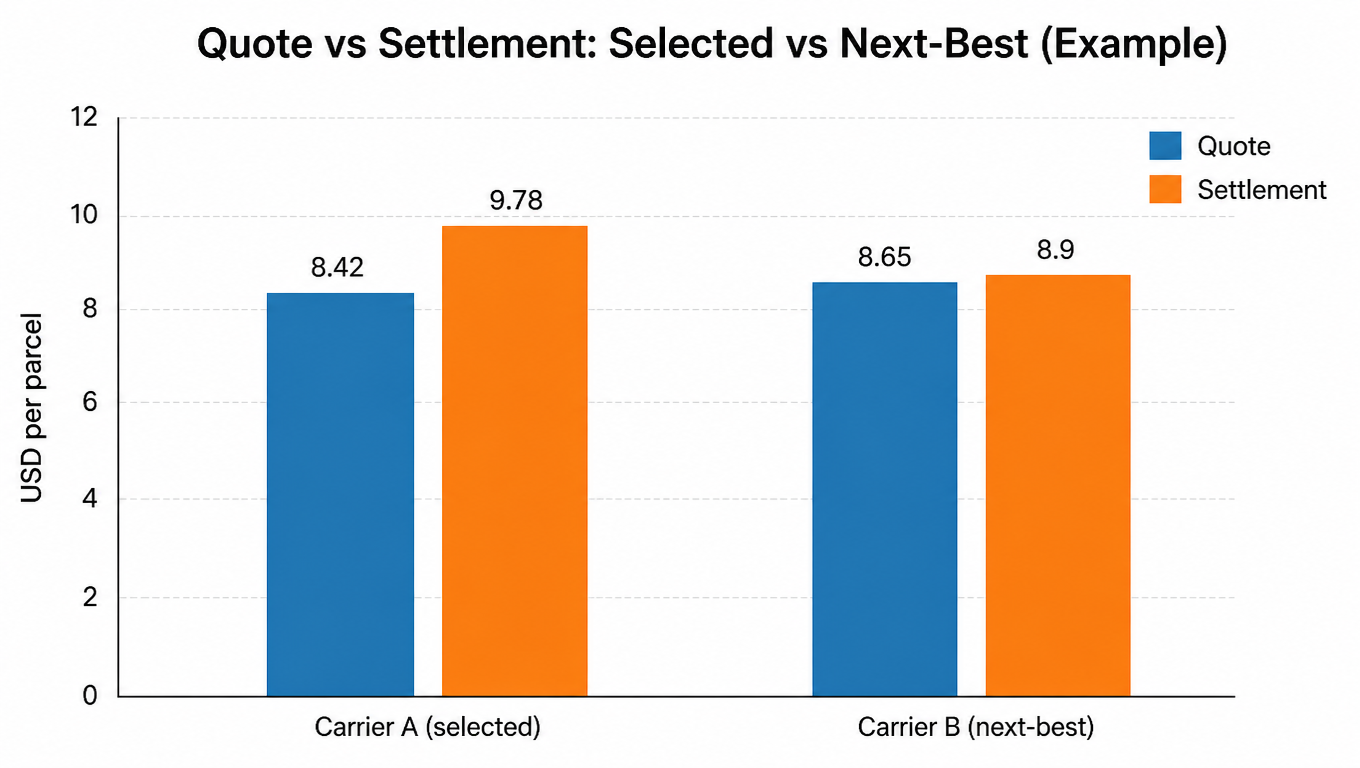
Here is a simplified example of why step 4 matters (the figures are for illustration only). Take one lane from a Los Angeles warehouse to the US East Coast, with 1,200 parcels in a 30-day sample. Carrier A, the system's pick, averages $8.42 on the quote page but $9.78 on the settled invoice, with the difference coming from DIM weight adjustments and residential surcharges. Carrier B, the next-best option, quotes $8.65 and settles at $8.90. Judging by quotes alone, choosing A saves $0.23 per parcel. Judging by settled cost, choosing A costs $0.88 more per parcel. That is roughly $1,056 per month on this lane, for a choice that looked cheaper.
Quote vs. settlement for the selected and next-best carriers (example data)
The value of the process is that every step produces evidence instead of conclusions. When the 30-day cycle ends, you get a list of which lanes are losing money, which rules are failing, and which data is drifting, rather than a vague "the rules seem fine". For the billing side of the reconciliation, see our shipping reconciliation guide, or run the numbers through our billing reconciliation checklist.
Set Thresholds from Your Own Margin, SLA, and Risk Tolerance
This article will not hand you a universal set of correct thresholds, because none exists. The right thresholds come from three numbers that are yours: margin sets the cost line, SLA sets the transit line, and risk tolerance sets the exception line.
Write the thresholds down and post them as hard boundaries for the rules
On the margin side, total your carriers' settled costs and see how much gross margin they eat; above a certain share, it is time to re-select. On the SLA side, when on-time rate falls below what you promised customers, or when the gap between promise and actual delivery exceeds tolerance, switch service or carrier. On the risk tolerance side, when the override rate passes the point where the rules lose trust, or when refund and claim costs on exception parcels cross a threshold, you must intervene. Write these three numbers down and post them as hard boundaries for the rules, instead of deciding by feel.
Thresholds also need to be baked into your operating cadence: review settlement and override variance monthly, run a full review quarterly, and trigger an ad-hoc pass whenever there is a major rate change or a carrier network change. An audit is not a one-off project; it is an ongoing operational capability. Its purpose is to make every automated parcel able to answer the question "why this carrier?"
Want every automated carrier decision to be explainable?
EasyShippingX's Shipping API provides a unified decision layer on top of multi-carrier rates, labels, and tracking: candidate sets filtered by real serviceability, selection reasons recorded per parcel, and settled costs comparable back to quotes. Combined with the 30-day audit in this guide, you can continuously verify "why this carrier?" across rules, data, and settlement. See pricing or book a demo.
Automated selection follows the priority and constraints written into the rules: the candidate set, eligibility limits, rate comparison, and fallback behavior. It cannot see what you cannot see on a quote page, such as settled surcharges or transit performance on one lane. That is exactly why auditing matters: pull up the inputs and rules behind each decision and check every stage, instead of second-guessing the outcome by feel.
Some gap is normal; what matters is how large it is and where it concentrates. DIM weight adjustments, residential surcharges, fuel surcharges, and address corrections all arrive after the quote. If the gap concentrates in a few surcharge types or a few lanes, your rules are likely deciding on quotes instead of settled cost.
A 30-day cycle is a good default, because most carrier billing cycles run on that scale and 30 days is enough to align quotes, settlement, and delivery outcomes. Trigger an ad-hoc pass whenever there is a major rate change or a carrier network change, and run a full review quarterly.
There is no universal threshold; it depends on your business complexity and risk tolerance. Judge by trend and distribution rather than the number itself: do overrides concentrate in the same order type or reason code? Are they steadily rising or sporadic? Standardize reason codes first, then argue about thresholds.
First locate which stage of the loop the problem lives in. If the same order type keeps getting mis-selected, it is usually a rule priority or candidate set configuration issue. If the errors concentrate in weight bands or ZIPs, it is usually a data problem, such as inaccurate dimensions or serviceability. Change one class at a time, run a small controlled rollout, and keep rollback conditions ready.
Look at three things. First, is there a reason code recorded at the time of the override? Without a record, the only honest action is to build the record, not to blame the rules. Second, which class does the reason fall into: a valid exception, an input error, a rule error, or a change in execution conditions. Third, look at the distribution: if overrides cluster on one customer, one warehouse, or one reason code, the cause is systemic; if they scatter across many different reasons, you are usually looking at the normal complexity of the business. For alternatives that never actually carried a parcel, you can estimate or pilot, and you cannot present their cost or delivery performance as a realized result.