Ecommerce Shipping Guide

Carrier Disruption Playbook for Ecommerce and 3PLs: When to Hold, Reroute, or Switch Carriers

A hurricane closes a regional gateway, the way Hurricane Helene disrupted FedEx, UPS, and USPS deliveries across the Southeast for weeks[1]. A national carrier hits capacity and pulls pickup windows. An API anomaly silently breaks tracking scans for six hours. Each of these moments forces the same question: do we hold the orders, reroute them, or switch carriers? The answer is rarely "switch", and it should never be decided in the heat of the moment. This playbook gives ecommerce sellers and the 3PLs that serve them a before, during, and after framework: a fallback matrix built in calm times, trigger thresholds that pick the response, separate handling for labeled and unlabeled orders, and the operational choreography for manifesting, tracking, claims, and customer communication.

Logistics manager reviews a route map with warning markers in a control room during a storm.
Every disruption forces the same question: hold, reroute, or switch?

Why "Just Switch" Is the Wrong Default

Most disruptions fall into four buckets: extreme weather, carrier capacity crunches, regional outages, and network anomalies. They look different but share one trait: they are temporary and largely outside your control. That is exactly why switching carriers is the wrong first move. A switch is a structural change applied to a situational problem, and it comes with a full load of cost: renegotiating rates, rebuilding integrations, retesting labels and packaging rules, learning a new carrier's pickup and claims quirks, and absorbing the customer-experience swings that follow any transition.

The second reason is inertia. A switch made under duress tends to stick long after the event is over, not because the new carrier is better, but because moving back is another switch. You pay the switching cost twice and end up with two disrupted quarters instead of one disrupted week. The operational version of this article's title matters: hold, reroute, and switch are three responses to one event, not three business models. For the portfolio-level view, start with our guide on when to move from a single carrier to a multi-carrier strategy.

So the framework here is a ladder. Hold stops the bleeding while the event passes. Reroute moves affected volume to a pre-approved backup. Switch changes the underlying relationship, and only when the data says the carrier itself is the problem. Most disruptions resolve with hold or reroute; switch is the rare, last-rung outcome. The playbook exists so that decision is made before the disruption, not during it. Thresholds, fallbacks, and approval chains are written in advance; the event only executes them.
Build Your Fallback Matrix Before the Disruption

The fallback matrix is the calm-times artifact that makes every during-event decision fast. It lists, for every route you ship, the primary carrier and the backup carrier per zone, weight band, and service level. A minimal matrix looks like this:

Route Weight band Service tier Primary carrier Backup carrier Backup promise
Zones 1-40-1 lbGroundCarrier ARegional carrier BSame tier, +0-1 day
Zones 1-41-10 lbGroundCarrier ARegional carrier BSame tier, +0-1 day
Zones 5-80-10 lbGroundCarrier ANational carrier CSame tier, +1 day
All zones0-5 lb2-day airCarrier DCarrier E2-day to 3-day
All zones0-10 lbOvernightCarrier DCarrier EOvernight to 2-day

The second layer is ZIP-level detail. "Zones 5-8" is not precise enough on a disrupted day. For each ZIP or ZIP cluster you need to know which gateway it rolls through, the cutoff time at that gateway, and the transit-day commitment the primary and backup each make. Backup carriers often use different gateways: your primary may sort a ZIP cluster through Salt Lake City while your backup serves it from Denver, which changes both the cutoff and the transit promise. Record the fallback promise explicitly, in writing, so "same tier" never silently becomes "who knows".

The matrix has to live somewhere operational, not in a slide. Keep it in three places: the shipping software's routing rules (so it can execute without a human), the 3PL contract (so the backup obligation is contractual, not courtesy), and a short SOP doc (so a new hire can read it in ten minutes). One owner, usually the logistics lead or the 3PL account manager, reviews it quarterly, and always after any rate change, service-guide change, or pickup-pattern change.

A minimum-viable matrix has at least one regional carrier per zone you ship to and one national alternative per service tier you sell at checkout. Regional carriers are a credible fallback tier, not a niche: they expanded sharply as shippers looked for alternatives when the national carriers tightened capacity[3]. That is the floor; the ceiling is whatever your volume justifies. One more rule: a backup is not a backup until it has shipped a test label, run a test manifest, and verified a pickup. An account number on a spreadsheet is not an operational fallback. For the lanes where regional carriers actually win, see our guide on when a regional carrier actually saves money.

Assess the Disruption: What's Actually Affected

Before touching a single order, read the carrier's own advisories and API status pages. Carriers publish official service-alert feeds for exactly this purpose, from USPS's newsroom alerts to carrier API status pages[2]. This is the evidence layer: the advisory timestamp, the affected service list, and the posted resolution estimate will later decide whether you hold, reroute, or file claims. Confirm the event from the carrier's official source before reacting to a forum post or a support ticket. If you use a 3PL, its carrier-relations team usually has the advisory parsed into plain language within an hour; ask for it.

Then map the blast radius. A winter storm rarely takes down a whole network: it hits one gateway, which hits the ZIPs that roll through it, which hits the services sorted at that gateway, which moves the cutoff for the affected routes. The output of this step is a concrete list of affected route, service, and volume triples, not a vague "things are bad in the Midwest". Enumerate affected ZIPs, services, gateways, and cutoffs explicitly, and quantify the volume sitting in each bucket.

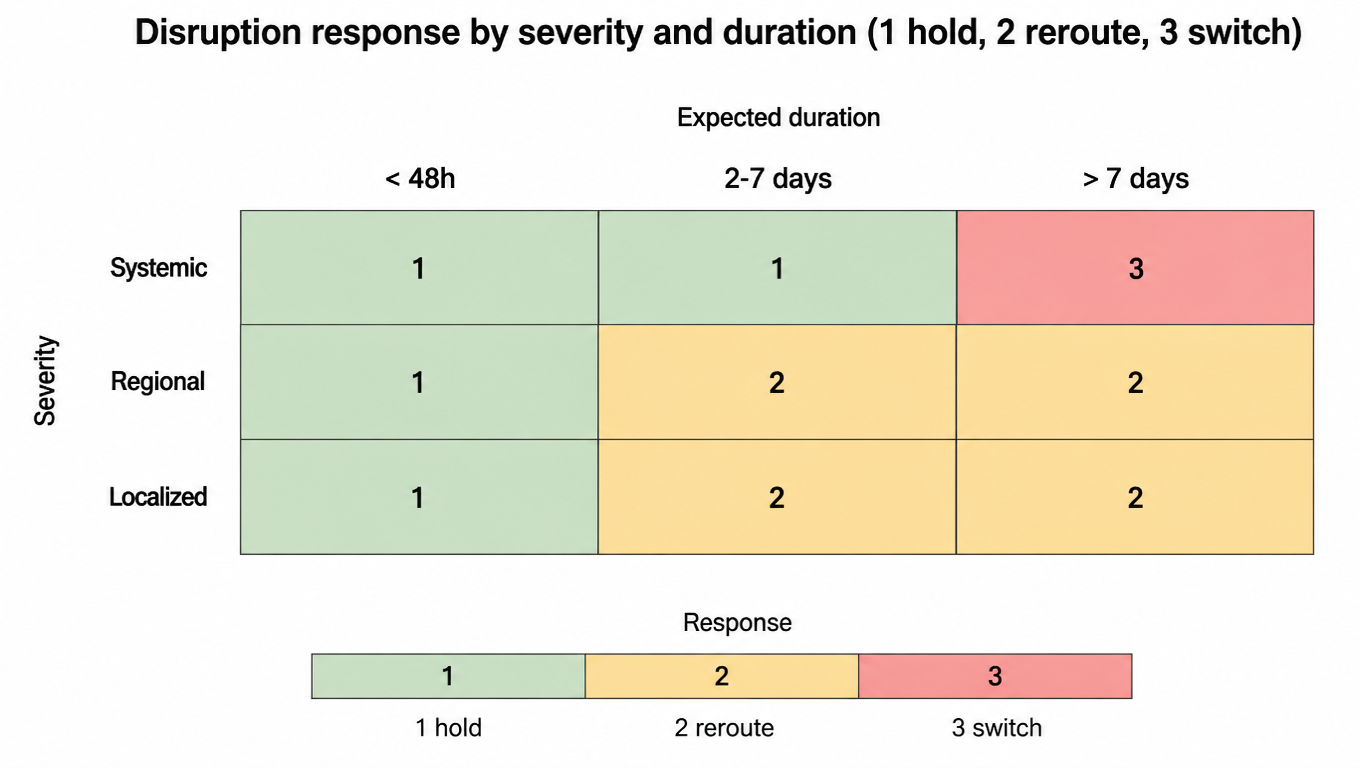
Classify severity into three levels: localized (one zone or gateway), regional (multiple zones), and systemic (network-wide). Then estimate duration in three bands: short (under 48 hours), medium (two to seven days), and extended (more than a week). Both numbers come from the carrier advisory plus your 3PL's read, and both feed directly into the trigger matrix in the next section.

Finally, check the promise before choosing any response. Pull the affected routes' committed transit times against the orders currently in flight and the checkout promises still being made. The promise you made at checkout decides whether hold and reroute are even viable: if your site is still quoting two-day delivery into an affected ZIP at noon, you have a promise problem that no carrier decision fixes by itself. For the full playbook on network-level anomalies, see our USPS API outage playbook.

Trigger Thresholds That Pick the Response

Thresholds turn "how bad is it" into "what do we do". They should be numbers you wrote down before the event, not vibes you generate during it. Three thresholds do most of the work:

  • Hold when the expected duration is under 48 hours, when no backup slot is available, when the goods are fragile or high-value, or when a route has failed for fewer than three days running. Holding is cheap when the event is short: you delay label generation for the affected routes, extend the promise, and recheck at the next cutoff.
  • Reroute when a backup carrier can meet the same service promise, when the affected volume clears a practical floor (as a rule of thumb, more than about 10% of a route's daily volume, or any volume that will miss its promise), and when the cost delta is within a pre-agreed range (for example, 10 to 15 percent per package). Reroute is the default answer for most medium-duration, regional events.
  • Switch only when the carrier itself is the problem, not the weather: service failures that repeat across consecutive months, cost divergence beyond your contract tolerance, and a contract-break reality check that confirms the exit clause, notice period, and migration cost are all bearable. One hurricane does not justify a switch; a carrier that keeps missing SLA for two or three months after the storm clears is a different story.

The matrix below maps severity against duration and picks the response: 1 means hold, 2 means reroute, 3 means switch evaluation. Localized events mostly hold, extended systemic events push toward a switch evaluation, and everything in between is a reroute question. Note that the switch cell is gated by trend: an extended systemic event triggers an evaluation, not an automatic move.

Heatmap: disruption response by severity (localized/regional/systemic) and duration (under 48h/2-7 days/over 7 days), 1 hold, 2 reroute, 3 switch evaluation
Severity × duration response matrix: 1 hold, 2 reroute, 3 switch evaluation

Keep the feeding metrics explicit so the thresholds can be audited after the event. For how to score and weight these metrics in normal times, see our carrier performance scorecard guide.

Metric Hold Reroute Switch evaluation
Expected durationUnder 48h2-7 daysOver 7 days, systemic
On-time vs promiseWithin slackMisses promise, backup can meet itMisses after 2-3 months of monitoring
Backup availabilityNone acceptablePre-approved and testedNot the deciding factor
Cost trendWithin toleranceDelta within pre-agreed rangeDivergence beyond contract tolerance
RecurrenceFirst eventRepeat within the seasonRepeated across consecutive months

Unlabeled vs Labeled Orders: Two Different Playbooks

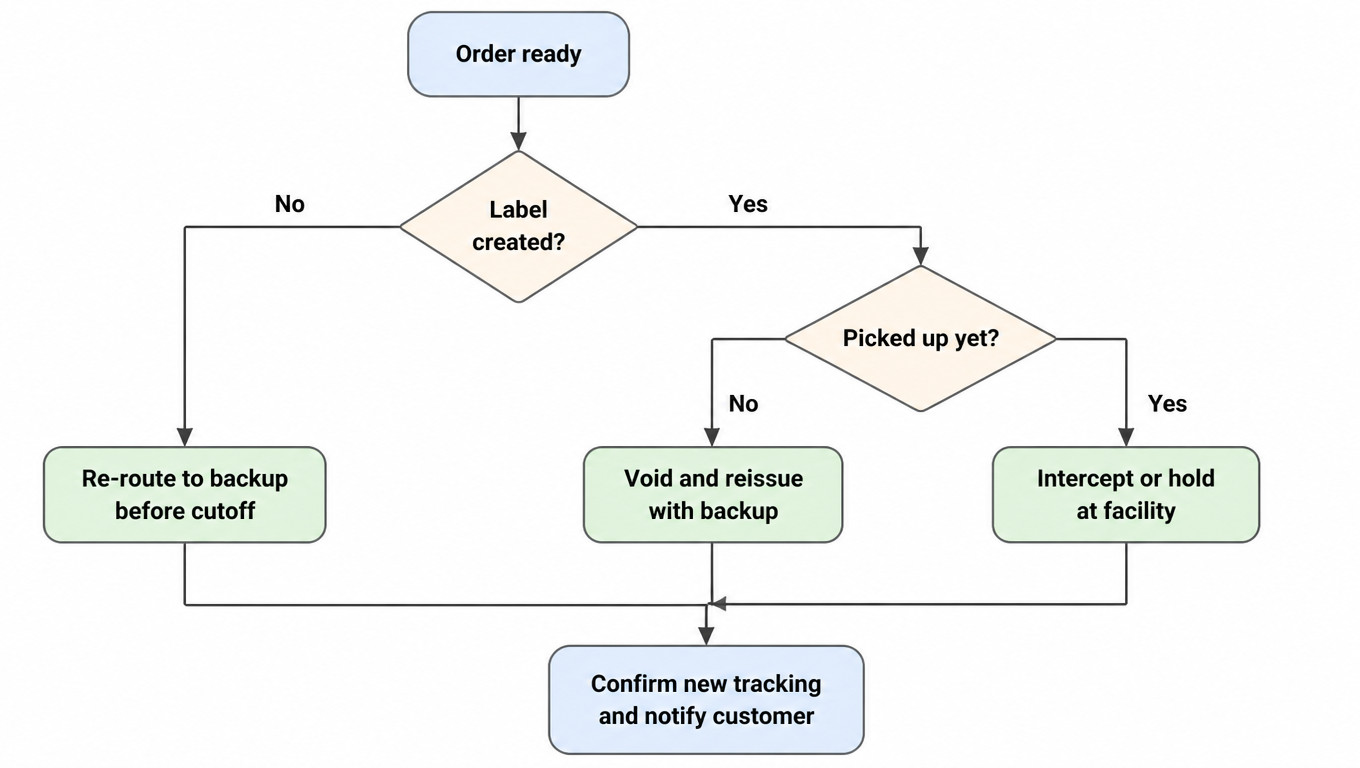
The single most useful split in this whole playbook is the label. Orders that have not generated a label yet are free: you can reroute them at the software level with zero cost, updating routing rules or overriding per order, and batching the reroute before the affected cutoff. No void, no label fee, no carrier pickup to cancel. Most rerouting should happen here, before you commit to a carrier that cannot deliver.

Orders that already have a label split into three sub-cases. If the carrier has not picked up yet, void the label and reissue with the backup carrier. If the shipment is in transit, request an intercept or hold at facility. If it arrives damaged or lost, that is a claims path, not a reroute path, and it runs separately. When you void or reroute in volume, cancel the pickup with the affected carrier, otherwise the truck shows up and you pay for labels you already voided.

On the 3PL side, the execution is about queues and approvals: which queue reroutes unlabeled orders in bulk, which operator handles voids and reissues, who approves a reroute above a volume threshold, and how manifest reprocessing repoints the day's batch at the backup carrier. Write those rules down before the event so the warehouse does not improvise at 4 p.m. under a deadline.

Flowchart: order ready, if no label reroute to backup before cutoff; if labeled and not picked up, void and reissue with backup; if in transit, intercept or hold at facility; then confirm new tracking and notify the customer
Unlabeled orders reroute freely; labeled orders split by pickup status

Two things never to do: never generate a duplicate label on the same order (double charge and double-delivery risk), and never reroute silently. Every order that changes carriers needs its tracking number and promise updated in the order record before the customer asks.

When to Hold vs Reroute, and How to Change Your Checkout Promise

Hold when the disruption is short, when no acceptable backup exists for the affected ZIPs, when the goods are fragile or high-value enough that transit roulette is worse than a delay, or when reshipping is not an option. For a 3PL, holding has two flavors: hold the pick (delay the warehouse work) or hold the label (pack but do not commit). Decide which one up front, because the communication to the seller differs.

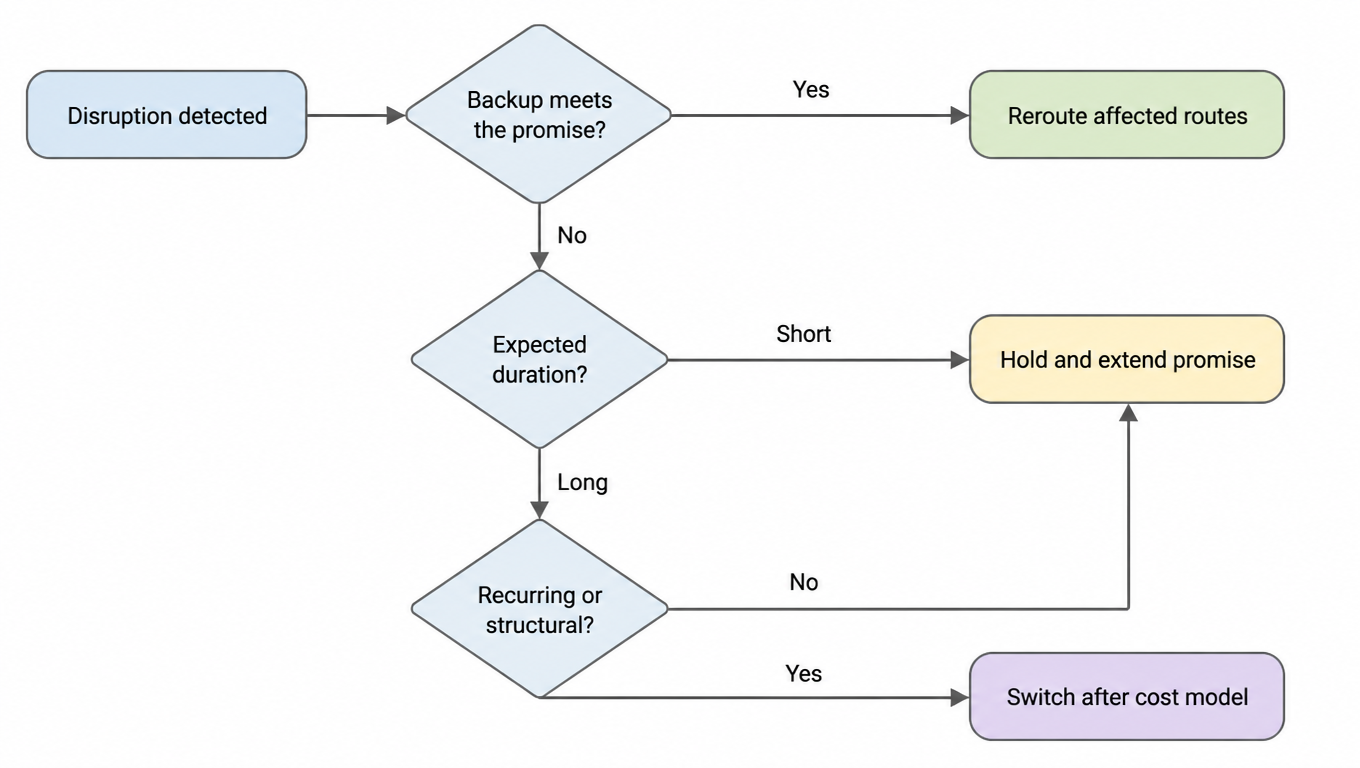
Reroute when the backup meets the same service promise, when the affected volume justifies the rework, and when the cost delta is within the pre-agreed range. Switching is reserved for structural failure, never for a single event. The decision flow below is the one to print and tape to the wall:

Decision flow: on disruption, if the backup meets the promise, reroute affected routes; else if the expected duration is short, hold and extend the promise; if long and recurring or structural, switch after a cost model
The wall chart: reroute when the backup meets the promise, otherwise judge duration and whether the failure is structural

Changing the checkout promise is the step sellers most often skip, and it is the one that saves the most support tickets. When a route is affected: broaden the delivery estimate (for example, from "2-3 business days" to "2-5 business days"), update the cutoff display so buyers do not order too late for the backup carrier's cutoff, adjust any carrier name shown at checkout, and add grace copy such as "delays possible in affected areas". Communicate the change before labels generate, not after. A checkout promise that contradicts the post-purchase promise is a refund you have already agreed to pay. When the data does point to a switch, our guide on when a 3PL should fire a carrier walks through the exit economics.

The Operations Playbook: Manifest, Tracking, Claims, Notifications

Re-manifesting to the backup is the mechanical heart of a reroute. Decide when to re-manifest (after the trigger decision, before the affected cutoff), how (bulk re-manifest in the shipping software, or a WMS reprocess on the 3PL side), and who approves it. Keep a record of the old label even after it is voided: it is part of the audit trail and the claims evidence. Schedule the backup carrier's pickup and cancel the primary's in the same step, so the day's batch lands on the truck that can actually move it.

Tracking continuity is where reroutes fall apart in practice. The customer sees one tracking number; your ops team sees several. Decide that the order lookup page shows the current tracking number and link, that stale in-transit scans from the old label are suppressed, and that the customer gets one proactive message with the new number. Update the order record before the customer asks, and keep the advisory timestamps next to the order data so the story of "why did this ship late" is answerable in one click.

Claims run on a separate clock. File when a shipment is lost, damaged, or fails the carrier's own service guarantee, within the carrier's stated claim window. The account holder files: the seller for a direct contract, the 3PL for 3PL-contracted volume. Keep the evidence bundle from the start of the event: advisory timestamps, scan history, delivery photos, packaging photos. Decide in advance who assembles the bundle, because doing it three weeks later from memory is how claims die.

Customer notifications are the visible half of the playbook. During an active disruption, run a 24-hour cadence: update customers every day the event lasts, even when there is nothing new to say, because silence is what generates tickets. A typical cadence looks like this:

Timeframe Action Owner
Hour 0-2Confirm advisory, assess blast radiusOps lead
Hour 2-6Run trigger matrix, decide hold or rerouteOps + carrier relations
Hour 6-12Update checkout promise, draft notificationEcommerce team
Hour 12-24First customer email, FAQ liveSupport
Daily until resolvedStatus update every 24 hoursSupport

Seller vs 3PL: Who Does What

The cleanest way to split the work is by who owns the relationship. The seller owns the customer promise and the checkout; the 3PL owns the physical execution and the carrier relationship on its contract. A RACI-style split keeps both sides honest:

Task Seller 3PL
Monitor advisories and status pagesCA, R
Run the trigger matrix, decide hold or rerouteAR
Execute reroutes, voids, reissues, pickupsIA, R
Update checkout promiseA, RC
Communicate with customersA, RC (status only)
File claimsR (direct contract)A, R (3PL contract)
Maintain the fallback matrixCA, R

What to write into the 3PL SLA so none of this is goodwill: disruption clauses with defined response times per severity level, a backup-carrier obligation (the 3PL must maintain the pre-approved backup list and execute a reroute within a stated number of hours of a confirmed advisory), notification SLAs (the 3PL tells you within a stated window that a disruption affects your volume), and a data handoff clause (scan history and advisory logs made available for claims within a stated time). If the SLA already covers these, audit it once a year against a real event. For how many carriers make a defensible backup set, see our guide on how much carrier redundancy is enough.

Finally, practice. Run a tabletop or simulated disruption drill at least twice a year, rotating scenarios across weather, capacity, outage, and anomaly. Use the real fallback matrix, not a made-up one. After each drill, fix the matrix, tighten the thresholds, and close the gaps the drill exposed. Once a quarter, on a low-volume route, execute one real reroute end to end just to prove the matrix still works on a live order. When the storm actually hits, the playbook should feel like rehearsal, not improvisation.

Want your carrier mix to hold up when the next disruption hits?

EasyShippingX's Shipping API delivers multi-carrier real-time rates, labels, and tracking, with fallback and reroute logic you can encode directly into routing rules: build your fallback matrix into the rules in calm times, reroute to a backup carrier in one step when a disruption hits, and keep tracking and notifications flowing. See pricing or book a demo.

FAQ

Hold when the expected duration is under 48 hours, when no tested backup slot is available for the affected ZIPs, or when the goods are fragile or high-value. Reroute when a pre-approved backup can meet the same service promise, when affected volume clears a practical floor (roughly 10% of a route's daily volume), and when the cost delta is within a pre-agreed range. Switch only when the carrier itself is the problem: repeated SLA misses across consecutive months or cost divergence beyond contract tolerance. One hurricane justifies hold or reroute, not a switch.
Follow a 24-hour cadence: within hours 0-2 confirm the carrier advisory and map the blast radius; by hour 6 run the trigger matrix and decide hold or reroute; by hour 12 update the checkout promise and draft the customer notification; by hour 24 send the first customer email and publish an FAQ. Then send a status update every 24 hours until the event resolves. Silence generates tickets; updates do not.
At least one regional carrier per zone you ship to and one national alternative per service tier you sell at checkout, with ZIP-level detail: which gateway each ZIP rolls through, the cutoff at that gateway, and the transit-day commitment of both primary and backup. Store it in three places: the shipping software's routing rules, the 3PL contract, and a short SOP. A backup is not operational until it has shipped a test label and verified a pickup.
Three cases. If the carrier has not picked up yet, void the label and reissue with the backup carrier. If the shipment is in transit, request an intercept or hold at facility. If it arrives damaged or lost, that is a claims path, not a reroute path. Never generate a duplicate label on the same order, and never reroute silently: every order that changes carriers needs its tracking number and promise updated before the customer asks.
The account holder files: the seller for a direct contract, the 3PL for 3PL-contracted volume, within the carrier's stated claim window. Build the evidence bundle from the start of the event: advisory timestamps, scan history, delivery photos, and packaging photos. Decide in advance who assembles the bundle; reconstructing it from memory three weeks later is how claims die.