Last-Mile Guide

US Last-Mile Delivery Carriers Deep-Dive (2026): 13 Networks Compared

Last-mile delivery is often a substantial cost in cross-border fulfillment; its cost share and controllability depend on the actual workflow. This guide groups 13 carriers active in the US market by network model, breaks down coverage, transit times, pricing, API, and pros and cons for each, and closes with a comparison matrix and selection paths so you can choose networks from your own parcel profile instead of from a sales pitch.

A white delivery van parked on a suburban US street in the evening, driver carrying a parcel to the doorstep

Introduction: Why Last Mile Decides Cross-Border E-commerce

Use your own data to evaluate last-mile cost and service risk because category, weight, destination, residential mix, and exception rate all change the result. This guide turns carrier marketing into auditable procurement inputs: ZIP coverage, written transit commitments, complete rates, API events, claims terms, and pilot results.

Use the multi-carrier strategy overview to turn the network comparison into carrier roles for defined shipment segments. The second-carrier evaluation path provides the coverage, handoff, cost, and pilot checks for the resulting shortlist.

This article does two things. First, a full landscape: the 13 carriers active in the US last-mile market are grouped by network model, with coverage, transit times, pricing, API, and pros and cons broken down carrier by carrier. Second, a decision tool: a comparison matrix and a set of typical selection paths turn "whoever sells the best story" into "choose networks from your own parcel profile."

Verification standard: this is an evaluation framework dated August 22, 2026, not a live coverage table, SLA, or quote. Replace every coverage, transit, and price conclusion with a dated ZIP file, written service commitment, and complete contract quote; a tracking link is for parcel lookup and is not evidence of service capability.

How the 13 Carriers Are Grouped

The grouping uses three dimensions: network coverage, operating model, and target customer. Along those dimensions the 13 carriers fall into four groups, with strong competition inside each group and mostly complementary relationships across groups.

Group Carriers Positioning in one line
National e-commerce networksOnTrac, Amazon Shipping, DHL eCommerce, OSM Worldwide, SEKONational coverage, competing head-on with the big three for e-commerce parcels
Pan-US / Canada emerging networksGOFO Express, SPEEDX, UniUni, Yanwen Express (US)Born from the cross-border ecosystem, self-built domestic last mile, aggressive pricing
Regional and urban-market networksUDS, Veho, SwiftX ExpressDeep regional or urban focus, winning on experience or relationships
Technology / air-belly platformSmartKargoAsset-light, turning passenger-plane belly cargo into a door-to-door network

A scope distinction matters: this article compares domestic U.S. or U.S./Canada last-mile products, not every business operated by each company. Verify Yanwen cross-border logistics separately from U.S. delivery arrangements; assess UniUni, GOFO, and SPEEDX by product, country, and tender workflow as well. Sellers holding inventory in U.S. warehouses should compare domestic last mile, first mile, customs, and direct cross-border shipping separately; assess an integrated offering only when the current contract explicitly includes those stages.

Coverage is a key grouping input, but population coverage does not answer whether your parcels are eligible. Population, ZIP, and pickup-eligibility definitions are not equivalent; procurement should match your historical destination ZIPs against each candidate's dated service response.

National E-commerce Delivery Networks

This group targets e-commerce parcels and competes through broad networks or postal injection. Whether any one becomes a primary network depends on your serviceable volume, pickup points, and fallback design, not a universal share-of-volume rule.

OnTrac

Track a parcel: OnTrac official tracking page

Background. OnTrac combines the legacy West Coast network with the LaserShip system, but historical regional labels do not represent today's eligibility or service quality. Procurement should return to the current ZIP file, service codes, and matched-lane pilot.

Coverage and transit. Request an OnTrac service response for your pickup point, destination ZIPs, parcel dimensions, and effective date, then measure actual transit on matched pilot lanes; do not treat a broad regional label as an SLA.

Pricing. Request a complete written quote against the real parcel file, including fuel, residential, peak, address-correction, dimension, and out-of-network handoff charges; another carrier's starting price is not evidence of OnTrac pricing.

Pros, cons, and fit. Retain pickup windows, API, reconciliation, price, East Coast transit, and claims as evaluation dimensions; current service documents and matched-lane samples must establish any advantage. Integration history suggests checks rather than proving present instability. Consider it for a multi-region ground primary or backup, testing pickup, first scan, delivery, claims handling, and final charges at low volume before scaling.

Amazon Shipping

Track a parcel: Amazon Shipping tracking page

Background. Amazon Shipping is Amazon's delivery service for business shippers and is distinct from the MCF fulfillment product; use the current product description on the official Amazon Shipping site.

Coverage and transit. Amazon Shipping eligibility varies by pickup origin, destination ZIP, and account availability; obtain a dated service response through the official entry point and record promised versus observed pilot transit separately.

Pricing. The official rates page publishes base tables and describes account rates based on billable weight, zones, parcel profiles, and volume. The public tables are dated 2026-01-06; confirm the account version, effective date, and complete terms. Compare the same shipment sample across networks rather than assuming volume guarantees lower total cost.

API and pros and cons. The official API page, describes rates, labels, tracking, testing, and support for Amazon and other sales channels. Verify shipping accounts, permissions, order association, data terms, third-party software, and migration effort; using FBA or MCF does not establish low integration cost. Scale and visibility are evaluation points, while platform dependence is a procurement risk. Both Amazon sellers and independent-store teams should assess actual eligibility rather than infer access from an existing platform relationship.

DHL eCommerce

Track a parcel: DHL eCommerce tracking page

Background. DHL eCommerce offers multiple parcel products; confirm the current products through the official DHL eCommerce entry point, then require the written proposal to identify responsibility boundaries and the final-delivery party.

Coverage and transit. Use a dated ZIP response and written transit commitment for the specific product; do not treat brand-level “national coverage” as parcel-level eligibility.

Pricing. Use DHL's complete contract quote against the real parcel file, separating postal injection, minimum charges, and value-added services; a USPS starting price is not evidence of DHL contract pricing.

Pros, cons, and fit. International coordination is an evaluation opportunity, but warehouse, direct-shipping, first-mile, customs, and final-delivery stages need separate account and contract confirmation. Check delivery parties, heavy/bulky restrictions, tracking ownership, and invoice responsibility; do not assume every product hands off to USPS. Multi-market EU/US sellers can test unified reconciliation against actual country products, then compare handoffs, full cost, and delivery outcomes.

OSM Worldwide

Track a parcel: OSM Worldwide tracking page

Background. The official OSM site, describes its Chicago origins, processing hubs, and lightweight e-commerce services. Assess consolidation economics against account injection points, delivery parties, and volume. Obtain product documents for any USPS-based proposal; a historical consolidator label does not establish current tender arrangements or guarantee below-retail cost.

Coverage and transit. Ask OSM for a written transit commitment tied to the specific product, injection point, and destination ZIPs, then record OSM and final-delivery-party scan events separately in the pilot.

Pricing. Use the current contract quote and complete minimum-charge, return, and address-correction terms; published USPS pricing can be a separate baseline but cannot replace an OSM quote.

Pros, cons, and fit. Lightweight-parcel cost, APIs, bulk upload, multi-account management, and reconciliation remain evaluation priorities; confirm current products and permissions individually. Test heavy/bulky eligibility, injection-to-first-scan timing, delivery quality, and any minimum-volume requirement. Do not infer best-in-market pricing or a universal volume threshold. Small-parcel sellers can shortlist OSM and scale it as a primary only when matched invoices and fulfillment evidence support that choice.

SEKO Logistics

Track a parcel: SEKO tracking page

Background. The official SEKO entry point, lists e-commerce logistics, home/last-mile delivery, and White Glove services separately. Confirm the scope of Omni Parcel, parcel delivery, and bulky home delivery individually. Brand-level bulky capabilities do not establish every product’s eligibility, and a category comparison with DHL eCommerce cannot replace contract qualification.

Coverage and transit. Confirm SEKO's available home-delivery level, destination ZIPs, appointment method, in-room service, and written transit for your product line; node proximity or population coverage cannot replace parcel-level eligibility.

Pricing. Obtain a written quote for the product line and confirm actual/dimensional weight, appointments, in-room delivery, installation, returns, and minimum charges. Model bulky home delivery separately from e-commerce parcels rather than applying one dimensional-weight formula universally. Keep unknown charges unconfirmed and reconcile them against final invoices.

API and pros and cons. Evaluate international coordination, bulky services, scheduled delivery, and integration. Confirm API documentation, account permissions, contract thresholds, and minimum volume for the specific product. Integration, appointments, and extra services can affect smaller sellers’ economics, but matched evidence is needed before declaring high barriers or poor small-parcel value. Teams handling bulky, overweight, or international shipments should obtain eligible-product and responsibility lists, then compare complete cost and pilot results.

Pan-US and Canada Emerging Networks

This group retains the perspective of cross-border e-commerce and domestic last-mile coordination without generalizing every company’s origins, prices, or stability. Evaluate U.S., Canadian, and cross-border products separately: confirm eligibility, tender, and account terms, then observe cost, service, and capacity on matched pilots. Expansion can signal a need for more lane evidence rather than establish an advantage or disadvantage.

GOFO Express

Unsupported addresses: Delivery to APO/FPO/DPO military or diplomatic addresses and PO Box addresses is not supported, even when the destination ZIP is within the coverage area.

Track a parcel: GOFO official tracking page

Background. GOFO expanded its US domestic network from cross-border e-commerce last mile. Public state, ZIP, and population totals change with the network and should not be treated as your serviceable-volume rate.

Coverage and transit. Network expansion can make public summaries stale quickly; use GOFO's dated service response for your pickup point and destination ZIPs, and pilot newly eligible lanes separately.

Pricing. A website starting price is not the contract rate and does not include your weight, dimensions, or surcharge profile; put only a written all-in quote against the real parcel file into the model.

Pros, cons, and fit. Price, coverage changes, Chinese-language support, tender arrangements, and interface availability are verifiable evaluation points rather than guaranteed advantages for every account. Observe first scans, delivery, exception response, and claims separately on new lanes; incomplete records remain unconfirmed rather than proving instability. Price-sensitive teams able to run pilots can scale gradually after eligibility, full invoices, and fulfillment evidence pass.

SPEEDX

Unsupported addresses: Delivery to APO/FPO/DPO military or diplomatic addresses and PO Box addresses is not supported, even when the destination ZIP is within the coverage area.

The permanent oversize adjustment tests longest side, L+W+H, and weight separately: 24–35.4 in longest side carries $15; over 35.4 in carries $15 plus partner shipping rates. L+W+H of 120–150 cm carries $20; over 150 cm carries $30 plus partner shipping rates. Weight over 30 lb carries $200 plus partner shipping rates. Fixed surcharges are per package. When two types apply, use the higher surcharge; partner shipping rates are provided separately.Charging thresholds differ from acceptance approval: length over 48 in or weight over 50 lb still requires prior written SpeedX approval. Paying a surcharge does not guarantee acceptance.

The notice explicitly identifies a permanent adjustment that does not expire with the temporary Fuel Surcharge. SpeedX oversize charges and acceptance conditions

Track a parcel: SPEEDX tracking page

Background. SPEEDX serves both cross-border and US domestic legs. Facility counts or “end-to-end” language do not replace responsibility boundaries; the written proposal should identify who owns first mile, customs, injection, and final delivery.

Coverage and transit. Request a current SPEEDX response tied to your pickup origin, destination ZIPs, and service codes; population coverage and city-level marketing cannot replace parcel-level commitments.

Pricing. Treat a public starting price as a marketing entry point, not a quote; the model should use written contract pricing that lists minimum charges and every surcharge.

Pros, cons, and fit. Evaluate cross-border/domestic coordination, first-attempt timing, and integration, but obtain an explicit responsibility schedule before treating one contract as covering first mile, customs, and last mile. Assess brand familiarity, node access, and claims through current files, actual tender conditions, and pilot records rather than language or historical reputation. Teams seeking China-US coordination should compare multi-stage and last-mile-only proposals with tender, exception, and final-cost evidence.

UniUni

Unsupported addresses: Delivery to APO/FPO/DPO military or diplomatic addresses and PO Box addresses is not supported, even when the destination ZIP is within the coverage area.

Track a parcel: UniUni tracking page

Background. UniUni expanded from Canada into the US and uses a flexible-capacity model. Population coverage and driver counts are changing company metrics and cannot replace your ZIP serviceability, peak-capacity commitment, or pilot quality.

Coverage and transit. Obtain dated ZIP files, peak-capacity commitments, and transit terms separately for the US and Canada, then validate them with your own pilot data; a crowdsourced model alone does not prove capacity or stability.

Pricing. Use UniUni's complete written quote for the real parcel profile; a public starting price or another seller's negotiation outcome should not enter your cost model.

API and pros and cons. Accept APIs, bulk upload, order association, and reconciliation against current documentation and account permissions. Verify U.S. and Canadian products, capacity arrangements, and service responses separately; a crowdsourced model alone establishes neither price nor elasticity. Retain driver delivery quality, peak-season loss, POD, exception labor, and claims as risk dimensions, measured against complete samples and denominators rather than unverified reputation. Assess both lightweight and high-value pilots against their respective claims, tracking, and delivery requirements.

Yanwen Express (US)

Track a parcel: Yanwen tracking page

Background. The official Yanwen Express site, describes its U.S. last-mile DSP partner network. Historical launch dates, locations, and combination with other Yanwen cross-border products remain unconfirmed without corresponding documents. Combining first mile, customs, U.S. injection, and delivery remains a useful procurement question, subject to named contracting entities, service codes, and stage-by-stage responsibility.

Coverage and transit. When public information is insufficient, do not insert an industry-standard transit estimate; make a sales-provided dated ZIP file and written SLA prerequisites for a pilot.

Pricing. Request a written quote with specific product codes, separating U.S. last mile, first-plus-last-mile proposals, and direct-shipping connections. Confirm whether injection, customs, tender, failure, returns, and accessorials are included. Brand association does not establish one bundled price for every account; undocumented combinations remain unconfirmed.

Pros, cons, and fit. Fewer handoffs, Chinese-language service, and cross-border coordination are evaluation goals; prove any reduced handoff with quote, label, injection, and delivery records. Verify standalone coverage and DSP quality through dated ZIP files, POD, exception labor, and claims samples rather than assuming weak control from the capacity model. Sellers using related Yanwen first-mile products can compare combined and separate-stage proposals, obtaining responsibilities, full charges, and exit conditions before scaling.

Regional and Urban-Market Networks

This group shares one philosophy: do not chase national scale, go deep instead. Regional networks take root through relationships and service; urban networks stand on technology and experience.

UDS (United Delivery Service)

Track a parcel: UDS tracking page

Background. For a Midwest regional-network shortlist, verify UDS pickup points, destination ZIPs, and service codes rather than deriving quality from operating history. The official UDS site, describes notifications, tracking, and delivery photos; account availability and service responses still require written confirmation.

Coverage and transit. Have UDS return current eligibility and written transit for the specific pickup and destination ZIPs; state-level labels do not prove edge-ZIP or same-day availability.

Pricing. Use the account’s written regional quote, checking tender, service level, minimum charges, and applicable accessorials before comparing a national network on the same lane. Relationship-based communication can clarify requirements but establishes neither lower unit rates nor opaque pricing. Retain every charge field and effective date in the comparison record.

Pros, cons, and fit. Verify regional density, local delivery quality, and response speed through first scans, delivery, POD, and exception records. Pair an available fallback with orders outside current eligibility; the actual destination-ZIP distribution determines whether UDS could serve the whole book. Sellers with concentrated Midwest volume can pilot it and include support, cost, and fulfillment evidence in primary/backup selection.

Veho

Track a parcel: Veho tracking page

Background. The official Veho site, emphasizes technology-supported e-commerce delivery, shopper communication, and delivery experience. Evaluate time windows, live tracking, photos, and return pickup as separate product requirements. A founding year does not decide procurement; current product files and demonstrations must establish account access to each capability.

Coverage and transit. Market counts and population shares change and do not prove parcel eligibility; use Veho's current market file, ZIP response, and written transit, then measure consumer-experience events in the pilot.

Pricing. Obtain a complete written quote for the same parcel profile, covering tender, delivery, return pickup, and optional services. Experience-focused positioning establishes neither higher unit rates than regional peers nor complaint or repurchase gains. Record final invoices separately from matched-lane experience outcomes before assessing total value.

API and pros and cons. Validate tracking, shopper communication, photos, and returns through demonstrations and integration acceptance. Establish any experience advantage through matched-lane complaints, missing POD, exception labor, and completed deliveries. ZIP eligibility, permissions, and full charges remain boundaries; benchmark status, low complaint rates, and high pricing require evidence. Apparel, beauty, and electronics DTC teams can pilot experience-focused requirements, while high-value goods need separate claims and delivery checks.

SwiftX Express

Unsupported addresses: Delivery to APO/FPO/DPO military or diplomatic addresses and PO Box addresses is not supported, even when the destination ZIP is within the coverage area.

Track a parcel: SwiftX official tracking entry

Background. The official SwiftX entry point, provides tracking and contact paths. Expansion timing, national coverage, and pricing strategy remain unconfirmed without dated supporting files; a new-entrant label establishes neither low prices nor instability. Retain network maturity, information transparency, and exit arrangements as dimensions to validate through product documents and pilots.

Coverage and transit. When public information is scarce, do not apply an “industry-standard” estimate; require a dated lane list, transit commitment, exception remedies, and exit terms from SwiftX before testing.

Pricing. EasyShippingX’s custom-quote entry is not a published SwiftX rate or discount guarantee. Obtain written account, lane, volume, and parcel-profile terms, separating pilot and ongoing prices, effective dates, minimum charges, and exit conditions. New-network status does not guarantee lower pilot rates than established carriers; compare the same orders and final invoices.

Pros, cons, and fit. Potential price opportunities and lane flexibility are procurement hypotheses; stability, transparency, and claims are verification gates. Missing records do not prove poor service. Use a limited pilot to verify eligibility, tender, POD, exceptions, and complete invoices within a controlled risk budget. Actual order coverage and pilot evidence determine primary or backup use rather than brand development stage alone.

Technology and Air-Belly Platform

SmartKargo

Track a parcel: SmartKargo platform. Confirm operating and tracking entry points for the actual partner product; an unverified consumer portal does not establish that none exists.

Background. SmartKargo is not a traditional ground network; it is an air-belly SaaS platform that turns unused capacity in passenger-plane cargo holds into an e-commerce door-to-door delivery network, using technology to connect airlines, ground services, and last-mile delivery.

Coverage and transit. The official platform overview, covers air-cargo software, domestic e-commerce, and cross-border solutions. Actual eligibility depends on partner products, routes, capacity, and ground services; a country example or fast air segment does not establish a universal door-to-door SLA. Record tender, security processing, departure, arrival handoff, and delivery separately, confirming notifications and exception ownership.

Pricing. Obtain a complete quote from the proposal’s operator covering air transport, ground handoffs, security processing, size/weight, peak capacity, and failure handling; confirm software and transport charges separately. An air-based model does not establish capacity-only pricing. Time-sensitive, high-value, or lightweight shipments are evaluation scenarios whose economics require matched full-cost and delivery results.

Pros, cons, and fit. Evaluate air-resource coordination, trunk timing, and the asset-light model while confirming ground-party ownership, flight availability, capacity, first/last-mile quality, and claims responsibilities for the proposal. Compare time-sensitive or high-value orders with ground options on matched lanes; air speed alone is not a door-to-door advantage. Establish eligibility, complete cost, and recovery before defining supplementary, primary, or backup use.

Comparison Matrix (Selection Decision Tool)

A 3PL can expand the matrix by client and origin warehouse. A 4PL should distinguish the executing warehouse, delivery party, tracking owner, and biller. A brand can include SKU, delivery promise, and return requirements in the same comparison file. Retain all 13 carrier classifications without inferring cross-border service, partnership authorization, or EasyShippingX activation from company origin or brand association.

Once eligible orders and tender arrangements are confirmed, request a rate review. Start system evaluation with the API product and onboarding evaluation, retaining pilot evidence, final invoices, and unresolved fields.

The matrix no longer assigns scores or coverage percentages that cannot be maintained reliably. It puts every candidate through the same procurement gates; fill each field with a dated file, written contract, or pilot data, never “industry reputation.”

Carrier Coverage Transit Pricing Tracking/API Large-parcel Stability
OnTracVerify ZIP fileVerify SLA + pilotComplete written quoteTest event feedVerify size limitsDue diligence
Amazon ShippingVerify ZIP fileVerify SLA + pilotComplete written quoteTest event feedVerify size limitsDue diligence
DHL eCommerceVerify ZIP fileVerify SLA + pilotComplete written quoteTest event feedVerify size limitsDue diligence
OSM WorldwideVerify ZIP fileVerify SLA + pilotComplete written quoteTest event feedVerify size limitsDue diligence
SEKOVerify ZIP fileVerify SLA + pilotComplete written quoteTest event feedVerify size limitsDue diligence
GOFO ExpressVerify ZIP fileVerify SLA + pilotComplete written quoteTest event feedVerify size limitsDue diligence
SPEEDXVerify ZIP fileVerify SLA + pilotComplete written quoteTest event feedVerify permanent oversize charges, partner rates, and approvalDue diligence
UniUniVerify ZIP fileVerify SLA + pilotComplete written quoteTest event feedVerify size limitsDue diligence
Yanwen Express (US)Verify ZIP fileVerify SLA + pilotComplete written quoteTest event feedVerify size limitsDue diligence
UDSVerify ZIP fileVerify SLA + pilotComplete written quoteTest event feedVerify size limitsDue diligence
VehoVerify ZIP fileVerify SLA + pilotComplete written quoteTest event feedVerify size limitsDue diligence
SwiftX ExpressVerify ZIP fileVerify SLA + pilotComplete written quoteTest event feedVerify size limitsDue diligence
SmartKargoVerify routes + final mileVerify end-to-end SLAComplete written quoteTest event feedVerify size limitsPartner diligence

If any candidate lacks one of these inputs, keep it “unverified” rather than filling the gap with an assumption.

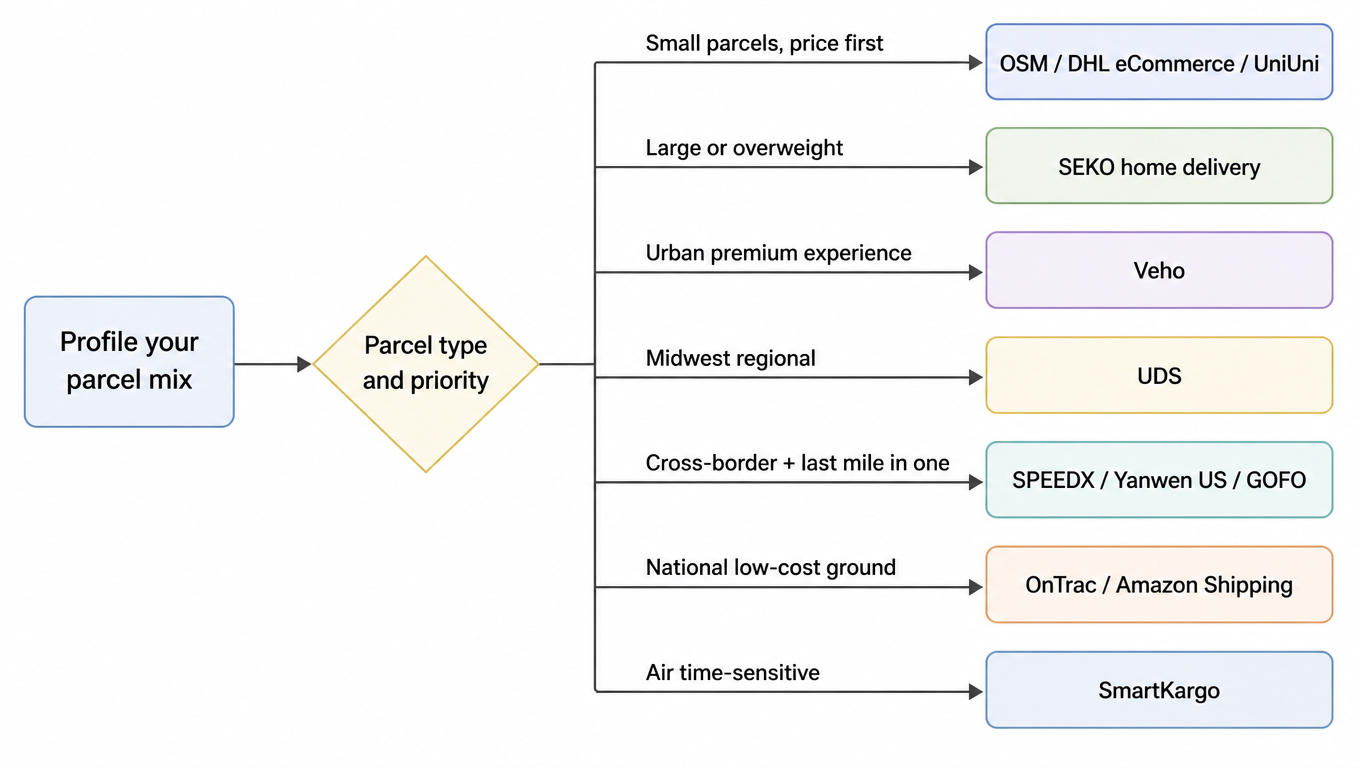
Translating the table into selection paths, typical scenarios look like this:

  • Small-parcel price-evaluation candidates: OSM / DHL eCommerce / UniUni; compare full cost for eligible shipments
  • Large and overweight home delivery: SEKO
  • Urban-market premium experience: Veho
  • Midwest regional parcels: UDS
  • U.S. last-mile candidates after cross-border inventory placement: SPEEDX / Yanwen US / GOFO; verify first mile and customs separately
  • Multi-region ground-service evaluation: OnTrac / Amazon Shipping; check origin, destination ZIP, and complete charges
  • Air time-sensitive: SmartKargo

The selection paths are easier to read as a flowchart:

Selection flowchart: profile your parcel mix, then route by parcel type and priority to OSM/DHL eCommerce/UniUni, SEKO, Veho, UDS, SPEEDX/Yanwen/GOFO, OnTrac/Amazon Shipping, or SmartKargo
Selection illustration retaining the original candidate groups. Labels such as “low cost” or “first mile plus last mile” are procurement hypotheses, not proof of account pricing, nationwide ZIP eligibility, customs, or first-mile scope. Use this section’s written checklist, contract responsibilities, and matched-pilot results.

One last piece of practical advice: do not put all your volume on a single carrier. Filter 2 to 3 candidates from your parcel profile, run a four-week parallel test at small volume, and pick the primary and backup networks on three numbers: loss rate, on-time rate, and how fast claims pay out, not on what the sales rep says.

Turn 13 networks into an executable evaluation list

Evaluation stageRequired evidenceNext step
Product eligibilityCheck origin, destination, size, weight, contents, and special addresses per product rather than brand; record source date and account eligibility.Retain eligible, ineligible, and unconfirmed outcomes; population coverage is not shipment serviceability.
Matched-sample quotesRate the same redacted orders; record tender cost, base charges, applicable accessorials, and failure/return terms.Compare net cost by lane and client profile while retaining the complete sample and exclusion rules.
Executable tenderConfirm the assigned tender address, account, appointment, local cutoff, operating days, first scan, and exception ownership.Validate actual warehouse execution; a national brand does not establish direct tender from every warehouse.
Systems and evidenceValidate the corresponding quote, label, order association, tracking, available POD, recovery behavior, and final invoice records.Use the integration acceptance guide to plan tests and the API product page to request onboarding.

The existing groups, network descriptions, matrix, and selection examples establish a candidate list. Treat pricing opportunities, windows, APIs, and experience tradeoffs as procurement questions that require account terms and pilot evidence. Keep account conditions unconfirmed where public references do not establish them; evaluation does not require integrating all thirteen networks.

EasyShippingX procurement and onboarding recommendations. Verify public references, retained files, and account activation separately; examples are not customer results or actual quotes.

Conclusion

No network wins automatically by category; the right design fits a specific parcel profile, service promise, and risk budget. Primary and backup networks must pass the same coverage, pricing, API, claims, and pilot gates.

Trend predictions should not decide a current carrier selection. Network consolidation, capacity models, and financing changes are risk signals to monitor; the decision evidence remains current documents, contracts, and your own operating data.

Start with weight, dimensions, destinations, parcel value, and exception profiles. Have every candidate quote the same file in writing, then select primary and backup networks with a matched-lane pilot. A public starting price can prompt a quote but should not enter the final ROI.

A winding road crossing several city-block color blocks, symbolizing multi-network last-mile combination, flat minimal illustration

FAQ

No fixed discount applies by carrier category. Have every candidate provide a complete written quote against the same real parcel file, then put coverage, handoffs, exceptions, claims, and added operating cost into one ROI model.
Use the fallback network when a candidate cannot meet a parcel's ZIP eligibility, transit, special-address, declared-value, tracking, or claims requirements. Evaluate each parcel by rule rather than routing automatically from a “national” or “emerging” label.
Yes. The mature play is to filter 2 to 3 candidates from your parcel profile, run a four-week parallel test at small volume, and decide the primary and backup on loss rate, on-time rate, and claims payout speed. A single carrier means more inventory risk and weaker negotiating leverage.
A public starting price can trigger a quote but should not enter ROI. Build weight, dimension, destination, value, and exception profiles, then require every carrier to quote the same basis: base rate, minimums, surcharges, out-of-network pricing, and claims terms.