电商物流指南Ecommerce Shipping Guide

运费比价工具:2026 年别再手动查 5 个承运商官网了Rate Comparison Tool: Stop Checking 5 Carrier Sites in 2026

如果你经营一个小型仓库、一家 3PL,或者一个从美国发货的电商品牌,你大概能背出这套流程:打开 USPS 官网,输入地址,记下运费。打开 UPS,再输一遍。FedEx,再一遍。然后是一家或两家区域承运商,又一遍。等五个数字摆在面前,十分钟已经没了,而你还得决定到底用哪家。这篇文章讲的是一种运费比价工具,能把整套流程压缩到一个屏幕里。If you run a small warehouse, a 3PL, or an ecommerce brand that ships from the US, you probably know the exact sequence by heart: open USPS.com, type the address, note the rate. Open UPS, type it again. FedEx, again. Then a regional carrier or two, again. By the time you have five numbers in front of you, ten minutes are gone, and you still have to decide which one to use. This article is about a rate comparison tool that collapses that whole routine into one screen.

没人查五个官网是为了好玩。费率真的会随承运商、分区、重量和服务档次而不同,也没人想为自己明明能更便宜发出去的包裹多付钱。问题在于这个习惯无法规模化:一天发几单的卖家可以承受这套仪式,一天发 60、100、300 单的仓库不行。每次发货都要把同样的地址和重量重新输进不同的表单,而重复输入,恰恰是出错的地方。Nobody checks five carrier sites for fun. Rates genuinely differ by carrier, by zone, by weight, and by the service you pick, and no one wants to overpay on a shipment they could have shipped cheaper. The problem is that the habit does not scale. A seller shipping a few parcels a week can afford the ritual; a warehouse pushing 60, 100, or 300 shipments a day cannot. Every shipment means retyping the same addresses and weights into a different form, and retyping is exactly where mistakes happen.

2026 年给了你换工具的理由:USPS 再次涨价,财务压力持续,区域承运商覆盖了更多线路,最便宜的选择越来越可能出现在你没想过去查的名字上。这篇文章先讲比价工具做什么,再讲为什么现在是切换的年份,然后给出价格之外该比的数字、时间与金钱的账、五点评分清单,以及一个 10 分钟的切换计划。2026 gives you a reason to switch: USPS raised rates again, financial pressure persists, regional carriers now cover more lanes, and the cheapest option is increasingly a name you would not have thought to check. This article covers what a rate comparison tool does, why this is the year to switch, the numbers to compare beyond price, the time and money math, a five-point checklist, and a 10-minute switch plan.

小仓库主人在堆满文件的桌前眯眼盯着开了五个浏览器标签页的笔记本电脑,身后摞着发货纸箱,午后光线
比价,从五个标签页变成一屏Rate comparison goes from five tabs to one screen

为什么你还在手动查 5 个承运商官网Why You're Still Checking 5 Carrier Sites

手动比价的动机是诚实的:费率真的因承运商、分区、重量和服务档次而不同,谁都不想为可以更便宜发出的包裹多付钱。所以你去查,这是在乎毛利的人的本能,只不过用的是最没效率的工具:你自己的手指。The instinct behind manual comparison is honest. Rates genuinely differ by carrier, by zone, by weight, and by service, and nobody wants to overpay on a shipment they could have shipped cheaper. So you check, the honest instinct of someone who cares about margins, applied with the most inefficient tool available: your own fingers.

问题在于这个习惯无法规模化。一天发几单的卖家可以承受这套仪式,一天推 60、100、300 单的仓库不行。每一单都意味着把同样的地址和重量重新输进不同的表单,而重复输入正是错误发生的地方。比错一个重量,要么多付面单钱,要么包裹已经发出去了,之后再来一张账单调整。The problem is that the habit does not scale. A seller shipping a few parcels a week can afford the ritual. A warehouse pushing 60, 100, or 300 shipments a day cannot. Every shipment means retyping the same addresses and weights into a different form, and retyping is exactly where mistakes happen. Compare a wrong weight and you either overpay for the label or get hit with a billing adjustment later, after the package is already gone.

还有一笔更安静的成本:时间本身。每单花五分钟在标签页之间跳来跳去,就是本该用于打包、拣货或回客户邮件的五分钟。乘上一天的出货量,它就不再是小麻烦,而是一个隐形的全职员工。There is also a quieter cost: the time itself. Five minutes of tab-hopping per shipment is five minutes that could have gone to packing, picking, or answering a customer email. Multiply it across a day of shipments and it stops being a small annoyance and starts being a missing employee.
运费比价工具到底做什么What a Rate Comparison Tool Does

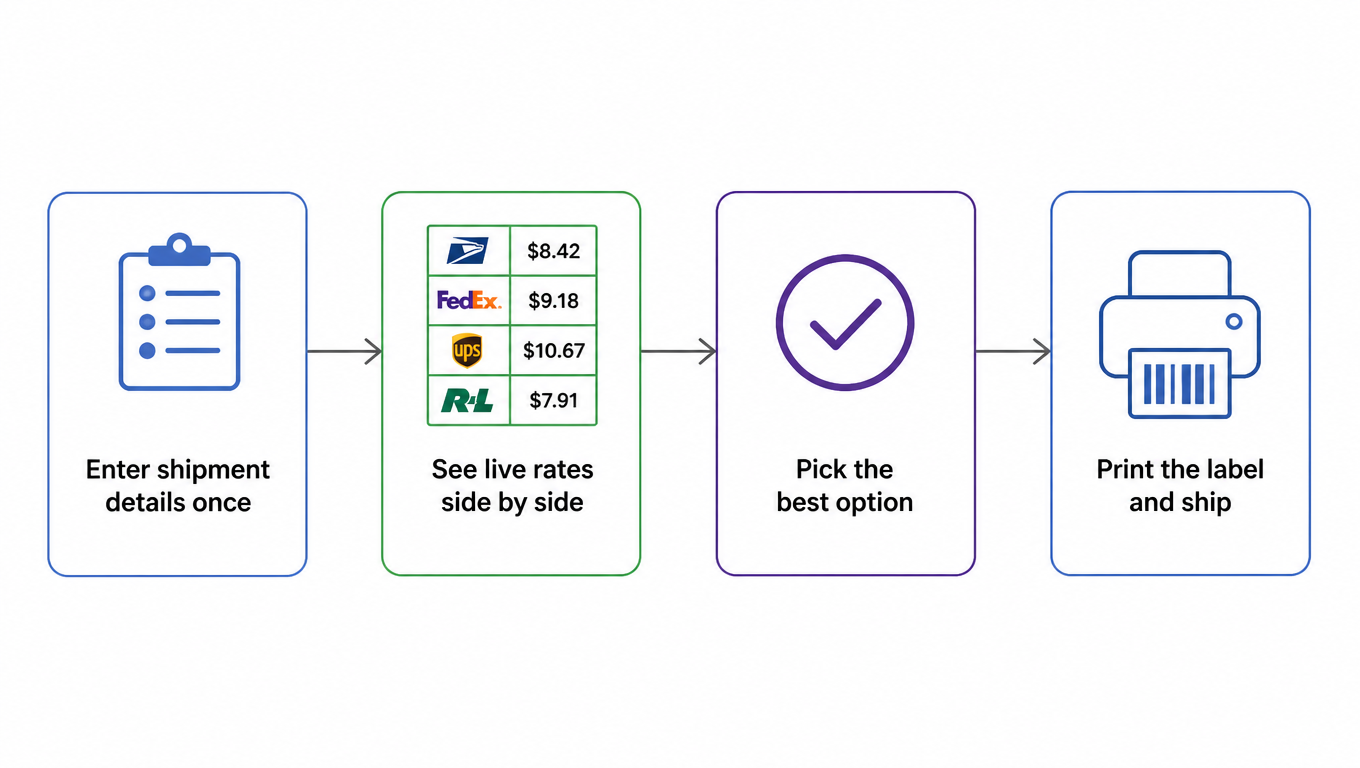
运费比价工具是一种物流软件,把多个承运商的实时运费拉进同一个视图。你只需要录入一次发货信息:寄件地、收件地、重量、尺寸。工具会查询它支持的每个承运商,从 USPS 和全国巨头到覆盖美国特定区域的区域承运商,然后把结果并排摆出来。A rate comparison tool is shipping software that pulls live rates from multiple carriers into a single view. You enter the shipment details once: origin, destination, weight, dimensions. The tool queries every carrier it supports, from USPS and the national giants to the regional carriers that cover specific parts of the US, and lays the results out side by side.

流程图:录入一次发货信息,并排查看实时运费,选择最优方案,打印面单并发货Flowchart: enter shipment details once, see live rates side by side, pick the best option, print the label and ship
一次录入,并排比价,选最优,打印面单Enter once, compare side by side, pick the best, print the label

这就是全部卖点。你原本要输五遍的数据,现在只输一遍;原本要十分钟的比价,瞬间完成。选定承运商后,工具用同一份信息直接生成面单,所以你比较的价格,就是你实际支付的价格。That is the whole pitch. The data you would have typed five times gets typed once. The comparison that used to take ten minutes happens instantly. When you pick a carrier, the tool generates the label from the same information, so the number you compared is the number you pay.

这不需要物流学位。会填发货表单,就会用比价工具。区别只在于:这个表单只让你填一次并记住,而不是在每个承运商网站上从头再来一遍。None of this requires a logistics degree. If you can fill in a shipping form, you can use a rate comparison tool. The difference is that the form asks you once and remembers, instead of making you start over on every carrier website.

为什么 2026 年是切换的年份Why 2026 Is the Year to Switch

USPS 在 2026 年再次上调了费率,延续着一连串没有停止迹象的年度涨价[^1]。对小型仓库来说,每一次涨价都在悄悄改写「哪条线路上哪家承运商最便宜」的算式。USPS raised its rates again in 2026, continuing a run of annual increases that shows no sign of stopping [^1]. For a small warehouse, every increase quietly rewrites the math of which carrier is cheapest on which lane.

涨价背后的更大图景同样重要。USPS 多年来一直承受着持续的财务压力,而且这种压力并没有消失[^2]。当一家承运商用涨价来撑收入时,发货人得出的结论很简单:不要把整个运营押在单一承运商身上,因为这家承运商的价格和服务,恰恰是你无法控制的两件事。The bigger picture behind those increases matters too. USPS has been under sustained financial pressure for years, and that pressure has not gone away [^2]. When a carrier is propping up its revenue with price hikes, the natural conclusion for shippers is simple: do not build your whole operation around a single carrier, because that carrier's price and service are the two things you cannot control.

这正是现在值得把比价自动化起来的原因。区域承运商已经在美国更多线路上扩张了覆盖[^4],这意味着某个包裹的最优解,更可能是你压根没想到去查的那个名字。承运商更多、费率变动更频繁、年度涨价更多,全都指向同一个方向:靠五个标签页肉眼比价,就是你错过省钱的方式。That is exactly why the comparison habit is worth automating now. Regional carriers have expanded their coverage across more US lanes [^4], which means the cheapest option for a given package is more likely to be a name you would not have thought to check. More carriers, more rate movement, and more annual increases all point in the same direction: eyeballing prices across five tabs is how you miss the savings.

价格不是唯一要比的数字Price Isn't the Only Number to Compare

价格是最抓眼的数字,但很少是唯一重要的数字。派送速度和服务窗口决定包裹能否兑现承诺日期。在客户预期两天送达的线路上,一个便宜 1 美元、但要五天的服务不是省钱,而是一笔等着发生的退款申请。Price is the number that gets your attention, but it is rarely the only number that matters. Delivery speed and service windows decide whether a package makes its promise date. On a lane where your customer expects delivery in two days, a dollar cheaper from a five-day service is not a saving, it is a refund request waiting to happen.

体积重是另一个陷阱。承运商按实重与体积重中的较大者计费[^3],体积重由箱子的长、宽、高算出。一件轻而占地方的货,比如枕头或折叠露营椅,可能按实重的三倍计费,而且各家承运商的规则和除数并不相同。两笔报价在重量上看起来一样,一旦把箱子尺寸放进去,差距立刻拉开。Dimensional weight is the other trap. Carriers bill by whichever is larger, the actual weight or the dimensional weight [^3], which is calculated from the box's length, width, and height. A light but bulky item, like a pillow or a folded camping chair, can bill as if it weighs three times what it does, and carriers do not all apply the same rules or the same divisor. Two quotes can look identical on weight and differ sharply once the box size is in the equation.

然后是附加费。燃油附加费、住宅派送费、派送区域附加费都叠在基础费率之上,而且各家不同。你在承运商网站上看到的贴纸价,往往不是实际支付价。一个好的比价工具展示的是全包价,而全包价才是唯一有意义的数字。Then come the surcharges. Fuel surcharges, residential delivery fees, and delivery area surcharges all sit on top of the base rate, and they differ by carrier. The sticker rate you see on a carrier website is often not the rate you actually pay. A good rate comparison tool shows the all-in number, which is the only number that means anything.

最后是可靠性。准点率和破损率因线路和承运商而异,把退款订单算进去之后,最便宜的选择并不总是最便宜的结局。比时效、比尺寸规则、比附加费、比可靠性,价格就只是表格里的一行,而不是全部故事。Reliability rounds out the list. On-time performance and damage rates vary by lane and by carrier, and the cheapest option is not always the cheapest outcome when you factor in a refunded order. Compare speed, size rules, surcharges, and reliability, and price becomes just one row in a table instead of the whole story.

你省下的:时间与金钱What You Save: Time and Money

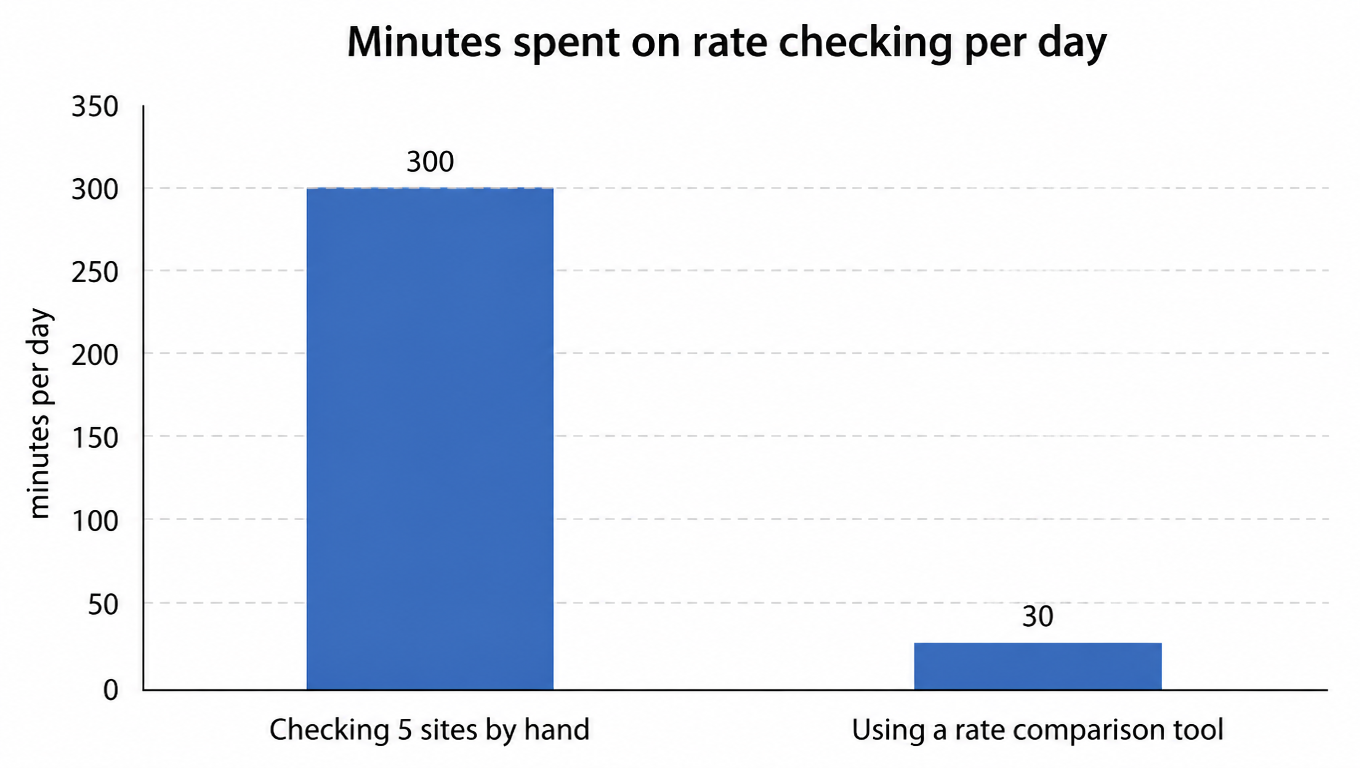
把时间账算具体。一个每天发 60 单的仓库,按每单查 5 分钟算,就是每天 300 分钟,整整五个小时,用在打印第一张面单之前的比价上。比价工具把同样的事压缩到每单约 30 秒,整批约 30 分钟。Let's make the time cost concrete. Take a warehouse that ships 60 parcels a day. At five minutes of checking per parcel, that is 300 minutes a day, a full five hours, spent comparing rates before a single label prints. A rate comparison tool turns the same job into roughly 30 seconds per parcel, about 30 minutes a day for the whole batch.

柱状图:每天用于比价的分钟数,手工查 5 个官网 300 分钟,使用比价工具 30 分钟Bar chart: minutes spent on rate checking per day, checking 5 sites by hand 300, using a rate comparison tool 30
每天比价时间从 300 分钟降到 30 分钟Daily rate-checking time drops from 300 minutes to 30

钱的账同样具体。如果比价工具平均每单只找到便宜 0.5 美元的费率,一天 60 单就是每天 30 美元,一个月约 900 美元,一个仓库一年超过 1 万美元。你不需要戏剧性的节省来让比价工具回本,你只需要每单上一点小而稳定的优势,而并排比价提供的正是这个。The money side is just as concrete. If a comparison tool finds a rate that is only 50 cents cheaper on average, 60 parcels a day is $30 a day, roughly $900 a month, more than $10,000 a year for one warehouse. You do not need dramatic savings for a rate comparison tool to pay for itself. You need a small, consistent edge on every shipment, and that is exactly what side-by-side pricing delivers.

还有一笔容易被忽视的节省:更少的错误。当信息只输一遍而不是五遍,地址和重量错误就不会成倍放大。地址校验在打印之前拦住一个坏邮编,而不是等承运商把包裹退回来。每一次避免的重复打印和每一次避免的账单调整,都是永远不会出现在节省报表上、却实实在在落进口袋里的钱。There is one more saving that is easy to overlook: fewer errors. When details are typed once instead of five times, address mistakes and weight mistakes stop multiplying. Address validation catches a bad ZIP before you print, not after the carrier returns the package. Every avoided reprint and every avoided adjustment is money that never shows up on a savings report but lands in your pocket anyway.

挑选比价工具要看什么What to Look For in a Rate Comparison Tool

比价工具并不平等,清单和价格标签同样重要。第一,实时费率。从静态价目表报价的工具,会在每次承运商涨价之后悄悄过时,这违背了工具存在的全部意义。你比较的费率,应该是你今天真正买得到的费率。Not all rate comparison tools are equal, and the checklist matters as much as the price tag. First, real-time rates. A tool that quotes from a static rate card will quietly drift out of date after every carrier increase, which defeats the whole purpose. The rates you compare should be the rates you can actually buy today.

第二,承运商覆盖。工具应该包含 USPS 和区域承运商,而不只是全国品牌,因为省钱的地方往往藏在区域选项里。如果工具只对比两家巨头,它仍然在把钱留在桌上。Second, carrier coverage. The tool should include USPS and regional carriers, not just the national brands, because the regional options are often where the savings hide. If a tool only compares the two giants, it is still leaving money on the table.

第三,批量能力。高峰日不应该意味着高强度的重复输入。找支持 CSV 或表格导入的工具,有订单系统的话还要有 API。第四,地址校验,在错误变成退件之前拦住它们。第五,透明计价:提前看得见的按单费用,好过发票上突如其来的附加项。Third, batch capability. High-volume days should not mean high-volume typing. Look for CSV or spreadsheet import, and an API if you have an order system. Fourth, address validation, which catches errors before they become return shipments. Fifth, transparent pricing: a per-label fee you can see in advance beats a surprise line item on your invoice.

暖色调极简插画:平静的仓库主管坐在整洁的桌前,面对一台大显示器,旁边整齐摞着发货纸箱,柔和自然光
一个顺手的比价工具,让发货台回归平静A rate comparison tool that fits, and the shipping desk stays calm

共同点很简单。工具应该从你身上拿走工作,而不是让你多一个要查的第六个网站。如果在一个屏幕里比价,比在五个屏幕里更快更清楚,你就找对了。The common thread is simple. The tool should take work off your plate, not add a sixth site to check. If comparing rates in one screen is faster and clearer than comparing them in five, you have found the right one.

10 分钟切换The 10-Minute Switch

测试一个比价工具不需要迁移项目。明天把前五票货放进工具里跑一遍,和你平时的流程并排,对比数字,也对比时钟。如果工具不比今天做得更好,走人;如果更好,你就找到了新的默认选项。You do not need a migration project to test a rate comparison tool. Run your first five shipments of tomorrow through one, next to your usual routine, and compare the numbers and the clock. If the tool does not match or beat what you are doing today, walk away. If it does, you have just found your new default.

2026 年的算式站在切换这一边。费率变动更多,承运商调整价格与服务组合更频繁,区域选项也比以往任何时候都强。在替代方案不存在的时候,手动查五个官网是合理的;从有人把五个费率放到同一个屏幕的那天起,它就不再合理了。The math of 2026 is stacked in favor of switching. Rates are moving more, carriers are changing their price and service mix more often, and the regional options are stronger than they have ever been. Checking five carrier sites by hand made sense when the alternative did not exist. It stopped making sense the day someone built a tool that shows all five rates on one screen.

那个工具就是运费比价工具,它的卖点很短:录入一次信息,并排看到每个承运商的价格,选最好的,打印。明天花 10 分钟测试,就能把每天五个小时拿回来。That tool is the rate comparison tool, and the pitch is short: enter the details once, see every carrier's price side by side, pick the best one, and print. Ten minutes of testing tomorrow is all it takes to get five hours of your day back.

常见问题FAQ

你只录入一次发货信息:寄件地、收件地、重量、尺寸。工具查询它支持的每一个承运商,从 USPS 和全国巨头到区域承运商,把实时费率并排展示。选定后直接生成面单,你比较的价格就是你支付的价格。原本要输五遍的数据输一遍,原本十分钟的比价瞬间完成。You enter the shipment details once: origin, destination, weight, dimensions. The tool queries every carrier it supports, from USPS and the national giants to regional carriers, and lays the live rates out side by side. Pick one and it generates the label, so the rate you compared is the rate you pay. Data you would have typed five times gets typed once, and a ten-minute comparison happens instantly.
USPS 在 2026 年再次涨价,财务压力持续;区域承运商在更多美国线路上扩张了覆盖。承运商更多、费率变动更频繁、年度涨价更多,都指向同一个结论:靠五个标签页手动比价,就是错过省钱的方式。自动化比价的意义,在于费率变化时你仍然每次都拿到最优价。USPS raised rates again in 2026 and its financial pressure persists, while regional carriers have expanded coverage across more US lanes. More carriers, more rate movement, and more annual increases all point the same way: eyeballing prices across five tabs is how you miss the savings. Automating the comparison is what keeps you on the best rate even as rates keep moving.
派送速度与服务窗口(能否兑现承诺日期)、体积重规则(承运商按实重与体积重较大者计费,除数各家不同)、附加费(燃油、住宅派送、派送区域附加费,各家不同)、可靠性(准点率与破损率)。承运商官网的贴纸价往往不是实际支付价,要看全包价。Delivery speed and service windows (can the package make its promise date), dimensional weight rules (carriers bill on the larger of actual or dimensional weight, with different divisors), surcharges (fuel, residential delivery, delivery area, which differ by carrier), and reliability (on-time and damage rates). The sticker rate on a carrier site is often not what you actually pay; compare the all-in number.
一个每天发 60 单的仓库,手工比价每天约 300 分钟(五个小时),工具约 30 分钟。钱的方面:平均每单只便宜 0.5 美元,一天 60 单就是每天 30 美元,一年超过 1 万美元。再加上更少的错误:信息只输一遍,地址与重量错误不再成倍放大。A warehouse shipping 60 parcels a day spends about 300 minutes (five hours) comparing rates by hand, versus about 30 minutes with a tool. On money: an average saving of just 50 cents per parcel is $30 a day, more than $10,000 a year for one warehouse. Add fewer errors: with details typed once instead of five times, address and weight mistakes stop multiplying.
五点清单:实时费率(不是静态价目表,涨价后不会悄悄过时);承运商覆盖(必须含 USPS 和区域承运商,而不只是两家巨头);批量能力(CSV/表格导入,有订单系统则要 API);地址校验(在错误变成退件之前拦住);透明计价(提前看得见的按单费用)。一句话:工具应该拿走工作,而不是让你多查一个网站。A five-point checklist: real-time rates (not a static rate card that drifts out of date after every increase); carrier coverage (must include USPS and regional carriers, not just the two giants); batch capability (CSV or spreadsheet import, plus an API if you have an order system); address validation (catches errors before they become return shipments); and transparent pricing (a per-label fee you can see in advance). In one line: the tool should take work off your plate, not add a sixth site to check.

想让比价建立在可信的实时承运商费率上?Want rate comparison grounded in live, trustworthy carrier rates?

EasyShippingX 在承运商执行层(费率、面单、追踪)工作。你的团队决定怎么比价、怎么选承运商;EasyShippingX 保证多个承运商的实时费率、面单生成与追踪事件准确、及时地工作,让每一次发货都建立在真实费率上,而不是五个标签页里的手工抄录。EasyShippingX operates in the carrier execution layer (rates, labels, tracking). Your team decides how to compare and which carrier to pick; EasyShippingX makes sure live rates across multiple carriers, label generation, and tracking events work accurately and in real time, so every shipment is grounded in real rates instead of manual notes across five tabs.

Get Rate Comparison
Get Rate Comparison