Ecommerce Shipping Guide

Box vs. Poly Mailer vs. Padded Mailer: A Total Shipping Cost Decision Framework for Ecommerce

The mailer you pick costs cents. The shipping label costs dollars. New sellers optimize the cents, ignore the dollars, and quietly bleed margin on every order. The carrier does not care what your packaging costs: it bills on the package itself, its size and its weight. A $0.10 poly mailer can ship the same item for dollars less than a $0.50 box, because the box is bigger, heavier, and sometimes billed on imaginary pounds.

This guide is written for US DTC and Shopify sellers fulfilling from their own inventory (FBM-style), and for anyone who owns packaging and shipping cost. The question is not which mailer is cheapest at the counter but total cost per order: packaging unit cost plus shipping plus damage and returns risk. The guide first explains how carriers bill by dimensional weight, then compares the three packaging types dimension by dimension, and closes with a six-step decision framework and a scenario cheat sheet you can run on your own orders.

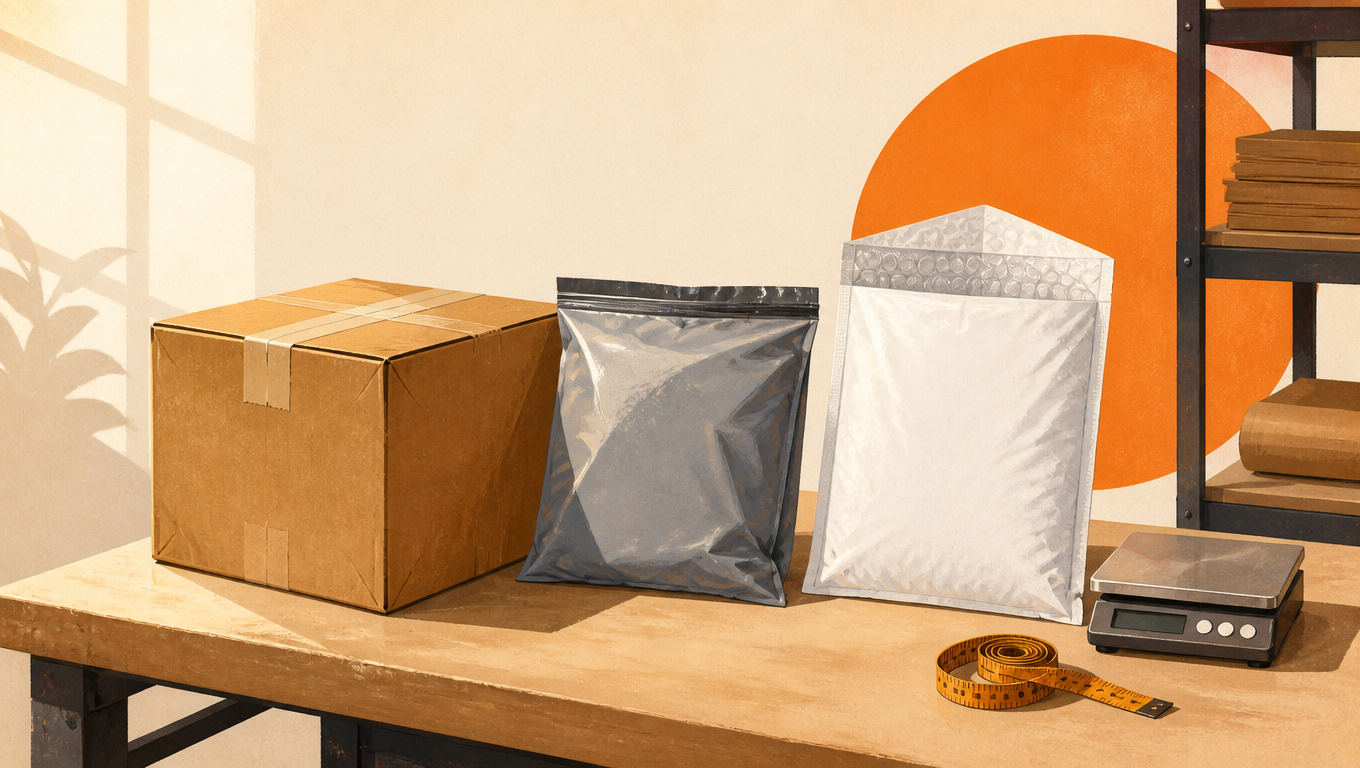
Editorial illustration, three-quarter view of a workshop table with a brown corrugated box, a gray poly mailer, and a puffed padded mailer side by side, parcel scale and tape measure nearby, warm light, kraft texture, handmade imperfections
Three packages side by side on the packing table; the number on the price tag is rarely what decides total cost

Why Packaging Choice Is a Cost Decision, Not a Preference

When a package is large relative to its actual weight, the carrier charges for the space it occupies in the truck or plane instead of what it weighs: that is dimensional weight, usually called DIM weight. Every inch of packaging you add inflates that space, and inflates the bill. So the real decision variable is not which mailer is cheapest at the counter, but total cost per order:

Packaging unit cost + shipping cost + damage and returns risk = total cost

Your job is to find the packaging that minimizes the total, not the one with the smallest price tag. Protection and unboxing experience matter, but only to the extent that they show up in the equation: as lower returns, higher repeat-purchase rates, or a premium you can charge. The framework below walks you through exactly how to compute it.

The Three Contenders at a Glance

Every packaging decision in ecommerce is a choice between three archetypes.

A corrugated box is rigid, crush-resistant, and stackable. It protects fragile and heavy items better than anything else, and it is the only option that survives a mixed mailstream with confidence. The price is bulk: boxes are big, they eat warehouse space, and their fixed rectangular shape inflates the volume the carrier bills you on.

A poly mailer is a thin polyethylene envelope. It is the lightest and cheapest option, it hugs its contents instead of boxing them, and it practically disappears from your shipping bill. It also offers zero impact protection: if you drop a poly mailer, whatever is inside hits the ground.

A padded mailer sits between them: a paper or poly envelope lined with a layer of bubble wrap. It is convenient, stores flat, and gives light cushioning without the rigidity of a box. But that bubble lining has a hidden cost, because it adds up to an inch of bulk on every side, and bulk is exactly what carriers charge you for.

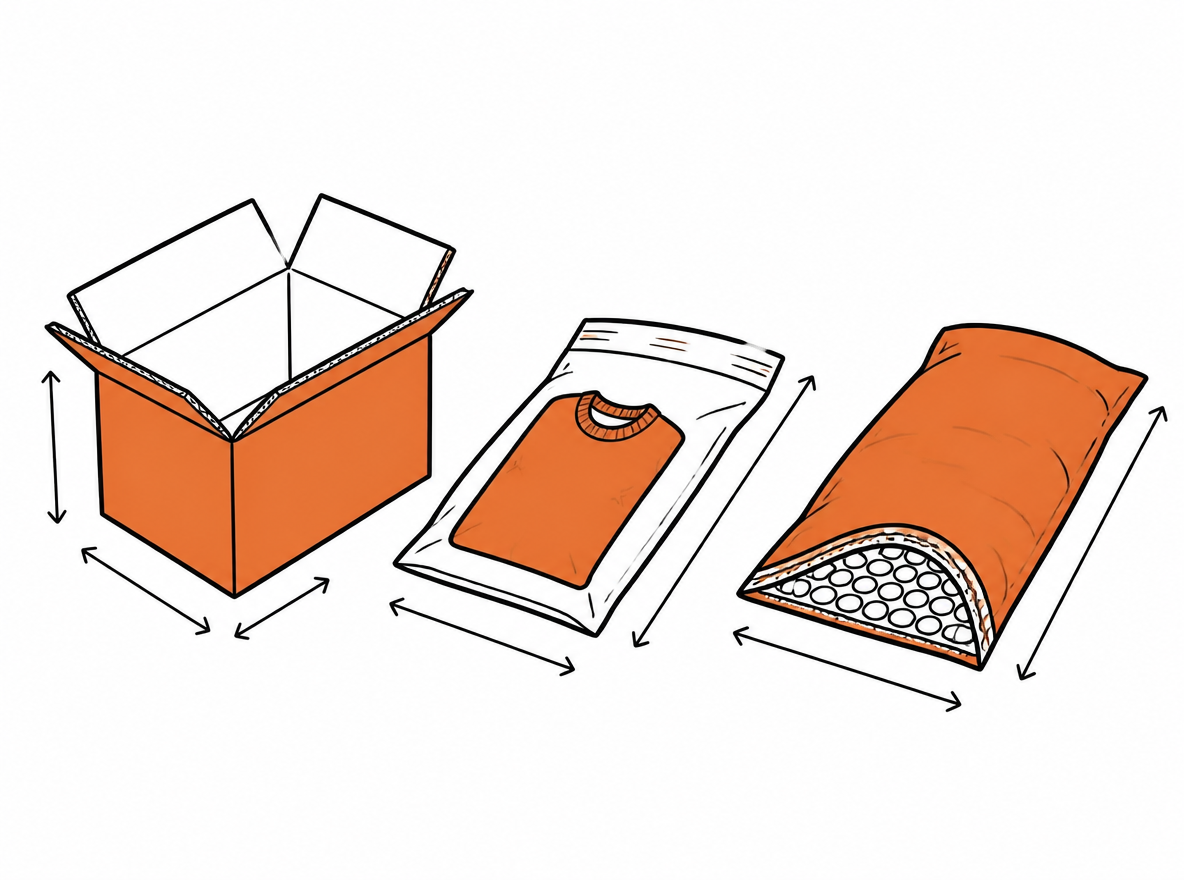
Hand-drawn editorial cartoon: three packages side by side, a rigid open box, a limp poly mailer hugging a folded sweater, and a plump padded mailer cut open to show bubble lining, loose ink lines with orange accents, generous white space, floating dimension arrows with no text
Three packages, three volume personalities: rigid, hugging, puffed
Dimension Corrugated box Poly mailer Padded mailer
Unit cost$0.40-$3.00+$0.10-$0.35$0.25-$0.80
Self weightModerateNegligibleLight
Impact protectionRigid, crush-resistantNoneLight cushioning
Volume profileBulky, fixed shapeHugs contents, minimalBulky, adds about 1 inch per side
Best forFragile, heavy, high-valueSoft goods, flat itemsSmall, light, fragile items

How Carriers Bill You: Dimensional Weight and the One-Cubic-Foot Threshold

Carriers compute two numbers for every package: actual weight and dimensional weight. Dimensional weight is the package's volume in cubic inches divided by a divisor: DIM weight = (length × width × height) ÷ divisor. The divisor varies by carrier. FedEx and UPS use 139 for domestic packages billed on daily or negotiated rates, and UPS retail counter rates still use 166. USPS historically used 166 as well, and on July 12, 2026 it dropped its divisor to 139 for Priority Mail Express, Priority Mail, USPS Ground Advantage, and Parcel Select packages larger than one cubic foot, aligning all three carriers. A lower divisor means a higher DIM weight, so the July 2026 change makes bulky packages bill heavier than they did in 2025, and every inch of packaging you add now costs more than it did.

The critical detail is the threshold: dimensional weight only applies to packages larger than 1 cubic foot, which is 1,728 cubic inches. Below that line, all three carriers bill on actual weight, rounded up to the next pound. Above it, they bill on whichever is larger, actual or DIM. This cliff is the whole game. A package at 1,700 cubic inches bills on its actual weight. A package at 1,800 cubic inches can bill at several times its actual weight.

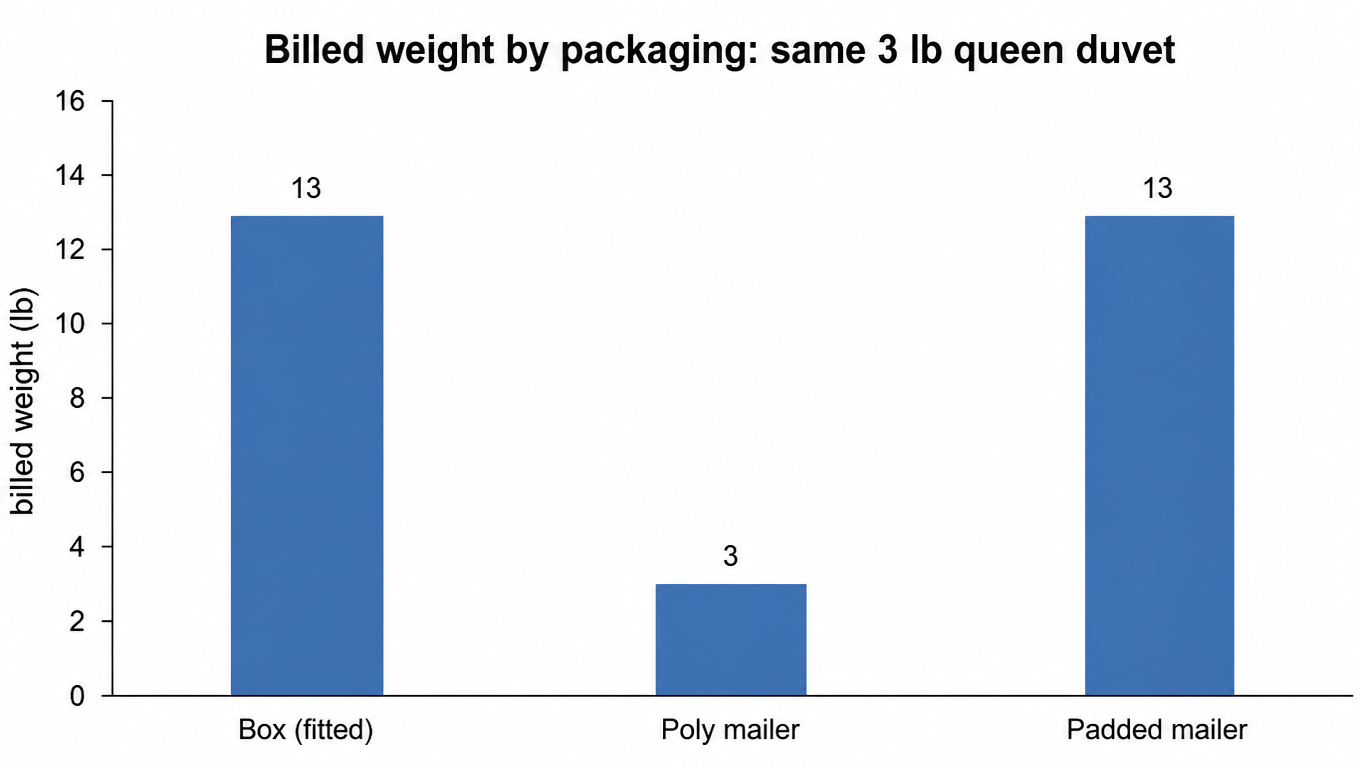
To see how packaging choice moves the bill, take a concrete example: a queen-size duvet, compressed to 18 × 12 × 6 inches and weighing 3 lb. Pack it three ways.

  • Poly mailer: it stays compressed at roughly 18 × 12 × 6 inches, 1,296 cubic inches, under the threshold, billed at actual weight, 3 lb.
  • Fitted corrugated box: cardboard walls add an inch of clearance, bringing it to about 19 × 13 × 7 inches, 1,729 cubic inches, one cubic inch over the line. DIM weight: 1,729 ÷ 139 = 12.4, rounded up to 13 lb with all three carriers.
  • Padded mailer: the bubble lining adds the same inch per side, 19 × 13 × 7 inches again, 1,729 cubic inches, billed at 13 lb the same way.
Bar chart: the same 3 lb queen duvet bills at 13 lb in a fitted box, 3 lb in a poly mailer, and 13 lb in a padded mailer
The same 3 lb duvet bills at 3 lb or 13 lb depending on the packaging

One inch of packaging, one cubic inch over the threshold, and the bill jumps from 3 lb to 13 lb, more than four times the billed weight. On a typical USPS Ground Advantage shipment, that roughly doubles to triples the shipping cost for the same duvet. This is why packaging choice is a cost decision: at small sizes it barely moves the bill, and near the 1,728 cubic inch line it moves it by dollars.

Boxes: Rigid Protection at a Size Premium

A corrugated box is the default for a reason: it is the only packaging that protects its contents from stacking pressure, crushing, and rough handling without relying on luck. If you sell ceramics, glass, heavy tools, or anything over roughly $75 in value, a box is rarely the wrong call.

The cost is real but bounded. Simple corrugated mailers run about $0.40 to $1.20 per unit at low volume, and larger or custom-printed boxes $1.20 to $3.00 and up at wholesale. The bigger cost is dimensional: rigid walls force you into a fixed rectangular volume, so the box is always larger than the item, and for light-but-bulky items that means DIM weight, as the duvet example showed. A 4 lb table lamp in an 18 × 14 × 10 inch box bills at 2,520 ÷ 139 = 18.1, rounded up to 19 lb. The lamp did not get heavier. The air around it did.

Boxes also carry operational costs that are easy to undercount. They arrive flat and need assembly, which adds seconds per order and labor minutes per week. They take up warehouse space out of proportion to what they hold. And you need several stock sizes to avoid shipping a lip balm in a shoebox.

What you get in return: the best protection, a premium unboxing experience, the ability to ship multiple items in one box, and a package customers can reuse for returns. For fragile, heavy, or high-value products, the box's size premium is simply the price of keeping the item intact.

Poly Mailers: The Volume Play, and Where It Bites

Poly mailers win on the two things that matter most to unit economics: price and volume. A small poly mailer costs about $0.10 to $0.15, a large one $0.25 to $0.35, and their self-weight is negligible. More importantly, they are flexible. A folded sweater, a book, a t-shirt, a scarf: the mailer shrinks to the item instead of surrounding it with air, which keeps the package under the dimensional weight threshold in almost every case.

That is why poly mailers are the default for apparel, textiles, and any compressible soft good. Shipping a 1 lb sweater in a poly mailer instead of a box saves the packaging cost itself, and for compressible items that stay under the DIM threshold in a mailer but not in a box, the freight saving can be several dollars per order. Over a thousand orders a month, that is real money.

The bite is protection. Poly mailers have zero impact resistance and minimal puncture resistance. A sharp edge inside the package, a heavier parcel stacked on top of it, or a drop onto a concrete sorting floor can all end badly. Use them only when the item can survive compression and a fall: soft goods, flat items, books with a stiff insert. Fragile items need inner packaging, and at that point you should ask whether a padded mailer or a box would do the job more cheaply and safely.

There is also a trap for bulky soft goods. Bedding, puffer jackets, and plush items compress beautifully, but only to a point. A queen duvet compressed to 18 × 12 × 6 inches is 1,296 cubic inches, safely under the line. Compressed less tightly, say 19 × 14 × 8 inches, it is 2,128 cubic inches, over the threshold, and the same duvet bills at 2,128 ÷ 139 = 15.3, rounded up to 16 lb. The poly mailer is not a magic exemption from dimensional weight. It is a tool for keeping volume down, and it only works if you actually compress the contents.
Padded Mailers: The Convenient Middle Ground With Hidden Bulk

Padded mailers feel like the sensible compromise: more protection than a poly mailer, less bulk than a box, and they store flat. They cost about $0.25 to $0.80 depending on size and whether the outer layer is paper or poly. They are genuinely the right answer for a narrow band of products: small, light, mildly fragile items such as cosmetics, small electronics accessories, and low-value jewelry, where a poly mailer is too flimsy and a box is overkill.

The hidden problem is bulk. A bubble lining is not cardboard; it is an air cushion, and a usable cushion is roughly half an inch to a full inch thick on every side. Add that to both dimensions of every side and a 14 × 10 × 4 inch item becomes a 16 × 12 × 6 inch package, 1,152 cubic inches instead of 560. The padded mailer often ends up with the same volume as a fitted box, sometimes more, while costing more per unit than the box.

The real danger is at the threshold. Because the lining inflates every dimension, a padded mailer is the easiest way to nudge a package past 1,728 cubic inches without noticing. The item looks small, the mailer looks fine, and the bill suddenly reflects a DIM weight several times the actual weight. The duvet example is the extreme case; the same dynamic shows up at smaller scales whenever a medium item sits close to the line.

The rule of thumb: if you ship light fragile items under about two pounds and under about 12 inches in their longest dimension, a padded mailer is a reasonable default. For anything bigger, measure the packed mailer before you commit, and compare it against a fitted box. The box may be cheaper to ship, cheaper per unit, or both.

Head to Head: Price, Protection, Experience, Sustainability

Dimension Box Poly mailer Padded mailer Winner
Price per unitHighest ($0.40-$3.00+)Lowest ($0.10-$0.35)Middle ($0.25-$0.80)Poly
Impact protectionBestNoneLightBox
Unboxing experiencePremium, reusableUtilitarianMiddleBox
SustainabilityRecyclable, reusableThin-film recycling is rareMixed materials, hard to recycleBox

Price is not close: the poly mailer wins on unit cost and on shipping cost for anything compressible. Protection is not close either: only the box offers real rigidity. The other two dimensions are subtler.

On unboxing experience, the box wins for the simple reason that customers can see, feel, and reuse it. A branded box signals a premium purchase; a gray poly mailer signals a commodity. That matters most for high-ticket or gifting products, and barely at all for a restock of t-shirts.

On sustainability, the honest answer is complicated. Corrugated boxes are the easiest to recycle, and customers actually do reuse them. Poly mailers are thinner and lighter, which means less material and less transport weight, but most municipal recycling programs do not accept thin film, and unless your mailer is made from recycled content it is virgin plastic. Padded mailers are the worst of both worlds: bubble lining glued inside a paper or poly shell makes a mixed-material package that most facilities cannot recycle. If sustainability is a differentiator for your brand, a recycled-content poly mailer or a box is the more defensible choice, and either beats a padded mailer.

The Total-Cost Decision Framework, With a Scenario Cheat Sheet

Here is the full decision process, compressed into six steps.

  • 1. Measure the packed package. Measure the outside of the packaging, not the item. Suppliers quote internal dimensions; carriers bill on external ones.
  • 2. Compute both weights. Actual weight rounded up to the pound, and DIM weight = (L × W × H) ÷ 139 for all three carriers (UPS retail counter rates still use 166), if volume exceeds 1,728 cubic inches.
  • 3. Add the packaging unit cost. Your landed cost per mailer or box, including the price of any void fill or inner protection.
  • 4. Add the damage risk. Estimate the probability of damage in transit for that packaging and multiply by the cost of a lost or damaged order: refund, reshipment, return shipping, and lost goodwill.
  • 5. Add the experience value. A premium unboxing lifts repeat purchase and review rates; a crumpled poly mailer does the opposite. Apply it as a discount to total cost for high-ticket items, or ignore it for commodity restocks.
  • 6. Pick the lowest total cost. Not the cheapest mailer, not the prettiest box. The lowest sum of steps 1 through 5.
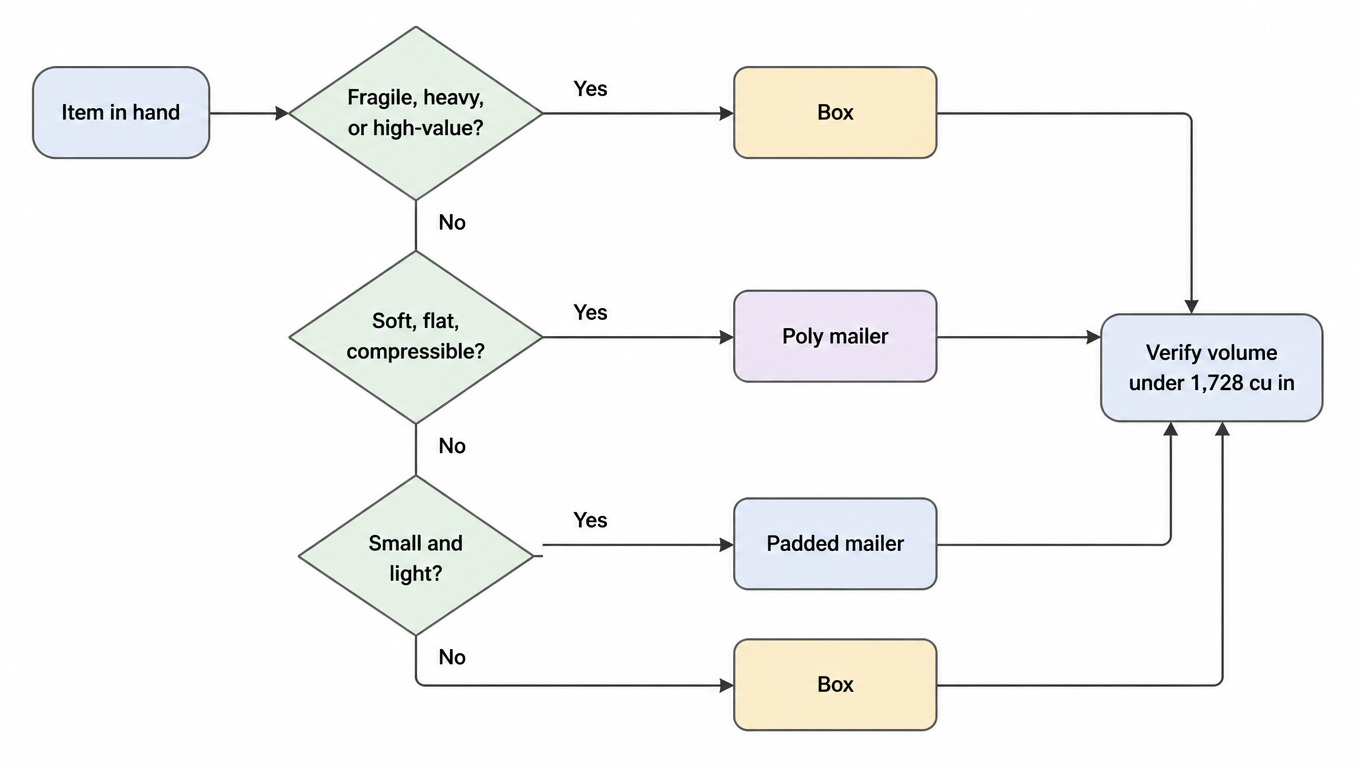
Decision tree flowchart: fragile, heavy, or high-value routes to box; otherwise soft, flat, compressible routes to poly mailer; otherwise small and light routes to padded mailer, else box; every path ends by verifying volume under 1,728 cubic inches
Answer fragile, heavy, or high-value first, branch by the item's nature, then verify the volume

The same logic, applied to the product categories that make up most of ecommerce:

Item type Recommended packaging Why
Jewelry, low valuePadded mailerLight cushioning without box cost
Jewelry, high valueBoxProtection plus premium unboxing
Apparel (shirts, knitwear)Poly mailerCompressible, lowest total cost
BooksPoly mailer + stiff insertCorner protection at low weight
Glass and ceramicsBox + void fillRigid walls, no flex in transit
Small electronicsPadded mailer or boxCushioning; box for anything with a screen
Supplements and glass bottlesBox or padded mailerGlass needs rigidity; heavy jars need a box
Bedding, jackets, bulky soft goodsPoly mailer, compress hardStay under 1,728 cubic inches
High-value items ($100+)BoxProtection, insurance, signature on delivery

A few closing notes. First, re-run this framework when your rates change, because carriers republish dimensional weight policies and price tables, and the winner can flip. Second, review your actual pack sizes quarterly; teams drift toward whatever box is on the shelf, and the "medium" box that fit last quarter may be a DIM-weight liability this quarter. Third, when in doubt between a poly mailer and a padded mailer, measure the padded mailer packed. If it is within a couple of inches of a fitted box in any dimension, ship the box.

Packaging is one link in the logistics cost chain. To see how dimensional weight is computed in metric units, read dimensional weight in cm and kg; for the cheapest USPS classes, see the cheapest USPS shipping options and how to ship padded envelopes cheaply; if your quotes never match the final charge, the problem may sit outside the rate table, in why shipping API quotes do not match final carrier charges; the fuller cost view starts with the true cost of last-mile delivery and cost per successful delivery; and the umbrella framework lives in how to lower shipping costs.

FAQ

Because carriers bill on size plus weight, not weight alone. The extra inch or two per side from a box or bubble lining can push a package past the 1,728 cubic inch dimensional weight threshold; once over the line, the bill is computed from length times width times height divided by 139, and can jump to several times the actual weight. Packaging choice is not about saving on packaging; it decides which number appears on the freight bill.
DIM weight equals length times width times height in cubic inches divided by a divisor, and applies only to packages larger than one cubic foot, 1,728 cubic inches. Since July 12, 2026 USPS, FedEx, and UPS all use 139 for domestic parcels, except UPS retail counter rates at 166. Above the line, the carrier bills the larger of actual or DIM weight, rounded up to the next pound.
Because the bubble lining inflates every dimension by half an inch to an inch. An item can sit far from the threshold, then double in volume and cross it once the lining inflates each side. A packed padded mailer is almost always bigger than your instinct says, so the rule is: measure it packed, then compare against a fitted box.
Not always, but usually. Light fragile items under about two pounds and about 12 inches along the longest side, like cosmetics, small accessories, and low-value jewelry, do fine in a padded mailer. Anything with a screen, glass and ceramics, heavy items, and high-value goods over $100 need a box with void fill to arrive intact.
At least quarterly, and immediately after a rate change or a carrier dimensional weight policy update. Teams drift toward the box that is handy, and a new rate table can turn last quarter's perfect size into this quarter's DIM liability. Pack a few representative items in each candidate, run the six-step framework, and you are usually done in ten minutes.