Workflow illustration, not a customer case or an actual account quote.
The cheapest way to ship clothes in the US is not a fixed list of carriers. A summer tee, a heavyweight hoodie, and a four-garment autumn order are three different billing problems. Three variables decide the bill: the weight after packing, whether the outer carton clears the dimensional-weight threshold, and the destination zone with its surcharges. The first two are locked at the packing bench, so a comparison run after the label prints has only one lever left.
Apparel is light, soft, and crush-resistant, so it carries none of the transport restrictions that batteries, liquids, or glass do. That narrows the saving logic to one thing: aligning the packaging method with the service tier. Get it right and the same garment ships one full band cheaper; get it wrong and it costs one band more for no reason. This guide puts three orders on one fixed lane, Ontario California (91710) to Dallas Texas (75001), a Zone 5 move, using commercial prices from USPS Notice 123, effective October 4, 2026, so the arithmetic can be checked line by line.
Start with the sequencing rule that is easiest to get backwards: dimensional weight does not begin at the first ounce. USPS bills parcels that exceed one cubic foot, or 1,728 cubic inches, on the greater of actual weight and dimensional weight (see the billing note in the price list). A 14x12x8 inch carton holding six pounds of clothes bills at six pounds. Swap in a 16x14x13 inch carton and the same contents bill at 21 pounds. That single detail saves more than switching carriers.
Three orders, three billing problems
Apparel shipping splits into roughly three bands, and each band compares different things. Knowing which band an order falls into is worth more than memorising any rate table.
Band
Typical order
What you compare
The real lever
4 to 15.999 ounces, one flat band
A tee, a light knit, an accessory
Barely a comparison at all
Do not cross the 16-ounce line
1 to 4 pounds, per pound plus zone
A hoodie, denim, two light pieces
Per-pound pricing against the flat rate envelope
Let the zone pick the envelope
Over 4 pounds, dimensional weight in play
Three to five pieces, outerwear
Actual weight, dimensional weight, cubic tiers
Compress under 1,728 cubic inches
The three scenarios below follow that order, and each answers the same question: how should this order be packed, and once packed, what should it be compared against.
Scenario one: a single tee, where there is almost nothing to compare
A single tee is the highest-frequency apparel order and structurally the simplest. Folded into a polyethylene mailer it weighs about six to ten ounces, sits under an inch thick, and is far too small for dimensional weight to matter.
The decisive fact about this band is that four ounces and 15.999 ounces cost exactly the same. On USPS commercial pricing the tee band runs from $7.33 in Zone 1 to $8.95 in Zone 8, and eight or twelve ounces are priced identically to four ounces. Shaving fractions of an ounce inside this band achieves nothing. The only thing that matters is not crossing the 16-ounce line, because one pound restarts the calculation at $8.01 in Zone 1 or $9.29 in Zone 5.
Packed weight
Zone 1
Zone 5
Zone 8
4 to 15.999 oz
$7.33
$8.24
$8.95
1 lb
$8.01
$9.29
$11.22
Why this band needs almost no comparison: every flat rate option is far more expensive. The Priority Mail Padded Flat Rate Envelope is $12.84 flat, the most expensive choice available for a light parcel. Meanwhile USPS charges no residential delivery fee while commercial carriers do, and it is a flat amount rather than a percentage (FedEx rate and surcharge changes). A light parcel starts from a low base rate, so a single residential charge of several dollars wipes out any low-base-rate advantage.
The conclusion is direct: bag it, ship it on Ground Advantage, and stop comparing. A regional carrier is still worth one look on short lanes, provided both ends sit inside its network.
Scenario two: a hoodie or denim, which forces a fresh comparison
A fleece hoodie or heavy denim lands between 1.2 and 2.2 pounds packed, about 2.5 inches thick in a mid-size mailer. The moment the parcel crosses 16 ounces the pricing switches from a single flat band to per-pound-by-zone, and the "no comparison needed" conclusion expires with it.
This band has three real options with completely different price structures: per-pound Ground Advantage, per-pound Priority Mail, and the padded flat rate envelope that ignores both weight and zone. Take a two-pound parcel, same bag, same lane.
Options for a 2 lb order
Zone 1
Zone 5
Zone 8
What moves the price
Ground Advantage, commercial
$8.39
$10.50
$13.42
Weight and zone
Priority Mail, commercial
$9.50
$14.02
$17.22
Weight and zone
Padded Flat Rate Envelope
$12.84
$12.84
$12.84
Nothing
The useful part of that table is the crossover it exposes. The same $12.84 flat price only pays off at two pounds once the lane reaches Zone 8; in Zone 5 it costs $2.34 more than per-pound pricing. At three pounds the crossover moves up to roughly Zone 6, and at four pounds Zone 5 is already at break-even. The question is therefore never whether the envelope is good, but whether it wins on this lane.
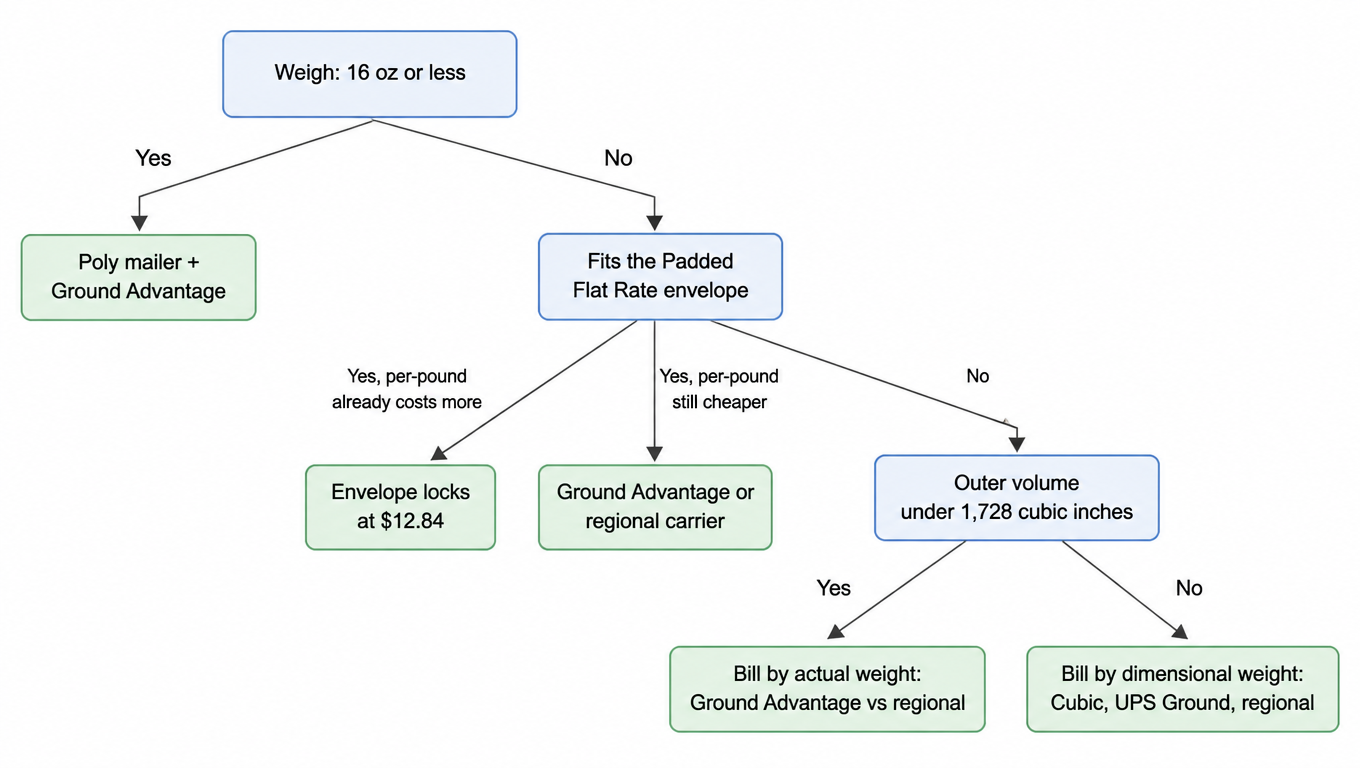
That fixes the operating order. Ask first whether the garment slides naturally into the envelope. If it does, ask whether this lane reaches the crossover; if it does, lock the price with the envelope. If not, return to per-pound pricing and pull in any regional carrier that covers the destination. The envelope has to be used as supplied, never modified or spliced, or the carrier can refuse it or bill it as another service.
Scenario three: three to five garments, where dimensional weight takes over
Four autumn garments packed come to six pounds actual, and this is the order most often billed wrongly, because the number that decides the bill is no longer the scale but the carton.
In a 14x12x8 inch carton: 1,344 cubic inches, below the 1,728 cubic inch threshold, so dimensional weight never applies and the parcel bills at six pounds actual: $15.33 in Zone 5.
In a 16x14x13 inch carton: 2,912 cubic inches, past the threshold, converted at a divisor of 139 to about 20.95 pounds and billed at 21 pounds, which is $27.88 in the same zone. Not one extra garment, and $12.55 more on the bill.
If those six pounds compress inside half a cubic foot, cubic tiers open up: Tier 0.3 bills $11.51 in Zone 5 and Tier 0.5 bills $14.37, both below the $15.33 per-pound price. Cubic eligibility means an outer volume of no more than 0.5 cubic feet, a weight of no more than 20 pounds, and a longest side of no more than 22 inches.
The Medium Flat Rate Box at $22.02 is the most expensive option in this band and only makes sense when the load genuinely cannot be compressed, or when the order is not cost-sensitive.
One fixed penalty that gets overlooked is the longest side. USPS adds $4.50 to parcels measuring over 22 inches but not over 30 inches, and $10.00 beyond 30 inches (USPS Notice 123 price list). For long coats, dresses, and ski jackets the packaging rule is therefore unambiguous: keep the longest side under 22 inches, which matters far more than saving a few cents on the rate.
The full dimensional-weight calculation, the greater-of-two rule, and how the divisors differ between carriers are worked through in how dimensional weight is calculated and billed and in the dimensional-weight tool, which is where to check how far a given order needs to be compressed.
Mailer or carton: packaging tiers and what materials cost
Packaging decisions are worth more in apparel than in almost any other category, because garments are almost always compressible and both costs of a carton are volumetric. The first is tare weight: an ordinary small corrugated box weighs four to eight ounces on its own, enough to push a sub-one-pound order into a higher band. The second is fixed outer size: past 1,728 cubic inches, dimensional-weight billing switches on regardless of what is inside.
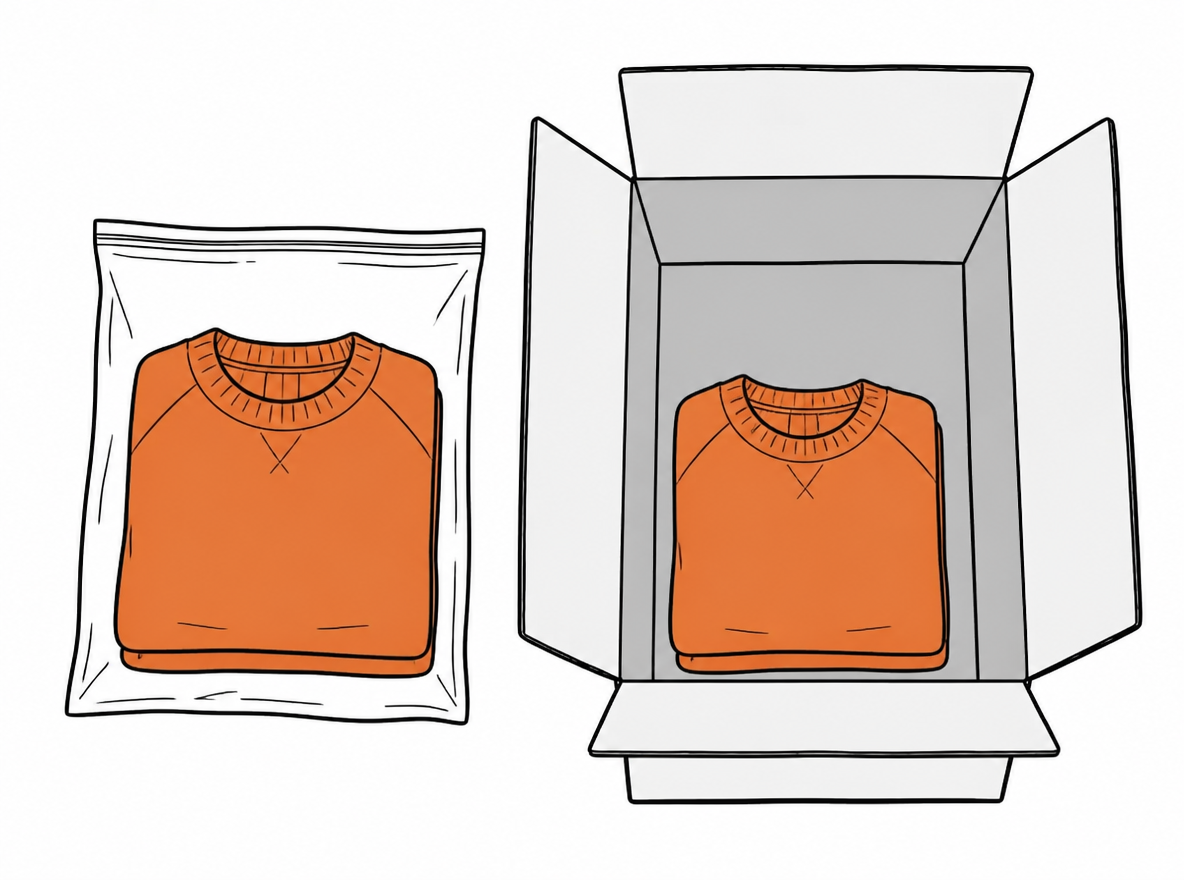
A polyethylene mailer removes both costs at once. At 1.5 to 2.5 mil the bag weighs under half an ounce and tightens around the folded garment, keeping the outer volume as small as the fabric allows. The one exception is metal zips, rivets, and hard buttons: line the bag with tissue paper or switch to a bubble mailer so hardware cannot tear the film and turn into a damage claim.
Same garment, two outer volumes; the hatched area is air being paid for
Bulky knits and down jackets need one extra step, air evacuation: fold the garment, load it into a perforated poly bag or a simple compression bag, press the air out with the palm, and seal. Only after that does the parcel have a chance of qualifying for a cubic tier, or at least of staying under the 1,728 cubic inch threshold.
Everyday apparel such as tees, hoodies, leggings, and shorts: one mailer type across the board. Weight is negligible, protection is adequate, and it adds no volume.
Structured pieces such as blazers, dress shirts, and leather jackets: board-folded with tissue lining, into a carton sized to the garment. When reusing old boxes, strip or cover every old label and barcode completely, then reinforce seams and corners with good tape.
Branded gift boxes and high-value multi-item orders: a custom inner box, then a tight protective outer carton. Outer dimensions have to be controlled precisely here, because for gift orders the billed weight is usually set by the outer box rather than by the goods inside.
Fair comparison conditions, and the surcharges that decide the outcome
Most bad comparisons are not arithmetic errors, they are inconsistent conditions. A fair comparison fixes four things: origin ZIP, destination ZIP, packed weight, and outer dimensions. Change any one of them and the conclusions stop being transferable. Current residential and fuel charges are set out in the FedEx rate and surcharge changes, and the longest-side charges and dimensional-weight threshold appear in USPS Notice 123.
Cost element
Who charges it
How it moves
Residential delivery
Commercial carriers; not USPS
A flat amount per parcel, and most ecommerce orders trigger it
Fuel surcharge
Commercial carriers
Reset weekly against a published index, as a percentage of base
Oversize length charge
Both USPS and commercial carriers
USPS adds $4.50 past 22 inches and $10.00 past 30 inches
Delivery area surcharge
Commercial carriers
Triggered by remote or low-density delivery areas
Additional handling
Commercial carriers
Charged per parcel for irregular packaging, poorly strapped soft packs, or oversize
This table explains how a single tee shipping on USPS and a six-pound order shipping on commercial ground can both be right at once: the first wins by avoiding residential and fuel charges, the second by absorbing weight under a bulk commercial discount. Putting both orders through one comparison sheet compares the wrong things.
Three orders against the available services, on one baseline
This is the comparison the guide exists for. The baseline is fixed: origin Ontario, California (91710), destination a residential address in Dallas, Texas (75001), a Zone 5 move, with commercial rates from USPS Notice 123, effective October 4, 2026, and weights and dimensions taken after packing.
Order
Packed specification
Services and commercial rates
Conclusion
Single summer tee
8 oz, 10x13 inch mailer
Ground Advantage: $7.33 to $8.95 from Zone 1 to Zone 8, identical to the 4 oz price
No comparison needed; the $12.84 flat rate envelope is pointless at this weight
Single hoodie
2 lb, 12x15 inch mailer, about 2.5 inches thick
Ground Advantage $10.50 in Zone 5; Priority Mail $14.02 in Zone 5; Padded Flat Rate Envelope $12.84 flat
Per-pound wins in Zone 5 and the envelope only wins in Zone 8; run both
Four-garment order
6 lb actual in a 14x12x8 inch carton, 1,344 cubic inches, no dimensional weight
$15.33 by actual weight in Zone 5; the same contents in a 16x14x13 carton bill at 21 lb for $27.88; cubic Tier 0.3 is $11.51; Medium Flat Rate Box $22.02
Get the carton under 1,728 cubic inches first, then test cubic eligibility, and treat the flat rate box as a last resort
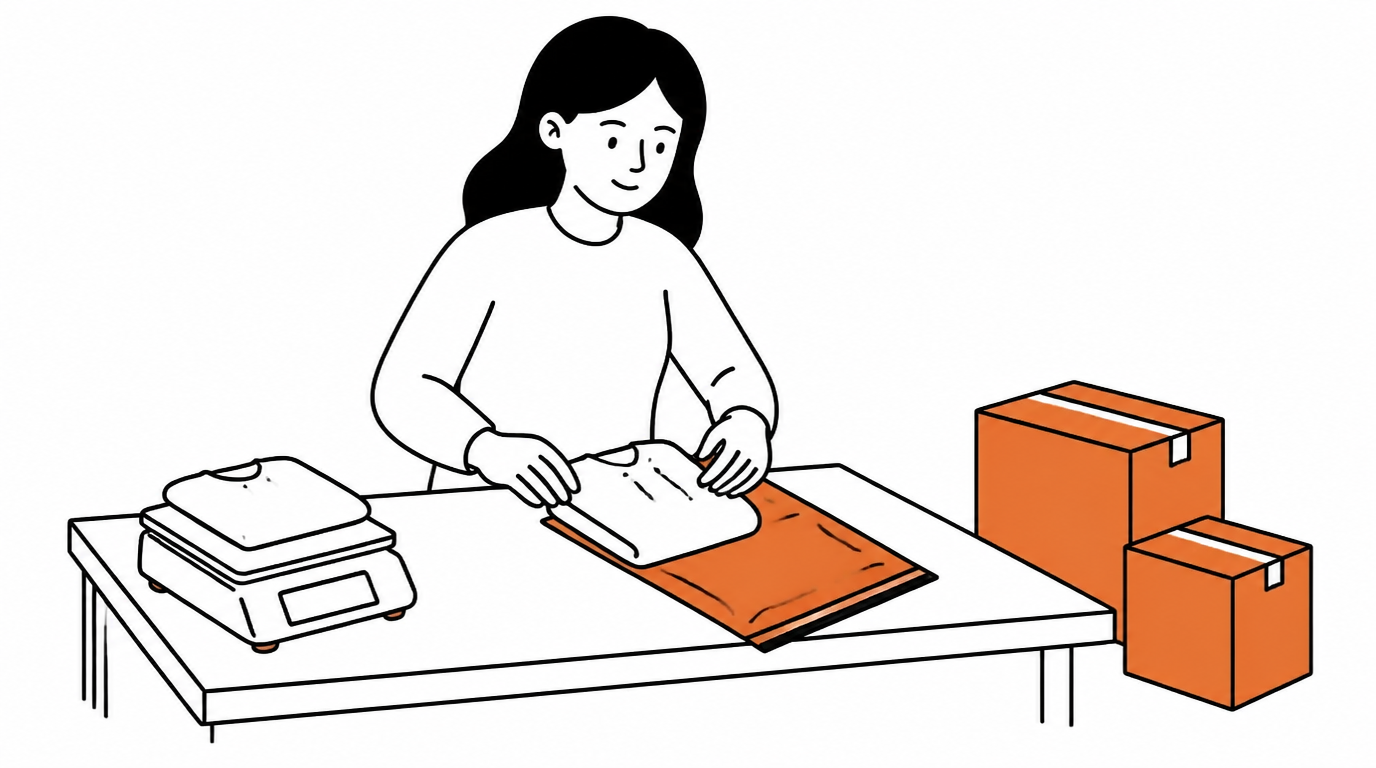
Three steps at the bench: weigh, test the envelope, measure the volume
Change the lane and the conclusions move. The same eight-ounce tee shipping New Jersey to California, Zone 8, makes the mailer look even better because per-pound pricing starts higher than it does in Zone 5. Conversely, Zone 2 and Zone 3 orders usually do not need the flat rate envelope at all: a plain weight comparison already lands on the best answer.
Returns: the second shipping funnel in apparel
Apparel returns more often than most categories, and fit is the usual reason. Savings won on the outbound side are easily eaten by careless reverse logistics, and that cost never shows up in outbound reporting.
Do not enclose a pre-paid paper return label. It bills when issued rather than when used, so unreturned parcels still cost postage and unused labels have to be voided.
Use a scan-based return label instead, so the account is charged only once the carrier scans the parcel and nothing is owed if it is never sent.
Let the returns portal route by buyer location, issuing regional labels for short lanes and postal labels for cross-country ones, so every return does not funnel into the most expensive path.
Turning the conclusions into a daily shipping rule
A seller or warehouse running dozens to thousands of orders a day cannot look up rates by hand. The logic has to become process. One premise first: counter and storefront retail rates sit well above online commercial pricing, and daily shipping has to run on the commercial side or every comparison above is built on the wrong prices.
Set up packing profiles per product family: Profile A for a single tee or accessory (mailer, 8 oz), Profile B for a hoodie or trousers (mid mailer, 2 lb), Profile C for a standard three-piece set (12x10x6 carton, 4.5 lb). Scanning the order loads the physical parameters automatically and removes manual entry error.
Run a coverage check: regional networks serve specific states or ZIP clusters, so screen the destination ZIP before the rate pool is built. If it is reachable, the regional option enters the comparison; if not, it drops out and the nationwide network stays.
Compare and buy through a neutral layer: EasyShippingX acts as a channel-neutral shipping layer, comparing carrier options inside the US and executing through the Portal, Excel, or the API, so the choice follows the comparison rather than a single carrier relationship. The full cost-reduction framework is broken down in how to lower shipping costs systematically, and USPS options are compared in the cheapest USPS shipping options.
Packing bench cheat sheet
Everything above, compressed into a sheet that can be taped to the bench. The premises are fixed: online commercial pricing, one origin and destination ZIP pair, and weight and dimensions measured after packing.
Packed parcel
First choice
Compare against
Under 16 oz in a flat mailer
Ground Advantage, no comparison needed
A regional carrier covering the destination
1 to 4 lb, fits the padded envelope
Lock the envelope price once the lane reaches the crossover
Below the crossover, compare Ground Advantage and regional ground per pound
2 to 5 lb, compressible under 0.5 cubic feet
Test cubic eligibility first
Ground Advantage by actual weight
Over 4 lb with a carton past 1,728 cubic inches
Refit the carton or evacuate air before pricing anything
After compression, compare actual-weight billing against cubic tiers
Structured pieces or gift box orders
A sized carton plus ground service
Judge on billed weight, not on flat rate
The sheet answers which lever to pull first, not which carrier wins. Within any band the cheaper option is still decided by the destination zone, and a different lane can move the answer.
FAQ
Under one pound it usually is, because no residential delivery fee applies and the 4 to 15.999 ounce band is a single price. Above two pounds the answer stops being fixed, and the lane decides between per-pound pricing, flat rate envelopes, and regional carriers.
Compressible everyday apparel goes in a mailer; structured pieces and gift orders go in a carton sized to the contents. A carton adds four to eight ounces of tare weight and triggers dimensional-weight billing once its outer volume passes 1,728 cubic inches, and both costs bite hardest on sub-one-pound orders.
Yes, and by more than switching carriers usually saves. Six pounds in a 14x12x8 inch carton bills $15.33 by actual weight; the same contents in a 16x14x13 inch carton clear the 1,728 cubic inch threshold and bill at 21 pounds for $27.88. Compress inside half a cubic foot instead and cubic Tier 0.3 bills $11.51.
It depends on the zone. The padded envelope costs $12.84 flat, which beats per-pound pricing at two pounds only from Zone 8, at three pounds from roughly Zone 6, and at four pounds from Zone 5. Garments that do not fit the envelope take this option off the table entirely.
Let the comparison happen when the label is created
EasyShippingX compares carrier options inside the US in one place and executes them through the Portal, Excel, or the API. Packing profiles settle the dimensional weight and the comparison settles the service tier, both running on the same parameters, so shipping cost cannot drift quietly between systems.