Ecommerce Shipping Guide

What Does Ecommerce Packaging Really Cost Per Order? A Parcel-First Audit Framework

The supplier quote says the box costs $0.55 and the poly mailer costs $0.12, and it feels like the whole decision is which one to buy. That unit price is the line everyone sees, which is exactly why it is the line everyone over-trusts. The actual cost of packaging only shows up later, scattered across the freight bill, the labor hours, the damage claims, and the warehouse shelf space, and none of those invoices say “packaging” on them.

The classic failure mode goes like this: a seller switches to the cheapest mailer to save pennies on material, then pays more in billable weight, surcharges, extra packing seconds, and damage replacements than the material saving was ever worth. Or the opposite: a seller buys the most protective box out of caution, and the oversized package crosses a dimensional weight step that adds $14 of freight per order. Both mistakes come from pricing the box instead of pricing the shipped parcel.

Worker holds a measured parcel beside a postal scale and kraft paper cushioning.
The freight bill is the scoreboard for packaging decisions

The Model: Seven Components of True Packaging Cost per Shipped Order

Nothing about packaging matters until it ships. A box has no economics sitting on a shelf; the economics are decided the moment it becomes a parcel with a billable weight, a service class, and a destination zone. So the decision unit for packaging should be the shipped order, not the box. This guide gives you three things: a seven-component cost model for true packaging cost per shipped order, a parcel-first audit workflow that takes you from an order sample to WMS decision rules, and a worked example that runs one order through three typical package profiles so you can see where the numbers actually diverge. It is deliberately an audit framework, not a packaging-sourcing guide; if you are still deciding between box types for a given product, start with our comparison of boxes, poly mailers, and padded mailers and come back here once the decision is about cost, not material.

True packaging cost per shipped order is not one number from one invoice. It is the sum of seven lines, and each line has a different data source and a different owner in your business:

True cost per shipped order = materials + packing labor + incremental parcel cost caused by packaging + packaging inventory and handling + expected damage and reshipment + 3PL packaging fees + applicable compliance cost

ComponentWhat it measuresData sourceOwner
MaterialsUnit price of box, mailer, void fill, tape, labels per orderSupplier invoice or POsProcurement / operations
Packing laborFully loaded labor for the seconds each configuration takesTime study or WMS pick and pack timestampsWarehouse manager
Incremental parcel cost caused by packagingThe part of the freight bill driven by your box's size and weight, not the base rateCarrier invoice vs. rate quoteShipping / finance
Packaging inventory and handlingCost of packaging SKUs, MOQ, storage, obsolescence, disposalInventory records, warehouse space costWarehouse manager
Expected damage and reshipmentDamage rate times the cost of a damaged order and its replacementClaims and reshipment recordsCustomer service / operations
3PL packaging feesPer-event fees for materials, custom pack, inserts, and other VAS3PL contract and invoiceFinance / account manager
Compliance costData collection and reporting obligations under packaging EPR rules where they applyState rules and registrationsCompliance / finance

Two boundary rules keep this honest. First, the parcel line is an increment, not the whole freight bill: your product would ship in some box either way, so the question is what packaging adds or removes from the bill compared with the base case for that service and zone. Second, do not double count: if labor already includes the time to build the box, do not also charge the box-building step as a separate 3PL event, and if the damage line includes the replacement parcel, do not add that parcel again under the parcel increment.

For sellers shipping through a 3PL, several components move off your own books and into the contract, which changes what you audit but not the model. Labor becomes the pick and pack fee, materials become a material fee per box, and the parcel delta either passes through at cost or sits inside the 3PL's rate card. The components you stop paying directly, you start paying as fee events, and those events have contract definitions that decide what actually appears on the invoice, so the audit target shifts from your own payroll and POs to the contract's definitions and its billed events. The framework transfers; only the data sources swap.

The Parcel-First Core: Billable Weight, DIM Thresholds, and Surcharges

The parcel-first method starts from one idea: after packaging, your parcel has a measured size and a measured weight, and that measurement is the only thing the carrier sees. Everything downstream, billable weight, service eligibility, surcharges, and the final invoice line, is computed from those two numbers plus the zone and the rate table. Packaging is your only chance to change the inputs; after the label prints, the parcel is what it is.

The carriers publish the conversion rules, and this is the one place in the audit where you must use the official formulas, not a rule of thumb. USPS applies dimensional weight only to packages over 1 cubic foot, and since July 2026 its divisor is 139, down from 166. [^1] UPS and FedEx compute dimensional weight at a divisor of 139 on business daily rates, with UPS retail counter rates still at 166. [^2][^3] In every case, billable weight is the greater of actual weight and dimensional weight, rounded up to the next whole pound where the rate table steps by pound. Beyond DIM, size-triggered fees matter too: additional handling and related surcharges are commonly keyed to a longest side over 48 inches, a second-longest side over 30 inches, or an actual weight over 70 pounds. [^4] The point is not to memorize today's numbers; it is to know that these thresholds change, that they key off your measured dimensions, and that your audit should check each package profile against the current rate guide rather than against what the thresholds were last year.

That is why near-threshold packages are the highest-leverage target in the whole audit. A box that clears the dimensional divisor step by one tenth of a pound, or a longest side that sits one inch inside a surcharge trigger, is a bill that a one-inch trim or a lighter void-fill swap can change permanently. Consider three typical profiles before the full numbers in the worked example later in this guide: a poly mailer at 11 by 8 by 1 inch bills on actual weight because its dimensional weight is trivial; a small corrugated box at 10 by 7 by 5 inches also bills around 3 pounds, with its dimensional weight just edging out actual; but a large-light box at 18 by 14 by 10 inches holding the same mid-weight item computes a dimensional weight around 18 pounds at the 139 divisor, so the carrier bills roughly six times the freight for the same product. Material cost goes up by cents; the freight bill goes up by dollars. The audit's job is to find exactly these parcels, the ones sitting near a DIM step, a size threshold, or a surcharge edge, because those are where packaging decisions move the most money per order.

Packing Labor, Damage, and Reshipment

Packing labor is the cost everyone knows exists and almost nobody measures per configuration. The method is simple: capture seconds per packaging profile, either with a quick time-and-motion study or from WMS pick and pack timestamps, then multiply by the fully loaded cost of an hour of labor, which includes wages, payroll taxes, and benefits, not the headline hourly wage. At a fully loaded $28 per hour, ten seconds is about $0.08 and sixty seconds is about $0.47. Seconds compound fast across thousands of orders, and the seconds belong to the packaging profile: a poly mailer is one grab, one drop, one seal, while a corrugated box needs setup, taping, void fill, and sometimes dunnage steps, and a fragile item demands a whole extra handling sequence.

Packer times a packing task with a stopwatch while holding a partly packed box.
Seconds belong to the packaging profile, not to “packing” in general

Damage and reshipment are the counterweight to every material saving. The expected cost is the damage rate times the cost of a damaged order, and the cost of a damaged order is the product COGS plus the repack and replacement parcel cost plus the claim handling where you can measure it. Expressed as a formula: expected damage cost per order = damage rate × (COGS + replacement parcel cost + handling). A mailer that saves $0.43 in material over a small box only wins if its higher damage rate does not eat the saving, and a large protective box that costs more in freight than the damage it prevents is over-insurance on the wrong line. This is why damage risk cannot be guessed per material: it depends on the SKU, the void-fill ratio, the crush resistance of the configuration, and the actual transit conditions your parcels see.

So the A/B test discipline is the guardrail. Pick the cheapest packaging candidate that passes a damage test at representative drop and transit conditions, and never optimize materials in isolation from damage outcomes. Run the candidate and the incumbent side by side on a real order flow long enough to see damage rates, then compare total cost including reshipment, not just material and freight. If you ship through a 3PL, your own labor seconds are replaced by the pick and pack fee, so run the same comparison against the fee events on your invoice; the decision rule is identical, only the labor line changes hands.

Packaging Inventory, 3PL Fees, and EPR Compliance

Material unit price also hides the inventory cost of the packaging itself. Every packaging SKU you carry has a quantity, a minimum order, a storage footprint, and a disposal cost when a box is redesigned or a season ends and the old stock becomes dead weight on a shelf. A mailer at $0.12 that you can order in one pallet and burn through in a month is cheaper in practice than a box at $0.10 that commits you to a year of storage for a SKU you are about to discontinue. Count packaging SKUs like you count product SKUs: each one has carrying cost, and SKU proliferation in packaging is a silent tax on the warehouse.

When a 3PL packs your orders, the fee events on the invoice are the packaging cost, and the contract wording decides which events exist. A material fee per box type, a custom-pack fee per order, an insert fee, a per-label or per-scan event, each one is a line defined somewhere in the contract, and two 3PLs with the same headline pick and pack rate can invoice very differently for the same packaging work. The audit discipline here is to read the billed events against the contract definitions rather than the rate quote, because the quote shows the price and the invoice shows the reality. Our guide to auditing 3PL shipping rates covers the invoice-verification mechanics in detail; the same method applies to packaging fee events.

Compliance is the newest line in the model and the easiest to miss. Seven states have enacted extended producer responsibility rules for packaging: Maine, Oregon, Colorado, California, Minnesota, Maryland, and Washington. [^5] The practical effect for sellers is data collection and reporting about the packaging they put into the market in each state. This section is a flag, not advice: the obligation depends on your volume, your nexus, and the state's thresholds, so the audit step is to check whether the rules apply to you, identify who owns the reporting data, and build the data capture into the packaging records you are already keeping. The packaging SKU data you track for the inventory line is the same data an EPR report needs, so one clean packaging master list serves both.

The Six-Step Audit Workflow

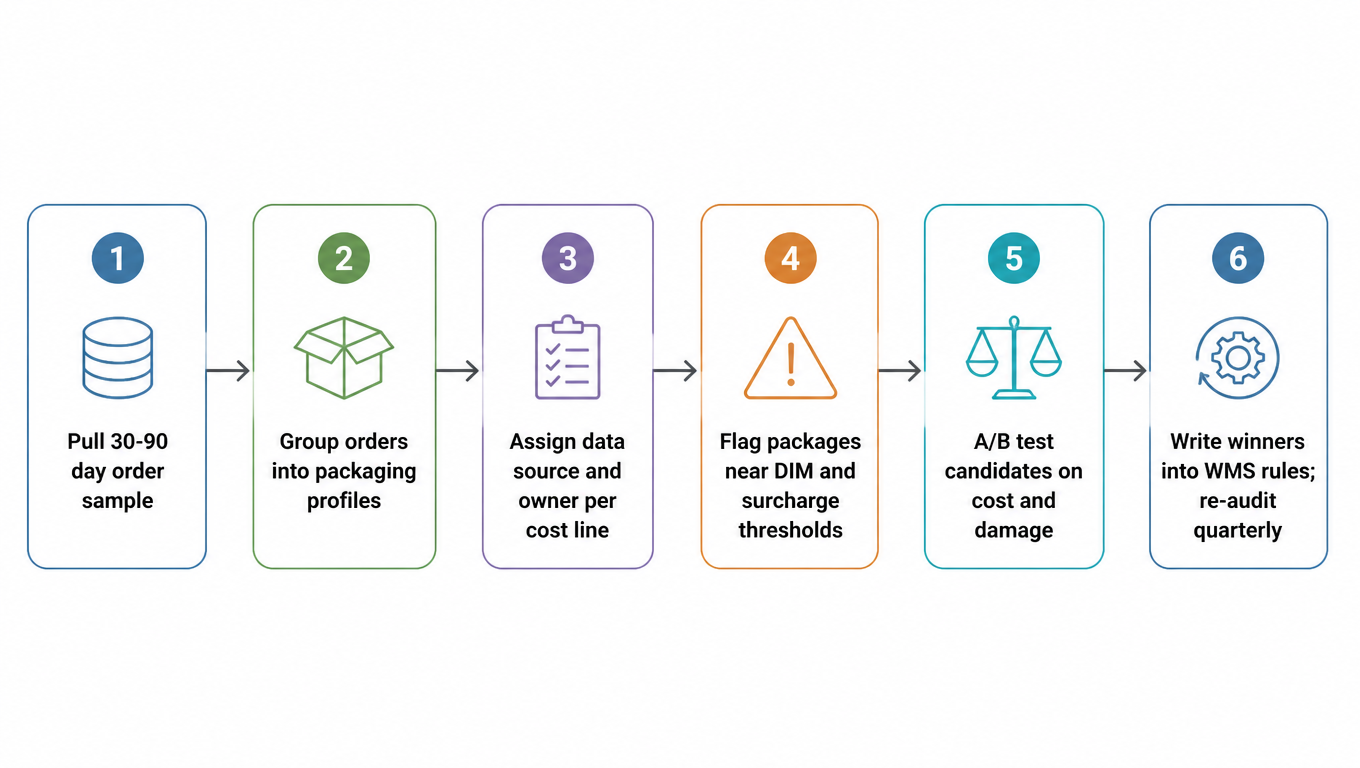
The model tells you what to measure; the workflow tells you how to get the numbers without boiling the ocean. Six steps, run on a cadence, each with a clear output:

  1. Pull a representative sample. Take 30 to 90 days of shipped orders, or a full quarter if volume is low, across your SKU classes and order profiles so the sample includes your heavy, your light, your large, and your fragile products, not just the best sellers.
  2. Group orders into packaging profiles. Cluster orders by SKU class times packaging configuration, so each profile gets its own cost per order instead of one meaningless average. A profile is a row you can audit; the average across profiles is a number you cannot act on.
  3. Assign a data source and an owner to every cost line. Walk the model table and name where each number comes from and who owns it, so nothing is estimated twice by two departments and nothing is never owned by anyone.
  4. Flag near-threshold packages. Mark every profile whose billable weight sits close to a DIM divisor step, whose dimensions sit near a size or surcharge trigger, or whose service class is at risk. These are the parcels where a trim or a swap saves real money.
  5. A/B test the candidates. Put the cheapest viable candidate against the incumbent on cost and damage for long enough to see real damage rates, and close the loop by validating the test prediction against the final carrier invoice, not the rate quote.
  6. Write the winners into rules and re-audit. Turn the winning profile into a pack-station decision (“use this config above this weight, below this dimension”) and a WMS packaging selection rule, then re-run the audit quarterly or whenever carriers, your product mix, or EPR rules change.
Flowchart: pull a 30 to 90 day order sample, group orders into packaging profiles, assign a data source and owner per cost line, flag packages near DIM and surcharge thresholds, A/B test candidates on cost and damage, write winners into WMS rules and re-audit quarterly
Step 4 is where the money is found; step 5 stops you from acting on a quote

The workflow is designed so step 4 is where the money is found and step 5 is what stops you from acting on a quote. Most sellers already know their freight bill is too high; the workflow exists to tell them which profiles, which thresholds, and which swaps deserve the attention first.

Worked Example: One Order, Three Packaging Profiles

To make the framework concrete, run one illustrative order through three packaging profiles. The product is a mid-weight DTC item with a $15 COGS that could plausibly ship in any of the three. All figures below are illustrative assumptions for method demonstration: a fully loaded labor rate of $28 per hour, a single ground service to the same zone so every freight difference is packaging-driven, billable weight rounded up to the next whole pound, and list rates of $9.50 at 3 pounds and $23.50 at 19 pounds. Your rate card, zone mix, and labor cost will differ; rerun the model with your own numbers, because the framework is the takeaway, not these figures.

LinePoly mailer (11×8×1 in)Small box (10×7×5 in)Large-light box (18×14×10 in)
Materials per order$0.12$0.55$1.05
Packing time20 seconds45 seconds60 seconds
Packing labor at $28/hr$0.16$0.35$0.47
Actual post-pack weight2.1 lb2.3 lb2.6 lb
Dimensional weight (139 divisor)0.6 lb2.5 lb18.1 lb
Billable weight3 lb3 lb19 lb
Parcel cost (illustrative, same zone)$9.50$9.50$23.50
Assumed damage rate1.0%0.2%0.15%
Expected damage cost$0.26$0.05$0.06
True cost per shipped order$10.04$10.45$25.08

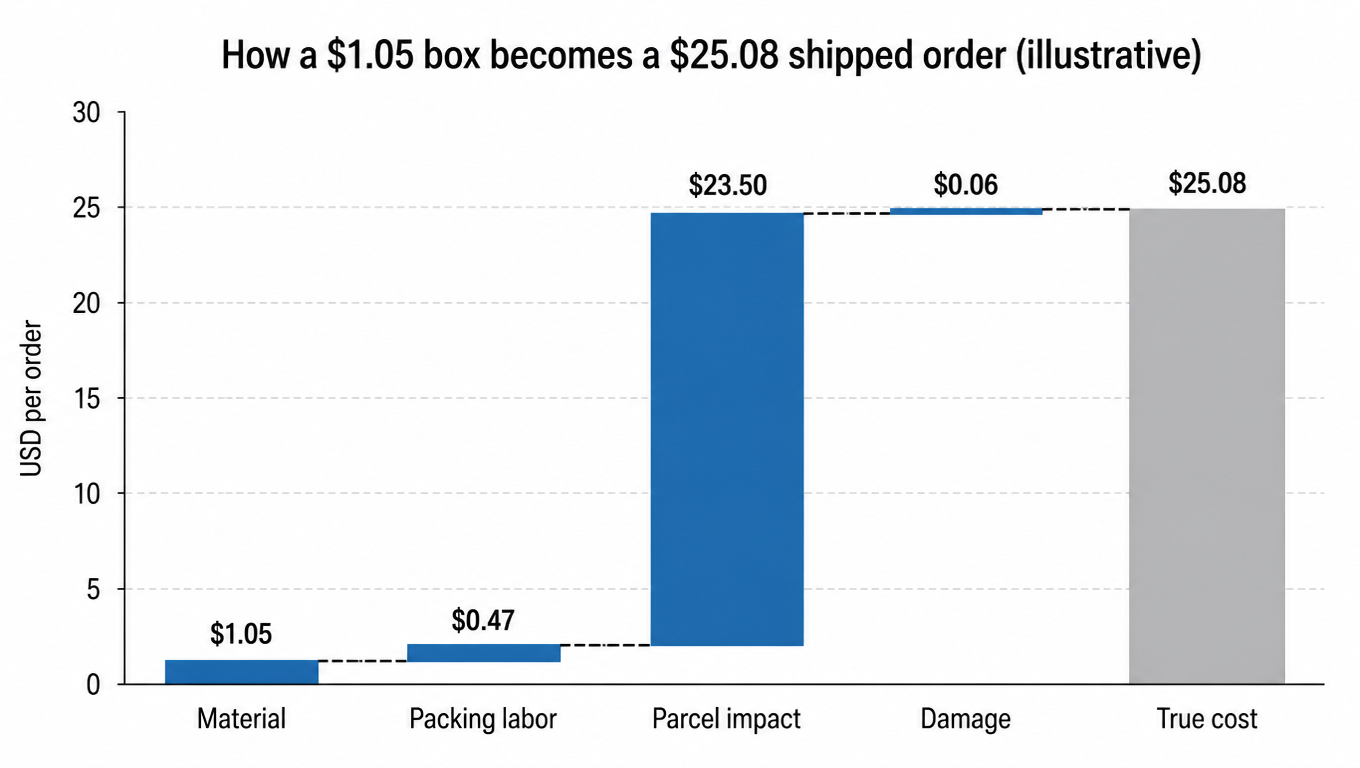
The large-light box is the story the waterfall tells best: a $1.05 box becomes a $25.08 shipped order, and almost all of the growth is the parcel line.

Waterfall chart: how a $1.05 box becomes a $25.08 shipped order, material 1.05, packing labor +0.47, parcel impact +23.50, damage +0.06, true cost 25.08
The large-light box is the story: $1.05 of material becomes a $25.08 shipped order

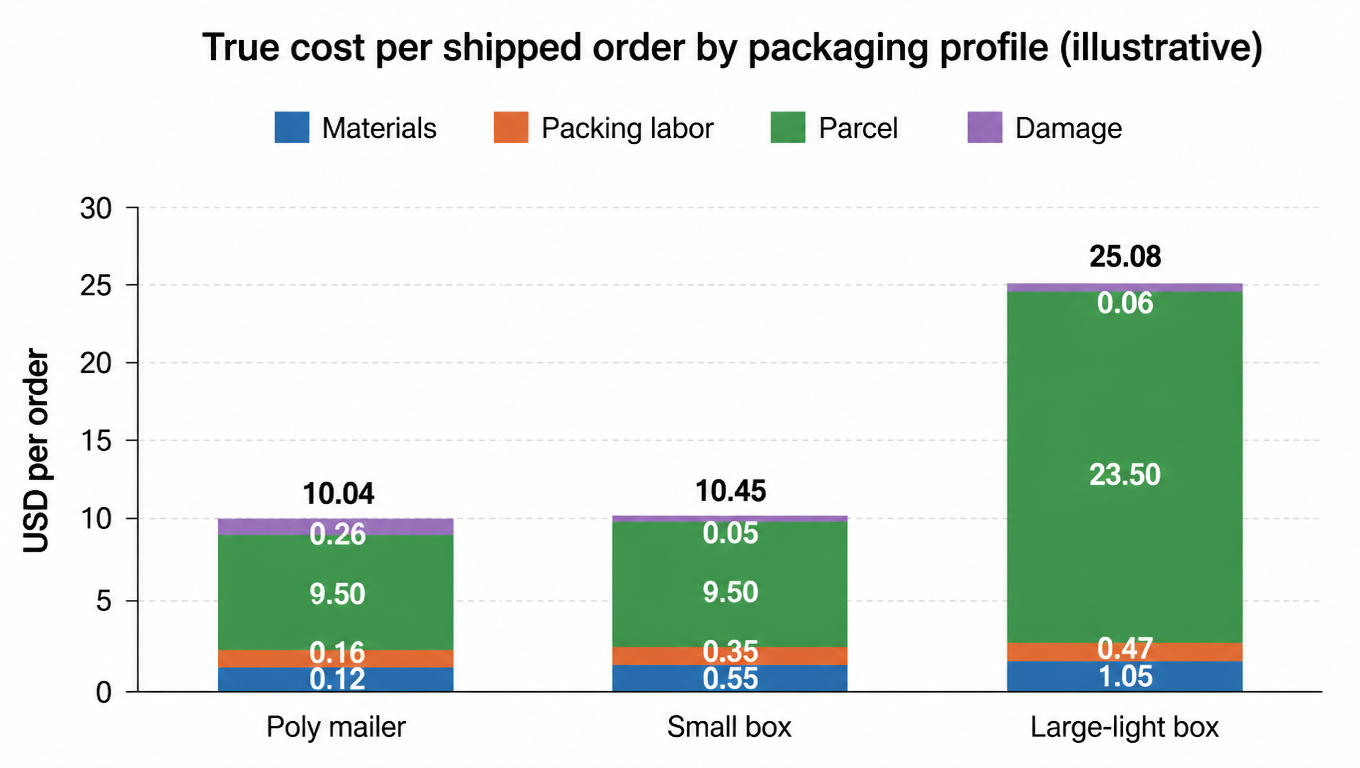
The comparison across all three profiles makes the same point from the other direction: materials differ by less than a dollar, labor by about thirty cents, and the parcel line is what separates the mailer and small box from the large-light box by roughly $14.

Stacked bar chart: true cost per shipped order by packaging profile, poly mailer 10.04, small box 10.45, large-light box 25.08, with the parcel line dominating the last profile
Materials differ by under a dollar; the parcel line splits the profiles by roughly $14

Three readings follow directly. First, the cheapest material is not the cheapest shipped order: the mailer at $0.12 material lands at $10.04 true cost, only $0.41 below the small box, and that gap assumes the mailer passes the damage test for this SKU at its 1.0% rate; if the real rate is worse, the mailer loses. Second, the small box is the quiet winner on risk: for $0.41 more than the mailer it cuts expected damage by $0.21 and protects the product, with the same $9.50 freight. Third, the large-light box is the cautionary tale: the extra material and labor add $0.84, but the dimensional weight step adds $14.00 of freight, so the “safer” choice costs $14.63 more than the small box it could have been. One inch less on the longest side, or a correctly sized box, turns most of that penalty off.

Run the same order through your own numbers before you switch anything. The profiles are illustrative; the structure of the comparison is the point.

From Audit to Pack-Station Rules, and Where EasyShippingX Fits

The audit only pays off when it changes what happens at the pack station. Step 6 turns the winners into decision rules that the people packing orders can follow without redoing the analysis: “use the small box for this SKU class, switch to the mailer above a 0.7-pound product weight only if the damage test holds,” “keep the longest side under 18 inches on this service,” “never hand-pack this profile without a void-fill check.” Where you run a WMS, the same rules become packaging selection logic keyed off the product, the destination service, and the measured dimensions, which is exactly the data our WMS package data audit guide shows you how to keep clean. And because carriers and EPR rules move, the rules carry a re-audit trigger, quarterly or on any carrier rate change, not a publish date.

Once the packaging profile is decided, the parcel is the unit of truth, and that is where EasyShippingX fits. EasyShippingX is a channel-neutral shipping layer for comparing US domestic carrier options and executing on them, through the Portal, Excel, or the API. We do not sell boxes and we do not claim to solve packaging procurement; that decision belongs to your audit. Our role starts where the audit ends: with a packaging profile and real parcel dimensions, you compare carrier rates for the actual billable weight, generate the label, and then reconcile the final shipping cost against what was quoted, which is the loop the audit's step 5 and step 6 need to stay honest. If the freight bill does not match the rate quote, the packaging economics you just computed are wrong, and that is the gap our platform exists to close. To see how the layer is delivered, see our pricing page.

Readers who want the tooling can go deeper: run each profile against carrier size and DIM thresholds with our package size checker before you commit to it, compare carriers on the billable weight your packaging actually produces with the shipping rate calculator, and chase the quote-to-invoice gap with our shipping cost variance analysis guide, all of which feed the same audit. If you ship through a 3PL, run the identical framework against the contract's fee events and rate card, with the data sources from the model table swapped for the ones on your invoice; our auditing 3PL shipping rates guide walks through the mechanics.

The closing thought is simple: the parcel bill is the scoreboard for packaging decisions. Material quotes, labor studies, and damage rates all feed the scoreboard, but the scoreboard itself is the freight invoice, and the audit framework in this guide is what makes that scoreboard readable. Measure the seven lines, flag the near-threshold parcels, test before you switch, and let the bill decide. This guide belongs to our series on lowering ecommerce shipping costs: pick the packaging type, keep the parcel data clean, and reconcile the bill.

FAQ

No. The unit price is one of seven components and often the smallest. True cost per shipped order = materials + packing labor + incremental parcel cost caused by packaging + packaging inventory and handling + expected damage and reshipment + 3PL packaging fees + applicable compliance cost. The cheapest mailer can lose overall on billable weight, surcharges, packing seconds, and damage; in this guide's worked example, a $0.12 mailer beats a sturdier small box by only $0.41 on true cost, and only if its assumed damage rate holds.
Capture seconds per packaging profile with a quick time-and-motion study or from WMS pick and pack timestamps, then multiply by the fully loaded hourly cost (wages plus payroll taxes plus benefits, not the headline rate). At a fully loaded $28 per hour, ten seconds is about $0.08 and sixty seconds about $0.47, and seconds compound across thousands of orders. The seconds belong to the profile: a mailer is one grab, one drop, one seal; a box needs setup, taping, and void fill.
The near-threshold ones: profiles whose billable weight sits close to a DIM divisor step, whose longest side sits near the 48-inch trigger, second-longest near 30 inches, or actual weight near the 70-pound line. These are the parcels where a one-inch trim or a lighter void fill permanently changes the bill, and where packaging decisions move the most money per order. Group them, flag them, then A/B test.
Yes, the model transfers and only the data sources swap. Your packing labor becomes the pick and pack fee, materials become a per-box material fee, and the parcel delta either passes through at cost or sits inside the 3PL's rate card. The audit target shifts from your payroll and POs to the contract's definitions of fee events and the events that actually appear on the invoice: material fees, custom pack, inserts, per-label or per-scan events, and contract wording decides which ones exist. Read the billed events against the definitions, not against the rate quote.
Re-run quarterly, plus whenever carriers change rates, your product mix shifts, or EPR rules update. Pull a 30 to 90 day order sample, group by packaging profile, flag near-threshold parcels, and write the winning configurations back into pack-station decisions and WMS packaging selection rules. Rate sheets and regulations drift; running the cadence keeps the cost decision anchored to current numbers.