
Fulfillment Ops Guide

Can You Edit a Shopify Order After It Reaches Your 3PL?

At 9:40 a customer tells you they moved last month and yesterday's order is going to the old address. You open the order in Shopify, edit the address, and the screen says it saved. At 9:42 a warehouse associate two time zones away scans the pick ticket printed at 7:00, pulls the item, seals the carton, buys a label, and the parcel leaves with the old address on it. Nothing in that sequence went wrong. The storefront did what you told it to do. The warehouse did what the order said when the order arrived.

The same failure has a second, quieter shape. A customer adds an item after checkout, or swaps a size, and the change lands cleanly in Shopify. But the parcel is now a different box and a different billable weight, and the quote you charged at checkout along with the label already purchased both describe a shipment that no longer exists. The order data moved. The physical and financial consequences did not move with it.

Both cases come from collapsing three separate events into one verb. There is a moment when the customer submits a change, a moment when a system stores that change, and a moment when the warehouse confirms and executes it. A success banner, a green checkmark, an API response with a 200 in it, all of these speak only to the second moment. They say the record was written. They say nothing about whether anyone has read it.

So the useful question is not "can I edit this order." It is narrower and much easier to answer: has the warehouse confirmed it will execute the edit, and if not, where is the parcel right now. Everything below is a way of getting that answer before you promise a customer anything.

Editorial illustration of a warehouse associate walking a picking cart between steel racking, a handheld scanner in one hand and three parcels of different sizes stacked on the cart, a packing bench with a sealed carton behind, a cool grey warehouse interior with one warm orange accent on the cart, off-centre composition and visible paper grain.
The edit can show as saved while the picking cart is already moving

Why "you can edit until it ships" stops being useful

The standard advice is that you can change an order any time before it ships. As a rule of thumb it is fine. As an operating answer it fails, because it never defines where "shipped" sits on the warehouse side, and the warehouse side is the one that sets the cost. Two merchants with identical Shopify screens can be standing in completely different situations: one order has not been touched, the other is sealed and sitting in an outbound lane with a label on it.

The first trap is treating fulfillment status as a live position feed. An order that is not marked fulfilled does not prove it has not been picked. Shopify's fulfillment status is a coarse, merchant-facing flag attached to the order record[^2], documented in Shopify's own APIs as a value used for display purposes[^3], not a view into a warehouse management system's task queue. A 3PL can have the item in a tote, on a cart, or already wrapped while the order still reads unfulfilled in your admin, because nothing in the loop has an obligation to write progress back to Shopify.

The second trap is treating the absence of a carrier scan as proof the parcel is still in the building. A parcel can be packed, labeled, weighed, and stacked in the staging area for hours waiting for a trailer. Until a driver scans it, no tracking event exists, and merchants routinely read that silence as "still ours to change." It is not. The building is full of parcels that have not been scanned and are no longer practically editable.

The third trap is financial. Changing an order's contents or address is not the same as updating the transportation quote behind it. Shopify's help documentation states that changing the shipping method or address on an order does not automatically recalculate the shipping rate you charged[^1], which means the amount the customer paid and the cost of the label the warehouse will buy can drift apart on an order that looks perfectly consistent in the admin. Any edit that touches destination, contents, or packaging has a transportation consequence, and that consequence has to be handled deliberately rather than absorbed by default.

So editability is not a yes or no property of the order. It is a value you read off the order's physical stage, and on a busy day that value changes several times between morning and afternoon.
The framework: six steps, in this order

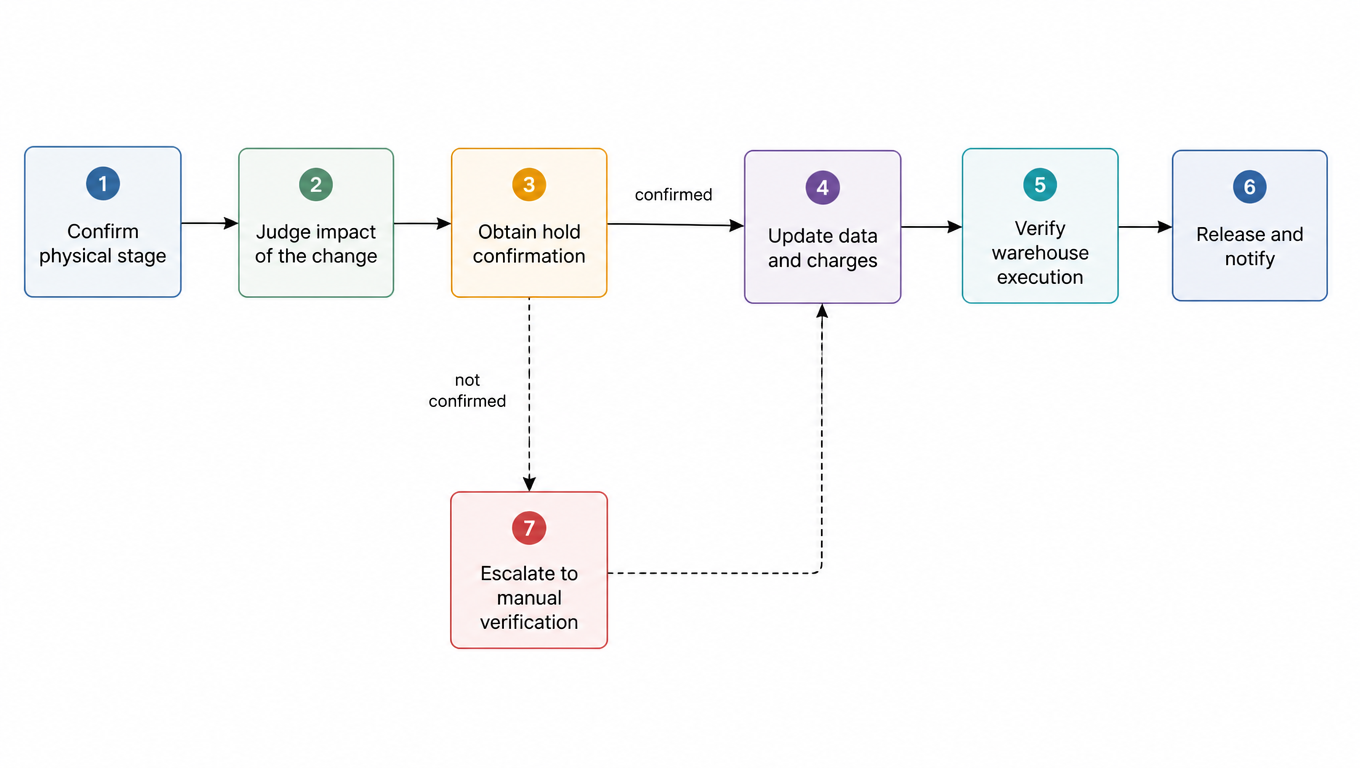
The sequence below is the whole method. It exists because skipping a step produces a specific, predictable kind of damage, and the most expensive mistake is also the most tempting one: changing the data first and telling the warehouse after.

  1. Confirm the physical stage. Get an answer to one question: what has actually happened to this parcel, not what the order status says. If nobody can state the stage with confidence, you are not ready to move.
  2. Judge the impact of the change. An address change and a quantity change place different demands on the floor. Decide what the change does to the picking task, the carton, the weight, the destination, the service, and the price.
  3. Obtain a hold confirmation. A named confirmation that the task is stopped or will not start. This is the step that converts a request into an instruction.
  4. Update the data and the charges. Only now edit the order, the WMS task, the inventory expectation, and the shipping cost or label.
  5. Verify warehouse execution. Check that the old task is genuinely dead and the new version is the one being worked. Sending is not the same as being accepted.
  6. Release. Let the order proceed, and tell the customer only after step five.

The order matters more than the list suggests. If you update the data before you have a hold confirmation, you have not made an edit, you have created two conflicting versions of the same order, one in Shopify and one on the floor, and the one on the floor usually wins because it is the one holding the box. Reversing steps three and four is the single most common way a routine address change turns into a wrong-address shipment plus a support thread.

This is also why a fixed countdown is a weak instrument. "Orders can be edited within two hours of placement" is only reliable when the warehouse process genuinely honors it, which means the cutoff has to map onto a real internal boundary such as the last moment before a pick wave is released. A countdown that nobody on the floor enforces is a promise you cannot keep. Define the window by the boundary the warehouse can actually confirm, and publish that boundary instead.

Flowchart: confirm the physical stage, judge the impact of the change, obtain a hold confirmation, update data and charges, verify warehouse execution, then release and notify. Without a confirmation the path escalates to manual verification and returns to the hold step
Step three is the gate: no confirmation, no further movement

Orders that have already been handed to a carrier leave this flow entirely. There is no fourth step that reaches into a moving parcel, only interception, rerouting, or after-sales handling, which section 8 covers.

The six variables that decide the answer

Once the framework is in place, the practical work is reading six variables correctly and refusing to make decisions on a partial set. Most bad edit calls come from knowing three of them and assuming the rest.

Type of change. Address, SKU, quantity, cancellation, and shipping service are not equally hard. An address change on an unpicked order is a field update. A cancellation at the same moment is a decision about inventory, money, and a task that may already be assigned to a person. A shipping service change can invalidate a label and reprice the shipment even when nothing physical changes. Rank the request before you act on it.

Physical stage. Not yet dispatched, waiting to be picked, being picked, packed, labeled, handed to the carrier. This is the variable that dominates the cost, and it is the one your admin screen is least likely to show you accurately.

Data state. Which version has been accepted by the warehouse system, and is there an explicit acknowledgment. "Sent successfully" and "accepted" are two different facts. A webhook that fired proves delivery, not adoption.

Transportation impact. Carton dimensions and billable weight, destination, service coverage, rate, delivery commitment. An edit that adds an item can push a parcel into a different dimensional weight band, because carriers bill the greater of actual and dimensional weight[^6], and a service that covered the old destination may not cover the new one at all.

Execution cost. Rework labor, repacking, removing or voiding the old label, cutoff timing, and whether the change creates a second parcel. These are the line items a 3PL prices, and knowing them in advance is what lets you decide whether an edit is worth requesting.

Failure modes. Edit rejected, status unknown, part of the order already gone. Write the customer-facing wording for these before you need it. An order split into two shipments where one has already left is the normal case, not the exception, and the customer should hear that from you rather than discover it from a tracking page.

The two-system state map

Every order that reaches a 3PL exists in two versions of the truth. Shopify tracks a business object with three visible states: unfulfilled, partially fulfilled, fulfilled. The warehouse tracks physical work: received, allocated, picked, packed, manifested, staged. These are not two views of the same number. They are different clocks, running at different speeds, in different systems, connected by a handoff that mostly transmits in one direction.

The practical consequence is that the merchant-visible state tells you how much of the order has been billed as fulfilled and almost nothing about where the work stands. This table reads the two clocks against each other.

Shopify visible state What it actually tells you Warehouse states it can be hiding What is normally still changeable Who executes
unfulfilledNo fulfillment record has been written backreceived, allocated, picked, packed, manifested, stagedAnything, up to the point where the WMS has accepted the taskSeller edits; 3PL confirms or executes
partially fulfilledPart of the order has a fulfillment recordAny of the above, for the units that have not been recordedThe unrecorded portion onlySeller edits the remainder; 3PL reconciles
fulfilledA fulfillment record exists and may already carry a labelpacked, manifested, staged, handed overNothing operationally; this is now interception or after-salesCarrier or 3PL exception desk

Partially fulfilled is the dirtiest row on the table, and it deserves its own warning. It tells you the order was split into multiple fulfillment units. It tells you nothing about where any individual unit physically sits. One unit can be on a truck while another has not been printed. Merchants read "partially fulfilled" as "half done, half editable" and then edit the order as a single object, which is how a customer ends up with two packages and one wrong address.

Two rules keep the table honest. First, read it along the timeline rather than as a lookup. The same order sits in the same cell at 9 a.m. and has moved three cells by 4 p.m., so an answer about editability is only valid for the moment it was given. Second, at any single physical node, feasibility differs by request type: an address change is easier than a SKU change, a SKU change is easier than a quantity increase, and all three are easier than a cancellation, because each step further from the label and closer to the inventory record demands more unwinding.

The two nodes where the cost jumps

Cost does not rise smoothly as the order advances. It steps, and there are two steps that matter.

The first is packed but not yet manifested. The parcel is closed and the contents are committed, but no label exists and no money has been spent on transport. Undoing this is labor: unsealing, taking the item back to the bench, adjusting the contents or the address, repacking, and rescanning the task. It is annoying, it is predictable, and 3PLs price it at the hourly labor rate already written into the contract. In practice this is the last stage where a change is a routine transaction rather than an escalation.

The second is manifested but not yet collected. A label exists. Depending on the carrier and the contract, voiding it may be free inside a void window and charged outside it, the shipment may be reweighed and re-rated when the new label is bought, and the old label has to be physically removed so it cannot be scanned by mistake. This is where a change stops being labor and starts being money plus a race against a cutoff.

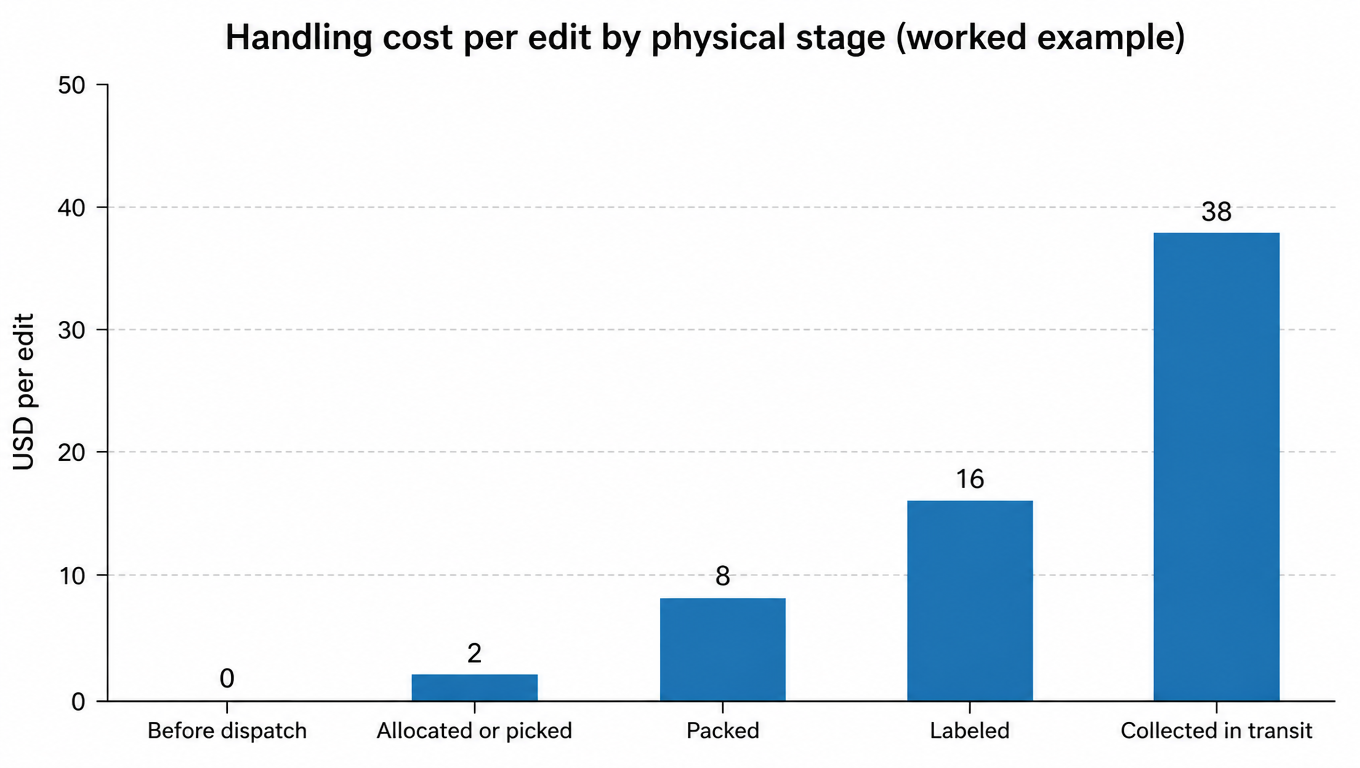
Collected and in transit is a different order of magnitude again. From that point the word is no longer "edit," and the options are interception, rerouting, or letting the parcel arrive and fixing the outcome. To compare the stages on one line, the worked example in section 8 assumes a handling cost per edit that steps up with the physical stage: nothing before dispatch, two dollars at allocation or pick, eight dollars once packed, sixteen once labeled, and thirty-eight dollars once collected and moving.

Bar chart: handling cost per edit by physical stage, 0 USD before dispatch, 2 USD at allocation or pick, 8 USD once packed, 16 USD once labeled, 38 USD once collected in transit
Worked-example figures: the real steps arrive after packing and labeling
Hand-drawn illustration of an outbound staging lane from a low angle, four sealed parcels on a wooden pallet beside a roll-up door, a hand truck leaning against the wall, floor tape marking the lane, and one parcel set slightly apart and turned the wrong way, loose ink linework with orange fills on a warm off-white ground.
The staging lane is where "not scanned" gets mistaken for "still changeable"

The decision table and the acceptance checklist

Everything above collapses into five situations. Find the row that matches what you can actually confirm, not the row that matches what you hope is true, and take the action attached to it.

Situation Recommended decision
Not yet in warehouse execution; the edit can be synchronized reliablyComplete the validation, apply the edit, then release the order
Already picked, but the warehouse can confirm a pauseGet the pause acknowledgment, update the task, the inventory, and the charges, then release
Packed or labeled, parcel still controllableAssess the rework; if it is justified, repack, recharge, replace the label, and remove the old one
Handed to the carrierMove to interception, rerouting, or after-sales. Do not promise the customer that a normal order edit will take effect
System states conflict and the physical location cannot be confirmedEscalate to a human check, and do not tell the customer the edit is done

The row merchants skip most often is the fifth one. When the admin says one thing and the warehouse says another, the temptation is to act on whichever answer is more convenient, usually the one that lets you tell the customer yes. Escalating costs a few minutes. Getting it wrong costs a wrong-address shipment plus a replacement, and it costs the customer's trust twice, once when the parcel arrives at the wrong place and once when you explain that you knew there was a conflict.

Every edit that goes through should close against the same four-point acceptance check, because an edit that is not verified is just another version of the data. The old task no longer runs, so nobody picks the original order by mistake. The live label matches the new data, and the old label is gone rather than sitting somewhere scannable. The physical parcel matches the system record. The charges are traceable, meaning you can say what the customer paid, what the label cost, and what the change cost.

Keep two timestamps, not one. Log the label void request and the refund or recharge separately. The gap between them is where real handling time hides, and it is the number to watch when your edit costs keep drifting upward. A change that takes four minutes of labor and eleven hours of queueing is not expensive because of the labor.

Sending the request, setting the rules, and paying the bill

On the seller side, the cost of a vague request is invisible until you count the round trips. "Can you change the address for me" starts a conversation: which order, which address, has it shipped, does the customer need to pay more, who approves the extra label charge. A request that arrives with the order number, the SKU and quantity affected, the current physical state as you understand it, the exact change, the latest time it is still useful, and who absorbs the fee can be executed as an instruction instead of negotiated as a favor. Send it as a filled template rather than a chat message, and send it before the daily cutoff, because a request that arrives after the pick wave has been released is really a request for the packed-parcel path or nothing.

On the 3PL side, the goal is to stop handling these as exceptions. A free window plus a hard cutoff converts most edits into scheduled work. A short priced list, edit, intercept, recall, reship, abandon, gives both sides a predictable basis for saying yes or no. An explicit refusal list in the SLA, for example no edits after the pick wave is released on peak days, is more useful than a generous promise nobody can keep. And a short hold window before release, measured in tens of minutes rather than hours, absorbs a surprising share of requests before any labor is spent at all.

When an edit fails, the fallback is a ladder, and the only real question is how far up it to climb. Level one: intercept, the parcel has not moved. Level two: recall or reroute, it has been collected but the carrier can still act[^4][^5]. Level three: let it ship and send the correct item, treating the first parcel as a return. Level four: let it ship and compensate the customer. The choice rule is a comparison, not a preference: intervention cost against wrong-order cost, where the latter is the return freight plus the cost to receive, inspect, and restock what comes back. If the customer keeps the wrong item, that cost drops and compensation often wins. If the wrong item is expensive and resellable, recall usually wins.

To see how this adds up, fill in a table with your own numbers, then check the arithmetic against one worked example.

Variable Worked example Your numbers
Edits per 100 orders6
Cost per edit before dispatch0 USD
Cost per edit at allocation or pick2 USD
Cost per edit once packed8 USD
Cost per edit once labeled16 USD
Cost per failed edit that becomes a reship and a return31 USD

Six edits per hundred orders, distributed as two before dispatch at no cost, one at allocation, two after packing, and one after labeling, comes to 34 USD per hundred orders. Add the one edit that fails and becomes a reship plus a returned parcel at 31 USD and the block reaches 65 USD per hundred orders, which is 65 cents per order before anyone counts the support time. At 2,000 orders a month that is 24,000 orders and roughly 15,600 USD a year, spent almost entirely on changes that were cheap or free when they arrived and expensive by the time anyone acted on them.

No industry average belongs in that table. Your edit rate comes from your own catalog and customer base, and your unit costs come from your 3PL's price list and your carrier contracts. Published benchmarks describe someone else's order mix, destination spread, and labor market.

What the table does show is where the leverage is. Three changes reduce edit volume without touching the warehouse at all: validate addresses at checkout so the most common edit never has to be made, hold orders briefly before release so late changes land before the pick wave instead of after it, and batch releases so edits arrive against a defined boundary. None of these require new carrier capability. They require deciding that the edit window is a designed part of your fulfillment flow rather than an argument you have with a warehouse every afternoon.

Summary

Three sentences to wrap up. Editability is set by the physical stage, not by the admin status. The order of operations is not negotiable: without a hold confirmation you do not touch the data, or you end up with two conflicting versions. And define the edit window by a boundary the warehouse can confirm, rather than promising a countdown nobody enforces.

Order editing is one layer of a larger fulfillment data problem. The matching logic across order, shipment, package, and label records is the foundation underneath it, in the order and label data model. What happens after an edit fails belongs to shipment exception management. Voided and reissued labels are their own cost line, covered in unused and voided shipping labels. System-to-physical consistency checking is the subject of the package data audit. And to place edit cost back inside the whole fulfillment bill, read Shopify fulfillment costs. All of it sits inside day-to-day 3PL shipping operations, with the quoting side covered by the shipping rate calculator and pricing.

Frequently asked questions

Not on that status alone. An unfulfilled order only means no fulfillment record has been written back to Shopify; it does not mean the warehouse has not started. The order can be allocated, picked, or packed while your admin still shows unfulfilled. Confirm the physical stage with the warehouse first, then get the hold confirmation, then edit the data.
Usually yes, once a label exists. A destination change affects the zone and the applicable service, and Shopify states that editing an order does not automatically recalculate the shipping rate. Handle it by physical stage: if no label exists, update the data; if one does, void and reissue, and remove the old label physically so it cannot be scanned by mistake. Log the fee difference separately.
Usually in time, but it has stopped being only labor. Whether the void is free depends on the void window, the new label may be rated on the reweighed parcel, and the old label has to go. Confirm the parcel is genuinely still in staging, then check the cutoff to see whether the rework can finish today; if it cannot, move it to the next day and tell the customer, rather than promising same-day delivery of the change.
Price by action rather than one bundled fee: edit, intercept, recall, reship, and abandon as separate lines, with a free window plus a hard cutoff on top. Itemized pricing lets both sides predict, so the seller can work out whether an edit is worth requesting before sending it, and the 3PL does not have to fold exception labor into the standard rate.
Three moves that never touch the warehouse: validate addresses at checkout so the most common edit never happens, hold orders briefly before release so late edits land before the pick wave, and batch releases so edits arrive against a defined boundary. The first two change how many requests arrive; the third changes when they arrive.

Want every edit priced at the moment it happens?

EasyShippingX is a channel-neutral shipping layer: it compares US carrier options in one place and executes them through the Portal, Excel, or the API. When an address or a carton changes, you can requote immediately and check billable weight and zone, so the cost of the change is known before the decision instead of showing up on a month-end invoice.