
Logistics Guide

AI in Cross-Border Shipping: From Booking to Clearance, Where AI Has Actually Landed

Most articles about AI transforming logistics over the past few years have pointed the camera at robotic arms in warehouses and delivery routes in cities. But the cost black holes that actually keep shippers up at night sit at the two ends of the cross-border chain: the first mile (capacity, space, booking) and customs clearance. These two segments are the most expensive, the most opaque, and the most dependent on manual experience, and they are exactly where AI has started to scale.

The market size confirms the direction. According to MarketsandMarkets, the global AI in supply chain market is expected to grow from about USD 13.9 billion in 2025 to about USD 50.4 billion by 2032, a compound annual growth rate of 20.1%. The money is flowing here not because the concept is sexy, but because every step of cross-border freight and clearance carries quantifiable waste: empty space on vessels, overpriced freight, reworked documents, and cargo stuck at port.

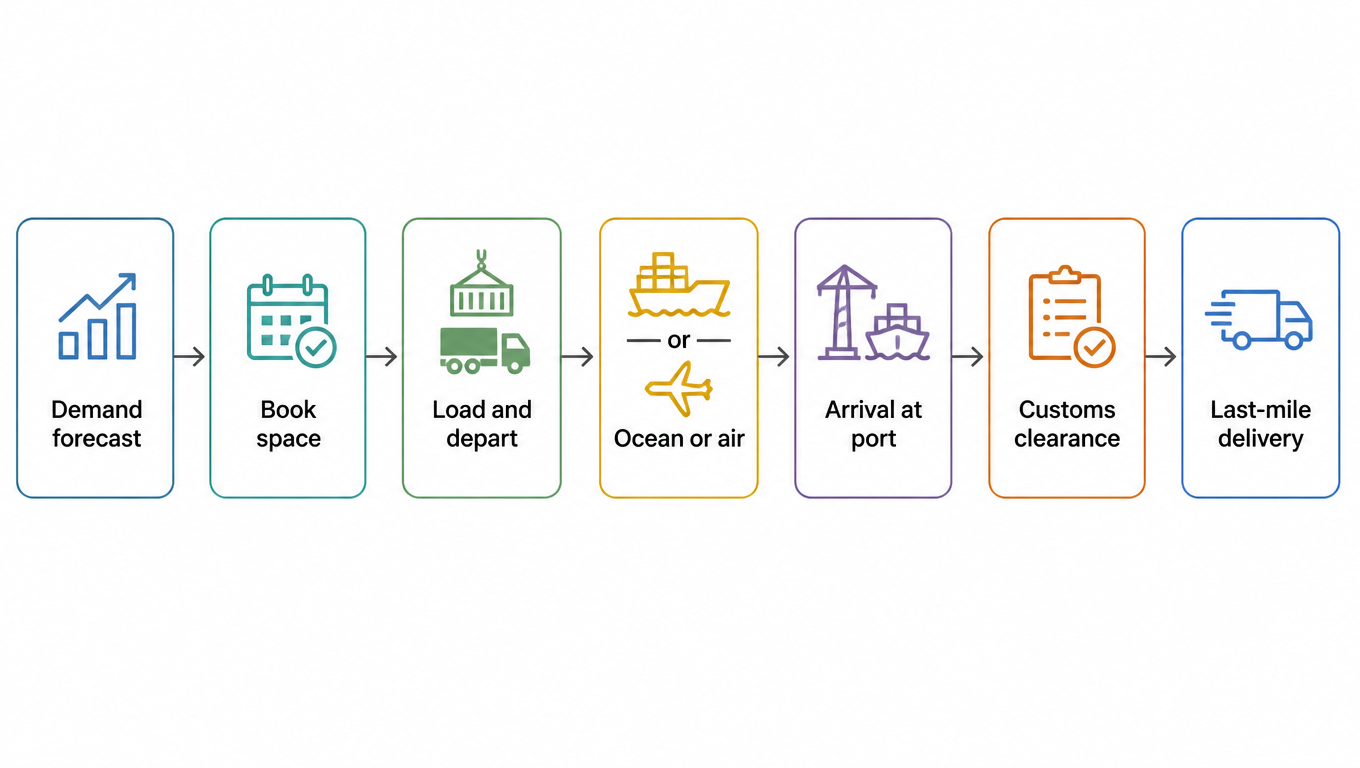
This article does not cover in-warehouse sorting or last-mile routing; those are topics for parcel shipping. We focus on four things from the cross-border shipper's point of view: demand forecasting, booking and capacity, customs compliance, and cross-border visibility, and we close with a framework for deciding where to start. The full chain looks like this:

Flowchart of the cross-border first-mile chain: demand forecast, book space, load and depart, ocean or air, arrival at port, customs clearance, last-mile delivery
The cross-border first-mile chain: from demand forecast to last-mile delivery
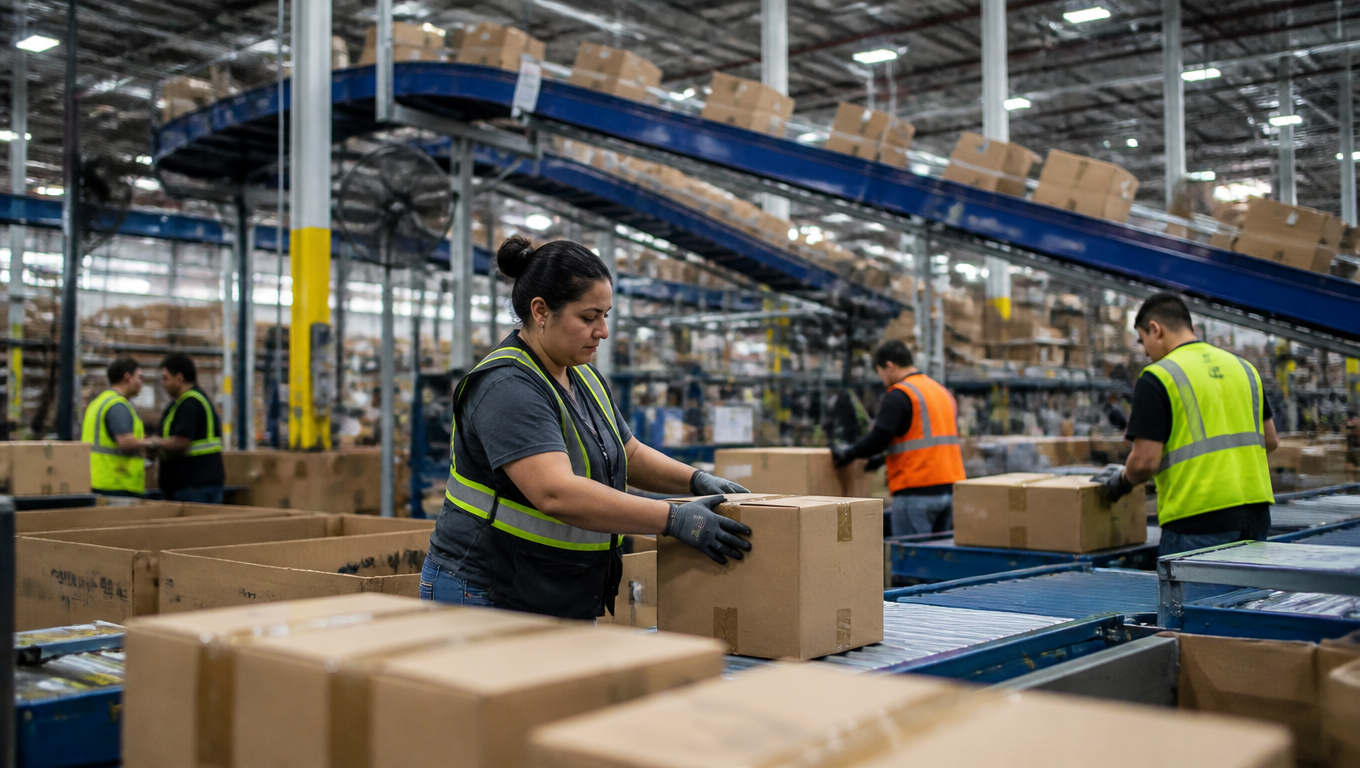
An automated container terminal with cargo data flows linking a ship, port and customs office.
The two ends of the cross-border chain, freight and clearance, are where AI scaled first

Demand Forecasting: From Gut Calls to Machine Learning

Demand forecasting is where AI has penetrated deepest and paid back first in the supply chain, for a simple reason: forecast error turns directly into inventory money. A McKinsey analysis cited on Maersk's website gives the number most often quoted: customers adopting predictive analytics see logistics costs fall 15% on average, inventory levels drop 35%, and service quality improve 65%.
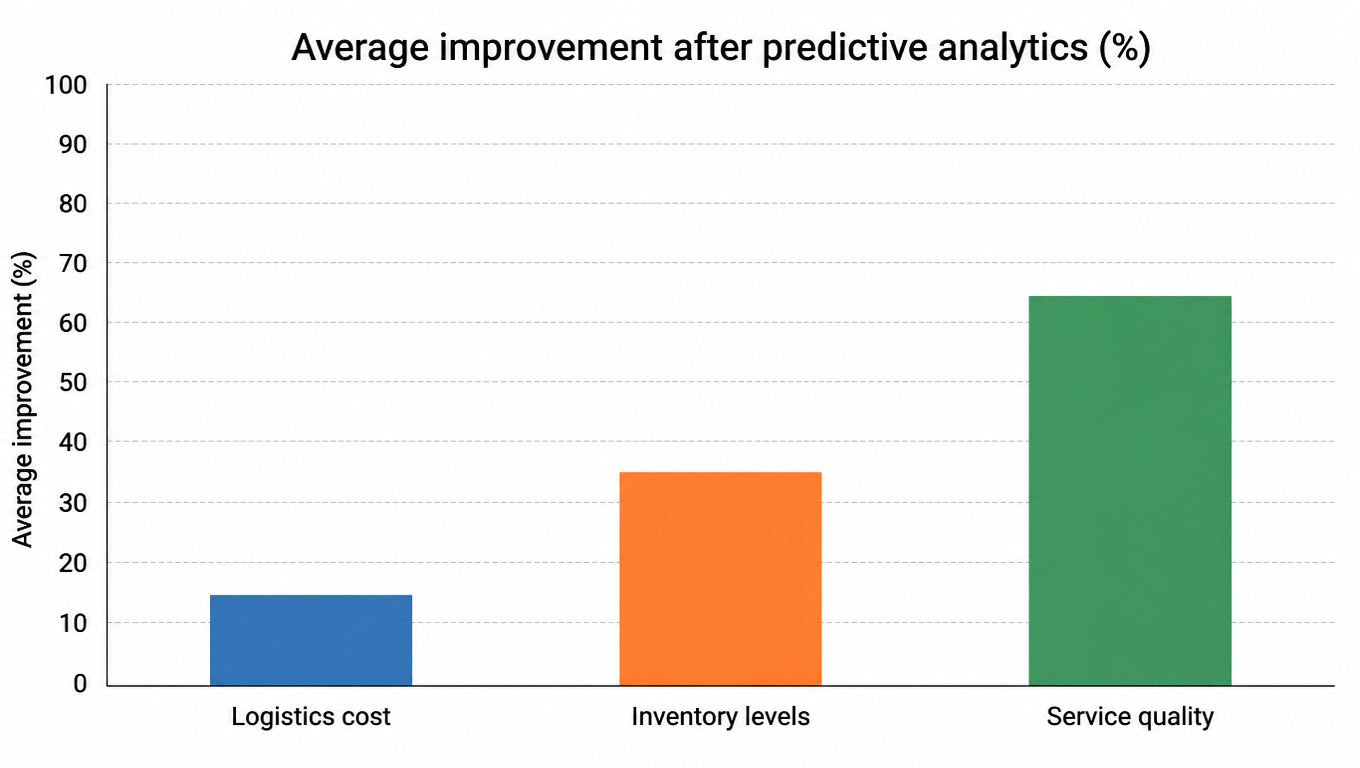
Bar chart of average improvement for Maersk customers after adopting predictive analytics: logistics cost down 15%, inventory down 35%, service quality up 65%
Average improvement for Maersk customers after adopting predictive analytics (%)

But cross-border is far harder than a domestic supply chain. Ocean freight lead times routinely run 30 to 60 days, which means the forecast you make today is betting on demand two months out, with schedule volatility from capacity swings, port congestion, and clearance delays layered on top. By the time the demand signal reaches the factory it is badly lagged. That is why cross-border players take a consistently pragmatic view of forecasting: they do not expect it to be perfectly accurate, only more accurate than a gut call, and the difference is profit.

Booking and Capacity: AI Enters the Freight Trade

Booking is the part of cross-border freight that most resembles a black market: rates swing wildly, capacity allocation is opaque, and the rate promised in the contract often does not match the invoice. Shippers decide on the strength of calls to contacts and a pile of Excel quotes, and forwarders make a living on the information gap.

Change has started to arrive in the last couple of years. In February 2025 Flexport released more than 20 AI-powered products at once. Flexport Intelligence lets users query supply chain data in natural language (for example, "which lanes have been delayed most in the last 30 days"), and Control Tower aggregates shipment status from factory to destination port into a single view, giving shippers a dashboard for their first mile for the first time.

Rate transparency is the other thread. Freightos brings real-time capacity from ocean carriers and airlines onto its platform, so shippers can confirm bookings 24/7 instead of waiting for a forwarder to reply during office hours. Xeneta takes the benchmarking route, covering actual contracted rates on more than 160,000 port-pair routes, and uses machine learning to predict where rates are heading (its Market Rate Outlook product), which is effectively a weather forecast for the rate market.

What these tools share is a shift of the capacity market from relationship-driven to data-driven: whose rate is real and which space can actually be locked are becoming facts that algorithms can compare and verify, not promises from a forwarder.

Customs and Compliance: The First Process AI Ate at Scale

Customs clearance is the most boring of all cross-border processes, and the first to be eaten at scale by AI. The reason is blunt: clearance pain points are many documents, messy formats, and manual entry errors, which happen to be exactly what AI is best at. The commodity name, HS code, origin, and value on a single customs declaration, entered line by line by hand, is slow and error-prone, and an error means detention, fines, and delay.

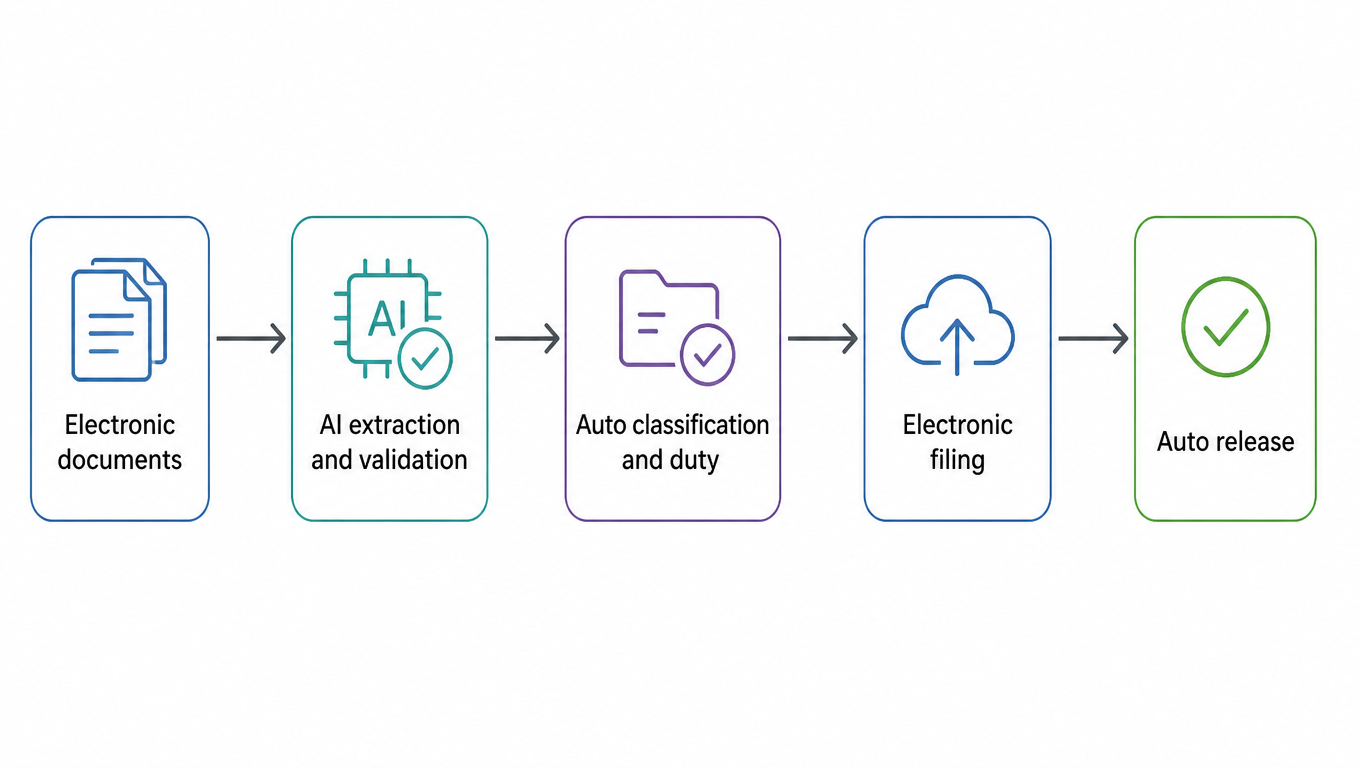
The ABBYY and CustomsTrack partnership provides the quantified footnote: AI document processing cuts clearance document handling costs by about 80%, automates 99% of customs declarations, and shortens processing time by more than 90%. European AI customs broker Digicust claims automation rates between 70% and 90%, freeing customs brokers from line-by-line data entry. In China, the China-Europe Railway Express "railway fast clearance" model has compressed port clearance from half a day to under half an hour, turning filing from a counter visit into one click.

Flowchart of straight-through customs processing: electronic documents, AI extraction and validation, auto classification and duty, electronic filing, auto release
Straight-through processing: from documents to automatic release

Why did clearance land before other processes? Because it satisfies three conditions at once: the data is highly structured (documents are structured information), errors are expensive (one bad declaration can hold an entire container), and the benefit is measurable (the time saved per shipment is calculable). When AI picks a process to attack, it never chooses the most glamorous one, only the most profitable one.

Cross-Border Visibility: End-to-End Transparency from Load to Release

For first-mile shippers, the experience of answering "where is my cargo" has long been stuck at a vague ETA from the carrier. Ocean, air, transshipment, and clearance each have their own systems, carriers operate in silos, and an ETA is often as useful as not checking at all.

Visibility platforms are using AI to stitch the chain together. project44's Movement platform integrates multimodal tracking data from ocean, land, and air onto one network, powered by the network effect of carrier coverage. FourKites claims ETA prediction accuracy of up to 95%, and its AI evaluates carriers automatically on cost, speed, and reliability and books on the shipper's behalf. For cross-border shippers the bigger change is that clearance progress is no longer a black box: when a shipment was filed, when it was inspected, when it was released are becoming queryable status events.

The value of visibility is not seeing, it is deciding. When a shipper can predict that a shipment will clear in 10 days and make the sale window, restocking, prepping, and presale plans can be made in advance. Visibility shifts from "checking where the cargo is" to "predicting when it can be sold."

A Framework for Getting Started: Not Whether, but Where

Having looked at every process, the real question for a cross-border shipper is not whether to use AI, but where to start. Here is a three-factor scoring framework:

  • Data maturity: is the data in this process already structured and accessible? Documents, rates, and tracking events are ready-made data sources, good candidates to start with; processes that depend on offline relationships should wait.
  • Cost of error: how much does one mistake cost? A wrong clearance declaration can hold and fine a whole container; high error cost means high AI payoff.
  • Ease of replacement: how hard is the existing manual process to replace? Steps with plug-and-play SaaS tools (AI customs filing, rate intelligence, visibility) are easier to start than ones requiring deep custom integration, such as building your own forecast model.

A bucket of cold water, by the way. Forbes research shows that although most organizations are increasing AI spending, fewer than 1% saw significant ROI in 2025. In PwC's CEO survey, more than half of CEOs said their previous AI investments had not paid off. In cross-border logistics, the processes where AI has proved itself (clearance, booking, visibility) and the ones where it has not (end-to-end predictive optimization) are separated by real data governance and process rework, which buying a tool does not cross.

For smaller players the path is clear: enter with a single SaaS point, AI customs filing, rate intelligence, or visibility. Pick the process where errors cost the most, prove the ROI, and only then consider building your own. Win one round first, then talk about the whole game.

Closing: Three Signals Worth Watching

The order in which AI has landed in cross-border logistics is the opposite of what most people assume. It did not start with the coolest process; it started with the most expensive, most repetitive, and dirtiest ones, and clearance and booking are exactly those places. Three signals are worth watching over the next 12 months: capacity APIs (more carriers and airlines turning space and rates into programmable interfaces), the spread of straight-through clearance (the share of human review keeps falling), and tariff and compliance automation (trade policy changes mapped automatically into filing rules). Every time one of these lights up, the cost structure of cross-border freight becomes a little more transparent.

FAQ

Customs clearance and booking. They satisfy three conditions at once: highly structured data (documents and rates are ready-made data), a high cost of error (one bad declaration can hold and fine a container), and a measurable benefit (the time saved per shipment is calculable). Demand forecasting follows close behind.
Lead time. Ocean freight runs 30 to 60 days, so today's forecast bets on demand two months out, with capacity swings, port congestion, and clearance delays layered on top. Cross-border players aim to be more accurate than a gut call, not perfectly accurate, and the difference is profit.
Start with a single SaaS point: AI customs filing, rate intelligence, or visibility. Pick the one where errors cost the most, prove the ROI first, and only then consider building your own. Do not start with a self-built forecast model.
It depends on the process. Clearance (about 80% cost reduction in the ABBYY and CustomsTrack case), booking, and visibility already show quantified returns. End-to-end predictive optimization is still early, and most organizations have not seen significant ROI yet. Look at data maturity and cost of error before investing.