Logistics Guide

How AI Is Changing Parcel Shipping: A Full-Chain Guide for 3PL and Fulfillment Owners

Over the past decade, most changes in parcel shipping were visible ones: bigger sorting hubs, more automation, faster delivery promises. Over the past two or three years, the change has moved to the invisible layer: how quotes are computed, which route a truck takes, and when a parcel will actually arrive are increasingly decided by models.

This guide follows the full chain, from the warehouse floor to the road to the customer, and covers where AI actually lands, real cases, the cost math, and the boundaries of the risk. It is written for owners and operations teams at 3PLs, fulfillment centers, and cross-border warehouses, so it skips theory and focuses on the accounting.

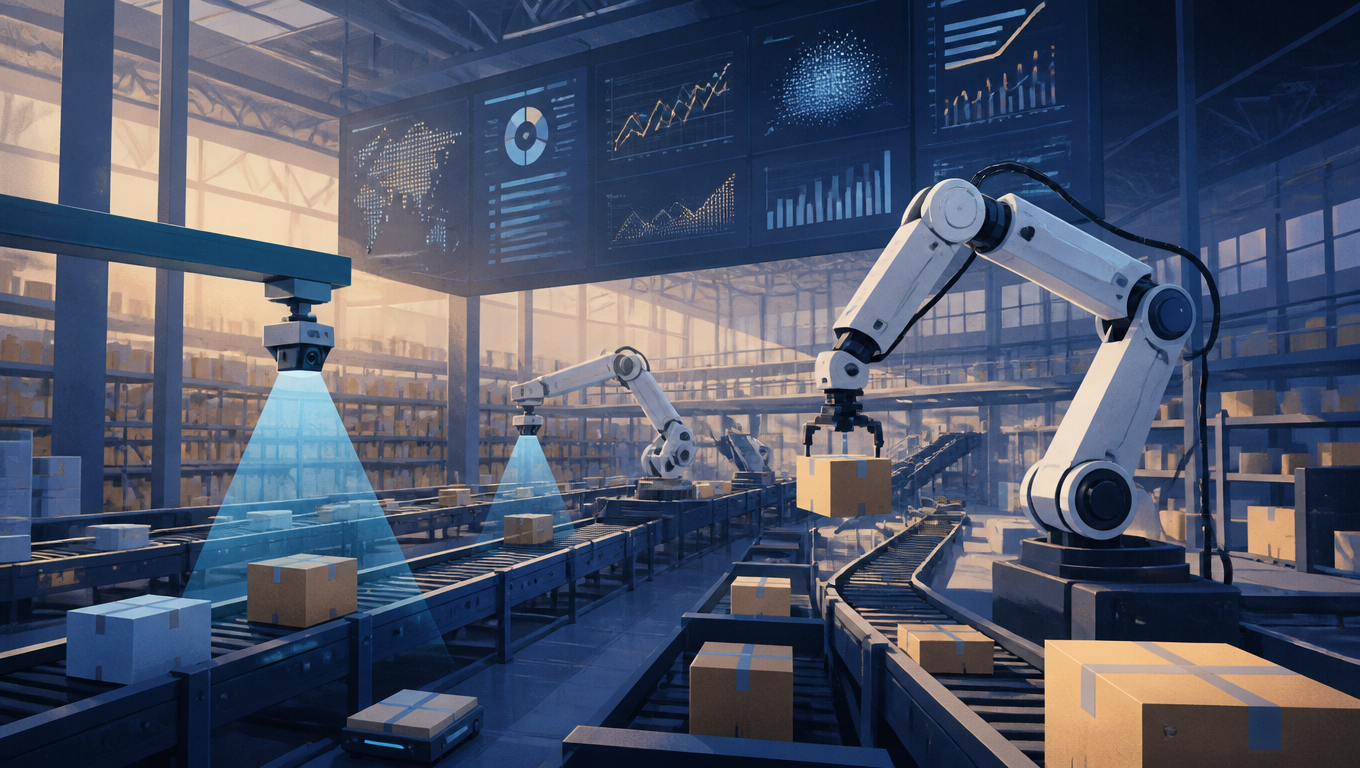
Robotic arms and camera systems sort parcels beneath a warehouse data display.
From the warehouse floor to the road to the customer, AI is rewriting every line of the parcel shipping ledger

Why Now: The Cost and Capacity Squeeze That Forced the AI Inflection

Let's start with the conclusion: this round of AI adoption was not sold by technology vendors, it was forced by the cost structure.

On the freight side, general rate increases, fuel surcharges, and peak-season surcharges stack on top of each other, making quotes increasingly unpredictable. A price set by experience used to hold for a year or two; now carrier policy can shift two or three times in a single quarter, and spreadsheets plus gut feel no longer keep up.

On the capacity side, warehouses and fleets are short on people. Loading, sorting, and delivery roles churn constantly, and peak-season temp labor is both expensive and hard to find. When labor gets pricier and scarcer, owners start running a different calculation: what a vision inspection point or a routing system costs, how many people it replaces, and how much it cuts error rates.

So AI's role changed. It is no longer the nice-to-have in a slide deck; it is the necessity the ledger forces once freight math stops adding up and hiring stops working.
In the Warehouse: Machine Vision and Smart Sorting

The warehouse is where AI adoption is most mature and pays back fastest.

Machine vision is the first building block. Measuring irregular parcels, reading barcodes, and capturing label data were traditionally manual work or the job of bulky dedicated equipment; now a camera plus a vision model can do it. DWS (dimensioning, weighing, scanning) vendors like CubiScan build scanning, weighing, measuring, and vision inspection into the same conveyor line, so even mid-size warehouses can add it module by module.

Defect detection goes a step further. Companies like Robovision run vision models as real-time quality gates on sorting lines, catching damaged parcels, loose labels, and missing shipping labels before they reach the next step instead of after a customer complains. The typical payback from this kind of point solution is roughly a 20% improvement in equipment uptime, on top of fewer mis-sorts and complaints.

Above that sit autonomous mobile robots (AMRs) and AI slotting. Pick paths, hot-item placement, and wave batching were once the judgment calls of a warehouse supervisor; now a model can compute them dynamically from order structure.

The key insight for small and mid-size warehouses: you do not need enterprise-scale automation on day one. Pick the most painful single point, such as label recognition errors or missed damage, deploy one vision inspection point, and you can see the change in the books within a quarter.

On the Road: Route Optimization from Gut Feel to Computed

Outside the warehouse, the most valuable AI use case is routing.

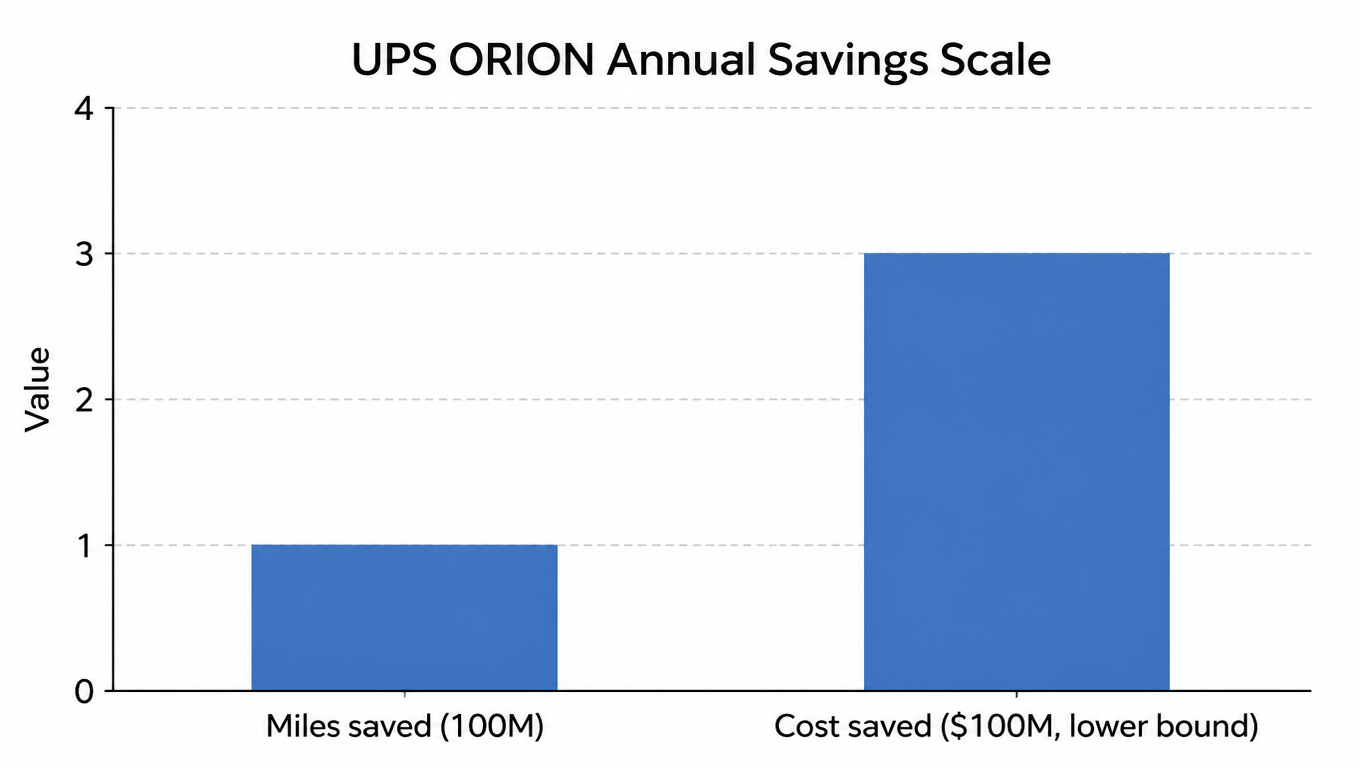
UPS's ORION system is the reference case. In 2024 UPS upgraded ORION to a dynamic version, adding machine learning to last-mile path computation. Public figures credit the system with saving about 100 million miles and $300 to $400 million a year, and by 2024 dynamic ORION was already live on 97% of the van fleet running ORION. For a 3PL, the takeaway is simple: even a fleet of a dozen trucks carries real diesel and labor costs in every 10% of redundant miles.

Bar chart of UPS ORION annual savings: 100 million miles saved and $300 million saved (lower bound)
UPS's public numbers for dynamic ORION: about 100 million miles and $300 to $400 million saved annually

The other frontier for the giants is teaching models from drivers. Amazon's Delivery Preference Model datafies the route knowledge experienced drivers accumulate in complex neighborhoods and applies it to last-mile optimization, and with MIT's Center for Transportation & Logistics Amazon ran the Last Mile Routing Research Challenge, where academic teams trained machine learning models on real route data to reproduce the choices of good drivers.

Small players should not copy ORION; instead they use SaaS routing tools for zone density management: clustering orders by ZIP code and delivery time window, merging routes, and cutting empty miles. These tools are subscription-based, and a month of one usually costs less than a day of one truck running empty.

The Cost Side: Dynamic Pricing, Multi-Carrier Comparison, and Freight Audit

For 3PLs and fulfillment centers, freight is the biggest cost line and the part AI rewrites most easily.

Real-time multi-carrier comparison is already mature. Multi-carrier platforms like Shippo and EasyPost expose rate cards, fuel surcharges, and live rates from dozens of carriers through one API, evaluating options in milliseconds at ship time and answering "which carrier is cheapest for this parcel, and when does it arrive?" What used to take a salesperson half a day of calling around now happens seconds before a label is printed.

The bigger change is the pricing model itself. FedEx, UPS, and even USPS are moving from fixed rate cards toward dynamic pricing, and larger shippers increasingly get prices that are computed rather than printed. For small forwarders and 3PLs, the spread business built on published rate cards is shrinking, and the ability to quote well is becoming the product.

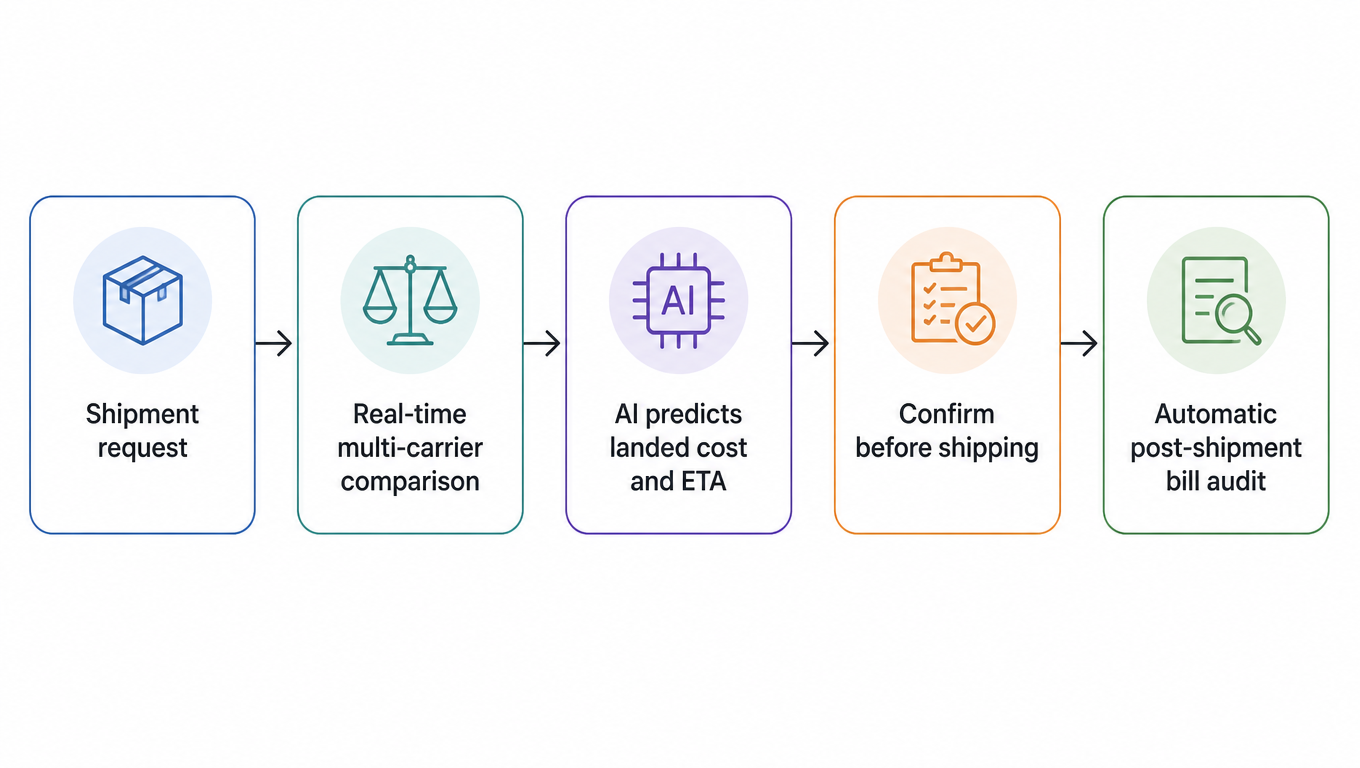
Freight audit is shifting from after-the-fact recovery to before-the-fact modeling. Instead of checking every invoice after it arrives and clawing back overcharges, historical data now predicts what a shipment should cost before it ships, and overruns can be blocked in advance. The flow looks like this:

Flowchart of pre-shipment freight audit: shipment request, real-time multi-carrier comparison, AI predicts landed cost and ETA, confirm before shipping, automatic post-shipment bill audit
Block overruns before shipping; audit invoices automatically afterward

Catching an overrun before shipping is far cheaper than recovering it afterward. It saves not just money but reconciliation headcount, plus the customer friction that billing disputes create.

The Customer Side: ETA Prediction, Exception Alerts, and AI Support

On the customer side, the change is from explaining after the fact to informing in advance.

ETA is the first upgrade. Instead of a rough window from the carrier and a tracking page to refresh, probabilistic predictions based on live data now answer "92% chance of delivery before 6 pm today", so both customers and operations can plan ahead.

Exception alerts are the second. When the model senses risk in tracking and weather data, a delay, an address change, or an unusual signature, it reaches the customer and the ops team automatically, before anyone asks "where is my parcel?" For fulfillment centers, this line maps directly to complaint and return rates.

The third is AI support and ticket triage. Routine questions, tracking, address changes, and claims intake go to a bot, and humans only handle exceptions that need judgment. The cost saving is headcount; the experience win is response speed.

Data Is the Fuel: The Prerequisite for AI

Every use case shares one prerequisite: data.

Shipments, labels, API integrations, and tracking pushes set the ceiling for any model. Garbage in, garbage out holds especially true in logistics: low label-recognition rates, misaligned fields, and flaky carrier connections waste even the best model.

Many owners think AI adoption starts with buying software. It actually starts with accumulating data. Clean historical freight data makes cost prediction and auditing possible; enough tracking data makes ETA models accurate. Small and mid-size warehouses can start with three datasets: per-shipment freight invoices, carrier transit and exception records, and in-house operations logs. Data first, models second.

The Adoption Roadmap for Small and Mid-Size 3PLs

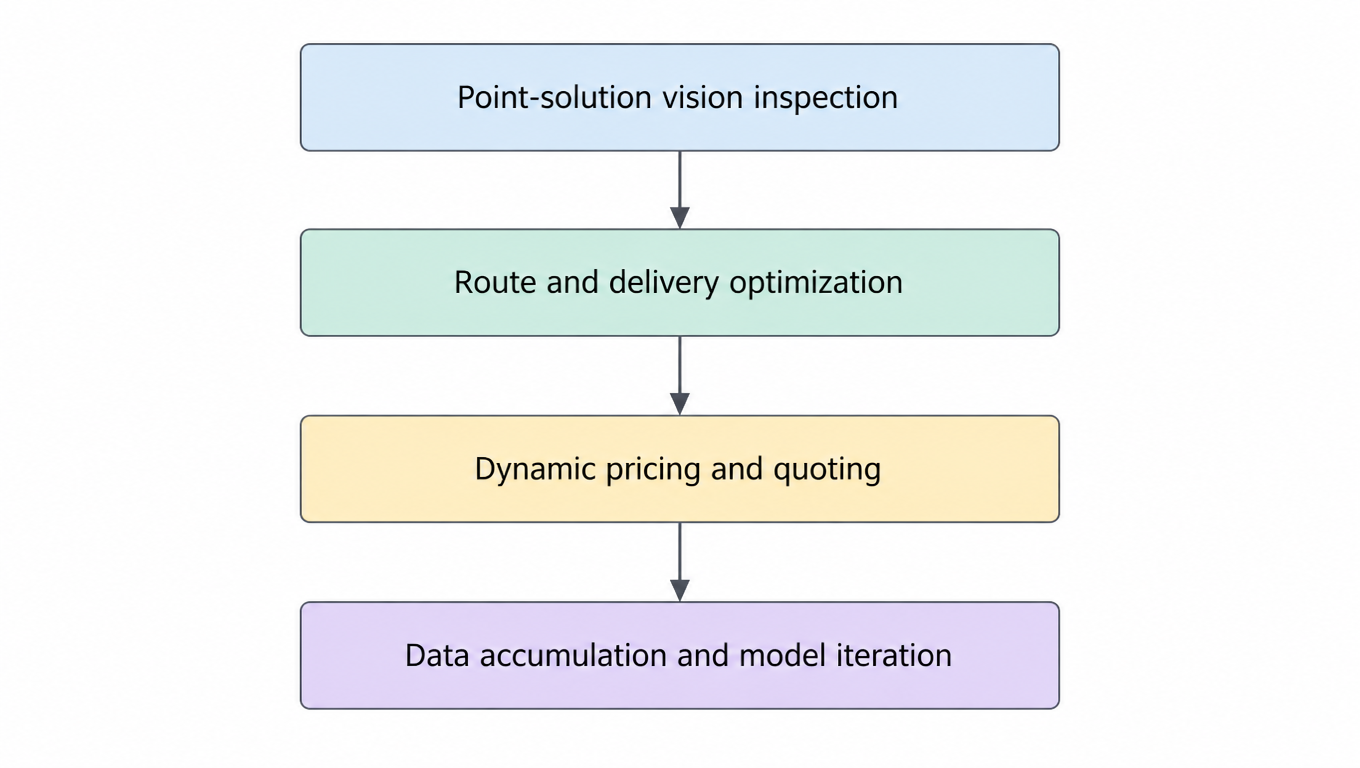
You cannot copy the giants' playbook, but you can borrow their sequence: single point first, systems second, ordered by ROI.

Flowchart of the AI adoption roadmap: point-solution vision inspection, route and delivery optimization, dynamic pricing and quoting, data accumulation and model iteration
Single point first, systems second, ordered by ROI

Priority one is in-house point inspection: small investment, fast payback, visible in mis-sort rates and complaints. Priority two is route optimization for fleets and regional delivery, saving diesel and labor. Priority three is dynamic pricing and quoting, which depends on the data accumulated in the first two steps. Between steps, keep accumulating data and metrics as fuel for the next one.

On tooling, SaaS first. Vision inspection, route optimization, and freight audit all have mature subscription products; rent before you buy, and avoid building models or hiring an algorithm team at the start. Only consider building in-house once data volume and complexity make it cheaper.

Measure returns with three numbers: cost per shipment, error rate, and on-time rate. Record the baseline of all three before any AI project, compare after a quarter, and kill any project that cannot prove its math.

Risks and Boundaries: AI Is Not a Panacea

A reality check: AI has clear boundaries.

First, data privacy and carrier terms. Before feeding customer and shipment data into third-party models, confirm data-usage boundaries and compliance requirements, especially cross-border data transfers.

Second, hallucination. AI produces confidently wrong suggestions, a wrong delivery promise or a miscomputed quote. Critical decisions need human review; the model's output is a recommendation, not a conclusion.

Third, vendor lock-in. Once data, interfaces, and workflows grow on a vendor's model, migration costs can become prohibitive. Make "can we take our data with us" a hard selection criterion.

Finally, the human layer. Exception handling, key account relationships, and negotiation still belong to people. AI changes how parcel shipping is priced and planned; it does not change who is trusted.

FAQ

Start with the most painful single point in the warehouse: machine vision for label recognition or damage detection. It is a small investment and shows up in mis-sort rates and complaints within a quarter. Then move to route optimization and dynamic pricing in ROI order. Do not build models at the start; SaaS first, rent before you buy.
Yes. The biggest public example is UPS ORION, which saves about 100 million miles and $300 to $400 million a year. For a small fleet, 10% of redundant miles is real diesel and labor, and a month of a SaaS routing tool usually costs less than a day of one truck running empty.
FedEx, UPS, and even USPS are moving from fixed rate cards toward dynamic pricing, which squeezes the spread business built on published rate cards. The ability to quote well is becoming the product, so 3PLs need real-time multi-carrier comparison and data-driven quoting built into their shipping flow instead of manual price hunting.
AI replaces the repetitive, predictable work: rate comparison, initial route computation, exception triage, and routine support. Exception handling, key account relationships, and negotiation still belong to people. The right posture is models for the routine, people for the exceptions.

Ready to put AI-era quoting power into your label workflow?

EasyShippingX bakes real-time multi-carrier comparison, intelligent routing, and freight verification into your shipping flow, so every label is priced by the rules and quoting power becomes your product.