3PL 指南3PL Guide

小型 3PL 仓储管理系统怎么选:8 款 WMS 横向对比(2026)Best Warehouse Management System for Small 3PLs: 8 Systems Compared (2026)

经营一家小型第三方物流(3PL)公司,意味着同时要管好几个客户账户、一支精简的仓库团队,以及薄得不能再薄的利润。你不是那种配有自建 IT 部门的大履约中心。你是那个凌晨两点收到"客户订单卡住了"消息的人,你需要一套软件,让按客户计费、拣货打包、承运商对账这些事像自动化流程一样顺畅,而不是靠人硬扛。Running a small third-party logistics (3PL) operation means juggling multiple client accounts, a lean warehouse team, and razor-thin margins. You are not a fulfillment giant with an in-house IT department. You are the person who gets the 2 a.m. message that a client's orders are stuck, and you need software that makes per-client billing, pick-and-pack, and carrier reconciliation feel automatic instead of heroic.

A tidy small 3PL warehouse with labeled shelves, a worker scanning a box with a handheld barcode scanner

一套真正的仓储管理系统(WMS),是区分"两人作坊"和"一门生意"的东西。只有一两个客户、每月几百单的时候,Excel 和通用 ERP 还够用。可一旦客户超过两三家,裂缝就出来了:仓储费靠手算、订单被分到错误的客户账户、面单从错误的承运商账户打印出来、库存数字没人敢信。专为 3PL 设计的 WMS 恰恰解决这些问题,因为它围绕普通库存软件没有的那件事来设计:按客户计费和运营。A real warehouse management system (WMS) is what separates a two-person operation from a business. Spreadsheets and a generic ERP work while you have one or two clients and a few hundred orders a month. The moment you pass two or three clients, the cracks show: storage fees computed by hand, orders allocated to the wrong client account, labels printed from the wrong carrier, and an inventory count nobody trusts. A WMS built for 3PLs solves exactly these problems, because it is designed around the one thing a plain inventory tool is not: billing and operations per client.

这份指南对比了小型 3PL 真正在用的八套系统:五款来自美国市场,三款国产系统在跨境团队中很受欢迎。每一款你都看得到核心功能、计费模式、坦诚的优缺点,以及最适合哪类运营。文末还有一张并排功能对比表和一套决策框架,让你用一个下午就能完成初筛,而不是花一个月泡在各种演示里。This guide compares eight systems that small 3PLs actually use, five from the US market and three China-built systems popular with cross-border teams. For each one you get the core features, the pricing model, the honest pros and cons, and the type of operation it fits best. There is also a side-by-side feature table and a decision framework, so you can shortlist in an afternoon instead of burning a month of demos.

关于价格先说一句:文中所有数字都是 2026 年年中的公开挂牌价,按询价出售的产品都标注了"询价制"。实施通常还要另外收费,所以把这些数字当作地板价,而不是总价。A note on pricing: all figures are published list prices as of mid-2026, and anything sold by quote is marked "quote-based." Implementations often cost extra, so treat the numbers as the floor, not the total.

这 8 款是怎么选出来的How We Picked These 8

小型 3PL 的 WMS 首先得做好一件事:把客户分开,把账算对。其他都是附加功能。我们按真正会咬到 5 到 50 人仓库的标准来打分:A WMS for a small 3PL has to do one job before anything else: keep clients separate and bill them correctly. Everything else is a feature. We scored candidates against the criteria that actually bite in a 5-to-50-person warehouse:

  • 多客户计费。按客户分别计仓储、入库和履约费用,能出具客户级发票,而不是共用一个库存池。Multi-client billing: per-client storage, receiving, and fulfillment billing with client-level invoicing, not just a shared inventory pool.
  • 条码扫描。入库、上架、拣货、出库全流程都能用扫码枪或移动设备驱动,因为靠手敲 SKU 是撑不大的。Barcode scanning: receiving, putaway, picking, and shipping flows driven by scanners or mobile devices, because typing SKUs does not scale.
  • 电商平台对接。Shopify、Amazon、Walmart、TikTok Shop 等平台连接器,自动拉取订单、回传物流跟踪号。E-commerce platform integrations: Shopify, Amazon, Walmart, TikTok Shop, and marketplace connectors that pull orders and push tracking automatically.
  • EDI。服务零售客户的 3PL 往往需要电子单据,而不只是消费者订单 API。EDI: for 3PLs serving retail accounts that require electronic documents, not just consumer-order APIs.
  • 承运商比价和面单打印。不用第二套系统就能比价并打印面单。Carrier rate shopping and label printing: compare rates and print labels without a second system.
  • 多语言、多币种。对有跨境客户、或团队本身讲多门语言的运营很重要。Multi-language and multi-currency: important for teams with cross-border clients or staff who work in more than one language.
  • 价格透明度。有公开价就标公开价,没有就明确标"询价制"。Pricing transparency: published prices where they exist, clearly marked quotes where they do not.
  • 跨境支持。FBA 备货、换标、退货、清关等流程,服务进出海外仓货物的团队都离不开。Cross-border support: FBA prep, relabeling, returns, and clearance workflows for teams moving goods into and out of overseas warehouses.

我们有意混合了两个阵营。美国市场的老牌产品(Extensiv、ShipHero、Cin7 Core、Logiwa、Fishbowl)在计费和零售 EDI 上很强,也主导着英文评测。国产系统(领星、极风、易仓)则为跨境而生:多语言界面、以平台为中心的订单管道、多币种计价。服务中国电商客户的美国 3PL,或者经营海外仓的中国团队,往往发现第二个阵营比第一个更合适。We deliberately mixed two families. The US-market incumbents (Extensiv, ShipHero, Cin7 Core, Logiwa, Fishbowl) are strong where billing and retail EDI matter, and they dominate English-language reviews. The China-built systems (Lingxing, Jifeng, ECCang) are built for cross-border flows: multi-language interfaces, marketplace-first order pipelines, and pricing in multiple currencies. A US-based 3PL serving Chinese e-commerce clients, or a China-based team running overseas warehouses, will often find the second family a better fit than the first.

仓储管理系统实施前的运营准备度Operational readiness before WMS implementation

选对系统只是第一道门。实施真正做的,是把仓库里默认靠经验运行的规则写进数据、权限和扫描步骤。流程没有统一、库存底数不可信、客户收费规则只存在于某个人的表格里时,系统不会自动修好这些问题;它会更快、更一致地放大它们。开始配置前,先过下面五道准备度关口。Choosing the product is only the first gate. Implementation converts rules that currently live in people's heads into data, permissions, and scan-controlled work. If processes are inconsistent, opening inventory is unreliable, or a client's rate card lives only in one person's spreadsheet, a WMS will not clean that up automatically; it will reproduce the ambiguity faster and more consistently. Clear these five readiness gates before configuration begins.

一、把正常流程和异常流程画到同一张图上1. Map the standard flow and the exception flow together

分别画出入库、质检、隔离、上架、补货、分配、拣货、包装、交接和退货流程,并标明每一步的触发条件、输入、输出、负责人和完成证据。不要只画“订单正常完成”的直线;缺货、超收、破损、条码无法识别、地址被承运商拒绝、订单分配后取消、客户要求返工,才是实施时最容易留下空白的地方。每个异常都要有负责人、允许的处理动作、客户通知规则和升级时限。若两个班组对同一种异常有两套做法,先统一运营规则,再让实施顾问配置。Map receiving, inspection, quarantine, putaway, replenishment, allocation, picking, packing, carrier handoff, and returns. For each step, name the trigger, input, output, owner, and evidence of completion. Do not map only the happy path. Shorts, overages, damage, unreadable barcodes, carrier address rejection, cancellation after allocation, and client-requested rework are where configuration gaps hide. Every exception needs an owner, allowed actions, client-notification rule, and escalation time. If two shifts handle the same exception differently, settle the operating rule before asking the implementer to configure it.

二、先清理主数据,再迁移库存2. Clean master data before migrating inventory

为每个客户和商品建立唯一编码,核对单件、内箱、整箱、托盘之间的计量单位换算,以及重量、尺寸、批次、序列号、有效期和存储要求。库位也要有唯一标识、类型、容量和可存放规则。甲骨文的仓储管理实施文档把商品、库位、计量单位和包装层级列为关键设置,并说明标准商品编码与扫描能减少交叉映射和录入错误,见 甲骨文仓储管理实施指南。迁移前做一次按“客户—商品—库位—批次或序列号”分层的实盘或受控循环盘点,处理负库存、重复商品、孤立库位和无法解释的占用量。旧系统里的错误余额不能因为成功导入新系统就变成正确库存。Give every client and item a unique identifier. Validate unit conversions across each, inner pack, case, and pallet, plus weight, dimensions, lot, serial, expiration, and storage rules. Locations need unique IDs, types, capacities, and item-eligibility rules too. The Oracle Warehouse Management Implementation Guide treats items, locators, units of measure, and packaging structures as core setup, and explains how standard product identifiers and scanning reduce cross-reference and entry errors. Before migration, perform a controlled physical or cycle count at client-item-location-lot/serial level. Resolve negative balances, duplicate SKUs, orphan locations, and unexplained allocations. A bad balance does not become good inventory merely because it imported successfully.

三、把客户合同改写成系统可执行的规则3. Translate client contracts into executable rules

逐个客户拆开收货、上架、仓储、订单、拣件、包装材料、退货、返工和最低消费等收费项,写清计费触发点、计量单位、阶梯、免收条件、四舍五入和人工调整权限。然后定义订单平台、购物车、承运商、会计和客户门户之间每个字段由谁维护:哪个系统是商品、库存、订单状态和追踪号的唯一事实来源;接口失败由谁收到告警;重试时如何避免重复订单和重复扣费。用同一批测试订单同时核对仓内动作、追踪事件和账单行。仓库流程通过、客户账单却算错,仍然不能上线。For each client, decompose receiving, putaway, storage, order, pick, packaging material, return, rework, and minimum charges. Define the billing trigger, unit, tier, waiver, rounding rule, and authority for manual adjustments. Then assign field ownership across the order platform, storefront, carriers, accounting system, and client portal: which system is authoritative for items, inventory, order status, and tracking; who receives interface-failure alerts; and how retries avoid duplicate orders or charges. Use the same test orders to reconcile warehouse actions, tracking events, and invoice lines. A flow that ships correctly but bills the client incorrectly is not ready for go-live.

四、在真实仓库里验证设备、网络和标签4. Validate devices, network, and labels on the actual floor

在收货月台、最高货架、冷库、笼车区和装车口测试无线网络,而不是只在办公室测试。用真实商品条码、客户标签、承运商面单和最差状态的打印样张验证扫描枪与打印机;确认操作员能够区分单件、整箱、托盘和库位条码。为断网、打印机故障、标签损坏和设备电量不足准备受控降级流程,规定哪些作业可以离线继续、哪些必须停止,以及恢复后如何补录而不制造重复交易。设备型号、耗材、备用机、充电和一线支持责任都要在培训前确定。Test wireless coverage at receiving docks, high racks, cold rooms, cage areas, and loading doors, not just in the office. Validate scanners and printers with real product barcodes, client labels, carrier labels, and deliberately poor print samples. Confirm that operators can distinguish each, case, pallet, and location codes. Define a controlled fallback for network loss, printer failure, damaged labels, and dead devices: which work may continue offline, which must stop, and how records are replayed without duplicate transactions. Set device models, consumables, spares, charging, and first-line support ownership before training begins.

五、按风险做验收测试和切换演练5. Test and rehearse cutover by risk

验收样本要覆盖最大客户、最大日单量、最复杂商品和最危险异常,而不是挑最容易通过的十单。至少跑通部分收货、超收与短收、批次或序列号、分批发货、分配后取消、补货不足、承运商拒单、退货和返工;再做一次峰值并发、库存迁移和彩排切换。微软的上线检查清单把用户验收、性能测试、系统集成、数据迁移验证、变更管理和上线支持分别列为上线条件,见 微软上线准备清单。小型仓库也可以缩小测试规模,但不能删掉这些风险类别。Your acceptance set should cover the largest client, peak-day volume, most complex items, and highest-risk exceptions, not the ten easiest orders. Run partial receipts, overages and shorts, lot or serial control, split shipments, cancellation after allocation, replenishment shortage, carrier rejection, returns, and rework. Then rehearse peak concurrency, inventory migration, and cutover. Microsoft's Dynamics 365 go-live checklist treats user acceptance, performance, system integration, migration validation, change management, and operational support as separate readiness conditions. A small warehouse can scale down the volume of testing; it should not delete the risk categories.

上线闸门:Go-live gate: 只有当期初库存按客户和库位核平、关键流程与异常都有负责人并通过验收、测试账单与合同一致、接口故障可监控可补偿、班组在真实设备上完成培训,而且切换失败时有明确回退方案,才安排生产切换。把这些条件写成签字清单;不要用笼统的“配置完成百分之九十”代替运营证据。Schedule production cutover only when opening inventory reconciles by client and location; critical flows and exceptions have owners and passed acceptance; test invoices match contracts; interface failures are observable and recoverable; every shift has trained on production-like devices; and a failed cutover has a named rollback path. Put those conditions on a signed checklist. “Configuration is 90 percent complete” is not operational evidence.

一图速览:核心功能对比表The Comparison Table at a Glance

下面这张表是 30 秒速览版。"原生"指能力内置;"部分"指要通过插件、合作伙伴或简化形态实现;"无"指不提供。说句公道话:国产系统是通过开放 API 对接平台,而不是传统零售 EDI,只有你的客户是美国零售商、点名要 EDI 850/856 单据时,这才算问题。The table below is the 30-second view. "Native" means the capability is built in; "partial" means it exists via an add-on, a partner, or a limited form; "no" means it is not offered. One honest caveat: the China-built systems integrate with marketplaces through open APIs rather than classic retail EDI, which matters only if your clients are US retailers demanding EDI 850/856 documents.

产品Product 最适合Best for 计费模式Pricing model 起步价Starting price 多客户计费Multi-client billing 扫码Barcode scanning 平台对接Platform integrations EDI 多语言/多币种Multi-lang / currency 试用Trial
Extensiv 3PL Warehouse Manager 需要按客户计费的小型专业 3PLSmall dedicated 3PLs needing per-client billing 订阅制Subscription $39/月 原生Native 原生Native 平台 + 承运商Marketplaces + carriers 原生Native 部分Partial 30 天30-day
ShipHero 以 Shopify 为主的 3PL 和 DTC 品牌Shopify-centric 3PLs and DTC brands 订阅制Subscription $1,995/月 原生Native 原生Native Shopify 原生 + 平台Shopify-native + marketplaces 部分Partial No 上线演示Onboarding demo
Cin7 Core 预算紧张、库存为先的运营Inventory-heavy ops on a tight budget 订阅制Subscription $349/月 部分Partial 原生Native 含 2 个,更高档位更多2 included, more on higher tiers No 部分Partial 免费试用Free trial
Logiwa 业务超出基础拣货、正在扩张的 3PLGrowing 3PLs scaling past basic picking 询价制Quote-based 询价Quote 原生Native 原生Native 电商 + 平台Ecommerce + marketplaces 原生Native No 演示Demo
Fishbowl 深度绑定 QuickBooks 的小型仓库Small shops deeply tied to QuickBooks 买断制One-time license $4,395(单用户) No 原生Native Shopify、Amazon、QuickBooksShopify, Amazon, QuickBooks No No 免费试用Free trial
领星 WMS 亚马逊为主的跨境团队Amazon-heavy cross-border teams 询价制Quote-based 询价Quote 原生Native 原生Native 60+ 平台60+ platforms 无(API)No (API) 原生Native 演示Demo
极风 WMS 想要 OMS + WMS 一体的双语团队Bilingual teams wanting OMS + WMS in one 询价制Quote-based 询价Quote 原生Native 原生Native 店小秘生态 + 平台Dianxiaomi ecosystem + marketplaces 无(API)No (API) 原生(7+ 语言)Native (7+ languages) 演示Demo
易仓 WMS 服务海外仓的中国 3PLChina-based 3PLs serving overseas warehouses 询价制Quote-based 询价Quote 原生Native 原生Native 30+ 平台30+ platforms 无(API)No (API) 原生Native 演示Demo

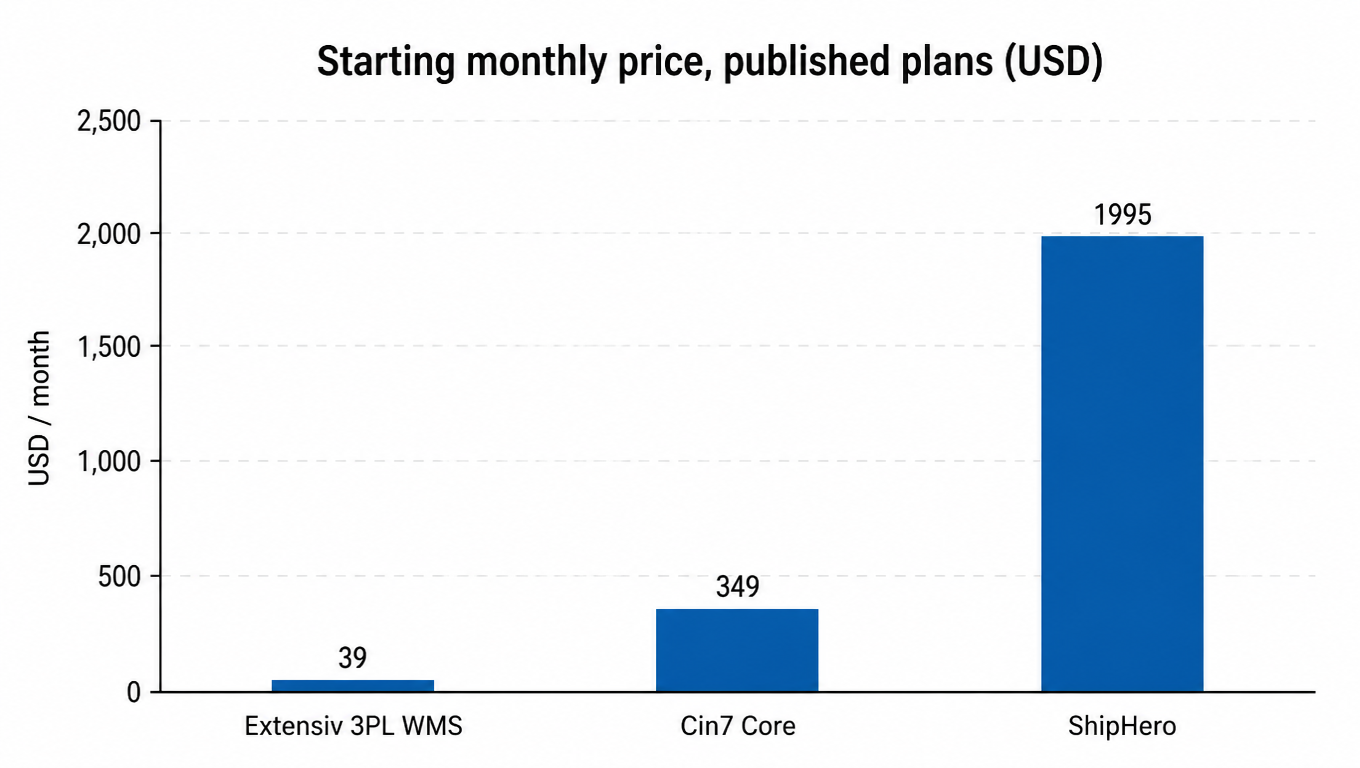
8 款里只有 3 款公布了挂牌价,而且跨度很大:Of the eight, only three publish list prices, and they span a wide range:

已公布套餐的起步月费对比(美元):Extensiv 3PL WMS $39、Cin7 Core $349、ShipHero $1,995Starting monthly price, published plans (USD): Extensiv 3PL WMS $39, Cin7 Core $349, ShipHero $1,995

Fishbowl 不在图里,因为它卖的是买断制永久授权(单用户约 $4,395 起),而不是月度订阅;Logiwa 和另外三款国产系统则是询价制。这个差距说明一件事:入门便宜不等于总价便宜,而那些月费上千美元的系统,贵的不是登录账号,而是内置的重型电商自动化。Fishbowl sits outside this chart because it sells a one-time perpetual license (from about $4,395 for a single user) rather than a monthly subscription, and Logiwa plus the three China-built systems price by quote. The spread tells you something useful: cheap entry does not equal cheap total, and the systems that charge $1,000-plus a month are pricing in heavy e-commerce automation, not just a login.

美国市场之选The US-Market Picks

这五款是大多数英文评测和软件目录里都会出现的系统。它们成熟、文档齐全,定价按美国运营场景设计。每款下面都有定位、核心功能、价格、优缺点,以及真正适合谁。These five are the systems you will see in most English-language reviews and software directories. They are mature, well-documented, and priced for US operations. Each section covers positioning, core features, pricing, pros and cons, and who it is actually for.

Extensiv 3PL Warehouse Manager(原 3PL Central)Extensiv 3PL Warehouse Manager (formerly 3PL Central)

Extensiv 3PL Warehouse Manager,业内仍习惯叫它旧名 3PL Central,是少数从第一天起就为 3PL 设计、而不是从库存工具长出来的 WMS。它最大的卖点是以计费为第一优先的架构:客户账户、按客户的仓储和履约费用、开票,都是系统里的核心对象,而不是事后补丁。对一个商业模式就是"向客户收仓储费"的小型运营商来说,这是最稳妥的默认选项。Extensiv 3PL Warehouse Manager, still widely known by its old name 3PL Central, is the rare WMS that was designed for 3PLs from day one instead of being an inventory tool that grew into one. The billing-first architecture is the headline: client accounts, per-client storage and fulfillment fees, and invoicing are core objects in the system, not afterthoughts. That makes it the safest default for a small operator whose whole business model is charging clients for warehousing.

功能上,它覆盖入库上架、扫码拣货、带承运商比价的发货,以及专门的 EDI 档位。对接常见的电商平台和平台市场,承运商列表也广,面单和物流跟踪都留在同一套系统里。报表是仓库视角的:仓储利用率、人工效率、按客户利润都是标准视图。On features, it covers receiving and putaway, barcode-driven picking, shipping with carrier rate shopping, and a dedicated EDI tier. It integrates with the usual e-commerce platforms and marketplaces, plus a broad carrier list, so labels and tracking flows stay inside one system. Reporting is warehouse-oriented: storage utilization, labor productivity, and per-client profitability are all standard views.

价格是这份指南里最透明的:四个公开档位,每月 $39、$99、$99、$199,其中第二个 $99 档加了 EDI,$199 的 Master Account 计划面向多仓运营。提供 30 天免费试用。Pricing is the most transparent of any product in this guide: four published tiers at $39, $99, $99, and $199 per month, where the second $99 tier adds EDI and the $199 Master Account plan is aimed at multi-warehouse operators. A 30-day free trial is available.

代价是它 3PL 专注的另一面。它首先是仓库工具,如果你的业务主要是零售库存管理或轻量制造,你会在用不上的功能上多花钱。评测里也提到界面比新 SaaS 产品显得老气,深度定制要走客服而不是自助。The trade-offs are the flip side of its 3PL focus. It is a warehouse tool first, so if your business is mostly retail inventory management or light manufacturing, you will be paying for capabilities you do not need. Reviews also flag that the interface feels dated next to newer SaaS products, and heavy customization runs through support rather than self-service.

最适合:需要开箱即用按客户计费、且想要公开可预期价格的小型专业 3PL。Best for: small dedicated 3PLs that need per-client billing out of the box and want published, predictable pricing.

ShipHero

ShipHero 在 Shopify 生态里长大,这一点体现得恰到好处:如果你的客户是 DTC 品牌,订单出现、分拣、发货、物流跟踪更新,整个流程就像店铺原生的。它服务的是电商履约的量,不是通用仓储,而这恰恰是很多小型 3PL 真正在跑的业务。ShipHero grew up inside the Shopify ecosystem, and it shows in the best way: if your clients are DTC brands, orders appear, get allocated, and ship with tracking updates that feel native to the storefront. It is built for e-commerce fulfillment volume, not general warehousing, which is exactly what many small 3PLs actually run.

核心功能围绕规模化拣货打包发货:波次拣货、批量拣货、组套与捆绑、退货处理,以及追踪工人效率与成本的人工管理。因为它先为品牌而生,库存可见性和订单状态都很出色,3PL 档位在基础上叠加了按客户隔离和计费。Core features center on pick, pack, and ship at scale: wave and batch picking, kitting and bundling, returns processing, and labor management that tracks worker productivity against cost. Because it was built for brands first, inventory visibility and order status are excellent, and the 3PL plan adds per-client separation and billing on top of that base.

价格是这份指南里门槛最高的:Standard 计划每月 $1,995 起,3PL 计划每月 $2,145 起,另加一次性上线费,定制开发按小时收费。没有公开的免费档,销售流程是演示,不是自助注册。Pricing is the highest floor in this guide: the Standard plan starts at $1,995 per month and the 3PL plan at $2,145 per month, plus a one-time onboarding fee and hourly charges for custom development. There is no published free tier, and the sales motion is a demo rather than self-serve signup.

优点是速度和电商深度;缺点在价格和专注度。这个价位买的是订单吞吐自动化,低单量的运营会觉得不值;如果客户的销售主要走平台而不是 Shopify,大量原生功能就闲置了。The pros are speed and e-commerce depth; the cons are cost and focus. At that price point you are paying for order-throughput automation, so a low-volume operation will see poor value, and if your clients sell through marketplaces more than Shopify, a lot of the native polish goes unused.

最适合:以 Shopify 为中心的小型 3PL,尤其是客户是有真实单量的 DTC 品牌那种。Best for: Shopify-centric small 3PLs, especially ones whose clients are DTC brands with real order volume.

Cin7 Core

Cin7 Core(原 DEAR Inventory)从库存这一侧切入问题。它首先是多渠道库存和订单管理系统,仓库流程是叠加上去的,也是美国名单里最便宜的正经入门选择。对小 3PL 来说,如果痛点是跨渠道库存准确度,而不是复杂的仓库自动化,这个取舍往往是对的。Cin7 Core (formerly DEAR Inventory) comes at the problem from the inventory side. It is a multichannel inventory and order management system first, with warehouse workflows layered on, and it is the cheapest serious entry point in the US list. For a small 3PL whose pain is stock accuracy across channels more than complex warehouse automation, that trade is often the right one.

它的强项是跨销售渠道和仓库的库存管理、采购订单与库存调拨、移动 App 扫码,以及电商平台、财务工具和 3PL 对接。Standard 计划含 3 个用户和 2 个电商对接,Pro 和 Advanced 档增加更多对接和自动化。Its strengths are inventory management across sales channels and locations, purchase orders and stock transfers, barcode scanning through mobile apps, and integrations with e-commerce platforms, accounting tools, and 3PLs. The Standard plan includes three users and two e-commerce integrations, with Pro and Advanced tiers adding more integrations and automation.

价格公开且简单:Standard 每月 $349,Pro $599,Advanced $999。有免费试用,订阅默认按年,预算要按一整年算。Pricing is published and simple: Standard at $349 per month, Pro at $599, Advanced at $999. There is a free trial, and the subscription is annual by default, so budget for the full year.

坦率的局限:Cin7 Core 不是真正的多客户计费系统。它管理多仓多仓点很在行,但按客户开票、仓储费计算、客户级报表不是它的原生模式。做传统 3PL 计费的团队要么外挂开票工具,要么用着用着就换掉了。它也没有原生 EDI,只有零售客户点名要求时才成问题。The honest limitation: Cin7 Core is not a true multi-client billing system. It handles multiple warehouses and locations well, but per-client invoicing, storage-fee calculations, and client-level reporting are not its native model. Teams doing classic 3PL billing usually bolt on invoicing or outgrow it. It also lacks native EDI, which matters only if retail accounts require it.

最适合:预算紧张、库存为重的运营,库存准确度比按客户仓储计费更重要的那种。Best for: inventory-heavy operations on a tight budget, where stock accuracy matters more than per-client warehouse billing.

Logiwa

Logiwa(现为 Logiwa IO)是面向高单量 DTC 和 3PL 运营的云端 WMS 与订单履约平台。Cin7 从库存出发,Logiwa 从吞吐出发:波次拣货、批量拣货、可对接自动化的流程,以及电商店铺和平台对接,是它宣传的核心。Logiwa (now Logiwa IO) is a cloud WMS and order fulfillment platform aimed at high-volume DTC and 3PL operations. Where Cin7 starts with inventory, Logiwa starts with throughput: wave picking, batch picking, automation-ready workflows, and integrations with e-commerce stores and marketplaces are the core of the pitch.

差异化在于速度。它接入新店铺和新平台很快,跑数字化仓库流程减少走动和扫描时间,还自带 3PL 需要的计费和客户管理。对正在超越基础拣货、想看起来像大得多运营的小型 3PL,Logiwa 是顺理成章的升级。Its differentiators are speed-oriented. It connects quickly to new stores and marketplaces, runs digital-warehouse workflows that reduce walking and scanning time, and includes billing and client management for 3PLs. For a small 3PL that is growing past basic pick-pack and wants to look like a much bigger operation, Logiwa is the natural step up.

价格是询价制。官方立场是"有增长野心的 3PL 不适合一刀切定价",所以流程是电话沟通加定制报价;第三方目录常引用的入门价约每月 $300,只当参考,不是公开价。Pricing is quote-based. The official position is that a one-size price does not fit growth-minded 3PLs, so expect a discovery call and a custom quote; third-party directories commonly cite entry pricing around $300 per month, but treat that as indicative, not published.

代价:因为价格和实施都是定制的,采购流程比自助档位慢;平台为单量优化,很小的仓库可能为暂时用不上的自动化买单。好处是它比预算型工具能走得更远,不用逼你再来一次迁移。The trade-offs: because pricing and implementation are custom, the buying process is slower than a self-serve tier, and the platform is optimized for volume, so a very small warehouse may pay for automation it cannot use yet. On the upside, it scales further than the budget tools without forcing a second migration.

最适合:业务超出基础拣货、正在扩张,想要波次拣货、自动化和平台速度集于一身的 3PL。Best for: growing 3PLs that are scaling past basic picking and want wave picking, automation, and marketplace speed under one roof.

Fishbowl

Fishbowl 是 QuickBooks 原生的老牌选手。大多数人买它就是因为双向 QuickBooks 同步:库存变动直接进财务,不用二次录入,对两人后厨式小仓库是实打实省时间。它有本地部署,现在也提供云订阅,而且是这份指南里唯一仍按永久授权售卖的产品。Fishbowl is the QuickBooks-native veteran. Its two-way QuickBooks sync is the reason most small shops buy it: inventory movements update accounting without double entry, which is a genuine time-saver for a warehouse run by a two-person back office. It is available on-premise and now as a cloud subscription, and it is the only product in this guide still sold as a perpetual license.

核心功能覆盖库存控制、扫码、入库和出库,更高版本还有制造和批次追踪。订单对接 Shopify 和 Amazon,QuickBooks 关系始终是整个产品的锚点。对活在 QuickBooks 里的小型 3PL,光这一个对接就值回票价。Core features cover inventory control, barcode scanning, receiving and shipping, and manufacturing and lot tracking in the higher editions. It integrates with Shopify and Amazon for orders, and the QuickBooks relationship remains the anchor of the whole product. For a small 3PL that lives in QuickBooks, that single integration can justify the system by itself.

Fishbowl Warehouse 单用户永久授权约 $4,395 起,随用户数和版本上涨(大配置能远超 $20,000)。现在也提供云订阅选项。有免费试用。Pricing starts around $4,395 for a single-user perpetual license of Fishbowl Warehouse, scaling up with users and edition (larger configurations can run well past $20,000). Cloud subscription options are also offered now. There is a free trial.

局限是结构性的。它是单公司工具:没有原生多客户计费、没有按客户仓储费、没有 3PL 专属开票。需要这些流程的团队只能在系统外管客户,或者再叠一层计费工具。桌面版要求 Windows,而且出了名的难上手。The limitations are structural. It is a single-company tool: no native multi-client billing, no per-client storage fees, no 3PL-specific invoicing. Teams that need those workflows manage clients outside the system or layer a billing tool on top. It also requires Windows for the desktop product and has a reputation for a steep setup.

最适合:深度绑定 QuickBooks、需要扎实的单公司库存控制、并且愿意在 WMS 之外管理客户计费的小型仓库。Best for: small shops deeply tied to QuickBooks that need solid single-company inventory control and are comfortable managing client billing outside the WMS.

跨境团队之选:国产三款The China-Built Picks for Cross-Border Teams

Shipping containers stacked at a busy port with parcels in the foreground, cross-border logistics scene

下面这三款产自中国,是跨境电商履约里默默干活的主力。它们为不同于美国老牌产品的流程而生:卖家在中国、库存和客户在海外,以平台为中心的订单管道把 Amazon、TikTok、Temu 当一等公民。如果你的客户是跨境卖家,或者你自己的运营横跨太平洋两岸,这三款值得认真考虑,而且它们都是询价制。The three systems below are built in China and are the quiet workhorses of cross-border e-commerce fulfillment. They were designed for a different flow than the US incumbents: sellers and warehouses in China, inventory and customers overseas, and a marketplace-first order pipeline that treats Amazon, TikTok, and Temu as first-class citizens. If your clients are cross-border sellers, or your own operation spans both sides of the Pacific, these are worth serious consideration, and they all price by quote.

领星 WMSLingxing WMS (领星 WMS)

领星在海外最出名的身份是亚马逊卖家 ERP,领星 WMS 是它的海外仓业务线。系统围绕"代理仓"模式构建:分代理仓和主仓的架构隔离客户数据,支持配置按客户的计费方案,自动为每个账户计算费用、成本和利润。对跨境 3PL 来说,这相当于 Extensiv 的计费优先设计,只是调校到了中国卖家市场。Lingxing is best known in the West as an Amazon seller ERP, and Lingxing WMS is its overseas-warehouse arm. The system is built around the "agency warehouse" model: a split-agent and main-warehouse architecture that keeps client data isolated, lets you configure per-client billing plans, and automatically computes fees, costs, and profit for each account. For a cross-border 3PL, that is the equivalent of Extensiv's billing-first design, tuned to the China seller market.

功能上相当深:对接 60 多个电商平台和市场、60 多家物流承运商,整合 6000 多家海外仓和 300 多套物流系统,订单全网自动下发。支持 FBA 备货换标、多仓库存、多币种对账,还能对接领星 ERP 和妙手、通途等第三方 ERP,ERP 对接免费。报表覆盖人工效率、进出库费率、仓容和按客户分析。Feature-wise it is deep: connections to 60-plus e-commerce platforms and marketplaces, 60-plus logistics carriers, and integration with 6,000-plus overseas warehouses and 300-plus logistics systems, with automatic order pushdown across the network. It handles FBA prep and relabeling, multi-warehouse inventory, and multi-currency reconciliation, and it plugs into Lingxing ERP and third-party ERPs such as Miaoshou and Tongtu with free ERP integrations. Reporting covers labor efficiency, inbound and outbound rates, storage capacity, and per-client analytics.

价格是询价制,符合品类惯例。免费的 ERP 对接和周更的产品迭代口碑稳定,亚马逊生态的深度意味着 FBA 为主的客户走原生流程,而不是靠变通方案绕。Pricing is quote-based, typical for the category. The free ERP integrations and the weekly feature releases get consistent praise, and the Amazon-ecosystem depth means FBA-heavy clients are handled natively rather than through workarounds.

代价:骨子里以亚马逊为中心,客户主要在亚马逊之外卖的,价值会打折;文档和支持面向中文团队,虽然产品本身支持跨境运营。The trade-offs: it is Amazon-centric at heart, so a client base that sells mostly off-Amazon gets less value, and documentation and support are oriented toward Chinese-speaking teams, though the product itself supports cross-border operations.

最适合:以亚马逊履约为主的跨境团队,尤其是已经在用领星 ERP、或服务的卖家在用的那种。Best for: cross-border teams running Amazon-heavy fulfillment, especially those already on Lingxing ERP or serving sellers who are.

极风 WMSJifeng WMS (极风 WMS)

极风 WMS 来自店小秘,中国最大的跨境 SaaS 厂商之一,把仓储、物流、库存、订单、客户管理打包成一个产品。卖点是一体化:店小秘 ERP 上的卖家把商品和订单推给仓库,仓库在同一生态里完成履约,消灭了一整类同步 bug。Jifeng WMS is the overseas-warehouse system from Dianxiaomi (店小秘), one of the largest cross-border SaaS vendors in China, and it packages warehouse, logistics, inventory, orders, and customer management into one product. The pitch is integration: sellers on Dianxiaomi ERP push products and orders to the warehouse, and the warehouse executes fulfillment inside the same ecosystem, which removes a whole class of sync bugs.

对国际化团队,它最突出的是语言。界面支持 7 种以上语言,包括英语、中文、印尼语、越南语、泰语、葡萄牙语、西班牙语、日语、韩语、俄语,如果你的员工和客户母语不同,这点很关键。计费是另一个强项:按客户计费策略、费用自动计算,还有预充值自动扣费模式,客户充值后订单直接流转。官方称一天即可上线,配套 24/7 支持和 1:1 实施顾问。Its standout for international teams is language. The interface ships in seven-plus languages including English, Chinese, Indonesian, Vietnamese, Thai, Portuguese, Spanish, Japanese, Korean, and Russian, which matters if your staff or your clients do not share a mother tongue. Billing is another strong point: per-client billing strategies, automatic fee calculation, and a pre-recharge model with automatic deduction, so clients can top up and orders just flow. Onboarding is claimed at one day, backed by 24/7 support and a 1:1 implementation consultant.

价格是询价制,背后是母公司的体量(17 年跨境 SaaS,服务 265 万+ 卖家)。Pricing is quote-based, with the parent company's scale (17 years of cross-border SaaS, 2.65 million-plus sellers served) behind it.

代价和它的强项互为镜像:客户来自店小秘生态时最强;和多数国产系统一样,传统零售 EDI 不是它的模式,平台 API 才是。如果你的客户是美国零售商、点名要 EDI 单据,回头选美国名单。The trade-offs mirror its strengths: it is strongest when clients come from the Dianxiaomi ecosystem, and like most China-built systems, classic retail EDI is not the model, marketplace APIs are. If your client base is US retailers demanding EDI documents, look at the US list instead.

最适合:想要 OMS 和 WMS 一体、还要跨语言界面服务员工和客户的双语团队。Best for: bilingual teams that want OMS and WMS in one system and a multi-language interface for staff and clients across borders.

易仓 WMSECCang WMS (易仓 WMS)

易仓科技是中国最大的跨境物流软件厂商之一,它的 WMS 被 500 多家海外仓使用。产品围绕四条业务线组织,直接对应跨境 3PL 真正在卖的东西:一件代发、退货换标、FBA 转运、清提派。如果你的收入是这四样的组合,这套系统从第一场演示起就讲你的语言。ECCang (易仓科技) is one of the largest China-based cross-border logistics software vendors, and its WMS is used by more than 500 overseas warehouses. The product is organized around four business lines that map directly to what a cross-border 3PL actually sells: dropshipping fulfillment (一件代发), return and relabel (退货换标), FBA transfer (FBA转运), and clearance, pickup, and delivery (清提派). If your revenue is a mix of those four, this system speaks your language from the first demo.

对接方面,易仓称无缝连接 Amazon、TikTok、Temu 等 30 多个平台,从手工或表格流程切换过来的团队,订单处理效率普遍提升约 50%。操作上很"吃硬件":出入库上架拣货支持 PDA 和条码枪,自动生成对账单和核销,把每月对账的苦差事省掉。退货换标这种吃利润的脏活,在系统里是一等公民流程,不是事后补丁。On integrations, ECCang claims seamless connections to Amazon, TikTok, Temu, and 30-plus platforms, with order processing efficiency improvements on the order of 50 percent cited for teams that switch from manual or spreadsheet workflows. Operations are hardware-friendly: inbound and outbound putaway and picking support PDA and barcode scanners, and auto-generated statements and reconciliation cut the monthly billing grind. Returns and relabeling, the messy work that eats margin, are first-class workflows rather than afterthoughts.

价格是询价制。公司还卖面向国际货代的 OMS 和更宽的套件,所以中国的运营方可以用同一家厂商的相邻系统跑仓库和货代。Pricing is quote-based. The company also sells an OMS for international freight forwarders and a broader suite, so a China-based operation can run warehouse and freight on adjacent systems from one vendor.

代价:和另外两款国产产品一样,EDI 不是原生模式;如果客户清一色是美国本土品牌,以平台为中心的功能集不是最佳匹配。它也是三款里最偏企业级的,很小的仓库可能会觉得实施的分量比轻量 SaaS 替代品重。The trade-offs: like the other China-built picks, EDI is not the native model, and if your client base is purely domestic US brands, the marketplace-centric feature set will not be the best fit. It is also the most enterprise-oriented of the three, so a very small warehouse may find the implementation weight heavier than a lighter SaaS alternative.

最适合:服务海外仓的中国 3PL,尤其是收入来自一件代发、退货换标、FBA 转运、清提派这四条经典跨境线的。Best for: China-based 3PLs serving overseas warehouses, especially those running the four classic cross-border revenue lines of dropshipping, relabeling, FBA transfer, and clearance.

到底该选哪一款Which One Should You Pick?

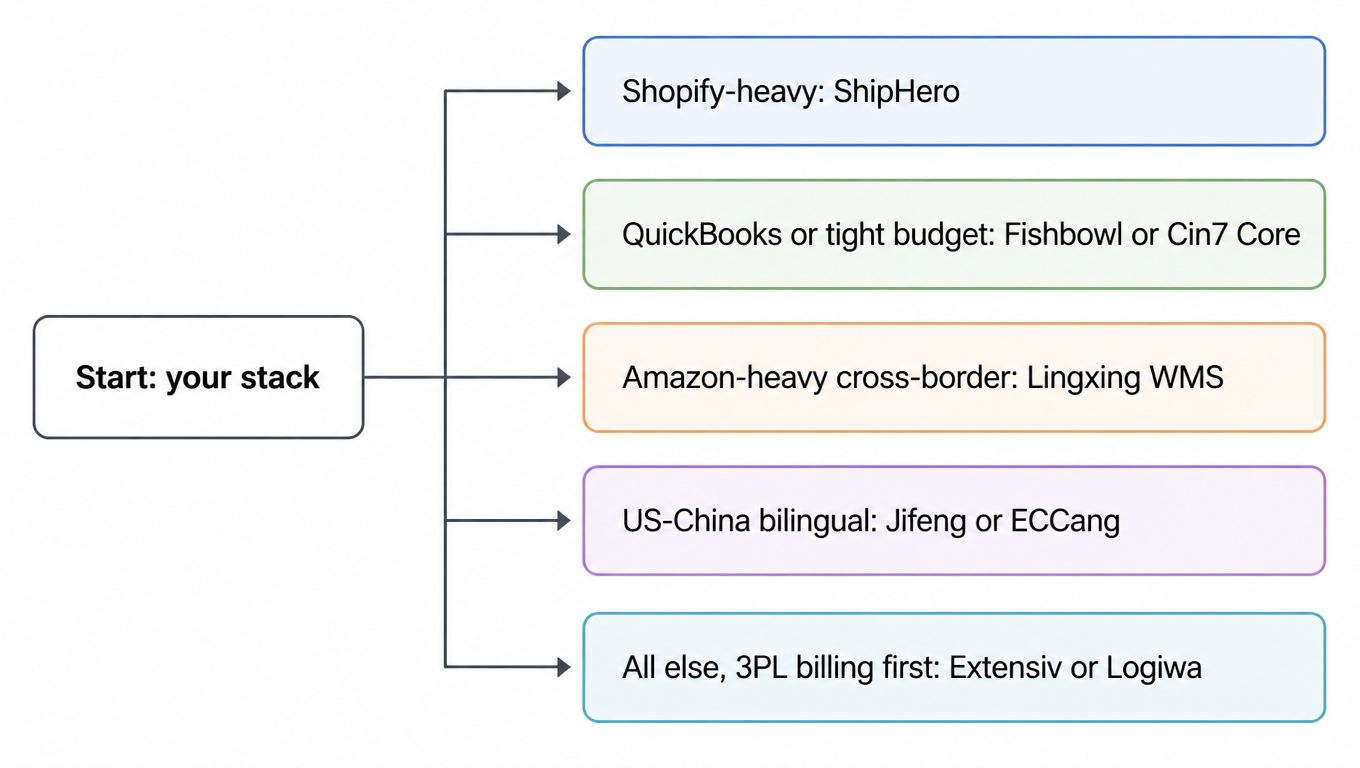
正确答案取决于你的客户结构,而不是谁的 Logo 最好看。按场景对号入座:The right answer is a function of your client stack, not of which system has the best logo. Walk through the scenarios:

  • 客户是 Shopify 品牌。选 ShipHero。原生 Shopify 流程和订单吞吐自动化,单量上来之后自然回本。Your clients are Shopify brands. ShipHero. The native Shopify flow and order-throughput automation pay for themselves once volume is real.
  • 你活在 QuickBooks 里,想保持简单。选 Fishbowl;或者,如果你更想要订阅制和多渠道库存而不是永久授权,选 Cin7 Core。You live in QuickBooks and want to keep it simple. Fishbowl, or Cin7 Core if you prefer a subscription and multichannel inventory over a perpetual license.
  • 客户是亚马逊卖家,你经营或服务海外仓。选领星 WMS。亚马逊生态深度和代理仓计费原生契合这个模式。Your clients are Amazon sellers and you run or serve overseas warehouses. Lingxing WMS. The Amazon-ecosystem depth and agency-warehouse billing fit the model natively.
  • 团队或客户是中美双语。想要 OMS + WMS 一体选极风 WMS;如果你的收入线是经典四条(一件代发、退货换标、FBA 转运、清提派),选易仓 WMS。Your team or clients are bilingual, US-China. Jifeng WMS for OMS-plus-WMS in one, or ECCang WMS if your revenue lines are the classic four (dropshipping, relabeling, FBA transfer, clearance).
  • 想要最稳妥的全能 3PL 计费默认项。选 Extensiv 3PL Warehouse Manager,它是这个品类里唯一有公开价、还有 30 天试用可以验证匹配度的。You want the safest all-around 3PL billing default. Extensiv 3PL Warehouse Manager, with the only published prices in the category and a 30-day trial to verify the fit.
  • 业务超出基础拣货、想要自动化。选 Logiwa,预算上为询价流程留好余量。You are growing past basic picking and want automation. Logiwa, budget for a quote-based process.
选型决策流程图:按客户结构选择 ShipHero、Fishbowl/Cin7 Core、领星 WMS、极风/易仓、Extensiv/LogiwaDecision flowchart: pick ShipHero, Fishbowl/Cin7 Core, Lingxing WMS, Jifeng/ECCang, or Extensiv/Logiwa by your client stack

在约任何一场演示之前,先过一遍这份清单。确认系统按你实际的开票方式做按客户计费(仓储、入库、履约、增值服务)。确认扫码覆盖入库、上架、拣货、出库,而不只是拣货。把前五大客户需要的对接逐条列出来并逐条核实,因为每一条你"以为有"却没验证的对接,以后都会变成手工活。问清楚实施、上线和持续支持怎么收费,因为这份指南里的每个厂商,报价单之外都还有一笔钱。最后要一家和你同规模的仓库做参考客户,因为适合 200 人运营的系统,可能淹死一个 10 人的。Before you book a single demo, run this checklist. Confirm the system does per-client billing the way you actually bill (storage, receiving, fulfillment, value-added services). Confirm barcode scanning covers receiving, putaway, picking, and shipping, not just picking. List the exact integrations your top five clients need and check each one, because every integration you assume and do not verify will surface later as a manual job. Ask how implementation, onboarding, and ongoing support are priced, since every vendor in this guide charges something beyond the headline number. And ask for a reference from a warehouse your size, because a system that works for a 200-person operator can drown a 10-person one.

选一套匹配你客户的系统,把计费和扫码这些基本功验证到位,你花在跟软件较劲上的时间就会变少,花在赢得生意上的时间就会变多。Pick the system that matches your clients, verify the billing and scanning basics, and you will spend less time fighting software and more time winning business.

常见问题FAQ

一两个客户、每月几百单,Excel 和通用 ERP 还能撑住。一旦客户超过两三家,按客户计费、仓储费计算、错分订单、错打面单这些裂缝会同时出现,手工作业的成本很快就超过软件订阅费。With one or two clients and a few hundred orders a month, spreadsheets and a generic ERP still hold. Once you pass two or three clients, the cracks show at once: per-client billing, storage-fee math, misallocated orders, labels from the wrong carrier, and the manual cost quickly exceeds the subscription.
看你的客户结构。Extensiv 计费优先、价格公开($39 起),是传统 3PL 计费最稳妥的默认项;ShipHero 在 Shopify 生态里最强,但门槛 $1,995/月起,单量不真实的话性价比很低。It depends on your client stack. Extensiv is billing-first with published prices from $39 and the safest default for classic 3PL billing; ShipHero is strongest inside the Shopify ecosystem, but the floor is $1,995/month, which only pays off with real order volume.
亚马逊为主的卖家客户选领星 WMS;想要 OMS + WMS 一体和多语言界面选极风 WMS;收入是经典四条线(一件代发、退货换标、FBA 转运、清提派)选易仓 WMS。三款都是询价制,逐一约演示比价。Pick Lingxing WMS for Amazon-heavy seller clients, Jifeng WMS for OMS plus WMS in one with a multi-language interface, and ECCang WMS for the classic four revenue lines (dropshipping, relabeling, FBA transfer, clearance). All three are quote-based, so book demos and compare.
月费上千美元的系统,买的是订单吞吐自动化、波次拣货和深度电商对接,不是登录账号本身。入门便宜的(如 Cin7 Core $349/月)在多客户计费上往往要打折扣。先列清楚自己必须的功能,再对号入座。Systems charging over $1,000 a month are selling order-throughput automation, wave picking, and deep e-commerce integrations, not just a login. Cheaper entry points like Cin7 Core at $349/month tend to compromise on multi-client billing. List your must-haves first, then match.
Get Rate Comparison
Get Rate Comparison