3PL Guide

Embedded Shipping vs. Standalone Shipping Software: Where Should Rates, Labels, Tracking, and Billing Live?

The most common way teams frame this decision is "can our OMS integrate with a shipping tool?" That is the wrong first question. Every serious shipping product can integrate. The question that actually decides your architecture is: who owns the shipping workflow, and who owns the data records it produces? Rates, labels, tracking, and billing can be executed in one system and recorded in another; the two do not have to sit in the same place. This article is a framework for deciding where each of those four responsibilities should live, written for the group that usually has to make the call together: 3PL technology leaders, fulfillment operators, OMS/WMS/ERP product managers, developers, and SaaS platforms.

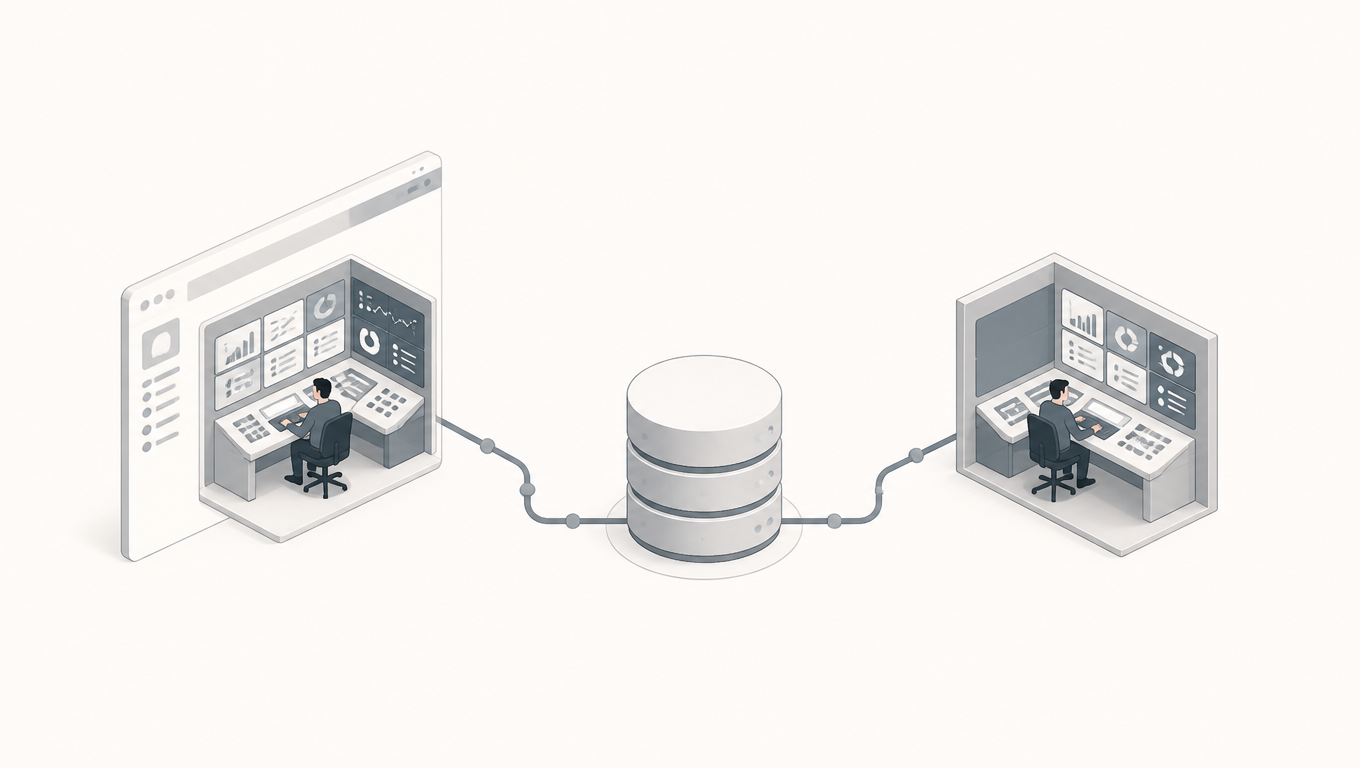
An editorial illustration of two control rooms, one embedded inside an order system and one standing alone, both wired to a single shared ledger at the center
Execution can move; records cannot fragment

1. What Shipping Software Actually Does: Four Responsibilities

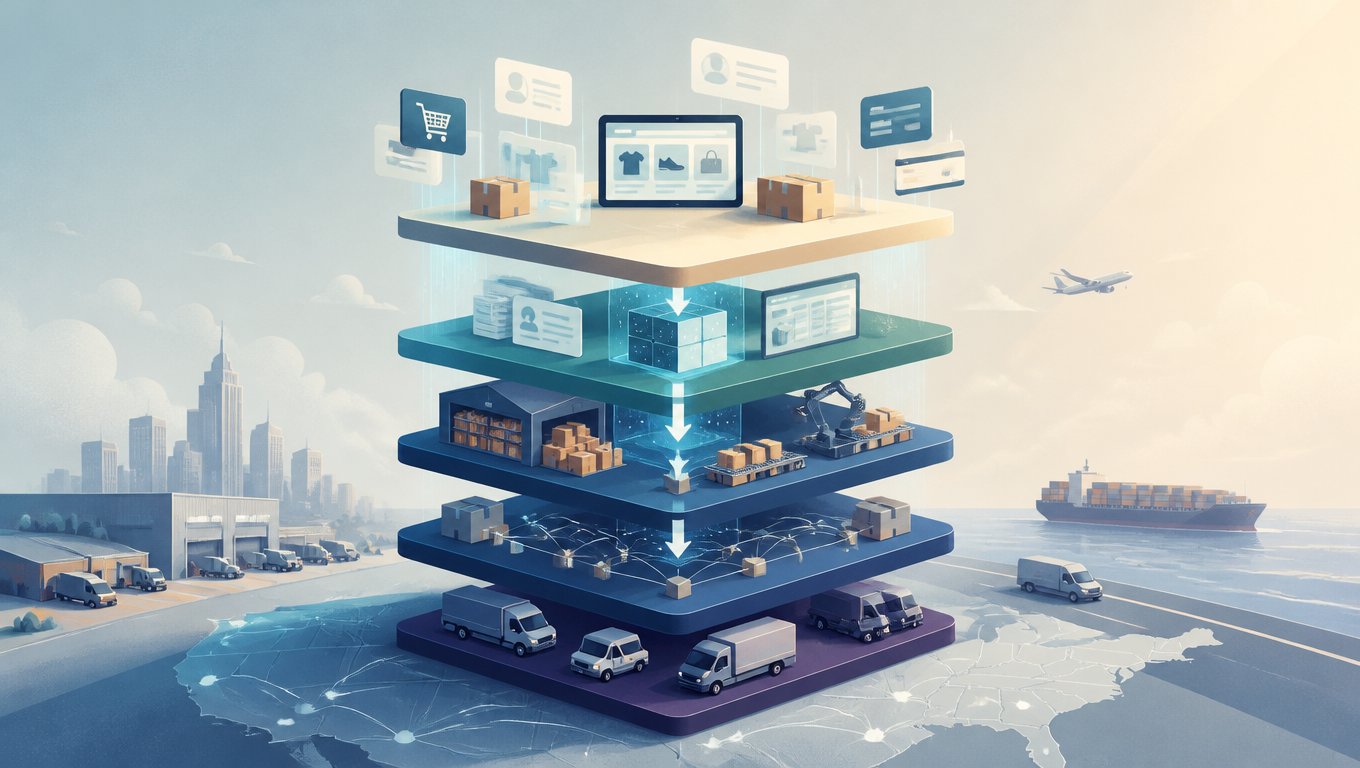
Shipping software is really four different products wearing one login. They share an order context, but they behave very differently and fail very differently:

Use the Shipping API workflow overview to identify which execution steps each system must own. The shipping data-model guide provides the entity and identifier checks needed to compare embedded and standalone designs.

  • Rates. Read-mostly and latency-sensitive. Needs product dimensions, origin and destination, carrier contracts, and service options. A rate lookup is cheap to retry, so it tolerates being cached and re-queried.
  • Labels. Write-once and must be reliable. Needs carrier credentials, address validation, and compliance fields. A label can be retried, but only for minutes; after that, a shipment is physically delayed.
  • Tracking. Long-lived and append-only. Event feeds, exception handling, and customer-facing status. Tracking must be durably captured even when no one is looking at it, because the events are the evidence for every downstream dispute.
  • Billing and reconciliation. Invoice matching, cost allocation, and client chargeback. This is the system of record, and it must be exact. A rate quote can be wrong and be corrected; a billing mismatch costs money and takes months to unwind.

Those failure modes explain a lot of architecture choices. A rate outage costs you quotes and checkout friction. A label outage stops shipments entirely. A tracking outage erodes trust. A billing mismatch costs real money. So the four responsibilities have very different tolerance for being "best effort": rates can be cached, labels can retry for minutes, tracking must be captured durably, and billing must be exact.

The hidden coupling is what makes this hard: all four share the same carrier contracts, the same parcel data, and the same order context. When rates, labels, tracking, and billing live in different systems, you are not maintaining four features. You are maintaining four copies of the same carrier contract and four interpretations of the same shipment. That shared state is the real architectural problem, and it is why "which tool" questions keep coming back.
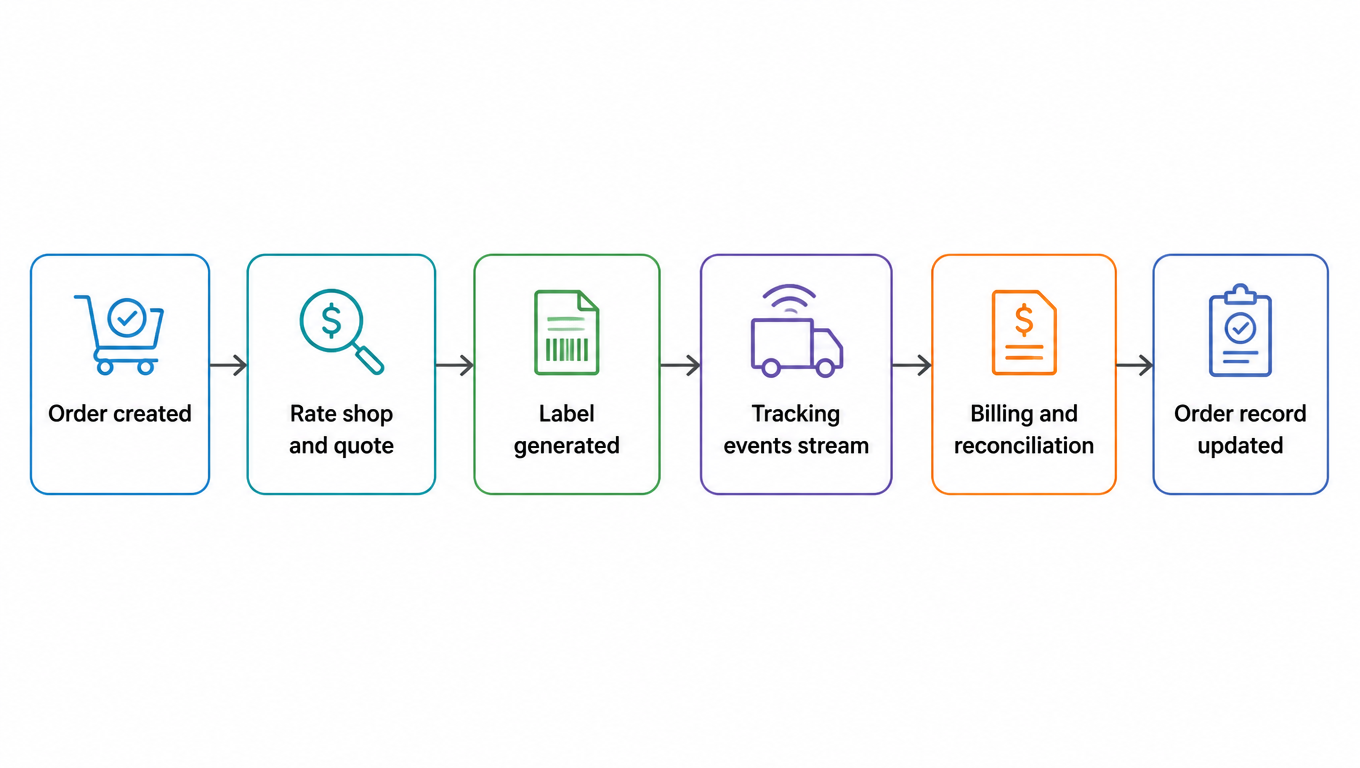
Flowchart: order created, rate shop and quote, label generated, tracking events stream, billing and reconciliation, order record updated
The full lifecycle of a shipment: quoting starts it, labels execute it, tracking evidences it, reconciliation closes it

2. Two Architectures, One Spectrum

Embedded means shipping lives inside the OMS/WMS/ERP as a module or an internal API layer. One workflow, no context switching, and data that is consistent by construction, because there is only one database. The cost is that carrier integrations become the ERP's roadmap: every new carrier, every rate change, every new service the ops team asks for now waits on your engineering queue, and shipping is rarely the most important thing on that queue.

Standalone means a shipping portal or a shipping platform API that is a separate system with its own UI, its own carrier credentials, and its own records. The carrier coverage is best-in-class, iteration is fast, and the ops team gets a purpose-built UI instead of a screen inside an ERP. The cost is data fragmentation: two systems both "know" about the shipment, and nobody can say which one is authoritative at 3 a.m.

Hybrid splits the difference on purpose: the execution layer can move, but the system of record stays unified. The order system owns the shipment record. A shipping platform executes the carrier-facing work (rates, label purchase) over APIs. Tracking streams back into the order record. Billing reconciles against the order record. Hybrid is not a compromise between the two; it is a different distribution of the four responsibilities, and it is the pattern most serious 3PLs converge on.

The core principle, and the one sentence to remember from this article: execution can move, records cannot fragment. Execution is where you want speed and iteration, which is what a shipping platform is good at. Records are where you want permanence and auditability, which is what an order system is good at. Split along that line and most of the trade-offs above stop being trade-offs.

3. Where Each Responsibility Should Live

Rates and quoting live where the order is created: checkout, OMS order entry, or WMS order prep. The quote engine itself can be anywhere; read it from any engine via API. But the quote must be captured on the order at creation time, because every downstream decision references it: the label service, the promise date, the client bill. Cache aggressively and stamp quotes with a timestamp and a validity window, because quotes expire.

Label generation is execution, and it can be external. The label can be bought in the shipping platform, printed from its UI, whatever suits the workflow. But every label event must write back to the order record: label ID, carrier, service, cost, tracking number, timestamp, and the credentials used. An orphan label, one that exists in the portal but has no order record behind it, is a billing leak waiting to happen.

Tracking aggregates in one place. Pick one tracking store, usually the order system or a dedicated tracking service, and have every carrier feed and every platform webhook write into it. Customer-facing tracking is a read from that single store; never scrape a second system for status. Exceptions (delayed, address issue, attempted delivery) should be matched back to the order record, so the ops team sees them in the same screen as the order, not in a separate tool they have to remember to open.

Billing and reconciliation stay in the system of record. Carrier invoices are matched against label events, never the other way around. Cost allocation to clients or SKUs happens against the order record. If your billing team reconciles in a spreadsheet because the shipping tool's export is the only complete list of labels, you have already lost; the order record should be the complete list.

Carrier credentials have a single owner regardless of architecture. One system holds the negotiated contracts and API keys, usually the shipping platform or a dedicated carrier team, and every other system reads through it. Never duplicate credentials across systems; when a contract changes, you want one place to update, not five.

To see the cost of ignoring this, run three failure scenarios. Put billing in the shipping portal and customers get double-charged, because client rate tables live in the portal while invoices live in the OMS. Generate labels without write-back and you get orphan labels whose cost is never allocated, and a month-end shortfall nobody can explain. Split tracking across tools and you get silent gaps where a shipment shows delivered in one system and in transit in another, and nobody can say which one is right.

4. The Five-Dimension Decision Matrix

Score your situation Low, Mid, or High on each of five dimensions. The pattern that fits falls out of the scores.

Dimension 1: order volume. Below 1,000 labels a month, the per-label economics do not matter, and a standalone portal is the rational choice. Between 1,000 and 50,000, per-label fees are real but not yet dominant, which is hybrid territory. Above 50,000, embedded starts to pay for itself if you have the engineering to own it: at 100,000 labels a month, a $0.10 per-label platform fee is $10,000 a month, which funds real engineering.

Dimension 2: customer count. A single brand ships for itself, the record is internal, and embedded or standalone both work. A multi-tenant 3PL ships for many clients with per-client rate tables, billing, branding, and reporting, and hybrid wins because client billing needs the order record while carrier execution can still be shared. Many small clients with individual terms push hard toward hybrid.

Dimension 3: engineering capability. Can you own carrier integrations and their failure modes? Carrier APIs change, rates get renegotiated, compliance rules shift. Owning that well is 1 to 3 engineers and 6 to 18 months to a mature state. If you have that team, embedded is on the table; if not, standalone or hybrid, because a half-maintained carrier integration is worse than none.

Dimension 4: exception frequency. Address issues, weight mismatches, service failures. A high exception rate means humans spend their day in the shipping tool, and a purpose-built portal queue beats a generic ERP screen. A low exception rate means automated handling rules can live in the order system, and embedded becomes viable.

Dimension 5: financial traceability. Invoice-level reconciliation, client billing, audits. If an auditor can ask "show me every label for this client in this month" and the answer requires joining three systems, you have a governance problem. High traceability requirements push the record into the order system regardless of where execution lives.

Dimension Low Mid High
Order volumeUnder 1k/mo1k-50k/moOver 50k/mo
Customer countSingle brandA few large accountsMany clients, per-client terms
Engineering capabilityNo in-house teamIntegration glue, 0.5-1 FTEDedicated team owning the carrier stack
Exception frequencyRare, rules cover itDaily queue, one person handles itConstant, humans live in the tool
Financial traceabilityMonthly export is enoughMonthly client billingInvoice-level reconciliation, audits

Read the output the same way every time. Low on most dimensions: standalone. High volume plus strong engineering plus few customers: embedded. Multi-client and reconciliation-heavy: hybrid. Most 3PLs land in hybrid, not because hybrid is a comfortable middle, but because their dimensions point there.

5. Three Reference Patterns

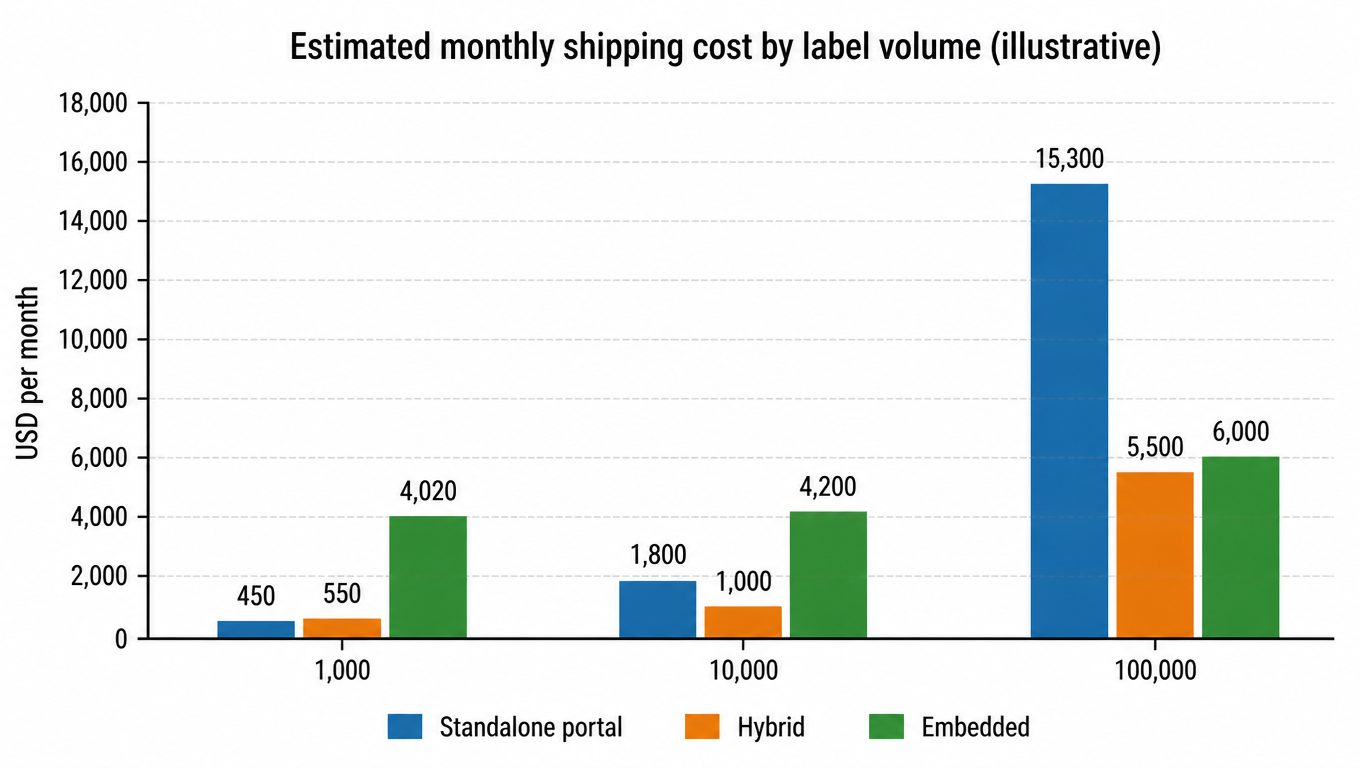
Pattern 1: standalone portal. This is the early-stage stack: a SaaS portal such as Shippo, ShipStation, or Pirate Ship[^2], with the OMS/WMS creating orders and syncing them over CSV or API. Cost on typical mid-point assumptions: $100 to $500 a month in subscription, plus $0.10 to $0.20 per label, roughly $450 a month at 1,000 labels and $1,800 a month at 10,000. It is the right answer for a small ops team that just needs to ship. The signal that it is time to leave: reconciliation stops being a monthly export and becomes a weekly argument.

Pattern 2: embedded. High volume, few customers, strong engineering. What you must build: a rate engine, a label service, a tracking pipeline, and a ledger that matches carrier invoices. Budget 6 to 18 months and 1 to 3 engineers, roughly $150,000 to $400,000 all-in on planning assumptions. It pays off when per-label savings at high volume cover the build and the team owns the whole failure surface. The honest numbers: embedded crosses standalone around 30,000 labels a month and crosses hybrid around 120,000 on the same assumptions. Below that, the build is a donation to the roadmap.

Pattern 3: hybrid. The recommended default for most 3PLs, and the pattern the decision matrix keeps producing. The order system owns the record, the shipping platform owns carrier execution, and a billing engine reconciles in the record. Cost sits between the other two: around $1,000 a month at 10,000 labels and $5,500 a month at 100,000 on the same assumptions. The real win is that no dimension forces a heroic build and no month ends in a spreadsheet.

Bar chart: estimated monthly shipping cost by label volume, standalone from $450 to $1,800 to $15,300, hybrid from $550 to $1,000 to $5,500, embedded from $4,020 to $4,200 to $6,000
Standalone climbs steeply with volume, embedded is expensive to start, and hybrid stays flat through the middle where most 3PLs actually operate

The chart uses the mid-point assumptions stated above: standalone at $300 a month plus $0.15 per label, hybrid at $500 a month plus $0.05 per label, and embedded at $4,000 a month of amortized build cost plus $0.02 per label. It is a planning sketch, not a quote; what matters is the shape. Standalone climbs steeply with volume, embedded is expensive to start, and hybrid stays flat through the middle where most 3PLs actually operate.

Dimension Standalone Embedded Hybrid
Order volumeUnder 1k/moOver 50k/mo1k-50k/mo, growing
CustomersOne1-3, largeMany, per-client terms
Engineering0-0.5 FTE1-3 engineers, 6-18 months0.5-1 FTE, platform handles carriers
ExceptionsManual queue in portalAutomated rulesPortal queue with OMS override
TraceabilityMonthly exportNative ledgerReconciled in system of record

6. Migration Path: Data First, Execution Last

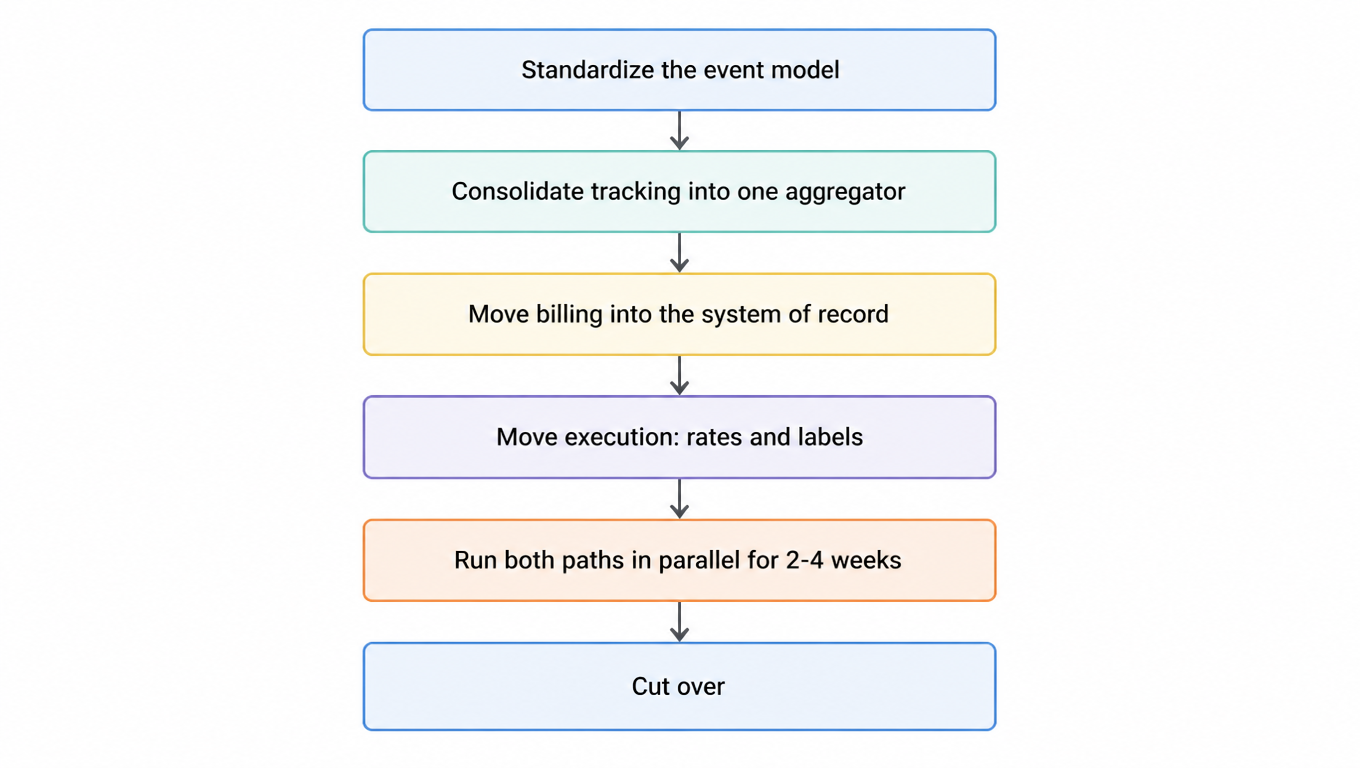
Never swap cold. The safest path moves data first and execution last, so the old system keeps shipping at every step. The sequence: standardize, consolidate, move records, then move execution.

Step 1: standardize the event model. Agree on the fields every system will use: order ID, parcel ID, label ID, carrier, service, timestamps, cost, status. Get the current shipping tool to export these in one shape and treat that shape as the contract. Everything later depends on this, and it is cheap to do before anyone cares.

Step 2: route all tracking events to one aggregator. Keep the old UI, but every webhook and poll now writes into the chosen tracking store. Users see no change; the data starts consolidating underneath.

Step 3: move billing and reconciliation into the system of record while execution still runs elsewhere. Carrier invoices now match against the order record, and client billing reads from it. This is the highest-value step and the one most teams skip; do not skip it.

Step 4: move execution, rates and labels, once the records are stable. Now the old tool is a UI in front of the new stack, and you can turn it off when you are ready.

Flowchart: standardize the event model, consolidate tracking into one aggregator, move billing into the system of record, move execution (rates and labels), run both paths in parallel for 2-4 weeks, cut over
Data moves first, execution last, with parallel reconciliation as the safety net

Parallel-run reconciliation is the safety net. Run both paths for 2 to 4 weeks before cutover, comparing per-shipment cost and status across old and new. Differences are expected early (timing, rounding, fee naming); the goal is a closed gap, not zero differences on day one.

The same sequence applies in reverse if you ever move embedded back to standalone, which happens when a 3PL takes on clients with divergent needs or when engineering decides it no longer wants to own carrier integrations. Keep the record in the order system, move execution out first, and the record stays authoritative through the transition.

7. Bottom Line

The one-sentence rule: put execution where it is fastest to iterate, put the records where they are hardest to lose.

Responsibility Standalone Embedded Hybrid
RatesRate shop in the portalNative rate enginePlatform API, quote captured on the order
LabelsPortal prints and recordsNative label servicePlatform executes, event writes back to order
TrackingPortal UI is the statusNative pipelineOne aggregator feeds the order record
BillingExport, manual reconcileNative ledgerOrder record matches carrier invoices

For each persona in the room, the recommendation is different and consistent. A 3PL tech lead defaults to hybrid: platform for carrier execution, order system for records, reconcile inside the record. A fulfillment operator demands one screen that shows the order and its shipping truth; a portal is fine as a view, it is not fine as a second truth. An OMS/WMS/ERP product manager treats shipping as a capability with SLAs (rates answered in milliseconds, labels idempotent, tracking durably captured) and designs the order record to accept events from outside. A developer keeps credentials single-owned, builds an idempotent label API, streams tracking into the record via webhooks, and keeps a ledger you can query instead of export. A SaaS platform offers both shapes: embedded APIs for teams that want to own their records, and a portal skin for teams that do not. Let the customer choose where the record lives, because that is the actual architecture decision, and the platform that makes it reversible wins the account.

None of this requires a rewrite of your stack this quarter. It requires one decision: name the system of record for shipping data, and make every other system a reader of it. Rates, labels, and tracking can move around it freely. That single decision settles most of the Shippo-and-Ordoro arguments before they start.

FAQ

Embedded shipping software runs inside the OMS/WMS/ERP as a module or internal API layer, so there is one workflow and one database. Standalone shipping software is a separate portal or platform API with its own UI, carrier credentials, and records. Hybrid splits the difference on purpose: execution (rates, labels) can run on the platform, but the order system stays the system of record.
Embedded pays off when three things hold: order volume above roughly 50,000 labels a month, a small number of large customers, and 1-3 engineers who can own carrier integrations full time. Below that, the build cost amortizes poorly and the integration backlog becomes the ERP's roadmap.
Below roughly 1,000 labels a month, per-label economics barely matter and a standalone portal (Shippo, ShipStation, Pirate Ship) is the rational choice. It also works when exceptions are rare and a monthly export satisfies your reconciliation needs.
Because their dimensions point there: many clients with per-client rate tables and billing (which pushes the record into the order system) plus shared carrier execution (which is cheaper and faster on a shipping platform). Hybrid keeps the record unified while letting execution iterate quickly, which is why it is the pattern serious 3PLs converge on.
In the order system. The order record should be the complete list of shipments: every label event writes back to it, tracking aggregates into it, and carrier invoices reconcile against it. Execution can move anywhere; records cannot fragment.

Ready to decide where your shipping workflow should live?

EasyShippingX treats "records in the order system, execution on the platform" as the default architecture: rate quotes written back to the order, label events streaming home, tracking aggregated into one record, billing reconciled inside it. Run the five-dimension matrix at your real volume and exception rate, then decide.