Why tracking, weight, and photos prove different things
The instinct when a dispute opens is to grab the tracking record, because it is the one piece of documentation both sides can see. It is also the weakest piece. A Delivered scan proves that a parcel reached an address. It says nothing about what was inside, whether the seal was intact, or whether the box that arrived is the box that shipped.
Weight is more useful, but only if you keep three different numbers apart. The declared weight printed on the label is what the shipper entered, often rounded and sometimes estimated. The billed weight is what the carrier charged for, which may include dimensional weight and is a pricing construct rather than a measurement of the parcel. The measured weight is what your scale reads on the receiving bench, at a known time, on a known device. Mixing these produces arguments that cannot be resolved, because a billed weight is not evidence about contents and a declared weight is not a measurement.
Two more limits are worth stating plainly. Matching weights does not prove matching contents; a box of the right mass can hold the wrong thing, so weight is a filter for theories, not a verdict. And a contents mismatch on its own does not assign fault, because an empty box is equally consistent with a customer error, a carrier loss, and a packing station that closed a carton before the item went in.
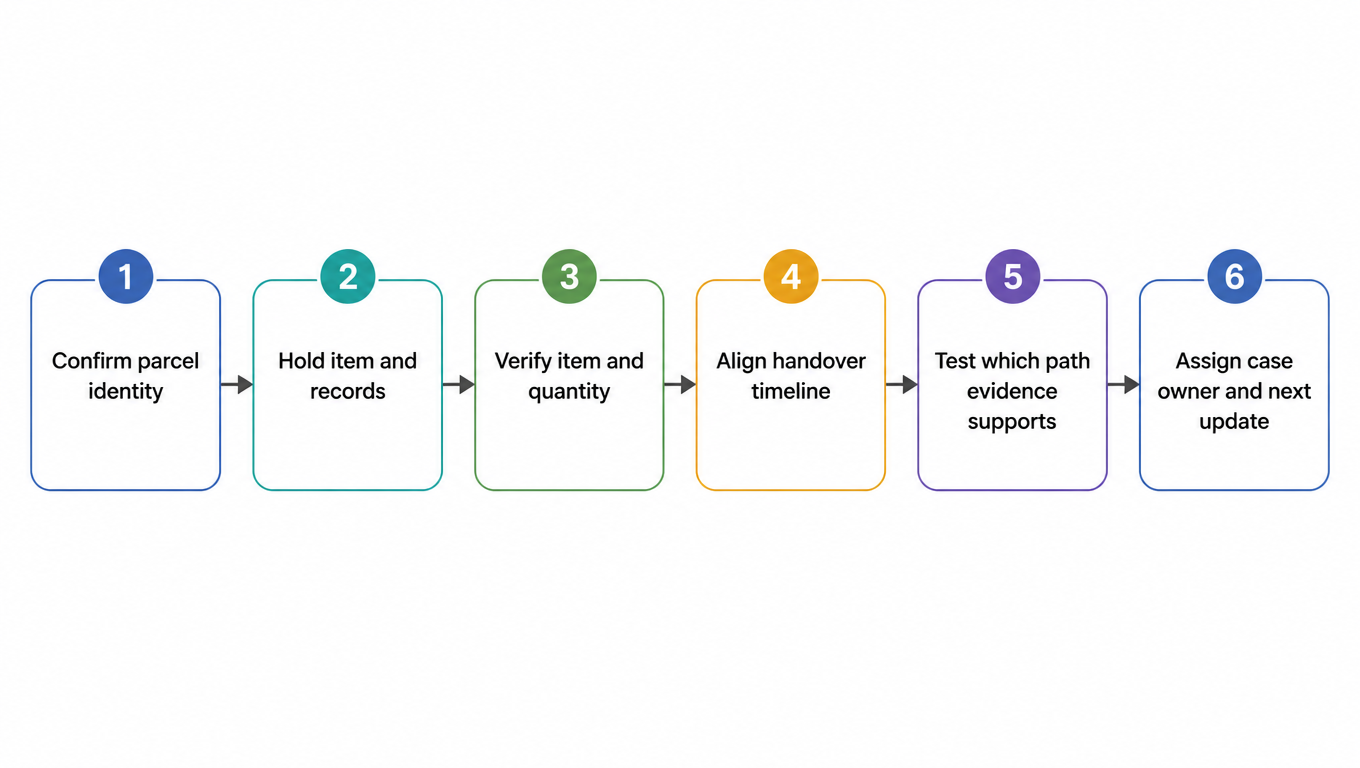
The practical conclusion is a separation of two activities that teams habitually merge: finding the anomaly and attributing the cause. The first is a mechanical observation anyone can record in minutes. The second requires a specific piece of independent evidence, and if that evidence does not exist yet, the honest output of the investigation is a case marked undetermined with a follow-up date, not a guess with a signature on it.