Free shipping is the loyalty benefit customers ask for most, and the one finance teams can price the least. Offer it as a reward and retention gets a headline feature. Miss the math and a "member perk" quietly becomes a per-order subsidy that no one on the team can defend. This guide gives DTC founders, Shopify operators, loyalty managers, and finance leads a framework to decide whether free shipping should be a loyalty reward, and if so, which of the six reward designs to ship.
The framework has one bias: profitability comes before perk. Every claim in this guide flows through the same gate. Does the incremental contribution this reward creates cover the incremental cost it incurs? If the answer is yes on paper and in a pilot, the reward earns its place. If not, the cheapest option is the one you never launch.
Free shipping is not a marketing gimmick, it is a profit-structure question
The Question Shipping and Finance Can't Answer
Picture the planning meeting. The retention team wants to raise the value of membership, and their most popular ask is free shipping or faster shipping. They turn to shipping and finance for a cost estimate, and the room goes quiet, because the standard answers don't fit the question.
Four questions come up in that meeting, and most DTC brands cannot answer a single one from data they already have:
How much more will each member actually spend because of this benefit?
How many of the orders that get the reward would have hit the free-shipping threshold anyway, making the benefit a gift to customers who needed no incentive?
Will the members who redeem most, the high-weight, far-zone, high-frequency buyers, eat the margin the rest of the program earns?
Can the carrier network actually deliver the delivery promise a VIP tier makes, and who absorbs the cost when it does not?
None of these are loyalty questions or shipping questions in isolation. They are profit-structure questions that sit exactly where loyalty, shipping, and finance overlap. That overlap is where this framework lives.
Why Both Averages Lie
Every team involved reaches for its favorite average. Loyalty looks at LTV, repeat rate, and reward redemption rate. Shipping looks at average label cost. Both numbers are true, and both are useless for this decision, because each average hides the six things that actually determine whether a shipping reward makes money.
The loyalty average hides redemption frequency. A reward that 90% of members never use is cheap. The same reward redeemed twice a quarter by power buyers is a different line item entirely. It hides threshold overlap: if 60% of your orders already qualify for free shipping, the "reward" mostly relabels money you were already spending. And it hides incrementality, the only number that matters: whether the benefit produces orders that would not have happened without it.
The shipping average hides the parcel profile. Your average label cost is a blend of light local parcels and heavy cross-zone ones, and the members who redeem shipping rewards skew toward the expensive end of that blend. It hides the gap between free standard and free expedited, which can be a 2x to 4x difference in label cost. And it hides the failure tail: delays, reships, returns, lost parcels, and the support time each one consumes. Average label cost smooths all of this into a number that flatters the program.
The fix is not a better average. It is a framework that tracks increments and units, not averages and totals.
The Incremental Framework
The core principle: credit the loyalty program only with the orders it causes, and charge it with every cost it triggers. Do not attribute the full value of a member's orders to a reward that merely changed the shipping line on orders that would have happened anyway.
The framework's core formula, expressed as annual value per member:
Incremental loyalty benefit = incremental contribution margin + membership/tier revenue − incremental shipping subsidy − service upgrade cost − incremental failure, return, and support cost
Each term is deliberately narrow. Incremental contribution margin counts only the margin from orders that would not have occurred without the reward. Membership revenue counts paid membership fees or the qualification value of reaching a tier. Incremental shipping subsidy is the difference between what shipping costs with the reward and what it cost without it, not the full label cost of every order. Service upgrade cost covers the delta when you promise expedited instead of standard. Failure, return, and support cost counts the exception tail the reward adds.
Once the formula is populated, watch three units, not one:
Cost per redeemed shipment. How much the subsidy and its failure tail cost every time a member actually uses the benefit.
Cost per active member per month. What the program costs for the members who engage, not the members who enrolled.
Cost per incrementally retained customer. The program cost divided by the number of customers who stayed or bought more because of it. This is the number to compare against your cost of acquisition.
If cost per incrementally retained customer is below your blended CAC, the reward is doing acquisition work at retention prices. If it is above, you are overpaying for customers you may have kept anyway.
Decompose the Variables
Before any model runs, list the variables the model must hold. Group them into four buckets, and for each one write down where the data lives today, because the gap between "we could know this" and "we do know this" is usually where the program loses money.
Reward design. Membership tiers and what each tier unlocks, how often members can redeem, and how much the reward overlaps your existing free-shipping threshold. Overlap is the quiet killer: if the threshold is $75 and the tier simply removes it, you pay for orders that would have crossed it anyway.
Commercial parameters. AOV, contribution margin, paid membership revenue, and tier qualification value. Contribution margin must be the margin after variable costs only: COGS, packaging, payment fees, and pick-and-pack. Fixed overhead does not belong in this model.
Fulfillment profile. Parcel weight, dimensions, and zone mix of the members who actually redeem, the gap between your economy, standard, and expedited promises, and how well USPS versus regional carriers fit each promise. A heavy, cross-zone parcel on a regional carrier that shines locally is a promise waiting to break.
Exception tail. Returns, reships, lost parcels, exceptions, split-order abuse (members splitting one cart into several orders to dodge a per-order cap), and peak-season cost and capacity. Each of these is a real line item once the reward scales, and none of them appear in average label cost.
Worked Example and the Reusable Template
Numbers make the framework concrete. Take a hypothetical apparel brand with a $60 AOV, a 60% contribution margin, and a $75 free-shipping threshold that most orders do not reach. Average label cost is $7.50, and on orders where the customer pays shipping, the customer pays $5.00, so the brand already absorbs $2.50 of subsidy on every paid-shipping order.
Parameter
Value
AOV
$60
Contribution margin (variable costs only)
60%, so $36 per order
Free-shipping threshold
$75
Average label cost
$7.50
Customer-paid shipping
$5.00
Brand subsidy on paid-shipping orders
$2.50
Purchases per year without reward
1.5 to 2
Purchases per year with free-shipping reward
3
Run the per-order math first. With the reward, every order ships free and costs the brand $7.50, leaving $28.50 of contribution per order. Without the reward, the typical order costs $2.50, leaving $33.50. The reward costs $5.00 of contribution per order, every order, forever. That is the number the whole decision rests on, because it is only worth paying if the reward buys enough extra orders.
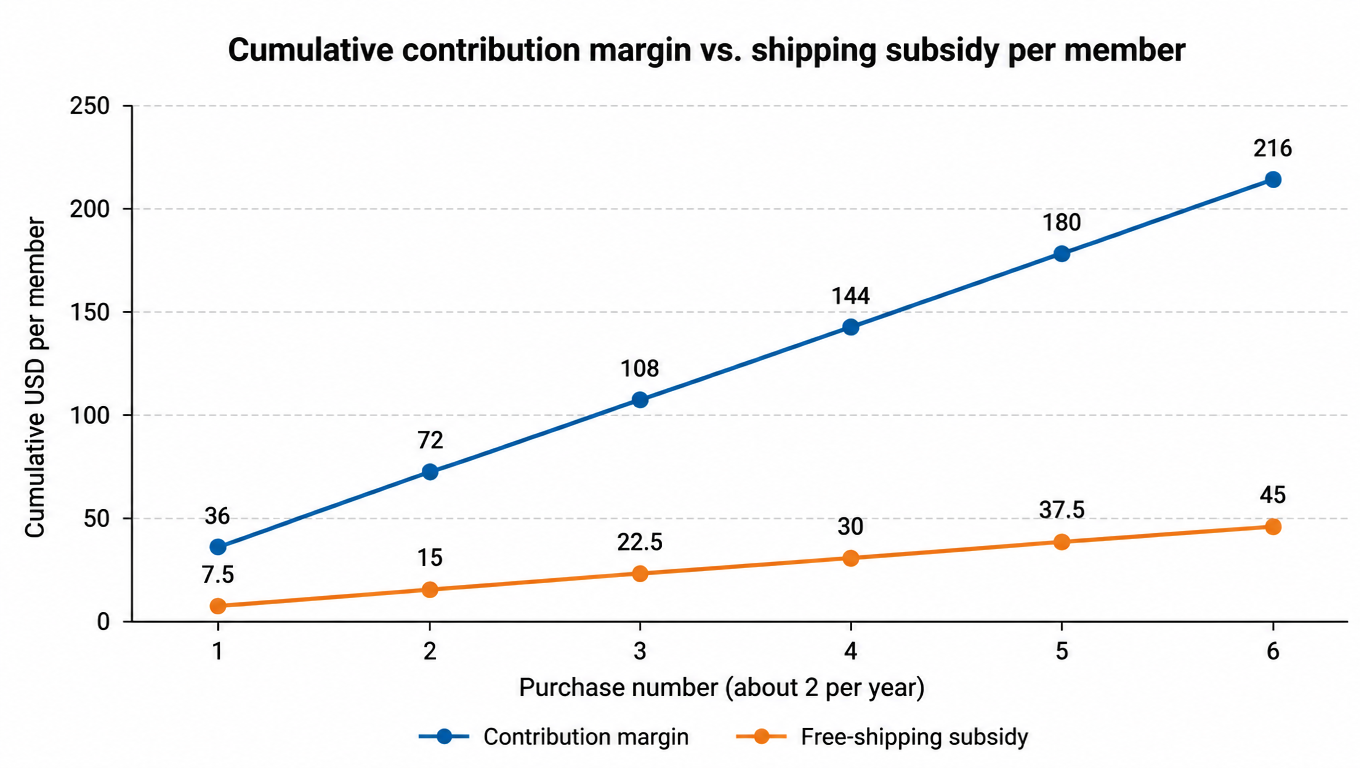
The three-year view: both margin and subsidy accumulate, with the subsidy around 21% of the margin pool
The following figures come from an illustrative member model, not a brand benchmark. It assumes six purchases, $216 in cumulative contribution, and $45 in cumulative free-shipping subsidy; replace those inputs with your own order frequency, margin, and shipping cost.
Now compare scenarios. Without the reward, a member buying four times at $33.50 of contribution each generates $134 over the period. With the reward, a member buying six times at $28.50 generates $171. The reward wins by $37 per member, but only if it genuinely moves a member from four purchases to six. If it moves them only from four to five, the reward loses: five times $28.50 is $142.50, barely ahead of $134, before counting any incremental failure and support cost. That is how fragile the deal is, and why the incrementality question comes first.
Generalize it into a reusable template. The break-even incremental order count is:
Break-even incremental orders per member = incremental shipping subsidy per member ÷ contribution margin per order
For this brand, the incremental subsidy per member per year is three free orders at $7.50 minus the $2.50 subsidy the brand paid on the 1.5 orders that would have happened anyway: $22.50 minus $3.75, or $18.75. Divide by $36 and the reward must produce just over 0.5 incremental orders per member per year to break even. That is the pass/fail number to put in front of the retention team: the benefit is profitable if members who get it buy at least half an order more per year, and unprofitable if they buy less.
Swap in your own numbers. The template holds for any brand: pick AOV and contribution margin, estimate the subsidy per redeemed order, estimate how many orders the reward actually adds, and compare incremental contribution against incremental cost. If the answer is marginal, the pilot gate at the end of this article is not a formality, it is the whole decision.
Six Reward Designs, Four Gates
Once the math points to "maybe," the design question follows, and there are six ways to structure free shipping as a loyalty reward. They differ in how much they cost per redeemed order, how much they leak to non-incremental orders, and how much operational machinery they require:
No shipping reward. The cheapest design. Members get status, early access, or points, and shipping stays a paid add-on. Correct when the per-order math cannot pass even with strong incrementality.
Member-only free-shipping threshold. A lower threshold for members, say $50 instead of $75. Caps the subsidy by keeping the biggest carts out of the free pool, and rewards the behavior you actually want to encourage.
Limited free shipments per month or year. A fixed count, like two free shipments a quarter. Converts an open-ended promise into a bounded cost you can price and forecast.
Fixed shipping credit. A dollar credit applied to the shipping line, for example $15 a quarter. The member sees a benefit, the cost is capped, and the credit covers a standard label while an expedited upgrade stays paid.
Free economy shipping with paid expedited upgrade. Members get free standard delivery as the baseline, and pay the delta for faster service. Aligns the reward with cost: the member pays exactly for the service level they want.
Paid membership including free standard shipping. The Amazon Prime pattern: an annual fee buys free standard shipping. The fee funds the subsidy pool and pre-selects the members most likely to redeem, which is precisely the population that makes the per-order math work.
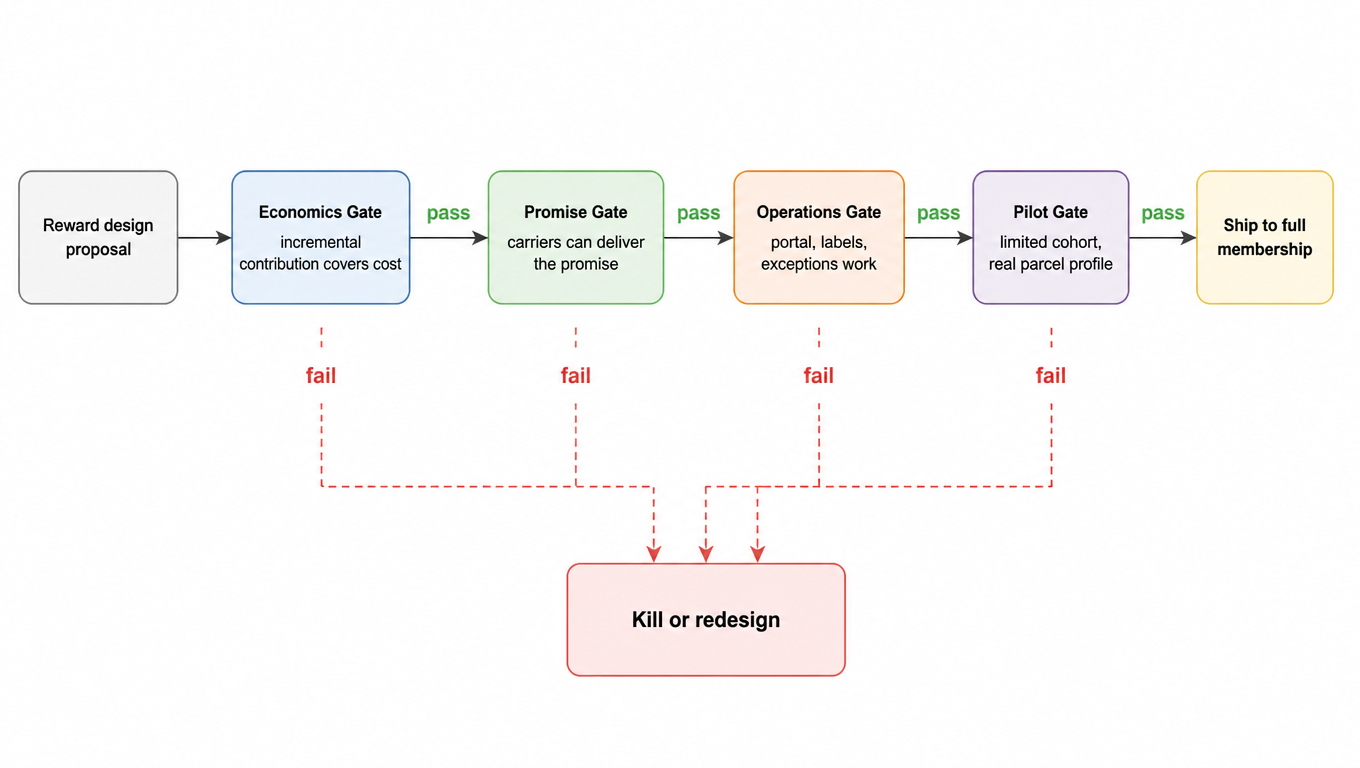
These six designs sit on a cost spectrum from zero to open-ended, and the right one depends on your parcel profile and your members' redemption behavior. But design choice is not the decision. Every design, even the cheapest, must pass four gates in order:
Economics Gate. Does the incremental contribution, plus membership revenue, cover the incremental subsidy, upgrade, and failure cost? Run the worked example with your own numbers before building anything.
Promise Gate. Can your carrier mix actually deliver the promise? Free expedited is a different operational promise than free standard, and a regional carrier that is excellent in zone 2 may be a liability in zone 8.
Operations Gate. Can your stack execute it? The loyalty app must pass the benefit to checkout, the shipping profile must price the label correctly, and the exception flow must handle reships and refunds without manual heroics.
Pilot Gate. Run it on a limited cohort with a real parcel profile for a fixed period, and read the result in the three units: cost per redeemed shipment, cost per active member per month, and cost per incrementally retained customer.
The four gates run in order, and each one is more expensive to fail than the last
The gates are sequential for a reason. A design that fails Economics cannot be rescued by good operations, and a design that passes Economics but fails Promise will spend its margin on exceptions and refunds. Moving left to right on the flowchart is a commitment ladder: each gate is cheaper to fail than the one after it.
Decision Matrix and Shipping It on Shopify
With the framework in hand, the design choice collapses into a small matrix. Read your AOV, contribution margin, and repeat-purchase behavior against the three questions below:
Your profile
Likely best design
Low AOV, thin margin, repeat purchases
No shipping reward, or member-only threshold. There is no room to subsidize, so protect the margin and use status instead.
High AOV, healthy margin, low frequency
Fixed shipping credit or free economy with paid upgrade. The order can carry a bounded subsidy, but do not promise speed you cannot price.
High AOV, healthy margin, high frequency
Paid membership with free standard shipping. This is the Prime-shaped profile: the fee funds the pool and redemption is concentrated in your best customers.
High frequency, heavy or far-zone parcels
Limited free shipments per period. Cap the exposure before the parcel profile caps it for you.
On Shopify, the execution stack is more modular than most teams fear. Loyalty apps like Smile, Yotpo Loyalty, and LoyaltyLion handle tier definitions and reward assignment; checkout-level shipping rules handle the member discount on the shipping line; and carrier accounts handle the label pricing underneath. The integrations matter less than the seams: the moment the loyalty system and the shipping profile disagree about who qualifies, you are shipping unplanned subsidies.
The two purchases worth making are a shipping-rule engine that can apply member logic at checkout without manual codes, and shipping insurance that covers the exception tail instead of letting reships and losses eat the program's margin. The rest is measurement: run the reward on a test segment against a matched control, and read repeat rate and net contribution per member in cohorts, not in the all-customers average that hid the problem in the first place.
The Bottom Line
The decision rule, in one sentence: offer free shipping as a loyalty reward only when the incremental contribution from the orders it creates, plus membership revenue, exceeds the incremental subsidy, upgrade, and failure cost it incurs, and skip it when the answer is close, because the exception tail and the overlap leak will close the gap.
And the trap list, for the day you present this to your team:
Attributing full order value to the reward instead of only the incremental orders.
Pricing the reward with average label cost instead of the redeemers' actual parcel profile.
Ignoring overlap with your existing free-shipping threshold.
Promising expedited when your carrier mix can only reliably deliver standard.
Forgetting that returns, reships, losses, and split-order abuse are program costs, not carrier costs.
Scaling from a launch week instead of a fixed-period pilot on a limited cohort.
Free shipping is not the enemy of DTC margin. Unpriced free shipping is. Run the incremental math, pass the four gates, and let a pilot with your own parcel profile decide the rest.
Only when the incremental contribution it creates, plus membership revenue, exceeds the incremental subsidy, upgrade, and failure cost it incurs. The worked example in this guide (a $60 AOV, 60% margin brand) lands on a break-even of at least 0.5 incremental orders per member per year. If you cannot measure incrementality, do not launch; if the answer is close, also do not launch, because the exception tail and threshold overlap will close the gap.
Because average label cost is a blend of light local parcels and heavy cross-zone ones, and the members who redeem skew toward the expensive end. It also hides the 2x to 4x gap between free standard and free expedited, plus the failure tail of delays, reships, returns, losses, and support time. Average LTV and repeat rate lie the same way: they hide redemption frequency, overlap with your existing threshold, and the one number that matters, whether the orders were caused by the reward.
Read three dimensions. Low AOV, thin margin: no shipping reward or a member-only threshold, with status instead. High AOV, healthy margin, low frequency: a fixed shipping credit or free economy with paid expedited upgrade. High AOV, healthy margin, high frequency: paid membership with free standard shipping, the Prime shape. High frequency with heavy or far-zone parcels: limited free shipments per period to cap exposure. And every design, even the free one, must pass the Economics, Promise, Operations, and Pilot gates.
Run a pilot: a limited cohort, a real parcel profile, a fixed period, and a matched control group. Read the result in three units: cost per redeemed shipment, cost per active member per month, and cost per incrementally retained customer. If the last one is below your blended CAC, the reward is doing acquisition work at retention prices; if it is above, you are overpaying for customers you may have kept anyway.
Only if your profile matches: high AOV, healthy margin, high purchase frequency. The point of the Prime pattern is not the annual fee itself, it is that the fee funds the subsidy pool and pre-selects the members most likely to redeem, precisely the population that makes the per-order math work. If your AOV or margin cannot carry the subsidy, paid membership just turns a loss-making program into a loss-making program with an entry fee.
Want a real label cost behind your free-shipping reward?
EasyShippingX operates in the carrier execution layer (rates, labels, tracking). Your loyalty system decides who qualifies; EasyShippingX makes sure the label is priced against the real parcel profile and real carrier rates, so "free shipping for members" stays an account that always adds up.