Customs Broker Guide

How to Choose a U.S. Customs Broker: A Practical Guide for Importers, 3PLs, and Overseas Warehouses

A Chinese DTC brand just produced 3,000 units of its best-selling product. The factory in Shenzhen packed them into cartons, a freight forwarder booked air freight, and a warehouse in Los Angeles confirmed the space is ready. The plane touches down at LAX on schedule, but the journey is not over: the cargo cannot roll straight to the warehouse. Before those 3,000 units can enter U.S. commerce, they have to pass through customs clearance. That is the moment a whole cast of characters enters the picture: the Importer of Record, the Customs Broker, the Freight Forwarder, the Customs Bond, HTS Classification, duty rates, CBP, and agencies like the FDA. This article breaks that chain apart, piece by piece, and then shows you how to choose the one partner who holds it together: your U.S. customs broker.

Wide shot of a cargo plane being unloaded at a U.S. airport at dawn, cargo containers and a logistics warehouse in the background

1. What Is a U.S. Customs Broker, Really?

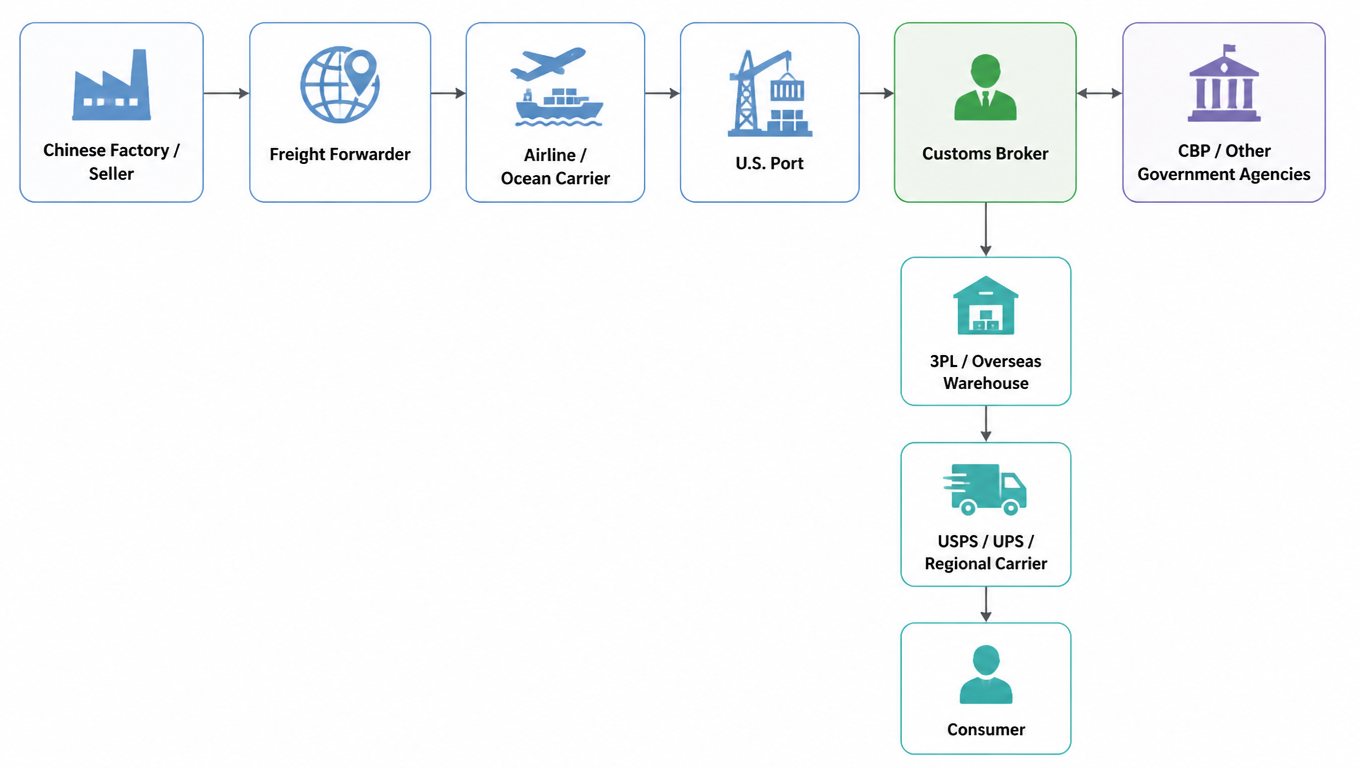
Before you can evaluate a broker, you need to see where they sit in the chain. Here is the entire journey of that shipment, from the factory floor in Shenzhen to a consumer's doorstep:

Full supply chain flow: Chinese factory/seller to freight forwarder to carrier to U.S. port to customs broker (with CBP) to 3PL warehouse to last-mile carrier to consumer

Each link has a distinct job, and importers routinely confuse them:

  • Freight Forwarder: moves the cargo from China to the United States. Booking air or ocean space, pickup at the factory, export handling, and coordinating the transport legs. The forwarder's job ends, functionally, when the goods reach the U.S. port.
  • Customs Broker: a licensed, CBP-regulated professional who files the import entry and clears the goods with U.S. Customs and Border Protection on behalf of the importer. The broker is the only party in this chain whose authority comes from a federal license.
  • 3PL / Overseas Warehouse: receives the goods after clearance, then handles storage, pick & pack, and order fulfillment. This is where your inventory becomes orders.
  • Last-mile carrier: takes parcels from the warehouse to the consumer via USPS, UPS, FedEx, or a regional carrier.

One more note on the chain, because it matters for the 3PLs and overseas warehouses reading this: between the warehouse and the last-mile carrier sits the software layer that makes fulfillment fast and affordable, the kind of logistics platform that turns a cleared shipment into a delivered parcel. That is where EasyShippingX operates, after clearance, at the point where cargo becomes orders. When you pick a broker, you are picking a partner for the front of this chain; the back half should already be running like clockwork.

2. What Does a Customs Broker Actually Do?

"File customs paperwork" undersells the job. A good broker performs seven distinct functions, and each one is a place where mistakes cost money:

  1. Review import documents: commercial invoice, packing list, bill of lading or airway bill, importer information, country of origin, product description. The broker checks these for the errors that trigger exams and holds.
  2. HTS classification: assigning the correct Harmonized Tariff Schedule code for each product. The code decides your duty rate and which regulatory requirements apply, so a wrong code is not a paperwork quirk, it is a misdeclaration with real consequences.
  3. Customs valuation: determining the customs value of the goods, normally the transaction value, the price actually paid. Assists, royalties, and related-party transactions add complexity, but most importers never need a tax-treatise level of depth here.
  4. Entry filing: submitting the import data to CBP through ACE, the Automated Commercial Environment, the system where every U.S. import entry lives.
  5. Duty, tax, and fee calculation: computing duties, the Merchandise Processing Fee, the Harbor Maintenance Fee on ocean shipments, and any additional tariffs that apply to your product.
  6. Customs bond: arranging the financial guarantee CBP requires, either a Single Transaction Bond covering one shipment or a Continuous Bond covering a year of imports. CBP treats these as two distinct products, and your broker should steer you to the right one.
  7. Agency compliance: not all goods answer only to CBP. Food touches the FDA, wood products touch the USDA, electronics touch the FCC, children's products touch the CPSC. A broker who files only with CBP is half a broker for your product.

Which brings us to the screening criterion that matters more than any marketing page: has this broker actually handled your product category, not just "can they file entries"? Filing is table stakes. Knowing how your specific goods move through the agencies above is the difference between a smooth entry and a shipment that sits in customs limbo while fees accrue.

3. Before Choosing a Broker, Know Who Your Importer of Record Is

Here is the confusion that trips up more cross-border sellers than any other. In a single shipment, the Factory, the Seller, the Shipper, the Consignee, the Importer of Record, the Customs Broker, and the Warehouse can be seven different entities, and they often are.

The Importer of Record is the one that matters most, and it is the one most sellers understand least. The IOR is the party that:

  • declares the goods to CBP and is legally responsible for the accuracy of that declaration,
  • owes the duty and fees,
  • must keep the import records,
  • answers to a CBP audit, and
  • bears the risk if classification or valuation is wrong.

In a DTC scenario, the seller's U.S. entity is usually the IOR. In a 3PL multi-client scenario, it gets more interesting: each client's goods need a decision about who is IOR, per client, documented in writing before the first shipment, not improvised when a customs exam lands.

Why does this matter before you choose a broker? Because the IOR decision drives everything downstream: whose bond to arrange, which legal entity the broker contracts with, what data you must hand over, and who shows up when CBP asks questions. A broker can tell you who should be IOR in your situation, and a good one will insist the answer is settled before they file a single entry.

4. When Do You Need a Customs Broker?

The honest answer: the day your cargo crosses into the United States, someone has to clear it, and that someone is a licensed broker. The real question is what kind of broker relationship you need at your volume. Four scenarios cover almost everyone:

Scenario A: you import an occasional commercial shipment. A per-entry service works fine. You pay per entry, the broker files, you move on. No long-term commitment needed.

Scenario B: you import every week. You now want a long-term broker, a Continuous Bond instead of per-shipment bonds, and a documented SOP so every entry looks the same and errors are caught early.

Scenario C: you are a DTC brand shipping high volume of China-made goods into U.S. warehouses. Priorities shift to clearance stability, batch processing of many entries, duty management across your product line, and a clean handoff to your warehouse.

Scenario D: you are a 3PL receiving imports for multiple clients. This is the hardest case, and it is the one this guide was written for. For each client you need to decide who is IOR, whether each client clears through their own broker or you run a unified arrangement, and how the broker's arrival and release flow connects to your warehouse receiving process. The broker you choose must be able to talk to this multi-client structure from day one.

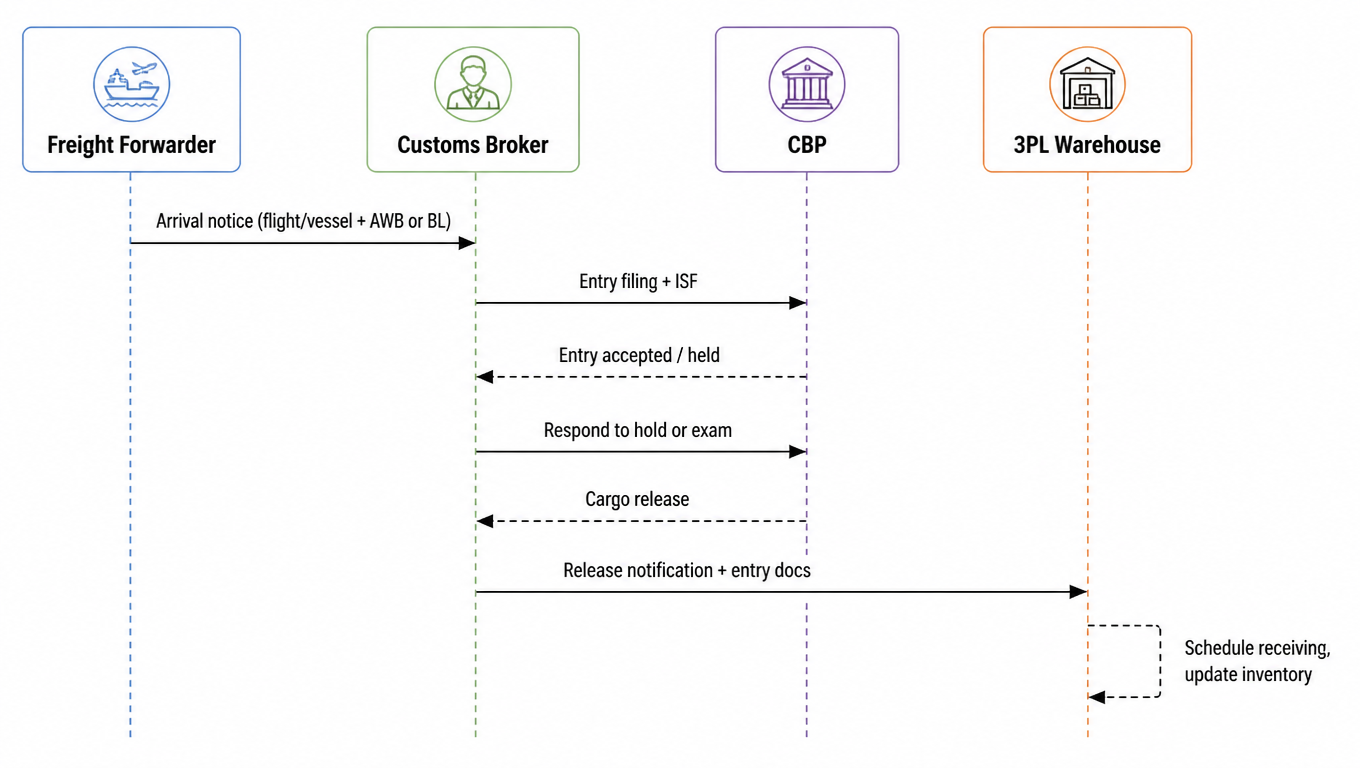
5. The Daily Handoff: From Arrival Notice to Release

The relationship between a 3PL and a broker is not a yearly contract review; it is a daily operational loop. Every shipment that lands in your warehouse passed through this sequence, and each step is a place where a perfectly good shipment can stall for no physical reason:

Clearance handoff sequence: arrival notice, entry filing and ISF, CBP release, release notification with docs, warehouse receiving
  1. Arrival notice: the broker tracks the flight or vessel carrying your goods, or the forwarder sends the arrival data. For ocean freight, ISF was already filed at least 24 hours before loading, so the broker knows the shipment is inbound before it docks.
  2. Entry and status: the broker files the entry through ACE, monitors its status, and handles any hold: document review, PGA referral, or exam. This is where product expertise and response speed get tested on every single shipment, not just in annual reviews.
  3. Release: CBP releases the cargo. The broker receives the release and produces the artifact the rest of the chain depends on: the release notification with the entry number.
  4. Handoff: the broker sends the release and delivery instructions to the 3PL, directly or through the drayage or trucking provider. This is the moment clearance becomes a physical receiving event.
  5. Receiving: the warehouse confirms the release documentation, schedules the receiving appointment, and turns the shipment into inventory. If your warehouse cannot see the release before the truck arrives, the truck waits, and the carrier charges.

The failure modes are boring and expensive. A shipment clears on Tuesday, nobody tells the warehouse, and it sits in airline storage accruing fees until Friday. An exam hold is never communicated, and the receiving team rejects the truck because the paperwork does not match. A drayage appointment is missed because the release notification went to a shared inbox nobody monitors. In every case, the cargo is fine and the process is broken.

So add two operational demands to your broker evaluation. First, release notifications must be automatic: a portal, an API push, or at minimum a notification to a monitored inbox with the entry number and release status in the subject line, not a PDF buried in a personal email. Second, your warehouse team needs a named contact at the broker for release questions, not a ticket queue. When the truck is at the gate and the release is missing, the person who answers the phone is the whole system.

In a multi-client 3PL, this is where standardization pays. Every client's broker will send releases in a different format, so define the minimum data your receiving team needs on every release notification: entry number, release date, bill of lading or airway bill number, and container or shipment reference. Require all of it before a truck can be scheduled. The broker that fits your operation is not just the one that clears well; it is the one whose release workflow your warehouse can run on autopilot.

6. How to Find a Licensed Customs Broker

Do not start with "Google customs broker near me." Start with the source of truth. CBP publishes a Permitted Customs Brokers Listing, and CBP itself recommends using that directory to find and verify brokers. Anyone on it holds a current permit to do customs business in the United States.

Read the listing like a pro. The directory lets you search by company name, city, state, and port of entry. When you pull up a candidate, check two things. First, the permit status: you want "current," not suspended, revoked, or expired. Second, the distinction between a corporate permit, which the company holds, and an individual license, which the person holds. If a broker will only name a person, ask which company holds the permit, because the permit is what you will be contracting with.

Go one level deeper: check for a disciplinary record. CBP has the authority to suspend, revoke, or fine a broker's license, and those actions are part of the public record. A broker who has been through a suspension, or who shows up in CBP's penalty actions, should drop to the bottom of your list no matter how smooth the sales call was. This is the verification step most importers skip, and it is the one that catches the brokers everyone else already knows to avoid.

Build a wider candidate pool. Beyond the CBP directory, three sources add quality signals:

  • The NCBFAA membership directory, the association for licensed customs brokers and freight forwarders in the United States. Membership is voluntary, so it is not a guarantee, but a firm that has stayed a member for years is showing commitment to the profession.
  • Industry conferences where brokers actually show up: TPM for transpacific trade, CSCMP EDGE, and the Sourcing Journal events. Thirty minutes face to face tells you more than thirty email threads, and every serious broker staffs these shows.
  • LinkedIn, searched the way a headhunter would: "licensed customs broker" plus your port and your product category. You can see the team's size, tenure, and whether they have people who actually worked your kind of goods.

Keep the classic channels too: referrals from your freight forwarder, relationships at the airports or ports you use, recommendations from peer importers in your industry, and referrals from your 3PL or overseas warehouse partners. They are all valid starting points. None of them replaces verification.

Verify everything yourself. Whatever the source of a candidate, run the same checklist before you sign anything:

  1. Ask for their CBP license and permit number, then look it up in the CBP listing yourself. Do not take their word for it.
  2. Check the disciplinary record described above.
  3. Ask for two or three references in your product category, and actually call them. Ask how the broker behaved when a shipment was examined, not just how fast the paperwork moved.
  4. Run a trial. Send one or two small shipments through them before committing to a long-term relationship. A broker's real behavior shows up in the first entry, not in the sales deck.
  5. Confirm coverage for your arrival pattern. Air freight from China lands in the U.S. in the middle of the night. Ask who picks up an after-hours arrival call, and whether the person filing your entries works in the same time zone as your cargo.
  6. Ask for receipts of recent work: which ports they filed entries at in the last 90 days, and roughly how many. A broker who cannot name their actual ports of operation cannot be expert at yours.

One last note for the 3PLs this guide is written for. When your warehouse partners recommend a broker, the recommendation may come with a commission arrangement attached, which is fine as long as you know it. Run the verification checklist anyway. You are not just choosing a broker for yourself; in a multi-client operation you are choosing the compliance partner for every importer of record who routes through your facility.

7. The 10-Point Customs Broker Evaluation Framework

When you have a shortlist, work through these ten points. Each one is a question you should be able to answer with evidence, not vibes.

  1. Are they properly licensed? Look them up in the CBP permitted brokers listing. This is non-negotiable and takes two minutes.
  2. Do they understand your product? Apparel is not food, and cosmetics are not electronics. Ask: "How many entries have you handled for products like ours in the past year?" The answer tells you more than the size of the company.
  3. Do they understand China-origin imports? China-origin goods carry specific baggage: Section 301 duties, origin questions, HTS classification nuances, trade remedies, and AD/CVD risk on certain categories. A broker who only files vanilla entries may not catch what your goods attract.
  4. Which ports can they actually handle? Broker licensing has been modernized: CBP replaced the old district-permit structure with a national permit, so "do you have an office at LAX" is the wrong question. Ask instead: "Do you routinely handle entries at LAX, LGB, JFK, ORD, and NY-NJ?" Operating experience at the ports you use beats office locations.
  5. How fast do they respond? While a shipment waits, storage, demurrage, detention, and airline warehouse fees accrue daily. A broker who answers emails in three days costs you money even when nothing goes wrong. Ask for their SLA on urgent issues, for example a response within one business day, and get it in writing.
  6. Who actually handles your account? The salesperson who wined you is not the person filing your entries. Ask who your day-to-day entry contact is, who handles classification questions, who handles customs exams, and who covers after-hours arrivals. If the answer is vague, that is your answer.
  7. How do they handle customs exams? Exams come in flavors: document review, intensive exam, VACIS or X-ray. No broker can guarantee you will never be examined, and any broker who claims they can is lying. The real question is what happens when an exam lands: who manages it, how fast, and who coordinates the extra documentation and fees.
  8. How transparent is their pricing? Never ask only "what is your brokerage fee?" Ask for the full fee schedule: entry fee, additional line fee, bond fee, PGA filing, duty advancement, disbursement, exam coordination, ISF, after-hours charges, messenger and document fees, storage coordination. The classic horror story is a quote of $85 per entry and an invoice for $400. If they will not share the complete schedule, walk.
  9. What technology do they provide? At five entries a month, emailing PDFs works. At five hundred, it collapses. Ask about API access, a client portal, ACE visibility, entry status updates, document upload, duty reports, CSV exports, and billing export. Your ops team will thank you at scale.
  10. Can they scale with you? Today you do 5 entries a month, next year 200, then daily. Do they have the automation, staff, SOPs, EDI or API capability, and multi-port coverage to grow with you? Choosing a broker who maxes out at your current volume means choosing to switch brokers twice.

8. 15 Questions to Ask Before Hiring a Customs Broker

Copy this list, paste it into an email, and send it to every candidate. Their answers will separate the professionals from the rest faster than any sales deck.

  1. Are you currently licensed and permitted by CBP?
  2. How many clients do you handle in our product category?
  3. Have you handled goods originating from China?
  4. Who will determine or review our HTS classifications?
  5. How do you handle Section 301 exposure?
  6. What government agencies may regulate our products?
  7. Do you help arrange customs bonds?
  8. Who will be our day-to-day contact?
  9. What is your average response time?
  10. What happens if our shipment is held or examined?
  11. Which ports do you regularly work with?
  12. Can you integrate with our freight forwarder and 3PL?
  13. What reports can we export?
  14. Can you provide your complete fee schedule?
  15. What information do you need before our first shipment?

A candidate who answers all fifteen in writing, with specifics, is showing you how they will work. A candidate who deflects, hand-waves, or asks to "discuss on a call" before answering question 14 is showing you something else.

9. Red Flags When Choosing a Customs Broker

Some signs you should treat as deal-breakers, no matter how good the price looks:

  • 🚩 "We guarantee you will never be examined." Nobody can guarantee that. This is a lie, and it is the most expensive kind, because you will not find out until an exam actually happens.
  • 🚩 They will not share their broker license or company information. Legitimate brokers are proud of their CBP permit. Evasion is a confession.
  • 🚩 They say "no problem" to every product. Batteries, supplements, medical devices, food: all genuinely hard, all requiring different expertise. A blanket "no problem" means they have not thought about your product at all.
  • 🚩 They never ask about HTS, origin, value, or product composition. A real broker interrogates you about the goods before quoting. Silence here means they will file whatever you hand them, accurately or not.
  • 🚩 Their quote is suspiciously low and they will not produce a fee schedule. The $85 quote becomes a $400 invoice, every time.
  • 🚩 Everything happens over WhatsApp with no formal records. Customs business runs on documents: entries, power of attorney, communications. If there is no paper trail, there is no accountability.
  • 🚩 They want you to use vague descriptions long-term: "accessories," "samples," "gifts." Vague descriptions are how misdeclarations happen, and the importer, not the broker, pays the penalty.
  • 🚩 They encourage deliberately undervaluing your goods. Low valuation reduces duty today and creates a liability that can surface in an audit years later, with interest and penalties.

10. Customs Broker vs Freight Forwarder: Know the Difference

Many Chinese sellers discover the difference between these two only after paying for both. The table below settles it:

CapabilityCustoms BrokerFreight Forwarder
International transportUsually not coreYes
Customs entry filingYesSometimes
CBP broker licenseRequiredNot required by virtue of being a forwarder
HTS and customs workYesMay assist
Air / ocean bookingUsually not coreYes
Delivery to warehouseCan coordinateYes

A company may offer both forwarding and brokerage under one roof, and many do. But they are two distinct functions with different licensing. When you vet a partner, verify which hat they are wearing: a freight forwarder with a partner broker is a normal setup; a forwarder implying they can file entries without a licensed broker is not.

11. 2026 Reality Check: The $800 De Minimis Era Is Over

If you learned U.S. importing from older guides, you may believe shipments under $800 slip through duty-free under the de minimis rule, Section 321. That playbook is dead, and it died recently. CBP announced in August 2025 that de minimis duty-free treatment is suspended globally, effective August 29, 2025, following earlier adjustments that had already ended it for goods from China and Hong Kong.

What that means in practice: sub-$800 shipments from China now go through formal entry, pay duty and the Merchandise Processing Fee, and face the same documentation requirements as larger shipments. The old "gift" or "sample" low-value channels are a compliance risk, not a shortcut, and any broker who tells you otherwise is selling you trouble.

For broker selection, the takeaway is stark: customs clearance is no longer a step for "big" shipments only. It is now a near-universal requirement for China-to-U.S. commerce, which makes the choice this article walks you through more important than ever. Pick your broker like the critical infrastructure decision it now is, because starting in 2026, almost every shipment you move will run through them.

Frequently Asked Questions

What is the difference between a customs broker and a freight forwarder?

A freight forwarder moves your cargo from China to the United States: booking, pickup, and coordinating transport legs. A customs broker files the import entry and clears goods with CBP, and must hold a CBP license. One company can offer both, but they are two functions with two licenses, so verify which hat your partner is wearing.

Who should be the Importer of Record?

The IOR is the party responsible for the declaration, owes duty and fees, keeps import records, and answers to CBP audits. In a DTC setup the seller's U.S. entity is usually the IOR. In a 3PL multi-client setup, decide per client, in writing, before the first shipment, because IOR drives everything downstream: bonds, contracts, data, and who shows up in an audit.

How much does a customs broker cost?

There is no standard price, which is exactly why you need the full fee schedule. Common fees: entry fee, additional line fee, bond fee, PGA filing, duty advancement, exam coordination, ISF, after-hours charges. Asking only for the "brokerage fee" is how you get an $85 quote and a $400 invoice. Get the complete schedule in writing.

Are sub-$800 shipments still duty-free in 2026?

No. De minimis duty-free treatment has been suspended globally since August 29, 2025, with China and Hong Kong adjusted earlier. Sub-$800 shipments from China now go through formal entry, pay duty and the Merchandise Processing Fee. The old low-value channels are a compliance risk, not a shortcut.

How do I verify a customs broker is licensed?

Look them up in CBP's official Permitted Customs Brokers Listing by company name or port. Confirm the permit status is current, and distinguish the corporate permit (the company) from an individual license (the person). Then check for CBP disciplinary and penalty actions, the verification step most importers skip.

Clearance is step one. Make the rest of the chain run like clockwork too.

easyshippingx takes over after clearance: multi-carrier rate comparison, batch label printing, and the warehouse-to-last-mile handoff that turns a released shipment into a delivered parcel.