Incoterms

Incoterms DDP vs DAP: The 2026 US-China Playbook

In 2026, anyone doing US-China trade has noticed that one abbreviation on a quote can decide whether an order makes money or loses it. The de minimis duty-free lane that was wide open at the start of the year is now suspended indefinitely, the T86 small-parcel clearance mechanism was formally abolished on May 2, and July added a 12.5% forced-labor tariff on top of Section 301 duties. Duty is no longer a variable you can defer until arrival; it is a hard cost you have to price before the shipment leaves.

Who carries that bill is exactly the question the two Incoterms, DDP and DAP, are designed to answer. They used to be three unremarkable letters in a contract; today they are the most sensitive negotiation point between US and Chinese buyers and sellers. Whether the price includes duty, who clears customs, and when risk transfers now decide how competitive your quote is and how thin your margin can go.

This is a complete 2026 US-China trade playbook: it starts with definitions and the difference between the two terms, walks through the latest tariff policy, breaks down small-parcel DDP in practice, covers when DAP is the safer B2B move, and ends with a decision quick-reference table you can use directly.

Container cranes load a cargo ship at an international port in sunset light.
Who carries the duty decides whether the order makes money

What DDP and DAP Are: Their Place in Incoterms 2020

Incoterms are the international trade terms published by the International Chamber of Commerce. The 2020 edition has 11 terms, ordered from the lightest to the heaviest seller obligation. Group E has only EXW (Ex Works), where the seller's obligation is lightest. Groups F and C mainly divide freight and insurance between the parties. What actually decides "where the goods are delivered and who clears customs" is the D group of arrival terms: DAP, DPU, and DDP.

DDP stands for Delivered Duty Paid. The seller bears all costs and risks of getting the goods to the buyer's named place, including international freight, insurance, and the critical piece: import clearance and the duty itself. Risk transfers only when the goods arrive at the destination and are placed at the buyer's disposal. In other words, the seller handles everything up to "in your hands, duty paid."

DAP stands for Delivered at Place. The seller also gets the goods to the named destination and bears the risk during transit, but import clearance and duty payment are the buyer's job. The goods arrive; the tax side is on the buyer.

The 30-second version: DDP is "delivered to your door, duty included," and the buyer does not have to think about anything. DAP is "delivered to your door, but you handle the tax." The two terms differ by exactly one step, and it happens to be the most expensive step in 2026.
The Core Difference in One Table

DDP and DAP transfer risk at almost the same point: when the goods arrive at the named place and are placed at the buyer's disposal, with the seller bearing the risk of damage during transit. The real difference is clearance and money: import clearance, duty payment, and broker fees are all on the seller under DDP and all on the buyer under DAP.

Putting the four most common terms side by side makes the boundaries clearer.

DimensionDDPDAPEXWFOB
Risk transfer pointAt destination, when placed at buyer's disposalAt destination, when placed at buyer's disposalAt the factoryOn board at the port of shipment
International freightSellerSellerBuyerBuyer
InsuranceSeller (recommended)Seller (recommended)BuyerBuyer
Export clearanceSellerSellerBuyerSeller
Import clearanceSellerBuyerBuyerBuyer
Duty paymentSellerBuyerBuyerBuyer
Unloading costBuyerBuyerBuyerBuyer

Moving from EXW to DDP, the seller's obligations grow step by step, and so does the quote. Choosing between them is really a question of who is better able and more willing to handle clearance and duty, not of which term sounds more sophisticated.

The 2026 Tariff Changes: Why DDP Got Harder

The 2026 tariff environment is the most volatile in a decade. The de minimis $800 duty-free lane that once supported the US-China small-parcel business was suspended indefinitely in June, and its companion, the T86 small-parcel clearance mechanism, was formally abolished on May 2. Small parcels can no longer use simplified entry; they all move into formal entry, and both the cost and the time per shipment have risen noticeably.

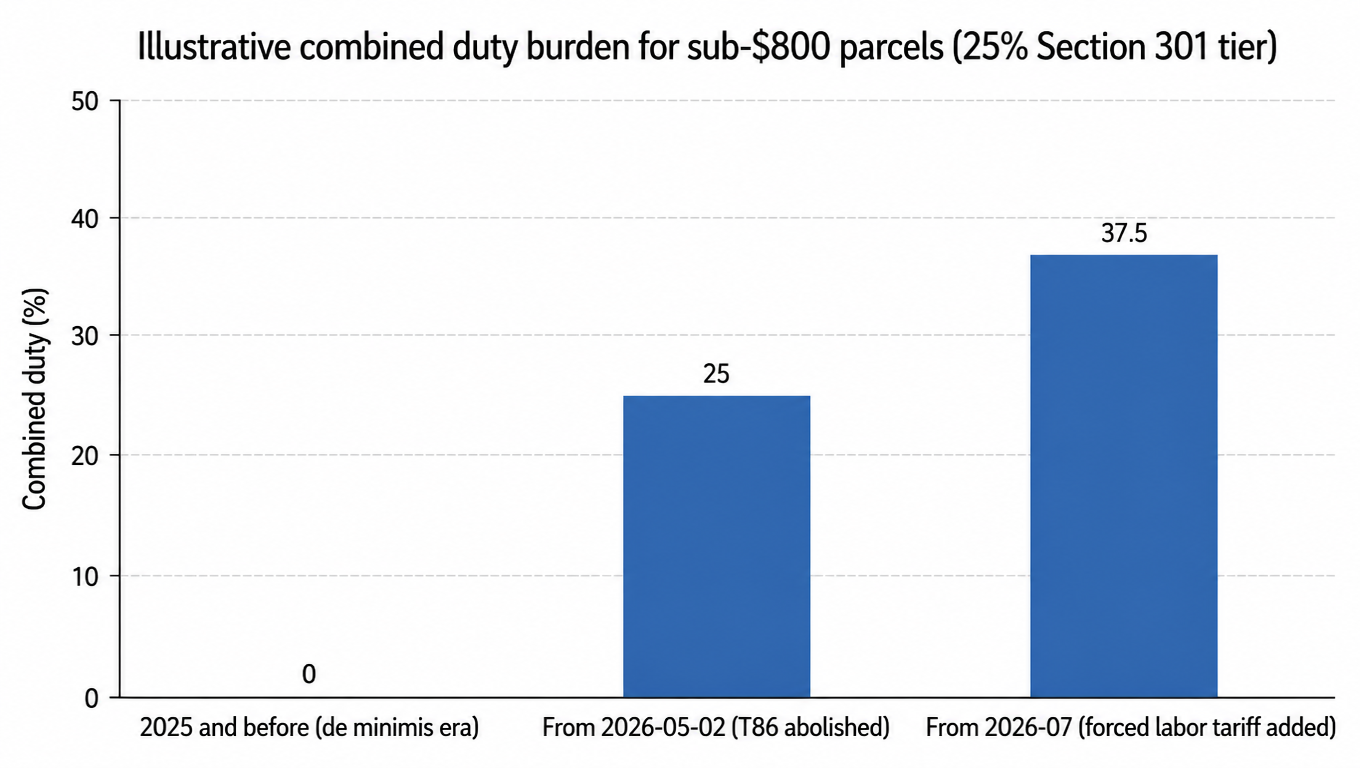
On top of Section 301 duties on Chinese goods (25% or 7.5% depending on the category), a 12.5% forced-labor tariff was added from July 2026. For a product in the 25% tier, those two items alone add up to 37.5%, and if the category also carries a base tariff, the total burden is even higher. The exact rate must always be checked against the product's HS code in the customs system. The chart below shows how the small-parcel duty burden has changed.

Illustrative combined duty burden for sub-$800 parcels: 0% in the de minimis era, 25% after T86 was abolished, 37.5% after the forced-labor tariff
Illustrative combined duty burden for sub-$800 parcels (25% Section 301 tier)

The most direct effect on DDP: the duty cost inside a seller's quote has become hard to predict. Rates can change with an executive order, broker fees are up because of formal entry, and exchange rates move. A shipment can take weeks from order to clearance, so the duty estimated at quote time can already be stale. For DAP, the effect is that the duty lands directly on the US buyer. A buyer who gets a "pay duty on delivery" bill will either refuse the parcel or demand a discount, so returns and disputes rise sharply.

Small-Parcel DDP in Practice

The first step in small-parcel DDP in 2026 is calculating the duty. Look up the applicable rate by the product's HS code, stack the base tariff, Section 301, and the new forced-labor tariff one by one, and use value plus freight as the tax base. Note that most small parcels no longer have de minimis protection in 2026, so stop assuming packages under $800 are duty-free.

The second step is choosing the clearance route. Sellers with a US EIN or ITIN can work directly with a licensed US customs broker; those without can use the built-in clearance service of their platform or freight forwarder, which is simpler. The key is to write down who the importer of record is. Under DDP the seller is the de facto importer: the entry documents, duty payment, and any inspection exposure sit with the seller. That identity cannot be vague.

On documents, the commercial invoice must state the product name, HS code, unit price, total value, and the Incoterm. The packing list reconciles quantity and weight, and a clearance authorization letter is attached. The price on the invoice especially has to survive scrutiny, because under-declaration is a prime customs target. From the platform angle, eBay and Shopify sellers mostly use carrier-built-in clearance (DDP services), while fully managed models like Temu and SHEIN bundle clearance and duty into the procurement price: the seller just hands the goods to the platform, but that cost eventually shows up in the quote anyway.

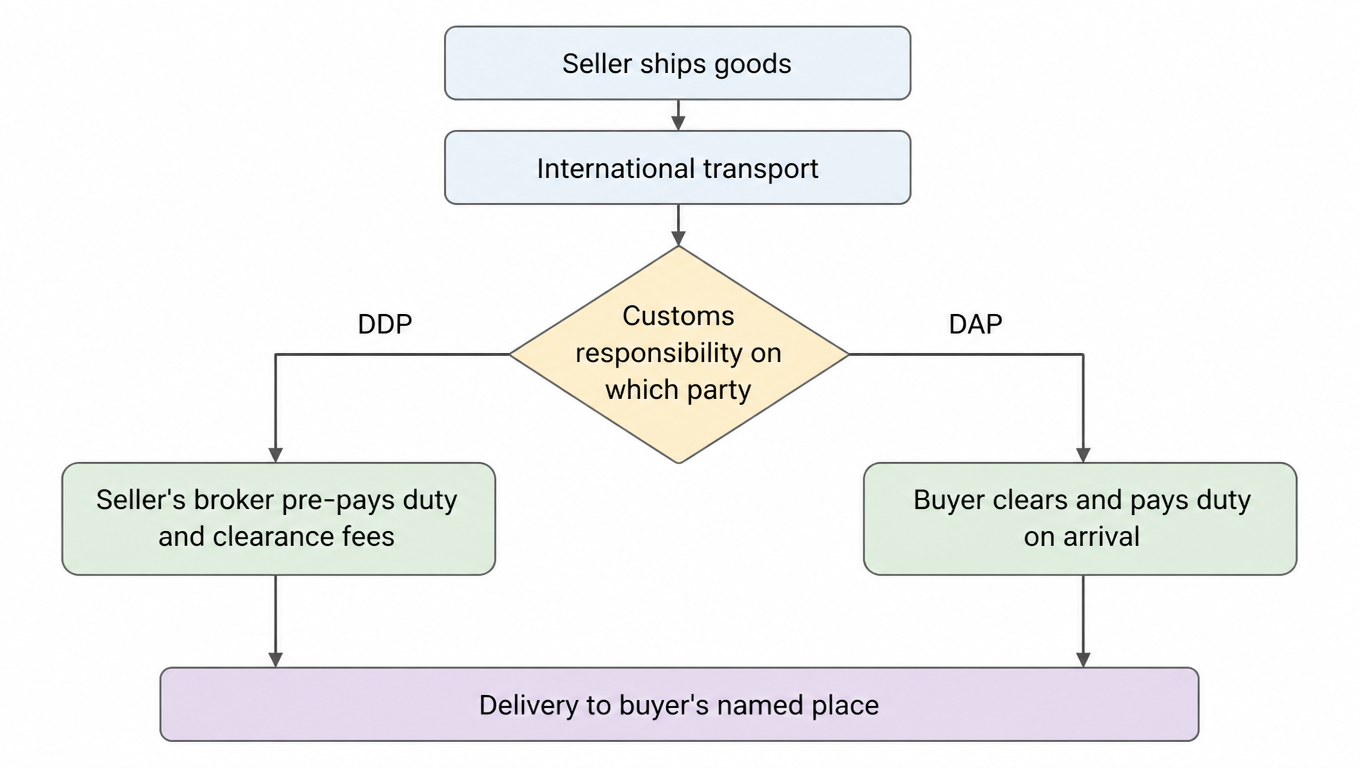
Finally, the quoting model: DDP price = goods + international freight + duty estimate + clearance fee + last-mile delivery + margin buffer. Reserve a buffer of 10% to 15% of the duty estimate, because rates and exchange rates can shift between dispatch and clearance. Better to quote slightly high than to discover at the port that the tax is worth more than the goods. The division of responsibility across the whole flow looks like this.

Flow: seller ships, international transport, where does customs responsibility sit: DDP seller's broker pre-pays duty and clearance fees, DAP buyer clears and pays on arrival, both end in delivery to the buyer's named place
Where DDP and DAP diverge

B2B Scenarios: When DAP Is the Safer Call

With bulk cargo and full-container loads, DDP's downsides scale up. Duty can easily run to tens of thousands of dollars, so the seller pre-paying means capital tied up for a long time, while clearance and inspection uncertainty puts all the risk on the seller's side. DAP hands the duty to the buyer instead, and the seller's capital and risk exposure both shrink dramatically.

When the US buyer is a mature importer with its own clearance team and import credentials, DAP is almost always better. Self-clearing costs them less, the process is under their control, and they can handle input tax credits at filing time. There is no reason for the seller to take on work the buyer could do more cheaply.

In return and refusal scenarios, DAP gives the seller more flexibility. If the buyer refuses the goods, they have not paid duty yet, so the seller can quickly arrange return, resale, or diversion without wading into a duty-refund process. Under DDP the seller has already fronted the duty, so a refusal means applying for a refund and absorbing demurrage: a visibly longer chain of work.

The negotiating reality: a strong buyer often simply demands DDP, duty paid to the door. Protect yourself with terms. Put the effective date and rate version of the duty estimate on the quote, and agree that if duty exceeds the estimate by a set percentage (say 10%), the buyer tops up the difference or the parties renegotiate. For high-duty categories, quote high with a buffer rather than promising a fixed price by handshake.

Common Pitfalls and Risks

Returned parcels with customs paperwork stacked in a dim warehouse corner.
Refusals and returns are the most expensive hidden cost under either term in 2026

Pitfall 1: duty eats the DDP margin. You estimate 25% at dispatch; by clearance a new rate is in effect, or the entry is inspected and taxed at a higher value, and the margin is gone instantly. Fix: buffer the quote, put a rate-change clause in the contract, and watch tariff executive orders closely.

Pitfall 2: the DAP buyer refuses. The goods reach the US, the buyer sees a duty bill higher than the value of the goods, and refuses. What remains is abandonment, return costs, or demurrage, none of it cheap. Fix: confirm the buyer understands and accepts duty responsibility in writing before shipping, and consider a deposit for high-duty categories.

Pitfall 3: under-declaration gets caught. Declaring half the value to cut the duty is a gamble. If CBP inspects, penalties are multiples of the value, the goods can be seized, and the seller lands on the inspection watchlist. Fix: declare truthfully. A DDP quote is supposed to include the real duty anyway.

Pitfall 4: mixed-up terms. DDU (Delivered Duty Unpaid) was deleted back in Incoterms 2010, yet it still shows up in contracts. DAP and DDP differ by one letter, and self-contradictory clauses like "seller may choose DDP but duty not included" still appear. Fix: state Incoterms 2020 in the contract, write the full term name and the named place, for example "DDP to the buyer's US warehouse," and leave no room for interpretation.

The 2026 Decision Quick-Reference

All of the above, compressed into one quick-reference table.

ScenarioRecommendationWhy
Small parcel, buyer wants convenienceDDPDuty paid to the door is a great experience, but buffer the duty in the quote
Small parcel, buyer willing to self-handleDAPNo duty fronting or duty risk for the seller
Bulk, FCL or LCLDAPDuty is large; the seller should not pre-fund it
Buyer has mature import credentialsDAPBuyer self-clears cheaper and with more control
High-duty categoryDDP with cautionDuty can eat the margin; leave a generous buffer
First-time buyer, no import experienceDDP or assisted clearanceBuyer cannot self-handle, but the seller must control risk

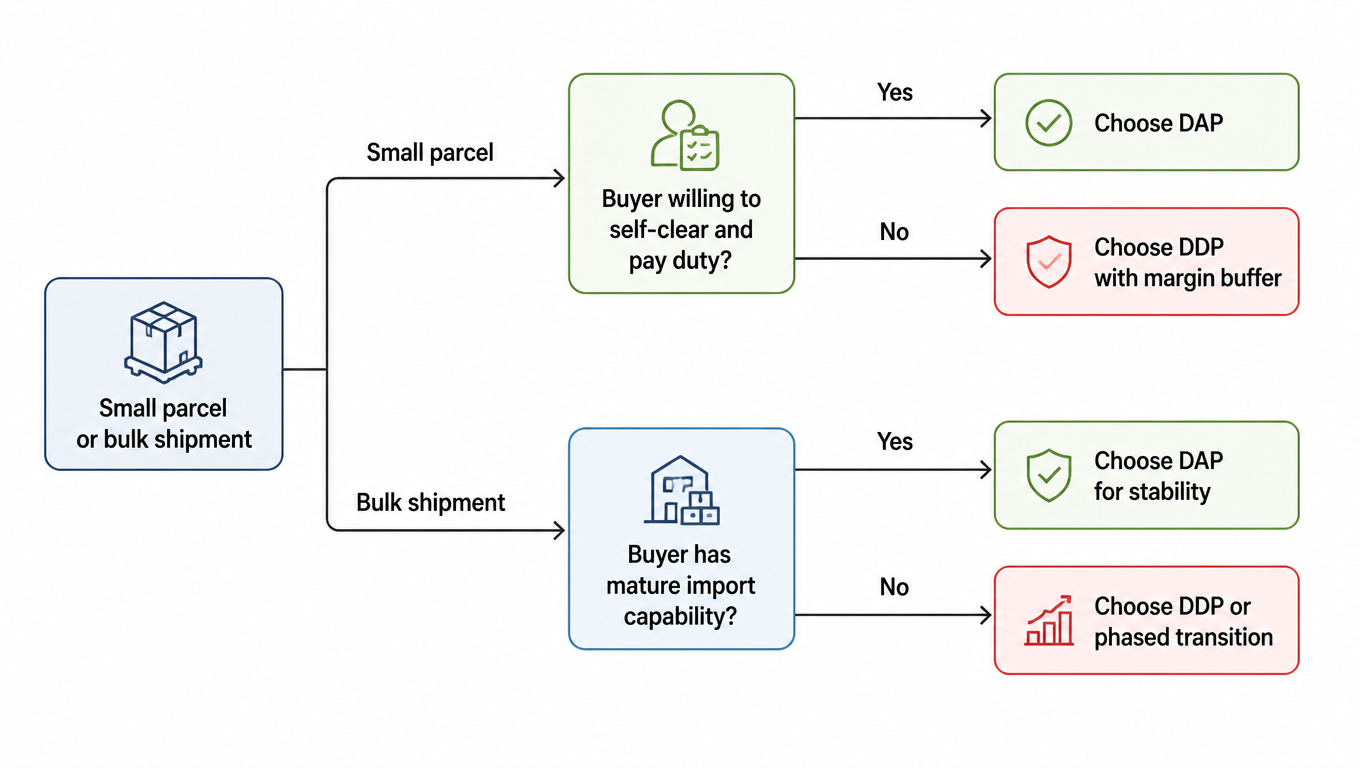
When in doubt, run the decision tree below.

Decision tree: small parcel or bulk; small parcel asks whether the buyer will self-clear and pay duty, yes DAP, no DDP with buffer; bulk asks whether the buyer has mature import capability, yes DAP, no DDP or phased transition
Two questions settle DDP or DAP

There is no one-size-fits-all answer in 2026. The choice between DDP and DAP depends on the category's duty rate, the value per shipment, the buyer's import capability, and your own cash position. The one certainty: only a quote that builds duty into the cost will survive the 2026 clearance reality. Write the term clearly, calculate the duty properly, leave the buffer, and let execution handle the rest.

FAQ

Both require the seller to deliver to the named place and bear the transit risk. The only difference is import clearance and duty: under DDP the seller clears and pre-pays the duty so the buyer receives the goods duty-paid; under DAP the buyer clears and pays the tax. In 2026 that one step happens to be the most expensive and fastest-changing step.
Basically no. The de minimis $800 duty-free lane was suspended indefinitely in June, and the companion T86 simplified entry was abolished on May 2. Small parcels now go through formal entry in 2026, so stop assuming packages under $800 are duty-free, and a DDP quote must include the duty.
Look up the rate by HS code, stack base tariff, Section 301, and the forced-labor tariff, use value plus freight as the tax base, then add clearance fees, last-mile delivery, and a margin buffer. Reserve a buffer of 10% to 15% of the duty estimate, because rates and exchange rates can shift between dispatch and clearance.
Under DAP the goods have not been taxed yet, so the chain is shorter than DDP: you can arrange return, resale, or diversion without a duty-refund process. More fundamentally, prevent it: get written confirmation that the buyer accepts duty responsibility before shipping, and take a deposit for high-duty categories so you never face a "the tax bill is higher than the goods" refusal.
State Incoterms 2020 explicitly, write the full term name and the named place, for example "DDP to the buyer's US warehouse." Stop using DDU, which was deleted in Incoterms 2010. Put the effective date and rate version of the duty estimate on the quote, and agree on a top-up or renegotiation mechanism when duty exceeds the estimate by a set percentage, say 10%.