Warehouse Operations

Serial Number Tracking for 3PLs: How to Match Each Unit to the Order and Package It Shipped In

Can a 3PL tell me which serial number shipped with an order? Yes, if someone captured the number on the unit actually packed, at a known step in the shipping workflow, and saved it against the right order line. To identify the box as well, the record must connect that unit to a particular physical parcel. Start with what support sees in this fictional case: “Order quantity: 2.” “Both packages show delivered.” “One return received.” Which printer came back, and which box carried it out? Those three records alone leave both answers undetermined.

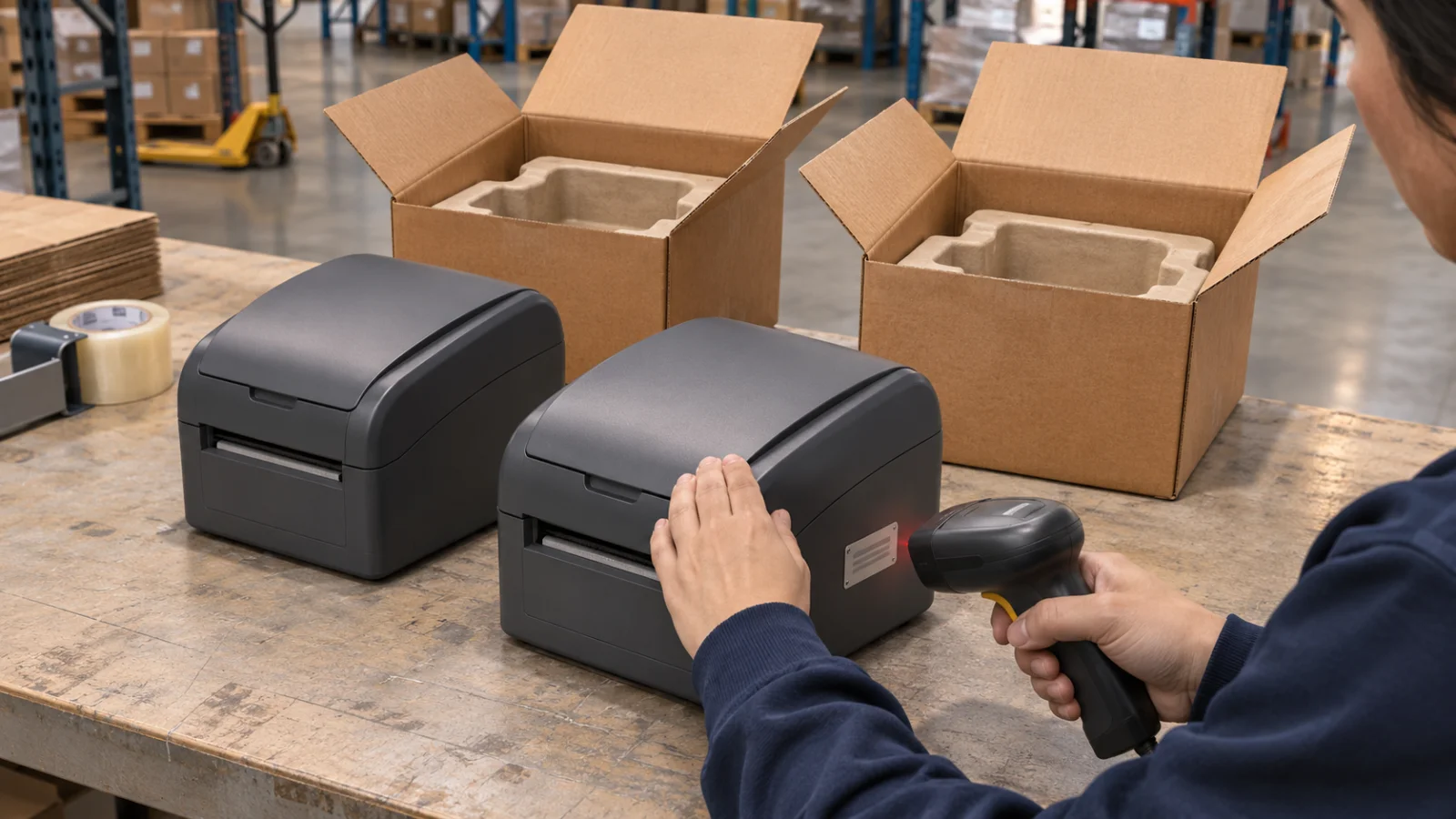
Two identical label printers and two open cartons at a packing bench. A packer reads the identification plate on one printer body.
Scan the object named in the work instruction while its destination carton is in front of the packer.

Decide what needs its own identity

At a New Jersey warehouse, client ND sells two LP-2 label printers on order O-220, line L1. The units carry manufacturer markings DEMO-041 and DEMO-042. Each goes to the same order destination in its own carton. Support already has authorized access to the customer record through the order. It needs a way to get from the device in hand to that record without copying the buyer’s name or address into a general warehouse file. All dates below are in 2026. All case times are local to warehouse NJ-1, Eastern Daylight Time, UTC−4.

Decide what question the brand will pay the warehouse to answer. For an ordinary cable with no individual marking, SKU, quantity and order line may settle a shortage. A printer covered by a per-device warranty calls for its manufacturer serial. Two refurbished printers can share the same model but have different memory, cosmetic grade or repair histories. Link the specific unit to the configuration and inspection revision promised at sale. Reading a serial identifies the unit being examined. Its present condition still requires an inspection.

For a kit, draw a short contents list. Record the host printer individually if warranty or exchange follows that device. Count an interchangeable power cord by SKU if the agreement allows any compliant cord. Record the serial of a detachable module separately when it has its own warranty, rental obligation or configuration promise. Link that module to the host and the parcel at pack time. The decision follows what must later be identified. Requiring a scan of a nonexistent serial only teaches operators to enter a placeholder to get past the prompt.

IdentifierQuestion it answersCase or limit
SKUWhich sellable model?LP-2 covers both printers.
GTIN / UPCWhich trade item?Ordinary UPC on matching products can repeat. GS1 Application Identifiers
LotWhich production batch?Many units may share one lot. GS1 Logistic Label Guideline
Manufacturer serialWhich unit within the issuer’s scope?DEMO-041 or DEMO-042.
Warehouse parcel IDWhich physical outbound carton?P-A persists through relabeling.
Carrier trackingWhich transport record?T-A1 voided, T-A2 used on P-A.

GS1 Application Identifiers describe the meaning of data in a GS1 carrier. For a trade item, AI (01) identifies the GTIN, AI (10) a batch or lot, and AI (21) a serial. A GTIN together with the serial can identify an individual trade item. The regular UPC symbol on two retail boxes of the same product commonly carries the same GTIN-12. It will confirm the product type twice. It cannot tell these two printers apart. A manufacturer's own plate may use a different format altogether. Preserve the literal identifier and the issuing context. GS1 Application Identifiers · GS1 Logistic Label Guideline

Treat the owner, manufacturer or approved identifier namespace, model and serial as part of the lookup specification. In this example ND and LP-2 identify a single agreed manufacturer namespace. Store the serial as text so that zeroes and hyphens survive an export. Document any conversion from raw scan to search value and keep the original read. Do not silently strip punctuation or change case if the issuer distinguishes it. At this point the first order entry is simply ND, LP-2, O-220/L1, two units requiring a body read. Neither printer has been assigned to a parcel yet.

Choose where the warehouse reads the serial

To answer “Which ten devices are still here?”, start at receipt and keep the unit records current. Count the inbound cartons, identify the owner, read each accessible unit, and link it to the receiving record and inventory status. Move or quarantine a particular serial when the unit moves or fails inspection. At outbound, read the device again and reconcile it to the open inventory record. A receipt proves what was observed on that date. The second read and the intervening adjustments are what make an on-hand list credible today.

Outbound-only capture is a smaller service with a different answer. Receive two LP-2 units as a quantity and record the manufacturer marks when each actual device reaches the packing bench. This supports the question “What did we ship on this line?” The warehouse cannot reconstruct which unsent serials were present last Monday from quantity receipts. In the worked case NJ-1 uses this approach. The receipt shows two units for ND. It contains no verified serials. The outbound search begins at the bench. Keep this boundary visible when giving the brand an inventory export.

Estimate the work on both ends before writing the statement of work. With receipt plus outbound verification, each ordinary unit needs at least two planned identity reads, plus discrepancy work and location updates when relevant. With outbound-only capture, the normal requirement here is one new identity read per device at pack, in addition to existing product and parcel scans. Time the steps at the actual stations. Opening a master carton, obtaining permission to inspect a unit and returning it to saleable condition may take much longer than reading the code itself.

At receiving, keep a carton count apart from a count of observed bodies. Ten sealed retail boxes can support a receipt of ten units under an agreed counting method. They do not supply ten body observations. If an inbound shipment mixes sealed new units and open refurbished units, give the two groups separate evidence descriptions. A later warranty agent then knows which observation can be compared directly with a returned body and which needs the manufacturer's pairing record.

A factory seal changes what can be observed. If the sales agreement requires an unopened retail box, ask for the permitted evidence before the first receipt. Record “serial on retail carton” when that is the object read. A manufacturer packing list or an approved pairing test may support a documented relationship, with its own scope and date. Without it, whether the device inside carries that same serial is undetermined. Route an unreadable exterior mark to a supervisor. Get the owner's authorization before breaking a factory seal.

ShipHero provides a useful product-specific check. Its Needs Serial Number setting applies at the product level. The documented Packing App and shipping web workflow accept a scan or manual entry at packing. ShipHero excludes Bulk Ship, Mobile single-order fulfillment, Kits and Built Kits. Enabling products with a bulk edit and actually fulfilling orders in Bulk Ship are different operations. Ask the supervisor to show the route used when the afternoon backlog builds. A demonstration on a quiet single-order bench cannot establish coverage in a different production flow. ShipHero product settings and supported flows

Ask the 3PL four questions before signing. What object will the operator read when the retail seal must stay intact? Which production paths can bypass the read, and who diverts affected orders to a supported path? Can a second employee retrieve the specific parcel for one serial after a label change? Who can correct a bad read, and can the brand see the prior value, reason and approver? Put the answers beside the SKU group in the operating agreement. Price an inbound registry separately if the brand also needs to know which units remain on hand.

Give every physical unit a box before sealing

On October 5 at 09:00, the packer opens O-220, selects L1 for ND, and checks that LP-2 requires two device-body reads. Set two empty cartons on the bench. Give them stable warehouse IDs P-A and P-B before buying postage. Scan or select the carton that is open in front of the operator. Keep one active carton at a time, with the other visibly parked. The warehouse identifier can be a printed, nonreused local ID. It has to stay with the physical box for the life of that outbound move.

At 09:07 the packer reads DEMO-041 from the first printer body, checks the characters shown on the screen against the plate, and places that printer in P-A. Save owner, SKU, order and line, serial, scan object, parcel, station operator and timestamp together. At 09:08 select P-B, read DEMO-042 from the other body and place it there. That second entry needs its own parcel ID even though the sales order has only one line. Never assign box membership afterward from the order in which two label files happened to print.

Before closing the lids, compare three counts. The order line requires two units. There must be two distinct valid unit identities for ND and LP-2, and the two box contents lists must each account for one of them. Check that a unit occurs on only one current contents list. A count of two scans can succeed with the same printer read twice. A count of two correct serials on the order can succeed with both assigned to P-A. Stop closure for either mismatch and reopen only the affected work at the bench. Warehouse barcode and scan verification

Agree on a restart procedure for interruptions. When the packer returns from a break, clear the previous order selection, scan the carton in front of them and compare its saved contents with the physical count. If the wrong order remained open during a read, hold both affected orders. A supervisor should identify the actual unit at each station before authorizing the correction. A message saying “moved to the right order” with no old and new line references is difficult to investigate later.

NJ-1 · Oct 5, EDTOrder line O-220/L1Current contents
09:00 · line openedLP-2 × 2 dueNo body-to-box link yet
09:07 · body readDEMO-041P-A · one printer
09:08 · body readDEMO-042P-B · one printer
09:10 / 09:11 · sealed2 distinct bodies checkedP-A and P-B contents frozen
A second DEMO-041 read is rejected. If DEMO-042 is missing, hold both boxes. Release for closure only when P-A and P-B each have the correct distinct unit.
Two scan events can still represent one device. Count distinct bodies and verify each open carton.

While a carton is still open, let the packer report a correction. Keep the mistaken association as a superseded entry and identify the replacement event. After the lids are checked, P-A seals at 09:10 and P-B at 09:11. Freeze their contents lists at that point. The examples assume a supervisor must authorize opening a sealed box. Someone moving a device after sealing changes the evidence support will use later. Require a fresh physical read before that box returns to the shipping lane, even when the sales line and total quantity have stayed the same.

Here is a counterfactual correction, outside the main order history. If DEMO-041 were moved from P-A into a fresh carton P-C before handoff, record the removal from P-A and the new placement in P-C under the same correction reference. Mark the emptied P-A withdrawn, invalidate its unused transport label as applicable, then seal and label P-C. Retain the original put and both correction events. DEMO-042 stays in P-B. In the actual teaching case neither box was reopened. There are exactly two outbound cartons to reconcile.

Follow a relabeled carton to handoff

At 09:12 P-A receives tracking reference T-A1. At 09:13 P-B receives T-B1. These are fictional training identifiers. A printer feed problem at 09:14 spoils the paper copy for P-B. The operator opens the existing label and reprints it. The replacement paper carries T-B1 again. Destroy or segregate the spoiled copy so it cannot be used on another carton. Log a reprint against the existing label. There is still one label purchase for P-B, one tracking reference on its current record and one physical box.

P-A takes a different path. Its label is smudged and the shipping desk chooses to void the unused label and buy a replacement before tender. At 09:16 the desk records confirmation that T-A1 is void. Until the replacement is attached, P-A has no valid label and stays off the dock. At 09:18 the desk buys T-A2, covers or removes the obsolete label, reads the new one on P-A and verifies the destination against O-220. The pack record still puts DEMO-041 in P-A. No one opened the box or moved the printer.

A void request, confirmation of void status and any postage credit are separate events. Use the actual response from the label provider. If a void is still pending, preserve the request reference and route the box to the shipping lead under the site's exception policy. Do not infer a credit from a fresh PDF. At 10:00 the example dock reconciles P-A/T-A2 and P-B/T-B1 to the two cartons released and records physical handoff. Later the two current references show delivery. There are three tracking strings in history, two labels used for transport and two delivered parcels. Order, shipment, package and label model

O-220/L1 sends DEMO-041 in P-A, relabeled from void T-A1 to used T-A2. DEMO-042 ships in P-B with reprinted T-B1.
P-A keeps its identity through the label change. Two physical parcels leave NJ-1.
Oct 5, EDT · eventCartonLabel evidence
09:12 · purchasedP-AT-A1 issued
09:13 · purchasedP-BT-B1 issued
09:14 · reprintedP-BT-B1 unchanged
09:16 · void confirmedP-AT-A1 void, hold carton
09:18 · replacement purchasedP-AT-A2 attached and checked
10:00 · tenderedP-A / P-BT-A2 / T-B1 respectively
Owner · model · siteOrder / lineObserved bodyCartonUsed at handoffPacking read · Oct 5 EDTException
ND · LP-2 · NJ-1O-220 / L1DEMO-041P-AT-A209:07Smudged T-A1 voided
ND · LP-2 · NJ-1O-220 / L1DEMO-042P-BT-B109:08T-B1 reprinted

Read the outbound sheet as a dispatch snapshot and the event sheet as its supporting history. One row per shipped device makes a warranty inquiry fast. One row per label or handling event explains why an old reference still appears in an export. Save both. A single cell containing all three tracking strings forces an agent to guess which one was on the carton. Erasing T-A1 produces the opposite problem when accounting asks about an unused purchase. Keep the stable carton ID on the unit and put a status on each label relationship.

ShipHero's Serial Number Report documents serial capture for outbound products and the associated order. It lists fields including SKU, serial, recorded date, scan versus manual entry, order, warehouse and 3PL customer. That makes it a sensible place to begin an order-level investigation. The published column list does not establish the contents of P-A versus P-B or the chain of label revisions. Have the provider demonstrate that second lookup with a real workflow and its supporting export. Where only the order is visible, mark the parcel result undetermined. ShipHero Serial Number Report

At low volume, start with preassigned parcel stickers, a scanner that enters text, and a shared workbook with controlled editing. Give each packer a separate batch or one writer per active box. Lock closed snapshots, append corrections with the prior row ID, and save a dated read-only export for support. Restrict each client to its own records. Test a restore and a cross-shift search before relying on the file. If two stations can accept the same scoped unit at once, a spreadsheet warning after both have shipped comes too late. Move the release check to a system that can reserve one unit once and log who changed it.

Catch the three exceptions that preserve a plausible count

First, imagine the scanner beeps twice on DEMO-041. The counter reads two and DEMO-042 is still on the mat. Stop both cartons before sealing. The lead compares the actual body plates, the two most recent scan events, the owner and line on the screen, and the contents list for each open carton. A second read may be an accidental double trigger or a retry after the screen froze. Neither is a second physical unit. Record the duplicate as rejected, capture the actual second unit into its intended box and have the lead approve the reconciled count.

Check how the software treats duplicate strings. ShipHero documents a default requirement for distinct serials within an order and a setting that allows duplicates. A brand that requires individual printer identities should have the provider show the actual setting and run the duplicate test. If two different bodies really carry the same manufacturer marking inside the same agreed scope, capture that fact and hold the affected units for owner review. A packer should not invent a suffix to make two rows pass. Resolve the identification policy and record its authority before release. ShipHero product settings and supported flows

Second, consider an unrelated client, WD, whose device also reads DEMO-041. A global search returns two hits. A receiver seeing a duplicate alert checks the incoming owner on the receipt, manufacturer context, model, scan object and physical custody. A lead may release the WD unit into WD stock once those match and its own scope is clear. If a mixed inbound pallet has no reliable ownership record, keep the unit on receiving hold. Preserve the two independent histories. Correct an owner only against source paperwork and a supervisor's signed correction, never by silently merging the histories.

Third, service authorizes an advance exchange. In this alternative exercise a new outbound order X-10 sends DEMO-077 while DEMO-041 is still with the buyer. Give the replacement its own line, parcel and valid label. Link it to the service case and to the original order. When the return arrives, receiving checks which serial was expected back, which was actually read, and whether the replacement also remains with the buyer. The shipping desk can release an authorized advance exchange under its terms. The returns desk holds an unexplained mismatch from resale and automatic financial action while the account lead investigates.

A later service note or manufacturer repair record may explain why a serial changed. A box with the wrong unit inside, a prior warehouse misread and a return against the wrong authorization are also live possibilities. Compare the outbound scan object, original contents record, exchange shipment and physical return before assigning a cause. The account owner approves a documented correction or a customer-service disposition. Keep expected, observed and resolved serials in separate fields. An unexplained mismatch leaves the cause undetermined. It establishes neither buyer misconduct nor the outcome of a marketplace claim.

Receive the one printer that came back

Return to the main example, with no exchange. On October 26, three weeks after dispatch, NJ-1 receives one unit under return authorization R-71 for O-220/L1. Record the quantity actually on the bench as one. Read the printer body and record DEMO-041 at 10:00, separately from any number on the returned retail box. Search ND, LP-2 and the exact serial in the dispatch snapshot. The single matching departure identifies O-220/L1, P-A and T-A2. The voided T-A1 belongs to the history of the same P-A. Close the identity match for one unit. Route condition and any refund for separate decisions.

R-71 receives DEMO-041, linked to O-220/L1, P-A and T-A2. An order-only file leaves the original parcel undetermined.
The receipt accounts for one device. DEMO-042 has no recorded return in this case.
Lookup fromRecorded answerWhat remains open
ND / LP-2 / DEMO-041O-220/L1 → P-A → T-A2Condition at delivery
R-71 · one body receivedDEMO-041 → O-220/L1 → P-ARefund decision awaits its own review
ND / LP-2 / DEMO-042O-220/L1 → P-B → T-B1No receipt for this device in R-71

Run the reverse query as a control. Open O-220/L1 and read the two dispatched units. DEMO-041 has one physically received return under R-71. DEMO-042 left in P-B with T-B1, and no return for that unit is recorded in this case. The dispatch count remains two even after the return. The return receipt count is one. Support can now identify the original order destination and parcel associated with each device. A delivery scan alone still cannot establish the identity of the person who opened a carton or the condition of the printer at delivery.

A return authorization is permission to send something back. At check-in, label the physical item with the receiving reference and keep its observed identity separate from the customer's description. If support approved a return for two units but the tote contains one, receive just the one and leave the remaining authorization open or close it according to the owner's instructions. Keep the receiving note and any photographs with that receipt so a second operator can review the conclusion without handling the item again.

Try the same return with a thinner file. Suppose the brand has only the order-level serial list and the two delivery scans. A body read of DEMO-041 can match the returned device to the order, assuming the identity scope and historical shipment are unambiguous. Its original box is undetermined. If the outbound record was an unverified retail-box mark, even the original device-body match is undetermined. State each result separately in the case note and ask for a contemporaneous pack record. A guess entered into the parcel field today may look like eyewitness evidence to next month's reviewer. Wrong-item return evidence checklist

Price the extra work and measure the service

For a pricing discussion, suppose a warehouse adds eight seconds of routine capture for each of 600 devices per month. At $24 per labor hour, 600 × 8 gives 4,800 seconds, or 80 minutes, costing $32. Twelve of those devices also take two additional minutes each to resolve an exception. That is another 24 minutes at the same hourly rate, or $9.60. The total is 104 minutes and $41.60 of incremental labor for these listed steps. Those twelve devices are already in the 600 and receive the eight-second charge only once.

Time the pilot against the same lane without the added identity work. Begin at the point where a packer would otherwise move directly from product confirmation to placement, and finish once the unit-to-box entry is saved. Mark exceptions separately. Use the loaded labor rate the warehouse actually budgets. Training, setup, scanners, additional receiving reads, second-person checks and dispute handling outside the timed interval need separate inputs. A 3PL's commercial fee also depends on its service agreement. The worksheet lets a brand change volume, seconds per device, exception count, minutes and hourly cost.

Time both clean and troublesome labels. Record how many successful first reads, retries and manual entries produced the eight-second average. If the provider bills by order, translate devices to orders using the actual mix. In this example O-220 contributes two routine unit reads but only one original order. Charging twice for order setup and twice for device capture would be appropriate only if the fee schedule explicitly calls for both events at that frequency.

Measure value at the service desk with questions operators can answer. Time a warranty inquiry from the first serial read to retrieval of an evidenced outbound order and parcel. Record the median completed time and the count that never yielded a parcel. Count unmatched physical returns at the end of the same review window and divide by the serialized returns actually received. For investigated and confirmed mispicks, count those traceable to a particular box out of that same confirmed group. Keep cases with missing evidence visible. A fast search that returns the wrong box is a failed lookup regardless of elapsed time.

Test the shipping lane in fifteen minutes

Set up the test before starting the clock. Supply two marked LP-2 samples, two test cartons, a test order and a return authorization. Use a sandbox or the provider's approved test-label facility, with deliverable-looking sample data kept out of live dispatch. Ask the packer to use the actual operational route for this client, including any bulk workflow the provider proposes. Reserve an independent support agent for the final lookup and hide the answer sheet. The brand should observe the screen and the physical movement together. A prefilled export can teach the format but cannot demonstrate the capture step.

Test action · minutesExpected recordActual resultGapOwner
0–3 · open lineND / LP-2, qty 2, body read________Account lead
3–7 · scan and splitDuplicate stopped, missing unit held, one body per box________Pack lead
7–10 · change labelsP-A keeps both revisions, P-B one reused reference________Shipping lead
10–12 · receive oneR-71 received 1, observed DEMO-041________Returns lead
12–15 · blind searchBoth searches resolve to O-220/L1, P-A, T-A2________Independent support agent

Use minutes zero through three to confirm the owner, item, required object and line quantity. During minutes three through seven, try scanning DEMO-041 twice on purpose. Watch where work stops, correct the extra read, and pack DEMO-042 into P-B. In minutes seven through ten, reprint P-B's existing label and void and replace P-A's test label. Ask the operator for the current two-box handoff list and the history that still contains T-A1. Do not count a third parcel to make the screen agree with the number of tracking strings.

In minutes ten through twelve, present only DEMO-041 as the returned body. Ask receiving to record one unit against R-71 and leave the other original unit untouched. Use the last three minutes for the blind query. First give the independent agent ND, LP-2 and DEMO-041. Then give only the return reference R-71 and ask for the observed unit, original line, outbound box and used tracking number. Let the agent show which saved records support each answer. Record actual results and a named owner for each gap. A working search in the supervisor's account may still be inaccessible to support.

Record a partial pass in these terms. “Both serials found on O-220/L1. Two delivery references found. Device-to-carton assignment undetermined.” For a truly single-carton operation, an order-level match may satisfy a limited warranty inquiry if the brand accepts that scope and every relevant shipment is demonstrably one box. Frequent splits, advance exchanges and reshipments need the missing relationship. Agree on a repair, an owner and a repeat test before claiming box-level traceability. The workbook contains a worked example and a blank actual-results column for the provider's run.

Bilingual Excel register · Outbound record (TSV) · 3PL acceptance test (TSV)

Once the records identify the two boxes actually shipped, the brand has a useful basis for evaluating outbound parcel service. Give EasyShippingX each sealed package's measured dimensions and gross weight along with warehouse origin, destination mix and delivery requirements. Use P-A and P-B as two parcels in the comparison. The retired T-A1 belongs in the label history. It adds neither a third carton to the rate comparison nor a second returned device to R-71.

Serial number tracking FAQ

The ordinary UPC identifies the trade item. For individual identity, capture the unit marking and its issuer or agreed scope.

Record the exterior mark as a retail-box observation. Use the brand’s approved pairing evidence when available. Otherwise the enclosed body identity is undetermined.

Keep the parcel ID if the same sealed carton remains. Retire the old label, record the new valid label and reconcile the physical handoff.

Record a partial pass for order-level lookup. Test the saved contents of each physical carton before accepting parcel-level service.

Receive the observed unit and route its disposition to the authorized owner. Check the other device separately before updating any additional quantity.