Most merchants ask the wrong question first. They ask which product to buy: shipping protection, carrier insurance, or signature confirmation. The right first question is which failure mode they are paying for. A parcel lost in a sort facility, a package stolen off a porch, and a customer who files a chargeback after receiving the box are three different problems. Each has a different responsible party, a different evidence requirement, and a different cheapest fix.
This guide is written for the people who actually make the call: DTC founders, Shopify store owners, Amazon FBM sellers, ecommerce operations and finance leads, risk and fraud managers, and 3PL customer success teams. You will get the mechanism, the real cost, and the traps for each tool, then a layered decision rule you can apply by order value and failure mode.
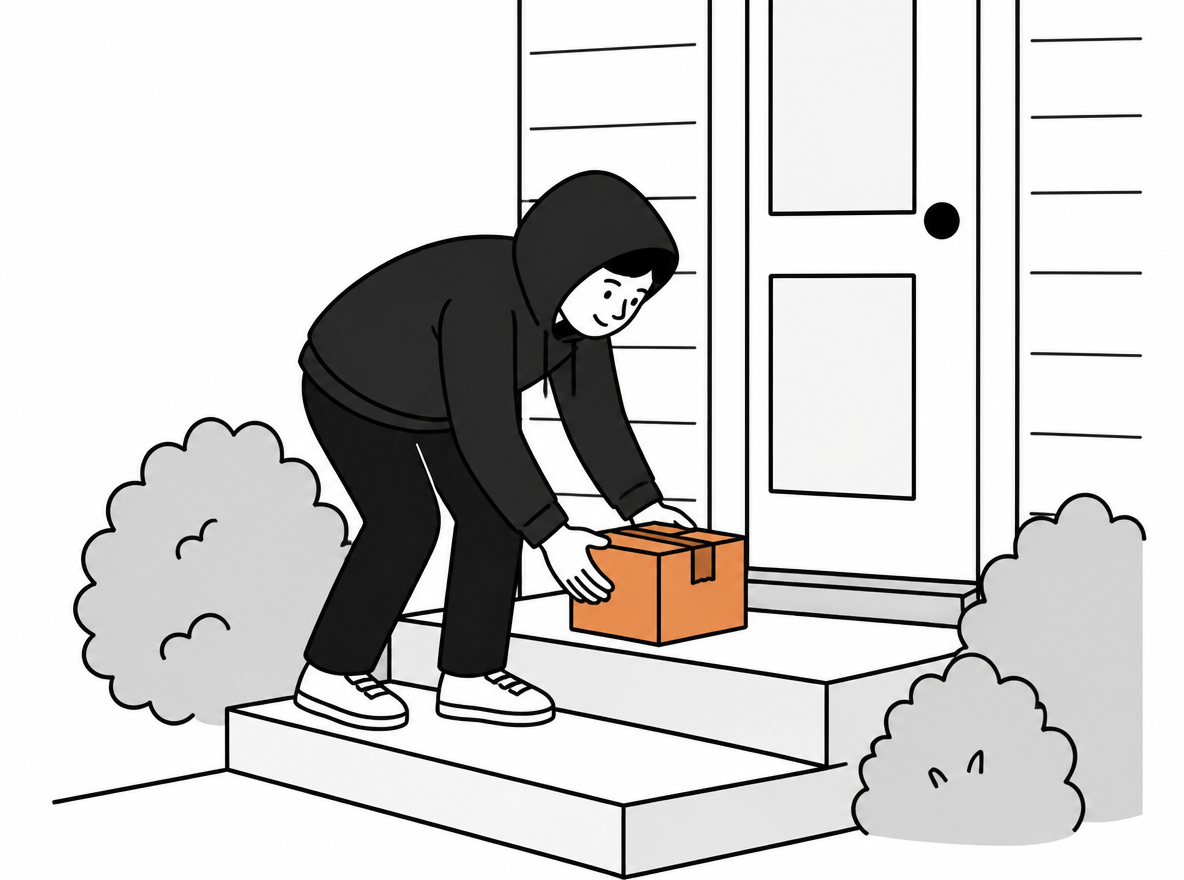
A porch handoff and a porch theft are two different liability zones
Why This Decision Costs More Than You Think
The default state of most brands is accidental self-insurance. When a package is lost, damaged, or stolen, the merchant refunds or reships out of pocket, and nobody files a carrier claim. The loss looks small because it is spread across thousands of orders, so it never gets a line item in the P&L. The right frame is expected loss per order: order value × loss probability, summed across SKUs, destinations, and carriers. For a brand shipping a few thousand orders a month, that number is almost always material, and it is almost always higher than the cost of the tool that would have covered it.
The hidden costs make it worse. Every delivery failure that reaches the buyer's credit card costs a chargeback fee (roughly $15 to $25, plus processor fees)[14] on top of the refund, and a reship burns the same cost of goods twice. Claims labor is the quiet line: a single carrier claim can take one to three hours of work across phone, paperwork, and follow-up, which is why most small teams never file at all. Add the lifetime value lost when a customer abandons a brand after a bad delivery experience, and the true cost of doing nothing is a multiple of the premium you were trying to save.
The Three Tools: Mechanism and Boundaries
Shipping protection is a buyer-facing coverage layer sold by third parties (Route, Extend, Shipsurance)[12][13] or embedded in platforms (Shopify Protect, Amazon's purchase protection). The merchant pays roughly 1% to 2% of cart value per order.[11] The buyer gets a one-tap claim flow at checkout or in the tracking page, and the merchant is reimbursed quickly, usually within days, without packaging photos or carrier arbitration. Crucially, many plans cover theft after delivery, which no carrier covers.
Carrier insurance, technically declared value, is the coverage attached to UPS, FedEx, or USPS shipments. The first $100 of coverage is included for free on most services. Above that you pay per $100 of value: about $1.15 at UPS and FedEx, and tiered fees at USPS.[1][2][3] It covers loss or damage while the parcel is in the carrier's network, and it ends at the delivery scan. Claims are filed by the shipper, require proof of value, and typically take weeks to resolve.
Signature confirmation is not insurance at all. It is evidence. For roughly $3 to $7 per package you get a delivery record that deters porch theft, neutralizes most not-received disputes, and shifts the burden of proof in a chargeback.[4] It never pays a claim, because its job is to stop the dispute from existing.
These are layers, not alternatives. The failure modes below map each problem to the layer that actually covers it, and the decision rules show when to stack them.
Failure Modes, Part 1: Logistics Liability
Lost in transit. The scan history goes dark after a sort facility and the parcel never arrives. This is the cleanest claim category: the loss happened inside the carrier's network, and declared value is the natural instrument. The free $100 bracket already covers a large share of DTC orders; above $100, the $1.15 per $100 at UPS and FedEx, or the USPS tiered fee, is cheap relative to the exposure. Third-party protection also covers this mode and pays faster, but you pay its 1% to 2% premium on every order, not just the risky ones. Signature confirmation does nothing here: the parcel never reached a delivery point.
Damaged parcel. The box arrives crushed, torn, or leaking. The carrier is liable only if the damage happened in transit and the packaging was adequate, and packaging disputes are the single most common denial reason across all three carriers.[5] Evidence decides the claim: photos of the packed box before shipment, photos of the damaged parcel at delivery, and the original sales invoice. Declared value pays out if the evidence is clean; protection providers pay faster and rarely litigate packaging, which is why merchants shipping fragile or high-margin goods often prefer them for this mode. Signature confirmation is irrelevant to damage.
Delivered but not received. The scan says delivered, the customer says it is not there. Once a valid delivery scan exists (USPS and FedEx include GPS and delivery photos),[15][16] every major carrier treats the case as closed, and no declared-value claim will be paid for delivered-but-not-received.[5][6][7] The burden of proof falls on the merchant, and the cheapest way to win is to never let the dispute exist: signature confirmation converts delivered-to-porch into delivered-to-a-person, which matters most at apartments, offices, and high-risk ZIPs. Protection plans are the only tool that pays out in this mode, since many treat it as covered loss up to the order value.
Failure Modes, Part 2: Buyer-Side and Risk
After the delivery scan is a liability vacuum; only protection covers that stretch
Porch theft. The parcel was delivered and then stolen off the doorstep. This is a responsibility vacuum: the carrier's liability ended at the delivery scan, and no declared-value coverage applies. Signature confirmation prevents the mode by forcing a handoff, or by making the buyer accept responsibility when they waive the signature. Third-party protection is the only layer that pays after delivery, and it is the main reason protection adoption keeps rising. Porch theft is also a neighborhood problem: theft rates vary sharply by ZIP, so the fix is data. Map the ZIPs that generate theft claims, route those orders to signature or pickup, and let protection carry the rest.
Friendly fraud. The customer received the parcel and files a chargeback or an item-not-received case anyway, claiming it never arrived or was not authorized. This is a representment problem, not a shipping problem, and your defense is the evidence file: tracking scans, the delivery photo, GPS coordinates, and a signature if you paid for one. Signature confirmation is the strongest single exhibit: delivered-to-recipient beats left-at-door in almost every dispute. Protection plans do not help here. They reimburse your loss, but they do not stop the chargeback, the processor fee, or the damage to your payment-provider risk score.
High-value orders. Every layer has a ceiling. USPS caps additional coverage around $5,000 on most products,[3] UPS and FedEx around $50,000 per package,[1][2] and protection plans and carrier contracts exclude or cap jewelry, cash, collectibles, and sometimes electronics. Before you rely on any layer, read the insurance-to-value language for your exact SKU. Two practical defaults: add declared value on every order above the free $100 bracket, and make signature confirmation mandatory, not optional, above roughly $200 to $500, where the cost of one friendly-fraud dispute exceeds a month of signatures.
High-risk destinations. Some addresses are structurally expensive: apartment buildings, offices, known theft ZIPs, freight forwarders and reshippers, and addresses that have already generated claims. Carriers and protection providers both track these patterns, and repeat claims at one address is the fastest way to get future claims declined. The layered answer: require signature at the ZIP level, keep protection for the rest of the network, and move repeat-loss addresses to pickup or block them outright. A destination that consumes more in claims than it generates in margin is not a customer, it is a liability.
The Layered Decision Rules
Six variables drive every choice: expected loss (order value × loss probability), order value, the surcharge of each tool, evidence quality (scans, photos, signatures), claims labor (hours per claim), and customer experience (refund speed and friction). None of them is the product name. Route, Extend, and Shipsurance are implementation details; the framework works whether you buy from one of them, from a platform, or from your carrier.
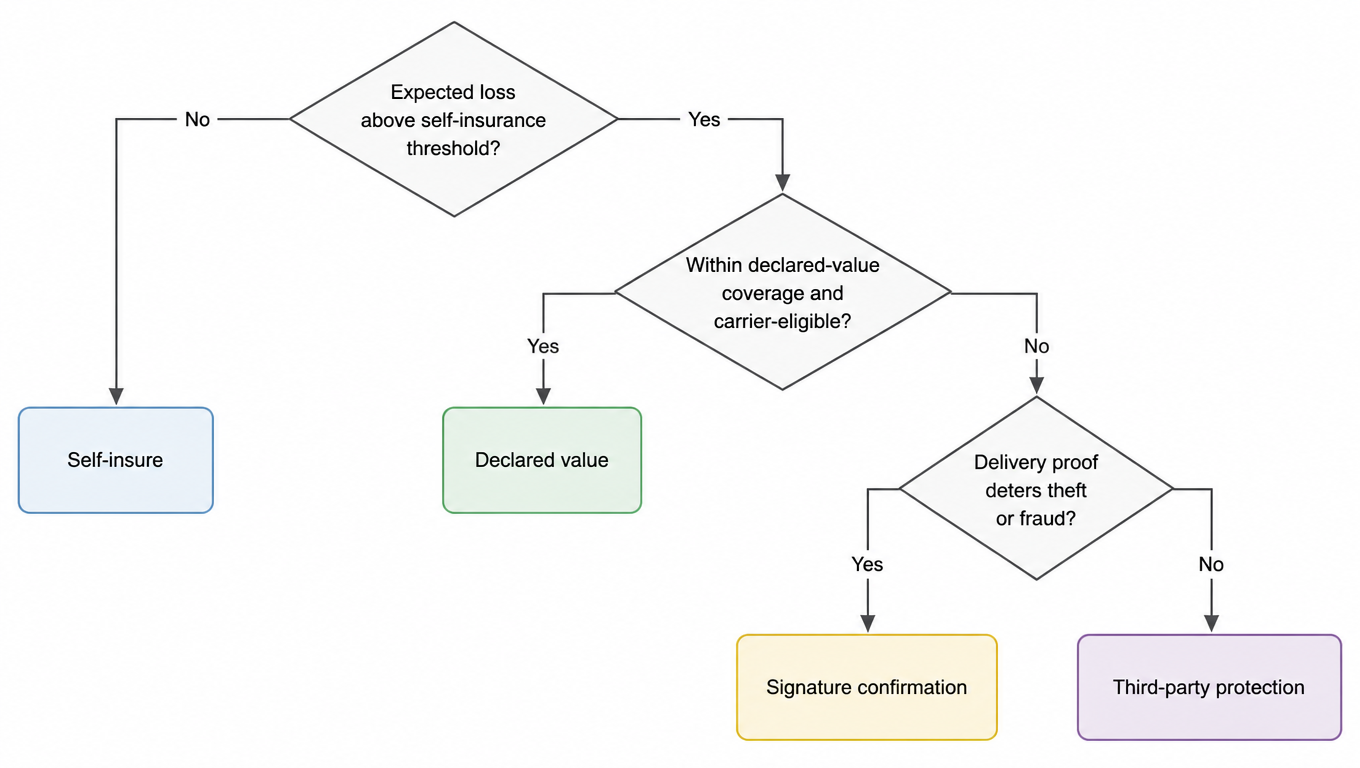
Four tiers fall out of those variables. Tier 0, self-insure: when expected loss is below the cost of any tool, typically low-value orders on safe routes, absorb the risk and skip the premium. Tier 1, declared value: when order value exceeds the free $100 bracket and the category is carrier-eligible, this is the cheapest coverage per dollar of exposure. Tier 2, signature confirmation: when delivery proof deters theft or fraud, or when a dispute would cost more than the $3 to $7 fee, add it. Tier 3, third-party protection: when your dominant failure mode is theft after delivery, or when claims labor is the real cost, pay 1% to 2% of cart value and let the provider handle the buyer and the payout.
Four tiers: compute expected loss first, then ask whether the carrier, delivery proof, or third-party protection covers the mode
Stacking rules: protection plus declared value is usually double payment, so pick the layer that covers your dominant failure mode and skip the redundant one. Signature stacks with everything, because it is evidence, not coverage. Keep declared value on the categories protection excludes: electronics, fragile goods, jewelry. And never buy a tool for a mode it cannot cover. Signature will not pay a theft claim, declared value will not pay a porch-theft claim, and protection will not stop a chargeback.
The Cost Ledger and Where Each Option Lives
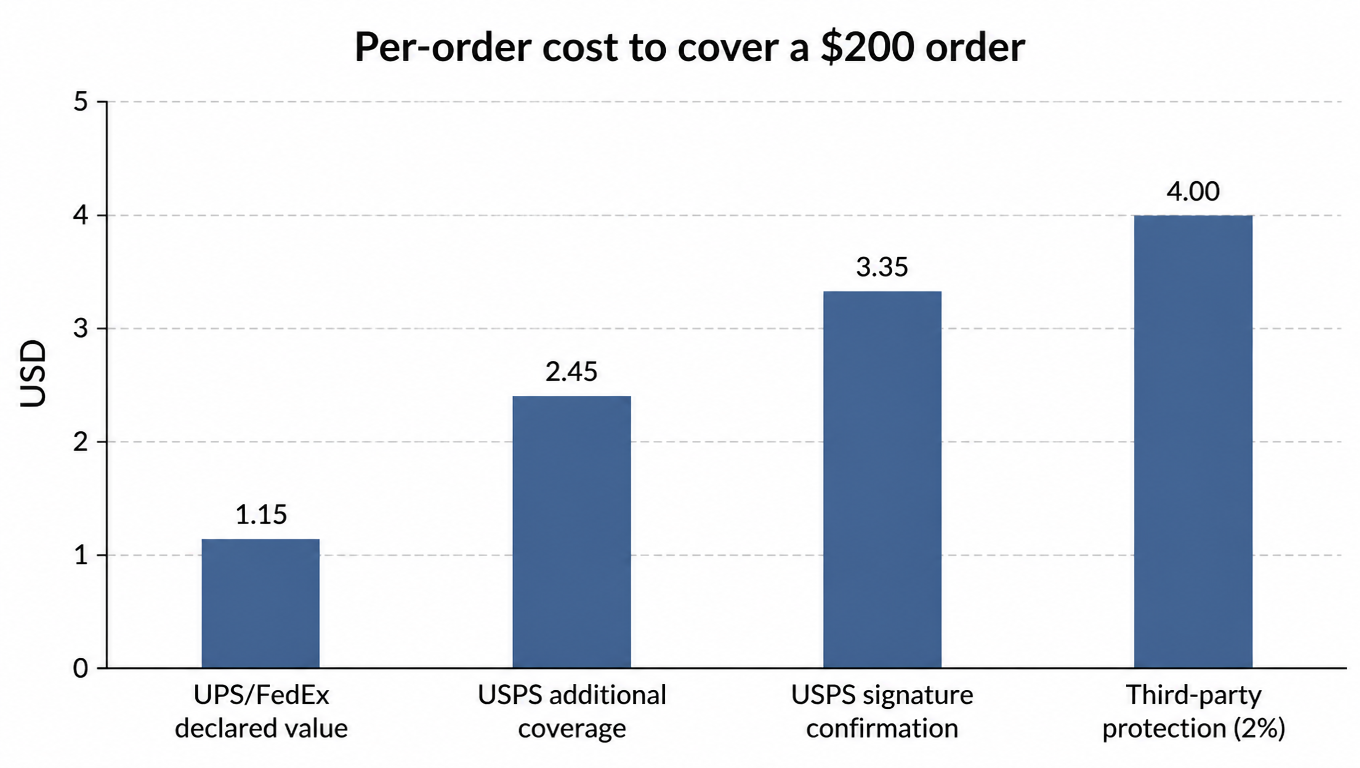
For a $200 order, the price of each layer: about $1.15 for UPS or FedEx declared value,[1][2] roughly $2.45 for USPS additional coverage,[3] about $3.35 for a USPS signature,[4] and around $4.00 for a 2% third-party protection plan.[11] Signature confirmation at UPS or FedEx runs $5 to $6,[17][18] which is why it is used selectively rather than on every parcel.
Covering the same $200 order, the four options differ by less than $3
Platform side: Shopify Protect covers eligible US and Canada orders up to $500 at no cost to the merchant,[8] and where it does not apply, Route is the standard one-tap integration for the rest of the cart.[11] Amazon FBM has no built-in protection: the A-to-Z guarantee is a buyer program,[10] and a losing claim costs you the order plus a fee, so FBM sellers typically buy third-party protection or rely on declared value. eBay sellers should treat signature confirmation as mandatory above $750,[9] where it becomes the difference between winning and losing an item-not-received case.
Carrier side: USPS includes the free $100 bracket on Priority Mail and most Ground products, with tiered additional coverage above it;[3] UPS and FedEx include $100 free on most services and charge about $1.15 per $100 of declared value above that.[1][2] Signature confirmation is added per package in every major shipping platform, at roughly $3.35 (USPS)[4] to $5 or $6 (UPS and FedEx).[17][18] One rule applies everywhere: these fees are negotiable. If you ship through a 3PL or a rate-shopping platform, declared value and signature rates are line items you can price-compare like any other surcharge.
The Pitfall Checklist
Common denial reasons are depressingly consistent across carriers: improper packaging (the number one), no photos of the box or the damage, missed claims windows (60 days on USPS[7] and FedEx,[6] nine months on UPS[5] depending on service), claims filed by the wrong party, and missing proof of value like the invoice or serial numbers.
Exclusions and contract traps: jewelry, cash, and collectibles are excluded or capped by most protection plans, lithium batteries and liquids are restricted under carrier declared value, and released-value contracts can cap carrier liability below what you declared. On the protection side, read the terms before you enable checkout: some plans close the case at the delivery scan, others exclude freight-forwarder addresses, and all of them have arbitration or dispute clauses that change who you can sue. And if the buyer unchecked the protection box at checkout, the merchant is on the hook: make the policy explicit in your own terms.
The evidence checklist that wins claims: photograph the packed box with the label visible, keep the invoice, record serial numbers for electronics, save scan history and delivery photos, and file inside the window with a written timeline. Five minutes of evidence at dispatch is worth five hours of claims work later.
Final Recommendations by Role
DTC brand: offer protection at checkout as the default (1% to 2%), require signature above $200 to $500, and keep declared value on excluded categories.
Shopify seller: turn on Shopify Protect where eligible, add Route for the rest of the cart, and require signature on high-value orders.
Amazon FBM seller: buy third-party protection on FBM shipments, and treat signature as mandatory above $750.
Ecommerce operations: own the failure-mode map by SKU and ZIP, and put signature rules in the shipping settings, not in a spreadsheet.
Finance: run the expected-loss model quarterly, and stop subsidizing claims you never file.
Risk and fraud: signature plus delivery photo is your representment stack, and track friendly fraud by ZIP and carrier.
3PL customer success: map each client's dominant failure modes, offer protection and signature as managed tiers, and price them against the claims labor you are removing.
The short answer to the title question: it depends on your failure modes. Compute expected loss per order, layer signature where delivery proof pays, use declared value for in-network loss above the free bracket, and let protection carry theft after delivery. The stack, not the single product, is the answer.
They cover different failure modes. Carrier insurance (declared value) covers only loss or damage inside the carrier's network, ending at the delivery scan, with the first $100 free; signature confirmation is not insurance but evidence, $3 to $7 for a delivery record that deters porch theft and neutralizes not-received disputes; shipping protection is a buyer-facing coverage layer at 1% to 2% of cart value with a one-tap claim flow, and many plans cover theft after delivery, which no carrier covers.
No. Carrier liability ends at the delivery scan, and once a valid scan exists, delivered-but-not-received claims are not paid by any major carrier. Porch theft is a liability vacuum; only third-party protection covers that loss, while signature confirmation prevents the mode by turning delivered-to-porch into delivered-to-a-person.
When delivery proof deters theft or fraud, or when a dispute would cost more than the $3 to $7 fee. Triggers: high-value orders above roughly $200 to $500 (one friendly-fraud dispute costs more than a month of signatures), apartment and office addresses, known theft ZIPs, and eBay orders above $750, where it decides item-not-received cases. The practical move is to encode the rules in shipping settings by ZIP, not decide order by order.
It depends on your failure modes. Compute expected loss per order (order value × loss probability) and compare it against the premium. Protection is usually worth it when your dominant failure mode is theft after delivery (porch theft), or when claims labor is the real cost (one carrier claim takes one to three hours, so small teams often never file). When losses happen inside the carrier network and the evidence is clean, declared value is cheaper. Run the math first, then decide; do not copy someone else's defaults.
You can, but usually should not: protection plus declared value is double payment, because when two layers cover the same liability stretch you only collect once. Pick the layer that covers your dominant failure mode and skip the redundant one. Signature stacks with everything because it is evidence, not coverage. Keep declared value on the categories protection excludes (electronics, fragile goods, jewelry); for theft after delivery, only protection pays.
Layer it by scenario: low-value orders whose expected loss is below any tool's cost should be self-insured, at zero premium; above the free $100 bracket on carrier-eligible categories, declared value is the cheapest coverage per dollar of exposure (about $1.15 per $100 at UPS/FedEx); orders where delivery proof deters theft or fraud get the $3 to $7 signature; only when theft after delivery is the dominant mode do you reach for 1% to 2% third-party protection. The order is self-insure, declared value, signature, protection, not the other way around.
Want every delivery exception covered by the right layer?
EasyShippingX bakes protection-layer costs into every shipping decision with multi-carrier rate comparison and transparent declared-value and signature pricing, so claims you are owed get paid and premiums you do not need get skipped.