物流指南Logistics Guide

电商物流保险:什么时候值得买,什么时候别买Shipping Insurance for Ecommerce: When It Pays and When It Doesn't

每个承运商都会丢失或损坏它经手的一小部分包裹,每个电商卖家最终都会自己承担其中一次损失。问题很少是「我该不该买物流保险」,而几乎总是「保费什么时候才真正值回票价」。保险的定价是按几百万件包裹的平均损失算的,这意味着平均水平的订单并不需要它。但让你睡不着的从来不是平均订单。这篇指南讲清楚:物流保险到底保什么、承运商已经免费给了你什么、附加保障什么时候能回本、Route、Shipsurance、XCover 这些第三方选项怎么比,以及怎样提交一单真正能通过的索赔。Every carrier loses or damages a small fraction of the packages it handles, and every ecommerce seller eventually eats one of those losses. The question is rarely "should I buy shipping insurance?" and almost always "when does the premium actually earn its keep?" Insurance is priced to cover the average loss across millions of packages, which means the average order does not need it. But the average order is not the order that keeps you up at night. This guide walks through what shipping insurance really covers, what your carrier already gives you for free, when extra coverage pays for itself, how third-party options like Route, Shipsurance, and XCover compare, and how to file a claim that actually gets approved.

快递员在郊区门口把一个小纸箱递给收件人,手里拿着面单和写字板,干净的电商插画风格
物流保险不是默认项,而是一个决策Shipping insurance is not a default, it is a decision

物流保险到底保什么(以及不保什么)What Shipping Insurance Actually Covers (and What It Doesn't)

无论是承运商还是第三方保险商提供的标准物流保障,都只针对两类事件:运输途中丢失、运输途中损坏。这是协议的核心。如果承运商收件后把包裹丢在网络里,或者送达时内件破损,保障就会赔付。其余所有情况,都写在小字条款里。Standard shipping coverage, whether from a carrier or a third-party insurer, protects against two events: a package lost in transit and a package damaged in transit. That is the core of the deal. If the carrier scans the package, loses it somewhere in the network, or delivers it with the contents broken, coverage responds. Everything else is where the fine print lives.

免责条款比保障本身更重要。包装不当是最常见的拒赔理由:箱子太薄、内件没有缓冲、面单破损,保险商都会认定损失是你的责任而不是他们的。违禁品或受限物品(液体、部分情况下的电池、任何违反承运规则的物品)会让保障完全失效。间接损失同样不在赔付范围内:保险赔付的是货物价值,不是你失去的那笔销售、你给客户退的款、流失的客户,也不是你花在客服上的时间。The exclusions matter more than the coverage. Improper packaging is the most common denial reason: if the box was too thin, the item not cushioned, or the label damaged, the insurer treats the loss as your fault, not theirs. Prohibited or restricted items (liquids, batteries in some cases, anything that breaks carrier rules) void coverage entirely. Consequential loss is also excluded: insurance reimburses the value of the goods, not the lost sale, the refund you issued, the customer churn, or the time you spent on support.

门廊盗窃值得单独说,因为它是电商损失的一大来源,而承运商的申报价值完全不保这种情况。承运商把包裹送到、扫描成已妥投、任务就结束了。小偷从门口拿走包裹不算运输损失。部分第三方结账保险(最典型的是 Route)确实保门廊盗窃;大多数按件申报价值的保险不保。如果你的市场门廊盗窃是真实问题,这个区别决定了你该买哪种产品。Porch theft deserves special attention because it is a huge source of ecommerce losses and it is not covered by carrier declared value at all. Carriers deliver the package, scan it delivered, and consider their job done. Whether a thief takes it from the doorstep is not a transit loss. Some third-party checkout policies (Route is the notable example) do cover theft from the porch; most per-shipment declared value policies do not. If porch theft is a real problem in your market, that distinction decides which product you need.

比价之前还有一个概念要理清:承运商的「申报价值」并不是真正的保险。你向 USPS、UPS 或 FedEx 申报更高价值,实际上是在提高承运商的责任上限,付一笔费用、按他们的条款把更多风险转移给他们。这是一种由承运商控制的赔偿安排,而不是为你利益承保的保单。当你被拒赔、或者拿它和真正的第三方保险产品对比时,这个区别很关键。One more distinction to get straight before comparing prices: carrier "declared value" is not really insurance. When you declare a higher value to USPS, UPS, or FedEx, you are raising the carrier's liability limit, paying a fee to shift more risk onto them under their terms. It is an indemnity arrangement controlled by the carrier, not an underwritten policy sold for your benefit. That matters when claims get denied and when you compare it against actual third-party insurance products.

基线:承运商已经给你保了多少The Baseline: What Your Carrier Already Covers

在花钱买任何保险之前,先弄清楚你已经拥有什么。USPS Priority Mail 和 Priority Mail Express 默认包含 100 美元保额,UPS 和 FedEx 的大多数境内服务每件包裹也大约承担 100 美元责任。对大多数 DTC 订单来说,这条基线不花一分钱就能覆盖全部订单价值。Before paying for anything, know what you already have. USPS Priority Mail and Priority Mail Express include $100 of coverage by default, and most domestic services from UPS and FedEx carry roughly $100 of liability per package too. For the majority of DTC orders, that baseline covers the full order value without you spending a cent.

当订单超过基线时,你可以申报更高价值,并按申报金额支付相应费用。USPS 附加保额每件最高 5,000 美元,超出内置 100 美元的部分起价约 2.80 美元,随申报价值上升而递增。UPS 和 FedEx 有各自的申报价值费率表。这笔费用很小,但不是零,而且会随着数千票货累积。When an order exceeds the baseline, you can declare a higher value and pay a fee that scales with the declared amount. USPS extra coverage goes up to $5,000 per package, starting at roughly $2.80 for coverage above the included $100 and climbing as the declared value rises. UPS and FedEx have their own declared value schedules with their own price points. The fee is small, but it is not zero, and it compounds across thousands of shipments.

实际结论:如果你的典型订单价值在 100 美元以下,免费的基线已经全额覆盖,额外保险基本是浪费钱。只有当订单经常显著超出基线时,这个决策框架才开始起作用。The practical takeaway: if your typical order value sits under $100, you are already fully covered by the free baseline, and extra insurance is mostly wasted money. The decision framework only starts to bite when orders routinely clear the baseline by a meaningful margin.

什么时候加保才划算When It Pays to Buy More Coverage

当保费相对于你消除的风险足够便宜时,加保就划算。三种情况最常成立:高客单价(一双 300 美元的球鞋或一台 600 美元的意式咖啡机)、比平均更容易在运输中破损的易碎品(陶瓷、玻璃器皿、电子产品)、以及门廊盗窃高发的市场。Extra coverage pays when the premium is cheap relative to the risk you are removing. Three profiles justify it most often: high average order value (a $300 sneaker or a $600 espresso machine), fragile goods that break in transit more often than average (ceramics, glassware, electronics), and markets where porch theft is endemic.

算账很简单。承运商的丢失率大约在运单量的 0.1% 到 0.5% 之间。一件包裹的期望损失 = 丢失率 × 风险敞口(订单价值减去承运商基线已覆盖的部分)。拿 500 美元订单、标准 100 美元基线来算:400 美元暴露在基线上方。按 0.3% 丢失率,每票的期望损失约 1.20 美元。花 2.80 美元为这 400 美元敞口投保,胜过自己承担 1.20 美元的期望损失,而且这还没算上你为了安抚客户要搭上的客服时间和退款。The math is straightforward. Loss rates across carriers run roughly 0.1% to 0.5% of shipments. Your expected loss on a package is the loss rate times the value at risk, which is the order value minus whatever the carrier baseline already covers. Take a $500 order under the standard $100 baseline: $400 of exposure sits above the baseline. At a 0.3% loss rate, the expected loss is about $1.20 per shipment. Paying $2.80 to insure that $400 of exposure beats a $1.20 expected loss you would have to eat yourself, and that is before counting the support time and the refund you would issue to keep the customer happy.

由此得出的经验法则:保费低于风险敞口约 1% 时买附加保额,高于则自保。这不是精确公式,而是一个过滤器。如果保费超过期望损失加上处理索赔的麻烦成本,保险就不值。The rule of thumb that falls out of this: buy extra coverage when the premium is under roughly 1% of the at-risk amount, and self-insure when it is not. It is not a precise formula, it is a filter. If the premium costs more than the expected loss plus the hassle of handling a claim, the insurance is not earning its keep.

什么时候不该买When It Doesn't Pay

另一面同样重要。对低价值、包装扎实的标准商品,附加保障就是毛利税。50 美元的 T 恤订单完全在 100 美元承运基线之内,按订单价值 2% 收的结账保险要花 1 美元,去保一个承运商已经免费承担的风险。每月一千单,你就是在白白交真金白银。The flip side is just as important. For low-value, well-packed, standard goods, extra coverage is a margin tax. A $50 t-shirt order sits entirely inside the $100 carrier baseline, so checkout insurance at 2% of order value costs a dollar to cover a risk the carrier already absorbs for free. Multiply that by a thousand orders a month and you have handed over real money for nothing.

盈亏平衡的逻辑:保费小于你本要自担的期望损失时,保险才合理。一旦保费吃掉的毛利超过它避免的损失,你就是在付钱让保险商持有你自己能以更低成本持有的风险。对大多数卖家来说,这个临界点落在订单价值 100 到 300 美元区间,具体取决于丢失率和包装质量。The breakeven logic: insurance makes sense when the premium is smaller than the expected loss you would otherwise carry. Once the premium eats more margin than the losses it prevents, you are paying the insurer to hold risk you could hold yourself at lower cost. For most sellers that crossover sits somewhere in the $100 to $300 order-value range depending on their loss rate and their packaging quality.

这里的小字条款值得再读一遍。一些第三方结账保险不保门廊盗窃、不保「离奇失踪」,或者只赔商品的批发成本而不是你收的零售价。400 美元订单收 1.25% 保费看起来很合理,直到你发现赔付额是 180 美元而不是 400 美元。在判断它值不值之前,先读清楚保单到底赔多少。The fine print deserves a second read here. Some third-party checkout policies exclude porch theft, exclude "mysterious disappearance," or only pay the wholesale cost of the item rather than the retail price you charged. A 1.25% premium on a $400 order looks reasonable until you find out the payout would be $180, not $400. Read what the policy actually pays before you decide what it is worth.

第三方保险商对比Third-Party Insurance Providers Compared

一旦超过承运基线,你有三个现实选项:提高承运商申报价值、购买按件计费的第三方保障、或提供面向买家的结账保险。三者的计价、保障范围和赔付方式都不一样。Once you leave the carrier baseline, you have three realistic options: raise the carrier's declared value, buy per-shipment third-party coverage, or offer buyer-facing checkout insurance. Each one prices, covers, and pays differently.

Route 是面向买家的结账保险,通常约为订单价值的 2%。它在结账时提供给客户选择,索赔由 Route 代买家处理。它是门廊盗窃保障最完整的产品,索赔体验也是为消费者设计的,而不是为对账的商家设计的。Route is checkout coverage aimed at the buyer, typically around 2% of order value. It is offered at checkout, the customer decides, and Route itself handles claims on the buyer's behalf. It is the most complete product on porch theft and its claim experience is built for shoppers, not for merchants reconciling a spreadsheet.

Shipsurance 是面向商家的按件申报价值保险。每票货申报一个价值,按每申报 100 美元约 0.40 到 0.75 美元的费率付费,通过它的门户或 ShipStation 之类的集成提交索赔。它适合想掌控每一票货、不想把保险决策交给客户的商家。Shipsurance is per-shipment declared value insurance for merchants. You declare a value on each shipment, pay a rate in the neighborhood of $0.40 to $0.75 per $100 declared, and file claims through its portal or through integrations like ShipStation. It is a workhorse for merchants who want control over every shipment and do not want to put insurance decisions in the customer's hands.

XCover 介于两者之间:结账保险约为订单价值的 1.25%,带 Shopify 集成,保丢失和损坏并自行处理索赔。当你的市场门廊盗窃问题不严重时,它是比 Route 更便宜的替代品。XCover sits between the two: checkout coverage around 1.25% of order value with a Shopify integration, covering lost and damaged items and handling claims itself. It is a lower-cost alternative to Route when porch theft is less of a concern in your market.

下面的对比表展示了四种方案在 500 美元订单上的实际保费,让价格差异一目了然。The comparison table below shows the effective premium on a $500 order across all four options, which makes the pricing differences concrete.

方案Provider500 美元订单的费用Cost on a $500 order保障范围What's covered谁来提交索赔Who files the claim最适合Best fit
承运商申报价值(USPS、UPS、FedEx)Carrier declared value (USPS, UPS, FedEx)约 2.80 美元起(USPS 附加保额)From about $2.80 (USPS added coverage)运输途中丢失和损坏Lost and damaged in transit你自己,直接与承运商对接You, directly with the carrier高价值、低频次的发货High-value, low-frequency shipments
ShipsuranceShipsurance约 2.00 到 3.75 美元About $2.00 to $3.75运输途中丢失和损坏Lost and damaged in transit你自己,通过 Shipsurance 门户或发货平台You, via the Shipsurance portal or your shipping platform按件掌控,ShipStation 用户Per-shipment control, ShipStation users
XCoverXCover约 6.25 美元About $6.25丢失和损坏Lost and damagedXCover 的索赔团队XCover's claims team提供结账保险的 Shopify 店铺Shopify stores offering checkout coverage
RouteRoute约 10.00 美元About $10.00丢失、损坏,以及多数门廊盗窃情况Lost, damaged, and many porch-theft casesRoute 的索赔团队Route's claims team面向买家的保障,门廊盗窃高发区Buyer-facing protection, porch-theft hotspots
柱状图:为 500 美元订单全额投保的保费,Shipsurance 2.75 美元、USPS 附加保额 2.80 美元、XCover 6.25 美元、Route 10 美元Bar chart of the premium to fully cover a $500 order: Shipsurance $2.75, USPS added coverage $2.80, XCover $6.25, Route $10
为 500 美元订单全额投保的保费Premium to fully cover a $500 order

两个要点很突出。第一,按件计费的商家保障(Shipsurance 和承运商申报价值)比结账保险便宜得多,因为它只保这票货本身。第二,结账产品更贵是因为保得更多:买家得到他们看得懂的保障,Route 在很多情况下保门廊盗窃,索赔体验也由对方代劳。选哪个,取决于你想保的是包裹本身还是客户关系。Two things stand out. First, per-shipment merchant coverage (Shipsurance, and carrier declared value) is dramatically cheaper than checkout coverage, because it only insures the shipment itself. Second, the checkout products cost more because they cover more: the buyer gets protection they understand, Route covers porch theft in many cases, and the claims experience is handled for you. The right choice depends on whether you want to insure the package or the customer relationship.

索赔流程详解The Claims Process, Demystified

当索赔不可避免时,结果通常取决于材料。承运商和保险商期望三样东西:价值证明(发票、订单记录或付款凭证)、商品和包装的照片、以及能说明问题出在哪一环的轨迹或扫描记录。提交时三样齐全的卖家能拿到赔付;事后才手忙脚乱补材料的卖家会被拒。When a claim is unavoidable, the outcome usually comes down to documentation. Carriers and insurers expect three things: proof of value (an invoice, order record, or payment receipt), photos of the item and its packaging, and the tracking or scan history showing where things went wrong. Sellers who have all three at hand when they file get paid. Sellers who scramble to reconstruct them after the fact get denied.

时限毫不留情。USPS 要求国内索赔在交寄之日起 60 天内提交。UPS 和 FedEx 有各自的窗口,有时从妥投而不是交寄起算,所以在你把文件搁置之前,先查清楚所用服务的现行规则。错过窗口,保障就没了,证据再清楚也没用。Deadlines are unforgiving. USPS requires domestic claims within 60 days of the mailing date. UPS and FedEx run their own windows that can be measured from delivery rather than mailing, so check the current rules for the specific service you used before you set the file aside. Miss the window and the coverage is gone, no matter how clear the evidence.

相当比例的 USPS 索赔会被拒,大约 30% 到 40%,而且拒赔集中在可预见的原因上:包装不符合承运标准、缺少价值证明、用错表格或填错细节。这些都不是运气不好,而是你可以预防的流程失误。A meaningful share of USPS claims get denied, roughly 30% to 40%, and the denials cluster around predictable causes: packaging that does not meet the carrier's standards, missing proof of value, and claims filed with the wrong form or the wrong details. None of those are bad luck. They are process failures you can prevent.

提高通过率的打法简单而重复。打包时给每件包裹拍照(商品、纸箱、缓冲、封箱状态)。把原始包装和购买凭证保留到妥投窗口过去很久之后。按所用服务选择正确表格,申报价值与面单上的完全一致。如果你通过 ShipStation 之类的平台发货,很多承运商的索赔可以从运单记录自动提交,这消除了最常见的人为错误。对高单量的卖家来说,索赔自动化不是便利,而是「追回损失」和「直接核销」的区别。The playbook that raises approval odds is simple and repetitive. Photograph every package at packing time (item, box, cushioning, sealed state). Keep original packaging and proof of purchase until the delivery window is long past. File with the right form for the service you used, and fill in the declared value exactly as it appears on the label. If you ship through a platform like ShipStation, many carriers' claims can be filed automatically from the shipment record, which removes the most common human errors. For sellers running high volume, claim automation is not a convenience, it is the difference between recovering losses and writing them off.

为你的店铺制定一套聪明的保险策略Building a Smart Insurance Policy for Your Store

聪明的保险策略不是每单临场决定,而是设定一次、自动执行的政策。定一个保障阈值(超过这个订单价值就总是买保障),写进你的物流平台规则,然后就不用再想它。大多数平台允许你设置超过某个金额就自动添加申报价值或第三方保障,于是 500 美元的陶瓷花瓶会被保,40 美元的 T 恤不会,每单零人工。A smart insurance policy is not a decision you make per package, it is a policy you set once and automate. Decide on a coverage threshold (the order value above which you always buy coverage), encode it in your shipping platform's rules, and stop thinking about it. Most platforms let you auto-add declared value or third-party coverage above a dollar amount, so the $500 ceramic vase gets insured and the $40 t-shirt does not, with zero manual effort per order.

同时把包装标准化。因包装问题被拒赔的频率高于任何其他证据问题,所以把纸箱、缓冲和封箱流程固定下来,并一次拍好照片。第一天就符合承运商标准的包裹,是一单你永远不用提交的索赔。Standardize packaging at the same time. Claims are denied on packaging grounds more often than on any other evidence failure, so make the box, cushioning, and sealing process consistent and photograph it once. A package that meets carrier standards on day one is a claim you never have to file.

门廊盗窃需要单独的应对措施,因为承运保障在那里帮不了你。高价值订单要求签收、为需要的客户提供承运商网点自取、以及为想要防盗保障的买家提供 Route(或类似结账产品),这三个杠杆才能真正改变数字。保险是事后补偿损失,这些是事前预防。Porch theft needs its own mitigations, because carrier coverage will not help you there. Signature-required delivery for high-value orders, carrier hold at the local facility for customers who want it, and Route (or a similar checkout product) for the buyers who want theft protection are the three levers that actually move the number. Insurance covers the loss; these prevent it.

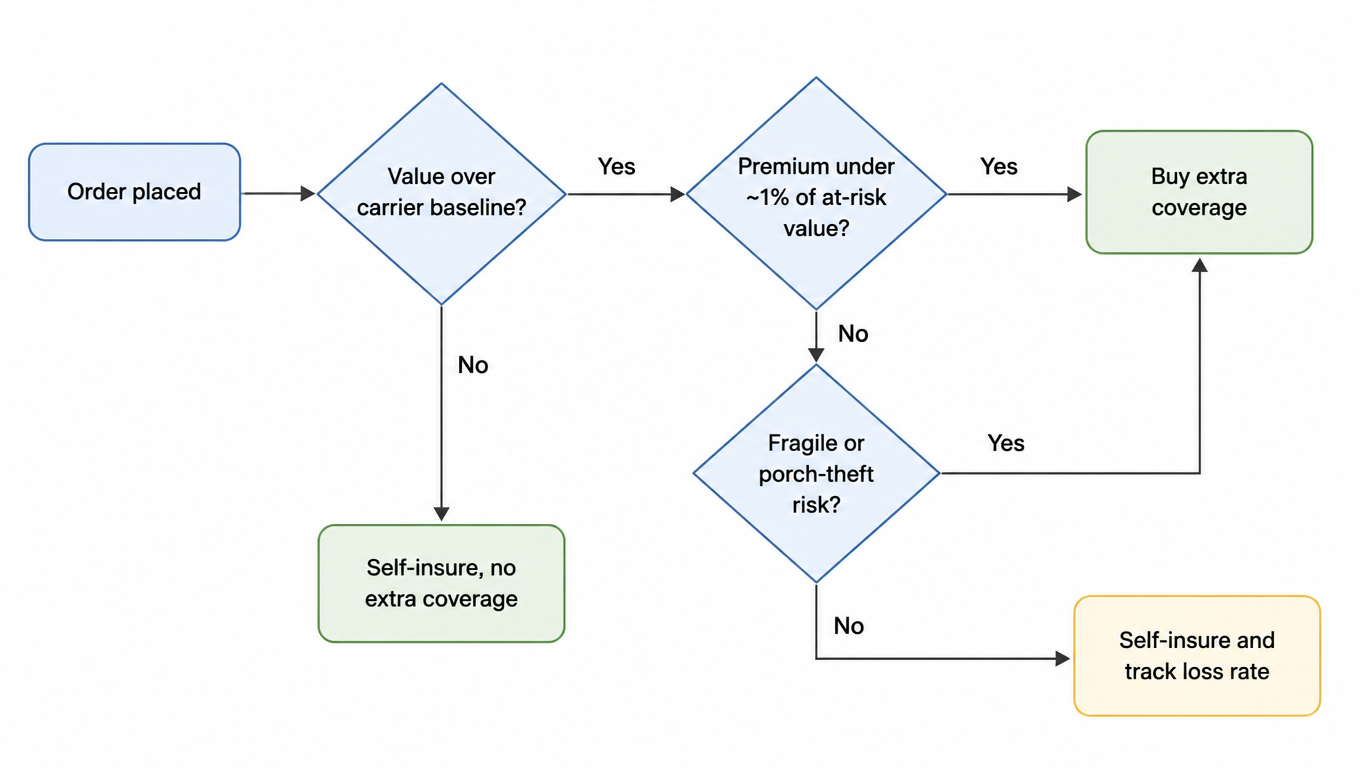
下面的流程图把本指南的全部内容变成一单一个决策。The flowchart below turns everything in this guide into a per-order decision.

投保决策流程图:订单下单,判断价值是否超过承运基线;未超过则自保不加保,超过则判断保费是否低于风险敞口的 1%;低于则购买附加保障,高于则继续判断是否易碎或存在门廊盗窃风险;是则购买附加保障,否则自保并跟踪丢失率Flowchart of the buy-or-not decision: order placed, is value over the carrier baseline? No means self-insure without extra coverage; yes means check if the premium is under roughly 1% of at-risk value; if yes buy extra coverage, if no check for fragile or porch-theft risk; if yes buy extra coverage, if no self-insure and track loss rate
这单要不要投保的决策流程The per-order insurance decision flow

这篇指南的主线是:物流保险不是默认项,而是一个决策。承运基线已经免费覆盖了大多数订单。当保费只是风险敞口的一小部分时,附加保障才划算,尤其是高客单价或易碎商品。当门廊盗窃真实存在、买家想要保障时,结账保险才划算。而真到索赔时,流程奖励有准备的人:全程留痕、按时提交、让自动化处理文书。定好阈值、标准化包装,然后让政策自己运转。The throughline of this guide is that shipping insurance is not a default, it is a decision. The carrier baseline already covers most orders for free. Extra coverage pays when the premium is a small fraction of the value at risk, especially for high-ticket or fragile goods. Checkout insurance pays when porch theft is real and the buyer wants the protection. And when you do claim, the process rewards the prepared: document everything, file on time, and let automation handle the paperwork. Set the threshold, standardize the packaging, and let the policy run itself.

常见问题FAQ

取决于算账。承运基线(约 100 美元)以内的订单已经免费覆盖,加保是浪费钱。当保费只是风险敞口的一小部分(通常低于 1%)时,保险才划算,最常见于高客单价或易碎商品。定一个保障阈值并自动化执行。It depends on the math. Most orders under the carrier's baseline (roughly $100) are already covered for free, so extra insurance is wasted money there. Coverage pays when the premium is a small fraction of the value at risk, typically under 1%, which is most often true for high-ticket or fragile goods. Set a coverage threshold and automate it.
USPS Priority Mail 和 Priority Mail Express 默认包含 100 美元保额。你可以购买附加保额,每件最高 5,000 美元,超出内置 100 美元的部分起价约 2.80 美元。USPS Priority Mail and Priority Mail Express include $100 of coverage by default. You can buy extra coverage up to $5,000 per package, starting at roughly $2.80 above the included $100.
不算。申报更高价值是按承运商自己的条款提高其责任上限,是一种由承运商控制的赔偿安排。第三方保险是有承保的保单,有自己的保障条款和索赔流程,而且往往覆盖更广,比如门廊盗窃。Not really. Declaring a higher value raises the carrier's liability limit under their own terms, which is an indemnity arrangement controlled by the carrier. Third-party insurance is an underwritten policy with its own coverage terms, claims process, and often broader protection such as porch theft.
承运商申报价值完全不保门廊盗窃,因为承运商的职责止于妥投。部分第三方结账保险(最典型的是 Route)确实保门廊盗窃。如果你的市场门廊盗窃是真实问题,这个区别决定了你该买哪种产品。Carrier declared value never covers porch theft, because the carrier's job ends at delivery. Some third-party checkout products, Route being the most notable, do cover theft from the porch. If porch theft is a real problem in your market, that distinction decides which product you need.
USPS 要求国内索赔在交寄之日起 60 天内提交。UPS 和 FedEx 有各自的窗口,有时从妥投起算。错过窗口保障就失效,所以带着材料尽早提交。USPS requires domestic claims within 60 days of the mailing date. UPS and FedEx run their own windows, sometimes measured from delivery. Miss the window and coverage is gone, so file with documentation in hand.

用 EasyShippingX 管理你的承运费率Manage carrier rates with EasyShippingX

在比较保险之前,先确认你为每个承运商支付的运费本身是合理的。用 EasyShippingX 对比折扣费率、轨迹和对账,让运费和保险各归其位。Before you compare insurance, make sure the freight itself is priced right. Use EasyShippingX to compare discounted rates, tracking, and reconciliation, so freight and insurance each do their job.

Get Rate Comparison
Get Rate Comparison