3PL Automation

What Should a 3PL Automate First? Six Costly Manual Failures and Their Fixes

This page prioritizes which 3PL workflow to automate first. For software scenarios and time-benefit measurement, see the shipping automation evaluation.

Most 3PLs buy software in the wrong order. They start with whichever tool is easiest to demo, a shiny dashboard here, a label printer there, and then bolt it onto the manual processes that are actually burning money. The result is an automation budget spent in the wrong places while the same errors keep happening, just faster.

The right first question is not "which tool" but "which process". Rank every manual failure with a simple formula: the cost of the error multiplied by how often it happens, divided by the cost to automate it. The failures that score highest are where you start, because they fund the next round of fixes. This is what "automate first" really means: before you hire more people or buy more capacity, find the expensive manual loop and close it.

Automation compounds. Every process you fix lowers the cost of fixing the next one: the integration you build for orders becomes the integration you reuse for returns, and the notification logic you build for exceptions becomes the tracking email customers actually open. This article walks through the six most expensive manual failures in a typical 3PL, each with its automation fix and a back-of-envelope ROI, so you can size the opportunity before you buy anything.

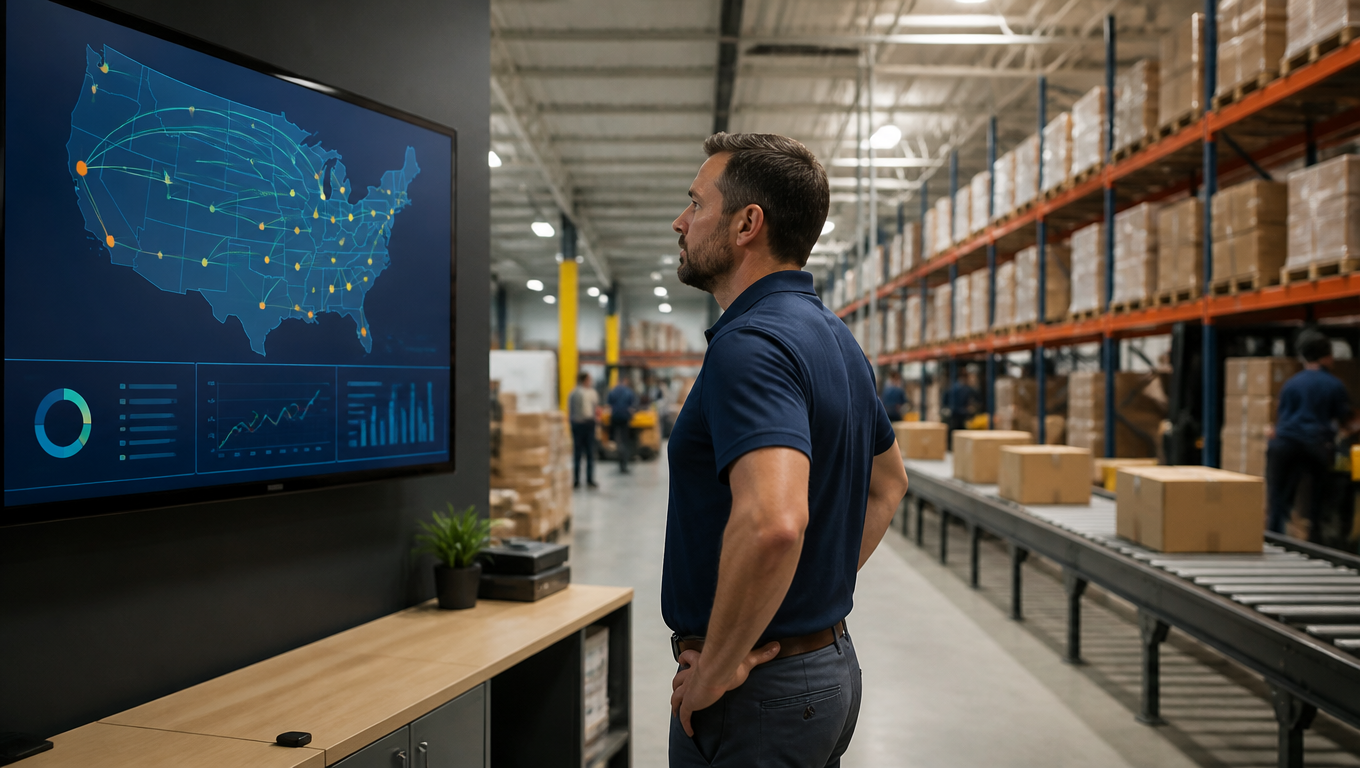
3PL operations manager checks a dashboard on a tablet beside parcels and conveyors.
Automation is not a one-time project; it is a compounding habit

Pain Point 1: Order Fragmentation and Manual Entry

Orders arrive from five directions: email, EDI, spreadsheets, marketplaces, and client portals. Somewhere in the middle sits a person re-keying them into the WMS. Every keystroke is a chance to introduce an error, and every error travels downstream: the wrong SKU gets picked, the wrong parcel gets built, the wrong address gets shipped. The problem gets worse exactly when you can least afford it, because order volume and order error rates rise together in a peak.

Use the 3PL shipping operating model to assign an owner to the workflow selected for automation. The shipping automation measurement guide explains how to measure the time benefit once that operating scope is agreed.

Benchmarks for manual data entry put error rates around 1 percent. That sounds small until you price a correction. Between re-picks, re-ships, and lost customer goodwill, a single corrected order typically costs in the $50 range. At 500 orders a day, 1 percent is 5 bad orders a day, roughly $250 a day and more than $60,000 a year, before the labor itself is counted.

The fix is API/EDI order integration that ingests orders in real time and validates them at the door: the SKU exists, the quantity is sane, the address is complete. No re-keying, no midnight batch uploads, no human in the middle of every order.

For a 500-order-per-day operation, integration saves 2 to 3 hours of data-entry labor a day and removes the error pipeline entirely. At $25 an hour that is roughly $15,000 to $20,000 a year in labor alone, and the error costs above never materialize. This is why order ingestion is almost always the first fix: cheap to implement, and it touches every order that moves through the building.
Pain Point 2: Address and Label Errors

Every mis-typed street number, missing apartment, or wrong ZIP becomes a correction fee at the carrier plus a late delivery to the customer. Carrier address-correction fees typically run $17 to $25 per parcel, and size or weight corrections are worse, because they reset the negotiated rate on top of the fee.

Even a 1 percent bad-address rate at a 1,000-parcel operation is 10 corrections a day. At $17 to $25 each, that is $3,400 to $5,000 a month and $40,000 to $60,000 a year, purely in fees, before the delayed-delivery chargebacks and the one-star reviews that follow.

Two automations kill most of this. Address validation at order entry catches typos and missing fields before a label exists. Carrier-selection rules then route the right parcel to the right service automatically, so the odd-shaped or oversized box stops getting the cheap label it cannot survive.

Catch even half the bad addresses and this fix pays for itself in a month. Address validation is a configuration change, not a project. It is the cleanest ROI of all six fixes.

Pain Point 3: Inventory Numbers That Drift

The WMS says 300 units. The shelf has 240. Nobody knows when the drift happened, because it happened in small unrecorded steps: a mis-pick fixed by hand, a return shelved without a scan, an adjustment made just to keep things moving.

The numbers are sobering. 58 percent of retailers report inventory accuracy below 80 percent. Stockouts cost 1 to 3 percent of sales, and about a third of shoppers who hit a stockout defect to another seller. For a 3PL, bad counts mean wrong promises to clients, and wrong promises are how you lose accounts.

The fix is boring and it works: barcode scanning on every touch, real-time sync between the WMS and the sales channels, and cycle counting on a schedule, so fast movers get counted weekly and slow movers monthly or quarterly, instead of everything waiting for one big annual shock.

Recovering even 1 percent of lost sales on a $2 million operation is $20,000 a year, before the overstock write-offs you avoid and the client retention you keep. Not the most exciting automation on this list, but one of the most reliable.

Pain Point 4: Exceptions That Someone Has to Babysit

Somewhere in the building, someone refreshes carrier portals all day. A parcel stuck in transit, a failed delivery, a service failure: each one lives in an email thread or a portal screen until a human notices it, and then it waits for a human to decide what to do. On a bad day, that human is out sick and the exceptions wait for tomorrow.

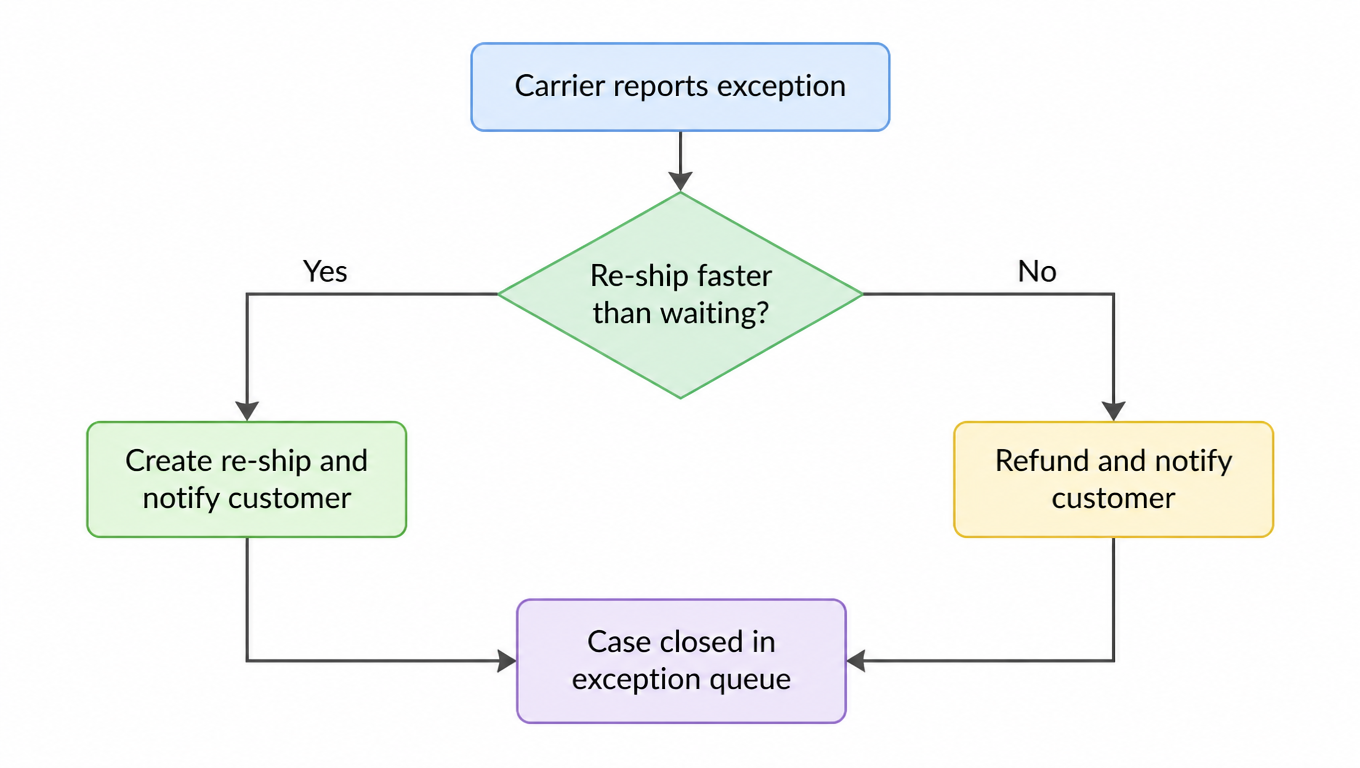
The fix is an exception queue that auto-detects failures from carrier feeds and routes each one. If a re-ship gets the customer their order faster than waiting on the damaged parcel, create the re-ship and notify; otherwise, refund and notify. The decision logic is simple, and it never sleeps.

Decision flow: carrier reports an exception, decide whether a re-ship arrives faster than waiting, create re-ship and notify or refund and notify, case closed in the exception queue
The routing logic is simple: re-ship if it is faster, refund otherwise, and close every case in the queue

Operations that put this in place report exception-handling labor down 70 to 80 percent and response times down from hours to minutes. The hidden wins are the ones you never see: fewer storage fees on stranded inventory, fewer negative reviews, fewer reships that should have been refunds.

Pain Point 5: Freight Invoices That Never Get Checked

Freight invoices are paid on autopilot because auditing them is somebody's part-time job and nobody's full-time job. Rating errors, accessorials, duplicate charges: all of it slips through, month after month.

Industry audits consistently find errors on 3 to 7 percent of freight invoices. Operations that never audit quietly overpay by 3 to 5 percent of annual freight spend. The money is not lost in one big mistake; it leaks out in hundreds of small ones.

Automated freight-audit workflows flag discrepancies against the negotiated rates and file claims automatically. Refund workflows close the loop by tracking each claim until the credit actually lands.

A 3PL moving $1 million a year in freight recovers $30,000 or more annually, often 3 to 5 percent of spend, with almost no labor. This is found money: the service was delivered either way, and the overcharge was pure leakage.

Pain Point 6: WISMO That Eats the Support Budget

"Where is my order?" is the most expensive question in e-commerce logistics. Customers ask because nobody told them. Each ticket costs $5 to $22 by the time a support agent looks it up, and WISMO makes up around 40 percent of support volume at most shippers.

The fix is to make the answer automatic. Proactive tracking notifications tell the customer at every milestone, and a self-serve tracking page answers the question without a human. The support team stops re-answering the same question and starts handling the exceptions that actually need a person.

Take a 10,000-order-per-month operation where 1 in 20 orders generates a WISMO ticket: 500 tickets a month at an average of $15 each is $7,500 a month, $90,000 a year, before the churn risk that every unanswered question carries.

The 3-Week Execution Checklist

None of these fixes requires a six-month transformation. The sequencing below front-loads the fast, high-confidence wins and lets each fix pay for the next.

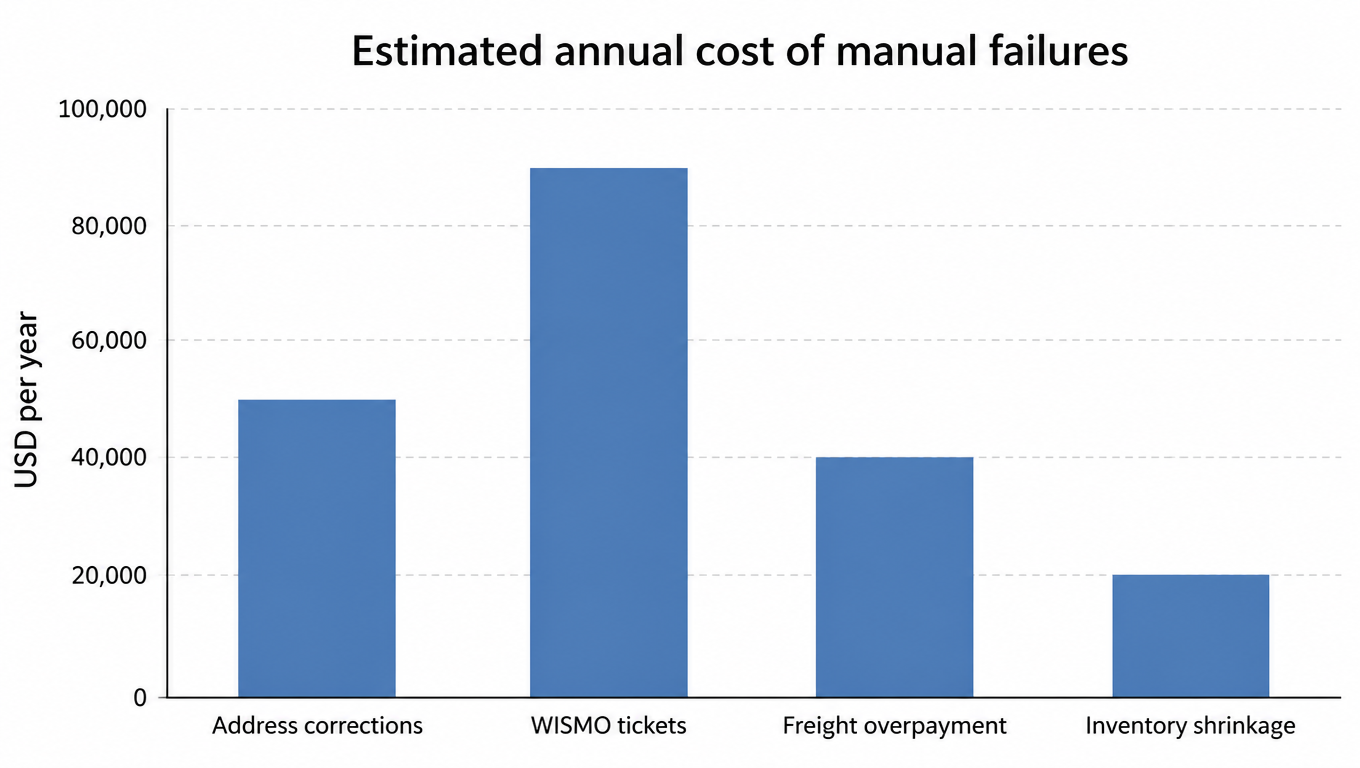
Sizing the opportunity first makes the sequence obvious. Using the volume assumptions in this article, the four cleanest numbers stack up to roughly $200,000 a year: about $50,000 in address-correction fees, $90,000 in WISMO costs, $40,000 in freight overpayment, and at least $20,000 in inventory shrinkage. Manual entry and exception babysitting are just as real, but they are better measured in hours than in dollars.

Bar chart of estimated annual cost of manual failures: address corrections 50k, WISMO tickets 90k, freight overpayment 40k, inventory shrinkage 20k USD
The four cleanest numbers stack up to roughly $200,000 a year (estimated on this article's volume assumptions)
  • Controls for AI-generated shipping labels
  • Week 1: fix order ingestion and address validation. Pain points 1 and 2 are configuration-level changes, and both touch every order. They are the fastest wins and the ones with the cleanest math.
  • Week 2: stand up the exception queue and start freight audit. Pain points 4 and 5 both run off data you already have: carrier feeds and the last 90 days of invoices. Point the queue at the carriers and start the audit on recent invoices in the same week.
  • Week 3: roll out scanning and tracking notifications. Pain points 3 and 6 are the behavioral changes, so they go last. Scanning and cycle counting need the team to change habits, and proactive tracking notifications need the templates and trigger logic to be right.

Track one metric per fix for 30 days: order-entry error rate, address-correction fees, inventory accuracy, exception resolution time, invoice error rate, and support tickets per 1,000 orders. If a metric does not move, the fix is not working, and you find out in 30 days instead of 12 months. Have the operations lead run a 30-minute weekly review against the metrics, and treat a metric that does not move as a signal to dig into the fix, not to move on.

Automation is not a one-time project; it is a compounding habit. Start with the six fixes above, and the next six get cheaper: the integration patterns, the notification logic, and the queue discipline all carry over. The 3PL that sequences automation by pain point instead of by demo schedule is the one that wins the compounding game.

Key Takeaways

  • The first question is not "which tool" but "which process": rank manual failures by error cost times frequency divided by implementation cost, and start with the highest score.
  • Order ingestion and address validation are configuration-level changes that touch every order, usually the cleanest, fastest-ROI first fixes.
  • 58 percent of retailers report inventory accuracy below 80 percent and stockouts cost 1 to 3 percent of sales; scanning, real-time sync, and cycle counting are among the most reliable automations.
  • Exception queues cut exception-handling labor 70 to 80 percent and response times from hours to minutes; freight audits find errors on 3 to 7 percent of invoices and can recover 3 to 5 percent of annual freight spend.
  • WISMO makes up about 40 percent of support volume; proactive notifications plus self-serve tracking save thousands a month and reduce churn risk.
  • Run the rollout in three weeks: orders and addresses first, then exceptions and freight audit, then scanning and notifications; track one metric per fix for 30 days.

FAQ

Start with order ingestion and address validation. They are configuration-level changes that touch every order and have the cleanest ROI: order integration removes the roughly 1 percent error rate with its $50 per-correction cost, and address validation eliminates most of the $17-25 per-parcel carrier correction fees. Rank your processes with error cost times frequency divided by implementation cost, and those two almost always score highest.
Benchmarks put manual entry error rates around 1 percent and each correction, re-pick, re-ship, and lost goodwill, around $50. At 500 orders a day that is over $60,000 a year in correction costs alone, before labor: integration saves 2 to 3 hours of entry work a day, another $15,000 to $20,000 a year.
Three variables: error cost, frequency, and implementation cost. High cost, high frequency, cheap to implement goes first. By that ranking, order ingestion, address validation, and freight audit almost always pay back first, because they touch every order or work directly against money.
Yes. Industry audits find errors on 3 to 7 percent of freight invoices, and operations that never audit overpay 3 to 5 percent of annual freight spend. A 3PL moving $1 million a year in freight typically recovers $30,000 or more with almost no labor.
Three weeks to roll out: week one for order ingestion and address validation (configuration-level, fastest payback), week two for the exception queue and freight audit, week three for scanning and tracking notifications (behavioral, so last). Track one metric per fix for 30 days; if a metric does not move, dig into the fix.