Amazon FBM Returns

Amazon FBM Returns: A Complete Guide for Sellers

Returns are the part of Amazon FBM that everyone avoids thinking about until the first one lands in your inbox. For Fulfilled by Merchant sellers, a return is not one event but a chain: a label to issue, a parcel to receive, an inspection to run, a refund to time, and a decision about what happens to the item afterward. Get the policy wrong and Amazon refunds for you. Get the economics wrong and every return quietly eats margin. This guide covers the 2026 policy rules, the three ways to handle a returned item, a decision flowchart you can print, and a return SOP you can copy, so the whole process stops being a fire drill.

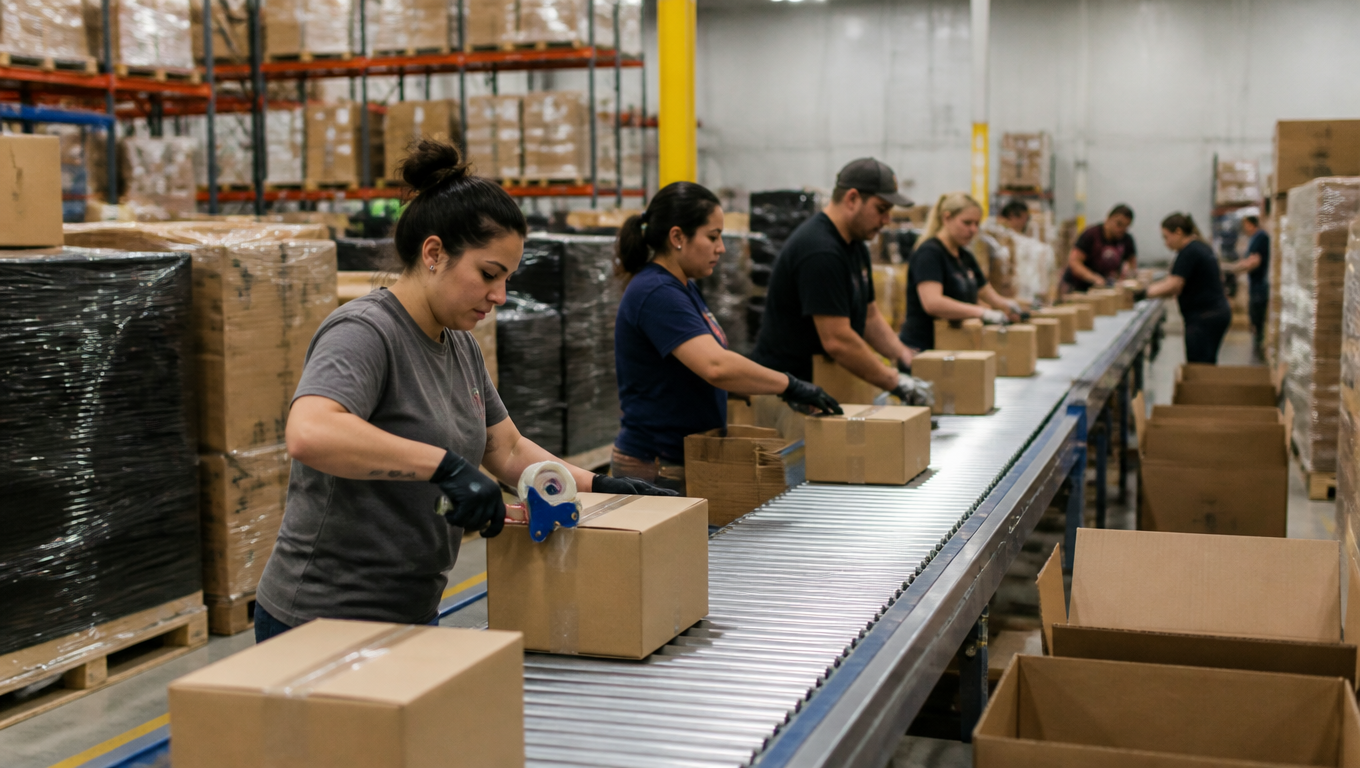
This guide is written for sellers at every stage: newcomers need to know where the policy floor sits, veterans need a framework that turns returns from firefighting into process. If you run a 3PL or a fulfillment warehouse, this is your territory too, because every FBM return eventually lands on a warehouse inspection bench. Read it knowing where you fit.

Seller opens a returned parcel at a warehouse returns desk beside a laptop showing Amazon Seller Central.
An FBM return is a full chain: label, inbound, inspection, refund, disposition

Why FBM Returns Deserve Their Own Playbook

FBA sellers hand returns to Amazon: the item goes to a fulfillment center, gets inspected, and is either restocked or marked unsellable. FBM sellers are the entire supply chain for a return. You choose the label, you pay for inbound shipping, you inspect the item, you decide restock, dispose, or refund without return, and you manage the refund timeline yourself. Every one of those steps has a cost and a failure mode.

Returns are also one of the least visible cost lines in an FBM business. The sticker price of the refund is only the beginning. Inbound shipping, inspection labor, repackaging, and lost selling time add up fast, and return rates routinely run in the double digits for apparel, shoes, and other fit-sensitive categories. A 12 percent return rate is a normal business condition, not a crisis, but it becomes a margin leak when the handling is unplanned.

Two policy changes in 2026 raised the stakes for every FBM seller. Prepaid return labels are now mandatory for every US return regardless of item value, and the refund timeline is now fixed at four calendar days before Amazon steps in. Both changes are good reasons to replace ad-hoc return handling with an actual playbook, which is what this guide gives you.
The 2026 Return Policy You Must Follow

Four rules define the floor of what you must do as an FBM seller.

Accept returns for 30 days from delivery, for any reason. Amazon requires sellers to match or exceed its own return policy. The buyer does not need to give a reason you agree with, and you have no practical way to decline a request inside the window. You can only be more generous, never stricter.

Use Amazon's prepaid return label for every US return. Starting February 8, 2026, all US FBM returns must use Amazon prepaid return labels regardless of item value. The long-standing exemption that let high-value items ship back on a merchant label is gone. The label cost is normally deducted from the refund, unless you choose to cover it.

Refund within four calendar days. Since January 26, 2026, the window to process an FBM refund is four calendar days, up from two business days. If you miss it, Amazon issues the refund automatically, and reclaiming that money later is hard. The extra time is meant to let you inspect the item before refunding, so use it deliberately rather than treating it as a deadline you keep missing.

Deductions are tightly limited. Amazon constrains what you can take out of a refund. Restocking fees and other deductions are only allowed in narrow circumstances, so the practical default is a full refund. If you want to deduct for a damaged return, you generally need documented policy and documented evidence.

The Three Ways to Handle a Return

Every returned item ends in one of three places: back in your sellable inventory, in the trash, or never shipped back at all. The right choice depends on one comparison: what the item is worth versus what it costs to handle.

Restock. The buyer ships the item back, you inspect, repackage, and relist. You recover the full selling value of the item, but you pay for inbound shipping, inspection labor, and repackaging. This is the right path for high-value items in resellable condition.

Dispose. The item comes back and goes to the trash or a liquidator. You pay inbound shipping plus a disposal fee, and you lose the product. This is usually a mistake for anything with resale value, but it can be the cleanest option for items that fail inspection.

Returnless refund. You refund the buyer and tell them to keep the item. Handling cost is zero and there is no inbound parcel to process, but you write off the full cost of goods. This is the cheapest option whenever the handling cost would exceed the product's value.

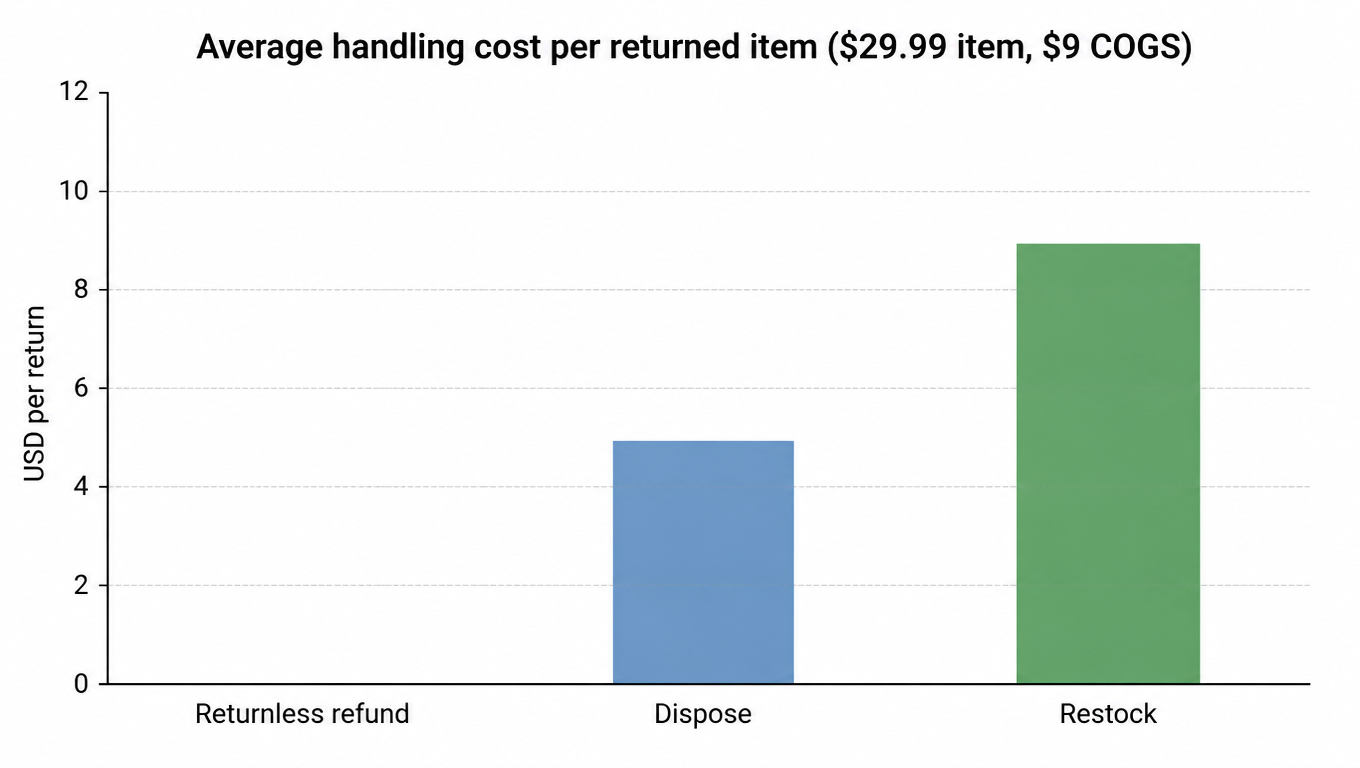
The numbers make the trade-off concrete. Take a $29.99 item with $9 in cost of goods. Restocking it costs roughly $9 in inbound shipping, inspection, and repackaging. Disposing of it costs about $5 (inbound shipping plus a disposal fee). A returnless refund costs $0 in handling, but you absorb the $9 COGS. So restock and returnless end up costing about the same here, and the tie-breaker is your cash position and how fast the item sells.

Average handling cost per returned item bar chart: returnless refund $0, dispose $5, restock $9 ($29.99 item, $9 COGS)
Handling cost per item by path: returnless $0, dispose $5, restock $9

Returnless Refunds: When to Use Them

The rule of thumb: issue a returnless refund when the cost of processing the return is greater than the value of getting the item back. For cheap, lightweight products, inbound shipping alone can be a third of the selling price, and the returned unit may be unsellable anyway. Refund without return and move on.

Start with a threshold based on your own numbers. A common starting point: use returnless refunds for items below your average order value where handling plus inbound shipping exceeds roughly half the item's resale value, and require a full return above that line. Your threshold should come from real handling costs, not a gut feeling. Track the actual inbound shipping, labor, and repackaging you pay per return for a few months, then set the line where the two curves cross.

The abuse question is real. Returnless refunds attract repeat returners, and there is no item coming back to inspect. Fight it with data, not paranoia: watch return reason codes, flag buyers with repeated returnless refunds on the same SKU, and keep returnless policies off high-value items. Some sellers also report that a short "keep it" message politely noting the gesture can cut repeat abuse, since serial returners tend to avoid stores where their pattern is visible.

The Return Decision Flowchart

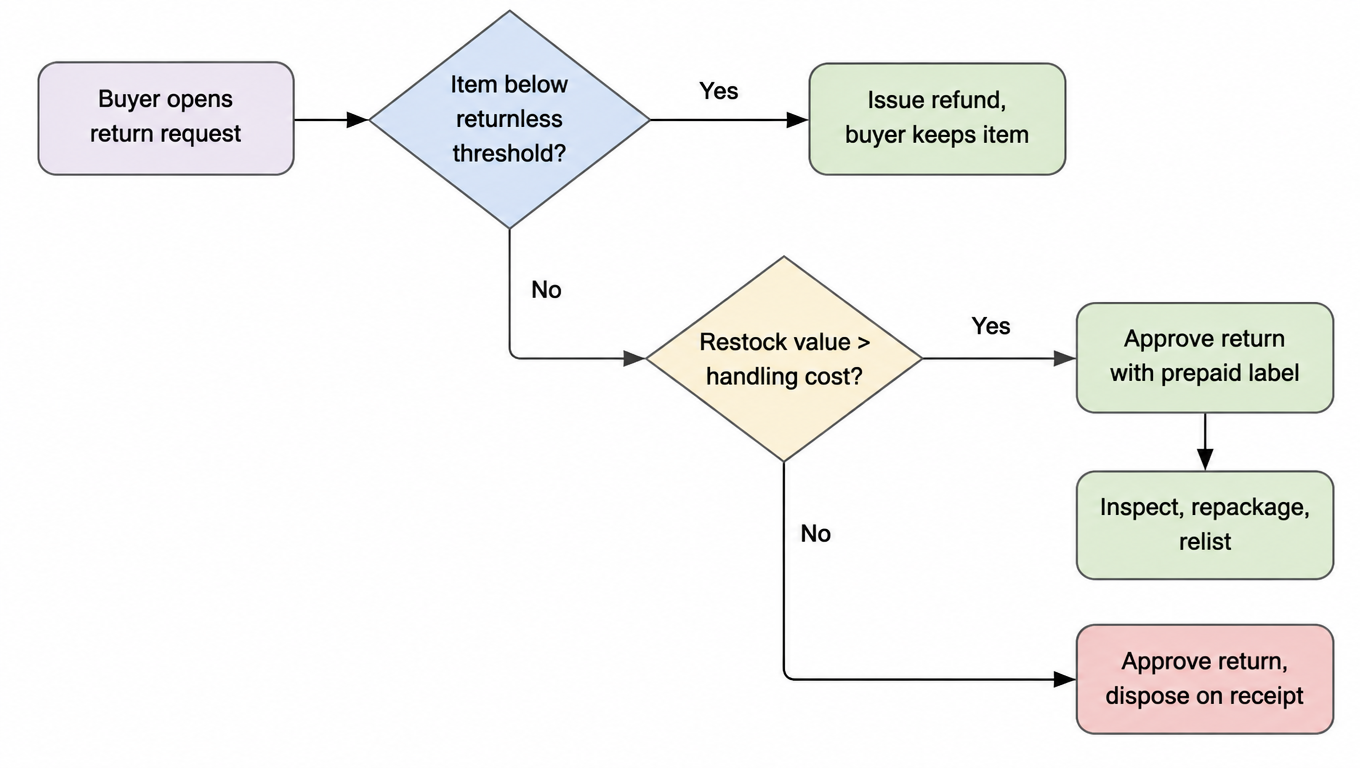
Here is the whole decision, as a flow you can hand to anyone on your team.

Return decision flowchart: buyer opens a return request, first check if the item is below the returnless threshold, if yes refund without return, otherwise check if restock value exceeds handling cost, if yes approve the return and restock, otherwise approve and dispose on receipt
Ask the returnless question first, then the restock question

Read the flow from the top. First, the returnless question: is this item cheap enough that processing the return costs more than the item is worth? If yes, refund without return. If no, ask the restock question: after inbound shipping and handling, is there still margin left in this unit? If yes, approve the return and restock it. If no, approve the return but plan to dispose on receipt.

Two edge cases deserve attention. Items damaged in transit are not the buyer's problem: refund promptly, and take the loss up as a carrier claim if the package was insured. And when a buyer opens a return for an item that never arrives, or claims they returned it without tracking, do not fight the refund, document the pattern, and let the A-to-z process handle the worst cases.

A Return SOP That Scales

A repeatable process matters more than any single decision. This is the SOP to copy and adapt:

  1. Monitor return requests daily. The four-calendar-day clock starts on the return request, not when you notice it.
  2. Run the decision flow on each request. Returnless, restock, or dispose, using the threshold from your own cost data.
  3. Approve and issue the prepaid label immediately for returns you want back. The label is Amazon-generated; your job is just to approve.
  4. Refund on inspection, not on arrival. Use the four days to open the parcel and check condition before refunding. For returnless, refund immediately.
  5. Grade the item on receipt. Sellable: repackage and relist within 24 hours. Defective: repair, part out, or dispose. Unopened: straight back to stock.
  6. Log every return. SKU, reason code, condition on arrival, path taken, and cost. This log is what turns return management from guesswork into numbers.
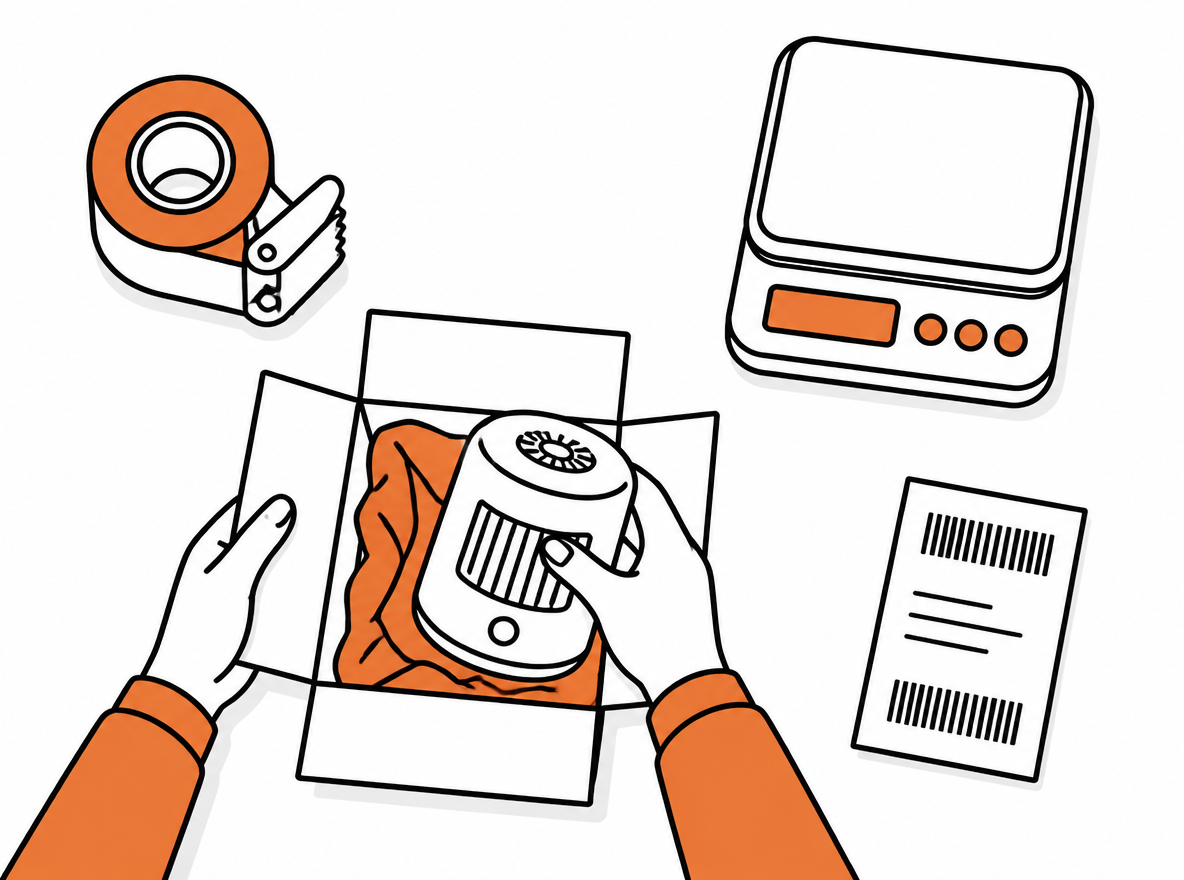
Overhead view of a returns inspection desk with a returned item, tape, parcel scale and printed return label.
The inspection bench is the heart of the SOP: every return gets graded here

Two supporting pieces keep the SOP honest. SAFE-T claims only cover refunds Amazon granted without your approval, so they are a backstop for policy mistakes, not a way to claw back money from legitimate returns. And the metrics that matter are return rate, refund rate, restock rate, and the top return reason codes per SKU, reviewed monthly.

Preventing Returns Before They Happen

The cheapest return is the one that never happens, and most preventable returns trace back to the listing. Descriptions that oversell, photos that hide the actual size or color, and missing measurement tables all produce buyers whose expectation does not match the parcel. Fix the listing before you blame the buyer.

Packaging is the second lever. Undersized boxes and thin padding turn an otherwise good product into a damaged-return claim. If your category is fragile or fit-sensitive, ship every order as if it will be handled roughly, and add a QC step for the top return reason codes you see in the log. A 1 percent cut in return rate often beats a 3 percent cut in handling cost, because it removes the whole chain: label, inbound, inspection, refund.

The 30-Second Cheat Sheet

Item Rule What to know
Return window30 days from delivery, any reasonYou can only be more lenient, never stricter
Return labelAmazon prepaid label for every US return since Feb 8, 2026No high-value exemption
Refund deadlineWithin four calendar days of the return requestMiss it and Amazon refunds for you
DispositionReturnless when handling costs more than value; restock when margin survives the round tripDispose only when the item is unsellable
Common mistakeRefunding on arrival instead of on inspectionIt throws away your only leverage

Sellers who take returns seriously all end up at the same place: returns are not a cost center, they are a system you can measure, optimize, and prevent. Policy is the floor, cost is the ruler, the SOP is the execution, and the data tells you where to go next.

FAQ

Amazon refunds the buyer automatically and it is very hard to reclaim that money later. Since January 26, 2026, the window is four calendar days from the return request, so treat it as a hard deadline. The extra time exists so you can inspect the item before refunding; use it deliberately rather than missing the deadline and letting Amazon refund for you.
Only in narrow circumstances. Amazon tightly limits what you can take out of a refund, so the practical default is a full refund. If you want to deduct for a damaged return, you generally need a documented policy and documented evidence. When in doubt, refund in full; the cost of a dispute is usually higher than the deduction.
When the cost of processing the return is greater than the value of getting the item back. For cheap, lightweight products, inbound shipping alone can be a third of the selling price. A common starting point: use returnless refunds for items where handling plus inbound shipping exceeds roughly half the resale value, and require a full return above that line. Set the threshold from your own tracked handling costs, not a gut feeling.
No. SAFE-T claims only cover refunds Amazon granted without your approval, so they are a backstop for policy mistakes, not a way to claw back money from legitimate returns. The better fix is to refund within four calendar days yourself, on inspection, so Amazon never has to step in.
Practically no. Within the 30-day window from delivery, the buyer can return for any reason, and you have no way to decline a request inside the window. You can only be more generous, never stricter. What you can control is the economics: returnless refunds below your threshold, restock versus dispose decisions, and preventing returns before they happen.