Choosing shipping software is not like choosing a storefront backend or an ERP. Pick the wrong storefront and operations suffers; pick the wrong shipping software and what suffers is your money, your delivery times, and the customers asking every day where their package is. Almost no two products can be compared head-to-head directly: carrier networks differ, pricing models differ, supported destination countries differ. They all look like \"print a label and ship\", but they are not the same species. This article gives you a three-step framework: draw your business profile, score vendors with weights, then verify in a trial. It will not decide which vendor to pick for you, but it guarantees your conclusion is explainable and repeatable, not \"that demo felt smoother\".
Choosing the wrong shipping software costs money, speed, and customer patience
Why Feature-Checklist Comparisons Pick the Wrong Tool
Most teams fail the same way: sit through a demo from each vendor, tick boxes on a feature list, compare price, sign the contract, and discover two weeks after go-live that the workflow does not fit. Two classic failure modes: a DTC brand doing 3,000 peak-season orders a day picked the \"most complete\" product and found in week one that the platform plugin only synced one way, forcing support to look up orders by hand; a mid-size 3PL signed on the spot after a polished demo, then found per-order pricing pushed unit cost above a dollar in peak season, while the quote had only shown the subscription fee.
The Shipping API workflow overview sets out the execution workflow behind the feature comparison. Use the 3PL API procurement guide when a multi-client 3PL needs to turn the shortlist into an evidence-based procurement decision.
The problem is not execution; it is the checklist itself. A feature table proves a feature exists, not that it fits you. Five blind spots: first, \"exists\" and \"works at my volume\" are separated by a whole gap of verification, and a checklist cannot show whether batch label printing still runs at a 5,000-order peak day; second, exception handling is the real workload, the smooth path is 80 percent of the flow and the rest is bad addresses, stockouts, oversize, restricted items, and returns, and demos only show the smooth path; third, cost is a curve over volume, per-order pricing is cheap at a few dozen orders a day and can blow past subscription pricing when volume quintuples; fourth, data and exit costs are invisible, whether history can be exported and how much notice termination needs never make the checklist, yet they decide your negotiating power three years out; fifth, the money not on the quote is the big money, failed delivery due to bad addresses, refunds for missed delivery windows from misrouting, customs holds from bad declarations, none of this appears on a quote, but software quality determines how often it happens.
Step One: Draw Your Business Profile
Before comparing vendors, compress your business into six variables, one line each, and that is your business profile: monthly order volume and peak daily volume, which set the weight on batch printing and stability and directly decide whether per-order pricing can spiral out of control; SKU count and average order value, which drive the workload of maintaining declaration data; number of sales channels, which sets the weight on integration depth; warehouse count and distribution, which drive the complexity of multi-warehouse routing, inventory sync, and label templates; current and candidate carriers, whether your core lanes are covered and whether negotiated rates can be maintained; and destination-country mix plus clearance model, which sets the weight on customs and compliance and is the most underrated item in cross-border selection. The profile is not paperwork; it determines every weight that follows. Scoring without a profile is letting each vendor's salesperson decide what matters to you.
Two typical profiles. Profile A is a DTC brand: 15,000 orders a month, 4,000 on peak days, 800 SKUs at a $45 average value, four sales channels, one overseas warehouse, twelve destination countries with the US at 60 percent and the EU at 25 percent, customs handled by a service provider. Its make-or-break dimensions are channel integration and destination compliance. Profile B is a small to mid-size 3PL or overseas warehouse: eight clients, 60,000 combined orders a month, 20,000 on peak days, two warehouses, 70 percent US domestic last mile (much of it on regional delivery networks) and 30 percent cross-border, with per-client billing and client-facing reports. Its make-or-break dimensions are batch flow, pricing model, and system stability: when one client's lane fails, the whole warehouse's outbound rhythm is affected.
Cross-border adds key differences. Multiple destination countries mean rates, transit times, and clearance rules must be handled per country, not by one \"international\" template. Small parcels bill per piece and reward platform-subsidized lanes and auto-sorting; large shipments care about dimensional weight, LCL/consolidation, and overseas-warehouse coordination. If you clear customs yourself, the software must produce complete customs documents and connect to a broker; if a service provider clears for you, it just hands over documents. Duty-payment mode (DDP vs DDU) is a new profile variable: after the de minimis removal, almost every US-bound parcel needs clearance and tax, and whether the software can calculate duty, pay it, push back tax documents, and collect consignee clearance information directly drives your return rate. Finally, a small seller with one carrier and one destination can push the routing weight near zero; a 3PL with many carriers and many destinations lives or dies by routing and automation.
Nine Core Evaluation Dimensions
The nine dimensions have no inherent ranking; your profile decides the weights. But each dimension has concrete checkpoints, and if you ask them in order, salespeople cannot bluff their way through a demo. Three are the easiest to overrate in a demo: multi-carrier routing, automation, and data capability. They all sound universal and behave completely differently in practice, so each one below comes with verifiable checkpoints.
Dimension 1: Carrier coverage and rate accuracy. Coverage is not usefulness. First check whether your core lanes are inside, then look at the structure: US domestic last mile should include regional delivery networks (West Coast and California-focused local networks, for example), not just the big national carriers; cross-border direct shipping should include line-haul express and postal small-parcel channels. Then three things about rates: real-time rates vs table rates (table rates are periodic snapshots that drift badly when fuel and peak surcharges move); whether your negotiated contract rates can be maintained and passed through; and whether the rate chain is transparent, do quote numbers match actual invoices. The verification is simple: quote the same shipment in each candidate, then reconcile against your recent real invoices. The gap hides in fuel surcharges, peak surcharges, remote-area fees, and residential-delivery fees.
Dimension 2: Multi-carrier routing. Multi-carrier does not mean \"integrates with many carriers\"; it means \"the system decides which carrier each order should take\". It is the biggest cost-saving lever in cross-border selection and the easiest to be fooled by in a demo, so it gets its own section below.
Dimension 3: Automation, measured by the no-touch rate. The right metric is not \"has automation features\" but the no-touch rate: out of 10,000 orders, how many go from order-in to label-returned without a human touching them. Checkpoints: how many steps in the end-to-end chain (order pull, address validation, routing, label, platform sync) need manual intervention; whether exceptions are handled automatically (address auto-complete or a hold queue instead of blocking the batch, stockout auto-hold, oversize auto-reroute, restricted-item auto-block); how automated returns and reships are; and who maintains rules, whether they are versioned, and whether a test environment exists. Worked example: at 3,000 orders a day, a 95 percent no-touch rate means 150 orders a day need manual handling, at three minutes each that is 7.5 hours of labor; at 98 percent it drops to 60 orders and three hours. That gap is far larger than the monthly fee difference between most products.
Dimension 4: Order and batch flow. Ask about peak days first: have the salesperson name the largest daily volume among real customers, then ask whether batch printing at your peak volume queues or times out. Then the batch mechanism: when one order gets stuck (address validation failure, stockout, oversize), does the whole batch stop for a human, or does that order get pulled out while the rest keeps running? Finally, automatic notifications: are labels, tracking-number returns, and tracking sync to channels fully automatic or semi-automatic?
Dimension 5: Integration depth. Ask whether integrations are \"usable\" or \"good\". Official plugins and third-party bridges are different things; a bridge adds a failure point. Two-way sync (orders in, status back, inventory decremented) is the floor; one-way downstream is half a product. API quality means documentation completeness, rate limits, a sandbox, and reliable webhooks. Match the channel matrix one by one: every channel you sell on must be in the official support list. Then the up- and downstream: ERP/WMS integrations, broker or tax-engine integrations (Avalara and the like), because a cross-border seller's compliance chain usually breaks between the software and the customs system.
Dimension 6: Customs and compliance. This dimension's weight has risen more than any other in 2025-2026 because the rules changed: the US $800 de minimis exemption is gone [^1], the EU's EUR 150 duty exemption is gone (replaced by a flat EUR 3 per-parcel fee [^3], while IOSS still collects VAT under EUR 150 [^4]), and the UK's GBP 135 threshold remains but is tightening [^5]. Low-value parcels are no longer automatically duty-free, so the software must support a complete declaration chain. Checkpoints: can customs documents be auto-generated with complete declared value, description, and HS code fields; is there an HS code database with auto-classification and per-country duty lookups; can DDP calculate, pay, and push back tax documents, and how is consignee clearance information collected; can IOSS and UK VAT registrations be maintained and taxed per country; and are restricted items (batteries, liquids, branded goods, food) blocked and flagged at the source instead of being held at customs.
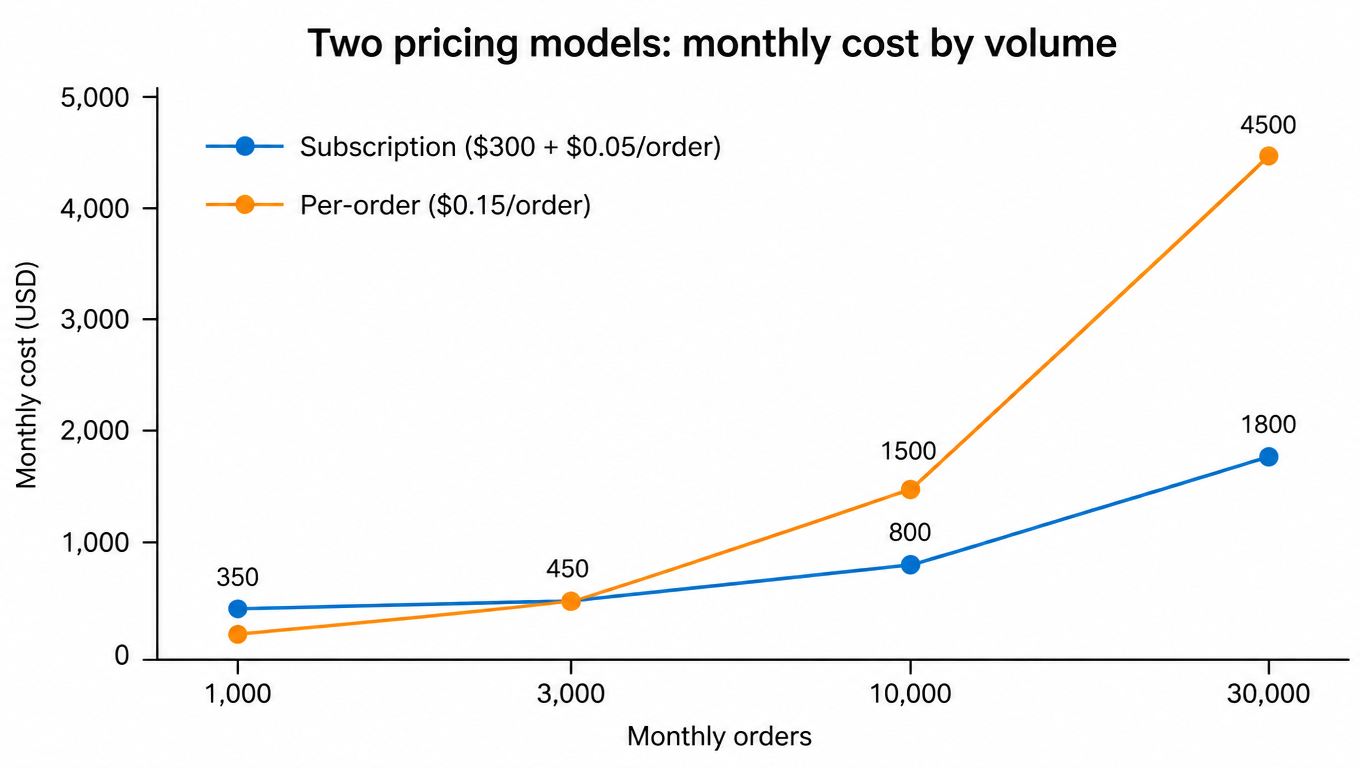
Dimension 7: Cost (purchase cost, growth curve, and business impact). Do not just look at the monthly number; look at three ledgers. Ledger one, purchase cost: address cleansing, label printing, API overage, extra user seats, support tiers, implementation fees, put every hidden fee on the quote and then compute per-order cost. Ledger two, the growth curve: a USD 300 subscription plus USD 0.05 per order and per-order pricing at USD 0.15 both come to USD 450 at 3,000 orders a month; at 30,000 orders the first is about USD 1,800 and the second USD 4,500, a difference above USD 30,000 a year. The reverse is also true: at 2,000 orders a month, subscription is the more expensive option. Make the salesperson lay out tiered pricing and draw your cost curve from current volume to three times it before signing. Ledger three, business-impact cost: at 30,000 orders a month, a 0.4 percentage point error-rate gap is 120 failed orders a month, at USD 10 each in reship plus support that is over USD 14,000 a year. That money is not on the quote, but software quality decides it, so include it in your TCO.
Two pricing models: monthly cost by volume
Dimension 8: Scalability and stability. Stability first: what availability does the SLA promise, what incidents has the vendor had and how were they compensated, what is the batch throughput ceiling at peak days, and can API rate limits stall status sync during peak season. Then support quality: response time, ticket channels, timezone coverage. Ask scalability direction by direction: does adding volume mean a plan change or a product change; does adding a warehouse require re-implementation and how long; are new channels, destinations, and carriers a configuration item or a new contract; and for 3PLs and overseas warehouses especially, ask about multi-client: how is data isolation done, can billing be per client, can independent or even white-label reports be issued. Every direction needs a one-line answer: \"configuration item\" or \"new contract\". Anything the salesperson cannot answer is a scalability trap.
Dimension 9: Data capability. Data capability decides two things: whether you can keep optimizing cost, and whether you have any negotiating power three years out. Checkpoints: report dimensions, can you break out unit cost, on-time rate, delivered rate, and return rate by carrier, destination, channel, and lane, because software that only gives one aggregate report has no reporting at all; reconciliation trust, do report numbers match carrier invoices, because a report that does not reconcile is more dangerous than no report; export and portability, can full history be exported anytime, in what format, with no field loss, this is the floor of all your negotiating power; and advanced capabilities, custom reports, BI access, cost-anomaly alerts, and routing-rule effect review. The space for cross-border cost optimization lives entirely in the breakdown by lane, destination, and service level, and if you cannot break it out you cannot optimize it.
Multi-Carrier Routing: The Engine That Spends Your Money Every Day
Of the nine dimensions, one spans rate accuracy and batch flow and deserves its own section: multi-carrier routing. It is the least visible in a demo and, after go-live, the only module that spends your money automatically every day. Every label, the routing engine makes three decisions: which carrier, which lane, how much money. To evaluate an engine, first look at rule expressiveness: are there enough condition dimensions (destination, weight band, value, SKU category, channel, client group, service level, warehouse), can they be freely combined, are ranges, lists, and ZIP regexes supported, is priority customizable, and is the semantics first-match or best-match. Try it with a real requirement: US orders over USD 100 go to a signed-delivery lane, the rest go to a regional network; orders placed after 2 p.m. Friday switch to next-day. If the engine cannot express that, it is a \"cheapest carrier\" button, not routing. Pure cost-first routing fails on two order classes: high-value orders, where a lost-parcel payout dwarfs the freight saved, and brand-experience scenarios, where customers remember three days vs five days.
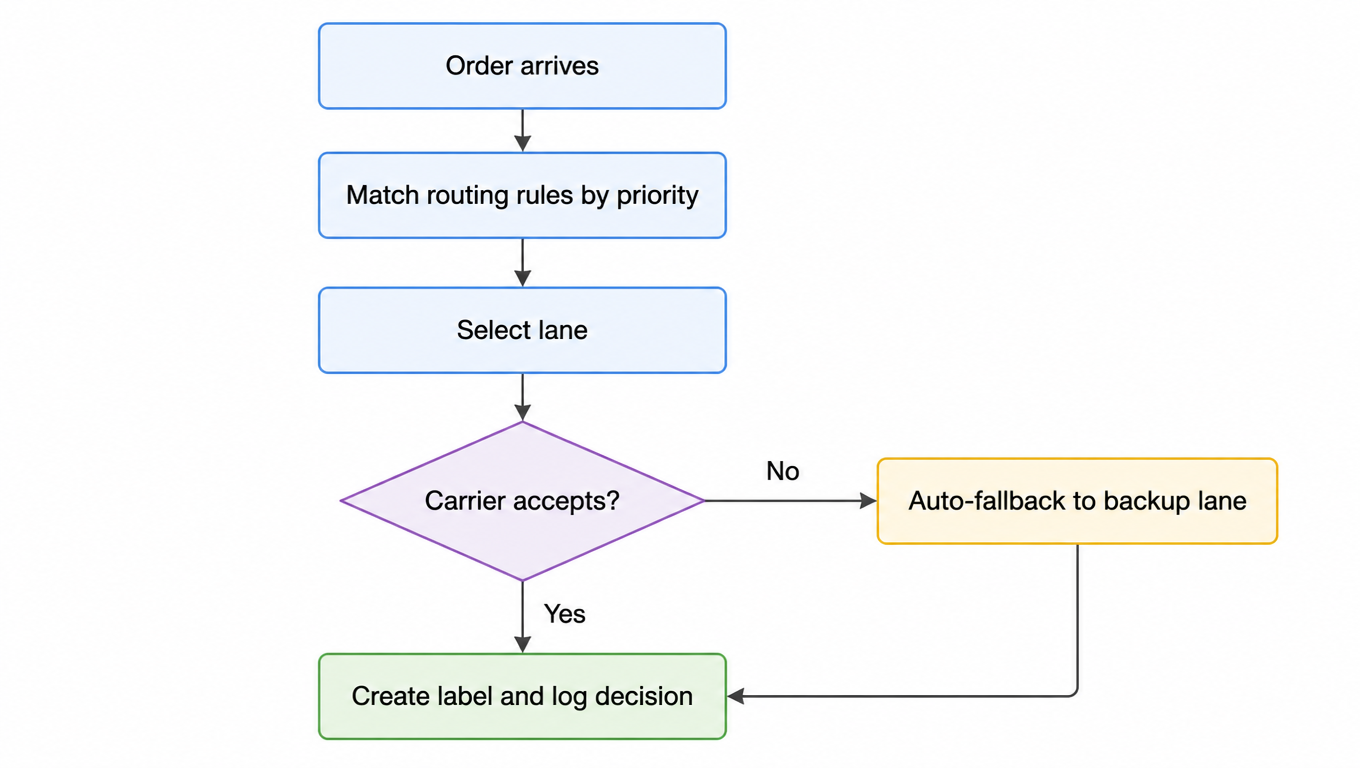
Second, where rates come from: does routing decide on real-time rates or table-rate snapshots, because when fuel and peak surcharges swing, table-rate routing systematically picks the wrong lane; then negotiated rates, can your contracted carrier rates be maintained in the system and used by the engine, because an engine that only knows public rates means your negotiating power was never cashed in. Third, fallback and resilience: first-choice lanes rejecting parcels is the norm, a good engine drops rejected parcels onto a backup lane automatically while the batch keeps running, a bad engine stops the whole batch for a human; and when a carrier has a large outage, can you switch the entire lane pool to a backup pool with one click, and who absorbs and how is recorded the cost difference of fallbacks. Fourth, audit and testability: why this parcel went with this carrier must be traceable through a decision log that records which rule matched and at what rate; and the sandbox should let you import historical orders, replay them, simulate two rule sets, and compare total cost and transit distribution before and after. A rule engine you cannot replay is a gamble at go-live.
In 2026 the routing engine has a new dividing line: landed-cost awareness. After the de minimis removal, carriers serving the same destination differ a lot in duty-payment capability, clearance speed, and consignee-cooperation requirements. For high-duty destinations, routing rules should prefer lanes with strong duty-payment and stable clearance, not the cheapest surface rate; a return caused by a buyer refusing to pay duty eats the saved freight several times over. Multi-warehouse sellers should also ask: does the engine consider inventory availability and inter-warehouse cost, and does it split orders. Run this list past a salesperson and the engine's quality shows in ten minutes: how many condition dimensions can a rule combine; are ranges, lists, and ZIP regexes supported; how is priority set, first-match or best-match; does routing decide on real-time or table rates; can negotiated rates be maintained in the engine and participate in routing; does a rejected first-choice lane auto-fallback; is there a decision log; and can the sandbox replay historical orders?
The routing decision flow
Weighted Scoring: Turning Gut Feel into Numbers
How do you set the weights? From your business profile. Split 100 percent across the nine dimensions. Profile A (DTC brand): rate accuracy 15%, routing 10%, automation 10%, batch flow 10%, integration depth 15%, customs and compliance 15%, cost 10%, scalability and stability 5%, data 10%, because its make-or-break is channel integration, multi-destination compliance, and data review. Profile B (3PL / overseas warehouse): rate accuracy 10%, routing 15%, automation 15%, batch flow 15%, integration depth 5%, customs and compliance 10%, cost 15%, scalability and stability 5%, data 10%, because its business runs on batch shipping for clients, multi-carrier routing, and cost control, and clients manage their own channels.
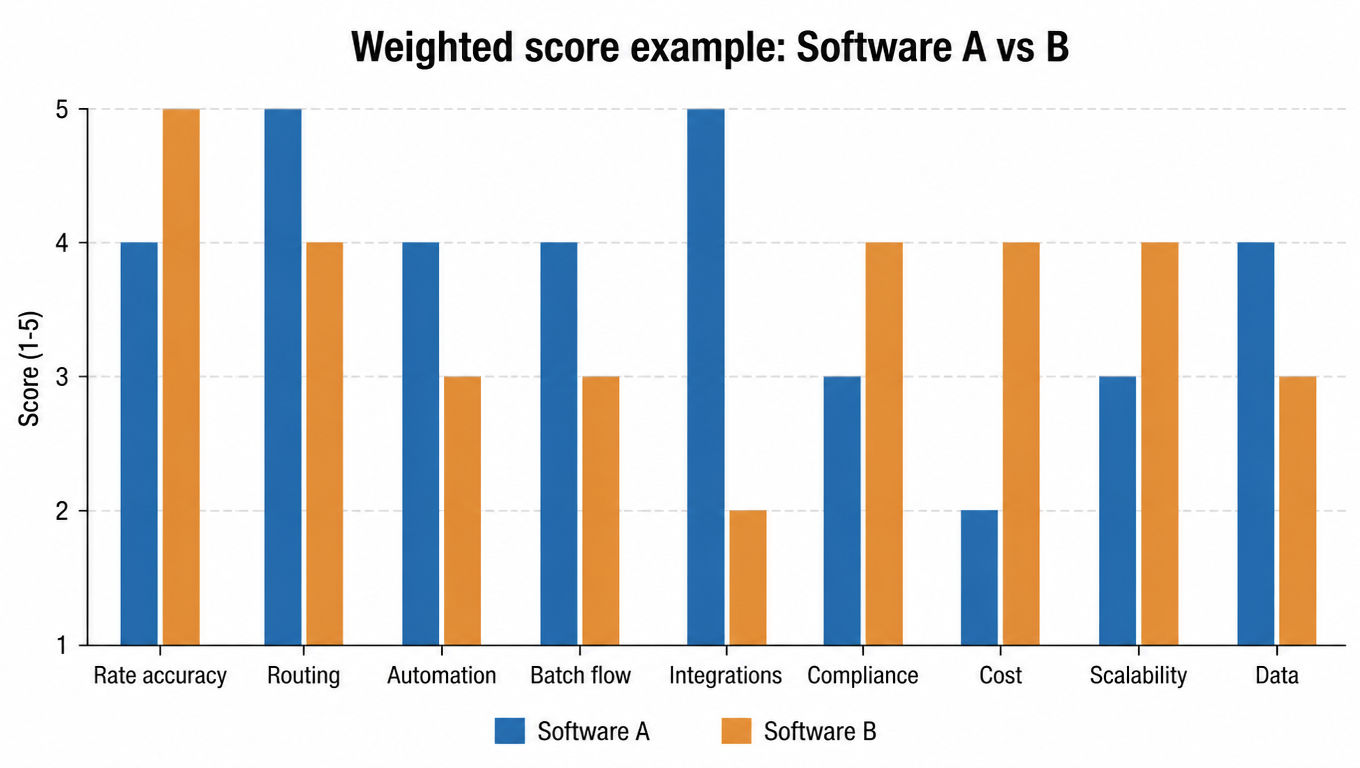
There is one scoring rule: score each dimension 1 to 5, and every score must come with evidence. Anchor the scores so two people do not give different meanings to the same \"4\": 5 means the dimension was verified at real business volume, with screenshots, invoices, or documentation as evidence; 4 means it was walked end-to-end in a demo or sandbox with records to show; 3 means the feature exists but was not verified in your target scenario; 2 means the feature is broken and needs workarounds or manual fallback; 1 means it does not exist or directly harms the business. Claiming a 5 on integration means showing a two-way sync screenshot; claiming a 4 on rates means showing the same lane quoted in two products side by side. Scores without evidence are void. If you can, have two or more people score independently and average, so the demo-day atmosphere does not carry the decision. The weighted score is each score times its weight, summed. Back to profile A: Software A scores rate 4, routing 5, automation 4, batch 4, integration 5, compliance 3, cost 2, scalability 3, data 4, for a weighted 3.85; Software B scores rate 5, routing 4, automation 3, batch 3, integration 2, compliance 4, cost 4, scalability 4, data 3, for a weighted 3.55. A wins even though B is better on rates, cost, and scalability, because this business puts its weight on integration and data, where B scored 2 and 3. That is exactly the difference between weighted scoring and ticking a feature list. Rank by total and take the top three into a trial.
Weighted score example: Software A vs Software B
After scoring, run a sensitivity check: swap weights in pairs and recalculate; if first place flips, the gap is not significant, do not sign yet, let the trial's real data decide. Three traps, and order matters. Demo effect: have the salesperson leave the room while you score, and click through the product yourself so the demo rhythm does not carry you. Weight inflation: scoring every dimension about the same means you have no weights and you are back to a feature list. Wrong order: scoring before vetoing wastes time on software that should be eliminated with one vote; the order must be reversed.
One-Vote Vetoes: Eliminate Before You Compare
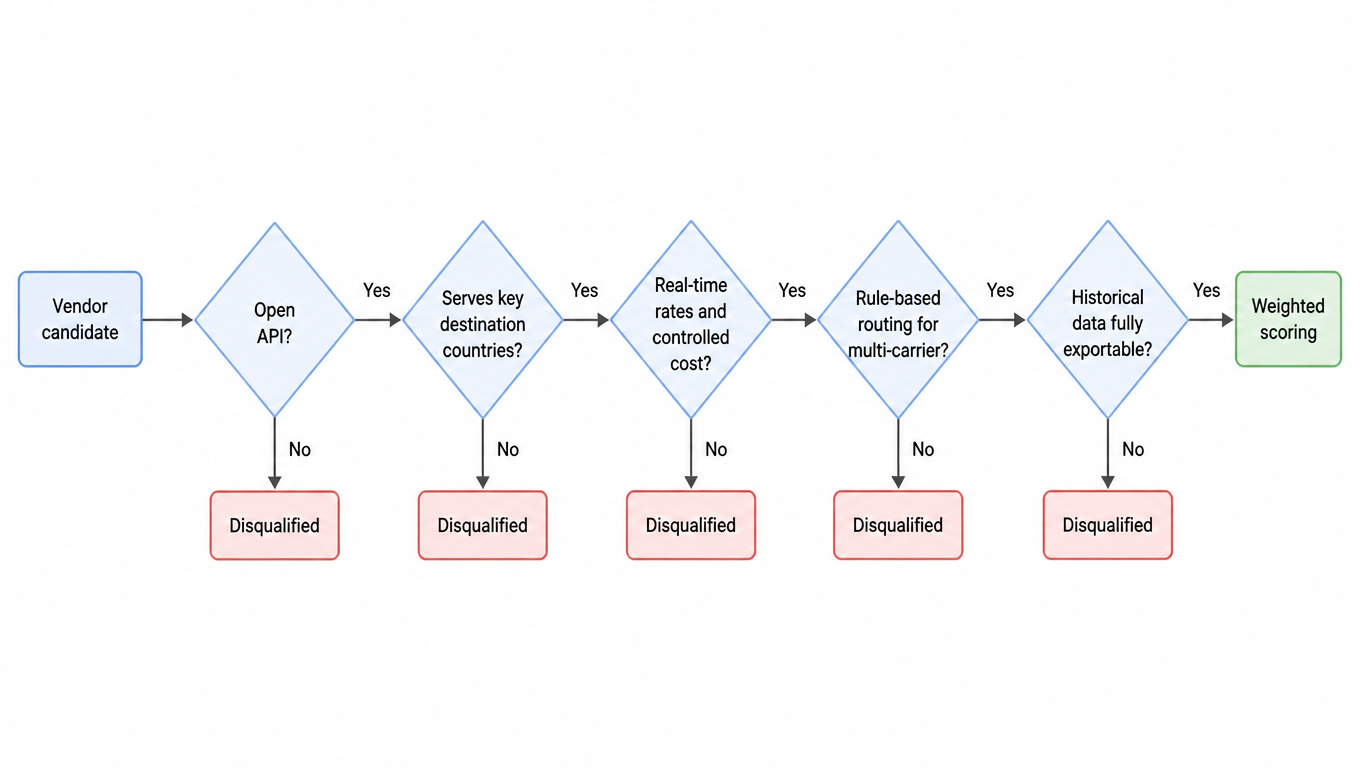
Before scoring, run every candidate through the veto list. Hitting any single item eliminates it, and it is not worth scoring. The list: no open API or broken integration options; key destination countries not covered with no clear roadmap; table rates only, no real-time rates; unit cost that spirals out of control at your target volume; history that cannot be fully exported, locking your data in; no sandbox or trial environment, demos only; multi-carrier business without rule-based routing or real-time rate shopping; report numbers that do not reconcile with carrier invoices; and missing security and compliance, no SOC 2 report, unclear data residency, or no GDPR processor terms. The difference between vetoes and weights: a veto is one-vote elimination, a weight only affects ranking. Eliminate first, then rank. The order cannot be reversed.
Eliminate first, then rank
The Two-Week Trial Verification Checklist
A trial is not watching demos; it is running real data through real workflows. Cover at least seven things. First, peak-day batch printing: replay a recent promo day's real orders and watch for stalls, missed orders, and how exceptions are handled. Second, rate verification: take ten to twenty real shipments, reconcile the candidate's quote against actual invoices three ways, and list every surcharge. Third, compliance edge cases: build one order each for restricted items, low-value parcels (which now need declaration too), incomplete addresses, and DDP, and walk each end-to-end. Fourth, integration and API testing: run the full chain in the sandbox, orders in, labels out, status back, and measure webhook drop rates and sync latency. Fifth, routing replay: import the last month of historical orders into the sandbox, replay them, compare the engine's recommendations against your actual choices, and compute the cost and transit gap; then construct boundary parcels (remote ZIPs, PO boxes, oversize, high value, restricted items) and see how routing handles them and whether the decision log explains each choice. Sixth, automation measurement: track one working day's no-touch rate and ask the software to produce the logs to back it up; then create exceptions and see whether they are handled automatically or dropped into a manual queue. Seventh, data acceptance: export the reports and reconcile against carrier invoices, then attempt a full historical-data export and record the format, speed, and field completeness.
Test the human side too. File a support ticket and note response time and answer quality; browse the API docs and help center to see whether they are complete and searchable or just sales recordings; and clarify the post-launch communication channels and timezone coverage. After go-live you deal with support and documentation every day, not sales, and the quality of those two things decides how you feel every day.
Before the trial ends, ask three closing questions. Contract details: do unit prices include surcharges, is there a price-increase clause, is there a minimum committed volume, and how are breaches handled. Data migration: can full history be exported, in what format, are all fields present, and how much effort would importing into another system take. Exit cost: how much notice does termination need, can the data be taken away, and do competitors have import tools. If these three cannot be answered clearly, be cautious about signing even after a satisfying trial. The framework now closes the loop: the profile sets the weights, the weights produce the scores, the vetoes handle elimination, and the trial verifies the finish. Next time someone sends you a feature list, you know where to look, and you know which dimension will quietly raise your costs in the 2026 cross-border business. Next time someone demos \"smart routing\", you know to ask about rules, fallback, and logs.
Ticking features off a list. A feature table proves a feature exists, not that it fits you: whether batch printing holds up on peak days, how exceptions are handled, how cost changes with volume, and whether data can be exported never appear on a feature list. The right order is: draw your business profile to set weights, apply one-vote vetoes first, then score.
Draw your business profile: monthly volume and peak daily volume, SKU count and average order value, number of sales channels, warehouse count and distribution, current and candidate carriers, and destination-country mix plus clearance model, one line each. Weights come from the profile, and only then is the conclusion convincing; scoring without a profile lets each vendor's salesperson decide what matters to you.
Because it is the only module that spends your money automatically every day. For every label, the routing engine decides which carrier, which lane, and how much. Evaluate it on four things: rule expressiveness (can condition dimensions combine freely, are ranges and ZIP regexes supported), the rate source (real-time vs table rates, can negotiated rates enter the engine), fallback and resilience (rejected parcels auto-fallback, one-click lane-pool switching), and audit and testability (decision logs, historical-order replay).
Seven things: replay peak-day batch printing, reconcile rates three ways on ten to twenty real shipments, build one order for each compliance edge case (restricted items, low value, incomplete address, DDP), test the full integration and API chain, replay historical orders through routing plus boundary parcels, measure one working day's no-touch rate, and verify report reconciliation and full-history export. Plus test support response and documentation quality, and before signing ask about contract details, data migration, and exit cost.