US Vinyl Record Shipping Guide

How to Ship Vinyl Records: Protect the Jacket and Choose the Right Postage

To ship vinyl records within the US, match the packaging to the condition you sold. Inventory everything going into the parcel before choosing an eligible service. Then compare costs using packed weight, exterior dimensions, and origin/destination ZIP Codes. Playability, factory-sealed condition, and postage eligibility require separate checks.

  • Order A: one opened, used 12-inch LP.
  • Order B: one collectible LP sold as factory sealed.
  • Order C: one LP and one band T-shirt for the same US buyer.

The workflow is for record shops, labels, Discogs sellers, band-merch stores, and their 3PLs. Packing steps are operational recommendations. Media Mail eligibility comes from USPS rules, not the selling price or the fact that every item is music-related.

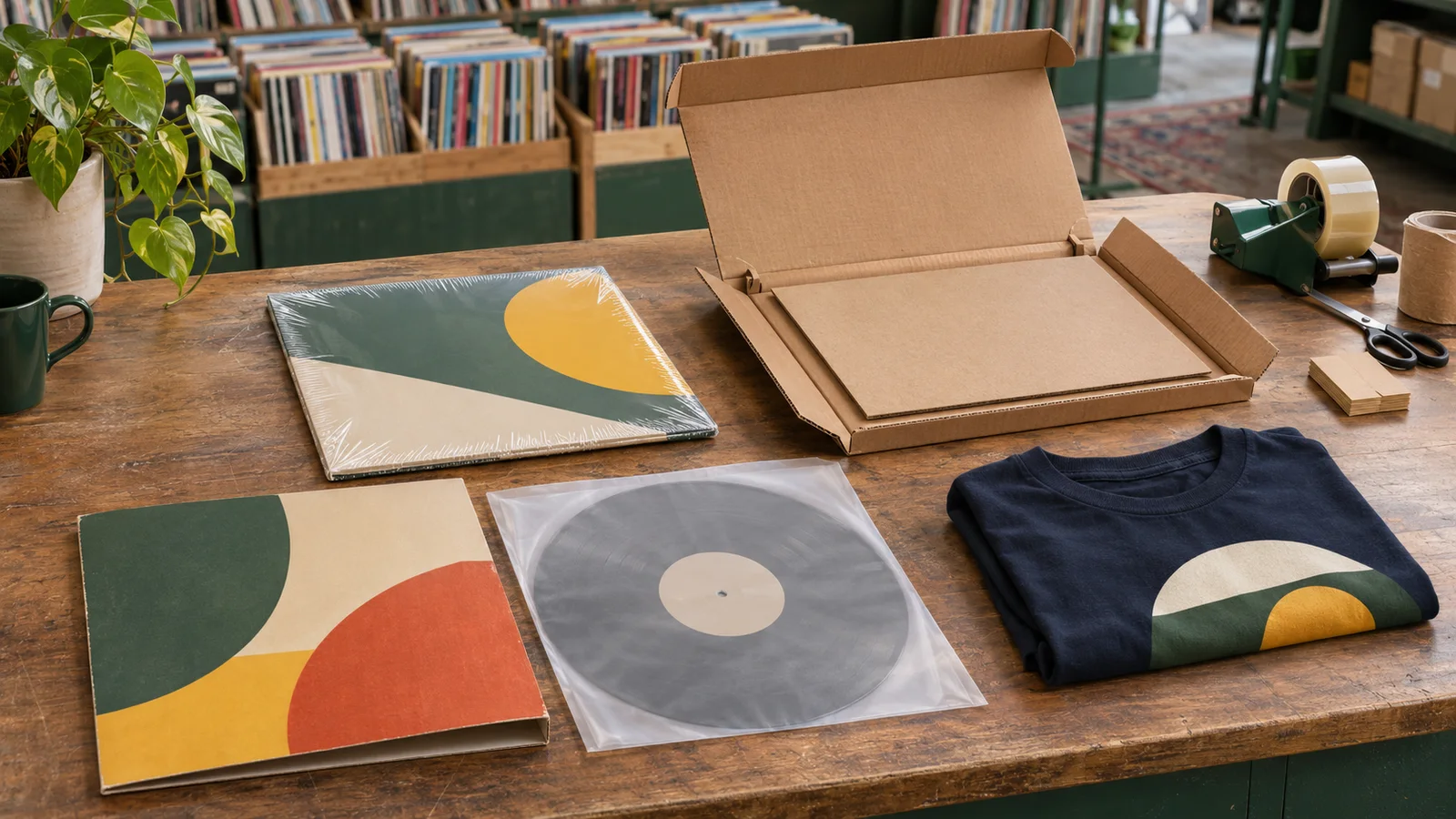
An independent record-shop bench with an opened LP jacket, a record protected in its inner sleeve, a factory-sealed LP, a shipping mailer, and a folded T-shirt; album artwork is fictional.
Sealed and opened records have different packing needs. The album covers shown are fictional.

1. A playable record can still arrive in the wrong condition

Start with consistent names. The normal storage relationship is record → inner sleeve → jacket; shipping adds support and a mailer. For order A, the sleeved record can travel outside the jacket, secured flat with it. The packing diagram below shows that change.

From the product parts to the shipping enclosure
PartMeaningDamage to prevent
RecordThe vinyl disc carrying the recordingGroove scratches and warping
Inner sleeveThe sleeve that directly holds the discExposed-disc abrasion; damage to a collectible printed inner
JacketThe printed cardboard album coverSeam splits, crushed corners, and creases
Shipping mailerThe shipping enclosure around the protected itemCollapse, shifting contents, and inadequate support

A scratch concerns the groove surface; a seam split is a torn jacket edge; a corner ding changes the cover’s shape; a warp means the disc is no longer flat. “It plays” does not resolve all four. Discogs grading guidance addresses both vinyl and LP covers, including cover creases and seam splits under Near Mint.

Factory sealed does not automatically mean Mint. Discogs defines Mint in terms of perfection and advises using it sparingly. Record visible wrap, corner, and seam condition, and describe what you actually inspected. Do not assign every shipping defect a fixed percentage loss.

2. Pack opened and factory-sealed LPs differently

Choose the packing path from the sold condition
OrderFirst handling decisionSupport and restraint
A: openedRemove the sleeved disc from the jacket, not the bare disc from its sleeveStack sleeved disc and empty jacket flat between support boards; restrain movement
B: factory sealedPreserve the sealed condition promised in the listingFit the complete sealed LP, supports, and corner protection without squeezing
Multiple LPsCheck each LP, thickness, gatefold, and insertUse actual thickness, weight, and mailer capacity; no universal LP count
Exploded packing diagram: at left, the unsealed record stays in its inner sleeve and is stacked with the empty jacket between support boards in a mailer; at right, the LP stays factory sealed with the inner sleeve and record inside.
Exploded illustration, not to scale: keep the record in its inner sleeve and the factory seal intact. Pack the layers flat and restrain them; the illustrated gaps are not packing gaps.

Shopify’s packing guide distinguishes separating unsealed records from their jackets from protecting a sealed record intact. Keeping the sleeved disc outside the jacket reduces its opportunity to push against jacket seams during movement. The inner sleeve protects the surface, while restraint limits the whole assembly sliding. This is not a damage-free guarantee.

  1. Verify and document. Confirm the release, disc count, and sold seal condition. Photograph inspectable disc surfaces, jacket corners, and seams. For a sealed order, document visible condition without opening it for a disc photo.
  2. Keep order A sleeved. If handling the disc is necessary, hold its edge and label area, keeping fingers off the grooves. Position the sleeved disc with the empty jacket, then stack them flat. Preserve a collectible original printed inner; use a suitable protective inner for the disc if needed.
  3. Leave order B sealed. Support the intact factory-sealed LP in a suitable mailer, protecting edges and corners so the jacket does not bear directly against vulnerable outer edges. Do not open it to apply order A’s method.
  4. Build a supported pack. Follow the mailer’s design: bottom support, flat product assembly, then top support and suitable cushioning. Avoid bending the jacket with a stiffener or crushing its corners with a protector. Recheck closure clearance for multiple LPs.
  5. Keep tape on packing materials. Tape the mailer’s closing flaps. If protective wrapping needs restraint, tape disposable packing materials to themselves. Keep adhesive off the disc, printed jacket, collectible inner, and factory shrinkwrap.
  6. Check movement before sealing. Trial-close the mailer and gently tilt it to detect obvious sliding. Reopen and adjust support where needed; avoid compression or vigorous shaking as a test. After sealing, inspect closures, edges, and label placement, and keep packed records out of heat and direct sun.

Choose the enclosure for the protection needed, not just its unit price. For broader material tradeoffs, see the box-versus-mailer guide. The exploded diagram identifies the parts; its display gaps are not empty spaces to leave in the finished pack.

3. Which vinyl orders can use Media Mail?

For retail mailings, start with USPS DMM 173 §4.1e: qualifying sound recordings can use Media Mail. Inventory the whole parcel, including freebies and inserts. The table is a preliminary screen, not a substitute for checking the actual mailing.

Screen the whole parcel, not just the presence of an LP
ContentsInitial screenBasisStill verify
One recorded LPPotentially eligibleSound-recording categoryAll contents, packed specifications, purchase channel
Two recorded LPsPotentially eligibleNot a one-record-per-parcel ruleEnclosures, total weight, dimensions
Factory-sealed LPPotentially eligibleSeal condition does not determine eligibilityQualifying recorded content; no ineligible mixed goods
LP plus ordinary T-shirtNot on Media Mail postage aloneShirt is not qualifying media or a permitted printed enclosureEligible whole-order service or separate parcels
LP plus promotional insertCheck individuallyActual content and applicable enclosure provisionRetail §6.1 and other provisions; commercial rules separately

The recording category comes from DMM 173 §4.1e. USPS warns that nonqualifying mixed contents can trigger higher postage in its Media Mail FAQ. A free or band-branded T-shirt does not become a qualifying recording.

Do not blanket-approve or prohibit promotional inserts. Retail DMM 173 §6.1 permits loose printed matter mailable as USPS Marketing Mail with qualifying contents; §4.1e also addresses incidental recording announcements and recording-specific guides. Check the actual content and format. Invoices and written additions have separate §6 provisions; being paper is not enough.

Check those retail enclosure provisions in DMM 173 §6. If a 3PL uses an applicable commercial mailing arrangement, consult DMM 273 §§3 and 6 for that mailing. Being a shop or company does not itself determine which mailing rules apply.

Media Mail is subject to inspection and has no guaranteed delivery within a specified time under DMM 173 §§2.1–2.2. For a required arrival date, compare eligible services and their commitments. Keep estimated transit separate from a guarantee. Continue with the Media Mail eligibility and cost guide for the wider service framework.

4. LP plus T-shirt: combine or split?

Option A: use an eligible parcel service for the whole order. Compare services accepting both items, such as USPS Ground Advantage when its requirements are met. Keep the LP’s rigid protection, restrain the shirt separately, and check that closing the box does not press or bend the jacket. Do not force a shirt into a too-shallow LP mailer.

Option B: ship the LP and shirt separately. Check the LP parcel’s complete contents before considering Media Mail or another eligible service; send the shirt with a suitable parcel service. Add both postage charges, extra materials, and packing labor. Tell the buyer to expect two tracking references and potentially different arrival dates.

Suppose splitting saves $1.80 in postage but adds $1.10 in materials and $1.20 in labor. The change versus combining is −$1.80 + $1.10 + $1.20 = +$0.50: splitting costs $0.50 more. This is an arithmetic illustration, not a carrier quote. Additional tracking-related support and return work are not priced into it.

LP plus T-shirt branches into one eligible parcel service for the combined order or separate services for the LP and shirt. Only an eligible LP can use Media Mail. Hypothetical split savings of $1.80 postage are outweighed by $1.10 materials and $1.20 labor, adding $0.50.
Hypothetical example in USD, not a carrier quote: −$1.80 + $1.10 + $1.20 = +$0.50. Assess the effect of two tracking numbers and support work separately.

Compare the same order, destination, and dispatch timing, and confirm both paths are executable. Replace the assumed postage, materials, and labor with your own costs before choosing. For a broader hold, reroute, or split decision, use the split-shipment cost framework.

5. “180 g vinyl” is not a shipping weight

“180 g” describes the record, not the packed shipment. Weigh the disc, inner sleeve, jacket, stiffeners, cushioning, and mailer, plus the shirt for order C. Weigh and measure each final packing configuration; do not copy the disc’s listed weight into the shipping label.

USPS’s domestic package instructions tie service selection to contents, weight, size, and destination. Use the sealed parcel’s measurements and ZIP Codes in the EasyShippingX rate calculator to check returned applicable options, then confirm service eligibility and purchasing-channel availability.

No live postage prices are listed here. Keep the quote date, ZIP Codes, sealed weight and dimensions, service, and retail, commercial, or account-returned price basis together. That makes the comparison reproducible; a quote tool returning options does not establish support for every service.

6. Packing-bench dispatch checklist

Checks to copy into a record-shop or 3PL packing workflow
CheckConfirm or retain
Release and sold conditionCorrect release, disc count, and sealed/opened status
Pre-dispatch conditionInspectable disc, jacket-corner, seam, and wrap photos; leave sealed items intact
Shipping mailerSuitable dimensions, depth, and capacity; support without jacket compression
Internal restraintDisc stays sleeved; flat stack; no obvious sliding; no adhesive on product
Packed measurementsActual sealed weight and exterior dimensions, with units
Mixed goods and enclosuresCheck shirt, freebies, inserts, and applicable provisions
Service and labelEligible contents, purchasing channel, address, parcel sequence, and order match
Split-order communicationBoth parcel references linked to the order; buyer informed

Trial a new pack with representative items and inspect support and movement. Track damage and support reasons after dispatch, then revise materials and handling. A fragile sticker or one successful delivery does not establish damage-free performance.

Vinyl shipping FAQ

For an opened order, the sleeved record can travel outside the jacket, secured flat with it. Keep the disc inside its protective inner; do not ship bare vinyl against stiffeners or the mailer.

Keep it sealed by default. Preserve the listed condition and use support, corner protection, and a mailer suited to the intact LP, rather than opening it to use the unsealed-record process.

Yes. Free does not change an ordinary shirt’s contents category. Do not send the LP-and-shirt parcel on Media Mail postage alone; use a service eligible for the whole order or split it.

Sources and example notes

Packing steps are operational recommendations. Postage, materials, and labor figures are labeled assumptions. Check actual contents against the applicable mailing rules; no live postage prices or damage-free guarantee are offered here.