Low-Cost Shipping Eligibility Guide

USPS Media Mail: Costs, Eligibility, and a Ground Advantage Comparison

A parcel with a book inside does not automatically qualify for Media Mail. This guide answers the three questions that decide the order: whether the entire contents fit the USPS eligible list, what the parcel costs once it is packed and rounded up to the next whole pound, and when a seller should switch to Ground Advantage instead. The order of operations is contents, then weight, then price, with price last.

Price coming last is not a figure of speech. When the contents fall outside the list, the best move is to change service or split the parcel, because the difference charged back on a non-qualifying parcel is normally far larger than what the service saved.

Editorial illustration of a used-book seller leaning over a wooden packing bench to box a stack of paperbacks, a small scale and a roll of tape beside them, low afternoon light slanting in through a window, scattered paper offcuts on the bench, generous empty space in the centre, black ink linework with a single orange accent and a faint paper-grain texture.
Look at the contents before the price, not after

Why Media Mail is an eligibility decision before it is a price decision

Most sellers who work in books have run into the same wrong assumption: that a parcel with a book in it can go as Media Mail. USPS does not define this service as printed matter. It defines it as a specific list of eligible items, and it keeps the right to open the parcel and check. Handing a parcel over as Media Mail is consent for USPS to look inside, however well you seal it (DMM 173, Media Mail and Library Mail prices and eligibility).

That fixes the order of operations, and the order is the point of this guide.

  1. Whether the entire contents qualify. The question is not whether there is a book inside, it is whether anything else is inside. One pair of earbuds removes the whole parcel from the list.
  2. What the parcel weighs once it is packed. Box and filler count, anything under 1 lb is billed as 1 lb, and the fraction above that rounds up to a whole pound.
  3. Whether this order should use Media Mail at all. The promised window, the item value, and any signature or insurance requirement can all make the more expensive service the cheaper total cost.

This guide works from the Notice 123 rate list effective July 12, 2026 and the eligibility rules in DMM 173. It takes the three questions one at a time and then puts Media Mail and Ground Advantage on the same weights side by side. The pricing structure of Ground Advantage itself lives in Ground Advantage pricing, which this article does not repeat.

What Media Mail is, and who should use it

Media Mail sits under Package Services as a market-dominant product. It was established in 1938 as Book Mail, initially to serve shipments between libraries. It is priced by weight, covers 1 to 70 pounds, and ignores zones: a parcel of a given weight costs the same to the next state and to the far coast. That structural difference is the main reason it can undercut Ground Advantage.

Set the expectation low before you promise anything. The published window is 2 to 8 business days, and DMM 173 states that USPS does not guarantee delivery within a specified time, so there is no late refund either (USPS Media Mail service page). USPS Tracking is included at no charge. Insurance is not.

The natural fits: single-title orders from used-book sellers, audio and video media sellers shipping CDs, DVDs, and vinyl, textbook and sheet-music sellers, content subscription boxes built around books, and 3PLs shipping these order types on behalf of clients.

The poor fits are just as clear: mixed orders, time-sensitive preorders, anything that needs insurance or a signature, and any listing that promises delivery inside the published window rather than beyond it.

Step one: what can ship, and what cannot

Price is meaningless before eligibility. Non-qualifying contents found in an inspection are charged postage at the standard rate, collected either as postage due from the recipient or billed back to the sender, and that difference is usually far larger than what Media Mail saved you (DMM 173, in the Postal Explorer).

The eligible list in DMM 173.4.1 can be checked item by item: bound books of at least 8 pages, sound and video recordings such as CDs, DVDs, and vinyl records, sheet music, plays and manuscripts, film of 16mm or narrower, educational reference charts, medical loose-leaf pages, computer-readable media carrying prerecorded content, and assessment materials used by educational institutions. Note the 8-page threshold; thin pamphlets fall outside it (USPS Publication Notice 121, Media Mail service).

Two entries on the ineligible list trip up sellers most often: video games in any form, and blank storage media such as USB drives, external drives, and flash cards, per CSR PS-334. Both look like media, and the rules do not treat them as such. The rest of the ineligible list includes board games, puzzles, blank notebooks and diaries, periodicals and magazines, and any advertising material (CSR PS-334, Media Mail eligibility).

Advertising needs its own line. The parcel as a whole may not contain advertising. For books the only exception is an incidental announcement of other books, and for recordings only an incidental announcement of other recordings. What may legitimately ride along is a short enumerated list: a single envelope or postcard, an order form, a book announcement page, an invoice directly related to the item being shipped, and an accompanying bill or note. Their weight is added to the total.

Item Eligible for Media Mail? Rule
Bound books, at least 8 pagesYesDMM 173.4.1
Sheet music, plays, manuscriptsYesDMM 173.4.1
CDs, DVDs, vinyl, other recordingsYesDMM 173.4.1
Film of 16mm or narrowerYesDMM 173.4.1
Educational reference charts, medical loose-leafYesDMM 173.4.1
Computer-readable media with prerecorded contentYesDMM 173.4.1
Video games, in any formNoCSR PS-334
Blank USB drives, external drives, flash cardsNoCSR PS-334
Blank notebooks and diariesNoDMM 173.4.1
Periodicals and magazinesNoDMM 173.4.1
Advertising material and promotional flyersNoDMM 173.6.1
One envelope or postcard, order form, related invoiceYes, weight counts toward the totalDMM 173.6.1

Three misreadings are worth marking separately: treating printed matter as equivalent to eligible content, which the blank notebook disproves; treating a related enclosed invoice as advertising, which it is not; and treating a blank notebook as a book, which the rules specifically exclude.

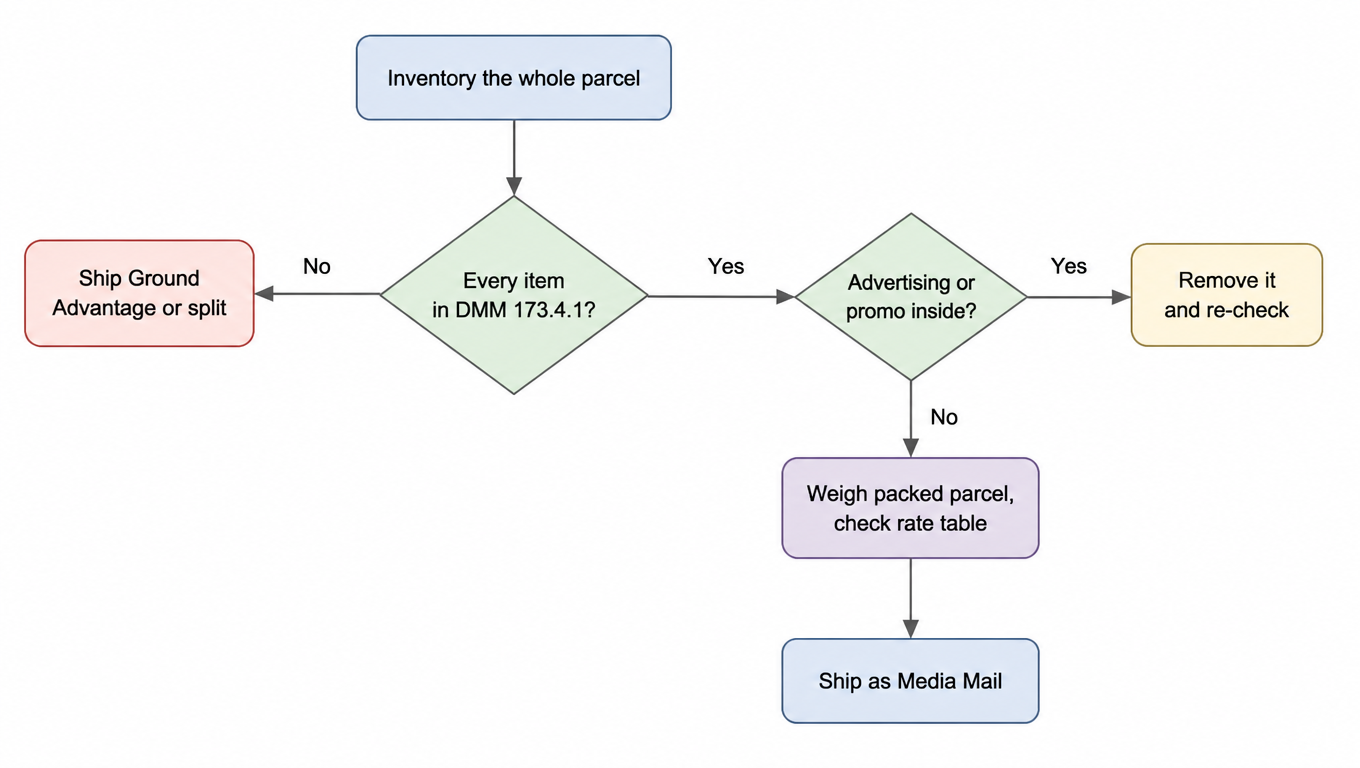
Flowchart: inventory the entire contents and check whether every item falls under the DMM 173.4.1 eligible categories; if not, switch to Ground Advantage or split the parcel; if yes, check whether advertising or promotional material is present and remove it before re-checking; once clear, weigh the packed parcel, look up the rate table, and hand it over as Media Mail
The eligibility path: contents first, rate lookup last

Like any routing rule, this check earns its keep by stopping an order before it leaves the dock rather than after a postage adjustment arrives.

Step two: how the postage is calculated

Rating takes three steps. First, weigh the parcel after packing, with the box and the filler included, not the item's listed weight. Second, round up: anything under 1 lb is charged as 1 lb, and above that the fraction rounds up to the next whole pound, so 4.4 lb is charged as 5 lb. Third, look up the Media Mail table in Notice 123 (USPS Notice 123 price list).

That third step contains the single most useful finding in this guide: Media Mail retail and commercial prices are identical. From $4.39 at 1 lb to $55.23 at 70 lb, the 70 tiers match to the cent (Notice 123, the Media Mail retail and commercial tables).

Ground Advantage runs the other way, with commercial pricing roughly 20 to 30 percent below retail (USPS Ground Advantage). The implication is direct: a label platform cannot discount Media Mail postage. What it saves on this service is process time, label accuracy, and data, not rate.

Two pricing features are easy to miss. The 8 percent temporary transportation surcharge applies to four competitive products, Priority Mail Express, Priority Mail, Ground Advantage, and Parcel Select, and the announcement states that no other products or services are affected, which leaves Media Mail out (USPS announcement, March 25, 2026). Second, zones do not apply: Ground Advantage commercial pricing for 1 lb runs from $7.61 in Zone 1 to $10.67 in Zone 8/9, while Media Mail is $4.39 to any ZIP code, so coast-to-coast orders show the widest gap.

Weight (lb) Media Mail retail Media Mail commercial
1$4.39$4.39
2≈$5.13≈$5.13
3≈$5.87≈$5.87
4≈$6.61≈$6.61
5$7.34$7.34
10$11.02$11.02
20≈$18.39≈$18.39
70$55.23$55.23

The 1, 5, 10, and 70 lb rows are published tiers; the others are estimated from the per-pound increment in the official table, so check the complete 70-tier list in Notice 123 for the figure that applies to your parcel.

Three worked examples

The three examples below run the same procedure end to end. The numbers are illustrative assumptions, so substitute your own packed weight and the current rate table.

Example A: a 1.2 lb paperback, rounding to 2 lb. Media Mail comes to about $5.13. The same parcel on Ground Advantage Zone 5 starts at $8.74 for 1 lb and reaches $9.44 with the 8 percent surcharge, so the saving is close to half (USPS commercial rates explained).

Example B: three hardcovers at 4.4 lb, rounding to 5 lb. Media Mail is $7.34. The same 5 lb on Ground Advantage Zone 5 with the surcharge is $14.56, a difference of $7.22. This order saves the most, because 5 lb sits where Ground Advantage climbs fastest (Ground Advantage zones and weight breaks).

Example C: a 17 lb textbook carton, no rounding needed. Charged as 17 lb, Media Mail comes to about $16.18. At this weight the marginal cost per pound is still around $0.74, while Ground Advantage has already layered on zone pricing and the nonstandard fee, whose rules are covered in avoiding the USPS nonstandard fee.

Step three: a book plus other items in one order

Hand-drawn editorial illustration of a paperback book and a pair of wireless earbuds lying side by side on a packing bench, a pair of scissors and a roll of bubble wrap between them, a slightly off-centre composition, ink linework filled with a single orange tone, generous white space and a lightly imperfect handmade line.
One accessory item is enough to disqualify the whole parcel

Scenario A: a books-only order

Everything qualifies, so it ships as Media Mail. The only thing to get right here is that the weight being charged is the packed weight, not the listed weight of the book. A hardcover listed at 0.9 lb plus a box and filler crosses 1.2 lb easily, and the rounding then lands it in the next tier.

Scenario B: a book plus an accessory

Shipping the whole order as Media Mail is a false declaration, and the exposure runs from a postage adjustment to damage to the account. There are two ways out: move the whole order to Ground Advantage, or split it into two parcels. Splitting has a criterion you can run yourself. A split pays the entry price of a second parcel, and Ground Advantage Zone 5 starts at $8.74 for 1 lb (USPS commercial rates), while each extra pound on Media Mail costs roughly $0.74, a factor of nearly twelve (these figures are an arithmetic illustration, not a quote for your parcel).

Here is the arithmetic. Four pounds of books plus a 1 lb pair of headphones is a 5 lb order on Ground Advantage Zone 5, which with the surcharge is $14.56. Splitting it means Media Mail for the 4 lb at about $6.61 plus Ground Advantage for the 1 lb at $9.44, roughly $16.05, about $1.49 more (Ground Advantage zones and weight breaks for 2026). So for most mixed orders, moving the whole order to one service costs less. The exception is a genuinely light accessory, where a few ounces on a lightweight service is cheap, or a light book portion; those are the cases where splitting wins, and they are worth running with your own weights before deciding.

The full cost framework for splitting is in the true cost of a split shipment, and the opposite trade-off is in combining orders into one shipment.

Scenario C: a book plus promotional material

DMM 173.6.1 allows printed matter that could be sent as USPS Marketing Mail to ride along, but genuine advertising, meaning promotional flyers, discount coupons, and new-title catalogs, removes the parcel from eligibility. Telling an enclosure apart from an advertisement turns on three questions: is it directly related to the item being shipped, does it originate with the sender's own business, and is its purpose to promote a third party's goods. A page that says thank you for the purchase, here are more books from this shop sits inside the rule. A third-party brand's money-off coupon does not.

Be clear about what an inspection actually produces. Non-qualifying contents are charged postage at the standard rate, collected either as postage due from the recipient or billed back to the sender. Either path usually costs more in customer experience than the few dollars of postage involved.

Media Mail or Ground Advantage

The difference compresses into six dimensions. On content limits, Media Mail has an eligibility list and Ground Advantage has none. On how the price is built, Media Mail is weight only with no zones, while Ground Advantage multiplies a zone by a weight tier and can additionally hit dimensional weight. On price, the gap is remarkably steady once common tiers are lined up.

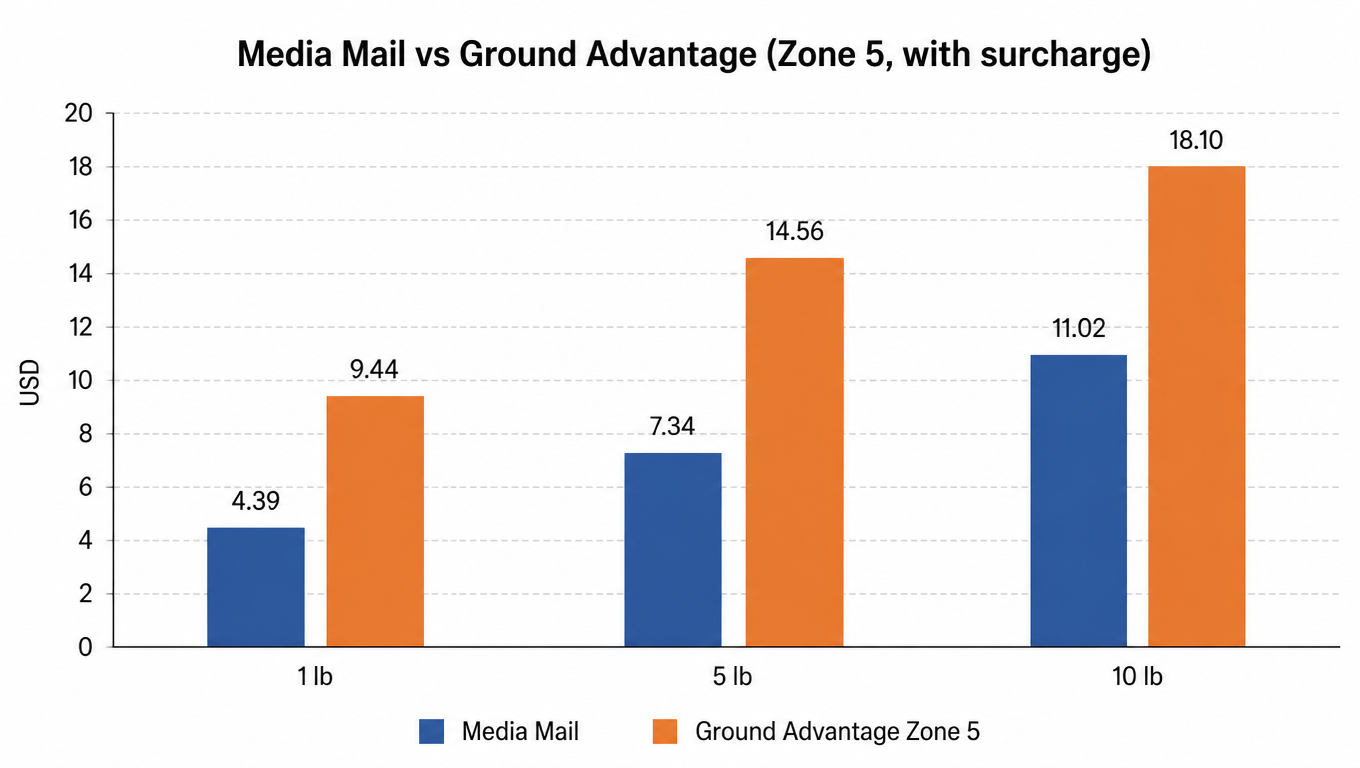
Weight tier Media Mail Ground Advantage Zone 5, commercial, with surcharge Difference
1 lb$4.39$9.44$5.05
5 lb$7.34$14.56$7.22
10 lb$11.02$18.10$7.08

On a bar chart the same three tiers show the narrowest gap at 1 lb and the widest at 5 lb, which happens to be the weight band where mixed orders most often land (comparison figures from USPS commercial rates explained and Ground Advantage zones and weight breaks).

Bar chart comparing Media Mail and Ground Advantage Zone 5 with the 8 percent surcharge at 1 lb, 5 lb, and 10 lb; Media Mail is 4.39, 7.34, and 11.02 dollars, Ground Advantage is 9.44, 14.56, and 18.10 dollars
The gap on the same weights: widest at the 5 lb tier

The last three dimensions decide whether that saving is actually collectable. On transit and guarantees, Media Mail carries the published window with no guarantee, while Ground Advantage publishes a shorter one. On tracking and insurance, both include tracking at no charge, Media Mail carries no insurance, and Ground Advantage includes $100 of cover (USPS Ground Advantage). On surcharges and discounts, Ground Advantage faces the temporary transportation surcharge, the nonstandard fee, and dimensional weight, while Media Mail has neither zones nor dimensional weight. The service-level comparison overall is in Ground Advantage and Priority Mail Flat Rate.

One reminder: the lowest price is not the lowest total cost. Postage adjustments, customer complaints, and replacements all belong in the same sum.

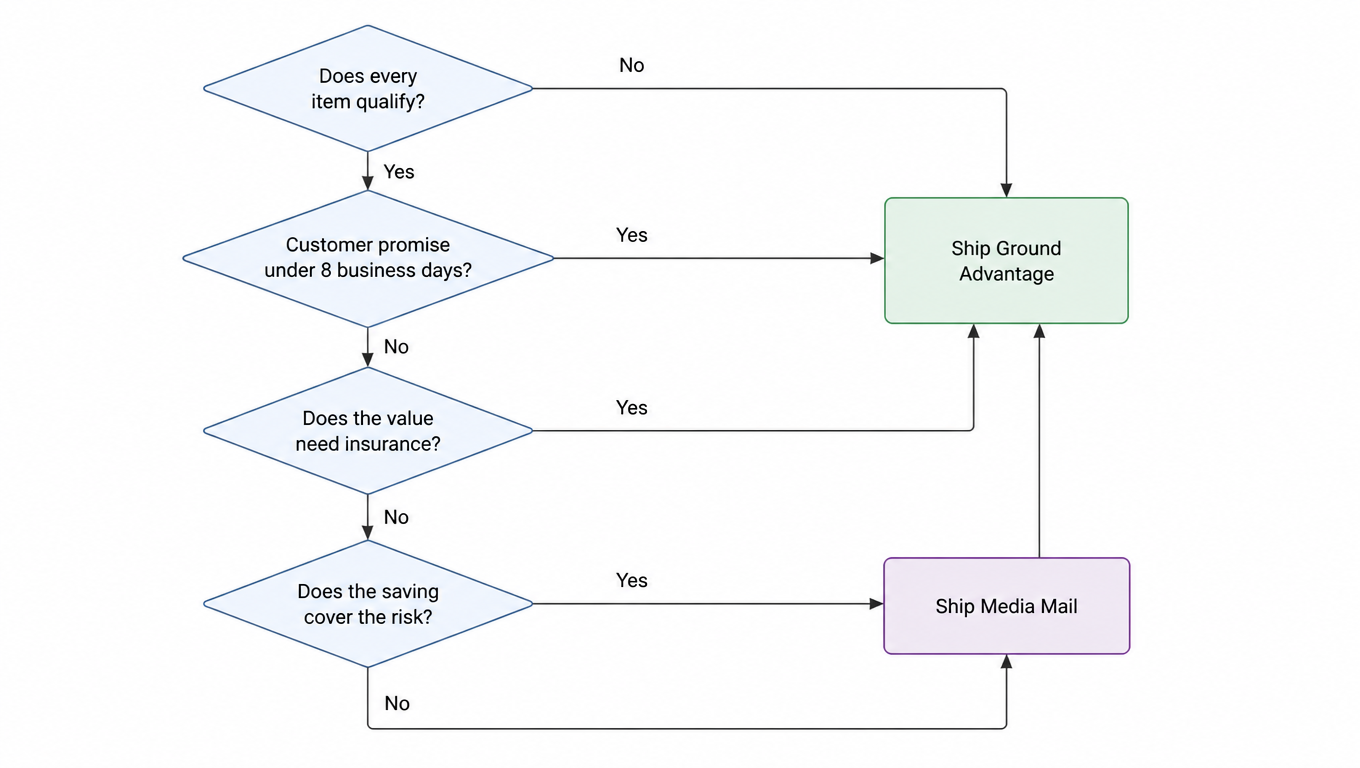
Flowchart: if not every item in the order qualifies, ship on Ground Advantage; if it qualifies, check whether the customer promise is shorter than 8 business days and ship on Ground Advantage if so; then check whether the item value needs insurance and ship on Ground Advantage if so; then check whether the price gap covers the risk, choosing Media Mail if it does and Ground Advantage if it does not
The service choice: content failure exits early, every other condition filters after that

That path is also why the cheapest USPS option is a per-order question rather than a table to memorize. The full service picture is on the USPS carrier page.

Pre-ship checklist and common questions

Five checks, in this order, before the label prints.

  1. Content eligibility. Walk the whole parcel against the eligibility table, paying attention to the two frequent misreads, video games and blank storage media.
  2. Mixed contents. Check for advertising or promotional material, for any non-media product, and for whether each enclosure is related to the item shipped and belongs to an enumerated category.
  3. Packed weight. Weigh the finished parcel, round the fraction up to a whole pound, and note that 4.0 lb and 4.9 lb land on the same price.
  4. Destination availability. Confirm the rules for Alaska, Hawaii, the territories, and APO and FPO addresses separately.
  5. Customer promise. Check whether the window stated on the listing or at checkout is compatible with the service's published window (USPS Media Mail service page).

Can I ship a sold book as Media Mail?

Yes, provided it is bound, at least 8 pages, and the parcel carries no advertising. Condition notes and listing photos do not affect eligibility, because they are not inside the parcel.

Can I include another product alongside it?

No. Every item in the parcel has to qualify, and enclosures are limited to the enumerated categories, so one pair of earbuds or a single pen can remove the parcel from eligibility.

What happens after an inspection?

Non-qualifying contents are charged postage at the standard rate, collected as postage due from the recipient or billed back to the sender, and the episode can damage the trust that later shipments depend on.

Can it ship to Alaska, Hawaii, or an APO address?

It depends. The absence of zone pricing works in Media Mail's favour, but some destinations and military postal addresses carry separate availability limits, so confirm the specific one before you commit.

Can Media Mail go international?

No. The service is domestic only.

Why is there no Media Mail discount from a label platform?

Because retail and commercial prices are the same, so there is no spread to pass on (Notice 123). What tooling saves on this service is process time and misprinted labels, not postage. For how USPS prices its other services, see USPS rate calculation for business shipping and the shipping rate calculator.

Fixing the order of operations is worth more than memorizing any rate table: contents first, weight rounded up second, price third, and the promise and insurance as the last gate.

Compare USPS options by contents, weight, and delivery requirement

EasyShippingX is a channel-neutral shipping layer: it compares US carrier options in one place and executes them through the Portal, Excel, or the API. Content eligibility and packed weight act as filters, and the quote and the execution follow whichever options survive them.